

Have you ever struggled to describe an unknown person, object, event, or idea without repeating the same words? 20 Idioms for Something With Real Examples explores creative expressions that make everyday English more vivid and natural. Idioms can add personality to business communication, conversations, stories, and formal writing when used in the right context. They also help learners understand how figurative language differs from literal meaning, making English usage more expressive and memorable. Instead of simply saying “something,” these expressions can help you describe situations with greater clarity, emotion, and precision.
In this guide, you’ll discover 20 useful idioms with real examples, clear meanings, alternative expressions, and practical explanations. The examples show how these phrases can work across scheduling, time management, meetings, online booking, broadcasting, and project management without sounding forced. You’ll also learn which expressions suit casual conversations and which work better in professional or written contexts. Understanding these differences can improve your grammar, word choice, and overall communication consistency.
Whether you’re an English learner, writer, student, or professional, this collection focuses on practical language you can actually use. Each idiom is explained in simple terms so you can recognize its figurative meaning, understand its tone, and apply it naturally. From everyday conversations to workplace messages and creative writing, these expressions offer flexible ways to communicate ideas more effectively. By the end, you’ll have a stronger vocabulary toolkit and a clearer sense of when each idiom fits the situation.
What Is an Idiom?
An idiom is a fixed expression whose meaning is different from the literal meaning of the individual words.
For example, “break the ice” does not usually mean physically breaking ice. It means helping people feel more comfortable in a new or awkward situation.
Similarly, “spill the beans” does not mean dropping actual beans. It means revealing information or a secret.
Idioms add figurative language, imagery, and personality to everyday communication. They can make an otherwise ordinary idea easier to remember.
Why Use Idioms for Something?
Using idioms to describe something can make vague or general ideas more expressive. Instead of simply saying that something is interesting, surprising, valuable, unusual, or impressive, an idiomatic expression can communicate the feeling behind it.
Idioms can help you:
- Express emotions without explaining every detail.
- Make descriptions more vivid and memorable.
- Give an abstract idea a recognizable image.
- Add personality to conversations and personal messages.
- Make creative writing and storytelling more engaging.
- Communicate complicated feelings in a short, familiar expression.
- Adjust your language to sound warm, playful, dramatic, poetic, or conversational.
The key is choosing an expression that genuinely fits the situation rather than adding figurative language simply for decoration.
Quick List of 20 Idioms
- A little something
- Something to write home about
- Something else
- Something out of the ordinary
- Something up your sleeve
- Something in the air
- Something fishy
- Something is brewing
- Something rings a bell
- Something clicks
- Something strikes a chord
- Something gets under your skin
- Something hits the spot
- Something goes a long way
- Something is worth its weight in gold
- Something is a breath of fresh air
- Something is a piece of cake
- Something is the tip of the iceberg
- Something is a mixed bag
- Something comes out of the blue
A Little Something
Read more:20 Idioms for Birthday Wishes With Real Examples
Meaning
“A little something” refers to a small gift, treat, gesture, or additional item. The expression often makes the thing sound thoughtful without making it seem overly important.
In a Sentence
“I brought you a little something to thank you for helping me.”
Other Ways to Say It
- A small gift
- A little surprise
- A small token
- Something special
Explanation
This expression creates a sense of warmth and thoughtfulness. It is useful when the speaker wants to downplay the size or value of something while emphasizing the gesture behind it.
Best Use
It works especially well in personal messages, conversations, gifts, and friendly situations. It usually has a warm and informal tone.
Something to Write Home About
Meaning
If something is “something to write home about,” it is unusually impressive, exciting, memorable, or noteworthy.
In a Sentence
“The view from the mountain was definitely something to write home about.”
Other Ways to Say It
- Truly impressive
- Worth talking about
- Remarkable
- Memorable
Explanation
The image comes from the idea of having an experience so noteworthy that you would want to tell people back home about it. It adds enthusiasm and emphasis without sounding overly dramatic.
Best Use
This expression fits conversations, travel writing, reviews, storytelling, and informal descriptions.
Something Else
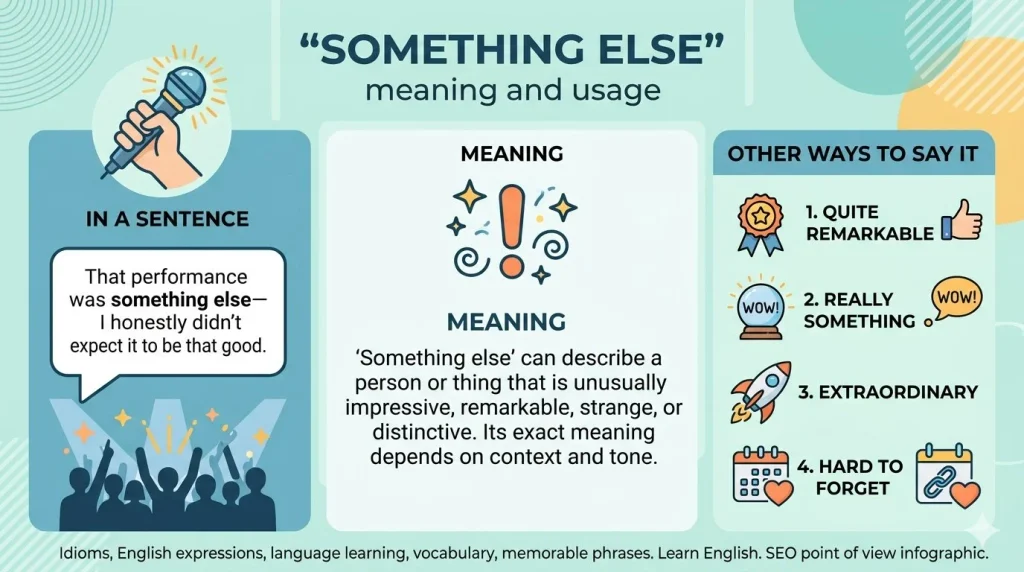
Meaning
“Something else” can describe a person or thing that is unusually impressive, remarkable, strange, or distinctive. Its exact meaning depends on context and tone.
In a Sentence
“That performance was something else—I honestly didn’t expect it to be that good.”
Other Ways to Say It
- Quite remarkable
- Really something
- Extraordinary
- Hard to forget
Explanation
The expression is intentionally broad, which makes it flexible. With an enthusiastic tone, it can suggest admiration or surprise; with a different tone, it can suggest disbelief or criticism.
Best Use
It is most natural in casual conversation and storytelling. Context and voice are important because the phrase can carry different emotions.
Something Out of the Ordinary
Meaning
“Something out of the ordinary” describes something unusual or different from what normally happens.
In a Sentence
“There was something out of the ordinary about the old house that made everyone curious.”
Other Ways to Say It
- Unusual
- Unexpected
- Different from normal
- Uncommon
Explanation
The expression creates a clear contrast between an ordinary experience and something that breaks the usual pattern. It is descriptive without necessarily suggesting that the thing is good or bad.
Best Use
It works well in essays, storytelling, conversations, and descriptive writing.
Something Up Your Sleeve
Meaning
Having “something up your sleeve” means having a secret plan, idea, trick, or solution that you have not revealed yet.
In a Sentence
“I don’t know how he’ll solve the problem, but I suspect he has something up his sleeve.”
Other Ways to Say It
- A secret plan
- A hidden idea
- A surprise strategy
- A trick in reserve
Explanation
The expression creates the playful image of someone hiding an object in their sleeve and producing it at just the right moment. It communicates mystery, preparation, or surprise.
Best Use
It suits conversations, storytelling, speeches, and playful situations. It is generally informal.
Something in the Air
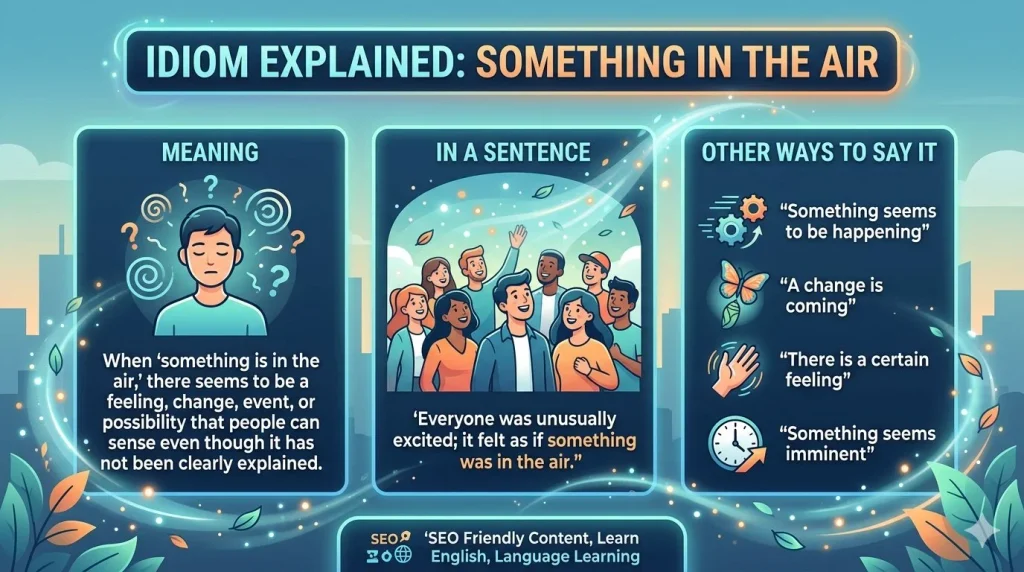
Meaning
When “something is in the air,” there seems to be a feeling, change, event, or possibility that people can sense even though it has not been clearly explained.
In a Sentence
“Everyone was unusually excited; it felt as if something was in the air.”
Other Ways to Say It
- Something seems to be happening
- A change is coming
- There is a certain feeling
- Something seems imminent
Explanation
This expression turns an unspoken atmosphere into an image. You cannot literally see the feeling floating in the air, but you can sense that something is different.
Best Use
It is effective in creative writing, storytelling, conversations, and emotional descriptions.
Something Fishy
Meaning
If “something is fishy,” it means something seems suspicious, dishonest, strange, or not quite right.
In a Sentence
“The numbers looked correct at first, but something fishy was going on.”
Other Ways to Say It
- Something seems suspicious
- Something isn’t right
- Something feels wrong
- There may be a catch
Explanation
The unusual image of a fishy smell or situation suggests that something is not quite clean or trustworthy. It is often used when you sense a problem before you can prove it.
Best Use
This is a casual and slightly playful expression that works well in conversations, stories, and informal writing.
Something Is Brewing
Meaning
When “something is brewing,” a situation, plan, event, conflict, or change appears to be developing.
In a Sentence
“The team has been meeting secretly all week, so something is brewing.”
Other Ways to Say It
- Something is developing
- Something is taking shape
- A plan is forming
- Something may happen soon
Explanation
The expression compares a developing situation to something being prepared in a pot. It creates a feeling of anticipation and mystery, especially when the final result is not yet known.
Best Use
It works particularly well in storytelling, casual conversation, social posts, and dramatic writing.
Something Rings a Bell
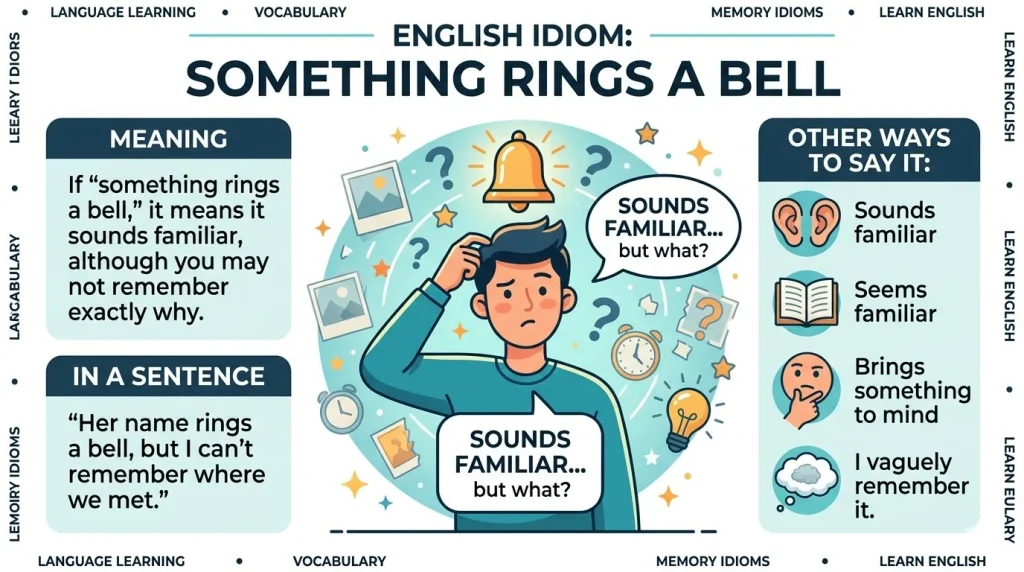
Meaning
If “something rings a bell,” it means it sounds familiar, although you may not remember exactly why.
In a Sentence
“Her name rings a bell, but I can’t remember where we met.”
Other Ways to Say It
- Sounds familiar
- Seems familiar
- Brings something to mind
- I vaguely remember it
Explanation
The expression compares recognition to the sound of a bell that catches your attention. It communicates partial or uncertain memory rather than complete recollection.
Best Use
This is common in everyday conversation and informal writing.
Something Clicks
Meaning
When something clicks, you suddenly understand it or recognize how its parts fit together.
In a Sentence
“After the teacher explained the example, something clicked, and the whole topic became clear.”
Other Ways to Say It
- It suddenly makes sense
- I finally understand
- It falls into place
- The idea becomes clear
Explanation
The word “click” suggests pieces fitting together neatly. It captures that satisfying moment when confusion turns into understanding.
Best Use
Use it in conversations, educational writing, personal reflections, and explanations.
Something Strikes a Chord
Meaning
If something “strikes a chord,” it creates a strong emotional response because it feels personally meaningful or familiar.
In a Sentence
“The story struck a chord with readers who had experienced a similar loss.”
Other Ways to Say It
- Touches a nerve
- Feels deeply personal
- Resonates emotionally
- Touches the heart
Explanation
The expression comes from music, where striking a chord produces a sound. Figuratively, it suggests that something has touched an emotional or personal connection.
Best Use
It is especially suitable for essays, speeches, reviews, personal writing, and thoughtful conversations.
Something Gets Under Your Skin
Meaning
When something “gets under your skin,” it strongly bothers, irritates, or emotionally affects you.
In a Sentence
“His constant interruptions really get under my skin.”
Other Ways to Say It
- Irritates you
- Bothers you deeply
- Gets on your nerves
- Stays with you
Explanation
The phrase creates the uncomfortable image of something getting beneath your skin and becoming difficult to ignore. It is often used for persistent irritation or emotional discomfort.
Best Use
This informal expression fits conversations, personal writing, and storytelling. It can sound quite emotional depending on the context.

Something Hits the Spot
Meaning
If something “hits the spot,” it satisfies exactly what you wanted or needed, especially food, drink, comfort, or relaxation.
In a Sentence
“After that long walk, a cold glass of water really hit the spot.”
Other Ways to Say It
- Was exactly what I needed
- Was perfectly satisfying
- Did the trick
- Felt just right
Explanation
The expression suggests that something has met a particular need perfectly. It is especially useful when describing satisfaction and relief.
Best Use
It is most natural in casual conversation, especially when discussing food, drinks, comfort, or small pleasures.
Something Goes a Long Way
Meaning
When something goes a long way, a small amount of it has a surprisingly helpful, positive, or lasting effect.
In a Sentence
“A little patience goes a long way when you’re teaching someone a new skill.”
Other Ways to Say It
- Has a big effect
- Makes a real difference
- Helps considerably
- Has lasting value
Explanation
The expression turns the idea of effectiveness into a journey: a small amount can travel surprisingly far. It emphasizes the value of modest actions or resources.
Best Use
It works well in advice, essays, speeches, workplace communication, and everyday conversations.
Something Is Worth Its Weight in Gold
Meaning
If something is “worth its weight in gold,” it is extremely valuable or useful.
In a Sentence
“During the project, her practical experience was worth its weight in gold.”
Other Ways to Say It
- Extremely valuable
- Incredibly useful
- Highly prized
- Very precious
Explanation
The expression compares an object’s value with the enormous worth of its equivalent weight in gold. It conveys strong appreciation and high value.
Best Use
This idiom suits workplace conversations, praise, storytelling, and informal writing. It is emphatic rather than neutral.
Something Is a Breath of Fresh Air
Meaning
Something that is “a breath of fresh air” feels pleasantly new, refreshing, different, or welcome after an ordinary or tiring experience.
In a Sentence
“Her practical approach was a breath of fresh air after weeks of complicated meetings.”
Other Ways to Say It
- Refreshingly different
- A welcome change
- Pleasantly new
- Refreshing
Explanation
Fresh air suggests relief after being in a stuffy environment. Figuratively, the phrase describes renewal and positive change.
Best Use
It works especially well in reviews, conversations, workplace writing, personal messages, and essays.
Something Is a Piece of Cake
Meaning
If something is “a piece of cake,” it is very easy to do.
In a Sentence
“Once you understand the instructions, setting up the account is a piece of cake.”
Other Ways to Say It
- Very easy
- Simple to do
- No trouble at all
- Easy as anything
Explanation
The expression creates a cheerful comparison between a task and something as simple and enjoyable as eating a piece of cake. It communicates ease and confidence.
Best Use
This is a highly informal and friendly expression. It works naturally in conversations and casual writing.
Something Is the Tip of the Iceberg
Meaning
When something is “the tip of the iceberg,” it is only a small, visible part of a much larger or more complicated situation.
In a Sentence
“The complaints we have received are probably just the tip of the iceberg.”
Other Ways to Say It
- Only a small part
- The visible portion
- A sign of a larger problem
- Only the beginning
Explanation
An iceberg may show only a small amount above the water while much more remains hidden below. The image communicates hidden depth, complexity, and scale.
Best Use
This expression is useful in essays, reports, journalism, discussions, and serious conversations.
Something Is a Mixed Bag
Meaning
A “mixed bag” describes something containing a combination of good and bad, positive and negative, or different kinds of results.
In a Sentence
“The new policy has been a mixed bag, helping some employees while creating difficulties for others.”
Other Ways to Say It
- A combination of positives and negatives
- Uneven
- A varied result
- Good in some ways and bad in others
Explanation
The image suggests opening a bag and finding different things mixed together. It is useful when a simple judgment such as “good” or “bad” would not accurately describe a situation.
Best Use
It works well in reviews, discussions, essays, workplace conversations, and analytical writing.
Something Comes Out of the Blue
Meaning
If something “comes out of the blue,” it happens unexpectedly and without much warning.
In a Sentence
“The invitation came out of the blue, so I was completely surprised.”
Other Ways to Say It
- Unexpectedly
- Without warning
- Suddenly
- Completely unexpectedly
Explanation
The phrase creates the image of something appearing suddenly against a clear blue sky. It captures surprise and unpredictability in a memorable way.
Best Use
It is natural in conversations, personal stories, messages, and informal writing.
Exercise: Practice Using Idioms
Choose the best answer for each question.
What does “something fishy” usually suggest?
A. Something delicious
B. Something suspicious
C. Something expensive
D. Something complicated
Which expression describes a small gift or thoughtful gesture?
A. Something in the air
B. Something clicks
C. A little something
D. A mixed bag
If an idea suddenly becomes clear, which expression fits best?
A. Something clicks
B. Something fishy
C. Something goes a long way
D. Something is brewing
What does “something out of the ordinary” mean?
A. Something very easy
B. Something completely ordinary
C. Something particularly expensive
D. Something unusual
Which expression suggests that a situation is developing?
A. Something hits the spot
B. Something is brewing
C. Something is a piece of cake
D. Something rings a bell
“Her name rings a bell” means:
A. Her name is difficult to pronounce.
B. Her name sounds musical.
C. Her name seems familiar.
D. Her name is very unusual.
Which expression describes something that strongly connects with someone’s emotions?
A. Something strikes a chord
B. Something goes a long way
C. Something is fishy
D. Something is a mixed bag
What does “something gets under your skin” usually mean?
A. Something makes you sleepy.
B. Something bothers or irritates you.
C. Something makes you hungry.
D. Something surprises you pleasantly.
Which expression means that something satisfies exactly what you needed?
A. Something comes out of the blue
B. Something is brewing
C. Something hits the spot
D. Something is up your sleeve
If a small action has a significant positive effect, what expression fits?
A. Something goes a long way
B. Something rings a bell
C. Something is a mixed bag
D. Something out of the ordinary
What does “worth its weight in gold” communicate?
A. Something is physically heavy.
B. Something is difficult to carry.
C. Something is extremely valuable.
D. Something is unusually expensive to produce.
Which expression describes a refreshing change?
A. Something is a breath of fresh air
B. Something is the tip of the iceberg
C. Something is up your sleeve
D. Something is fishy
What does “a piece of cake” mean?
A. Something is enjoyable to eat.
B. Something is very easy.
C. Something is surprisingly expensive.
D. Something requires careful preparation.
If visible problems are only a small part of a larger situation, which expression fits?
A. Something else
B. Something hits the spot
C. Something is the tip of the iceberg
D. Something is brewing
What does “comes out of the blue” suggest?
A. Something happens unexpectedly.
B. Something takes a long time.
C. Something becomes easier.
D. Something gradually improves.
Answers
- B — “Something fishy” suggests that something seems suspicious or not quite right.
- C — “A little something” commonly refers to a small gift, treat, or thoughtful gesture.
- A — “Something clicks” describes the moment when an idea or explanation suddenly makes sense.
- D — “Something out of the ordinary” means something unusual or different from normal.
- B — “Something is brewing” suggests that a plan, event, conflict, or change is developing.
- C — If something “rings a bell,” it seems familiar even though you may not remember the details.
- A — “Strike a chord” describes an emotional or personal connection.
- B — Something that gets under your skin bothers or irritates you.
- C — “Hit the spot” means something satisfies exactly what you wanted or needed.
- A — “Goes a long way” means that something has a significant effect despite perhaps being small.
- C — “Worth its weight in gold” means extremely valuable or useful.
- A — “A breath of fresh air” describes something refreshingly new or different.
- B — “A piece of cake” means something is very easy to do.
- C — “The tip of the iceberg” means that the visible part represents only a small portion of a larger situation.
- A — “Out of the blue” describes something that happens suddenly and unexpectedly.
FAQs
What is an idiom for something?
There is no single idiom that works for every use of something. Expressions such as “a little something,” “something else,” and “something out of the ordinary” describe different qualities, while others communicate surprise, value, suspicion, or emotion.
How do I create my own idiom?
A strong idiom usually connects an idea with a clear mental image. Start with the feeling or quality you want to communicate, then find a familiar object, action, or situation that illustrates it in an interesting way.
What makes an idiom effective?
An effective idiom is easy to understand in context, memorable, and appropriate for the situation. It should add meaning rather than simply replace an ordinary word.
Can I use these idioms in everyday conversation?
Yes. Many of these expressions, including “something fishy,” “something clicks,” “a piece of cake,” and “something rings a bell,” are natural in casual conversation. More poetic expressions may work better in creative or descriptive writing.
What is the difference between an idiom and a simile?
An idiom is an established expression whose figurative meaning is understood beyond its literal words. A simile directly compares two things using words such as “like” or “as.” For example, “as busy as a bee” is a simile, while “spill the beans” is an idiom.
Conclusion
The right idiom can turn a simple description of something into language that feels more vivid, emotional, or memorable. The 20 expressions in this guide cover a wide range of meanings—from something small and thoughtful in “a little something” to something unexpected in “out of the blue,” and from emotional connection in “strikes a chord” to hidden complexity in “the tip of the iceberg.”
The best figurative language is not necessarily the most dramatic. It is the expression that fits your intended meaning and audience naturally. Choose an idiom because its image adds something useful to your message, not simply because it sounds clever. When the comparison feels right, even an ordinary idea can become much more expressive.




[…] Read more:20 Idioms for Something With Real Examples […]