
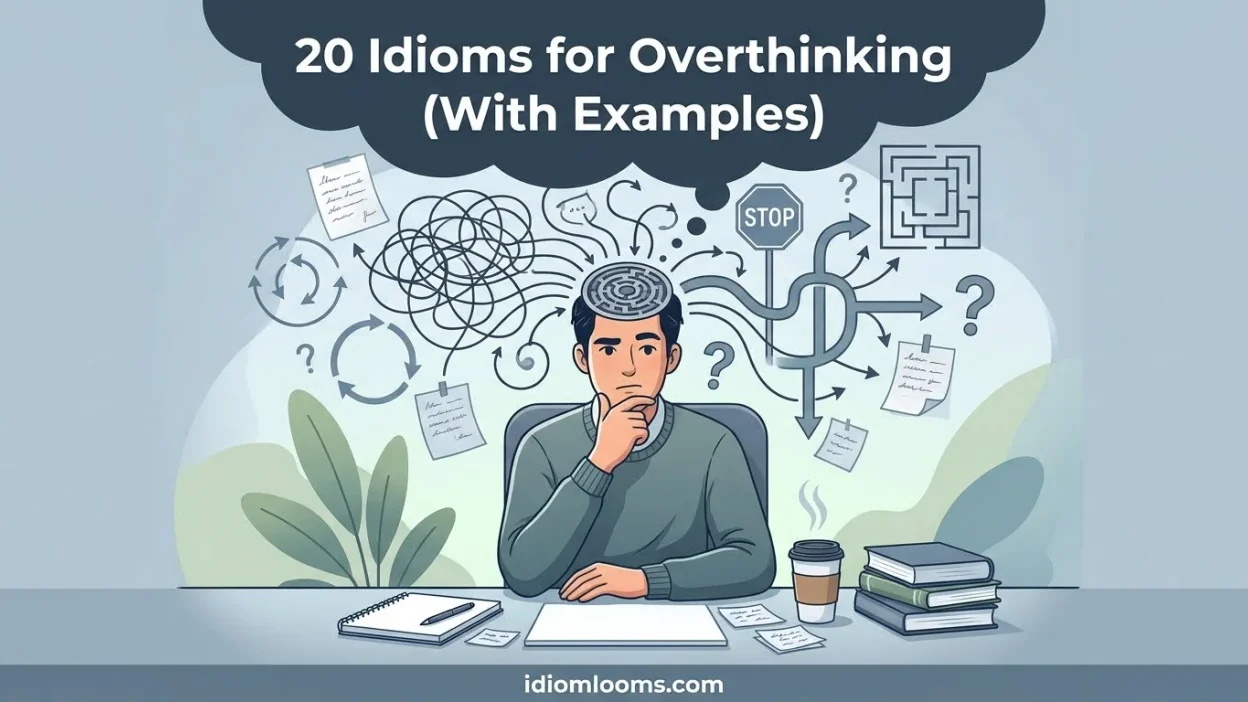
Have you ever thought about something so much that a simple decision suddenly feels complicated? 20 Idioms for Overthinking With Real Examples introduces useful expressions for describing overthinking, hesitation, worry, and repeated thoughts. These phrases make everyday English more vivid, natural, and expressive while helping readers communicate complex feelings clearly.
Overthinking can affect decision-making, time management, and everyday communication. This guide explains each idiom with a clear meaning and realistic example. You will also see how these expressions can fit business communication, meetings, formal writing, English usage, and grammar while maintaining natural language and consistency.
You will also discover how figurative expressions relate to scheduling, online booking, broadcasting, calendar planning, and project management. Each example shows practical usage in context. Whether you are improving vocabulary, strengthening writing skills, or speaking more naturally, these idioms can make your English more precise, engaging, and memorable.
What Is an Idiom?
An idiom is a commonly understood expression whose meaning is different from the literal meaning of its individual words.
For example, if someone says, “I’m feeling under the weather,” they usually mean they feel unwell—not that they are physically beneath the weather.
Similarly, “break the ice” does not usually mean breaking frozen water. It means helping people feel more comfortable in a social situation.
Idioms add figurative meaning, imagery, and personality to everyday language.
Why Use Idioms for Overthinking?
Overthinking is an abstract mental process, so figurative language can make it easier to describe. An idiom can turn an invisible thought pattern into a picture that readers or listeners immediately understand.
For example, “going around in circles” suggests repeatedly considering the same issue without reaching an answer. “Tying yourself in knots” gives the feeling of becoming increasingly confused by your own thoughts.
These expressions can help you:
- Express emotions without explaining every detail.
- Make descriptions of overthinking more vivid and memorable.
- Turn complicated mental experiences into simple images.
- Add personality to conversations and personal messages.
- Make creative writing more expressive and engaging.
- Communicate feelings such as doubt, confusion, worry, or indecision.
Quick List of 20 Idioms for Overthinking
- Go around in circles
- Tie yourself in knots
- Go down a rabbit hole
- Split hairs
- Make a mountain out of a molehill
- Second-guess yourself
- Spin your wheels
- Beat a dead horse
- Can’t see the forest for the trees
- Put the cart before the horse
- Get hung up on something
- Read too much into something
- Overanalyze every detail
- Drive yourself up the wall
- Lose sleep over something
- Let your mind run wild
- Make a meal of something
- Chase your own tail
- Have too many irons in the fire
- Go back and forth
Go Around in Circles
Read more:20 Idioms for Poor With Real Examples
Meaning
Go around in circles means to keep thinking, talking, or working on the same issue without making meaningful progress. It is especially useful when overthinking prevents a person from reaching a decision.
In a Sentence
I kept going around in circles, wondering whether sending that message would make things better or worse.
Other Ways to Say It
- Keep returning to the same question
- Get nowhere with your thoughts
- Think about the same thing repeatedly
- Keep going over the issue
Explanation
The image is simple: you move around but eventually arrive where you started. That makes this expression particularly effective for repetitive thinking.
It works well when someone has considered the same possibilities many times but still cannot move forward.
Best Use
Best for conversations, essays, personal writing, and storytelling. It sounds natural rather than overly poetic.
Tie Yourself in Knots
Meaning
Tie yourself in knots means to make yourself extremely confused, worried, or anxious by thinking too much about something.
In a Sentence
Don’t tie yourself in knots trying to predict exactly how everyone will react.
Other Ways to Say It
- Make yourself confused
- Get yourself worked up
- Complicate things in your mind
- Worry yourself sick
Explanation
The expression creates the image of a person becoming physically tangled in knots. It suggests that your own thoughts are making the situation harder.
It is particularly strong when overthinking combines with worry or emotional tension.
Best Use
This idiom works naturally in everyday conversation, advice, and personal messages. It has a supportive but slightly dramatic tone.
Go Down a Rabbit Hole
Meaning
Go down a rabbit hole means to become deeply involved in a subject, question, or chain of thoughts, often far beyond the original issue.
In a Sentence
I only wanted to check one fact, but I went down a rabbit hole and spent two hours researching it.
Other Ways to Say It
- Get deeply absorbed in something
- Go far down a line of thought
- Get sidetracked
- Dive too deeply into an issue
Explanation
The expression comes from the famous image of Alice following the rabbit into an increasingly strange world. For overthinking, it captures the feeling of one thought leading to another until the original question becomes much bigger.
It can describe curiosity as well as unhelpful mental spiraling.
Best Use
Excellent for casual conversation, blogs, social media, and storytelling. It is less suitable for very formal writing unless the tone allows figurative language.
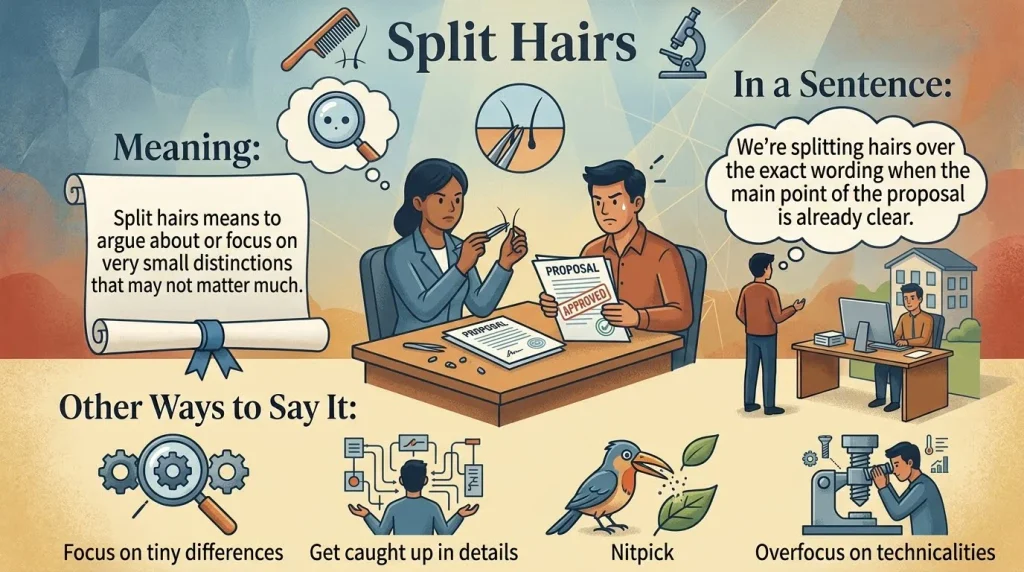
Split Hairs
Meaning
Split hairs means to argue about or focus on very small distinctions that may not matter much.
In a Sentence
We’re splitting hairs over the exact wording when the main point of the proposal is already clear.
Other Ways to Say It
- Focus on tiny differences
- Get caught up in details
- Nitpick
- Overfocus on technicalities
Explanation
The image of trying to divide a single hair into smaller pieces suggests extreme attention to insignificant differences.
It can describe overthinking when someone becomes trapped in minor details instead of considering the bigger picture.
Best Use
Best for debates, workplace conversations, essays, and discussions. It can sound mildly critical, so use it carefully.
Make a Mountain Out of a Molehill
Meaning
Make a mountain out of a molehill means to treat a small problem as if it were much bigger or more serious than it really is.
In a Sentence
I probably made a mountain out of a molehill by assuming that one short reply meant he was angry with me.
Other Ways to Say It
- Make too much of something
- Blow something out of proportion
- Turn a small issue into a big one
- Overreact to a minor problem
Explanation
A molehill is small, while a mountain is enormous. The expression highlights how overthinking can magnify a minor concern.
It is useful when the problem itself is relatively small but the person’s interpretation has grown much larger.
Best Use
Works especially well in everyday conversation, advice, personal writing, and humorous situations.
Second-Guess Yourself
Meaning
Second-guess yourself means to question a decision or judgment after you have already made it.
In a Sentence
I chose the blue design yesterday, but now I’m second-guessing myself.
Other Ways to Say It
- Doubt your decision
- Question your judgment
- Reconsider your choice
- Lose confidence in your decision
Explanation
This expression captures one of the most familiar forms of overthinking: revisiting a decision after it has already been made.
It does not necessarily mean the original decision was wrong. The focus is on uncertainty and self-doubt.
Best Use
Ideal for conversations, professional situations, personal messages, and reflective writing.
Spin Your Wheels
Meaning
Spin your wheels means to spend time and energy without making useful progress.
In a Sentence
I’ve been spinning my wheels all morning, comparing every possible solution without choosing one.
Other Ways to Say It
- Waste time thinking
- Make no progress
- Keep working without results
- Stay stuck
Explanation
The image comes from wheels turning without moving the vehicle forward. It fits overthinking because the mind can be busy without actually getting anywhere.
This expression focuses more on wasted effort than on emotional worry.
Best Use
A good choice for workplace conversations, productivity discussions, essays, and everyday speech.
Beat a Dead Horse
Meaning
Beat a dead horse means to keep discussing, arguing about, or trying to solve something that is already settled or unlikely to change.
In a Sentence
We’ve already decided on the schedule, so there’s no point beating a dead horse.
Other Ways to Say It
- Keep revisiting the same issue
- Dwell on the past
- Keep arguing about something
- Rehash an old problem
Explanation
The expression creates a deliberately strong image: beating an animal that can no longer respond will not accomplish anything.
For overthinking, it describes repeatedly returning to an issue that no longer benefits from more thought.
Best Use
Best in casual conversations and workplace discussions. It is vivid and informal, so a gentler expression may be better in sensitive situations.
Can’t See the Forest for the Trees
Meaning
Can’t see the forest for the trees means being so focused on individual details that you lose sight of the larger situation.
In a Sentence
I was so worried about every sentence in the report that I couldn’t see the forest for the trees.
Other Ways to Say It
- Lose sight of the big picture
- Focus too much on details
- Miss the overall point
- Get buried in the details
Explanation
The image is of standing among countless trees while failing to recognize that they form a forest. It is a strong metaphor for detail-focused overthinking.
Unlike some expressions on this list, it is less about worry and more about losing perspective.
Best Use
Particularly effective in essays, workplace communication, education, and thoughtful discussions.
Put the Cart Before the Horse
Meaning
Put the cart before the horse means doing things in the wrong order or worrying about a later step before dealing with what needs to happen first.
In a Sentence
You’re putting the cart before the horse by worrying about the interview results before you’ve even had the interview.
Other Ways to Say It
- Get ahead of yourself
- Worry about things too early
- Do things in the wrong order
- Focus on a later problem first
Explanation
The traditional image is a cart placed in front of the horse, making forward movement difficult. In the context of overthinking, it describes creating problems about events that have not happened yet.
It is especially useful for anxious anticipation.
Best Use
Works well in conversation, advice, coaching, and practical writing.

Get Hung Up on Something
Meaning
Get hung up on something means becoming excessively focused on one particular issue and finding it difficult to move past it.
In a Sentence
She got hung up on one awkward sentence from the meeting and kept thinking about it all evening.
Other Ways to Say It
- Fixate on something
- Get stuck on an issue
- Dwell on something
- Have trouble letting something go
Explanation
The phrase suggests being mentally caught or suspended on one point. It is useful for describing persistent thoughts that keep demanding attention.
The expression is usually conversational and does not necessarily imply severe worry.
Best Use
Best for casual conversations, personal messages, and storytelling.
Read Too Much Into Something
Meaning
Read too much into something means finding a deeper meaning or intention in words, actions, or events than may actually be there.
In a Sentence
Don’t read too much into his short reply; he may simply have been busy.
Other Ways to Say It
- Overinterpret something
- Look for hidden meaning
- Assume too much
- Analyze someone’s actions excessively
Explanation
This expression is particularly relevant when overthinking involves interpreting clues that may not carry the meaning we assign to them.
It can describe uncertainty in relationships, work situations, texts, or ordinary conversations.
Best Use
Very natural in everyday conversation, relationship discussions, personal advice, and social situations.
Overanalyze Every Detail
Meaning
Overanalyze every detail means examining small parts of a situation so intensely that the analysis becomes excessive or unhelpful.
In a Sentence
If I overanalyze every detail of the conversation, I’ll probably convince myself that something went wrong when it didn’t.
Other Ways to Say It
- Analyze everything too closely
- Obsess over details
- Examine every little thing
- Think too deeply about minor points
Explanation
Unlike many expressions here, this is a more direct figurative phrase rather than a traditional fixed idiom. It is still useful descriptive language for overthinking because it clearly identifies excessive analysis.
Its strength is precision: it tells the reader exactly what kind of mental behavior is happening.
Best Use
Suitable for essays, self-reflection, educational writing, and everyday conversation.
Drive Yourself Up the Wall
Meaning
Drive yourself up the wall means making yourself extremely frustrated, irritated, or stressed by continually thinking about or dealing with something.
In a Sentence
I’ve been driving myself up the wall wondering whether I made the right choice.
Other Ways to Say It
- Make yourself extremely stressed
- Frustrate yourself
- Work yourself into a state
- Agitate yourself
Explanation
The phrase creates an exaggerated image of frustration becoming so intense that you want to climb the walls. It works well when overthinking has become emotionally exhausting or irritating.
The tone is informal and expressive rather than serious.
Best Use
Good for casual speech, humorous writing, personal messages, and storytelling.
Lose Sleep Over Something
Meaning
Lose sleep over something means to worry about a problem so much that it affects your ability to relax or sleep.
In a Sentence
Try not to lose sleep over a mistake that can easily be corrected tomorrow.
Other Ways to Say It
- Worry about something constantly
- Lose peace of mind
- Stress over an issue
- Let something keep you awake
Explanation
This expression connects mental worry with a familiar physical experience: being unable to rest because your mind will not let go.
It is stronger than simply saying you are thinking about something because it suggests significant concern.
Best Use
Useful in conversations, supportive messages, advice, and reflective writing.
Let Your Mind Run Wild
Meaning
Let your mind run wild means allowing your imagination or thoughts to move freely, often producing extreme, unlikely, or uncontrolled possibilities.
In a Sentence
Once I saw the missed call, I let my mind run wild and imagined every possible reason for it.
Other Ways to Say It
- Imagine every possibility
- Let your thoughts wander
- Imagine the worst
- Allow your imagination to take over
Explanation
The image compares the mind to something moving without restraint. In overthinking, it can describe thoughts rapidly creating possibilities without enough evidence.
The phrase can be positive when referring to creativity, so context determines whether it sounds anxious or imaginative.
Best Use
Effective in storytelling, personal writing, creative work, and casual conversation.
Make a Meal of Something
Meaning
Make a meal of something means making a task or issue much more complicated, difficult, or time-consuming than necessary.
In a Sentence
I made a meal of choosing a simple gift by comparing dozens of options.
Other Ways to Say It
- Make something unnecessarily complicated
- Make too much fuss over something
- Turn a simple task into a big project
- Overcomplicate things
Explanation
The phrase uses the image of turning something into an entire meal—more elaborate than it needs to be. Applied to overthinking, it suggests adding unnecessary complexity to a simple decision.
It has a mildly humorous tone and can make self-description feel less heavy.
Best Use
Best for informal British-style English, humor, conversations, and light personal writing.
Chase Your Own Tail
Meaning
Chase your own tail means repeatedly trying to solve a problem or reach a goal without making progress, often because your actions keep leading back to the same place.
In a Sentence
I was chasing my own tail, changing the plan every time I thought of another possible problem.
Other Ways to Say It
- Go in circles
- Keep getting nowhere
- Run around without progress
- Repeat the same cycle
Explanation
The image of a dog repeatedly chasing its own tail captures busy but unproductive movement. It can describe overthinking when every new thought creates another question.
The expression is playful, making it less heavy than some anxiety-related phrases.
Best Use
Works well in casual conversation, humorous writing, storytelling, and social media posts.
Have Too Many Irons in the Fire
Meaning
Have too many irons in the fire means being involved with too many activities, plans, possibilities, or responsibilities at the same time.
In a Sentence
I’ve got too many irons in the fire right now, and thinking about all of them is making it hard to focus on one decision.
Other Ways to Say It
- Have too many things going on
- Juggle too many possibilities
- Take on too much
- Have several plans in progress
Explanation
The expression comes from the old image of having several pieces of iron heating in a fire at once. Too many can become difficult to manage.
For overthinking, it captures the mental overload that comes from considering too many options simultaneously.
Best Use
Especially useful in workplace conversations, productivity writing, personal reflection, and planning discussions.
Go Back and Forth
Meaning
Go back and forth means repeatedly changing between two choices, opinions, or possibilities without settling on one.
In a Sentence
I’ve been going back and forth about whether to accept the offer, and I still haven’t made up my mind.
Other Ways to Say It
- Waver between choices
- Keep changing your mind
- Debate with yourself
- Remain undecided
Explanation
The expression creates the image of moving repeatedly in opposite directions. That makes it a natural description of indecision and mental debate.
It is straightforward, flexible, and common enough to fit many everyday situations.
Best Use
Suitable for conversation, emails, essays, personal writing, and decision-making discussions.
Exercise: Practice Using Idioms
Test your understanding of the expressions above. Choose the best answer for each question.
1. If someone keeps considering the same problem without reaching a decision, which expression fits best?
A. Lose sleep over something
B. Go around in circles
C. Have too many irons in the fire
D. Make a meal of something
2. What does “tie yourself in knots” suggest?
A. Becoming confused or worried through excessive thinking
B. Completing a difficult physical task
C. Solving a problem quickly
D. Avoiding an important decision
3. Someone researches one small question for several hours and becomes absorbed in unrelated information. What are they likely doing?
A. Splitting hairs
B. Losing sleep over something
C. Going down a rabbit hole
D. Putting the cart before the horse
4. Which expression describes focusing excessively on tiny differences?
A. Go back and forth
B. Split hairs
C. Chase your own tail
D. Drive yourself up the wall
5. Maria worries for hours about a tiny mistake in an email. Which expression may describe her reaction?
A. Make a mountain out of a molehill
B. Have too many irons in the fire
C. Go down a rabbit hole
D. Beat a dead horse
6. What does “second-guess yourself” mean?
A. Ask another person for advice
B. Make a decision immediately
C. Question your own decision after making it
D. Refuse to consider another option
7. A person spends all day planning but makes no actual progress. Which expression fits best?
A. Read too much into something
B. Spin your wheels
C. Make a meal of something
D. Lose sleep over something
8. Your team has already settled an issue, but one person keeps reopening the discussion. Which expression is most appropriate?
A. Let your mind run wild
B. Put the cart before the horse
C. Beat a dead horse
D. Split hairs
9. What does “can’t see the forest for the trees” describe?
A. Being distracted by nature
B. Focusing on details and losing sight of the bigger picture
C. Refusing to examine details
D. Making a decision too quickly
10. Someone worries about how a future event will turn out before the event has even happened. Which expression may fit?
A. Put the cart before the horse
B. Chase your own tail
C. Split hairs
D. Make a meal of something
11. If someone becomes fixated on one small part of a situation, they may:
A. Have too many irons in the fire
B. Get hung up on something
C. Go back and forth
D. Lose sleep over something
12. What does “read too much into something” mean?
A. Study a book carefully
B. Interpret something as having more meaning than it may actually have
C. Ignore an important message
D. Forget what someone said
13. Which expression best describes imagining many possible outcomes without control over where your thoughts go?
A. Let your mind run wild
B. Beat a dead horse
C. Split hairs
D. Spin your wheels
14. Which expression emphasizes worrying so much that it affects your rest?
A. Make a meal of something
B. Lose sleep over something
C. Chase your own tail
D. Go around in circles
15. If someone cannot choose between two options and keeps changing their preference, they:
A. Exaggerating a minor issue
B. Focusing on tiny, unimportant details
C. Repeatedly changing between options
D. Continuing to discuss a settled matter
Answers
- B — “Go around in circles” describes repeated thinking without meaningful progress.
- A — “Tie yourself in knots” suggests becoming confused, worried, or stressed by your own thoughts.
- C — “Go down a rabbit hole” means becoming deeply involved in a subject or chain of thoughts.
- B — “Split hairs” means focusing on very small distinctions or details.
- A — “Make a mountain out of a molehill” means treating a small problem as much bigger than it is.
- C — “Second-guess yourself” means questioning a decision you have already made.
- B — “Spin your wheels” describes effort that produces little or no progress.
- C — “Beat a dead horse” means continuing to discuss something that is already settled or unproductive.
- B — The expression means becoming so focused on details that you lose sight of the overall situation.
- A — “Put the cart before the horse” describes dealing with something out of order or worrying about a later step too soon.
- B — “Get hung up on something” means becoming mentally stuck on a particular issue.
- B — “Read too much into something” means assigning more meaning or intention to something than may actually exist.
- A — “Let your mind run wild” describes uncontrolled or far-reaching thoughts and possibilities.
- B — “Lose sleep over something” means worrying enough that it interferes with rest.
- C — “Go back and forth” describes repeatedly moving between choices or opinions.
FAQs
What is an idiom for overthinking?
There are several useful expressions for overthinking, depending on the situation. “Go around in circles” works for repetitive thinking, while “tie yourself in knots” emphasizes confusion or worry. “Second-guess yourself” is particularly useful for describing doubt about a decision.
How do I create my own idioms?
Start with the feeling or mental process you want to describe. Then connect it to a clear physical image, such as movement, objects, weather, or animals. The image should make the abstract idea easier to understand rather than simply replacing one word with another.
What makes an idiom effective?
A strong idiom creates a recognizable mental picture and communicates an idea quickly. It should also fit the context and sound natural when spoken or written.
Can I use these idioms in everyday conversation?
Yes. Many of these expressions, including “go around in circles,” “second-guess yourself,” “go down a rabbit hole,” and “go back and forth,” are natural in everyday English. More vivid expressions may feel informal or humorous, so choose them according to your audience.
What is the difference between an idiom and a simile?
An idiom is an established expression whose overall meaning cannot always be understood literally from its individual words. A simile directly compares two things using words such as “like” or “as.” For example, “as busy as a bee” is a simile, while “beat a dead horse” is an idiomatic expression.
Conclusion
Overthinking can be difficult to describe because it happens inside the mind. The right idiom gives that invisible process a clear image and emotional shape. Expressions such as “go around in circles,” “tie yourself in knots,” and “read too much into something” help explain different forms of repetitive thinking, doubt, worry, and mental overload.
The best expression depends on what you are trying to communicate. If the problem is indecision, “go back and forth” may fit. If small details have taken over, “can’t see the forest for the trees” may be stronger. For anxious interpretation, “read too much into something” can say a great deal in just a few words.
Use figurative language thoughtfully, and let the image support your meaning rather than distract from it. Sometimes, the clearest way to describe an overactive mind is to give its thoughts a picture the reader can see.

Eleanor Prose is a writer and English teacher with a soft spot for the phrases that trip us up. She has spent years helping students and professionals use idioms with confidence not just memorizing them, but understanding the culture and humor behind each one.
Through Idiom Looms, Eleanor explores the threads that connect language, history, and everyday conversation. Her goal is simple: to make English idioms clear, memorable, and actually fun to use.
She writes from a quiet desk surrounded by notebooks, and firmly believes there’s an idiom for every situation usually more than one.



[…] Read more:20 Idioms for Overthinking With Real Examples […]