The phrase “around the world” can describe far more than simply traveling from one country to another. It can suggest global connection, exploration, cultural diversity, shared experiences, and the feeling of seeing life from a wider perspective. Idioms are useful because they turn these ideas into vivid images that are easier to remember and more enjoyable to use.
Instead of saying that something happens everywhere, for example, figurative language can make the idea feel expansive, energetic, or even poetic. In this article, you’ll discover 20 idioms and idiomatic expressions that can help describe around the world in different contexts. Each expression includes its meaning, a natural example, alternatives, and guidance on when it works best.
What Is an Idiom?
An idiom is a word or phrase whose meaning is different from the literal meaning of the individual words.
For example, “break the ice” does not usually mean physically breaking ice. It means to make people feel more comfortable when they first meet.
Similarly, “hit the road” usually means to leave or begin a journey rather than literally striking a road.
Idioms add figurative language and personality to communication. They allow speakers and writers to express ideas through familiar images rather than straightforward statements.
Why Use Idioms for Around the World?
Talking about around the world often involves ideas that are difficult to capture in a single literal sentence. Figurative language can give those ideas shape and emotion.
Idioms and idiomatic expressions can help you:
- Express the excitement of global travel and exploration.
- Describe connections between people in different places.
- Make writing about cultures and countries more vivid.
- Turn an abstract idea such as globalization into a memorable image.
- Add personality to conversations and travel stories.
- Make creative writing, speeches, and essays more engaging.
- Communicate feelings such as wonder, adventure, curiosity, and belonging.
The key is choosing an expression that matches the exact feeling you want to communicate.
Quick List of 20 Idioms
- Around the globe
- Go around the world
- See the world
- Travel the world
- Hit the road
- Off the beaten track
- Take the scenic route
- On the map
- A world apart
- Worlds collide
- Small world
- The world is your oyster
- Open up the world
- At the ends of the earth
- Far and wide
- Across the seven seas
- Four corners of the world
- In every corner of the globe
- Around the clock
- It’s a small world after all
Around the Globe
Meaning
“Around the globe” means in or across many parts of the world. It creates a broad image of movement that reaches different countries and continents.
In a Sentence
The news of the discovery quickly spread around the globe.
Other Ways to Say It
- Across the world
- Worldwide
- Throughout the world
- Across the globe
Explanation
This expression gives a strong sense of global reach without sounding overly complicated. The word “globe” creates an immediate mental picture of Earth as a whole.
It works especially well when discussing international travel, communication, events, ideas, or cultural influence.
Best Use
Best for essays, articles, speeches, journalism, and everyday conversation. It sounds natural rather than highly poetic.
Read more: 20 Idioms for Jealousy With Real Examples
Go Around the World
Meaning
“Go around the world” means to travel through many different countries or regions, often as part of a long journey.
In a Sentence
After graduating, he dreamed of saving enough money to go around the world.
Other Ways to Say It
- Travel internationally
- Journey around the world
- Travel across different countries
- Take a global journey
Explanation
This expression focuses on movement and adventure. Unlike an expression describing something that exists everywhere, it usually suggests that a person is physically traveling from place to place.
It is straightforward and easy to understand, making it useful for both literal and storytelling contexts.
Best Use
Ideal for travel conversations, personal stories, travel blogs, and creative writing.
See the World
Meaning
“See the world” means to travel widely and experience different places, cultures, and ways of life.
In a Sentence
She wanted to see the world before settling into a permanent career.
Other Ways to Say It
- Explore the world
- Discover new places
- Experience different cultures
- Travel widely
Explanation
This expression is about more than collecting destinations. It can suggest curiosity, personal growth, and exposure to new experiences.
Because it carries an adventurous feeling, it often sounds more personal than simply saying “travel internationally.”
Best Use
Works particularly well in travel writing, conversations, inspirational speeches, and personal reflections.
Travel the World
Meaning
“Travel the world” means visiting different countries and experiencing places beyond one’s home region.
In a Sentence
Their long-term goal is to travel the world and learn about different cultures.
Other Ways to Say It
- Explore different countries
- Journey across the globe
- Travel internationally
- Visit countries around the world
Explanation
This is a direct and familiar expression, but it still carries an appealing image of freedom and discovery.
It is less figurative than some other expressions on this list, so it is useful when clarity matters more than dramatic imagery.
Best Use
Best for everyday conversations, travel plans, blogs, essays, and social media captions.
Hit the Road
Meaning
“Hit the road” means to leave and begin traveling. It is informal and energetic.
In a Sentence
We packed our bags at sunrise and hit the road for the next country.
Other Ways to Say It
- Set off
- Get going
- Head out
- Start the journey
Explanation
The expression creates an image of someone setting out on an adventure. It adds movement and energy to a travel story.
It does not specifically mean traveling around the entire world, but it fits naturally when describing a journey that forms part of a wider global adventure.
Best Use
Excellent for casual conversation, travel stories, blogs, and playful writing. It can sound too informal for very formal documents.
Off the Beaten Track
Meaning
“Off the beaten track” describes a place or experience that is away from common tourist routes and less frequently visited.
In a Sentence
We spent a week exploring off the beaten track, far from the crowded attractions.
Other Ways to Say It
- Away from the tourist crowds
- Beyond the usual route
- Less-traveled
- Hidden away
Explanation
This idiom creates an image of leaving a familiar path and discovering something less obvious. It is particularly useful when around-the-world travel involves unusual destinations rather than famous landmarks.
The expression also suggests curiosity and independence.
Best Use
Great for travel writing, storytelling, adventure content, and conversations about unusual destinations.
Take the Scenic Route
Meaning
“Take the scenic route” means choosing a longer or less direct path because the journey itself offers enjoyable sights or experiences.
In a Sentence
Rather than flying straight home, they decided to take the scenic route through several countries.
Other Ways to Say It
- Take the longer way
- Enjoy the journey
- Travel the less direct route
- Explore along the way
Explanation
This expression emphasizes the experience of the journey rather than simply reaching the destination. Applied to around-the-world travel, it suggests slowing down and appreciating places encountered along the way.
It can also be used figuratively for life choices.
Best Use
Especially effective in travel narratives, inspirational writing, captions, and reflective essays.
On the Map
Meaning
“On the map” means recognized, noticed, or known by a wider audience. Literally, a location appears on a map; figuratively, it becomes significant or visible.
In a Sentence
The small coastal town was barely known before the festival put it on the map.
Other Ways to Say It
- Make it widely known
- Gain international attention
- Become recognized
- Enter the spotlight
Explanation
The expression connects geography with recognition and visibility. It works particularly well when describing a place that suddenly becomes important to travelers or the international community.
The phrase is often more figurative than literal.
Best Use
Useful in journalism, tourism writing, business discussions, essays, and everyday speech.
A World Apart
Meaning
“A world apart” describes two people, places, or experiences that are extremely different from one another.
In a Sentence
Although the two cities are on the same continent, their lifestyles can feel a world apart.
Other Ways to Say It
- Completely different
- Vastly different
- Worlds away
- Very far removed
Explanation
The expression turns difference into distance. Rather than simply saying two things are different, it suggests that they belong to almost separate realities.
It can describe cultural, emotional, social, or geographical differences.
Best Use
Best for essays, storytelling, comparisons, personal reflections, and thoughtful conversations.
Worlds Collide
Meaning
“Worlds collide” describes a situation in which people, cultures, lifestyles, or experiences that are normally separate suddenly meet.
In a Sentence
When the musicians from five continents performed together, it felt as though worlds collided on one stage.
Other Ways to Say It
- Different cultures meet
- Separate lives come together
- Cultures intersect
- Different perspectives converge
Explanation
The image is dramatic: two previously separate “worlds” suddenly come together. It can communicate both cultural exchange and unexpected contrast.
The expression has a slightly dramatic or creative quality, so it can make descriptions more memorable.
Best Use
Excellent for creative writing, speeches, cultural discussions, storytelling, and event descriptions.
Small World
Meaning
“Small world” is commonly said when an unexpected connection is discovered between people, places, or experiences.
In a Sentence
“You studied in Tokyo too? Small world!”
Other Ways to Say It
- What a coincidence
- It’s amazing how connected people are
- What a small world
- Funny how paths cross
Explanation
The phrase creates a playful contrast: the Earth is geographically enormous, yet human connections can make it feel surprisingly close and interconnected.
It is especially natural when travelers discover an unexpected shared connection.
Best Use
Perfect for everyday conversation, travel stories, friendly messages, and informal writing.

The World Is Your Oyster
Meaning
“The world is your oyster” means that you have many opportunities available and can choose your own path.
In a Sentence
With her new qualifications and love of travel, she felt the world was her oyster.
Other Ways to Say It
- Anything is possible
- You have many opportunities
- The possibilities are endless
- You can choose your own path
Explanation
The idiom presents the world as something containing valuable possibilities waiting to be discovered. In an around-the-world context, it can suggest freedom, ambition, and adventure.
It is generally optimistic and encouraging.
Best Use
Works well in motivational speeches, personal messages, graduation writing, travel captions, and inspirational content.
Open Up the World
Meaning
“Open up the world” means to make new places, ideas, cultures, or opportunities accessible and understandable.
In a Sentence
Learning another language can open up the world in ways a translation app cannot.
Other Ways to Say It
- Broaden your horizons
- Discover new possibilities
- Expand your perspective
- Gain a wider view
Explanation
The phrase creates the image of a door opening onto a much larger landscape. It is especially useful when discussing education, languages, technology, travel, or cultural understanding.
It emphasizes discovery rather than physical distance.
Best Use
Best for educational writing, motivational content, speeches, and personal reflections.
At the Ends of the Earth
Meaning
“At the ends of the earth” describes an extremely distant or remote place. It can also be used dramatically to express a willingness to go anywhere.
In a Sentence
The expedition took us to communities that seemed at the ends of the earth.
Other Ways to Say It
- In a remote part of the world
- Very far away
- In the farthest reaches
- At a distant corner of the world
Explanation
This expression creates a powerful image of extreme distance. It is often more dramatic than literal, since the Earth does not have actual geographical “ends.”
It works particularly well when the writer wants to emphasize remoteness or extraordinary effort.
Best Use
Strong for poetry, adventure stories, travel narratives, speeches, and dramatic descriptions.
Far and Wide
Meaning
“Far and wide” means over a large area or across many places.
In a Sentence
Travelers came from far and wide to experience the ancient celebration.
Other Ways to Say It
- From many places
- Across a broad area
- Everywhere
- From near and far
Explanation
The paired words “far” and “wide” create a sense of breadth and distance. The expression can describe people, searches, journeys, news, or influence.
It is flexible and usually sounds natural rather than overly poetic.
Best Use
Useful in storytelling, speeches, travel writing, event descriptions, and everyday conversation.
Across the Seven Seas
Meaning
“Across the seven seas” is a traditional expression meaning across the world’s oceans or to distant parts of the world.
In a Sentence
The old sailor’s stories carried us across the seven seas without leaving the room.
Other Ways to Say It
- Across the oceans
- Around the world
- Across distant waters
- To faraway places
Explanation
This phrase has a distinctly adventurous and old-fashioned flavor. The “seven seas” create an expansive picture of oceans separating distant lands.
It is not usually the most natural choice for technical or formal writing, but it can add atmosphere to creative work.
Best Use
Ideal for poetry, fiction, storytelling, travel captions, and imaginative writing.
Four Corners of the World
Meaning
“The four corners of the world” refers figuratively to distant or widely separated parts of the Earth.
In a Sentence
The competition attracted talented performers from the four corners of the world.
Other Ways to Say It
- Every part of the world
- Distant parts of the globe
- All over the world
- From many corners of the Earth
Explanation
The expression imagines the world as having four distant corners, giving the reader a strong sense of geographic breadth.
It often emphasizes that people or things have come from many different places.
Best Use
A good choice for speeches, literary writing, event descriptions, journalism, and formal storytelling.
In Every Corner of the Globe
Meaning
“In every corner of the globe” means in many or nearly all parts of the world.
In a Sentence
The tradition has found admirers in every corner of the globe.
Other Ways to Say It
- Across the world
- In many countries
- Around the globe
- Throughout the world
Explanation
This expression combines the familiar image of a “corner” with the shape of the globe to emphasize wide geographical reach.
It can sound slightly more expressive than simply saying “worldwide,” making it useful when descriptive language matters.
Best Use
Suitable for articles, speeches, essays, cultural writing, and polished descriptive prose.
Around the Clock
Meaning
“Around the clock” means continuously, for 24 hours, without stopping.
In a Sentence
With customers calling from different time zones, the international support team operates around the clock.
Other Ways to Say It
- Day and night
- 24 hours a day
- Continuously
- Without stopping
Explanation
Unlike most expressions on this list, this idiom describes time rather than geography. It fits the around-the-world theme when activities continue across different time zones.
The phrase is practical and widely understood.
Best Use
Best for business writing, news, conversations, travel information, and descriptions of global services.
It’s a Small World After All
Meaning
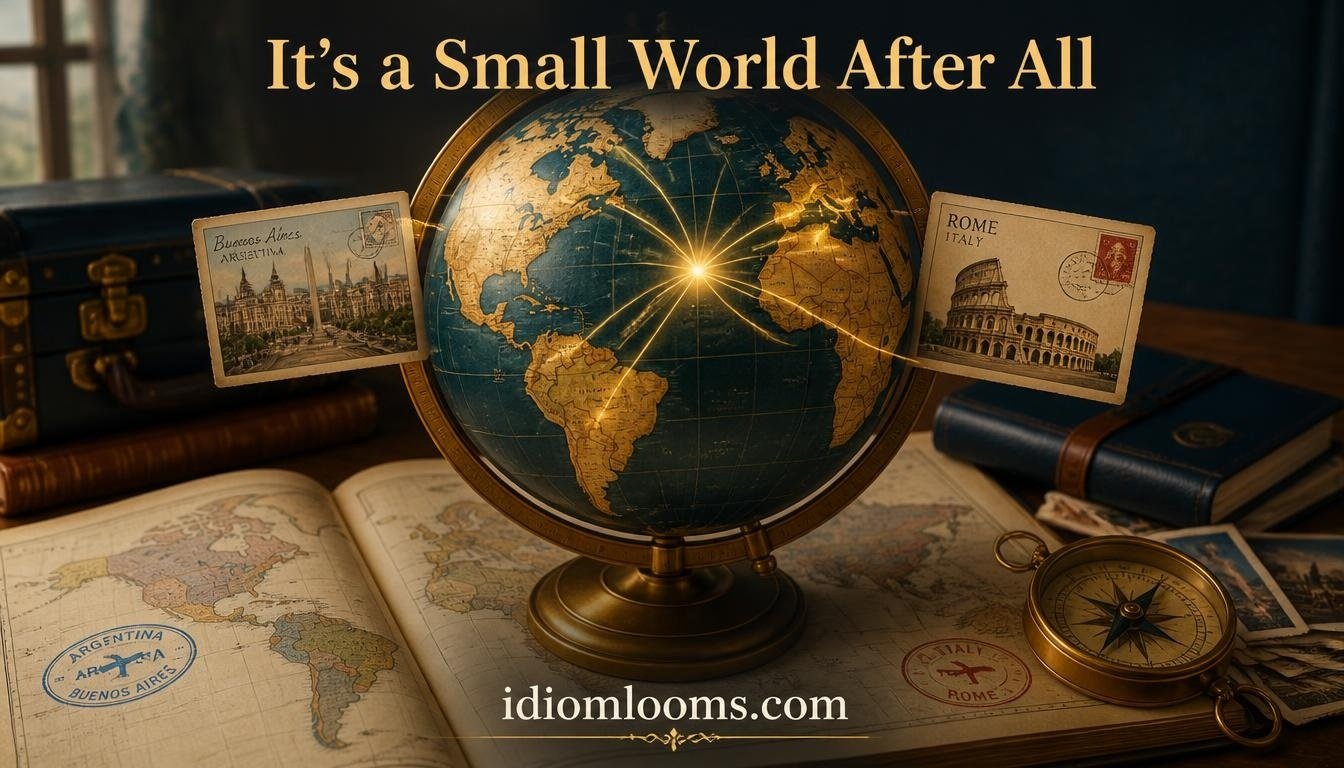
“It’s a small world after all” expresses the idea that people and places can feel surprisingly connected despite the enormous size of the planet.
In a Sentence
We met by chance in Morocco after growing up thousands of miles apart—it’s a small world after all.
Other Ways to Say It
- The world is surprisingly connected
- What a coincidence
- You never know where paths will cross
- The world can feel surprisingly small
Explanation
This expression captures one of the most charming contradictions of around-the-world experiences: enormous geographical distances can coexist with unexpected human connections.
It is warm, conversational, and often used after a surprising coincidence.
Best Use
Especially effective in personal stories, casual conversations, travel posts, and reflective writing.
Read more: 20 Idioms for Going With Real Examples
Exercise: Practice using idioms
Choose the best answer for each question.
Which expression means traveling through many countries and experiencing different places?
A. Around the clock
B. Travel the world
C. On the map
D. A world apart
What does “a world apart” usually describe?
A. Two things that are extremely different
B. A journey across an ocean
C. A trip lasting one day
D. A famous tourist destination
Which expression suggests discovering less-visited places?
A. Around the globe
B. Small world
C. Off the beaten track
D. Around the clock
If a town becomes internationally famous, which expression can describe what happened?
A. After a long day, we hit the road early in the morning.
B. Over time, the small town became a world apart from the busy city.
C. To enjoy the beautiful scenery, we took the scenic route.
D. The discovery of gold put the small town on the map.
What does “the world is your oyster” communicate?
A. The world is dangerous
B. Many opportunities are available
C. Traveling is expensive
D. Every country is similar
Which expression focuses on choosing a longer route because the journey itself is enjoyable?
A. Take the scenic route
B. Four corners of the world
C. Far and wide
D. Worlds collide
Which phrase can describe people from very different cultures meeting?
A. Around the clock
B. See the world
C. Worlds collide
D. On the map
What does “at the ends of the earth” suggest?
A. A central location
B. An extremely distant place
C. A short journey
D. A busy city
Which expression is most likely to be used after discovering an unexpected connection with someone?
A. Small world
B. Off the beaten track
C. Across the seven seas
D. On the map
“Across the seven seas” is best understood as a figurative reference to:
A. Traveling across distant oceans and lands
B. Working seven days a week
C. Visiting seven nearby cities
D. Staying in one country
Which expression means “throughout many parts of the world”?
A. A world apart
B. In every corner of the globe
C. Hit the road
D. Take the scenic route
Which sentence uses “around the clock” correctly?
A. We visited around the clock in three countries.
B. The mountain was around the clock from the city.
C. The emergency service operates around the clock.
D. They walked around the clock to find a museum.
Which statement best explains the difference between literal and figurative language?
A. Figurative language always uses difficult words.
B. Literal language cannot describe travel.
C. Figurative language communicates an idea through an image or comparison.
D. Literal language is always more emotional.
Which expression is especially suitable for describing an opportunity to explore new possibilities?
A. The world is your oyster
B. A world apart
C. At the ends of the earth
D. Far and wide
Which expression emphasizes people or things coming from many distant places?
A. Around the clock
B. Four corners of the world
C. Hit the road
D. Take the scenic route
Answers
1. B — “Travel the world” means visiting and experiencing different countries and places.
2. A — “A world apart” describes things that are extremely different from each other.
3. C — “Off the beaten track” refers to places away from common or well-used routes.
4. D — Something is “put on the map” when it gains recognition or attention.
5. B — “The world is your oyster” expresses the idea that many opportunities are available.
6. A — “Take the scenic route” means choosing a route for the experience and sights rather than speed alone.
7. C — “Worlds collide” describes separate cultures, people, or experiences coming together.
8. B — “At the ends of the earth” suggests an extremely distant or remote place.
9. A — “Small world” is commonly used when an unexpected connection or coincidence is discovered.
10. A — “Across the seven seas” is an imaginative expression for traveling across distant oceans and lands.
11. B — “In every corner of the globe” means across many or nearly all parts of the world.
12. C — “Around the clock” means continuously, day and night.
13. C — Figurative language uses an image, comparison, or symbolic idea to communicate meaning beyond literal wording.
14. A — “The world is your oyster” is an optimistic expression about having opportunities and choices.
15. B — “Four corners of the world” emphasizes people or things coming from widely separated parts of Earth.
FAQs
What is an idiom for around the world?
Expressions such as “around the globe,” “across the seven seas,” “four corners of the world,” and “in every corner of the globe” can describe the idea of around the world. The best choice depends on whether you want to emphasize global reach, distance, adventure, or connection.
How do I create my own idiom for around the world?
Start with the idea you want to communicate, such as adventure, cultural connection, distance, or discovery. Then create a memorable image that represents that idea. A strong figurative expression should feel understandable rather than simply replacing one ordinary phrase with another.
What makes an idiom effective?
An effective idiom creates a clear mental image while communicating an idea naturally. It should add something beyond literal wording, such as emotion, personality, humor, atmosphere, or emphasis.
Can I use these idioms in everyday conversation?
Yes, although some are more conversational than others. “Small world,” “hit the road,” “see the world,” and “the world is your oyster” can sound natural in casual speech. Expressions such as “across the seven seas” may sound more poetic or dramatic.
What is the difference between an idiom and a simile?
An idiom is an established expression whose overall meaning is not necessarily predictable from its individual words. A simile directly compares two things using words such as “like” or “as.” For example, “as busy as a bee” is a simile, while “hit the road” is an idiom.
Conclusion
Idioms give the idea of around the world more color and personality. Instead of relying only on straightforward phrases such as “internationally” or “in many countries,” you can use expressions that suggest adventure, distance, cultural exchange, opportunity, or human connection. Some choices, such as “around the globe,” work naturally in everyday and professional writing, while others, such as “across the seven seas,” create a more poetic atmosphere.
The most effective expression depends on the feeling and message you want your reader to receive. When describing global experiences, choose imagery that feels natural to your context rather than using figurative language simply for decoration. After all, around the world can mean not only how far we travel, but also how much of life we discover along the way.