

Have you ever wanted to describe victory without simply saying “we won”? 20 Idioms for Victory With Real Examples introduces vivid expressions for triumph, success, achievement, and winning. These phrases can make everyday English more engaging and memorable.
Learning victory idioms can strengthen English usage, formal writing, and business communication. You may encounter them in meetings, broadcasting, project discussions, or creative writing. They also help improve grammar, clarity, and consistency when describing successful outcomes.
This article explains 20 useful idioms through clear meanings, realistic examples, and practical explanations. You will learn expressions suitable for conversations, speeches, essays, and storytelling. Related skills such as scheduling, time management, online booking, calendar planning, and project management also benefit from confident communication. By the end, you can use victory idioms naturally and accurately.
What Is an Idiom?
An idiom is a fixed expression whose meaning is different from the literal meaning of the individual words.
For example, “break the ice” does not usually mean physically breaking ice. It means to make people feel more comfortable in a new or awkward situation.
Similarly, “spill the beans” does not mean dropping beans. It means to reveal a secret.
Idioms add figurative language, imagery, and personality to everyday communication. Their meanings are usually understood from common usage and context rather than from the literal words alone.
Why Use Idioms for Victory?
Victory can bring many different feelings: relief after a struggle, excitement after a competition, pride after hard work, or satisfaction after overcoming an obstacle. A single word such as “win” cannot always capture those shades of meaning.
Idioms can help you:
- Express emotion more strongly.
- Make a victory sound more vivid and memorable.
- Describe success without using the same word repeatedly.
- Show whether the win was easy, difficult, unexpected, or dramatic.
- Add personality to conversations and storytelling.
- Make speeches and creative writing more engaging.
- Explain an abstract idea through a familiar image.
The key is to choose an expression that matches the kind of victory you want to describe.
Quick List of 20 Idioms
- Carry the day
- Come out on top
- Win hands down
- Snatch victory from the jaws of defeat
- Pull off a win
- Have the upper hand
- Get the better of someone
- Come from behind
- Go the distance
- Rise to the occasion
- Beat the odds
- Turn the tables
- Hold all the cards
- Knock it out of the park
- Be on a winning streak
- Cross the finish line
- Score a triumph
- Have a breakthrough
- Land on your feet
- Emerge victorious
Carry the Day
Read more:20 Idioms for Adventure With Real Examples
Meaning
Carry the day means to succeed in the end or win an argument, contest, or difficult situation. The expression emphasizes the outcome after different sides or forces have competed.
In a Sentence
After hours of debate, her carefully researched proposal carried the day.
Other Ways to Say It
- Win in the end
- Prevail
- Come out successful
- Gain the advantage
Explanation
The phrase creates the image of one side ultimately prevailing over the others. It works particularly well when victory comes after discussion, competition, or resistance rather than being immediate.
Best Use
It fits speeches, essays, formal conversations, and storytelling. It can sound slightly more formal than everyday expressions such as “win.”
Come Out on Top
Meaning
Come out on top means to finish in the best position after a competition, struggle, or challenging situation.
In a Sentence
Several teams played brilliantly, but our school came out on top in the final match.
Other Ways to Say It
- Finish first
- End up winning
- Take first place
- Prevail over the competition
Explanation
The phrase gives a simple visual picture of someone ending up above the others. It can describe sports, business competition, personal challenges, or other situations where there is a clear winner.
Best Use
This is one of the most natural choices for everyday conversation, sports writing, and informal storytelling.
Win Hands Down
Meaning
Win hands down means to win very easily, with little or no serious competition.
In a Sentence
With her experience and preparation, she won hands down.
Other Ways to Say It
- Win easily
- Win by a wide margin
- Dominate the competition
- Have an easy victory
Explanation
The expression suggests a person can win while keeping their hands down because the challenge is not difficult enough to require much effort. It communicates confidence and ease, rather than a hard-fought victory.
Best Use
Use it in casual conversation, sports commentary, and informal writing. It may sound too relaxed for some highly formal contexts.
Snatch Victory from the Jaws of Defeat
Meaning
Snatch victory from the jaws of defeat means to win when defeat seems almost certain.
In a Sentence
The team was losing badly, but two late goals helped them snatch victory from the jaws of defeat.
Other Ways to Say It
- Win against the odds
- Stage a dramatic comeback
- Turn an almost-certain loss into a win
- Escape defeat at the last moment
Explanation
This dramatic expression imagines defeat as something that is already about to swallow the winner, only for victory to be pulled away at the final moment. It strongly communicates drama, determination, and surprise.
Best Use
It is especially effective in sports reports, storytelling, speeches, and dramatic writing.
Pull Off a Win
Meaning
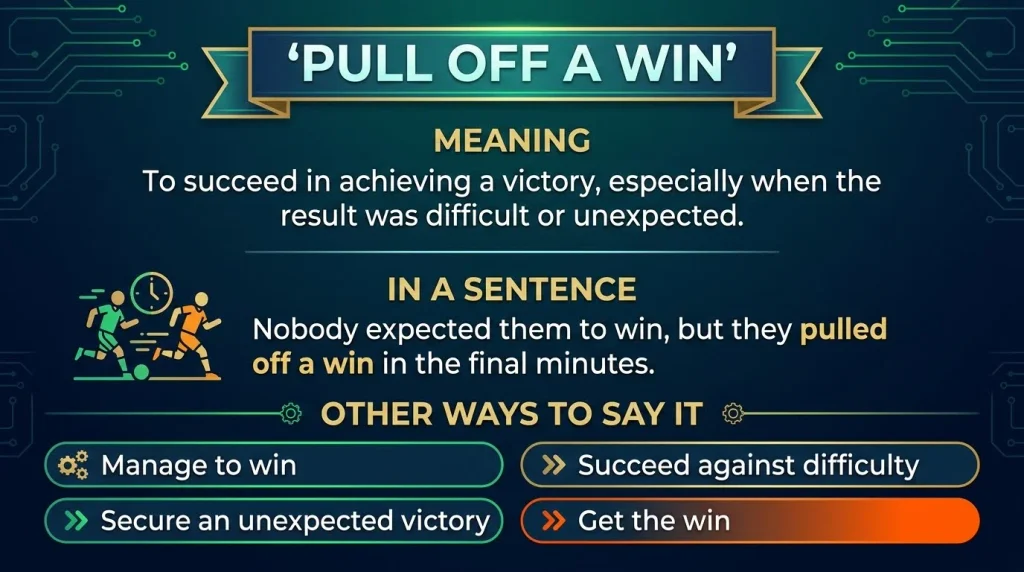
Pull off a win means to succeed in achieving a victory, especially when the result was difficult or unexpected.
In a Sentence
Nobody expected them to win, but they pulled off a win in the final minutes.
Other Ways to Say It
- Manage to win
- Secure an unexpected victory
- Succeed against difficulty
- Get the win
Explanation
The phrase suggests that the victory required skill, effort, or cleverness. It often carries a sense of pleasant surprise because success was not guaranteed.
Best Use
This expression works naturally in conversation, sports, news-style writing, and informal storytelling.
Have the Upper Hand
Meaning
Have the upper hand means to have an advantage over someone or to be in a stronger position.
In a Sentence
Once our side understood the opponent’s strategy, we had the upper hand.
Other Ways to Say It
- Have the advantage
- Be in control
- Hold the stronger position
- Gain the lead
Explanation
The phrase creates a picture of one person being physically higher and therefore better positioned. It does not always mean the final victory has already happened; it often describes an advantage that may lead to success.
Best Use
It suits business discussions, negotiations, competitions, essays, and serious conversations.
Get the Better of Someone
Meaning
Get the better of someone means to defeat or outsmart another person in a particular situation.
In a Sentence
The experienced player eventually got the better of his younger opponent.
Other Ways to Say It
- Defeat someone
- Outplay someone
- Outsmart someone
- Gain the advantage over someone
Explanation
This expression focuses on one person overcoming another, either through ability, strategy, or persistence. It can describe physical competitions as well as verbal or intellectual contests.
Best Use
Use it in storytelling, sports discussions, and descriptions of personal competition.
Come from Behind
Meaning
Come from behind means to win after being in a losing position earlier in a competition or struggle.
In a Sentence
They came from behind to win the championship after trailing by two goals.
Other Ways to Say It
- Make a comeback
- Overcome a deficit
- Recover from a losing position
- Turn the game around
Explanation
The phrase emphasizes the journey to victory, not merely the final result. It creates a sense of movement from weakness toward success and often suggests persistence.
Best Use
It is particularly natural in sports, personal success stories, and motivational writing.
Go the Distance
Meaning
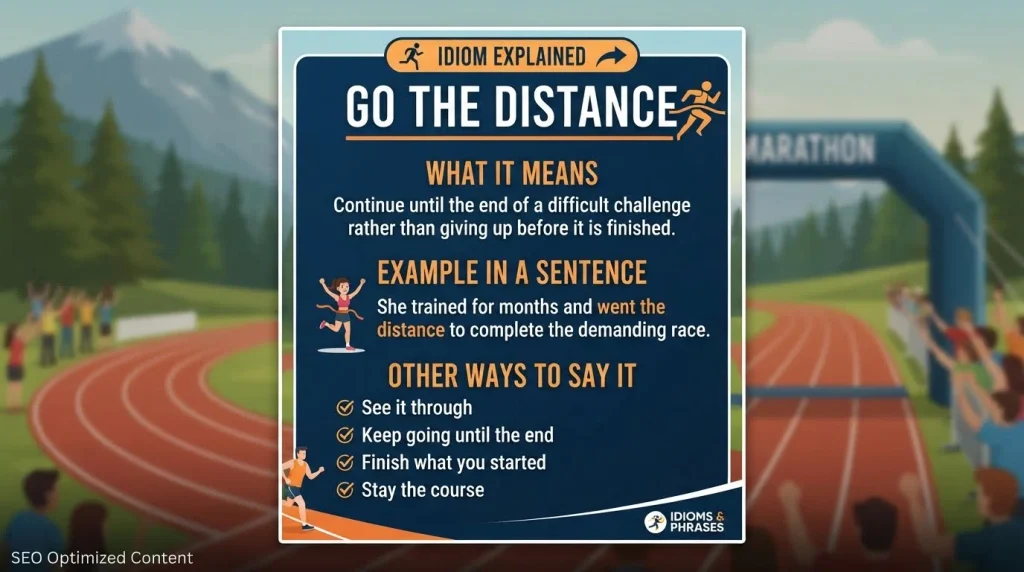
Go the distance means to continue until the end of a difficult challenge rather than giving up before it is finished.
In a Sentence
She trained for months and went the distance to complete the demanding race.
Other Ways to Say It
- See it through
- Keep going until the end
- Finish what you started
- Stay the course
Explanation
The expression comes from the idea of completing an entire distance or challenge. It does not automatically mean winning, but it can describe the endurance that makes victory possible.
Best Use
It works well in motivational speeches, personal stories, essays, and conversations about perseverance.
Rise to the Occasion
Meaning
Rise to the occasion means to perform well when a difficult or important situation requires your best effort.
In a Sentence
The pressure was enormous, but the young captain rose to the occasion when the final moment arrived.
Other Ways to Say It
- Meet the challenge
- Perform under pressure
- Step up
- Give your best when it matters
Explanation
The expression suggests that a person rises above ordinary performance when circumstances demand it. It is useful when victory depends on courage, skill, or composure at an important moment.
Best Use
It fits speeches, sports writing, professional situations, and inspirational stories.
Beat the Odds
Meaning
Beat the odds means to succeed even though the circumstances made success seem unlikely.
In a Sentence
Against expectations, the small team beat the odds and reached the final.
Other Ways to Say It
- Succeed against expectations
- Overcome unlikely circumstances
- Defy expectations
- Triumph against the odds
Explanation
The “odds” represent the chances of success. Beating them suggests a victory that feels unexpected and hard-earned, making the phrase especially powerful when obstacles were significant.
Best Use
It works beautifully in motivational writing, personal success stories, speeches, and journalism.
Turn the Tables
Meaning
Turn the tables means to change a situation so that the person or group who had the advantage becomes disadvantaged.
In a Sentence
The defending team turned the tables in the second half and took control of the match.
Other Ways to Say It
- Reverse the situation
- Change the balance of power
- Take control
- Reverse the advantage
Explanation
The phrase creates a striking image of a situation being physically turned around. It highlights a change in power rather than simply stating that someone won.
Best Use
This expression is effective in storytelling, sports, negotiations, and dramatic accounts of competition.
Hold All the Cards
Meaning
Hold all the cards means to be in a very strong position because you have the advantages, information, or resources needed to succeed.
In a Sentence
With several other companies interested in the deal, the seller held all the cards.
Other Ways to Say It
- Have all the advantages
- Be in a powerful position
- Control the situation
- Have the leverage
Explanation
The expression comes from card games, where having strong cards can put a player in control. It describes strategic advantage, so it is often about being positioned for victory rather than having already won.
Best Use
It is particularly useful in business, negotiations, strategy discussions, and competitive situations.
Knock It Out of the Park
Meaning
Knock it out of the park means to do something extremely well or achieve an impressive success.
In a Sentence
The speaker knocked it out of the park with a confident and memorable presentation.
Other Ways to Say It
- Do an excellent job
- Achieve a major success
- Impress everyone
- Hit the mark brilliantly
Explanation
The image comes from baseball: hitting the ball out of the playing area is an especially impressive result. The phrase therefore suggests exceptional performance, not merely an ordinary win.
Best Use
It works best in casual conversations, workplace praise, social media, and encouraging messages. It has a lively, informal tone.
Be on a Winning Streak
Meaning
Be on a winning streak means to experience several victories or successes one after another.
In a Sentence
After winning three competitions in a row, the young athlete was on a winning streak.
Other Ways to Say It
- Keep winning
- Enjoy repeated success
- Have consecutive victories
- Be on a run of success
Explanation
A streak is a continuing series of similar events. This expression focuses on repeated victory, making it different from idioms that describe a single successful outcome.
Best Use
It is natural in sports, games, business, personal goals, and informal conversation.
Cross the Finish Line
Meaning
Cross the finish line means to complete a race, task, project, or difficult journey successfully.
In a Sentence
After months of revisions, the team finally crossed the finish line with its new project.
Other Ways to Say It
- Complete the challenge
- Reach the end
- Finish successfully
- See the project through
Explanation
The literal image is a competitor reaching the end of a race. Figuratively, it represents completion after sustained effort. It can suggest victory when reaching the goal itself is the important achievement.
Best Use
It is especially useful in motivational writing, project discussions, speeches, and personal messages.
Score a Triumph
Meaning
Score a triumph means to achieve a notable or impressive victory.
In a Sentence
The campaign scored a major triumph after months of careful planning.
Other Ways to Say It
- Achieve a victory
- Secure a success
- Enjoy a major win
- Accomplish something impressive
Explanation
Unlike highly casual expressions, this phrase gives victory a stronger sense of significance and achievement. “Triumph” suggests that the success deserves recognition.
Best Use
It can work well in formal writing, essays, speeches, journalism, and descriptions of significant achievements.
Have a Breakthrough
Meaning
Have a breakthrough means to make an important advance after struggling with a problem or challenge.
In a Sentence
After weeks of testing, the researchers had a breakthrough that solved the central problem.
Other Ways to Say It
- Make a major advance
- Find a solution
- Make an important discovery
- Overcome a barrier
Explanation
A breakthrough is imagined as breaking through a barrier that had prevented progress. It may not mean winning a competition, but it is strongly connected with victory over a difficult obstacle.
Best Use
Use it in academic writing, professional contexts, creative nonfiction, and discussions of personal or technical progress.
Land on Your Feet
Meaning
Land on your feet means to recover successfully from a difficult situation and end up in a stable or favorable position.
In a Sentence
Even after losing his first business, he landed on his feet and built a successful career elsewhere.
Other Ways to Say It
- Recover successfully
- Come through safely
- Bounce back
- End up in a good position
Explanation
The phrase creates the image of someone falling but managing to land safely on their feet. It emphasizes resilience and recovery rather than a direct competitive win.
Best Use
It works naturally in personal conversations, life stories, advice, and informal writing.
Emerge Victorious
Meaning
Emerge victorious means to come out of a competition, conflict, or difficult situation as the winner.
In a Sentence
After a demanding final round, the experienced candidate emerged victorious.
Other Ways to Say It
- Come out the winner
- Prevail
- Achieve victory
- Win in the end
Explanation
The word “emerge” suggests coming out of a difficult experience, while “victorious” makes the successful outcome clear. Together, they create a polished and slightly dramatic expression.
Best Use
This phrase suits formal writing, speeches, essays, sports reports, and dramatic storytelling more than casual conversation.
Exercise: Practice Using Idioms
Test your understanding of the idioms by choosing the best answer for each question.
1. What does “come out on top” mean?
A. Withdraw from a contest before it ends
B. Secure the top spot in a competition
C. Escape from a challenging circumstance
D. Modify the existing regulations
2. Which idiom describes winning when defeat seemed almost certain?
A. Go the distance
B. Have a breakthrough
C. Hold all the cards
D. Snatch victory from the jaws of defeat
3. If someone “wins hands down,” how difficult was the victory?
A. The task involved little difficulty
B. Success came after repeated efforts
C. Nobody saw it coming
D. Neither side emerged victorious
4. Which expression focuses on having an advantage rather than necessarily having won already?
A. Cross the finish line
B. Score a triumph
C. Have the upper hand
D. Come from behind
5. A team is losing at halftime but wins the match. Which idiom fits best?
A. Hold all the cards
B. Come from behind
C. Win hands down
D. Have a breakthrough
6. What does “beat the odds” suggest?
A. Success was guaranteed
B. The person avoided competition
C. The result was decided early
D. Success seemed unlikely
7. Which expression is most associated with doing something exceptionally well?
A. Knock it out of the park
B. Land on your feet
C. Carry the day
D. Cross the finish line
8. What does “turn the tables” describe?
A. Ending a competition
B. Making a small improvement
C. Reversing who has the advantage
D. Refusing to participate
9. If a company “holds all the cards,” what does it have?
A. A guaranteed victory
B. A strong strategic position
C. A finished project
D. A losing position
10. Which idiom describes continuing through a difficult challenge until the end?
A. Get the better of someone
B. Carry the day
C. Go the distance
D. Be on a winning streak
11. “Be on a winning streak” means:
A. Achieve victory on multiple occasions
B. Get ready to participate in a contest
C. Secure an unforeseen victory on a single occasion
D. Withdraw from the competition entirely
12. Which phrase best describes recovering successfully after a setback?
A. Score a triumph
B. Land on your feet
C. Win hands down
D. Hold all the cards
13. If a person “rises to the occasion,” what do they do?
A. Leave when things become difficult
B. Avoid taking responsibility
C. Perform well when circumstances demand it
D. Win without making an effort
14. Which expression best describes an important advance after struggling with a problem?
A. Have a breakthrough
B. Come out on top
C. Get the better of someone
D. Be on a winning streak
15. Which statement uses an idiom figuratively rather than literally?
A. The runner crossed the finish line.
B. The player held the cards in his hand.
C. The team turned the tables and regained control.
D. She walked across the room after winning.
Answers
- B — “Come out on top” means to finish as the winner or in the strongest position.
- D — “Snatch victory from the jaws of defeat” describes a dramatic win when loss seemed almost certain.
- A — “Win hands down” means to win very easily.
- C — “Have the upper hand” means to possess an advantage or stronger position.
- B — “Come from behind” describes winning after being in a losing position.
- D — “Beat the odds” means succeeding despite unfavorable or unlikely circumstances.
- A — “Knock it out of the park” means to perform exceptionally well or achieve impressive success.
- C — “Turn the tables” means to reverse the balance of power or advantage.
- B — “Hold all the cards” means having the strongest strategic position or most leverage.
- C — “Go the distance” means continuing through a challenge until the end.
- A — A “winning streak” is a series of victories or successes occurring consecutively.
- B — “Land on your feet” means recovering successfully after difficulty or trouble.
- C — “Rise to the occasion” means performing well when an important challenge requires it.
- A — A “breakthrough” is an important advance that overcomes a barrier or difficult problem.
- C — “Turn the tables” is being used figuratively to describe reversing the situation.
FAQs
What is an idiom for victory?
An idiom for victory is a figurative expression used to describe winning, succeeding, overcoming difficulty, or gaining an advantage. Examples include “come out on top,” “carry the day,” and “beat the odds.”
How do I create my own idiom?
A strong idiomatic expression usually connects an idea with a clear mental image. Start with the feeling or situation you want to express, then find a familiar object, action, or experience that can represent it. However, newly invented expressions may not be understood as idioms unless people adopt them through repeated use.
What makes an idiom effective?
An effective idiom is clear in context, memorable, and appropriate for the situation. Good figurative language gives readers or listeners an image that helps them understand an emotion or idea quickly.
Can I use these idioms in everyday conversation?
Yes. Expressions such as “come out on top,” “pull off a win,” “come from behind,” and “knock it out of the park” can sound very natural in casual conversation. More formal expressions, such as “emerge victorious,” may be better suited to speeches or writing.
What is the difference between an idiom and a simile?
An idiom is an established expression whose figurative meaning is understood through usage, such as “hold all the cards.” A simile directly compares two things using words such as “like” or “as,” such as “the victory felt like a sunrise after a long night.” Both can create imagery, but they work differently.
Conclusion
Victory can be quiet or dramatic, expected or surprising, personal or competitive. The right idiom helps show how the victory happened and what it felt like, rather than simply stating that someone won. Expressions such as “come from behind” emphasize a comeback, while “win hands down” suggests an easy success. “Beat the odds” highlights unlikely achievement, and “go the distance” focuses on perseverance.
When choosing an idiom, think about the message behind the victory. Do you want to emphasize effort, confidence, resilience, strategy, surprise, or achievement? The strongest figurative expression is the one that fits that feeling naturally. With the right words, a simple win can become a memorable story of determination and triumph.




[…] Read more:20 Idioms for Victory With Real Examples […]