

Have you ever wanted to describe winning without repeating the same simple words? The 20 Idioms for Winning With Real Examples in this guide will help you express success, achievement, triumph, and victory with greater impact. These expressions add color and confidence to everyday English while making your communication more memorable.
Whether you are writing about a personal achievement, discussing business communication, or preparing for important meetings, the right idiom can strengthen your message. You will discover natural expressions that fit conversations, formal writing, speeches, storytelling, and professional contexts. Each example shows how native English speakers use these phrases naturally.
This guide also supports better English usage, grammar, and consistency in everyday expression. The idioms can complement topics such as project management, time management, scheduling, calendar planning, online booking, and broadcasting when describing successful outcomes. Explore each expression, understand its figurative meaning, and learn how to use it confidently.
What Is an Idiom?
An idiom is a familiar expression whose meaning is different from the exact meaning of its individual words. Idioms are a form of figurative language, so they often create a mental picture rather than stating an idea literally.
For example, if someone says, “She broke the ice,” they usually do not mean that she physically broke ice. They mean that she helped people feel more comfortable in a social situation.
Similarly, saying someone “has the upper hand” does not mean that one person’s hand is physically above another’s. It means that the person has an advantage or greater control.
Idioms make language more colorful because they communicate an idea through an image, comparison, or familiar expression.
Why Use Idioms for Winning?
Winning is not always a simple matter of getting a trophy or finishing first. It can involve confidence, persistence, strategy, timing, resilience, and overcoming setbacks. Idioms help capture these different sides of success.
An expression such as “come out on top” focuses on the final result, while “beat the odds” emphasizes overcoming difficult circumstances. “Have the upper hand” is more about advantage, whereas “snatch victory from the jaws of defeat” highlights a dramatic turnaround.
Using the right idiom can:
- Make a description more vivid and memorable.
- Express the emotion behind a victory.
- Add personality to conversations and stories.
- Make creative writing more engaging.
- Help explain abstract ideas such as success, advantage, and perseverance.
- Give speeches and personal messages more energy.
- Show the difference between an easy win and a hard-fought victory.
The key is to choose an expression that matches the kind of winning you want to describe.
Quick List of 20 Idioms for Winning
- Come out on top
- Carry the day
- Have the upper hand
- Beat the odds
- Snatch victory from the jaws of defeat
- Knock it out of the park
- Hit a home run
- Seal the deal
- Be in the winner’s circle
- On a winning streak
- Hold all the cards
- Take the crown
- Steal the show
- Go the distance
- Edge someone out
- Game, set, match
- Raise the bar
- A feather in your cap
- In the driver’s seat
- Triumph against the odds
Come out on top
Read more:20 Idioms for Unexpected With Real Examples
Meaning
Come out on top means to finish in the best position or ultimately succeed after competition, difficulty, or uncertainty. The image is simple: several people or teams struggle through a challenge, but one person ends up above the rest.
It is one of the most flexible expressions for winning because it can describe sports, business, arguments, competitions, and personal challenges.
In a Sentence
After months of negotiations, our team came out on top and secured the contract.
Other Ways to Say It
- Finish first
- End up victorious
- Emerge as the winner
- Prevail over the competition
Explanation
This expression focuses mainly on the final outcome rather than how the victory happened. It works particularly well when success was uncertain or several people were competing for the same result.
It can also describe a person who experiences setbacks but eventually succeeds, giving it a quietly confident tone.
Best Use
Best for: conversations, essays, storytelling, sports writing, business writing, and personal success stories.
Carry the day
Meaning
Carry the day means to succeed in a contest, debate, argument, or difficult situation. The expression suggests that someone’s position, effort, or performance ultimately wins the situation.
It does not necessarily mean taking first place in a formal competition. Instead, it often describes a successful outcome after competing ideas or forces have been weighed against each other.
In a Sentence
Her carefully researched proposal carried the day when the committee made its final decision.
Other Ways to Say It
- Prevail
- Win the argument
- Succeed in the end
- Prove decisive
Explanation
This idiom is useful when winning comes through persuasion, evidence, skill, or determination rather than physical competition. It gives a sense that something eventually became the deciding factor.
The expression has a slightly more traditional or formal feel than some everyday phrases, so it can add polish to writing.
Best Use
Best for: essays, speeches, debates, formal conversations, storytelling, and professional writing.

Have the upper hand
Meaning
To have the upper hand means to have an advantage over another person or group. The advantage may come from better preparation, stronger resources, more information, better timing, or greater influence.
Unlike “come out on top,” this expression often describes the situation before the final result is known.
In a Sentence
With two goals already scored, the home team had the upper hand going into the final quarter.
Other Ways to Say It
- Have the advantage
- Be in a stronger position
- Hold an advantage
- Have the edge
Explanation
The expression creates the image of one person being positioned above another, giving them greater control. It is especially useful when you want to describe strategic advantage rather than completed victory.
Someone can have the upper hand and still lose, which makes this expression different from idioms that clearly describe a finished win.
Best Use
Best for: sports commentary, negotiations, debates, business discussions, and competitive situations.
Beat the odds
Meaning
Beat the odds means to succeed even though the circumstances suggest that success is unlikely. It emphasizes unexpected achievement in the face of difficulty.
The “odds” represent the chances of success, so beating them means achieving a result that many people would not have expected.
In a Sentence
Against all expectations, the small team beat the odds and reached the final.
Other Ways to Say It
- Defy expectations
- Overcome the chances
- Succeed against expectations
- Defy the odds
Explanation
This expression is especially powerful because it makes winning about more than the final score. It tells the reader that the journey was difficult and the result was surprising.
It can create an inspirational tone when describing someone who succeeds despite limited resources, setbacks, or strong competition.
Best Use
Best for: motivational writing, personal stories, speeches, sports stories, and inspirational messages.
Snatch victory from the jaws of defeat
Meaning
Snatch victory from the jaws of defeat means to win when defeat seems almost certain. It describes a dramatic turnaround in which success arrives at the very last moment.
The image is deliberately dramatic: defeat appears ready to claim the victory, but the winner manages to pull it away.
In a Sentence
Trailing by three points with seconds remaining, the team snatched victory from the jaws of defeat with a stunning final play.
Other Ways to Say It
- Make a dramatic comeback
- Turn the game around
- Win at the last moment
- Pull off an unlikely victory
Explanation
Few expressions capture the excitement of a close contest as vividly as this one. It is much stronger than simply saying “they won” because it emphasizes danger, suspense, and reversal.
Because of its dramatic language, it can sound excessive when describing a minor success.
Best Use
Best for: sports writing, dramatic storytelling, speeches, headlines, and exciting personal narratives.
Knock it out of the park
Meaning
Knock it out of the park means to do something extremely well or achieve an impressive result. It comes from baseball, where hitting the ball out of the playing area for a home run is a major success.
The expression is often used for excellent performance, rather than literal victory.
In a Sentence
You really knocked it out of the park with that presentation; everyone was impressed.
Other Ways to Say It
- Do an excellent job
- Excel
- Hit a home run
- Perform brilliantly
Explanation
The baseball image makes the expression energetic and easy to visualize. It suggests a performance so strong that it goes far beyond ordinary expectations.
It is usually casual and enthusiastic, making it more suitable for friendly communication than highly formal writing.
Best Use
Best for: conversations, workplace praise, social media, sports-related writing, and informal messages.
Hit a home run
Meaning
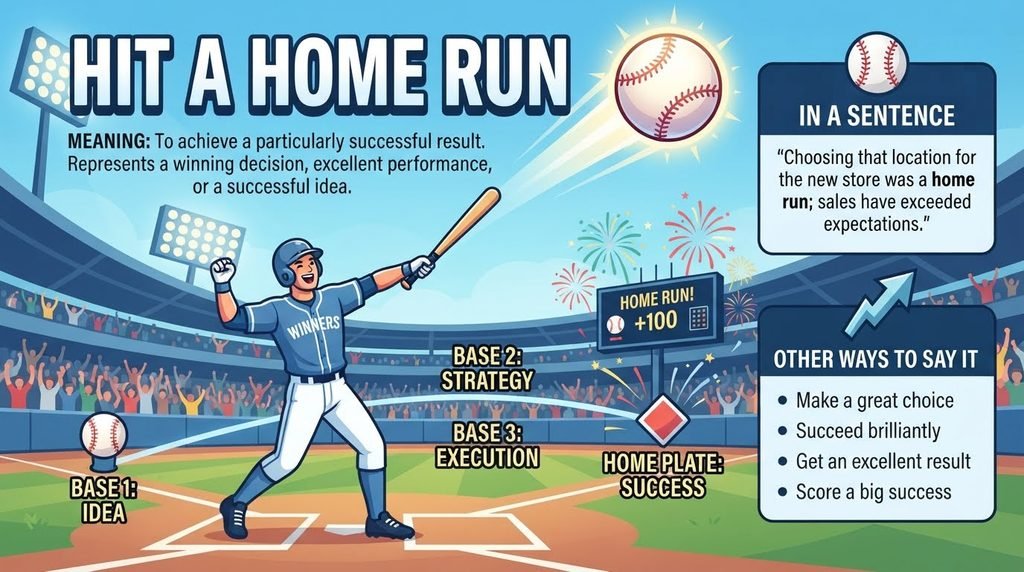
Hit a home run means to achieve a particularly successful result. Like “knock it out of the park,” it comes from baseball, where a home run is one of the clearest signs of offensive success.
The expression can describe a winning decision, an excellent performance, or a successful idea.
In a Sentence
Choosing that location for the new store was a home run; sales have exceeded expectations.
Other Ways to Say It
- Make a great choice
- Succeed brilliantly
- Get an excellent result
- Score a big success
Explanation
This idiom turns success into a vivid sporting image. It often carries a positive, upbeat, and confident feeling.
It does not necessarily mean someone literally won a competition. Instead, it highlights a choice or action that produced an especially good outcome.
Best Use
Best for: casual conversation, business discussions, marketing copy, workplace praise, and personal messages.
Seal the deal
Meaning
Seal the deal means to complete an agreement or take the final action needed to make a successful outcome certain.
The expression is particularly useful when winning depends on closing the final gap rather than simply gaining an early advantage.
In a Sentence
His final answer during the interview sealed the deal, and the company offered him the position the next day.
Other Ways to Say It
- Close the agreement
- Make it official
- Secure the result
- Finalize the arrangement
Explanation
The image comes from the idea of putting a seal on an agreement so that it becomes official. It suggests that the important work has already happened and one final step confirms success.
It is especially useful when describing business, negotiations, decisions, or competitive situations.
Best Use
Best for: business writing, workplace conversations, negotiations, storytelling, and informal professional communication.
Be in the winner’s circle
Meaning
Be in the winner’s circle means to be among successful people or to have achieved a winning position. The expression comes from horse racing, where winning horses and their connections traditionally gather in a designated area after a race.
It can describe belonging to a group of successful people as well as achieving a particular victory.
In a Sentence
After years of hard work, the young athlete finally found herself in the winner’s circle.
Other Ways to Say It
- Be among the winners
- Reach the top
- Join the successful group
- Achieve recognition
Explanation
This expression creates a strong image of celebration after achievement. Unlike “have the upper hand,” it generally points toward successful results rather than temporary advantage.
It can sound polished and slightly figurative, especially when used outside sports.
Best Use
Best for: sports writing, motivational content, success stories, speeches, and creative writing.
On a winning streak
Meaning
To be on a winning streak means to experience a series of consecutive successes. The expression suggests that one victory is followed by another, creating a continuing pattern of good results.
It can apply to sports, games, business, work, or even everyday accomplishments.
In a Sentence
The team is on a winning streak and has not lost a match in six weeks.
Other Ways to Say It
- Keep winning
- Enjoy repeated success
- Be on a roll
- Have a run of victories
Explanation
The important idea here is repetition. One win is not a streak; several successes in succession create the streak.
The expression has an energetic, optimistic tone and works naturally when someone or something seems to have developed strong momentum.
Best Use
Best for: sports, games, casual conversation, business updates, and motivational writing.
Hold all the cards
Meaning
Hold all the cards means to be in a very strong position because you have the information, resources, choices, or power needed to influence an outcome.
The expression comes from card games, where a player holding the important cards may have a major advantage.
In a Sentence
With several other buyers interested, the seller seemed to hold all the cards during the negotiations.
Other Ways to Say It
- Have all the advantages
- Control the situation
- Be in a powerful position
- Have the leverage
Explanation
This expression focuses on power and control, not necessarily a completed victory. Someone who holds all the cards has a strong chance of winning, but the final result may still be undecided.
It works particularly well when describing negotiations or strategic situations.
Best Use
Best for: business writing, negotiations, political analysis, conversations, and strategic storytelling.
Take the crown
Meaning
Take the crown means to become the winner, champion, or person recognized as the best in a particular competition or category.
The crown represents first place, leadership, or supremacy.
In a Sentence
After three rounds of competition, Maya took the crown with her final performance.
Other Ways to Say It
- Win the title
- Become champion
- Claim first place
- Take the top spot
Explanation
The crown gives this expression a sense of ceremony and distinction. It works especially well when someone wins a title or becomes the leading performer in a particular field.
Because of its royal imagery, it can sound more dramatic than ordinary phrases such as “finish first.”
Best Use
Best for: competitions, entertainment writing, sports articles, headlines, creative writing, and celebratory messages.
Steal the show
Meaning
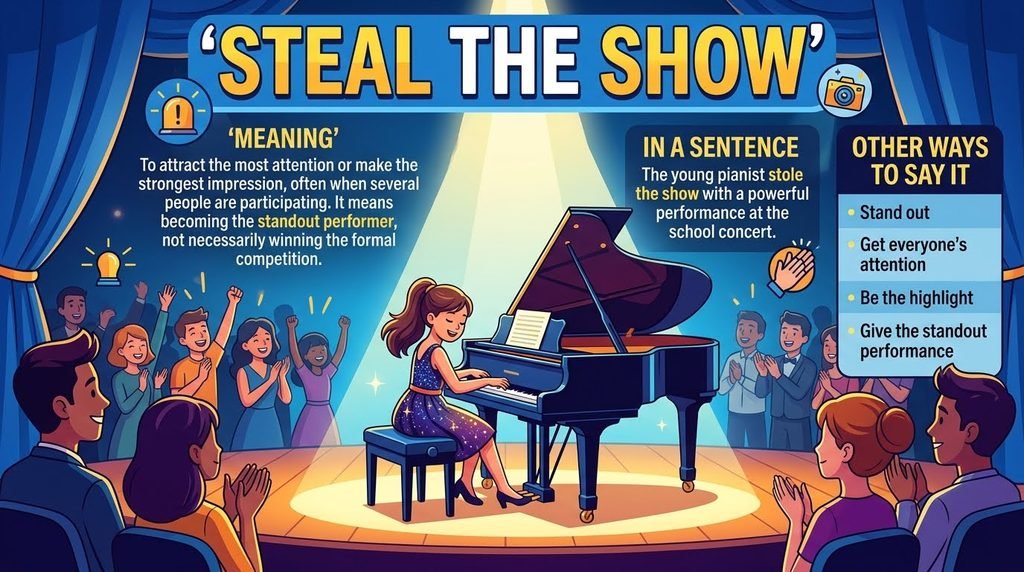
Steal the show means to attract the most attention or make the strongest impression, often when several people are participating.
It does not necessarily mean winning the formal competition. Instead, it means becoming the standout performer.
In a Sentence
The young pianist stole the show with a powerful performance at the school concert.
Other Ways to Say It
- Stand out
- Get everyone’s attention
- Be the highlight
- Give the standout performance
Explanation
The expression creates a playful image of someone “taking” the attention that might have belonged to everyone else. It is useful when success means making the biggest impression, rather than receiving an official prize.
It can be complimentary, but context matters because “stealing” attention may occasionally sound competitive.
Best Use
Best for: performances, presentations, events, storytelling, social media, and casual conversation.
Go the distance
Meaning
Go the distance means to continue through an entire challenge or competition without giving up. It can also mean lasting until the end or successfully completing something demanding.
The expression emphasizes endurance and determination, rather than simply being the strongest competitor.
In a Sentence
She stayed focused through every difficult round and went the distance to win the championship.
Other Ways to Say It
- See it through
- Last until the end
- Keep going
- Complete the challenge
Explanation
This expression is valuable when winning depends on persistence. It suggests that the person did not quit when the challenge became tiring or difficult.
Someone can “go the distance” without winning, so the phrase is more about endurance than the final result. When paired with a winning outcome, it highlights the effort behind the victory.
Best Use
Best for: motivational writing, sports, personal stories, speeches, and discussions about perseverance.
Edge someone out
Meaning
Edge someone out means to defeat another person by a small margin or gain a narrow advantage over them.
The word “edge” suggests that the difference between the winner and the runner-up is small but decisive.
In a Sentence
Our team edged out its closest rival by one point in the final seconds.
Other Ways to Say It
- Beat narrowly
- Win by a small margin
- Outscore slightly
- Gain a narrow victory
Explanation
This phrase is particularly useful for close competitions. It tells readers that the victory was hard-fought and narrowly won, rather than easy.
Because it focuses on a small difference, it works best when the margin of victory genuinely matters.
Best Use
Best for: sports reports, competition stories, business comparisons, and analytical writing.
Game, set, match
Meaning
Game, set, match is a phrase associated with tennis that signals that the competition is over and the winner has been determined. More broadly, it can be used to suggest that someone has definitively won.
It often carries a feeling of finality.
In a Sentence
When the final evidence confirmed his argument, it was game, set, match.
Other Ways to Say It
- It’s over
- That’s decisive
- The victory is settled
- Case closed
Explanation
The expression has a strong sporting image and a slightly playful quality when used outside tennis. It works especially well when one final development settles an argument or competition.
Because it comes from a specific sport, it may sound more informal or dramatic than a straightforward statement of victory.
Best Use
Best for: casual conversation, sports writing, storytelling, humorous comments, and informal social media posts.
Raise the bar
Meaning
Raise the bar means to set a higher standard of performance or achievement. It is often connected with winning because a person who raises the bar makes future success more demanding.
The expression is not a direct synonym for winning. Instead, it describes improving the standard that others must meet.
In a Sentence
Her record-breaking performance raised the bar for everyone competing next season.
Other Ways to Say It
- Set a higher standard
- Improve expectations
- Set a new benchmark
- Make excellence the standard
Explanation
The image comes from raising a bar so that it becomes harder to clear. It is especially useful when someone’s success changes what people consider excellent performance.
This makes it a strong choice when talking about achievement that influences future competition.
Best Use
Best for: professional writing, sports analysis, education, business, speeches, and achievement-focused content.
A feather in your cap
Meaning
A feather in your cap means an achievement that gives you pride, recognition, or a reason to feel accomplished.
It does not necessarily describe winning a competition. Instead, it describes a notable accomplishment that adds to someone’s reputation.
In a Sentence
Winning the national design award was a real feather in her cap after years of creative work.
Other Ways to Say It
- A proud achievement
- A notable accomplishment
- Something to be proud of
- A mark of success
Explanation
The expression comes from the old image of placing a feather in a hat as a sign of achievement. Today, it creates a symbolic picture of earned recognition.
It is warmer and less aggressive than expressions focused on defeating an opponent, making it useful when you want to celebrate achievement without emphasizing competition.
Best Use
Best for: personal messages, essays, professional conversations, biographies, speeches, and celebratory writing.
In the driver’s seat
Meaning
To be in the driver’s seat means to be in control of a situation or to have the power to influence what happens next.
When connected with winning, it suggests that someone has gained control of the path toward success.
In a Sentence
After scoring twice early in the match, the home side was firmly in the driver’s seat.
Other Ways to Say It
- Be in control
- Have the advantage
- Be in charge
- Control the outcome
Explanation
The metaphor compares a situation to driving a vehicle: the person in the driver’s seat has control over the direction and movement.
Like “have the upper hand,” this expression can describe an advantage before the final victory is certain. Its tone is generally conversational and confident.
Best Use
Best for: sports commentary, business discussions, negotiations, conversations, and strategic writing.
Triumph against the odds
Meaning
Triumph against the odds describes succeeding despite difficult circumstances or a low expectation of success. It combines the idea of victory with the challenge of overcoming unfavorable conditions.
Unlike a routine win, it suggests that the achievement required courage, persistence, skill, or resilience.
In a Sentence
The community project triumphed against the odds and raised enough money to rebuild the library.
Other Ways to Say It
- Succeed despite difficulties
- Overcome major obstacles
- Win against expectations
- Achieve the unlikely
Explanation
This expression puts the spotlight on the obstacles behind the success. It is particularly effective when the achievement feels meaningful because the circumstances were challenging.
It has an inspirational and somewhat dramatic tone, so it fits stories of perseverance better than ordinary descriptions of routine success.
Best Use
Best for: inspirational writing, speeches, biographies, storytelling, personal essays, and motivational messages.
Exercise: Practice Using Idioms
Test your understanding of the expressions above. Choose the best answer for each question.
What does “come out on top” mean?
kar ka doo
A. To reach a winning position
B. Leaving a competition before it ends
C. Changing the established rules
D. Choosing not to take part in a contest
Which expression describes succeeding despite an unlikely chance of success?
A. Seal the deal
B. Beat the odds
C. Steal the show
D. Hold all the cards
If a team “has the upper hand,” what does that mean?
A. The players have already exited the field
B. A new strategy has been adopted by the team
C. An advantage has been gained by the team
D. The match ended in a close defeat
Which expression best describes a dramatic last-minute victory?
A. Raise the bar
B. Be in the winner’s circle
C. Go the distance
D. Snatch victory from the jaws of defeat
What does “knock it out of the park” usually mean in everyday English?
A. Perform extremely well
B. Avoid a difficult task
C. Lose by a small margin
D. Stop a competition
Which expression describes a series of consecutive victories?
A. Take the crown
B. On a winning streak
C. A feather in your cap
D. Carry the day
If someone “holds all the cards,” what do they have?
A. A collection of awards
B. A winning streak
C. A strong position or advantage
D. A difficult opponent
Which expression is most closely associated with becoming a champion or taking first place?
A. Take the crown
B. Raise the bar
C. Go the distance
D. Seal the deal
A performer who “steals the show” has what effect?
A. Departing before the event comes to an end
B. Becoming the center of everyone’s attention
C. Refusing to take part in the performance
D. Shortening the duration of the event
What does “go the distance” emphasize?
A. Winning by a large margin
B. Having more resources
C. Completing or enduring a challenge
D. Gaining control immediately
If one player “edges out” another player, what probably happened?
A. Securing victory by a very small difference
B. Declining to take part in the competition
C. Joining a different team
D. Claiming victory without facing an opponent
Is this conversation helpful so far?
Which expression suggests that a final action makes an agreement or result official?
A. Beat the odds
B. Seal the deal
C. Steal the show
D. Take the crown
Which phrase can be used playfully to suggest that a result is now completely settled?
A. Game, set, match
B. A feather in your cap
C. In the driver’s seat
D. Raise the bar
What does “a feather in your cap” describe?
A. A minor mistake
B. A difficult negotiation
C. A notable achievement
D. A temporary disadvantage
Which expression focuses on setting a higher standard for future achievement?
A. Come out on top
B. Raise the bar
C. Carry the day
D. Hit a home run
Answers
- A — “Come out on top” means to finish successfully or emerge as the winner.
- B — “Beat the odds” means to succeed even when success seems unlikely.
- C — Having “the upper hand” means having an advantage over someone else.
- D — “Snatch victory from the jaws of defeat” describes an unexpected victory when defeat seemed nearly certain.
- A — “Knock it out of the park” means to perform exceptionally well.
- B — A “winning streak” is a series of consecutive successes.
- C — Someone who holds all the cards has strong advantages, information, or control.
- A — To “take the crown” means to become the champion or top competitor.
- B — To “steal the show” means to attract the most attention or make the strongest impression.
- C — “Go the distance” emphasizes lasting through or completing a demanding challenge.
- A — To “edge out” someone means to defeat them by a small margin.
- B — To “seal the deal” means to complete the final step that confirms a successful agreement or result.
- A — “Game, set, match” can signal that an outcome is decisively settled.
- C — “A feather in your cap” refers to a noteworthy achievement or accomplishment.
- B — “Raise the bar” means to establish a higher standard of achievement or performance.
FAQs
What is an idiom for winning?
There are many expressions for different kinds of winning. “Come out on top” is a broad choice for describing a successful final result, while “beat the odds” emphasizes succeeding despite difficult circumstances. “Take the crown” is useful when someone becomes the champion.
How do I create my own idiom for winning?
Start with the specific feeling or idea you want to communicate. Think about an image connected to victory, progress, competition, endurance, or achievement, and build a comparison around it. However, if you are writing formal English, it is usually better to use established idioms when you want your meaning to be immediately clear.
What makes an idiom effective?
An effective idiom creates a clear mental image while communicating an idea naturally. It should fit the context and add something beyond a plain statement. The best expression is not necessarily the most dramatic one; it is the one that accurately matches the feeling and situation.
Can I use these idioms in everyday conversation?
Yes. Expressions such as “come out on top,” “beat the odds,” “on a winning streak,” “seal the deal,” and “hit a home run” can sound natural in everyday speech. More dramatic expressions may be better suited to storytelling, sports writing, or inspirational content.
What is the difference between an idiom and a simile?
An idiom is a familiar expression with a figurative meaning, such as “have the upper hand.” A simile directly compares two things using words such as “like” or “as.” For example, “Her victory was like a sunrise after a long night” is a simile. Both can create imagery, but they work differently.
Conclusion
Winning can mean much more than simply finishing first. It can involve overcoming the odds, gaining an advantage, performing brilliantly, enduring pressure, or achieving recognition after a long effort. That is why idioms are useful: they allow you to express the character of a victory rather than merely naming the result.
Choose your expression according to the situation. “Come out on top” works for a broad success, while “edge someone out” describes a narrow victory. “Beat the odds” highlights difficulty, and “snatch victory from the jaws of defeat” adds drama. In creative writing, speeches, conversations, and essays, the right figurative expression can make an achievement feel more vivid and memorable.
A strong description of winning does more than tell readers who succeeded it helps them feel what the victory meant.

Eleanor Prose is a writer and English teacher with a soft spot for the phrases that trip us up. She has spent years helping students and professionals use idioms with confidence not just memorizing them, but understanding the culture and humor behind each one.
Through Idiom Looms, Eleanor explores the threads that connect language, history, and everyday conversation. Her goal is simple: to make English idioms clear, memorable, and actually fun to use.
She writes from a quiet desk surrounded by notebooks, and firmly believes there’s an idiom for every situation usually more than one.


[…] Read more:20 Idioms for Winning With Real Examples […]