Have you ever felt fear so strongly that ordinary words seemed inadequate? The 20 Idioms for Fear With Real Examples in this article will help you describe anxiety, nervousness, panic, and worry naturally. These expressions make everyday English more vivid, memorable, and emotionally precise.
Fear can appear during meetings, presentations, conversations, or unexpected situations. Learning these fear idioms can improve English usage, grammar, and formal writing while supporting clearer business communication. They can also strengthen language skills used in scheduling, time management, online booking, broadcasting, calendar planning, and project management contexts.
Each idiom includes a clear meaning, realistic sentence, useful alternatives, and practical explanation. You will learn how figurative language expresses different levels of fear and emotion. Whether you are writing creatively or speaking casually, these expressions can help you communicate with greater clarity, confidence, and consistency.
What Is an Idiom?
An idiom is a familiar expression whose meaning cannot always be understood by taking every word literally. It often uses an imaginative phrase to communicate an idea, emotion, or situation in a more colorful way.
For example, if someone says, “It’s raining cats and dogs,” they do not mean animals are falling from the sky. They mean that it is raining very heavily.
Another example is “break the ice.” It does not literally mean breaking frozen water. It means to make people feel more comfortable when they first meet.
Idioms differ from literal statements because their intended meaning is figurative. Understanding that figurative meaning helps you recognize what a speaker or writer really wants to communicate.
Why Use Idioms for Fear?
Fear is not always a simple feeling. It can range from mild nervousness to overwhelming terror. Idioms help show these different shades more clearly.
For example, saying someone was “shaking like a leaf” highlights a physical reaction, while “scared out of their wits” suggests extreme fright. An expression such as “lose your nerve” focuses more on losing courage when facing a difficult situation.
Using idioms for fear can help you:
- Express emotions vividly instead of relying on basic words such as “afraid.”
- Create strong mental images for readers and listeners.
- Make stories and personal experiences more memorable.
- Add personality to everyday conversations.
- Show whether fear is mild, intense, sudden, or connected to a specific situation.
- Make creative writing, storytelling, and speeches more expressive.
- Communicate complicated emotional reactions in a short, familiar expression.
The key is choosing an idiom that matches the kind of fear you want to describe.
Quick List of 20 Idioms for Fear
- Scared stiff
- Scared out of your wits
- Jump out of your skin
- Have your hair stand on end
- Make your blood run cold
- Shake like a leaf
- Shake in your boots
- Frozen with fear
- Scared to death
- Afraid of your own shadow
- Lose your nerve
- Get the jitters
- Have your heart in your mouth
- Give someone the creeps
- Send shivers down your spine
- Run for your life
- Chicken out
- White as a sheet
- Scared witless
- Quaking in your boots
Scared Stiff
Read more:20 Idioms for Relief With Real Examples
Meaning
“Scared stiff” means extremely frightened, especially to the point that a person feels unable to move or react normally. The word “stiff” creates the image of someone becoming rigid because of fear.
In a Sentence
When the lights suddenly went out in the abandoned building, Jake was scared stiff.
Other Ways to Say It
- Terrified
- Frozen with fear
- Extremely frightened
- Frightened out of your senses
Explanation
This idiom presents fear as something that can almost paralyze the body. It works especially well when a person is so frightened that they hesitate, freeze, or struggle to react.
The expression is dramatic but still natural in everyday speech. It can describe a frightening story, sudden surprise, or dangerous situation.
Best Use
Best for conversations, storytelling, fiction, and informal personal writing. It is less suitable for highly formal or technical writing.
Scared Out of Your Wits
Meaning
“Scared out of your wits” means extremely frightened or terrified. It suggests that fear is so powerful that a person temporarily feels unable to think clearly.
In a Sentence
The strange noise coming from the attic scared me out of my wits.
Other Ways to Say It
- Terrified me
- Frightened me badly
- Scared me senseless
- Gave me a terrible fright
Explanation
The phrase creates an image of fear overwhelming someone’s ability to think normally. It is stronger than simply saying “nervous” or “worried.”
Because the expression is emphatic, it fits moments of serious or sudden fright rather than small everyday worries.
Best Use
Use it in casual conversation, dramatic storytelling, fiction, and personal anecdotes.
Jump Out of Your Skin
Meaning
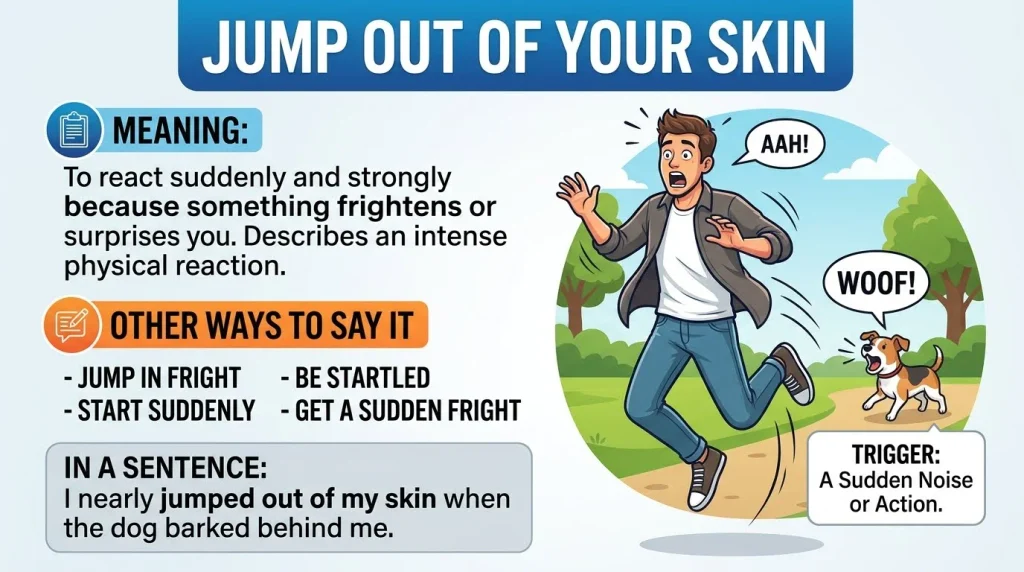
“Jump out of your skin” means to react suddenly and strongly because something frightens or surprises you. It describes an intense physical reaction rather than a long period of worry.
In a Sentence
I nearly jumped out of my skin when the dog barked behind me.
Other Ways to Say It
- Jump in fright
- Start suddenly
- Be startled
- Get a sudden fright
Explanation
The expression creates a vivid picture of someone reacting so strongly that it seems as though they might leap right out of their body.
It is particularly useful for sudden scares. It can also describe surprise, so context determines whether the reaction is caused by fear or simple shock.
Best Use
This idiom works naturally in everyday conversation, humorous stories, personal messages, and informal storytelling.
Have Your Hair Stand on End
Meaning
When something makes your hair stand on end, it frightens or deeply unsettles you. The expression refers to the physical sensation associated with fear or horror.
In a Sentence
The eerie voice on the recording made my hair stand on end.
Other Ways to Say It
- Give me goosebumps
- Frighten me
- Make me uneasy
- Send a chill through me
Explanation
This idiom turns fear into a physical image. Instead of simply telling the reader that something was frightening, it suggests a powerful bodily response.
It often has a mysterious, eerie, or horror-related feeling, making it especially effective when describing unsettling scenes.
Best Use
Best for fiction, horror stories, storytelling, poetry, and expressive conversation.
Make Your Blood Run Cold
Meaning
“Make your blood run cold” means to frighten or horrify someone deeply. It often suggests a sudden, chilling realization or frightening event.
In a Sentence
The detective’s description of what happened made my blood run cold.
Other Ways to Say It
- Horrify me
- Terrify me
- Send a chill through me
- Frighten me deeply
Explanation
The image is deliberately physical: fear is imagined as making the blood feel cold inside the body. It gives an experience a serious and chilling quality.
This expression often sounds more dramatic than “scared me,” so it is useful when the fear is intense or disturbing.
Best Use
Particularly effective in dramatic storytelling, novels, journalism-style narratives, and serious personal accounts.
Shake Like a Leaf
Meaning
“Shake like a leaf” describes someone whose body is trembling because of fear, nervousness, or extreme stress.
In a Sentence
Before walking onto the stage for the first time, I was shaking like a leaf.
Other Ways to Say It
- Tremble with fear
- Shake with nerves
- Tremble badly
- Be visibly frightened
Explanation
A leaf can move easily in even a gentle breeze. Comparing a trembling person to a leaf creates an image of someone who cannot stop shaking.
The expression does not necessarily mean terror. It can also describe strong nervousness before an important event.
Best Use
Use it in conversation, creative writing, personal stories, and descriptions of nervous situations.
Shake in Your Boots
Meaning
“Shake in your boots” means to be very frightened or nervous about something. The image suggests that fear is making your whole body tremble.
In a Sentence
The thought of confronting the angry manager had everyone shaking in their boots.
Other Ways to Say It
- Be terrified
- Tremble with fear
- Be very nervous
- Feel intimidated
Explanation
The “boots” provide a concrete image for a person’s physical reaction to fear. The expression often has a slightly playful or exaggerated tone, even when the fear itself is genuine.
It can be used literally or humorously to describe someone feeling intimidated.
Best Use
Best suited to informal conversation, humorous writing, storytelling, and dramatic descriptions.

Frozen with Fear
Meaning
“Frozen with fear” means so frightened that you cannot move, speak, or react normally.
In a Sentence
When I saw the snake beside my shoe, I stood frozen with fear.
Other Ways to Say It
- Paralyzed with fear
- Unable to move
- Terrified
- Too frightened to react
Explanation
This expression treats fear almost like ice, making the person temporarily motionless. It clearly communicates the connection between an emotional reaction and a physical response.
Unlike some playful fear idioms, this one can sound serious and intense.
Best Use
It works well in fiction, essays, storytelling, speeches, and serious descriptions.
Scared to Death
Meaning
“Scared to death” is an exaggeration meaning extremely frightened. It does not literally mean that the person died from fear.
In a Sentence
You scared me to death when you appeared behind me without making a sound.
Other Ways to Say It
- Terrified me
- Frightened me terribly
- Scared me badly
- Gave me a huge fright
Explanation
This is a classic example of figurative exaggeration. The phrase makes fear sound enormous by comparing it with the ultimate consequence: death.
It is often used casually, including when the danger was not actually serious.
Best Use
Very natural in everyday conversation, informal writing, personal messages, and storytelling.
Afraid of Your Own Shadow
Meaning
If someone is afraid of their own shadow, they become frightened very easily, even by harmless or ordinary things.
In a Sentence
After the break-in, Tom was afraid of his own shadow for several weeks.
Other Ways to Say It
- Easily frightened
- Very jumpy
- Nervous about everything
- Easily startled
Explanation
The shadow represents something completely harmless, yet the person is afraid of it. That contrast makes the idiom effective for describing excessive or unusually sensitive fear.
It can be humorous, but it may sound insensitive if used toward someone experiencing genuine distress.
Best Use
Best in informal conversation, fiction, character descriptions, and light storytelling.
Lose Your Nerve
Meaning
To lose your nerve means to suddenly lose your courage or confidence when you are about to do something difficult, risky, or frightening.
In a Sentence
I planned to speak in front of the entire class, but I lost my nerve when my name was called.
Other Ways to Say It
- Lose your courage
- Back down
- Become too frightened to act
- Get cold feet
Explanation
This idiom focuses less on physical terror and more on the moment when fear overcomes courage. Someone may have been confident earlier but suddenly hesitate when action becomes necessary.
It is especially useful when describing a decision or missed opportunity.
Best Use
Use it in conversation, essays, stories, speeches, and situations involving challenges or difficult decisions.
Get the Jitters
Meaning
“Get the jitters” means to become nervous, uneasy, or anxious, often before an important or stressful event.
In a Sentence
I always get the jitters before giving a presentation.
Other Ways to Say It
- Feel nervous
- Get anxious
- Feel on edge
- Become uneasy
Explanation
Unlike expressions describing terror, this idiom usually refers to milder nervousness. It can describe the restless feeling that comes before an interview, performance, examination, or difficult conversation.
Its informal tone makes it sound relaxed rather than dramatic.
Best Use
Best for casual conversation, workplace discussions, personal writing, and everyday situations.
Have Your Heart in Your Mouth
Meaning
To have your heart in your mouth means to feel suddenly frightened, anxious, or tense, especially while waiting to see what happens.
In a Sentence
My heart was in my mouth as the car slid toward the edge of the road.
Other Ways to Say It
- Feel terrified
- Be extremely anxious
- Feel a sudden rush of fear
- Hold your breath in fear
Explanation
The idiom turns anxiety into a striking physical image: your heart seems to have moved from your chest into your mouth.
It works particularly well for tense moments when the outcome is uncertain, rather than for constant fear.
Best Use
Excellent for storytelling, fiction, personal experiences, and dramatic descriptions.

Give Someone the Creeps
Meaning
If something gives you the creeps, it makes you feel uncomfortable, uneasy, or slightly frightened.
In a Sentence
That empty house at the end of the road gives me the creeps.
Other Ways to Say It
- Make me uneasy
- Creep me out
- Make me uncomfortable
- Give me an eerie feeling
Explanation
This is generally a milder form of fear. It often describes something strange, eerie, unsettling, or difficult to explain rather than an immediate danger.
Its informal tone makes it especially natural in everyday speech.
Best Use
Best for conversation, social media, informal writing, horror discussions, and casual storytelling.
Send Shivers Down Your Spine
Meaning
“Send shivers down your spine” means to cause a strong physical feeling of fear, excitement, horror, or emotional intensity.
In a Sentence
The sudden whisper behind the door sent shivers down my spine.
Other Ways to Say It
- Send a chill through me
- Give me chills
- Make me shudder
- Make me feel uneasy
Explanation
The spine becomes the pathway for a wave of sensation moving through the body. The image makes the reaction feel immediate and physical.
The phrase can describe fear, but it can also be used for suspense, excitement, or an emotionally powerful experience.
Best Use
Especially effective in creative writing, poetry, storytelling, film reviews, and dramatic descriptions.
Run for Your Life
Meaning
To run for your life means to run away as quickly as possible because you believe you are in serious danger.
In a Sentence
When the fire spread toward the campsite, everyone ran for their lives.
Other Ways to Say It
- Flee in panic
- Run as fast as possible
- Escape quickly
- Get away from danger
Explanation
This idiom presents fear through action rather than emotion. Instead of telling readers that someone was terrified, it shows the person responding to danger by fleeing.
Because it implies serious danger, it is stronger than expressions used for ordinary nervousness.
Best Use
Works well in action stories, fiction, news-style narratives, adventure writing, and dramatic storytelling.
Chicken Out
Meaning
To chicken out means to decide not to do something because you become too frightened or nervous.
In a Sentence
I was going to ride the roller coaster, but I chickened out at the last minute.
Other Ways to Say It
- Back out
- Lose your nerve
- Get cold feet
- Decide not to do it out of fear
Explanation
This informal idiom focuses on avoiding an action because of fear. It is often used jokingly or teasingly rather than as a serious description of terror.
Because it is casual, it should generally be avoided in formal writing.
Best Use
Best for friendly conversations, humorous stories, casual messages, and informal social situations.
White as a Sheet
Meaning
If someone becomes white as a sheet, their face becomes very pale, often because of fear, shock, illness, or distress.
In a Sentence
When he heard the crash downstairs, he turned white as a sheet.
Other Ways to Say It
- Turn pale
- Look terrified
- Lose the color from your face
- Look shocked
Explanation
The idiom uses the whiteness of a sheet as a visual comparison for a person’s suddenly pale face.
It is especially useful because it shows fear through a visible physical change rather than simply naming the emotion.
Best Use
Effective in fiction, storytelling, descriptive writing, and conversations about a frightening event.
Scared Witless
Meaning
“Scared witless” means extremely frightened, to the point that a person feels unable to think clearly.
In a Sentence
The unexpected explosion left everyone scared witless.
Other Ways to Say It
- Terrified
- Scared senseless
- Frightened out of your mind
- Extremely alarmed
Explanation
The expression suggests that intense fear has temporarily taken away a person’s ability to think normally. It is similar in strength to “scared out of your wits,” but its shorter form can sound punchier.
The phrase is informal and often has a dramatic or slightly humorous edge.
Best Use
Best for casual speech, fiction, storytelling, and informal writing.
Quaking in Your Boots
Meaning
To be quaking in your boots means to be extremely frightened or nervous. It emphasizes trembling caused by fear.
In a Sentence
The thought of facing the strict examiner had the students quaking in their boots.
Other Ways to Say It
- Trembling with fear
- Shaking with nerves
- Terrified
- Very intimidated
Explanation
The phrase creates a humorous visual image of someone’s boots shaking because the person is trembling so much.
It often sounds exaggerated and playful, so it can make a frightening situation feel less serious.
Best Use
Best for informal conversation, humorous writing, storytelling, and playful descriptions.
Exercise: Practice Using Idioms
Choose the best answer for each question.
Which idiom means “extremely frightened and unable to react normally”?
A. Get the jitters
B. Scared stiff
C. Lose your nerve
D. Run for your life
Which expression describes someone who becomes frightened very easily?
A. Afraid of your own shadow
B. White as a sheet
C. Run for your life
D. Chicken out
If a sudden noise makes you “jump out of your skin,” what does it mean?
A. You became physically injured.
B. You became very tired.
C. You reacted suddenly because of surprise or fear.
D. You decided to leave the place.
Which idiom focuses on trembling because of fear or nervousness?
A. Give someone the creeps
B. Make your blood run cold
C. Have your heart in your mouth
D. Shake like a leaf
What does “lose your nerve” mean?
A. Forget someone’s name
B. Lose courage when facing something difficult
C. Become physically exhausted
D. Become angry with someone
Which expression usually describes mild nervousness rather than extreme terror?
A. Feel extremely nervous
B. Become completely terrified
C. Experience overwhelming fear
D. Grow frightened beyond control
What does “give someone the creeps” usually suggest?
A. Causing someone to burst into laughter
B. Leaving a person feeling nervous or unsettled
C. Making an individual feel physically sick
D. Giving someone a sense of confidence
Which sentence uses “white as a sheet” correctly?
A. The cake was white as a sheet after baking.
B. The teacher became white as a sheet because the students laughed.
C. He turned white as a sheet when he heard the frightening news.
D. She painted the wall white as a sheet.
Which idiom describes fleeing from serious danger?
A. Run for your life
B. Get the jitters
C. Lose your nerve
D. Have your heart in your mouth
What does “chicken out” mean?
A. Plan everything with great care
B. Achieve remarkable success
C. Back away from an action due to fear
D. Suddenly lose one’s temper
Which idiom creates an image of fear causing a chilling sensation?
A. Make your blood run cold
B. Chicken out
C. Shake like a leaf
D. White as a sheet
In the sentence “The horror story sent shivers down my spine,” what does the idiom communicate?
A. The story made the reader sleepy.
B. The story caused a physical feeling of fear or unease.
C. The story was difficult to understand.
D. The story made the reader laugh.
Which expression best describes someone who is too frightened to move?
A. Get the jitters
B. Frozen with fear
C. Chicken out
D. Run for your life
Which idiom means someone is so frightened that they temporarily cannot think clearly?
A. Scared witless
B. Give someone the creeps
C. Shake in your boots
D. White as a sheet
Why is “scared to death” considered figurative language?
A. It describes an actual death.
B. It means a person is pretending to be afraid.
C. It exaggerates the intensity of fear rather than describing literal death.
D. It refers only to dangerous medical situations.
Answers
- B — “Scared stiff” describes being extremely frightened, often with the sense that fear makes a person unable to move or react normally.
- A — “Afraid of your own shadow” describes someone who is unusually or easily frightened.
- C — “Jump out of your skin” describes a sudden, strong reaction to fear or surprise.
- D — “Shake like a leaf” compares a trembling person to a leaf moving in the breeze.
- B — “Lose your nerve” means losing courage when you are about to face something challenging or frightening.
- A — “Get the jitters” generally refers to nervousness or anxiety rather than overwhelming terror.
- B — “Give someone the creeps” means to make someone feel uneasy, uncomfortable, or mildly frightened.
- C — “White as a sheet” describes someone whose face becomes very pale because of fear, shock, or another strong reaction.
- A — “Run for your life” means to flee quickly because of serious or perceived danger.
- C — “Chicken out” means deciding not to do something because fear or nervousness becomes too strong.
- A — “Make your blood run cold” creates a chilling image for deep fear or horror.
- B — “Send shivers down your spine” describes a physical sensation associated with fear, suspense, or strong emotion.
- B — “Frozen with fear” means being so frightened that you become temporarily unable or unwilling to move.
- A — “Scared witless” means extremely frightened, suggesting that fear has temporarily affected clear thinking.
- C — “Scared to death” is an exaggeration used to emphasize very strong fear; it does not normally describe literal death.
FAQs
What is an idiom for fear?
An idiom for fear is a figurative expression used to communicate fright, nervousness, anxiety, intimidation, or a physical reaction to fear. Expressions such as “scared stiff” and “get the jitters” allow speakers and writers to describe different levels and types of fear more vividly.
How do I create my own idiom?
Creating a completely new idiom takes time because idioms usually become meaningful through repeated use. Start with a strong image connected to the emotion, then develop a short expression that suggests the feeling without stating it literally. However, newly invented expressions may not immediately be understood as idioms by other readers.
What makes an idiom effective?
An effective idiom creates a clear mental picture while communicating a recognizable meaning. It should fit the situation naturally and add something that a plain statement does not. The best choice also matches the intensity and tone of the fear being described.
Can I use these idioms in everyday conversation?
Yes. Many of these expressions are natural in informal conversation, including “scared to death,” “get the jitters,” “chicken out,” and “give me the creeps.” Some expressions, such as “make your blood run cold,” may sound more dramatic and are particularly effective in storytelling.
What is the difference between an idiom and a simile?
An idiom is a familiar expression with a figurative meaning that may not be predictable from its individual words. A simile directly compares two things, usually with “like” or “as.” For example, “shake like a leaf” uses a comparison, while the full expression is commonly understood as describing someone who is trembling with fear or nerves.
Conclusion
Fear can be difficult to describe with ordinary vocabulary because it has so many forms. A person can feel mildly nervous, suddenly startled, deeply unsettled, or completely overwhelmed. Idioms give each reaction its own image and personality. “Get the jitters” can show nervous anticipation, while “frozen with fear” emphasizes physical helplessness. “Lose your nerve” focuses on courage disappearing at a crucial moment, while “run for your life” shows fear through urgent action.
The most effective expression depends on the situation, audience, and emotional intensity you want to communicate. Choose an idiom because its image genuinely fits the feeling, not simply because it sounds dramatic. When used thoughtfully, figurative language can turn a simple description of fear into something readers can see, feel, and remember.

Oliver Whitcombe is a British writer and language enthusiast who has been fascinated by English expressions since childhood, when his grandmother told him he was “born with a silver spoon” and he spent a week trying to find it.
He created Idiom Looms to help learners and native speakers alike make sense of English idioms. Their origins, their meanings, and the moments they’re best used. His writing mixes plain explanations with a good dose of British wit.
Oliver lives in England, where he divides his time between writing, walking, and correcting everyone’s grammar (politely).