

Have you ever felt a wave of calm after a stressful moment finally passed? The 20 Idioms for Relief With Real Examples explores natural expressions for describing relief, comfort, reassurance, and emotional release in everyday English. These idioms help writers and speakers express feelings more vividly than simple statements. You’ll discover practical examples that show how each expression works in real conversations, messages, and writing.
Understanding these expressions can also strengthen English usage, grammar, and formal writing. They can add personality to business communication, meetings, and professional conversations when used appropriately. The examples also connect with everyday situations involving scheduling, time management, calendar planning, online booking, project management, and even broadcasting, where clear communication and consistency matter.
Throughout this article, you’ll learn the meanings, contexts, alternatives, and practical uses of each idiom. The examples are designed to make figurative language easier to understand and remember. Whether you are improving vocabulary, preparing for conversations, or refining your writing, these idioms for relief offer useful ways to express positive emotions naturally. By the end, you’ll have a stronger understanding of how context shapes idiomatic meaning.
What Is a Idiom?
An idiom is a fixed expression whose meaning is different from the literal meaning of the individual words. Idioms are a form of figurative language because they communicate an idea through an image or comparison.
For example, if someone says, “That test was a piece of cake,” they do not mean they literally ate cake. They mean the test was very easy. Similarly, “I’m under the weather” usually means someone feels unwell, not that they are physically beneath the weather.
Idioms make language more expressive, colorful, and memorable.
Why Use Idioms for Relief?
Relief is more than simply feeling happy. It can involve release from worry, escape from danger, freedom from pressure, or the comfort of knowing that something difficult is over.
Idioms help communicate these shades of meaning. For example:
- “A weight off my shoulders” emphasizes the disappearance of pressure.
- “Out of the woods” suggests that danger or difficulty has passed.
- “Off the hook” focuses on escaping blame, responsibility, or an unpleasant obligation.
- “A close shave” captures the relief that follows a narrow escape.
These expressions can make conversations more natural and creative writing more vivid. They are also useful in personal messages, storytelling, speeches, essays, and everyday conversations when a simple “I’m relieved” does not fully express the feeling.
Quick List of 20 Idioms for Relief
- A weight off my shoulders
- Breathe a sigh of relief
- A load off my mind
- Take a load off
- Out of the woods
- In the clear
- Off the hook
- Out of hot water
- See the light at the end of the tunnel
- Dodged a bullet
- A close shave
- Saved by the bell
- Home free
- Breathing room
- Weather the storm
- Back on track
- A breath of fresh air
- Let your guard down
- See daylight
- Get something off your chest
A Weight Off My Shoulders
Read more:20 Idioms for Writing With Real Examples
Meaning
This idiom describes the feeling of relief after a burden, worry, or responsibility has been removed. The image is of carrying something heavy on your shoulders and finally putting it down.
In a Sentence
“When Dad told me the surgery had gone well, it felt like a weight off my shoulders.”
Other Ways to Say It
- A burden has been lifted.
- I feel much lighter.
- The pressure is finally gone.
- I can breathe more easily now.
Explanation
The expression works because physical weight provides an easy image for emotional pressure. When the burden disappears, the person feels lighter. It is especially effective when relief follows a period of serious worry or responsibility.
Best Use
Best for everyday conversations, personal writing, emotional messages, and storytelling. It sounds natural rather than overly poetic.
Breathe a Sigh of Relief
Meaning
To breathe a sigh of relief means to visibly or emotionally relax after discovering that something frightening, stressful, or uncertain has ended well.
In a Sentence
“We all breathed a sigh of relief when the missing child was safely found.”
Other Ways to Say It
- Relax after worrying.
- Feel reassured.
- Finally relax.
- Let go of the tension.
Explanation
The idiom connects relief with a physical reaction: a deep breath after tension. It creates an immediate picture of someone releasing anxiety. It can work for both small everyday worries and serious situations.
Best Use
Suitable for conversation, news-style writing, storytelling, and personal messages.
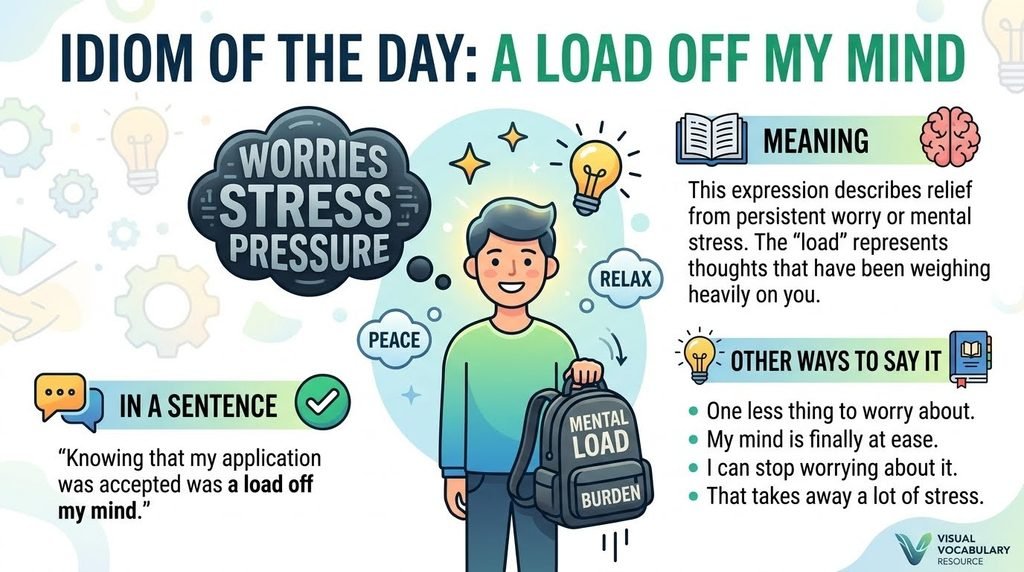
A Load Off My Mind
Meaning
This expression describes relief from persistent worry or mental stress. The “load” represents thoughts that have been weighing heavily on you.
In a Sentence
“Knowing that my application was accepted was a load off my mind.”
Other Ways to Say It
- One less thing to worry about.
- My mind is finally at ease.
- I can stop worrying about it.
- That takes away a lot of stress.
Explanation
Unlike “a weight off my shoulders,” this expression focuses more directly on mental worry. It is useful when an answer, decision, or piece of information finally removes uncertainty.
Best Use
Works particularly well in casual conversation, emails, personal messages, and reflective writing.
Take a Load Off
Meaning
“To take a load off” means to relax or sit down after physical or mental effort. It can suggest relief from tiredness, pressure, or a demanding situation.
In a Sentence
“You’ve been working all morning, so take a load off and have some tea.”
Other Ways to Say It
- Take a break.
- Relax for a while.
- Put your feet up.
- Rest for a bit.
Explanation
The expression treats tiredness as a heavy load that can be temporarily put down. It is usually informal and friendly, making it different from expressions that describe relief after danger.
Best Use
Best in casual conversations, friendly messages, and informal storytelling.
Out of the Woods
Meaning
Being out of the woods means being free from a difficult, dangerous, or uncertain situation.
In a Sentence
“The fever has finally gone down, but we’re not completely out of the woods yet.”
Other Ways to Say It
- Past the worst.
- Free from danger.
- Through the difficult part.
- On safer ground.
Explanation
The image comes from someone finding their way through a dark or difficult forest and reaching safety. Importantly, the idiom can also suggest that some risk remains, especially when used with “not yet.”
Best Use
Useful in conversation, journalism, storytelling, and serious discussions about difficult situations.
In the Clear
Meaning
To be in the clear means to be free from danger, suspicion, trouble, or a particular problem.
In a Sentence
“Once the doctor confirmed that the results were normal, I knew I was in the clear.”
Other Ways to Say It
- Free from trouble.
- Safe now.
- No longer at risk.
- Off the danger list.
Explanation
The phrase suggests moving from a risky or uncertain area into a safe, open space. It often brings a strong sense of reassurance and finality, although the exact meaning depends on context.
Best Use
A good choice for everyday speech, professional conversations, storytelling, and practical situations.
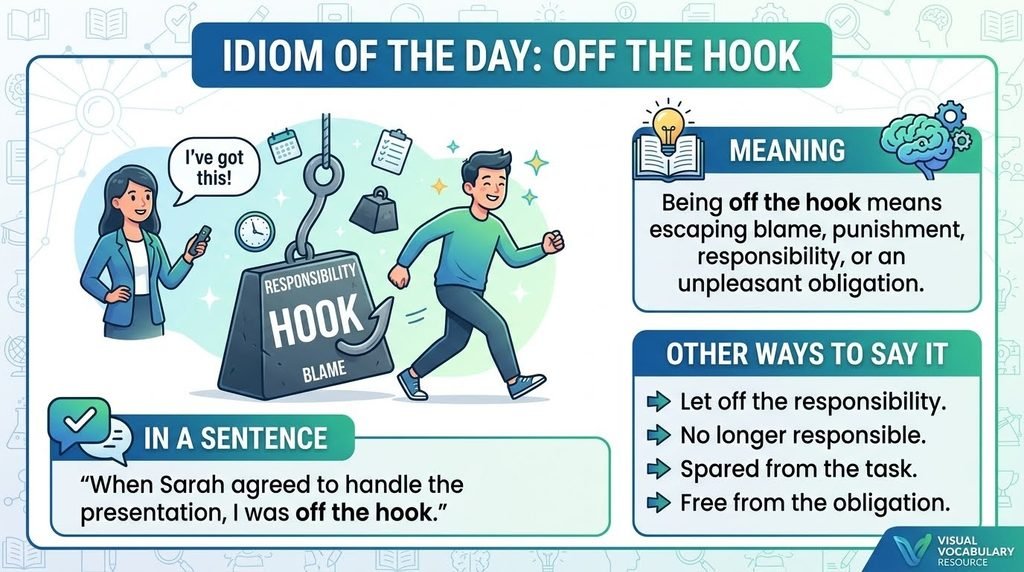
Off the Hook
Meaning
Being off the hook means escaping blame, punishment, responsibility, or an unpleasant obligation.
In a Sentence
“When Sarah agreed to handle the presentation, I was off the hook.”
Other Ways to Say It
- Let off the responsibility.
- No longer responsible.
- Spared from the task.
- Free from the obligation.
Explanation
The expression is often associated with escaping something that could have caused trouble. Its relief is usually practical rather than deeply emotional. It can also sound playful in casual conversation.
Best Use
Best for informal conversations, workplace chats, messages, and humorous situations.
Out of Hot Water
Meaning
To be out of hot water means to have escaped a difficult, embarrassing, or troublesome situation.
In a Sentence
“Once I explained the mistake to my manager, I was finally out of hot water.”
Other Ways to Say It
- Out of trouble.
- In the safe zone.
- The problem has passed.
- No longer in difficulty.
Explanation
The phrase creates a humorous image of escaping from something uncomfortably hot. It works particularly well when someone has avoided consequences or solved a problem.
Best Use
Best suited to casual conversation, humorous writing, storytelling, and friendly messages.
See the Light at the End of the Tunnel
Meaning
This idiom means to begin seeing hope after a long or difficult period.
In a Sentence
“After months of training, I can finally see the light at the end of the tunnel.”
Other Ways to Say It
- Things are finally looking up.
- Hope is in sight.
- The hardest part is nearly over.
- Better days are ahead.
Explanation
The tunnel represents a long period of hardship, while the light represents hope, progress, and approaching relief. It is especially powerful when the difficult situation has lasted for a long time.
Best Use
Excellent for speeches, motivational writing, personal reflections, and conversations about long-term challenges.
Dodged a Bullet
Meaning
To dodge a bullet means to narrowly avoid a serious problem, danger, mistake, or bad outcome.
In a Sentence
“I almost signed that contract without reading it—I really dodged a bullet.”
Other Ways to Say It
- Narrowly avoided trouble.
- Had a lucky escape.
- Avoided a disaster.
- Got out just in time.
Explanation
The image is dramatic: a person moves out of the path of a bullet at the last moment. Because of that image, the expression conveys strong relief mixed with luck. It is informal and often dramatic.
Best Use
Works best in casual conversations, storytelling, social media, and informal writing.
A Close Shave
Meaning
A close shave is a situation in which someone narrowly avoids danger, failure, injury, or another unpleasant outcome.
In a Sentence
“Missing that speeding car by a few seconds was a close shave.”
Other Ways to Say It
- A narrow escape.
- A near miss.
- A lucky escape.
- A very near disaster.
Explanation
The phrase suggests that the danger came extremely close but was avoided. It naturally combines tension before the outcome with relief afterward.
Best Use
Especially effective in storytelling, conversation, adventure writing, and accounts of near misses.
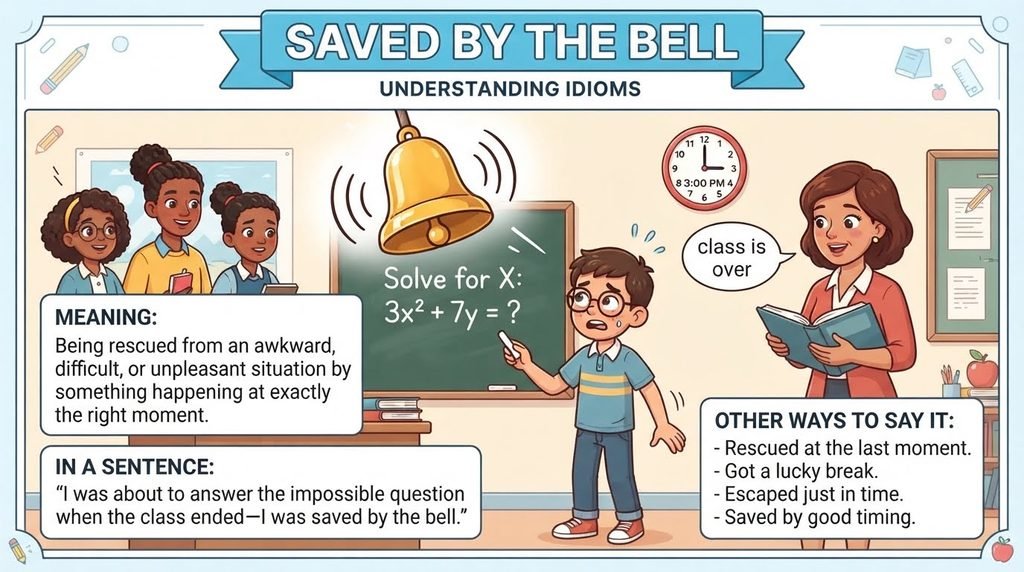
Saved by the Bell
Meaning
Saved by the bell means being rescued from an awkward, difficult, or unpleasant situation by something happening at exactly the right moment.
In a Sentence
“I was about to answer the impossible question when the class ended—I was saved by the bell.”
Other Ways to Say It
- Rescued at the last moment.
- Got a lucky break.
- Escaped just in time.
- Saved by good timing.
Explanation
The expression creates a vivid picture of an external event suddenly ending an uncomfortable situation. It is often playful or humorous, rather than appropriate for serious danger.
Best Use
Best for casual conversation, school stories, humorous writing, and lighthearted situations.
Home Free
Meaning
To be home free means to have reached a point where success or safety seems assured and there are no major obstacles left.
In a Sentence
“Once we passed the final inspection, we were home free.”
Other Ways to Say It
- Almost there.
- Safe from here.
- The hardest part is over.
- Nearly finished.
Explanation
The phrase draws on the comforting image of being close enough to home that the journey is essentially won. It combines relief, confidence, and a sense of completion.
Best Use
Natural in conversation, sports discussions, storytelling, and informal writing.
Breathing Room
Meaning
Breathing room means extra time, space, freedom, or flexibility that allows someone to relax or handle a situation without immediate pressure.
In a Sentence
“The deadline was extended by a week, giving the team some much-needed breathing room.”
Other Ways to Say It
- More time to think.
- Some extra space.
- A little flexibility.
- A chance to relax.
Explanation
The expression compares pressure with the physical difficulty of breathing in a cramped space. Once there is room to breathe, stress becomes easier to manage.
Best Use
Useful in workplace communication, planning, essays, conversations, and practical discussions.
Weather the Storm
Meaning
To weather the storm means to survive a difficult period and remain strong until conditions improve.
In a Sentence
“Small businesses had to weather the storm until customers began returning.”
Other Ways to Say It
- Get through the crisis.
- Survive the difficult period.
- Ride out the trouble.
- Hold on through the hardship.
Explanation
The storm represents a period of trouble, while surviving it suggests eventual stability. The expression emphasizes endurance before relief, rather than relief arriving immediately.
Best Use
Particularly suitable for speeches, articles, business writing, storytelling, and serious conversations.
Back on Track
Meaning
Being back on track means returning to a normal, successful, or planned course after experiencing a problem or setback.
In a Sentence
“After fixing the technical issue, the project is back on track.”
Other Ways to Say It
- Back to normal.
- Moving forward again.
- Making progress again.
- Returning to the plan.
Explanation
The image comes from a train or journey returning to its intended route. It communicates relief through restored progress, making it useful when something has gone wrong but is now being corrected.
Best Use
Excellent for workplace communication, academic writing, planning, conversations, and personal goals.
A Breath of Fresh Air
Meaning
A breath of fresh air describes someone or something that brings new energy, relief, freshness, or a welcome change.
In a Sentence
“After weeks of stressful meetings, the quiet weekend was a breath of fresh air.”
Other Ways to Say It
- A welcome change.
- Refreshing and uplifting.
- A pleasant break.
- Something wonderfully different.
Explanation
Fresh air suggests openness and renewed energy after being somewhere stuffy or uncomfortable. The expression can describe emotional relief, but it often carries a positive feeling of renewal as well.
Best Use
Works well in reviews, personal writing, conversations, social media, and creative descriptions.
Let Your Guard Down
Meaning
To let your guard down means to stop being so cautious, defensive, or tense because you feel safer or more comfortable.
In a Sentence
“Once I realized everyone was friendly, I could finally let my guard down.”
Other Ways to Say It
- Relax your defenses.
- Feel safe enough to relax.
- Stop being so cautious.
- Open up.
Explanation
The expression treats emotional defenses as a physical guard protecting someone. Lowering that guard suggests trust, safety, and emotional release. It is especially meaningful when relief involves feeling secure around other people.
Best Use
Best for personal writing, relationships, storytelling, conversations, and reflective essays.
See Daylight
Meaning
To see daylight means to begin recognizing hope, progress, or a way out after being stuck in a difficult situation.
In a Sentence
“After weeks of negotiations, we are finally seeing daylight.”
Other Ways to Say It
- See a way forward.
- Find hope.
- Make progress.
- Begin to see an escape.
Explanation
Daylight symbolizes possibility and freedom after darkness. The expression is especially useful when relief is connected to finally understanding how a problem can be solved.
Best Use
Most effective in storytelling, reflective writing, speeches, and conversations about challenging situations.
Get Something Off Your Chest
Meaning
To get something off your chest means to talk about something that has been worrying, troubling, or emotionally burdening you.
In a Sentence
“I need to get something off my chest before we move on.”
Other Ways to Say It
- Talk about what’s bothering you.
- Say what you’ve been holding inside.
- Unburden yourself.
- Speak honestly about the problem.
Explanation
The chest represents the place where emotional pressure seems to build. Speaking honestly releases that pressure, creating a feeling of emotional relief and freedom.
Best Use
Ideal for personal conversations, emotional storytelling, relationship discussions, and informal writing.
Exercise: Practice Using Idioms
Choose the best answer for each question.
What does “a weight off my shoulders” usually communicate?
A. Physical exhaustion
B. Emotional or mental relief
C. A difficult journey
D. A heavy object
Which idiom suggests that a person has escaped danger or difficulty?
A. A breath of fresh air
B. Take a load off
C. Out of the woods
D. Back on track
If someone says, “I breathed a sigh of relief,” what probably happened?
A. They became more worried.
B. They started a new task.
C. They became physically stronger.
D. Something worrying ended successfully.
Which expression is most closely connected with escaping blame or responsibility?
A. Off the hook
B. See daylight
C. Weather the storm
D. A close shave
What does “see the light at the end of the tunnel” suggest?
A. A person is literally underground.
B. A person has given up.
C. A difficult period is beginning to show signs of improvement.
D. A person is looking for a new home.
Which idiom describes narrowly avoiding a serious problem?
A. Breathing room
B. Dodged a bullet
C. Back on track
D. A breath of fresh air
If someone is “out of hot water,” what does the expression mean?
A. They are taking a bath.
B. They are feeling cold.
C. They are preparing dinner.
D. They have escaped a troublesome situation.
Which expression is especially appropriate when an unpleasant task is no longer your responsibility?
A. Off the hook
B. See daylight
C. Weather the storm
D. Let your guard down
What does “breathing room” usually provide?
A. Increased pressure
B. Greater danger
C. Extra time, room, or flexibility
D. Reduced independence
Which idiom suggests that success or safety is almost assured?
A. A close shave
B. Home free
C. Out of hot water
D. Get something off your chest
Which expression emphasizes surviving a difficult period?
A. Take a load off
B. A breath of fresh air
C. Weather the storm
D. Saved by the bell
Someone says, “I was saved by the bell.” What does this most likely mean?
A. A bell caused a problem.
B. Someone was rescued from an awkward situation at the right moment.
C. Someone bought a new bell.
D. Someone arrived home safely.
Which idiom focuses on emotional relief through honest conversation?
A. Get something off your chest
B. Home free
C. In the clear
D. Back on track
Which statement uses an idiom figuratively rather than literally?
A. The hikers walked through the woods.
B. She opened the window for fresh air.
C. We are finally back on track with the project.
D. He sat down after the long walk.
Which expression best fits someone who has stopped feeling defensive because they now feel safe?
A. Dodge a bullet
B. Let your guard down
C. See daylight
D. Take a load off
Answers
B — “A weight off my shoulders” describes relief from emotional pressure or responsibility.
C — “Out of the woods” means that a person has moved beyond a difficult or dangerous situation.
D — A sigh of relief usually follows the resolution of something worrying.
A — “Off the hook” means escaping responsibility, blame, or an unpleasant obligation.
C — The tunnel represents hardship, while the light represents approaching hope or improvement.
B — “Dodged a bullet” describes narrowly avoiding a serious problem or bad outcome.
D — Being “out of hot water” means being out of trouble.
A — “Off the hook” is commonly used when someone no longer has to deal with a responsibility or consequence.
C — “Breathing room” means extra time, space, or flexibility that reduces pressure.
B — “Home free” suggests that the remaining obstacles are minor and success or safety is close.
C — “Weather the storm” emphasizes enduring and surviving a difficult period.
B — “Saved by the bell” describes being rescued from an awkward or difficult situation at exactly the right time.
A — “Get something off your chest” means talking about a concern to relieve emotional pressure.
C — “Back on track” is figurative when it describes a project returning to its intended progress.
B — “Let your guard down” means becoming less defensive or cautious because you feel safe or comfortable.
FAQs
What is an idiom for relief?
An idiom for relief is a figurative expression that communicates release from worry, pressure, danger, responsibility, or difficulty. Examples include “a weight off my shoulders,” “breathe a sigh of relief,” and “out of the woods.”
How do I create my own idiom?
Start with a strong physical image that represents the feeling you want to communicate. Think about what relief feels like physically or emotionally—putting down a heavy object, escaping danger, finding an open path, or finally breathing freely. However, newly invented expressions may not function as established idioms unless other speakers adopt them.
What makes an idiom effective?
An effective idiom creates a clear mental picture while communicating an idea naturally. Strong expressions are easy to understand from context, emotionally appropriate, and distinct enough to add something beyond a plain statement.
Can I use these idioms in everyday conversation?
Yes. Many of these expressions, such as “a load off my mind,” “off the hook,” “in the clear,” and “back on track,” are natural in everyday English. More dramatic expressions, such as “dodged a bullet,” are better suited to informal contexts.
What is the difference between an idiom and a simile?
An idiom is an established expression with a figurative meaning, such as “out of the woods.” A simile directly compares two things using words such as “like” or “as.” For example, “The relief felt like a cool breeze after a hot day” is a simile rather than a traditional idiom.
Conclusion
The feeling of relief can take many forms: escaping danger, releasing emotional pressure, finding hope, solving a problem, or simply realizing that the worst is over. The right idiom lets you communicate these differences with more color and precision than a simple statement such as “I feel better.” Expressions like “a weight off my shoulders,” “in the clear,” “out of the woods,” and “get something off your chest” give readers and listeners an image they can immediately understand.
When choosing an idiom, think about the exact kind of relief you want to express. Is it emotional, practical, humorous, dramatic, or hopeful? The strongest expression is not necessarily the most colorful one it is the one that matches the feeling and context naturally. Sometimes relief is simply the moment when you realize you can finally breathe again.

Oliver Whitcombe is a British writer and language enthusiast who has been fascinated by English expressions since childhood, when his grandmother told him he was “born with a silver spoon” and he spent a week trying to find it.
He created Idiom Looms to help learners and native speakers alike make sense of English idioms. Their origins, their meanings, and the moments they’re best used. His writing mixes plain explanations with a good dose of British wit.
Oliver lives in England, where he divides his time between writing, walking, and correcting everyone’s grammar (politely).



[…] Read more:20 Idioms for Relief With Real Examples […]