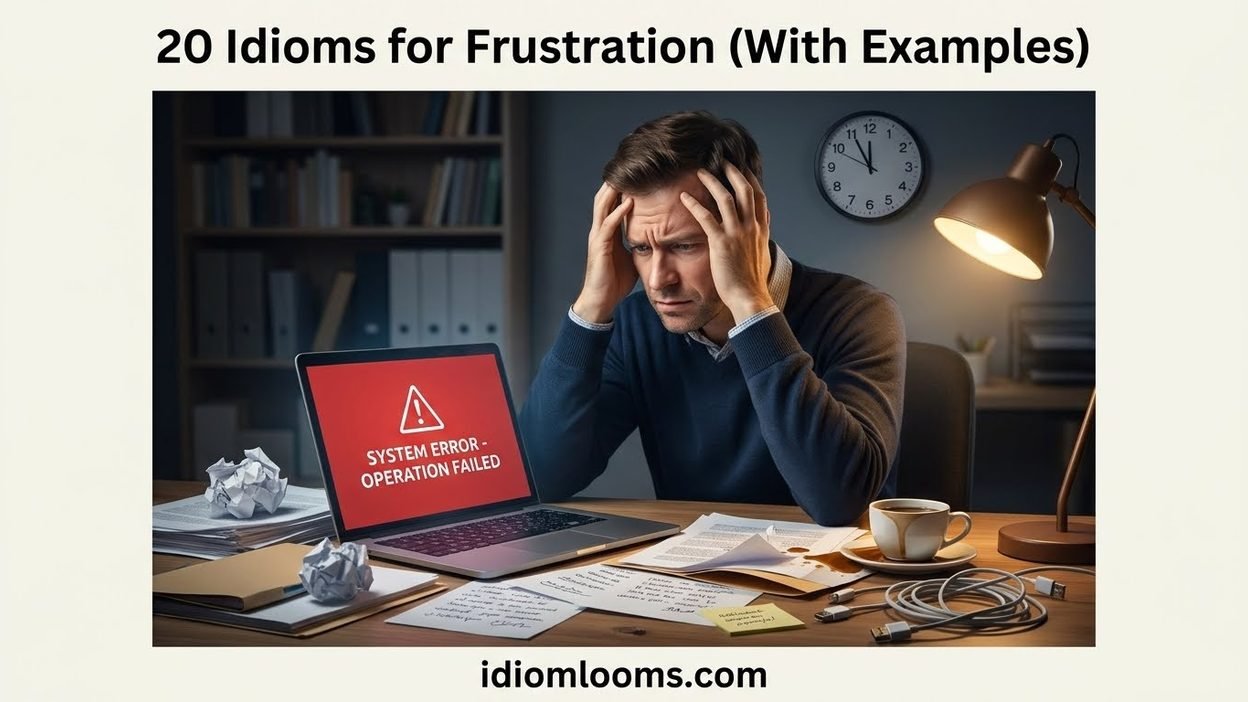
Have you ever felt frustrated when plans change, tasks pile up, or communication breaks down? This guide to 20 Idioms for Frustration With Real Examples helps you express those feelings naturally and clearly. Idioms can make everyday English usage more vivid while adding personality to conversations, messages, and writing. They are especially useful when simple words do not fully capture irritation, disappointment, impatience, or stress.
You’ll discover practical expressions for situations involving scheduling, time management, meetings, and project management. Some idioms also fit business communication, online booking, broadcasting, and calendar-related situations where unexpected problems can test your patience. Each expression includes a clear meaning, a realistic example, alternative phrases, and helpful context.
Understanding these expressions can strengthen your grammar, formal writing, and conversational confidence. You’ll also learn when each idiom sounds natural and which situations suit it best. Whether you are writing an email, discussing a delayed calendar plan, or describing an annoying experience, these examples make figurative language easier to understand and use with consistency.
What Is an Idiom?
An idiom is a fixed expression whose overall meaning is different from the literal meaning of the individual words.
For example, if someone says, “It’s raining cats and dogs,” they do not mean animals are falling from the sky. They mean it is raining very heavily.
Another example is “break the ice.” Literally, it sounds as though someone is breaking frozen water. Figuratively, it means to make people feel more comfortable in a social situation.
Idioms are a form of figurative language. They create mental pictures or associations that communicate an idea more vividly than a direct statement. That is why idioms are especially useful when describing emotions such as frustration, impatience, anger, or exhaustion.
Why Use Idioms for Frustration?
Frustration can range from mild annoyance to complete emotional exhaustion. A simple word such as “annoyed” does not always capture those differences.
Idioms give you more expressive choices. For example, saying someone is “fed up” suggests they have had enough of something, while saying they are “at their wit’s end” suggests they cannot see what to do next.
These expressions can help you:
- Express emotions without repeatedly using the word “frustrated.”
- Make descriptions more vivid and memorable.
- Explain difficult or abstract feelings through familiar images.
- Add personality to conversations and personal messages.
- Make creative writing and storytelling more expressive.
- Show the difference between annoyance, impatience, anger, and emotional exhaustion.
- Communicate a complicated feeling in just a few words.
The best idiom depends on the situation. Some sound natural in everyday conversation, while others are more dramatic or particularly effective in storytelling.
Quick List of 20 Idioms
- At your wit’s end
- Fed up
- Drive someone up the wall
- Get under someone’s skin
- Pull your hair out
- At the end of your rope
- Lose your patience
- Be on your last nerve
- Have had it up to here
- Bang your head against a wall
- Reach your boiling point
- Hit the roof
- See red
- Blow a fuse
- The last straw
- At breaking point
- Go round the bend
- Throw in the towel
- Go bananas
- Tear your hair out
At Your Wit’s End
Read more:20 Idioms for Running With Real Examples
Meaning
Being at your wit’s end means you are so frustrated or troubled that you cannot think of a good solution anymore. You have tried different approaches and feel mentally exhausted.
In a Sentence
After three hours of trying to fix the printer, I was at my wit’s end.
Other Ways to Say It
- Feel completely stuck
- Not know what else to do
- Be desperate for a solution
- Feel mentally exhausted
Explanation
This idiom emphasizes helplessness and mental exhaustion rather than simple annoyance. The expression suggests that your ability to think of another answer has been pushed to its limit.
It works particularly well when repeated problems leave someone feeling overwhelmed and unable to decide what to try next.
Best Use
This expression fits everyday conversations, storytelling, personal writing, and essays. It can sound serious, but it is common enough for ordinary speech.
Fed Up
Meaning
To be fed up means to be extremely tired, annoyed, or frustrated by something that has continued for too long. It often carries the feeling of “I have had enough.”
In a Sentence
I’m fed up with waiting for the repair to be finished.
Other Ways to Say It
- Have had enough
- Be tired of something
- Be sick of something
- Be thoroughly annoyed
Explanation
“Fed up” is short and direct, making it one of the most natural ways to express strong frustration. It often suggests that the irritating situation has been happening repeatedly.
Unlike some dramatic idioms, it does not create a complicated mental image. Its strength comes from its emotional directness.
Best Use
Use it in casual conversations, personal messages, dialogue, and informal writing. It is less suitable for highly formal professional communication.
Drive Someone Up the Wall
Meaning
If something drives you up the wall, it makes you extremely annoyed or frustrated.
The “wall” is figurative: the expression creates the image of irritation becoming so intense that you feel pushed to an extreme.
In a Sentence
The constant noise from the construction site is driving me up the wall.
Other Ways to Say It
- Make someone extremely annoyed
- Drive someone crazy
- Make someone lose patience
- Irritate someone badly
Explanation
This idiom gives frustration a strong physical image. Instead of simply saying “the noise annoys me,” it suggests that the irritation is pushing me toward my limit.
It is especially effective when describing a repeated habit, noise, delay, or problem that keeps bothering someone.
Best Use
It works naturally in conversation, informal writing, dialogue, and humorous storytelling. Because it is expressive, it can also add personality to social media posts.
Get Under Someone’s Skin
Meaning
When something gets under your skin, it bothers or irritates you deeply, often in a way that stays on your mind.
In a Sentence
His habit of interrupting everyone really gets under my skin.
Other Ways to Say It
- Irritate someone deeply
- Really bother someone
- Rub someone the wrong way
- Get on someone’s nerves
Explanation
The expression creates the unpleasant image of something getting beneath your skin and continuing to bother you. It often describes personal irritation that lingers rather than a momentary annoyance.
It can also suggest that a particular person, behavior, or situation bothers you for reasons that are difficult to ignore.
Best Use
This is useful in everyday conversations, character descriptions, dialogue, and informal writing. It has a conversational tone.

Pull Your Hair Out
Meaning
To pull your hair out means to feel extremely frustrated, worried, or stressed because you cannot solve or control a problem.
Of course, the expression is usually figurative. It creates an exaggerated picture of someone being so frustrated that they want to physically pull their hair.
In a Sentence
I’ve been pulling my hair out trying to understand why the software keeps crashing.
Other Ways to Say It
- Feel extremely frustrated
- Struggle desperately with a problem
- Be tearing your hair out
- Feel overwhelmed
Explanation
This idiom uses a memorable physical image to communicate intense frustration. It is stronger than simply saying something is annoying.
It is particularly effective when someone has spent considerable time trying to solve a problem without success.
Best Use
Use it in conversation, informal writing, storytelling, and humorous descriptions. It can be too casual for some formal documents.
At the End of Your Rope
Meaning
Being at the end of your rope means you have reached the limit of your patience, energy, or ability to deal with a difficult situation.
In a Sentence
After weeks of dealing with the same unresolved issue, the manager was at the end of his rope.
Other Ways to Say It
- Reach your limit
- Have no patience left
- Feel unable to continue
- Be completely exhausted
Explanation
The idiom creates an image of someone holding onto a rope and reaching its very end. Figuratively, there is almost nowhere else to go.
It can describe frustration mixed with exhaustion, especially when a difficult problem has continued for a long time.
Best Use
It works well in storytelling, conversations, personal writing, and emotional descriptions. It can sound more dramatic than “fed up.”
Lose Your Patience
Meaning
To lose your patience means to stop being able to remain calm when something irritating, slow, or difficult continues.
In a Sentence
I tried to stay calm, but I lost my patience after the fourth unanswered phone call.
Other Ways to Say It
- Become impatient
- Stop being patient
- Reach your limit
- Become irritated
Explanation
Unlike more colorful idioms, this expression is relatively straightforward. Its strength is its clarity: it shows the moment when patience runs out.
It is useful when frustration develops gradually and eventually changes someone’s behavior or tone.
Best Use
This expression fits everyday conversation, professional communication, essays, and storytelling. It is one of the safer choices when you want figurative language without sounding overly dramatic.
Be on Your Last Nerve
Meaning
If someone or something is on your last nerve, it is irritating you so much that you have almost no patience left.
In a Sentence
The repeated delays are really getting on my last nerve.
Other Ways to Say It
- Be extremely irritating
- Test someone’s patience
- Push someone to the limit
- Be driving someone crazy
Explanation
The expression suggests that a person has several layers of patience, and only the final bit remains. It therefore communicates stronger irritation than simply saying “I’m annoyed.”
It is particularly useful for describing repeated behavior that keeps wearing someone down.
Best Use
This is best for casual conversation, dialogue, humorous writing, and personal messages. It has a distinctly informal feel.
Have Had It Up to Here
Meaning
To have had it up to here means you have become so frustrated or annoyed that you cannot tolerate any more.
The phrase often accompanies a gesture with the hand held at a certain height, symbolically showing that the frustration has reached a limit.
In a Sentence
I’ve had it up to here with these constant last-minute changes.
Other Ways to Say It
- I’ve had enough
- I can’t take any more
- I’ve reached my limit
- I’m completely fed up
Explanation
This expression makes frustration feel like something that has physically risen to a maximum level. It is especially effective when someone wants to make their limit unmistakably clear.
The tone is usually emotional and informal, and it can sound dramatic without necessarily suggesting serious anger.
Best Use
Use it in conversation, dialogue, personal messages, and expressive social media writing. It is less appropriate for formal business writing.
Bang Your Head Against a Wall
Meaning
To bang your head against a wall means to keep trying to solve a difficult or frustrating problem without making progress.
The phrase is figurative and intentionally exaggerated.
In a Sentence
Trying to explain the same simple point for the fifth time felt like banging my head against a wall.
Other Ways to Say It
- Struggle without making progress
- Keep trying the same thing unsuccessfully
- Feel completely stuck
- Fight a losing battle
Explanation
Few expressions communicate fruitless effort as vividly as this one. The imagined action is painful and repetitive, which reflects the feeling of repeatedly encountering the same obstacle.
It works especially well when frustration comes from lack of progress, rather than simply from someone’s unpleasant behavior.
Best Use
It is effective in conversation, storytelling, essays, and informal explanations. It can add dramatic emphasis to a frustrating situation.
Reach Your Boiling Point
Meaning
To reach your boiling point means to become so frustrated or angry that your emotions are close to overflowing.
In a Sentence
After another complaint was ignored, the staff had reached their boiling point.
Other Ways to Say It
- Reach your limit
- Become extremely frustrated
- Be close to losing control
- Reach a point of intense anger
Explanation
This expression compares rising emotion with water becoming hotter and eventually boiling. It suggests that frustration builds gradually rather than appearing all at once.
Because of that image, it is useful when describing pressure that has been accumulating over time.
Best Use
It works well in storytelling, essays, speeches, news-style writing, and serious conversations. It is more dramatic than simply saying “become annoyed.”
Hit the Roof
Meaning
To hit the roof means to become extremely angry or upset.
Although anger is usually stronger than ordinary frustration, the expression can describe frustration when a situation suddenly pushes someone beyond their tolerance.
In a Sentence
Dad hit the roof when he discovered that the car had been returned with a new scratch.
Other Ways to Say It
- Become furious
- Lose your temper
- Get extremely angry
- Blow up
Explanation
The phrase creates a striking image of emotion rising so sharply that it seems to burst through the roof. It is therefore much stronger than mild expressions such as “get annoyed.”
Use it carefully when the emotional reaction is genuinely intense.
Best Use
This idiom is particularly effective in storytelling, dialogue, informal conversation, and dramatic writing. It may sound too emotional for a calm professional setting.
See Red
Meaning
To see red means to become extremely angry.
The expression is associated with the idea that intense anger can affect how someone experiences the world.
In a Sentence
I saw red when I realized someone had deliberately deleted the project files.
Other Ways to Say It
- Become furious
- Lose your temper
- Become enraged
- Get extremely angry
Explanation
This idiom uses color imagery to represent intense emotion. It is stronger than ordinary frustration and usually suggests that anger has taken over.
For that reason, it is best reserved for situations where irritation has developed into genuine anger.
Best Use
Use it in creative writing, storytelling, dialogue, and informal conversation. It can make an emotional scene more vivid.
Blow a Fuse
Meaning
To blow a fuse means to suddenly become very angry or lose your temper.
The idiom compares a person’s emotional reaction to an electrical fuse that stops functioning when too much energy passes through it.
In a Sentence
My supervisor blew a fuse when the same mistake appeared in the report again.
Other Ways to Say It
- Lose your temper
- Explode with anger
- Blow up
- Become furious
Explanation
The electrical image suggests that too much pressure has built up and something suddenly gives way. It works particularly well when frustration has been accumulating before a sudden angry reaction.
The expression is informal and can sometimes sound slightly humorous because of its exaggerated comparison.
Best Use
It fits conversation, dialogue, informal writing, and storytelling. Avoid it when a very neutral or formal tone is required.
The Last Straw
Meaning
The last straw is the final problem or annoyance that makes someone unable or unwilling to tolerate a situation any longer.
It usually appears in the expression “the last straw.”
In a Sentence
The missed deadline was the last straw; after that, the client decided to cancel the project.
Other Ways to Say It
- The final problem
- The final irritation
- The breaking point
- The thing that finally ended it
Explanation
The idiom comes from the image of adding one final straw to a load until it becomes too heavy to carry. The important idea is that the final event may seem small on its own, but it becomes decisive because of everything that happened before it.
This makes it especially useful for explaining why someone suddenly stops tolerating a situation.
Best Use
Use it in essays, storytelling, conversations, workplace discussions, and personal writing. It is flexible and widely understandable.
At Breaking Point
Meaning
Being at breaking point means being under so much emotional pressure, stress, or frustration that you feel you can no longer cope.
In a Sentence
After months of working without a proper break, he felt he was at breaking point.
Other Ways to Say It
- At the limit
- Unable to cope
- Under extreme pressure
- Close to giving up
Explanation
The expression compares a person or situation to something that may break under excessive pressure. It emphasizes accumulated strain rather than a single irritating event.
It can describe frustration, stress, exhaustion, or emotional pressure, so the surrounding context determines the exact meaning.
Best Use
This expression is suitable for serious writing, personal reflections, essays, journalism-style prose, and conversations. It has a more serious tone than “fed up.”
Go Round the Bend
Meaning
To go round the bend means to become extremely annoyed, stressed, or mentally overwhelmed by a situation.
In a Sentence
The endless paperwork is driving me round the bend.
Other Ways to Say It
- Drive someone crazy
- Make someone extremely frustrated
- Make someone lose patience
- Become unbearable
Explanation
This idiom is often used humorously to exaggerate the effect of an irritating situation. It creates the sense that frustration has become so intense that normal calm is disappearing.
The expression is especially useful when the speaker wants to sound dramatic but not necessarily furious.
Best Use
It works best in informal British English, conversation, humorous writing, and dialogue. Readers unfamiliar with the expression may understand it from context, but it is less universal than “fed up.”
Throw in the Towel
Meaning
To throw in the towel means to give up or stop trying, usually because continued effort feels pointless or too difficult.
In a Sentence
After months of unsuccessful negotiations, the team finally threw in the towel.
Other Ways to Say It
- Give up
- Stop trying
- Abandon the effort
- Admit defeat
Explanation
The phrase comes from boxing, where throwing a towel into the ring traditionally signals that a fighter should stop. As an idiom, it describes the moment when frustration or difficulty leads someone to quit.
It is therefore different from “fed up”: being fed up means you are tired or annoyed, while throwing in the towel means you actually stop pursuing the goal.
Best Use
This expression works well in conversation, sports writing, business discussions, essays, and motivational contexts. It is useful when frustration results in giving up.
Go Bananas
Meaning
To go bananas can mean to become extremely excited, wild, or out of control. In some contexts, it can also describe someone becoming extremely angry or frustrated.
In a Sentence
When the website crashed just before the deadline, everyone went bananas.
Other Ways to Say It
- Go crazy
- Become frantic
- Lose control
- Become extremely upset
Explanation
The expression has a playful, exaggerated quality. When used for frustration, it suggests that a situation has become chaotic or emotionally overwhelming rather than simply mildly annoying.
Because it is informal and somewhat humorous, it can soften the seriousness of a frustrating situation.
Best Use
It works particularly well in casual conversation, humorous storytelling, dialogue, and social media writing. It is not a strong choice for formal essays or professional reports.
Tear Your Hair Out
Meaning
To tear your hair out means to become extremely frustrated, worried, or stressed while trying to deal with a difficult problem.
In a Sentence
The students were tearing their hair out over the complicated final assignment.
Other Ways to Say It
- Be extremely frustrated
- Struggle with a problem
- Feel overwhelmed
- Be at your wit’s end
Explanation
Like “pull your hair out,” this expression uses an exaggerated physical image to show intense emotional pressure. The image suggests that the problem has become almost unbearable.
Although it overlaps with “pull your hair out,” the expression can be especially useful when emphasizing the stress caused by a complicated task or difficult situation.
Best Use
Use it in informal conversation, storytelling, dialogue, and humorous descriptions. It is expressive rather than formal.
Exercise: Practice Using Idioms
Test your understanding of these idioms for frustration. Choose the best answer for each question.
What does “at your wit’s end” mean?
A. Feeling extremely happy
B. Having no idea what to do next
C. Finishing a difficult task
D. Becoming physically tired
Which idiom means that you have had enough of an irritating situation?
A. See red
B. Go round the bend
C. Throw in the towel
D. Fed up
If a noisy neighbor is “driving you up the wall,” what does that mean?
A. Your neighbor is causing you serious frustration
B. The neighbor is assisting you with moving
C. Someone next door is fixing your wall
D. A visitor is stopping by your house
Which expression describes frustration that comes from repeatedly trying without making progress?
A. See red
B. Hit the roof
C. Bang your head against a wall
D. Go bananas
What does “lose your patience” mean?
A. Forget someone’s name
B. Stop being able to remain patient
C. Become more understanding
D. Decide to wait longer
Which idiom suggests that frustration or stress has reached an extreme level?
A. Reach your boiling point
B. Get under someone’s skin
C. Throw in the towel
D. Have had it up to here
If something “gets under your skin,” how does it affect you?
A. It causes physical discomfort
B. Drowsiness comes over you
C. Something gets on your nerves
D. Pride fills you with happiness
Which expression means that a person has almost no patience left?
A. Be on your last nerve
B. Go bananas
C. See red
D. Throw in the towel
What does “the last straw” refer to?
A. A helpful solution
B. The first problem in a situation
C. A small inconvenience that is easily ignored
D. The final problem that makes someone stop tolerating a situation
Which idiom means to become extremely angry?
A. At the end of your rope
B. Hit the roof
C. At your wit’s end
D. Fed up
If someone is “at breaking point,” what is most likely true?
A. They are facing overwhelming stress
B. A difficult problem has just been solved by them
C. They feel calm and at ease
D. A fresh project is getting underway
What does “throw in the towel” mean?
A. Start again
B. Ask for help
C. Give up
D. Become angry
Which expression is most strongly associated with intense anger rather than ordinary frustration?
A. See red
B. Lose your patience
C. Fed up
D. Get under your skin
A person says, “I’ve had it up to here with these delays.” What are they communicating?
A. Waiting does not bother them
B. They can no longer tolerate the situation
C. More delays are exactly what they want
D. Confusion has left them uncertain about what happened
Which idiom is especially appropriate when someone keeps trying to solve a difficult problem but gets nowhere?
A. Go bananas
B. Hit the roof
C. Bang your head against a wall
D. See red
Answers
B — “At your wit’s end” means you feel unable to think of another solution or course of action.
D — “Fed up” means extremely tired, annoyed, or frustrated with something.
A — “Drive someone up the wall” means to make someone extremely irritated or frustrated.
C — “Bang your head against a wall” describes repeated effort that produces little or no progress.
B — To “lose your patience” means you can no longer remain patient with a situation.
A — “Reach your boiling point” describes emotions that have built up to an intense level.
C — Something that “gets under your skin” deeply irritates or bothers you.
A — Being “on your last nerve” means having almost no patience left.
D — “The last straw” is the final problem or irritation that makes someone reach their limit.
B — “Hit the roof” means to become extremely angry.
A — Being “at breaking point” means being under such great pressure that you feel close to being unable to cope.
C — “Throw in the towel” means to give up or stop trying.
A — “See red” is strongly associated with intense anger.
B — “Have had it up to here” means you have reached your limit and cannot tolerate any more.
C — “Bang your head against a wall” is especially appropriate for frustrating efforts that repeatedly fail to produce progress.
FAQs
What is an idiom for frustration?
An idiom for frustration is a figurative expression that communicates annoyance, impatience, emotional pressure, or feeling unable to cope. Examples include “fed up,” “at your wit’s end,” and “drive someone up the wall.”
How do I create my own idiom?
A good original figurative expression usually connects an emotion with a clear, memorable image. Think about what frustration feels like physically or emotionally, then build a comparison around that experience. However, when writing formal English, established idioms are usually safer because readers already understand them.
What makes an idiom effective?
An effective idiom communicates an idea quickly while creating a strong mental picture. It should fit the context naturally and add something that a plain statement does not. The best choice also matches the intensity of the emotion.
Can I use these idioms in everyday conversation?
Yes. Expressions such as “fed up,” “lose your patience,” “get under my skin,” and “drive me up the wall” are natural in informal conversation. Stronger expressions such as “see red” and “hit the roof” should be used when the situation genuinely involves intense anger.
What is the difference between an idiom and a simile?
An idiom is an established expression whose overall meaning is not necessarily literal, such as “throw in the towel” meaning “give up.” A simile directly compares two things, usually with words such as “like” or “as,” such as “her frustration was like a pressure cooker.” Both use figurative language, but they work differently.
Conclusion
Frustration does not always look the same. Sometimes it is mild irritation, sometimes it is repeated impatience, and sometimes it builds until a person feels completely overwhelmed. The right idiom can capture those differences far better than simply repeating the word frustration. Expressions such as “fed up,” “at your wit’s end,” and “the last straw” give everyday language more emotional detail, while phrases such as “reach your boiling point” and “hit the roof” create stronger dramatic imagery.
When choosing an idiom, always consider the situation, audience, and emotional intensity. A good expression should make your meaning clearer rather than simply sound colorful. With the right figurative language, even a frustrating experience can become easier to describe, understand, and remember.

Oliver Whitcombe is a British writer and language enthusiast who has been fascinated by English expressions since childhood, when his grandmother told him he was “born with a silver spoon” and he spent a week trying to find it.
He created Idiom Looms to help learners and native speakers alike make sense of English idioms. Their origins, their meanings, and the moments they’re best used. His writing mixes plain explanations with a good dose of British wit.
Oliver lives in England, where he divides his time between writing, walking, and correcting everyone’s grammar (politely).