

Have you ever wondered how English can describe a night of rest in such vivid ways? The 20 Idioms for Sleeping With Real Examples explores natural expressions that make conversations and writing more expressive. Instead of simply saying someone is asleep, these idioms can convey deep sleep, tiredness, relaxation, or the end of a busy day. Each expression has its own tone, context, and figurative meaning, helping readers understand how native speakers use sleep-related language naturally.
Learning these expressions also strengthens practical English usage, grammar, and everyday communication. Although terms such as scheduling, time management, calendar, meetings, and project management belong to broader communication contexts, understanding idiomatic language can make messages more natural across different situations. Whether you are writing a personal message, preparing formal writing, or improving business communication, knowing when an expression sounds casual, humorous, poetic, or professional helps you communicate with greater clarity and consistency.
In this guide, you will discover 20 carefully selected sleeping idioms, each explained through a clear meaning and a realistic example. You will also learn alternative expressions and the situations where each idiom works best. The article focuses on practical English expressions, sleep vocabulary, figurative language, and context rather than memorizing definitions alone. From everyday conversations to storytelling, broadcasting, and even online booking messages, these examples show how idiomatic English can add personality and precision without making your writing feel unnatural.
What Is an Idiom?
An idiom is a familiar expression whose meaning cannot always be understood by looking at each word literally.
For example, if someone says, “I hit the books,” they usually mean they started studying, not that they physically struck some books. Similarly, “break the ice” means to make people feel more comfortable in a social situation.
Idioms use figurative language to create an image or communicate an idea in a memorable way. Their figurative meaning is often different from the literal meaning of the words.
Why Use Idioms for Sleeping?
Sleeping is something everyone experiences, yet simply saying “I slept” does not always express exactly how you feel. Idioms can add much more detail and personality.
For example, “I caught a few Zs” suggests a short period of sleep, while “I was dead to the world” suggests extremely deep sleep or being unaware of what was happening around you.
These expressions can help you:
- Express feelings about tiredness, rest, or relaxation.
- Create stronger mental images than plain descriptions.
- Make conversations sound more natural and lively.
- Add personality to stories, essays, and personal writing.
- Describe different kinds of sleep without repeating the same words.
- Make creative writing more memorable and expressive.
The key is choosing an expression that matches the situation. Some sleeping idioms are casual, some are humorous, and others have a more poetic or dramatic feeling.
Quick List of 20 Idioms for Sleeping
- Sleep like a log
- Hit the hay
- Hit the sack
- Catch some Zs
- Saw logs
- Sleep like a baby
- Catch forty winks
- Get some beauty sleep
- Sleep tight
- Let sleeping dogs lie
- Put something to bed
- Dead to the world
- Out like a light
- Nod off
- Doze off
- Drift off
- In the land of Nod
- Get some shut-eye
- Sleep on it
- Go to sleep
Sleep Like a Log
Meaning
“Sleep like a log” means to sleep very deeply and soundly. The comparison suggests that a heavy, motionless log does not move or react easily.
In a Sentence
After hiking all afternoon, I slept like a log as soon as my head touched the pillow.
Other Ways to Say It
- Sleep very deeply
- Sleep soundly
- Have a deep sleep
- Be fast asleep
Explanation
The image of a log is useful because a log simply lies still without reacting to its surroundings. The expression therefore gives the impression of deep, peaceful sleep.
It is informal and works naturally in everyday conversation and storytelling.
Best Use
Best for casual conversations, personal messages, and storytelling when you want to emphasize how deeply someone slept.
Hit the Hay
Meaning
“Hit the hay” means to go to bed or go to sleep. It is a casual expression rather than a literal reference to hitting hay.
In a Sentence
I have an early meeting tomorrow, so I think I’ll hit the hay soon.
Other Ways to Say It
- Go to bed
- Turn in
- Call it a night
- Head to bed
Explanation
The phrase creates an old-fashioned image of someone settling down on a bed made with hay or a hay-filled mattress. Today, the expression simply means going to bed.
It sounds relaxed and conversational rather than formal.
Best Use
Use it in everyday conversation, friendly texts, and informal storytelling.
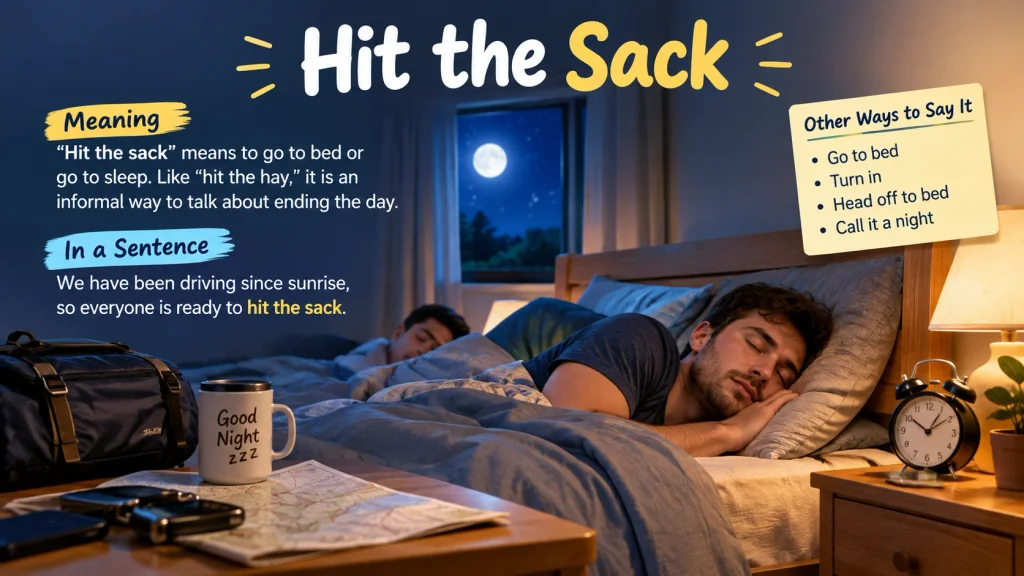
Hit the Sack
Meaning
“Hit the sack” means to go to bed or go to sleep. Like “hit the hay,” it is an informal way to talk about ending the day.
In a Sentence
We have been driving since sunrise, so everyone is ready to hit the sack.
Other Ways to Say It
- Go to bed
- Turn in
- Head off to bed
- Call it a night
Explanation
The “sack” refers to a bed or sleeping place in the expression. The wording is playful and casual, making a simple bedtime decision sound more colorful.
It does not usually suggest anything about the quality or depth of sleep; it focuses on going to bed.
Best Use
This expression works well in casual speech, messages, and humorous conversations.
Catch Some Zs
Meaning
“Catch some Zs” means to get some sleep. The letter “Z” represents the sound traditionally associated with sleeping or snoring in cartoons and popular writing.
In a Sentence
I’m exhausted after studying all evening, so I’m going to catch some Zs.
Other Ways to Say It
- Get some sleep
- Get some rest
- Take a nap
- Get some shut-eye
Explanation
The expression turns the idea of sleep into something you can supposedly “catch,” creating a playful mental image. It is especially useful when the speaker simply wants some rest, without specifying how long or deeply they will sleep.
It has a distinctly casual tone.
Best Use
Best for texts, social media, friendly conversations, and informal writing.
Saw Logs
Meaning
“Saw logs” means to sleep deeply and often noisily, especially when someone is snoring. The expression compares loud snoring with the sound of cutting wood.
In a Sentence
My brother was sawing logs so loudly that I could hear him from the hallway.
Other Ways to Say It
- Snore loudly
- Sleep noisily
- Sleep deeply
- Make a lot of noise while sleeping
Explanation
The phrase creates a humorous sound image: instead of quietly breathing, the sleeping person seems to be cutting through a pile of logs.
Unlike some sleeping expressions, this one focuses particularly on loud or noticeable sleep, not simply peaceful rest.
Best Use
It works best in humorous stories and casual conversations.
Sleep Like a Baby
Read more: 20 Idioms for Cold Weather With Real Examples
Meaning
“Sleep like a baby” means to sleep very peacefully and soundly. It is generally used to suggest comfortable, restful sleep.
In a Sentence
After changing my routine, I finally slept like a baby last night.
Other Ways to Say It
- Sleep peacefully
- Sleep soundly
- Have a restful night
- Sleep deeply
Explanation
Babies are commonly associated with peaceful, undisturbed sleep, which gives this expression its comforting image. However, the phrase is an informal comparison, not a literal statement about how babies actually sleep.
It often carries a warm and positive emotional tone.
Best Use
Use it in personal conversations, lifestyle writing, stories, and friendly messages.
Catch Forty Winks
Meaning
“Catch forty winks” means to take a short nap or get a little sleep. It does not literally mean sleeping for forty winks.
In a Sentence
I’m going to catch forty winks before we leave for the evening.
Other Ways to Say It
- Take a short nap
- Have a quick rest
- Take a little sleep
- Get some rest
Explanation
The expression uses “forty winks” as a playful way of describing a brief period of sleep. It often suggests short, temporary rest rather than a full night’s sleep.
It has a slightly old-fashioned charm but is still understandable and useful.
Best Use
It fits casual conversation, humorous writing, and light storytelling.
Get Some Beauty Sleep
Meaning
“Get some beauty sleep” means getting enough sleep so that you look or feel more refreshed. The expression is usually playful.
In a Sentence
You have a busy morning tomorrow, so get some beauty sleep tonight.
Other Ways to Say It
- Get some rest
- Get a good night’s sleep
- Rest up
- Recharge overnight
Explanation
The phrase connects sleep with looking refreshed the next day. Its focus is less on the mechanics of sleeping and more on the fresh, rested appearance associated with a good night’s sleep.
It is often used humorously or affectionately.
Best Use
Best for friendly conversations, personal messages, lifestyle content, and playful social posts.
Sleep Tight
Meaning
“Sleep tight” is a friendly way to wish someone a good night’s sleep. It means something like “sleep well” or “have a restful night.”
In a Sentence
Good night, everyone—sleep tight and I’ll see you in the morning.
Other Ways to Say It
- Sleep well
- Have a good night
- Rest well
- Sweet dreams
Explanation
Unlike expressions such as “sleep like a log,” this phrase is normally used as a good-night wish rather than a description of someone’s sleep.
It has a warm, familiar, and slightly old-fashioned feel.
Best Use
It works especially well in personal messages, family conversations, children’s stories, and bedtime wishes.
Let Sleeping Dogs Lie
Meaning
“Let sleeping dogs lie” means it is often better not to bring up an old problem or disturb a situation that is currently peaceful.
In a Sentence
We finally settled the disagreement, so I think we should let sleeping dogs lie.
Other Ways to Say It
- Leave the issue alone
- Don’t reopen old problems
- Let the past stay in the past
- Don’t stir things up
Explanation
This idiom uses the image of a sleeping dog: waking it could create unnecessary trouble. The “sleeping dog” represents a quiet problem that could become active again if disturbed.
This expression is not actually about bedtime, which makes it a useful example of how figurative language can develop a broader meaning.
Best Use
Use it in conversations, advice, essays, speeches, and storytelling when discussing old conflicts or sensitive issues.
Put Something to Bed
Meaning
“Put something to bed” can mean to settle, resolve, or finish an issue, discussion, rumor, or disagreement.
In a Sentence
The final meeting helped put the rumors to bed once and for all.
Other Ways to Say It
- Settle the issue
- Resolve the matter
- End the discussion
- Lay the matter to rest
Explanation
The expression borrows the familiar image of putting something to bed at the end of the day. Figuratively, the “something” is finished or settled, so it no longer needs attention.
Because it can sound decisive, it is particularly useful when talking about unresolved questions or rumors.
Best Use
It fits journalism, essays, workplace discussions, speeches, and everyday conversation.
Dead to the World
Meaning
“Dead to the world” means sleeping so deeply that a person seems unaware of what is happening around them.
In a Sentence
After the long journey, Dad was dead to the world before dinner was even served.
Other Ways to Say It
- Fast asleep
- Completely asleep
- Deeply asleep
- Unaware of everything around you
Explanation
The phrase uses dramatic language to emphasize extreme unawareness during sleep. It does not mean that someone is actually dead.
Because of its dramatic wording, it is best understood as a strong figurative description.
Best Use
Use it in casual storytelling and humorous descriptions, especially when someone is difficult to wake.
Out Like a Light
Meaning
“Out like a light” means to fall asleep very quickly, often almost immediately.
In a Sentence
The children were out like a light within minutes of getting into bed.
Other Ways to Say It
- Fall asleep instantly
- Drop off quickly
- Fall asleep right away
- Be asleep in seconds
Explanation
The image comes from a light suddenly being switched off. In the same way, a person who is “out like a light” seems to switch from awake to completely asleep in an instant.
It is vivid and informal.
Best Use
This idiom is excellent for storytelling, casual conversations, and humorous writing.
Nod Off
Meaning
“Nod off” means to fall asleep briefly, often without intending to. It commonly describes someone becoming sleepy while sitting or resting.
In a Sentence
I nodded off on the train and nearly missed my stop.
Other Ways to Say It
- Doze off
- Fall asleep briefly
- Drift into sleep
- Take a quick nap
Explanation
The expression creates a simple physical image: as someone becomes sleepy, their head may slowly nod downward.
It usually suggests an unplanned or short period of sleep rather than deliberately going to bed.
Best Use
Use it in everyday conversation, travel stories, workplace anecdotes, and casual writing.
Doze Off
Meaning
“Doze off” means to fall asleep lightly or for a short time, often while sitting somewhere comfortable.
In a Sentence
I started to doze off while reading, so I put the book down and went to bed.
Other Ways to Say It
- Nod off
- Drift into sleep
- Fall asleep
- Take a brief nap
Explanation
“Doze” suggests a light, usually short sleep, making this expression different from stronger phrases such as “dead to the world.”
It works well when someone gradually becomes sleepy rather than suddenly falling into deep sleep.
Best Use
Best for ordinary conversation, personal writing, and everyday descriptions.
Drift Off
Meaning
“Drift off” means to gradually fall asleep. The expression suggests a smooth, gentle transition from being awake to being asleep.
In a Sentence
I listened to the rain against the window and slowly drifted off.
Other Ways to Say It
- Gradually fall asleep
- Ease into sleep
- Doze off
- Slip into sleep
Explanation
The word “drift” creates an image of floating gently without effort. That makes this expression feel calm, peaceful, and slightly poetic.
It is particularly effective when describing a quiet bedtime scene.
Best Use
It works beautifully in creative writing, personal reflections, stories, and gentle descriptions of nighttime.
In the Land of Nod
Meaning
“In the land of Nod” is a playful expression meaning asleep or in a state of sleep.
In a Sentence
By the time the movie ended, the youngest children were already in the land of Nod.
Other Ways to Say It
- Fast asleep
- In dreamland
- Sleeping peacefully
- Off to sleep
Explanation
The expression turns sleep into an imaginary dreamlike place that someone enters. That imaginative quality gives it a softer and more whimsical feeling than simply saying “asleep.”
It can sound charming, playful, or slightly old-fashioned.
Best Use
Best for children’s writing, storytelling, humorous descriptions, and poetic language.
Get Some Shut-Eye
Meaning
“Get some shut-eye” means to get some sleep or rest.
In a Sentence
We have an early flight, so I need to get some shut-eye.
Other Ways to Say It
- Get some sleep
- Get some rest
- Catch some Zs
- Turn in
Explanation
The expression focuses on the simple physical idea of closing your eyes to sleep. Its casual wording makes an ordinary statement sound more colorful.
It does not necessarily suggest deep sleep; it simply means getting some rest.
Best Use
It is useful in casual conversation, travel situations, friendly messages, and informal writing.
Sleep on It
Meaning
“Sleep on it” means to wait before making an important decision, usually by giving yourself time to think about it.
In a Sentence
The offer sounds interesting, but I’d like to sleep on it before giving them an answer.
Other Ways to Say It
- Think it over
- Take some time to decide
- Give it careful thought
- Consider it overnight
Explanation
The expression connects sleep with taking time away from an immediate decision. The underlying image is that a person can step back, rest, and return to the question with a clearer perspective.
It is common and natural in everyday English.
Best Use
Use it in conversations, workplace situations, negotiations, advice, and personal decisions.
Go to Sleep
Meaning
“Go to sleep” is a straightforward expression meaning to enter a state of sleep. Although it is not strongly figurative, it is a common expression associated with sleeping and contrasts with more colorful idioms on this list.
In a Sentence
I usually go to sleep around the same time each night.
Other Ways to Say It
- Go to bed
- Fall asleep
- Turn in
- Retire for the night
Explanation
Unlike strongly figurative expressions such as “hit the hay,” “go to sleep” is mostly literal and direct. Including it helps show that not every familiar expression connected with sleep has the same level of figurative meaning.
It is the clearest choice when simplicity matters more than imagery.
Best Use
It is appropriate for everyday conversation, instructions, educational writing, and straightforward communication.
Exercise: Practice Using Idioms
Choose the best answer for each question.
Which expression means to sleep very deeply?
A. Hit the hay
B. Sleep like a log
C. Sleep on it
D. Get some shut-eye
Which idiom means to go to bed?
A. Saw logs
B. Catch forty winks
C. Hit the sack
D. Dead to the world
What does “catch some Zs” mean?
A. Get some sleep
B. Make a difficult decision
C. Wake up early
D. Sleep noisily
Which expression specifically suggests loud or noticeable snoring?
A. Drift off
B. Sleep tight
C. Saw logs
D. Sleep on it
If someone “caught forty winks,” what did they probably do?
A. Stayed awake all night
B. Took a short nap
C. Went to bed permanently
D. Made a difficult decision
What does “sleep like a baby” generally suggest?
A. Enjoying a peaceful sleep
B. Taking a daytime nap
C. Making loud noises while asleep
D. Resting for exactly sixty minutes
Which expression is commonly used as a good-night wish?
A. Put something to bed
B. Sleep tight
C. Let sleeping dogs lie
D. Sleep on it
What does “let sleeping dogs lie” mean figuratively?
A. Take a long nap
B. Avoid disturbing an existing problem
C. Go to bed early
D. Ignore someone who is asleep
If a rumor is “put to bed,” what does that mean?
A. Confusion makes the situation worse
B. Public attention spreads the matter
C. Resolution brings the issue to an end
D. Sleep causes the matter to be forgotten
What does “dead to the world” suggest?
A. Deep sleep leaves a person unaware of their surroundings
B. Refusing to sleep keeps someone awake
C. Careful thinking occupies the person’s mind
D. A brief nap provides a little rest
If someone is “out like a light,” what probably happened?
A. Suddenly, they woke from sleep
B. Quickly, they drifted off to sleep
C. Noisily, they continued sleeping
D. Instead, they chose to remain awake
Which expression usually describes briefly falling asleep unintentionally?
A. Nod off
B. Sleep tight
C. Hit the hay
D. Put something to bed
What is the main difference between “doze off” and “drift off”?
A. “Doze off” often suggests light or brief sleep, while “drift off” emphasizes gradually falling asleep.
B. “Doze off” means to go to bed, while “drift off” means to wake up.
C. “Doze off” always means deep sleep, while “drift off” means loud snoring.
D. There is no difference in meaning or feeling.
What does “sleep on it” mean?
A. Sleep on top of an object
B. Decide immediately
C. Delay a decision to think about it
D. Take a long afternoon nap
Which expression has the most direct, non-figurative meaning?
A. In the land of Nod
B. Go to sleep
C. Out like a light
D. Hit the hay
Answers
- B — “Sleep like a log” describes sleeping very deeply and soundly.
- C — “Hit the sack” is an informal way to say go to bed.
- A — “Catch some Zs” means to get some sleep.
- C — “Saw logs” humorously refers to sleeping noisily, especially snoring.
- B — “Catch forty winks” means to take a short period of sleep or a nap.
- A — “Sleep like a baby” suggests peaceful, restful sleep.
- B — “Sleep tight” is commonly used to wish someone a good night’s sleep.
- B — “Let sleeping dogs lie” means not to disturb or reopen a potentially troublesome situation.
- C — “Put something to bed” can mean to settle or end an issue, rumor, or discussion.
- A — “Dead to the world” describes someone who is deeply asleep and unaware of what is happening around them.
- B — “Out like a light” means falling asleep very quickly.
- A — “Nod off” commonly describes briefly or unintentionally falling asleep.
- A — “Doze off” emphasizes light or brief sleep, while “drift off” emphasizes the gradual transition into sleep.
- C — “Sleep on it” means to wait before making a decision so you have time to consider it.
- B — “Go to sleep” is a direct expression rather than a strongly figurative idiom.
FAQs
What is an idiom for sleeping?
An idiom for sleeping is a familiar expression that describes sleep or related ideas in a colorful or figurative way. Examples include “sleep like a log,” “hit the hay,” “catch some Zs,” and “get some shut-eye.”
How do I create my own idiom?
A useful idiomatic expression usually begins with a strong image or comparison. Think about an object, action, place, or experience that can represent the feeling you want to describe. However, newly invented phrases may not function as established idioms until they become familiar to other speakers.
What makes a sleeping idiom effective?
A good expression creates a clear mental picture while adding meaning beyond the literal words. For example, “out like a light” immediately suggests the sudden change from being awake to being asleep.
Can I use these idioms in everyday conversation?
Yes. Many of these expressions are natural in casual English, including “hit the hay,” “catch some Zs,” “nod off,” “doze off,” and “get some shut-eye.” Some, such as “in the land of Nod,” can sound more playful or old-fashioned.
What is the difference between an idiom and a simile?
A simile directly compares two things using words such as “like” or “as,” while an idiom is a familiar expression with an established figurative meaning. For example, “sleep like a log” uses a comparison, while its common use as a whole expression gives it an idiomatic character.
Conclusion
English gives us many expressive ways to talk about sleeping, from the deep rest suggested by “sleep like a log” to the gentle transition described by “drift off.” Some expressions are humorous, such as “saw logs,” while others are warm and comforting, such as “sleep tight.” Others move beyond literal sleep, like “let sleeping dogs lie” and “sleep on it,” showing how sleep-related imagery can communicate ideas about decisions, problems, and relationships.
The best idiom depends on the feeling, context, and message you want to convey. In casual conversation, choose expressions that sound natural and familiar. In creative writing, you can use more imaginative phrases to create atmosphere and emotion. When used thoughtfully, sleeping idioms can make ordinary language feel more vivid and sometimes, more memorable.

Oliver Whitcombe is a British writer and language enthusiast who has been fascinated by English expressions since childhood, when his grandmother told him he was “born with a silver spoon” and he spent a week trying to find it.
He created Idiom Looms to help learners and native speakers alike make sense of English idioms. Their origins, their meanings, and the moments they’re best used. His writing mixes plain explanations with a good dose of British wit.
Oliver lives in England, where he divides his time between writing, walking, and correcting everyone’s grammar (politely).



[…] Read more:20 Idioms for Sleeping With Real Examples […]
[…] Read more:20 Idioms for Sleeping With Real Example […]