
What makes an ordinary moment memorable, meaningful, or worth describing? The 20 Idioms for Moments With Real Examples explores natural expressions that help capture brief experiences, important occasions, and everyday situations. These idioms for moments add personality and emotional depth to conversations and writing. They can also make descriptions more vivid without sounding forced or overly formal.
Whether you are discussing scheduling, time management, meetings, or a memorable event, the right expression can communicate more than literal words. This guide connects English usage, grammar, and formal writing with practical examples you can understand quickly. You will discover idioms that fit personal conversations, business communication, project management, and situations involving a calendar, online booking, or broadcasting. Each expression includes a clear meaning and a realistic sentence.
The goal is simple: help you recognize, understand, and confidently use these expressions in context. You will explore figurative language, descriptive language, and natural patterns that strengthen everyday communication. Real examples show how each idiom works while maintaining clarity and consistency. By the end, you will have useful expressions for conversations, messages, creative writing, and professional communication.
What Is an Idiom?
An idiom is a familiar expression whose meaning is different from the literal meaning of the individual words.
For example, “break the ice” does not usually mean physically breaking ice. It means to make people feel more comfortable when they first meet. Similarly, “hit the nail on the head” means to identify something accurately.
Idioms add figurative meaning and personality to language. Rather than stating an idea in a plain, literal way, they create an image that helps readers or listeners understand the feeling behind it.
Why Use Idioms for Moments?
Moments can be difficult to describe because they are often brief, emotional, or meaningful. An idiom can turn a simple statement into a stronger image.
For example, saying that a special opportunity appeared “once in a blue moon” suggests that it was unusually rare. Saying that something happened “in the blink of an eye” emphasizes how quickly the moment passed.
Idioms can help you:
- Express emotions without lengthy explanations.
- Make descriptions of moments more vivid and memorable.
- Explain abstract experiences such as urgency, nostalgia, or opportunity.
- Give creative writing a stronger sense of imagery.
- Add personality to everyday conversations.
- Communicate complicated feelings in a simple, familiar way.
- Make speeches, stories, essays, and personal messages more expressive.
Quick List of 20 Idioms
- Seize the moment
- In the blink of an eye
- In the nick of time
- A moment in the sun
- Once in a blue moon
- Time flies
- Against the clock
- At the eleventh hour
- Time stands still
- Every now and then
- For old times’ sake
- Stop and smell the roses
- Make the most of it
- Before you know it
- Split second
- Turn back the clock
- At the drop of a hat
- A flash in the pan
- Live for today
- A golden opportunity
Seize the Moment
Read more:20 Idioms for Gossip With Real Examples
Meaning
Seize the moment means to take advantage of an opportunity while it is available instead of waiting too long. It suggests acting with confidence when the right moment arrives.
In a Sentence
When the audience finally became quiet, Maya decided to seize the moment and share her idea.
Other Ways to Say It
- Take the opportunity
- Make the most of the moment
- Act while you can
- Take your chance
Explanation
This expression creates the image of grabbing an opportunity before it disappears. It is especially useful when a particular moment calls for action rather than hesitation.
It has an encouraging and motivational tone and works naturally in conversations, speeches, personal messages, and inspirational writing.
Best Use
Use it for important opportunities, decisions, celebrations, personal growth, or moments that require courage.
In the Blink of an Eye
Meaning
In the blink of an eye means something happens extremely quickly. It emphasizes how little time passes between two events.
In a Sentence
The children were playing peacefully, and in the blink of an eye, the garden was covered in rain.
Other Ways to Say It
- In an instant
- In a split second
- Very quickly
- Before you could react
Explanation
The expression compares a brief event to the tiny amount of time needed to blink. That familiar physical image makes the idea of speed easy to understand.
It works particularly well when describing surprising changes or moments that seem to disappear almost immediately.
Best Use
Use it in storytelling, conversations, creative writing, and dramatic descriptions of sudden events.
In the Nick of Time
Meaning
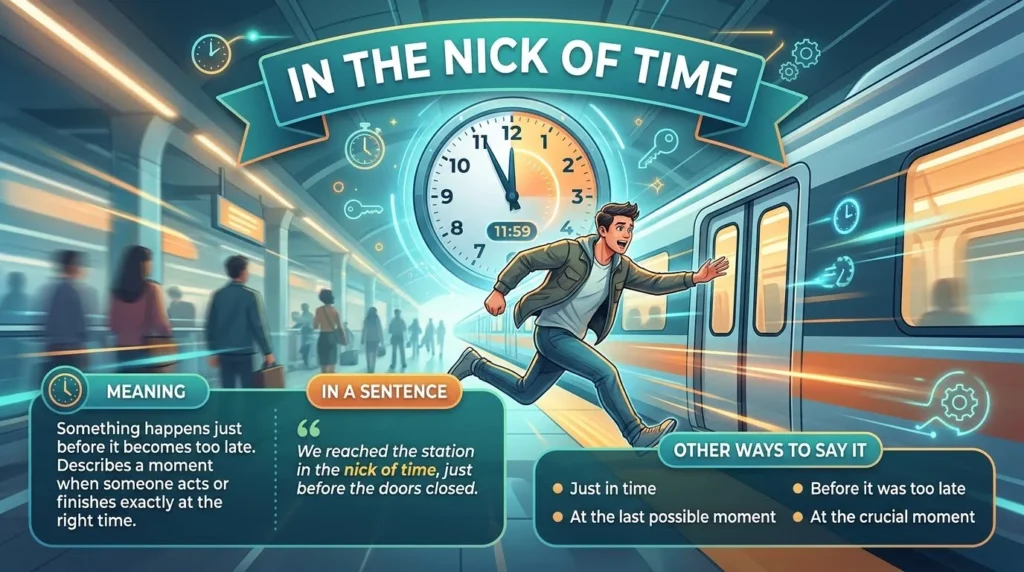
In the nick of time means something happens just before it becomes too late. It describes a moment when someone arrives, acts, or finishes something at exactly the right time.
In a Sentence
We reached the station in the nick of time, just before the doors closed.
Other Ways to Say It
- Just in time
- At the last possible moment
- Before it was too late
- At the crucial moment
Explanation
This idiom carries a sense of relief and urgency. The image is of someone arriving at a narrow window when there is barely enough time left.
It is usually more conversational than poetic, making it easy to use in everyday speech.
Best Use
Use it for deadlines, travel, emergencies, rescues, appointments, and close calls.
A Moment in the Sun
Meaning
A moment in the sun describes a period when someone or something receives attention, recognition, success, or admiration.
In a Sentence
After years of quiet work, the young musician finally had a moment in the sun when her song reached a wide audience.
Other Ways to Say It
- A time of recognition
- A brief period of success
- A chance to shine
- A moment of glory
Explanation
The expression creates an image of someone stepping into warm sunlight after being in the background. It suggests visibility and appreciation.
The phrase can sound celebratory or slightly temporary, depending on context, because the moment of attention may not last forever.
Best Use
Use it in profiles, storytelling, speeches, essays, and discussions of achievement or recognition.
Once in a Blue Moon
Meaning
Once in a blue moon means something happens very rarely.
In a Sentence
We still meet for coffee once in a blue moon, but those conversations are always special.
Other Ways to Say It
- Very rarely
- Once in a while
- On rare occasions
- Hardly ever
Explanation
The phrase creates a memorable picture of an unusual moon in the night sky. It gives a sense of rarity without needing a precise measurement of time.
It is friendly and conversational, though it is more figurative than precise.
Best Use
Use it when talking about rare meetings, unusual events, occasional experiences, or infrequent opportunities.
Time Flies
Meaning
Time flies means that time seems to pass very quickly, especially when we are enjoying ourselves or looking back on an important period.
In a Sentence
It feels like we just started the project, but time flies when everyone is having fun.
Other Ways to Say It
- Time passes quickly
- The days go by fast
- Where did the time go?
- The hours slipped away
Explanation
The expression imagines time moving as quickly as a flying object. It often carries a mixture of happiness and mild nostalgia.
It is one of the most natural expressions for reflecting on how quickly meaningful moments disappear.
Best Use
Use it in everyday conversation, personal reflections, social posts, speeches, and nostalgic writing.
Against the Clock
Meaning
Against the clock means working under strong time pressure to finish something before a deadline.
In a Sentence
The team worked against the clock to prepare the presentation before the meeting.
Other Ways to Say It
- Under time pressure
- Racing against time
- Working to a deadline
- Short on time
Explanation
The expression creates the image of a person competing with a clock. It makes urgency feel immediate and active.
Unlike softer expressions about time, this one emphasizes pressure and the possibility of running out of time.
Best Use
Use it for work, exams, projects, competitions, deadlines, and other time-sensitive situations.
At the Eleventh Hour
Meaning
At the eleventh hour means something happens at the last possible moment, shortly before it is too late.
In a Sentence
At the eleventh hour, the organizers found a new venue for the event.
Other Ways to Say It
- At the last minute
- Just before the deadline
- At the final moment
- At the last possible chance
Explanation
This expression suggests that very little time remains. It can communicate both urgency and relief when a problem is solved just before the deadline.
It is slightly more formal than “at the last minute,” so it can work well in essays and polished writing.
Best Use
Use it in formal writing, news-style storytelling, speeches, work situations, and dramatic narratives.
Time Stands Still
Meaning
Time stands still describes a moment that feels so powerful, emotional, beautiful, or shocking that everything seems to pause.
In a Sentence
As the curtain rose and the music began, time seemed to stand still.
Other Ways to Say It
- Everything seemed to pause
- The world seemed to stop
- The moment felt timeless
- Everything faded into the background
Explanation
This expression is strongly figurative. It turns an emotional experience into the image of a world where the clock has stopped moving.
It often sounds poetic and works particularly well for moments of wonder, love, grief, achievement, or intense anticipation.
Best Use
Use it in poetry, creative writing, romantic messages, speeches, and emotional storytelling.
Every Now and Then
Meaning
Every now and then means occasionally or from time to time. It describes moments that happen sometimes but not regularly.
In a Sentence
Every now and then, I return to the old neighborhood just to remember how different life once felt.
Other Ways to Say It
- From time to time
- Occasionally
- Once in a while
- Every so often
Explanation
This expression gives a gentle sense of occasional repetition. It is useful when describing small moments that appear throughout a longer period.
Unlike “once in a blue moon,” it does not necessarily suggest extreme rarity.
Best Use
Use it in everyday conversations, personal writing, memories, and reflective storytelling.
For Old Times’ Sake
Meaning
For old times’ sake means doing something because it brings back pleasant memories of the past.
In a Sentence
We visited our old meeting place for old times’ sake.
Other Ways to Say It
- To remember the past
- For nostalgia
- To revisit an old memory
- In memory of earlier days
Explanation
This expression carries a distinctly nostalgic and sentimental feeling. It connects a present action with shared memories from the past.
It is especially effective when a current moment becomes meaningful because of what happened there before.
Best Use
Use it in personal messages, conversations, reunions, storytelling, and nostalgic writing.
Stop and Smell the Roses
Meaning
Stop and smell the roses means to slow down and appreciate the good things happening around you instead of rushing constantly.
In a Sentence
We had spent weeks worrying about deadlines, so we decided to stop and smell the roses during our weekend away.
Other Ways to Say It
- Slow down and enjoy life
- Appreciate the little things
- Take time to enjoy the moment
- Pause and appreciate what you have
Explanation
The expression creates a simple image of someone literally pausing to enjoy the scent of flowers. Its deeper message is about attention, gratitude, and presence.
It has a warm, reflective, and encouraging tone.
Best Use
Use it in personal advice, inspirational writing, speeches, captions, and conversations about enjoying everyday moments.
Make the Most of It
Meaning
Make the most of it means to use a situation or period of time as well as possible, especially when the circumstances may not last.
In a Sentence
We only had one afternoon in the city, so we decided to make the most of it.
Other Ways to Say It
- Use the opportunity well
- Get the best from it
- Enjoy it while it lasts
- Take full advantage of the situation
Explanation
This expression focuses on value rather than duration. A moment does not need to be long to be meaningful if someone uses it well.
It is practical and natural rather than highly poetic, which makes it useful in everyday speech.
Best Use
Use it for travel, opportunities, celebrations, limited time, challenging situations, and personal encouragement.
Before You Know It
Meaning
Before you know it means something will happen sooner than expected or that time will pass surprisingly quickly.
In a Sentence
Keep practicing, and before you know it, you’ll be performing confidently in front of an audience.
Other Ways to Say It
- Very soon
- Before long
- Sooner than expected
- In no time
Explanation
The phrase highlights how quickly circumstances can change without us noticing the passing time.
It often sounds reassuring or optimistic, especially when someone is waiting for progress or anticipating a future event.
Best Use
Use it in conversations, encouragement, storytelling, advice, and informal writing.
Split Second
Meaning
A split second is an extremely short amount of time. The expression is often used when someone must react or decide almost instantly.
In a Sentence
In a split second, he realized that he had left his keys on the table.
Other Ways to Say It
- Instant
- Fraction of a second
- Brief moment
- Flash of time
Explanation
The phrase emphasizes speed and immediacy. It is particularly useful when a tiny amount of time makes a major difference.
It sounds natural in both everyday and dramatic contexts.
Best Use
Use it for quick decisions, sudden reactions, sports, accidents, suspenseful stories, and unexpected discoveries.
Turn Back the Clock
Meaning
Turn back the clock means to return to an earlier period or try to recreate something from the past.
In a Sentence
The reunion felt like a chance to turn back the clock and relive our school days.
Other Ways to Say It
- Return to the past
- Relive earlier days
- Go back in time
- Recreate the past
Explanation
The image comes from imagining a clock physically moving backward instead of forward. It expresses nostalgia or a desire to experience an earlier moment again.
It should usually be understood figuratively because literal time cannot be reversed.
Best Use
Use it in nostalgic writing, reunions, personal reflections, stories, and discussions about memories.
At the Drop of a Hat
Meaning
At the drop of a hat means doing something immediately and without much hesitation.
In a Sentence
My brother would travel to the mountains at the drop of a hat if someone invited him.
Other Ways to Say It
- Immediately
- Without hesitation
- At once
- Without needing much encouragement
Explanation
The phrase suggests such a quick reaction that a person would act the instant a hat dropped. It conveys spontaneity rather than careful planning.
It usually has a casual and energetic tone.
Best Use
Use it in conversations, informal stories, character descriptions, and lighthearted writing.
A Flash in the Pan
Meaning
A flash in the pan describes something that attracts attention or succeeds briefly but does not last.
In a Sentence
The band’s first hit was impressive, but some critics wondered whether it was a flash in the pan.
Other Ways to Say It
- Brief success
- Short-lived sensation
- Temporary success
- Something that did not last
Explanation
This idiom is useful when a memorable moment of success is temporary rather than lasting. It creates a contrast between a sudden burst of attention and what happens afterward.
The expression can sound skeptical or critical, so it is not ideal when you want to celebrate someone’s achievement without qualification.
Best Use
Use it in commentary, essays, conversations, reviews, and discussions of short-lived success.
Live for Today
Meaning
Live for today encourages someone to focus on the present and enjoy the opportunities available now rather than becoming consumed by the future.
In a Sentence
We cannot predict what next year will bring, so sometimes it is important to live for today.
Other Ways to Say It
- Enjoy the present
- Focus on today
- Be present
- Make today count
Explanation
This expression emphasizes present awareness and enjoyment. It can be inspiring, but context matters: it does not necessarily mean ignoring future responsibilities.
It works best when encouraging someone to appreciate meaningful experiences happening now.
Best Use
Use it in motivational writing, personal reflections, speeches, captions, and informal conversations.
A Golden Opportunity
Meaning
A golden opportunity is an especially valuable chance to do something important or beneficial.
In a Sentence
The scholarship gave him a golden opportunity to continue his education.
Other Ways to Say It
- Excellent opportunity
- Valuable chance
- Rare opportunity
- Great opening
Explanation
The word golden suggests something precious and worth taking seriously. The expression makes an opportunity feel valuable without claiming that success is guaranteed.
It is generally positive and can sound natural in both everyday and professional contexts.
Best Use
Use it for education, careers, personal growth, important decisions, business, speeches, and motivational writing.
Exercise: Practice Using Idioms
Choose the best answer for each question.
Which expression means to take advantage of an opportunity while it is available?
A. Turn back the clock
B. Seize the moment
C. Every now and then
D. A flash in the pan
What does “in the blink of an eye” emphasize?
A. Costs a fortune
B. Seems hard to understand
C. Happens in the blink of an eye
D. Repeats itself time after time
If someone arrives “in the nick of time,” what does that mean?
A. Reaching the destination ahead of schedule
B. Showing up when everyone has already left
C. Appearing at an event without an invitation
D. Getting there just before time runs out
Which expression describes a period of recognition or attention?
A. A moment in the sun
B. Against the clock
C. For old times’ sake
D. At the drop of a hat
What does “once in a blue moon” mean?
A. Every day
B. Very rarely
C. At the exact right time
D. Without warning
Which idiom describes the feeling that time is passing quickly?
A. Time flies
B. Time stands still
C. Turn back the clock
D. At the eleventh hour
If you are working “against the clock,” what is the main challenge?
A. Finding a place
B. Remembering the past
C. Finishing before time runs out
D. Waiting for an opportunity
What does “at the eleventh hour” suggest?
A. An event takes place very early
B. The incident occurs at the very last moment
C. Regularly, the event takes place
D. Years later, something happens unexpectedly
Which expression can describe a powerful moment when everything seems to pause?
A. Time stands still
B. Once in a blue moon
C. Against the clock
D. At the drop of a hat
What does “for old times’ sake” communicate?
A. Acting based on memories of the past
B. Responding to intense pressure
C. Taking action spontaneously
D. Pursuing a monetary reward
Which expression encourages people to slow down and appreciate life?
A. A flash in the pan
B. Stop and smell the roses
C. At the eleventh hour
D. In the nick of time
If you “make the most of” a moment, what are you doing?
A. Avoiding it
B. Forgetting it
C. Using or enjoying it as well as possible
D. Repeating it exactly
Which phrase means something may happen sooner than expected?
A. Before you know it
B. Turn back the clock
C. For old times’ sake
D. A moment in the sun
Which expression describes an extremely brief period of time?
A. A golden opportunity
B. Split second
C. Every now and then
D. Live for today
What does “a golden opportunity” describe?
A. A valuable chance
B. A short memory
C. A rare weather event
D. A disappointing experience
Answers
- B — “Seize the moment” means to take advantage of an opportunity while it is available.
- C — “In the blink of an eye” describes something that happens extremely quickly.
- D — “In the nick of time” means arriving or acting just before it becomes too late.
- A — “A moment in the sun” refers to a period of attention, recognition, or success.
- B — “Once in a blue moon” means something happens very rarely.
- A — “Time flies” expresses the idea that time seems to pass quickly.
- C — “Against the clock” means working under pressure to finish before time runs out.
- B — “At the eleventh hour” refers to something happening at the last possible moment.
- A — “Time stands still” describes a moment that feels so powerful that everything seems to pause.
- A — “For old times’ sake” means doing something because it brings back memories of the past.
- B — “Stop and smell the roses” encourages people to slow down and appreciate what is happening around them.
- C — “Make the most of it” means to use or enjoy a situation as well as possible.
- A — “Before you know it” suggests that something will happen sooner than expected.
- B — A “split second” is an extremely short period of time.
- A — “A golden opportunity” means a particularly valuable or promising chance.
FAQs
What is an idiom for moments?
An idiom for moments is a familiar figurative expression that helps describe time, opportunity, speed, emotion, memory, or significance. Expressions such as “seize the moment” and “time flies” can make descriptions more vivid than literal language alone.
How do I create my own idioms?
Start with the idea you want to communicate, then connect it to a clear physical image or comparison. For example, if you want to express a moment that disappears quickly, think about something that vanishes almost instantly. Keep the image simple enough for readers to understand.
What makes an idiom effective?
An effective idiom creates a clear mental image while communicating an idea or feeling naturally. It should fit the context rather than being included simply because it sounds creative.
Can I use these idioms in everyday conversation?
Yes. Many of these expressions, including “time flies,” “in the nick of time,” “make the most of it,” and “every now and then,” are natural in everyday English. More poetic expressions such as “time stands still” may be especially effective in creative or emotional writing.
What is the difference between an idiom and a simile?
An idiom is a recognized expression with a figurative meaning, such as “seize the moment.” A simile directly compares two things using words such as “like” or “as.” For example, “The moment felt like a dream” is a simile rather than an idiom.
Conclusion
The right expression can make an ordinary description of moments feel much more vivid. The 20 idioms and figurative expressions in this guide cover different experiences: taking action, appreciating the present, remembering the past, dealing with urgency, recognizing opportunities, and noticing how quickly time passes.
The best choice depends on the feeling you want to communicate. “Seize the moment” can sound motivational, while “for old times’ sake” creates nostalgia. “Time stands still” has a poetic quality, whereas “against the clock” emphasizes pressure.
When choosing an idiom, think about the image and emotion behind it rather than simply searching for a decorative phrase. A strong expression makes the reader feel the moment, not just understand it.

Oliver Whitcombe is a British writer and language enthusiast who has been fascinated by English expressions since childhood, when his grandmother told him he was “born with a silver spoon” and he spent a week trying to find it.
He created Idiom Looms to help learners and native speakers alike make sense of English idioms. Their origins, their meanings, and the moments they’re best used. His writing mixes plain explanations with a good dose of British wit.
Oliver lives in England, where he divides his time between writing, walking, and correcting everyone’s grammar (politely).
[…] Read more:20 Idioms for Moments With Real Examples […]