
Have you ever heard a rumor that quickly became the talk of the town? The 20 Idioms for Gossip With Real Examples explores natural expressions for discussing rumors, private information, and casual conversations. These idioms add color and personality to everyday English usage, helping readers understand how native speakers describe sharing information. You will discover useful expressions that make conversations more vivid without sounding forced.
Gossip appears in many settings, from friendly conversations to workplace meetings and business communication. Understanding these expressions can improve grammar, formal writing, storytelling, and everyday communication. This guide also explains when each idiom fits best, whether you are discussing scheduling, time management, an online booking, a calendar, or project management situation. Each example focuses on practical context and clear meaning.
You will learn the figurative meanings behind all 20 idioms, along with realistic sentences and alternative expressions. The article also highlights broadcasting, conversation, and formal writing contexts where appropriate. Clear explanations make these phrases easier to remember and use with consistency. By the end, you will have a practical collection of gossip-related idioms for confident, natural English.
What Is an Idiom?
An idiom is a fixed expression whose meaning is different from the literal meaning of the individual words.
For example, “break the ice” does not normally mean physically breaking ice. It means to make people feel more comfortable when they first meet.
Another example is “hit the nail on the head,” which means to describe something exactly or identify the main point.
Idioms use figurative language to communicate an idea in a memorable way. Their meanings are often understood through common usage rather than by interpreting every word literally.
When talking about gossip, idioms can make descriptions more vivid. Saying that someone “spilled the beans” creates a much stronger image than simply saying that the person revealed information.
Why Use Idioms for Gossip?
Gossip can involve many different situations: sharing a secret, repeating a rumor, discussing someone’s private life, or exchanging casual news about people who are not present. A single word such as gossip does not always capture these differences.
Idioms help add specificity and emotion.
For example, “hear it through the grapevine” suggests receiving unofficial information indirectly, while “dish the dirt” has a more playful and slightly mischievous tone. “Loose lips sink ships” takes a more serious approach by warning about the consequences of careless speech.
These expressions can help you:
- Express feelings about rumors and private conversations.
- Make descriptions more vivid and memorable.
- Explain complicated social situations in a few words.
- Add personality to conversations and storytelling.
- Make creative writing feel more natural.
- Choose language that sounds playful, dramatic, cautious, or serious.
- Understand how native English speakers describe gossip and rumor.
Quick List of 20 Idioms
- Spill the beans
- Let the cat out of the bag
- Hear it through the grapevine
- Dish the dirt
- Talk of the town
- Rumor has it
- Spread like wildfire
- Loose lips sink ships
- Kiss and tell
- Tell tales out of school
- Word on the street
- Water-cooler talk
- Behind someone’s back
- Keep it under wraps
- Let something slip
- The walls have ears
- Give someone the lowdown
- A little bird told me
- Make someone’s business public
- Air someone’s dirty laundry
Spill the Beans
Read more:20 Idioms for Fear With Real Examples
Meaning
“Spill the beans” means to reveal information that was supposed to be private, secret, or confidential. In gossip, it often describes someone accidentally or deliberately telling others something they were not meant to know.
In a Sentence
Marcus promised not to mention the engagement, but he spilled the beans during dinner.
Other Ways to Say It
- Reveal the secret
- Let the secret out
- Give away the information
- Tell someone what happened
Explanation
The image is of someone accidentally knocking over a container of beans and making its contents visible. Figuratively, the hidden information becomes impossible to keep hidden.
The expression can sound playful, especially when the secret is relatively harmless. It can also suggest mild annoyance when someone reveals information too soon.
Best Use
This idiom works especially well in everyday conversations, storytelling, informal writing, and social situations. It is usually too casual for formal professional communication.
Let the Cat Out of the Bag
Meaning
“Let the cat out of the bag” means to reveal a secret or disclose information that was supposed to remain private.
It is particularly useful when the revelation happens before the right time.
In a Sentence
We were planning a surprise party, but Daniel let the cat out of the bag before the invitations were sent.
Other Ways to Say It
- Reveal the secret
- Give the game away
- Let the secret slip
- Reveal something prematurely
Explanation
The expression creates a memorable picture of a hidden cat escaping from a bag. Once the cat is out, putting it back becomes difficult—just like trying to hide information after someone has revealed it.
It often carries a lighthearted or mildly humorous tone.
Best Use
Use it in casual conversation, humorous writing, stories, and informal messages, especially when a secret has been accidentally revealed.
Hear It Through the Grapevine
Meaning
To “hear it through the grapevine” means to learn information indirectly, usually through conversations with other people rather than from an official or direct source.
It is closely connected with rumors and unofficial news.
In a Sentence
I heard through the grapevine that the company may be moving to a new office.
Other Ways to Say It
- Hear it from someone
- Learn it indirectly
- Hear a rumor
- Pick up some news
Explanation
The grapevine is an old figurative image for a network through which information travels from person to person. The expression emphasizes that the information may have passed through several people before reaching you.
Because of that, it can also hint that the information may not be completely reliable.
Best Use
This expression fits everyday conversation, workplace talk, storytelling, and informal writing. It is useful when you want to show that information is unofficial rather than confirmed.
Dish the Dirt
Meaning
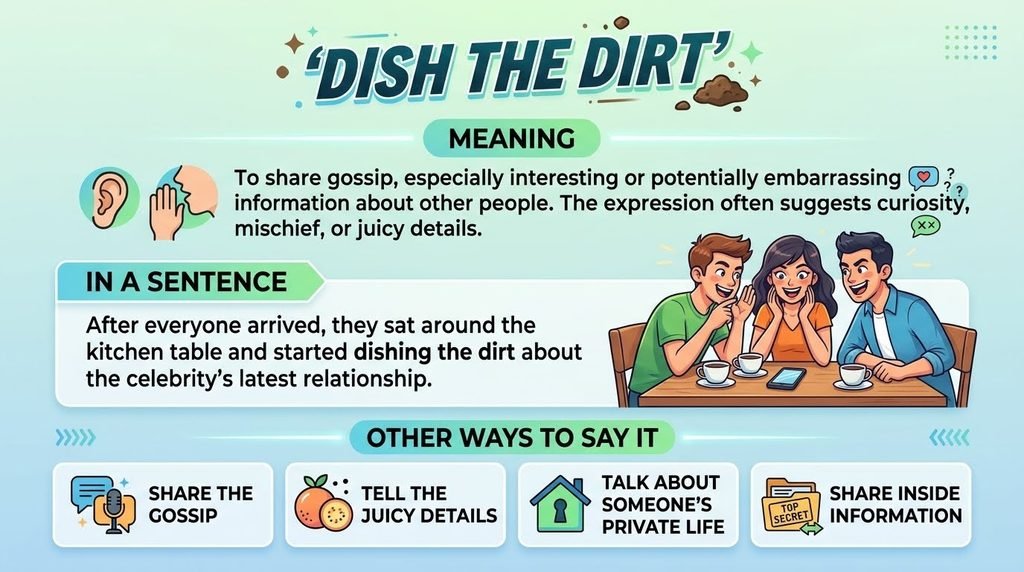
“Dish the dirt” means to share gossip, especially interesting or potentially embarrassing information about other people.
The expression often suggests curiosity, mischief, or juicy details.
In a Sentence
After everyone arrived, they sat around the kitchen table and started dishing the dirt about the celebrity’s latest relationship.
Other Ways to Say It
- Share the gossip
- Tell the juicy details
- Talk about someone’s private life
- Share inside information
Explanation
This is a strongly informal expression. The word dirt suggests information that is unpleasant, embarrassing, or not meant for public discussion.
It is often playful among friends, but it can sound judgmental or disrespectful when used about someone’s genuinely private matters.
Best Use
Use it mainly in casual conversations, entertainment writing, humorous storytelling, and informal social media content.
Talk of the Town
Meaning
When someone or something is “the talk of the town,” many people in a community or social group are discussing it.
The topic may be positive, negative, surprising, or simply interesting.
In a Sentence
After the unexpected announcement, the new restaurant became the talk of the town.
Other Ways to Say It
- Everyone is talking about it
- A hot topic
- The subject of conversation
- What everyone is discussing
Explanation
Unlike some gossip idioms, this expression does not automatically mean the information is malicious or secret. It focuses on widespread conversation.
It can describe gossip, but it can also refer to an event, person, product, achievement, or news story that attracts attention.
Best Use
It works well in conversations, journalism, storytelling, social media, and descriptive writing. It can sound neutral, positive, or dramatic depending on context.
Rumor Has It
Meaning
“Rumor has it” introduces information that people are saying, but that has not necessarily been confirmed.
It is a useful way to signal that something is unofficial or uncertain.
In a Sentence
Rumor has it that the old theater will reopen next summer.
Other Ways to Say It
- People are saying
- I have heard that
- There is a rumor that
- Word is that
Explanation
This expression creates distance between the speaker and the claim. Instead of presenting the information as fact, the speaker makes it clear that the source is rumor.
That distinction matters when discussing potentially sensitive information.
Best Use
Use it in informal conversation, fiction, storytelling, entertainment writing, and conversational articles. In serious reporting, unverified claims should be handled with greater care.
Spread Like Wildfire
Meaning
Something that “spreads like wildfire” travels extremely quickly from person to person.
When used with gossip, it describes a rumor that seems to move through a group before anyone can stop it.
In a Sentence
The story about the manager’s resignation spread like wildfire around the office.
Other Ways to Say It
- Travel quickly
- Spread rapidly
- Go around fast
- Reach everyone quickly
Explanation
A wildfire can move rapidly across a large area, making it a powerful image for information that travels quickly.
The expression emphasizes speed, not necessarily whether the information is true or false.
Best Use
It fits storytelling, informal writing, journalism-style prose, conversations, and dramatic descriptions. It can be especially effective when describing how quickly gossip travels through a community.
Loose Lips Sink Ships
Meaning
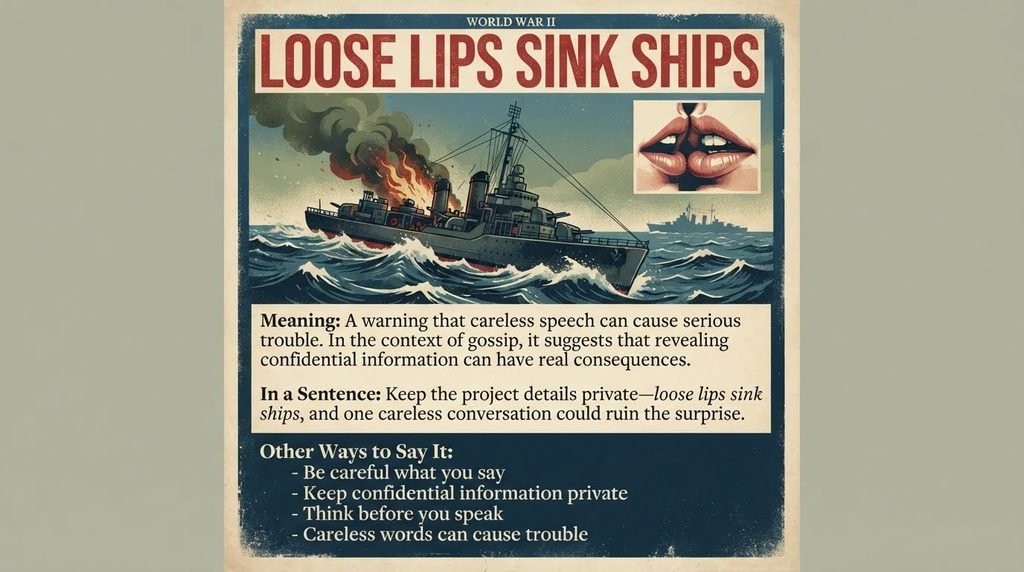
“Loose lips sink ships” is a warning that careless speech can cause serious trouble. In the context of gossip, it suggests that revealing confidential information can have real consequences.
In a Sentence
Keep the project details private—loose lips sink ships, and one careless conversation could ruin the surprise.
Other Ways to Say It
- Be careful what you say
- Keep confidential information private
- Think before you speak
- Careless words can cause trouble
Explanation
The phrase uses a dramatic image: careless talking is powerful enough to put ships in danger. Historically, the expression was used as a warning about revealing sensitive information.
Today, it can be used more broadly as a reminder about privacy and discretion.
Best Use
This expression works best in serious conversations, speeches, workplace reminders, storytelling, and situations involving confidentiality. It can also be used humorously when the consequences are minor.
Kiss and Tell
Meaning
“Kiss and tell” means to publicly reveal private or intimate details about a romantic relationship or encounter.
It usually carries a sense of indiscretion.
In a Sentence
The actor refused to kiss and tell, saying that what happened during the date was private.
Other Ways to Say It
- Reveal private romantic details
- Publicize a relationship
- Share intimate information
- Tell private stories
Explanation
The expression combines romance with disclosure. It suggests that someone has shared details about a private relationship that might reasonably have remained confidential.
The phrase is often used in entertainment contexts and can sound playful, cheeky, or critical depending on how it is used.
Best Use
It is particularly suitable for casual conversation, entertainment writing, celebrity coverage, fiction, and humorous storytelling.
Tell Tales Out of School
Meaning
To “tell tales out of school” means to reveal private information, especially information about other people or matters that should have remained confidential.
It can refer to betraying a confidence.
In a Sentence
Don’t tell tales out of school about your coworkers just because you’re frustrated with them.
Other Ways to Say It
- Reveal private information
- Break someone’s confidence
- Tell secrets
- Share what should remain private
Explanation
Despite the word school, this expression is not limited to children or classrooms. It has an old-fashioned flavor and refers to telling stories or secrets that were not yours to share.
Because it sounds somewhat traditional, it can add an interesting tone to literary or historical writing.
Best Use
It works particularly well in literary writing, storytelling, formal-ish conversation, and discussions about discretion. It may sound old-fashioned in casual modern speech.
Word on the Street
Meaning
“Word on the street” refers to information or rumors circulating among people in a particular community, workplace, neighborhood, or social group.
In a Sentence
The word on the street is that the bookstore may move to a larger building.
Other Ways to Say It
- People are saying
- The rumor going around
- What I’ve been hearing
- The latest word
Explanation
The phrase creates the image of information circulating naturally among ordinary people rather than arriving through an official announcement.
It often suggests unconfirmed information, so it should not automatically be treated as fact.
Best Use
This expression suits casual conversation, dialogue, fiction, social media, and informal commentary. It has a relaxed, conversational feel.
Water-Cooler Talk
Meaning
“Water-cooler talk” refers to casual conversation among coworkers, especially talk about news, events, entertainment, workplace developments, or sometimes gossip.
In a Sentence
The new policy became the main subject of water-cooler talk the following morning.
Other Ways to Say It
- Office chatter
- Casual workplace conversation
- Workplace gossip
- Informal discussion
Explanation
The phrase comes from the familiar idea of coworkers gathering around a water cooler and chatting during a break.
It does not necessarily mean harmful gossip. The focus is on informal social conversation in a workplace.
Best Use
It is particularly useful in workplace writing, business features, articles, fiction, and conversations about office culture.
Behind Someone’s Back
Meaning
To do or say something “behind someone’s back” means to do or say it when that person is absent, especially when the person would not approve.
In gossip, it often describes discussing someone without giving them a chance to respond.
In a Sentence
I don’t like hearing coworkers criticize her behind her back.
Other Ways to Say It
- When someone is not present
- Without their knowledge
- In private
- Out of someone’s hearing
Explanation
The expression creates a clear physical image: someone is standing behind another person, outside their view.
In social situations, it can carry a negative or disapproving tone, particularly when the conversation is unkind.
Best Use
This phrase is natural in everyday conversation, personal messages, fiction, essays, and discussions about relationships or workplace behavior.
Keep It Under Wraps
Meaning
To “keep something under wraps” means to keep it secret or prevent other people from learning about it.
Although it describes the opposite of gossip, it is highly relevant when discussing how to prevent private information from spreading.
In a Sentence
The team is keeping the details of the new product under wraps until the official launch.
Other Ways to Say It
- Keep it secret
- Keep it private
- Keep it confidential
- Don’t let anyone know
Explanation
The phrase suggests that information has been physically covered or wrapped so others cannot see it.
It is often neutral rather than dramatic and can be useful when explaining privacy, confidentiality, or secrecy.
Best Use
Use it in business communication, conversations, news-style writing, storytelling, and everyday situations involving secrets.
Let Something Slip
Meaning
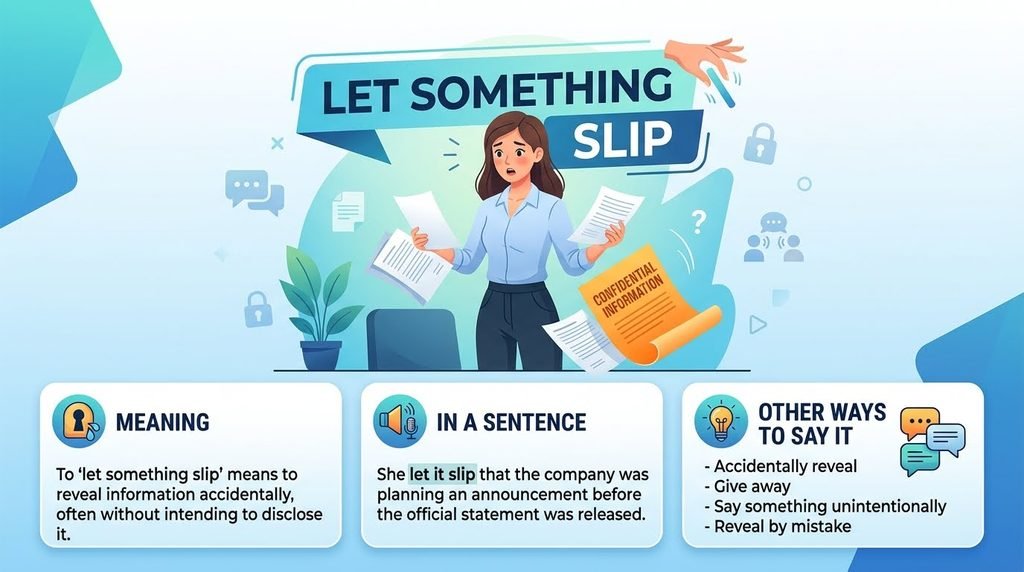
To “let something slip” means to reveal information accidentally, often without intending to disclose it.
In a Sentence
She let it slip that the company was planning an announcement before the official statement was released.
Other Ways to Say It
- Accidentally reveal
- Give away
- Say something unintentionally
- Reveal by mistake
Explanation
The image suggests that words have slipped out before the speaker could stop them. Unlike deliberate gossip, this expression often emphasizes accidental disclosure.
It can describe anything from a harmless surprise to important confidential information.
Best Use
It is natural in everyday speech, workplace conversations, fiction, personal stories, and informal writing.
The Walls Have Ears
Meaning
“The walls have ears” is a warning that someone may be listening even when you think a conversation is private.
It encourages people to be careful about what they say.
In a Sentence
Let’s discuss the contract somewhere else—the walls have ears in this office.
Other Ways to Say It
- Someone may be listening
- Be careful what you say
- You never know who can hear
- Keep your voice down
Explanation
The phrase gives an imaginary ability to walls: they can hear conversations. That unusual image makes the warning memorable.
It is especially effective when a conversation involves secrets, sensitive information, or potentially dangerous gossip.
Best Use
This idiom works well in fiction, suspenseful storytelling, conversations, speeches, and situations involving secrecy. It can also be used playfully.
Give Someone the Lowdown
Meaning
To “give someone the lowdown” means to give them the important facts or details about a situation.
Although it is not limited to gossip, it can be used when someone wants the latest details about a person or event.
In a Sentence
Give me the lowdown—what happened after I left the party?
Other Ways to Say It
- Give me the details
- Fill me in
- Tell me what happened
- Bring me up to date
Explanation
This expression is more neutral than dish the dirt. It does not automatically imply malicious gossip or a rumor.
Its strength is its conversational quality: it sounds natural when someone wants a quick explanation or update.
Best Use
Use it in casual conversations, dialogue, storytelling, workplace chats, and informal writing.
A Little Bird Told Me
Meaning
“A little bird told me” is a playful way of saying that you learned information from an unnamed source.
The speaker deliberately avoids revealing who provided the information.
In a Sentence
A little bird told me you’re getting a promotion—congratulations!
Other Ways to Say It
- I heard a little rumor
- Someone told me
- I’ve heard something
- I have it on good authority
Explanation
The expression creates a whimsical image of a tiny bird carrying news from one person to another.
It is usually lighthearted and teasing, especially when the speaker wants to keep the source secret.
Best Use
It is best suited to friendly conversations, playful messages, social media, jokes, and informal storytelling. It can sound too casual for serious professional situations.
Make Someone’s Business Public
Meaning
To “make someone’s business public” means to reveal another person’s private affairs to other people.
It can describe gossip that crosses a line by exposing information that was not meant for public discussion.
In a Sentence
There’s no reason to make his business public just because you disagree with him.
Other Ways to Say It
- Expose someone’s private life
- Reveal personal information
- Publicize someone’s affairs
- Share someone’s private matters
Explanation
Unlike a playful gossip idiom, this expression is usually serious and critical. It emphasizes the boundary between private and public information.
It is especially useful when the focus is not merely on gossip itself but on the ethics of sharing personal information.
Best Use
Use it in serious conversations, essays, opinion writing, discussions about privacy, and storytelling with a moral dimension.
Air Someone’s Dirty Laundry
Meaning
To “air someone’s dirty laundry” means to reveal someone’s private problems, embarrassing behavior, or personal troubles to other people.
It often suggests that the information should have remained private.
In a Sentence
Their disagreement was personal, and neither of them needed to air their dirty laundry on social media.
Other Ways to Say It
- Reveal private problems
- Publicize personal troubles
- Expose embarrassing details
- Make private matters public
Explanation
The expression creates an image of dirty clothes being displayed where everyone can see them. Figuratively, the private problems of a person or relationship are put on public display.
It usually has a strongly negative or critical tone.
Best Use
This idiom is effective in essays, opinion pieces, conversations, fiction, relationship discussions, and social media commentary. It is less suitable for formal professional writing.
Exercise: Practice Using Idioms
Choose the best answer for each question.
Question 1
What does “spill the beans” mean?
A. Preparing food for others
B. Letting a secret slip
C. Provoking a heated disagreement
D. Staying away from a discussion
Question 2
Which idiom describes hearing unofficial information indirectly?
A. Keep it under wraps
B. Kiss and tell
C. Loose lips sink ships
D. Hear it through the grapevine
Question 3
Someone tells a friend private details about a romantic relationship. Which expression fits best?
A. Kiss and tell
B. Talk of the town
C. Water-cooler talk
D. Give someone the lowdown
Question 4
What does “the talk of the town” suggest?
A. Nobody knows about the subject
B. A person is keeping a secret
C. Many people are discussing the subject
D. Someone has stopped talking
Question 5
Which expression warns that careless speech can cause serious problems?
A. A little bird told me
B. Loose lips sink ships
C. Word on the street
D. Spill the beans
Question 6
If someone “lets something slip,” what usually happens?
A. Information is revealed by accident
B. All the details are forgotten entirely
C. Certain facts are deliberately kept secret
D. The discussion shifts to a different topic
Question 7
Which expression is most playful when you do not want to reveal your source?
A. Air someone’s dirty laundry
B. Behind someone’s back
C. A little bird told me
D. Tell tales out of school
Question 8
What does “dish the dirt” usually involve?
A. Cleaning someone’s house
B. Sharing interesting or embarrassing gossip
C. Protecting confidential information
D. Ending a conversation
Question 9
Which expression is most directly associated with casual workplace conversation?
A. Water-cooler talk
B. Kiss and tell
C. The walls have ears
D. A little bird told me
Question 10
If someone discusses a coworker negatively while that coworker is absent, which expression fits?
A. Talk of the town
B. Keep it under wraps
C. Behind someone’s back
D. Give someone the lowdown
Question 11
Which expression means to keep information secret?
A. Spread like wildfire
B. Keep it under wraps
C. Spill the beans
D. Dish the dirt
Question 12
What does “rumor has it” communicate?
A. The information is officially confirmed
B. The speaker witnessed everything personally
C. The information is impossible
D. People are saying something that may not be confirmed
Question 13
Which sentence uses an idiom appropriately?
A. The secret was under wraps because everyone shouted it publicly.
B. She heard it through the grapevine that the store might close.
C. He spilled the beans by carefully hiding the announcement.
D. The walls have ears means nobody can hear you.
Question 14
Which idiom has the strongest connection with publicly revealing someone’s private problems?
A. Air someone’s dirty laundry
B. Give someone the lowdown
C. Word on the street
D. Talk of the town
Question 15
Why is “the walls have ears” usually figurative?
A. Buildings literally listen to conversations.
B. It describes the shape of a wall.
C. It uses an imaginary image to warn that someone may be listening.
D. It means that people should decorate their walls.
Answers
- B — “Spill the beans” means to reveal information that was supposed to remain secret.
- D — “Hear it through the grapevine” means receiving information indirectly, often through informal conversation.
- A — “Kiss and tell” refers specifically to revealing private or intimate romantic details.
- C — “The talk of the town” describes something that many people are discussing.
- B — “Loose lips sink ships” warns that careless speech can lead to serious consequences.
- A — “Let something slip” means to reveal information accidentally or unintentionally.
- C — “A little bird told me” is a playful way to mention information without identifying the source.
- B — “Dish the dirt” means to share gossip, especially interesting or potentially embarrassing information.
- A — “Water-cooler talk” describes informal conversation among coworkers.
- C — “Behind someone’s back” refers to saying or doing something when the person is absent.
- B — “Keep it under wraps” means to keep something secret or confidential.
- D — “Rumor has it” introduces information that people are saying but that has not necessarily been confirmed.
- B — The sentence correctly uses “heard it through the grapevine” to describe unofficial information.
- A — “Air someone’s dirty laundry” means exposing private problems or embarrassing personal matters publicly.
- C — The expression uses an imaginary image of walls having ears to warn that someone may be listening.
FAQs
What is an idiom for gossip?
An idiom for gossip is an established figurative expression used to describe rumors, private information, casual talk, or the sharing of information about other people. Examples include “dish the dirt,” “hear it through the grapevine,” and “water-cooler talk.”
How do I create my own idiom?
A strong original figurative expression should connect an idea with a clear, memorable image. Think about the behavior you want to describe—such as secrecy, rapid communication, or accidental disclosure—and find a concrete image that communicates that idea.
However, newly invented expressions are not automatically established idioms. An expression becomes idiomatic through repeated and recognizable use.
What makes an idiom effective?
An effective idiom creates a mental image while communicating a recognizable meaning. It should be clear in context, memorable, and appropriate for the situation. The best expression also adds a tone—such as humor, seriousness, warmth, or drama—rather than simply replacing an ordinary word.
Can I use these idioms in everyday conversation?
Yes. Many of these expressions, including “spill the beans,” “let something slip,” “rumor has it,” and “hear it through the grapevine,” are natural in informal English.
Some, such as “tell tales out of school,” may sound old-fashioned, while “air someone’s dirty laundry” can sound strongly critical.
What is the difference between an idiom and a simile?
An idiom is an established expression whose figurative meaning is understood as a unit. A simile directly compares two things using words such as “like” or “as.”
For example, “spill the beans” is an idiom. “The rumor spread like wildfire” contains a simile because it directly compares the spread of the rumor with the spread of wildfire.
Conclusion
Idioms can turn an ordinary discussion about gossip into language that is clearer, more colorful, and more memorable. Expressions such as “spill the beans” emphasize revealing a secret, while “hear it through the grapevine” focuses on unofficial information traveling from person to person. Others, such as “loose lips sink ships” and “air someone’s dirty laundry,” highlight the possible consequences of careless or inappropriate sharing.
The most effective choice depends on the situation. A playful conversation may call for “a little bird told me,” while a serious discussion about privacy may be better served by “make someone’s business public.” Understanding these differences helps you communicate with greater precision and personality. When talking about gossip, choose an expression that matches not only the information but also the feeling and context behind it.