

Have you ever noticed how rain can change the mood, atmosphere, and language around you? The 20 Idioms for Rain With Real Examples guide explores colorful expressions that describe weather, emotions, situations, and everyday experiences. These rain idioms make conversations more vivid while helping learners understand natural English usage. They also show how figurative language can communicate ideas beyond literal descriptions.
From gentle showers to heavy downpours, rain appears in many expressions used in everyday English. You may encounter these phrases in conversations, formal writing, business communication, meetings, or creative storytelling. They can even add natural context to scheduling, time management, calendar planning, and project management when weather affects daily activities. Learning the right expression also strengthens vocabulary, grammar, and communication consistency.
In this article, you will discover 20 useful idioms connected with rain and rainy weather, each explained with real examples. You will learn their meanings, alternative expressions, and the situations where they sound most natural. The examples also demonstrate how these idioms work in communication related to online booking, broadcasting, and everyday planning. By the end, you will have practical expressions that make your English more expressive, natural, and engaging.
What Is an Idiom?
An idiom is a fixed or commonly recognized expression whose overall meaning cannot always be understood by taking each word literally.
For example, “break the ice” does not usually mean physically breaking ice. It means to make people feel more comfortable when they first meet.
Likewise, “hit the nail on the head” does not necessarily involve a real nail. It means to say or do something exactly right.
This is what makes idioms different from literal statements. Literal language says exactly what it means, while idiomatic language often uses figurative meaning, imagery, and cultural familiarity to communicate an idea.
Why Use Idioms for Rain?
Rain provides a surprisingly rich subject for figurative language. A simple shower can represent difficulty, relief, persistence, inconvenience, renewal, or even an unexpected change of plans.
Using idioms about rain can help you:
- Express feelings about difficult or pleasant situations.
- Make descriptions more vivid and memorable.
- Turn an ordinary weather observation into a stronger image.
- Explain abstract ideas through familiar comparisons.
- Add personality to conversations and storytelling.
- Make creative writing and personal messages more expressive.
- Communicate complicated situations in a short, familiar phrase.
Some expressions are suitable for everyday conversation, while others sound more poetic, humorous, dramatic, or proverbial. Knowing that difference helps you choose an expression that fits your message naturally.
Quick List of 20 Idioms
- Raining Cats and Dogs
- Save for a Rainy Day
- Come Rain or Shine
- Right as Rain
- Rain on Someone’s Parade
- Take a Rain Check
- When It Rains, It Pours
- Every Cloud Has a Silver Lining
- April Showers Bring May Flowers
- Fair-Weather Friend
- Under the Weather
- Storm in a Teacup
- Weather the Storm
- Steal Someone’s Thunder
- Calm Before the Storm
- A Storm Is Brewing
- After the Storm Comes the Calm
- Make Hay While the Sun Shines
- Come in Out of the Rain
- Rain or Shine
Raining Cats and Dogs
Read more:20 Idioms for Sleep With Real Examples
Meaning
“Raining cats and dogs” means that rain is falling very heavily. It is a humorous idiomatic expression rather than a literal description of animals falling from the sky.
In a Sentence
We had planned to walk home, but it started raining cats and dogs before we even reached the corner.
Other Ways to Say It
- Pouring with rain
- Raining heavily
- Coming down in buckets
- A torrential downpour
Explanation
The expression creates an exaggerated, almost cartoon-like picture of an extremely heavy downpour. It is useful when ordinary words such as “raining hard” do not capture the intensity.
Because it sounds playful, it works particularly well in casual conversation, storytelling, and humorous writing.
Best Use
Use it in informal conversations, stories, children’s writing, and lighthearted descriptions. It can sound too playful for formal weather reports.
Save for a Rainy Day
Meaning
“Save for a rainy day” means to keep money, supplies, or resources for a future difficult or unexpected time.
In a Sentence
My grandfather always told me to save part of every paycheck for a rainy day.
Other Ways to Say It
- Keep something in reserve
- Prepare for a difficult time
- Build an emergency fund
- Put something aside for later
Explanation
Here, rain represents a period of trouble or uncertainty. The expression encourages preparation before difficulties arrive.
The phrase is especially useful when discussing money, savings, resources, or practical preparation rather than describing actual weather.
Best Use
It fits everyday conversations, financial advice, personal writing, and practical discussions. It is less about the weather itself and more about being prepared for life’s storms.
Come Rain or Shine
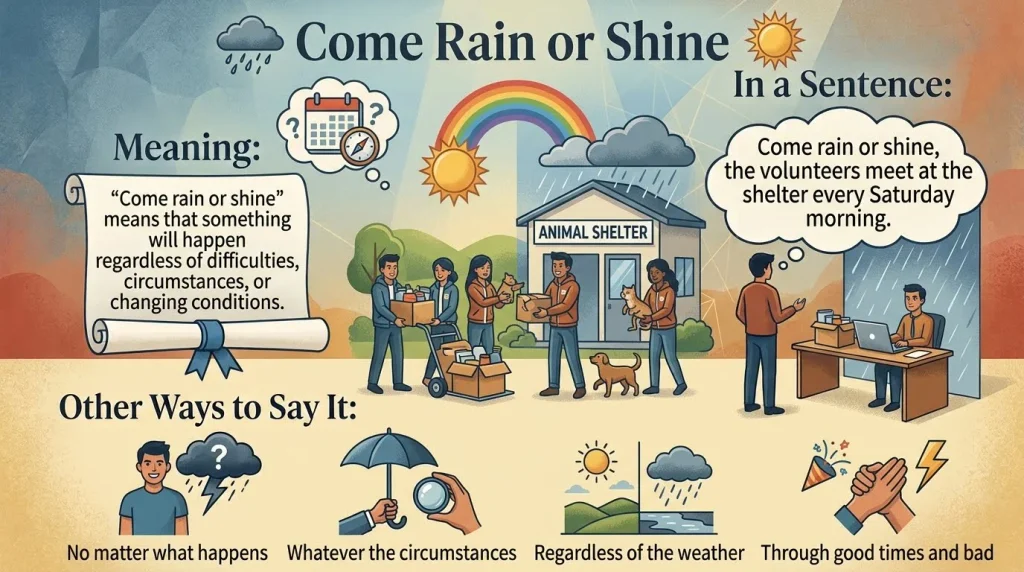
Meaning
“Come rain or shine” means that something will happen regardless of difficulties, circumstances, or changing conditions.
In a Sentence
Come rain or shine, the volunteers meet at the shelter every Saturday morning.
Other Ways to Say It
- No matter what happens
- Whatever the circumstances
- Regardless of the weather
- Through good times and bad
Explanation
The contrast between rain and sunshine represents changing conditions. The speaker is emphasizing reliability and determination.
It can sound warm and encouraging when used to describe someone’s commitment to another person or a cause.
Best Use
This expression works naturally in conversations, speeches, storytelling, personal messages, and inspirational writing.
Right as Rain
Meaning
“Right as rain” means feeling healthy, well, or completely fine, especially after feeling unwell.
In a Sentence
After a quiet weekend and plenty of rest, Dad was right as rain again by Monday.
Other Ways to Say It
- Feeling fine
- Back to normal
- Fit as a fiddle
- Feeling good again
Explanation
The phrase uses the familiar regularity of rain as a picture of being in a proper or satisfactory condition.
It is generally friendly and reassuring, making it useful when someone has recovered from a minor illness or problem.
Best Use
Use it in casual conversations, family messages, friendly storytelling, and informal writing. It is more conversational than professional.
Rain on Someone’s Parade
Meaning
To “rain on someone’s parade” means to spoil someone’s happiness, excitement, plans, or enjoyment.
In a Sentence
I don’t want to rain on your parade, but you should check the train schedule before celebrating.
Other Ways to Say It
- Spoil someone’s fun
- Put a damper on something
- Take the excitement out of something
- Throw cold water on an idea
Explanation
The image is easy to imagine: someone is enjoying a parade, and unexpected rain ruins the experience.
The expression is usually playful or mildly critical, although the situation itself may be disappointing.
Best Use
It works well in conversations, social posts, storytelling, and informal writing when discussing disappointing news or unwanted criticism.
Take a Rain Check
Meaning
To “take a rain check” means to politely postpone an invitation, activity, or plan with the suggestion that you may do it another time.
In a Sentence
Thanks for inviting me to dinner, but I’m exhausted tonight. Can I take a rain check?
Other Ways to Say It
- Do it another time
- Postpone the plan
- Reschedule
- Put it off until later
Explanation
The phrase originally connects with the idea of postponing an outdoor event because of rain. Today, it is commonly used even when weather has nothing to do with the situation.
It is a polite and casual way to decline something temporarily without rejecting it permanently.
Best Use
Use it in everyday conversations, text messages, friendly emails, and informal invitations.
When It Rains, It Pours
Meaning
“When it rains, it pours” means that when one problem happens, several other problems often seem to follow quickly.
In a Sentence
First my car broke down, then I lost my wallet—when it rains, it pours.
Other Ways to Say It
- Problems seem to come all at once
- One thing leads to another
- Trouble comes in waves
- Everything went wrong at once
Explanation
The expression compares a difficult period in life with a downpour that becomes much heavier than an ordinary shower.
It captures the feeling of being overwhelmed by several setbacks at once, often with a touch of humor or resignation.
Best Use
It is effective in conversations, personal stories, social media posts, and informal writing about frustrating circumstances.
Every Cloud Has a Silver Lining
Meaning
“Every cloud has a silver lining” means that even a difficult or disappointing situation may contain something positive.
In a Sentence
Missing the flight was frustrating, but every cloud has a silver lining—we found a wonderful little café while waiting for the next one.
Other Ways to Say It
- Look for the positive
- Something good may come from it
- There is a bright side
- Find the lesson in the setback
Explanation
The image comes from a dark cloud appearing to have a bright edge when sunlight shines behind it. Rain and clouds therefore become symbols of difficulty with hope hidden inside the situation.
It is especially effective when you want to sound encouraging without pretending that a problem is not real.
Best Use
This expression works well in speeches, personal messages, inspirational writing, conversations, and reflective essays.
April Showers Bring May Flowers
Meaning
“April showers bring May flowers” expresses the idea that temporary difficulties or effort can lead to something beautiful or rewarding later.
In a Sentence
The long months of training were exhausting, but April showers bring May flowers—the hard work finally paid off.
Other Ways to Say It
- Hard work brings rewards
- Difficult times can lead to better days
- Good things take time
- Patience can bring results
Explanation
The literal image connects spring rain with the growth of flowers. Figuratively, it suggests that uncomfortable or challenging periods can contribute to future growth and success.
It has a distinctly hopeful and poetic quality.
Best Use
Use it in motivational writing, speeches, cards, reflective essays, and conversations about patience or perseverance.
Fair-Weather Friend
Meaning
A “fair-weather friend” is someone who stays around when life is easy but disappears when you need genuine support during difficult times.
In a Sentence
She discovered who her true friends were after the business failed; a fair-weather friend rarely stays when things become difficult.
Other Ways to Say It
- A friend only in good times
- An unreliable friend
- A conditional friend
- Someone who disappears during trouble
Explanation
“Fair weather” represents pleasant circumstances, while storms represent hardship. The phrase creates a clear contrast between easy times and difficult times.
It can sound critical, so it should be used carefully when describing a real person.
Best Use
It fits conversations, essays, storytelling, and reflective writing about friendship, loyalty, and character.
Under the Weather
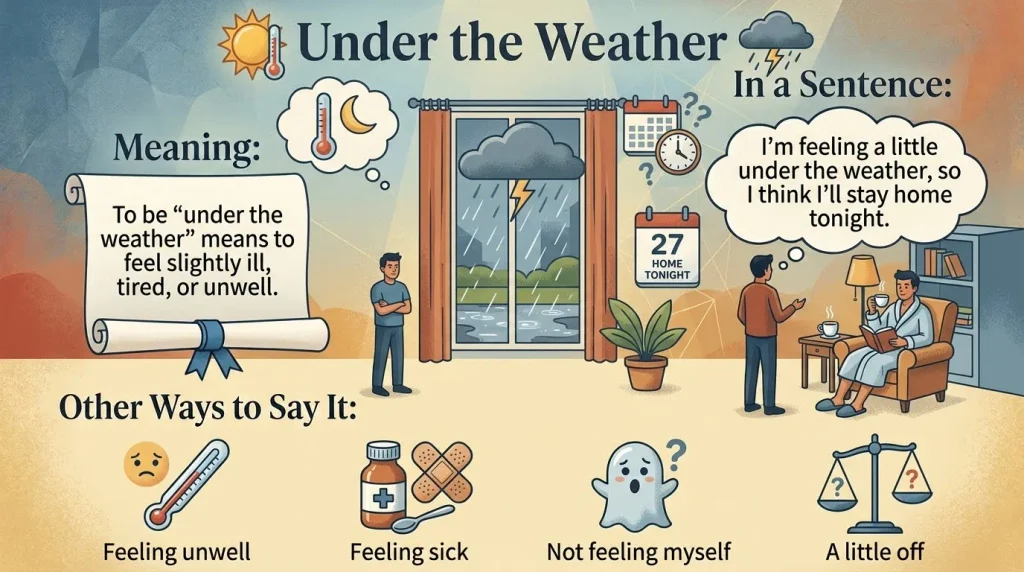
Meaning
To be “under the weather” means to feel slightly ill, tired, or unwell.
In a Sentence
I’m feeling a little under the weather, so I think I’ll stay home tonight.
Other Ways to Say It
- Feeling unwell
- Feeling sick
- Not feeling myself
- A little off
Explanation
The phrase creates the imaginative picture of being physically beneath unpleasant weather. It is a familiar way of describing minor illness without sounding overly dramatic.
It usually suggests something mild rather than a serious medical condition.
Best Use
Use it in casual conversations, messages, informal emails, and everyday storytelling.
Storm in a Teacup
Meaning
A “storm in a teacup” describes a situation in which people become very upset about a small or unimportant problem.
In a Sentence
The argument over who should choose the restaurant was a storm in a teacup.
Other Ways to Say It
- A fuss over nothing
- An overreaction
- A minor issue made dramatic
- Much ado about little
Explanation
The contrast is deliberately humorous: a storm is enormous, but a teacup is tiny. Putting them together suggests big emotions surrounding a very small issue.
The expression is especially useful when you want to gently point out that a disagreement has become unnecessarily dramatic.
Best Use
It works well in conversations, opinion writing, storytelling, and light criticism. It can sound somewhat playful.
Weather the Storm
Meaning
To “weather the storm” means to survive or endure a difficult period or challenging situation.
In a Sentence
The small company managed to weather the storm and eventually returned to steady growth.
Other Ways to Say It
- Get through a difficult time
- Endure the crisis
- Ride out the problem
- Survive the setback
Explanation
A storm becomes a metaphor for hardship, while successfully getting through it represents resilience and endurance.
The expression has a serious but encouraging tone and can apply to personal, financial, professional, or social difficulties.
Best Use
Use it in speeches, essays, business writing, conversations, and motivational contexts.
Steal Someone’s Thunder
Meaning
To “steal someone’s thunder” means to take attention, praise, credit, or excitement away from someone by revealing or doing something first.
In a Sentence
I was about to announce the new project, but my colleague stole my thunder by sharing the news first.
Other Ways to Say It
- Take the spotlight
- Upstage someone
- Take away someone’s moment
- Get the credit first
Explanation
Thunder suggests dramatic sound and attention, so “stealing” it creates an image of taking away another person’s dramatic moment.
It is generally informal and expressive, and it can be used humorously when someone unintentionally takes the spotlight.
Best Use
This phrase is useful in conversations, workplace stories, social situations, and informal writing.
Calm Before the Storm
Meaning
The “calm before the storm” is a peaceful or quiet period that comes before an expected period of trouble, excitement, or intense activity.
In a Sentence
The office was unusually quiet that morning—the calm before the storm before the conference began.
Other Ways to Say It
- A quiet period before trouble
- Temporary peace
- The silence before chaos
- A pause before intense activity
Explanation
The expression creates a strong visual contrast: still air and quiet surroundings before a powerful storm arrives.
It can be used literally for weather, but its figurative meaning is especially effective for dramatic situations and storytelling.
Best Use
Use it in storytelling, creative writing, conversations, speeches, and dramatic descriptions.
A Storm Is Brewing
Meaning
When “a storm is brewing,” it means that trouble, conflict, or an intense situation appears to be developing.
In a Sentence
The two departments have been arguing for weeks, and it feels like a storm is brewing.
Other Ways to Say It
- Trouble is developing
- Conflict is building
- Something is about to happen
- Tension is rising
Explanation
A brewing storm suggests that something powerful is forming before it becomes obvious or unavoidable.
The phrase is useful for creating tension and anticipation, particularly when describing conflict.
Best Use
It works especially well in storytelling, journalism-style writing, conversations, and dramatic or creative prose.
After the Storm Comes the Calm
Meaning
“After the storm comes the calm” expresses the idea that peace or relief can follow a difficult period.
In a Sentence
The project was exhausting, but after the storm comes the calm, and the team can finally enjoy some quiet time.
Other Ways to Say It
- Difficult times eventually pass
- Peace follows hardship
- Things will settle down
- Relief comes after struggle
Explanation
The image moves from violent weather toward stillness. It provides a reassuring reminder that intense periods do not last forever.
This expression has a reflective and hopeful quality, making it more suitable for thoughtful writing than quick casual conversation.
Best Use
Use it in motivational messages, reflective essays, speeches, poetry, and personal writing.
Make Hay While the Sun Shines
Meaning
“Make hay while the sun shines” means to take advantage of a good opportunity while favorable conditions last.
In a Sentence
The weather is perfect for painting the house, so let’s make hay while the sun shines.
Other Ways to Say It
- Take advantage of the opportunity
- Use the good conditions
- Act while the chance is available
- Make the most of the moment
Explanation
Hay needs suitable dry weather for harvesting, so the literal image encourages people to work while conditions are favorable.
Figuratively, it is about timing, opportunity, and practical action.
Best Use
It works well in conversations, advice, business discussions, essays, and motivational writing.
Come in Out of the Rain
Meaning
To “come in out of the rain” can literally mean moving indoors to escape wet weather. Figuratively, it can suggest leaving an uncomfortable, difficult, or exposed situation.
In a Sentence
You’ve been dealing with that argument all afternoon; sometimes it’s better to come in out of the rain and give yourself some space.
Other Ways to Say It
- Step away from the trouble
- Find shelter from the problem
- Remove yourself from the situation
- Give yourself a break
Explanation
The phrase creates a simple image of someone standing outside in unpleasant rain and choosing to seek shelter.
Its figurative use is more context-dependent and poetic than some of the better-known rain idioms, so it should not be treated as a fixed idiom in every situation.
Best Use
It works best in creative writing, reflective prose, storytelling, and metaphorical personal messages. For formal writing, a clearer literal expression may be preferable.
Rain or Shine
Meaning
“Rain or shine” means that something will happen whether conditions are favorable or unfavorable.
In a Sentence
The charity run will take place rain or shine.
Other Ways to Say It
- Whatever the weather
- No matter what happens
- Under any conditions
- Regardless of circumstances
Explanation
The expression places rain and sunshine at opposite ends of the weather spectrum. Together, they represent all possible conditions.
It is concise, familiar, and usually confident rather than dramatic.
Best Use
Use it in announcements, conversations, event descriptions, advertisements, personal messages, and everyday writing.
Exercise: Practice Using Idioms
Choose the best answer for each question.
What does “raining cats and dogs” mean?
A. Animals are outside in the rain.
B. It is raining very heavily.
C. The weather is becoming warmer.
D. The rain has completely stopped.
Which expression means saving something for a difficult future situation?
A. Save for a rainy day
B. Steal someone’s thunder
C. Right as rain
D. Take a rain check
Someone says, “Come rain or shine, I’ll be there.” What do they mean?
A. They only come when the weather is sunny.
B. They are waiting for a weather forecast.
C. They will come regardless of the circumstances.
D. They expect the event to be canceled.
Which expression means feeling slightly ill?
A. Weather the storm
B. Under the weather
C. Rain on someone’s parade
D. Fair-weather friend
If someone rains on your parade, what have they done?
A. Helped you celebrate.
B. Changed the weather.
C. Improved your plans.
D. Spoiled your enjoyment or excitement.
What does “take a rain check” usually mean in modern conversation?
A. Check whether rain is expected.
B. Refuse an invitation permanently.
C. Postpone something until another time.
D. Accept an invitation immediately.
Which expression describes several problems arriving one after another?
A. When it rains, it pours.
B. Right as rain.
C. Make hay while the sun shines.
D. Rain or shine.
A “fair-weather friend” is someone who:
A. Loves outdoor activities.
B. Only supports you when things are easy.
C. Always predicts the weather.
D. Enjoys rainy afternoons.
What does “weather the storm” mean figuratively?
A. Predict bad weather.
B. Avoid going outside.
C. Survive or endure a difficult period.
D. Make a storm disappear.
Which expression suggests that a difficult situation may contain something positive?
A. Every cloud has a silver lining.
B. Storm in a teacup.
C. Steal someone’s thunder.
D. A storm is brewing.
If a disagreement is described as a “storm in a teacup,” what does that suggest?
A. It is a serious natural disaster.
B. It is a large problem with no solution.
C. It is a small issue that has caused too much drama.
D. It is caused by bad weather.
What does “steal someone’s thunder” mean?
A. Make loud noises during a storm.
B. Take attention or credit away from someone.
C. Prevent rain from falling.
D. Predict a change in weather.
Which phrase describes a quiet period before expected trouble or intense activity?
A. Right as rain
B. Save for a rainy day
C. Calm before the storm
D. Rain or shine
What does “April showers bring May flowers” suggest figuratively?
A. Rain always damages gardens.
B. Difficult periods or effort can lead to positive results.
C. Spring weather is always predictable.
D. Flowers only grow during storms.
Which expression encourages someone to use a good opportunity while it lasts?
A. Make hay while the sun shines
B. Under the weather
C. Rain on someone’s parade
D. Take a rain check
Answers
- B — “Raining cats and dogs” is an exaggerated expression for very heavy rain.
- A — “Save for a rainy day” means keeping resources for a future difficulty or unexpected need.
- C — “Come rain or shine” means doing something regardless of changing conditions.
- B — “Under the weather” means feeling slightly unwell or not quite yourself.
- D — To “rain on someone’s parade” means to spoil their happiness, plans, or excitement.
- C — “Take a rain check” means postponing an invitation or activity until another time.
- A — “When it rains, it pours” describes several problems or events happening at once.
- B — A fair-weather friend supports someone mainly when circumstances are easy.
- C — “Weather the storm” means successfully enduring a difficult period.
- A — “Every cloud has a silver lining” expresses hope that something positive can exist within a difficult situation.
- C — A “storm in a teacup” is a small problem that has generated an unnecessarily large reaction.
- B — “Steal someone’s thunder” means taking attention, excitement, or credit away from another person.
- C — The “calm before the storm” is a peaceful period preceding trouble or intense activity.
- B — The proverb suggests that difficult periods or effort can eventually lead to growth or better results.
- A — “Make hay while the sun shines” means taking advantage of favorable conditions or opportunities.
FAQs
What is an idiom for rain?
An idiom for rain is a familiar expression that uses rain, storms, clouds, sunshine, or weather imagery to communicate a meaning beyond literal weather. Examples include “raining cats and dogs,” “save for a rainy day,” and “rain on someone’s parade.”
How do I create my own idiom?
Creating a convincing idiom takes more than replacing one noun with another. Start with a clear image, connect it to a recognizable human experience, and make sure the figurative meaning is easy to understand from context. A strong expression should feel natural rather than forced.
What makes an idiom effective?
An effective idiom creates a memorable mental picture while communicating an idea efficiently. Familiar imagery, emotional clarity, and natural wording make an expression easier to understand and remember.
Can I use these rain idioms in everyday conversation?
Yes, many of them are common in everyday English. Expressions such as “take a rain check,” “under the weather,” “rain on someone’s parade,” and “raining cats and dogs” are especially natural in informal conversation. Some expressions, such as “April showers bring May flowers,” have a more proverbial or poetic tone.
What is the difference between an idiom and a simile?
An idiom is a recognized expression with a figurative meaning, such as “under the weather.” A simile directly compares two things using words such as “like” or “as,” for example, “the rain fell like a curtain.” Idioms are generally established expressions, while similes can be created freely.
Conclusion
Rain gives English an impressive range of images for talking about much more than weather. It can represent difficulty, persistence, disappointment, recovery, opportunity, conflict, and hope. Expressions such as “weather the storm” help us describe resilience, while “take a rain check” gives us a polite way to postpone a plan. Others, such as “raining cats and dogs,” simply make everyday descriptions more colorful.
The best idiom depends on the feeling and situation you want to communicate. A playful expression may work perfectly in conversation but feel out of place in formal writing. A more poetic phrase may be ideal for a story or personal reflection. Choose imagery that feels natural, clear, and purposeful and let the language fall as naturally as rain.

Margaret Saywell is an English author and editor who has spent more than fifteen years working with words teaching, proofreading, and writing about the quirks of the English language.
At Idiom Looms, Margaret gathers idioms from across the English-speaking world and weaves them into clear, practical guides. She loves digging into the history of a phrase and showing readers how a few well-chosen words can say far more than a long explanation.
She believes language should be enjoyed, not feared and that the best way to learn an idiom is to see it in action.



[…] Read more:20 Idioms for Rain With Real Examples […]