

Have you noticed how weather can shape a conversation, mood, or daily plan? The 20 Idioms for Weather With Real Examples explores colorful expressions that make everyday English more vivid and natural. Weather-related idioms often describe emotions, situations, challenges, and changing circumstances without sounding overly literal. You’ll discover expressions that work naturally in conversations, storytelling, English usage, and formal writing. Each idiom includes a clear meaning and practical example to help you understand its figurative sense. These expressions can also strengthen descriptive language, improve communication, and make your writing more engaging.
Weather affects more than outdoor plans. It can influence scheduling, time management, meetings, and calendar decisions. In professional settings, weather expressions can add personality to business communication while keeping conversations natural. They may also appear in online booking, broadcasting, travel discussions, and project management contexts. Learning these phrases helps you recognize figurative meanings instead of interpreting every expression literally. With practical examples, you can see how native speakers use weather idioms across different situations and levels of communication.
This guide focuses on 20 useful weather idioms with straightforward explanations and real-world examples. You’ll learn how each expression works, when it sounds appropriate, and which alternatives can convey a similar idea. The examples support better grammar, vocabulary development, and consistency in everyday English. Whether you are improving conversation skills, preparing written content, or studying figurative language, these idioms offer useful ways to express ideas naturally. By understanding their meanings and contexts, you can communicate with greater clarity, confidence, and creativity.
What Is an Idiom?
An idiom is a fixed expression whose overall meaning cannot always be understood by taking every word literally.
For example, “break the ice” does not mean physically breaking ice. It means to make people feel more comfortable when they first meet. Likewise, “spill the beans” means to reveal a secret, not to drop beans on the floor.
A literal statement describes something directly. An idiom uses figurative language to communicate an idea through an image, comparison, or familiar expression.
Why Use Idioms for Weather?
Weather gives English speakers a rich source of figurative imagery. Rain, clouds, wind, sunshine, storms, and changing skies can represent experiences that have nothing to do with the actual forecast.
Weather idioms can help you:
- Express emotions such as happiness, worry, sadness, or uncertainty.
- Make descriptions more vivid and memorable.
- Explain difficult or abstract situations through familiar images.
- Add personality to conversations and personal messages.
- Make creative writing and storytelling more engaging.
- Communicate complicated feelings in a short, recognizable phrase.
- Give ordinary descriptions a more poetic or expressive quality.
Quick List of 20 Weather Idioms
- Under the weather
- Come rain or shine
- Save for a rainy day
- Every cloud has a silver lining
- Weather the storm
- Fair-weather friend
- Take a rain check
- Rain cats and dogs
- A storm in a teacup
- Steal someone’s thunder
- On cloud nine
- Head in the clouds
- Throw caution to the wind
- Get wind of something
- Know which way the wind is blowing
- The calm before the storm
- Snowed under
- Chase rainbows
- A ray of sunshine
- A breath of fresh air
Under the Weather
Read more:20 Idioms for Rain With Real Examples
Meaning
“Under the weather” means feeling unwell, tired, or slightly sick. It is usually used for minor illness rather than a serious medical condition.
In a Sentence
I’m feeling a little under the weather, so I think I’ll stay home tonight.
Other Ways to Say It
- Feeling a bit unwell
- Not feeling myself
- Feeling poorly
- A little off
Explanation
The expression creates the image of someone being weighed down by unpleasant weather. Its meaning is not literal; it refers to a person’s physical or general condition.
It is especially natural in casual conversation and friendly messages.
Best Use
Use this idiom in everyday conversations, personal messages, and informal writing. It is friendly and understated rather than dramatic.
Come Rain or Shine
Meaning
“Come rain or shine” means something will happen regardless of difficulties or circumstances.
In a Sentence
Come rain or shine, our family meets at the park every Sunday morning.
Other Ways to Say It
- No matter what happens
- Whatever the circumstances
- Through good times and bad
- Regardless of the situation
Explanation
The phrase contrasts rain with sunshine to represent changing conditions. It suggests reliability, determination, or commitment even when circumstances are unfavorable.
Its tone can be warm and reassuring when describing a person who keeps a promise.
Best Use
It works well in speeches, personal writing, conversations, and inspirational messages.
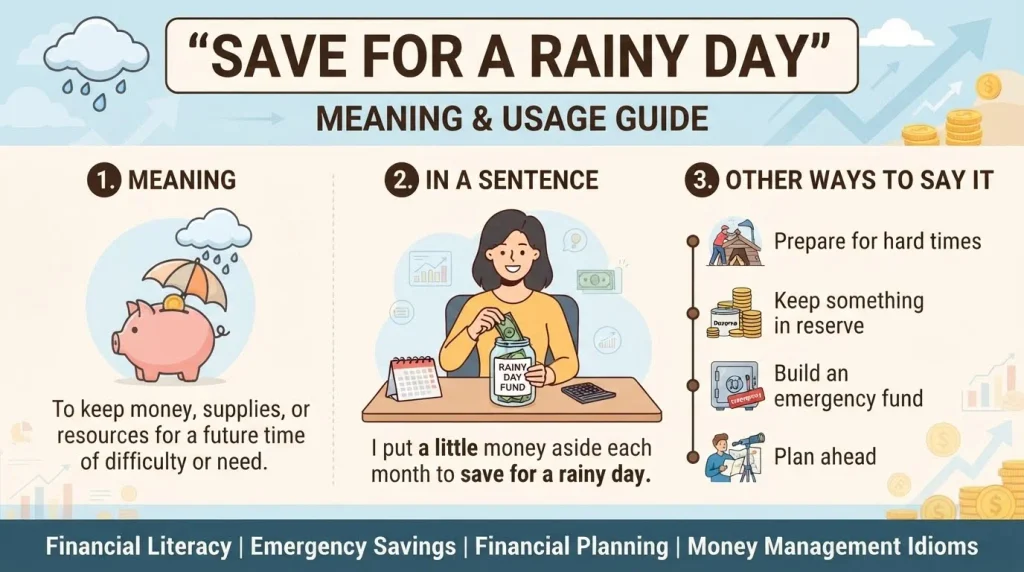
Save for a Rainy Day
Meaning
“Save for a rainy day” means to keep money, supplies, or resources for a future time of difficulty or need.
In a Sentence
I put a little money aside each month to save for a rainy day.
Other Ways to Say It
- Prepare for hard times
- Keep something in reserve
- Build an emergency fund
- Plan ahead
Explanation
The “rainy day” represents a difficult period that may arrive unexpectedly. The expression turns financial or practical preparation into a simple weather image.
It is useful because the metaphor makes the idea of being prepared before trouble arrives easy to understand.
Best Use
This idiom fits financial advice, everyday conversations, essays, and practical discussions.
Every Cloud Has a Silver Lining
Meaning
“Every cloud has a silver lining” means that even a difficult situation may contain something positive or hopeful.
In a Sentence
Losing that job was painful, but it led me to a career I enjoy; every cloud has a silver lining.
Other Ways to Say It
- Something good may come from it
- Look for the positive
- There is hope in difficulty
- Find the bright side
Explanation
The image comes from sunlight appearing around the edge of a dark cloud. The cloud represents a problem, while the bright edge represents a possible benefit.
The expression has an optimistic and encouraging tone, although it can sound insensitive if used too quickly after someone experiences serious loss.
Best Use
Use it in encouraging conversations, speeches, personal reflections, and inspirational writing.
Weather the Storm
Meaning
“Weather the storm” means to survive and continue through a difficult period or serious challenge.
In a Sentence
The company had a difficult year, but careful planning helped it weather the storm.
Other Ways to Say It
- Get through a difficult period
- Survive the crisis
- Stand firm
- Ride out the difficulties
Explanation
A storm is dangerous and unpredictable, so surviving one creates a strong image of resilience under pressure. The expression focuses less on avoiding difficulty and more on enduring it.
It can sound serious and determined, making it useful when discussing prolonged challenges.
Best Use
It works especially well in business writing, speeches, news-style writing, and serious conversations.
Fair-Weather Friend
Meaning
A “fair-weather friend” is someone who stays close when life is easy but disappears when you need support during difficult times.
In a Sentence
When I lost my job, I discovered that one of my supposed friends was only a fair-weather friend.
Other Ways to Say It
- An unreliable friend
- A friend only in good times
- Someone who disappears during trouble
- A conditional friend
Explanation
The phrase compares friendship with pleasant weather. A fair-weather friend is present when conditions are comfortable but not when a storm arrives.
It carries a critical or disappointed tone, so it is better suited to reflective writing and serious conversation than cheerful small talk.
Best Use
Use it in personal stories, essays, conversations, and discussions about relationships.
Take a Rain Check
Meaning
“Take a rain check” means to politely postpone an invitation or plan and possibly do it at another time.
In a Sentence
I’d love to come for dinner, but I’m exhausted tonight. Can I take a rain check?
Other Ways to Say It
- Postpone it
- Do it another time
- Reschedule
- Put it off for now
Explanation
The expression originally relates to postponing an outdoor event because of rain. Today, it is commonly used when someone cannot accept an invitation but would like another opportunity.
It sounds friendly and informal, especially in spoken American English.
Best Use
It is best for casual conversations, invitations, texts, and personal messages.
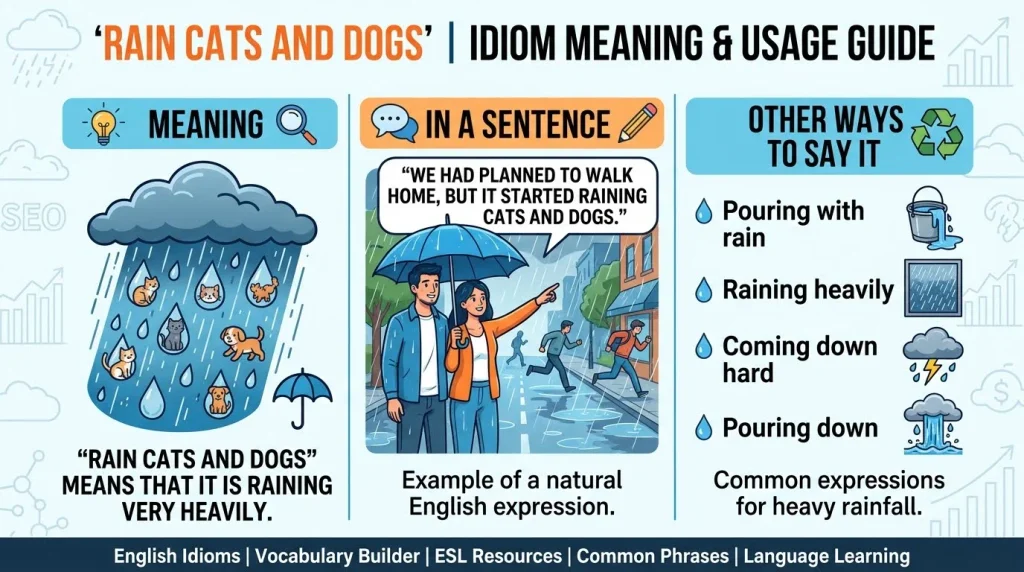
Rain Cats and Dogs
Meaning
“Rain cats and dogs” means that it is raining very heavily.
In a Sentence
We had planned to walk home, but it started raining cats and dogs.
Other Ways to Say It
- Pouring with rain
- Raining heavily
- Coming down hard
- Pouring down
Explanation
This is a vivid example of figurative language because the words create an exaggerated and memorable picture. It does not literally mean animals are falling from the sky.
The expression has a playful, colorful quality, although “raining heavily” may sound more natural in formal writing.
Best Use
Use it in casual conversation, storytelling, children’s writing, and playful descriptions.
A Storm in a Teacup
Meaning
“A storm in a teacup” describes a big argument or dramatic reaction over a small problem.
In a Sentence
Their disagreement over the seating plan was really a storm in a teacup.
Other Ways to Say It
- A fuss over nothing
- An exaggerated reaction
- Much ado about little
- A minor issue made dramatic
Explanation
The phrase places the powerful image of a storm inside something as small and ordinary as a teacup. That contrast makes the idea of unnecessary drama immediately understandable.
The British expression is often humorous or mildly dismissive.
Best Use
It works well in conversations, opinion writing, storytelling, and light criticism.
Steal Someone’s Thunder
Meaning
“Steal someone’s thunder” means to take attention, praise, or credit away from someone, especially by announcing something before they can.
In a Sentence
I was going to announce my promotion at dinner, but my brother stole my thunder by telling everyone first.
Other Ways to Say It
- Take the spotlight
- Upstage someone
- Take credit
- Take attention away
Explanation
The word “thunder” represents dramatic attention or impact. If someone steals it, they take away the effect another person hoped to create.
The expression can be playful or mildly annoyed, depending on the situation.
Best Use
Use it in conversations, storytelling, workplace discussions, and social situations.
On Cloud Nine
Meaning
“On cloud nine” means feeling extremely happy, excited, or delighted.
In a Sentence
After hearing that he had been accepted into his dream university, he was on cloud nine.
Other Ways to Say It
- Extremely happy
- Over the moon
- Walking on air
- Delighted
Explanation
The expression imagines happiness as being high above the ground among the clouds. It communicates a feeling of emotional elevation and excitement.
This is a warm and cheerful idiom that works naturally in many informal situations.
Best Use
It is suitable for conversations, personal messages, storytelling, social media, and informal writing.
Head in the Clouds
Meaning
“Head in the clouds” describes someone who is dreamy, distracted, or not paying enough attention to reality.
In a Sentence
He spends so much time imagining future adventures that he sometimes has his head in the clouds.
Other Ways to Say It
- Lost in thought
- Daydreaming
- Not focused
- Out of touch with reality
Explanation
The image suggests that someone’s thoughts have floated upward into the clouds while their body remains on the ground.
It can be gentle and affectionate when describing a dreamer, but it can also suggest impractical thinking.
Best Use
Use it in casual conversation, character descriptions, storytelling, and creative writing.
Throw Caution to the Wind
Meaning
“Throw caution to the wind” means to stop worrying about possible risks and act boldly or spontaneously.
In a Sentence
We had planned everything carefully, but at the last minute we threw caution to the wind and took the road trip.
Other Ways to Say It
- Take a risk
- Act boldly
- Let go of your worries
- Take a chance
Explanation
Wind can carry something away suddenly, creating an image of deliberately releasing your usual caution. The expression often suggests adventure, spontaneity, or reckless confidence.
It does not always praise the decision; context determines whether the action seems brave or unwise.
Best Use
It fits storytelling, motivational writing, personal reflections, and informal conversations.
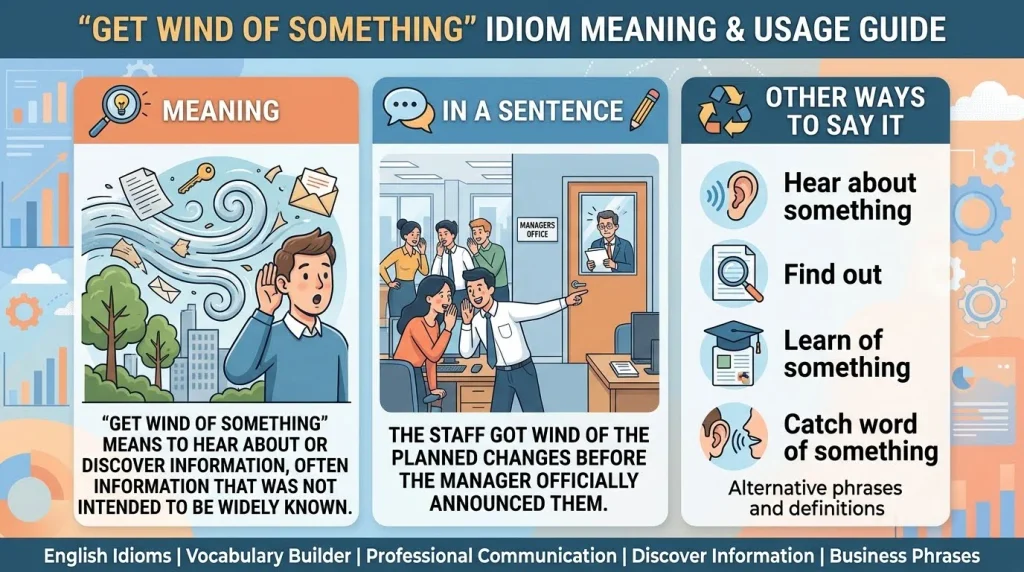
Get Wind of Something
Meaning
“Get wind of something” means to hear about or discover information, often information that was not intended to be widely known.
In a Sentence
The staff got wind of the planned changes before the manager officially announced them.
Other Ways to Say It
- Hear about something
- Find out
- Learn of something
- Catch word of something
Explanation
The expression treats information like something carried invisibly by the wind. Once the information reaches you, you have “got wind” of it.
It can suggest that the information was unofficial, unexpected, or quietly circulating.
Best Use
Use it in conversations, journalism-style writing, storytelling, and informal workplace discussions.
Know Which Way the Wind Is Blowing
Meaning
“Know which way the wind is blowing” means to understand how a situation is developing or what people’s opinions are likely to be.
In a Sentence
Before proposing the new policy, the manager wanted to know which way the wind was blowing among the employees.
Other Ways to Say It
- Read the situation
- Gauge public opinion
- Understand the mood
- See where things are heading
Explanation
Someone who watches the wind can tell which direction conditions are moving. Figuratively, the expression describes someone who pays attention to changing attitudes, opinions, or circumstances.
It can suggest practical awareness rather than simple prediction.
Best Use
It works well in business conversations, political discussions, essays, and situations involving changing opinions.
The Calm Before the Storm
Meaning
“The calm before the storm” describes a quiet or peaceful period that comes before trouble, conflict, or intense activity.
In a Sentence
The office was unusually quiet on Friday morning; it felt like the calm before the storm before the deadline arrived.
Other Ways to Say It
- A quiet period before trouble
- A temporary lull
- Peace before conflict
- A pause before things intensify
Explanation
The expression draws on the unsettling quiet that can sometimes come before severe weather. It creates a sense of anticipation and tension.
Because of this, it is particularly effective when a peaceful scene feels temporary.
Best Use
Use it in storytelling, creative writing, speeches, and descriptions of tense situations.
Snowed Under
Meaning
“Snowed under” means having too much work or too many tasks to deal with easily.
In a Sentence
I’d love to join you for lunch, but I’m snowed under with work this week.
Other Ways to Say It
- Extremely busy
- Overloaded with work
- Buried in tasks
- Swamped
Explanation
The metaphor imagines someone buried beneath a heavy layer of snow. The image communicates how responsibilities can make a person feel overwhelmed and unable to catch up.
It is informal and especially natural when talking about work or responsibilities.
Best Use
It works well in workplace conversations, emails with a casual tone, and everyday speech.
Chase Rainbows
Meaning
“Chase rainbows” means pursuing something that is unlikely, unrealistic, or difficult to achieve.
In a Sentence
Instead of chasing rainbows, she created a practical plan for turning her idea into a business.
Other Ways to Say It
- Pursue an unrealistic dream
- Follow an unlikely goal
- Dream without a plan
- Pursue something elusive
Explanation
A rainbow looks beautiful but cannot be caught or reached. That makes it a useful image for something attractive that remains just out of reach.
The expression can be critical, but in some contexts it can also suggest idealism and ambitious dreaming.
Best Use
Use it in essays, advice, storytelling, and reflective writing.
A Ray of Sunshine
Meaning
“A ray of sunshine” describes someone or something that brings happiness, warmth, hope, or encouragement.
In a Sentence
Her cheerful message was a ray of sunshine during a difficult week.
Other Ways to Say It
- A source of joy
- A bright spot
- A source of hope
- A cheerful presence
Explanation
Sunlight is associated with warmth and brightness, so the image naturally represents something positive appearing during a difficult time.
This expression usually has a warm, affectionate, and uplifting tone.
Best Use
It is especially effective in personal messages, speeches, cards, creative writing, and descriptions of kind people.
A Breath of Fresh Air
Meaning
“A breath of fresh air” describes a person, idea, experience, or change that feels refreshing and pleasantly different.
In a Sentence
The new teacher was a breath of fresh air, bringing energy and creativity to the classroom.
Other Ways to Say It
- Refreshing change
- A welcome difference
- A new perspective
- Something revitalizing
Explanation
Fresh air feels pleasant after being inside a stuffy space. Figuratively, the expression suggests that something new has brought energy, relief, or renewed interest.
It is positive without being overly dramatic, making it useful in both personal and professional settings.
Best Use
Use it in reviews, essays, conversations, workplace writing, and descriptions of new ideas or people.
Exercise: Practice Using Idioms
Choose the best answer for each question.
What does “under the weather” usually mean?
A. Standing outside in bad weather
B. Feeling slightly unwell
C. Preparing for a storm
D. Getting caught in heavy rain
Which idiom describes someone who remains supportive during difficult times?
A. Fair-weather friend
B. Head in the clouds
C. A ray of sunshine
D. Come rain or shine
What does “save for a rainy day” suggest?
A. Buying an umbrella
B. Avoiding outdoor activities
C. Preparing resources for future difficulties
D. Waiting for better weather
Which expression means that something will happen regardless of circumstances?
A. Chase rainbows
B. Come rain or shine
C. Snowed under
D. Take a rain check
If someone “steals your thunder,” what have they done?
A. Made you feel sick
B. Created unnecessary drama
C. Taken attention or credit you expected
D. Changed their plans
Which idiom means “extremely happy”?
A. On cloud nine
B. Under the weather
C. Snowed under
D. A storm in a teacup
What does “a storm in a teacup” describe?
A. A dangerous weather event
B. A small problem treated as a major drama
C. A successful celebration
D. A sudden change in plans
Which sentence uses “take a rain check” correctly?
A. I took a rain check because I was soaked.
B. She took a rain check on the invitation and suggested meeting next week.
C. We took a rain check to protect ourselves from lightning.
D. He took a rain check because the forecast was sunny.
What does “head in the clouds” suggest about someone?
A. They are very practical.
B. They are physically outdoors.
C. They are dreamy or distracted.
D. They are feeling ill.
What does “weather the storm” mean figuratively?
A. Predict tomorrow’s forecast
B. Avoid all difficult situations
C. Survive a difficult period
D. Travel during bad weather
Which expression describes a person who is present only when life is easy?
A. Fair-weather friend
B. A breath of fresh air
C. A ray of sunshine
D. Come rain or shine
If a manager wants to “know which way the wind is blowing,” what does the manager want to understand?
A. The day’s weather forecast
B. How opinions or circumstances are changing
C. Where employees are traveling
D. Whether it will rain
Which phrase means “hear about something, often unofficially”?
A. Throw caution to the wind
B. Get wind of something
C. Chase rainbows
D. Save for a rainy day
Which sentence uses “snowed under” correctly?
A. The mountain was snowed under because the sun was bright.
B. She was snowed under with assignments before the examination.
C. He was snowed under because he felt extremely happy.
D. They snowed under the invitation until next month.
Which idiom is most suitable for describing a refreshing new idea or person?
A. A breath of fresh air
B. A storm in a teacup
C. The calm before the storm
D. Throw caution to the wind
Answers
1. B — “Under the weather” means feeling slightly ill or generally unwell.
2. D — “Come rain or shine” describes reliability regardless of circumstances.
3. C — “Save for a rainy day” means keeping money or resources for future difficulties.
4. B — “Come rain or shine” means something will happen no matter what conditions arise.
5. C — “Steal someone’s thunder” means taking attention, credit, or impact away from someone else.
6. A — “On cloud nine” describes a state of great happiness or excitement.
7. B — “A storm in a teacup” describes excessive drama about a relatively minor matter.
8. B — “Take a rain check” means postponing an invitation or plan, usually with the intention of doing it later.
9. C — “Head in the clouds” suggests being dreamy, distracted, or impractical.
10. C — “Weather the storm” means successfully getting through a difficult period.
11. A — A “fair-weather friend” is supportive mainly when circumstances are pleasant.
12. B — The expression means understanding the direction of opinions, attitudes, or circumstances.
13. B — “Get wind of something” means to hear or learn about information, often informally.
14. B — “Snowed under” means being overwhelmed with work or responsibilities.
15. A — “A breath of fresh air” describes something pleasantly new, refreshing, or revitalizing.
FAQs
What is an idiom for weather?
A weather idiom is a figurative expression based on weather-related images such as rain, clouds, sunshine, wind, storms, or snow. Its meaning is usually different from a literal weather description. For example, “under the weather” means feeling unwell.
How do I create my own weather idiom?
Start with a clear idea, such as hope, uncertainty, conflict, happiness, or resilience. Then connect that idea with a strong weather image. However, if you are writing for everyday English learners, established idioms are usually safer because readers already recognize their meanings.
What makes a weather idiom effective?
A strong idiom creates a clear mental image while communicating an idea efficiently. It should feel natural in context and add something beyond a plain literal statement.
Can I use these weather idioms in everyday conversation?
Yes. Many of these expressions are common in informal English, including “under the weather,” “take a rain check,” “on cloud nine,” and “snowed under.” More poetic expressions may fit creative writing better than formal documents.
What is the difference between an idiom and a simile?
An idiom has an established figurative meaning, such as “save for a rainy day.” A simile directly compares two things using words such as “like” or “as,” for example, “the clouds were like mountains.” Idioms are usually recognized expressions, while similes can be created freely.
Conclusion
Weather gives English a surprisingly expressive vocabulary for talking about life. Rain can represent difficulty, sunshine can suggest hope, clouds can reflect uncertainty, and storms can symbolize conflict or hardship. The 20 idioms in this guide show how ordinary weather images can communicate ideas that would otherwise require longer explanations. The key is to choose an expression that genuinely matches the situation. “On cloud nine” suits excitement, while “weather the storm” is better for resilience.
“A breath of fresh air” suggests positive change, whereas “a storm in a teacup” points to unnecessary drama. Used thoughtfully, weather idioms can make everyday English more vivid without making it complicated. Sometimes, the right image can make an ordinary thought feel as clear as a bright sky after rain.

Margaret Saywell is an English author and editor who has spent more than fifteen years working with words teaching, proofreading, and writing about the quirks of the English language.
At Idiom Looms, Margaret gathers idioms from across the English-speaking world and weaves them into clear, practical guides. She loves digging into the history of a phrase and showing readers how a few well-chosen words can say far more than a long explanation.
She believes language should be enjoyed, not feared and that the best way to learn an idiom is to see it in action.



[…] Read more:20 Idioms for Weather With Real Examples […]