Have you ever noticed how a simple beginning can shape an entire story? The 20 Idioms for Beginning With Real Examples explores expressive phrases that describe starting, launching, and moving forward. These idioms can make everyday English sound more vivid and natural. They also help writers express new opportunities, fresh starts, and important first steps with greater personality. Whether you are learning English or improving your communication skills, understanding these expressions can strengthen your English usage and grammar.
Idioms about beginning appear in many practical situations. You may encounter them while discussing scheduling, time management, meetings, or project management. They can also fit business communication, formal writing, and everyday conversations. Some expressions work well when discussing a new task, while others describe a major change or opportunity. Understanding their figurative meanings helps you choose language that feels clear, confident, and appropriate for each context.
In this guide, you will discover 20 useful idioms connected with beginning and starting something new. Each expression includes a clear meaning, a natural example, alternative phrases, and helpful usage guidance. You will also see how these idioms can relate to a calendar, online booking, broadcasting, and other real-world contexts. By learning them in context, you can improve consistency, vocabulary, and confidence while making your spoken and written English more engaging.
What Is a Idiom?
An idiom is a group of words that has a meaning understood by fluent speakers that cannot always be worked out from the words literally.
For example, “break the ice” does not literally mean smashing frozen water. It means to make people feel more comfortable when they first meet.
Likewise, “hit the nail on the head” does not describe physically hitting a nail. It means identifying something exactly or expressing an idea accurately.
Idioms make language more colorful, expressive, and natural. Their figurative meanings allow speakers and writers to communicate ideas that might otherwise require a longer explanation.
Why Use Idioms for Beginning?
Beginnings are not all the same. A new experience can be carefully planned, sudden, uncertain, exciting, cautious, or full of possibility. Idioms give you different ways to capture those shades of meaning.
For example, “start from scratch” emphasizes having no previous work to rely on, while “hit the ground running” suggests beginning with energy and immediate action. “Dip your toes in” presents a much more cautious approach.
These expressions can help you:
- Express hope, excitement, uncertainty, or determination.
- Make descriptions more vivid through imagery.
- Explain abstract ideas about change and progress.
- Give creative writing a stronger voice.
- Make speeches and personal messages more memorable.
- Add personality to everyday conversations.
- Describe complicated feelings about a new beginning in a few words.
Quick List of 20 Idioms
- A fresh start
- Turn over a new leaf
- Start from scratch
- Get the ball rolling
- Hit the ground running
- Get off the ground
- Set the wheels in motion
- Lay the groundwork
- Break new ground
- Open a new chapter
- From the get-go
- At the outset
- Take the plunge
- Dip your toes in
- Cut your teeth
- Learn the ropes
- Back to square one
- Go back to the drawing board
- On the ground floor
- The dawn of a new era
A Fresh Start
Read more:20 Idioms for Panicking With Real Examples
Meaning
A fresh start refers to an opportunity to begin again, often after leaving behind mistakes, difficulties, or an unwanted situation. The image is one of clean space and renewed possibility.
In a Sentence
After moving to a new city, Marcus felt that he finally had a fresh start.
Other Ways to Say It
- Begin again
- Make a new beginning
- Start over
- Have a clean slate
Explanation
The word “fresh” suggests something new, clean, and full of possibility. This expression often carries a hopeful or positive feeling, especially when someone wants to leave the past behind.
It works particularly well when the beginning involves personal change rather than simply starting a task.
Best Use
This expression fits naturally in personal messages, conversations, essays, storytelling, and motivational writing.
Turn Over a New Leaf
Meaning
Turn over a new leaf means to change your behavior or lifestyle for the better and begin a different phase of life.
In a Sentence
After years of missing deadlines, Priya decided to turn over a new leaf and organize her work properly.
Other Ways to Say It
- Change your ways
- Make a positive change
- Start behaving differently
- Begin a better chapter
Explanation
The image comes from turning a page or leaf in a book and moving into something new. It suggests that the past remains part of the story, but a different direction begins now.
The expression is especially useful when the new beginning involves personal improvement.
Best Use
Use it in conversations, personal writing, speeches, and stories about growth or change.
Start from Scratch
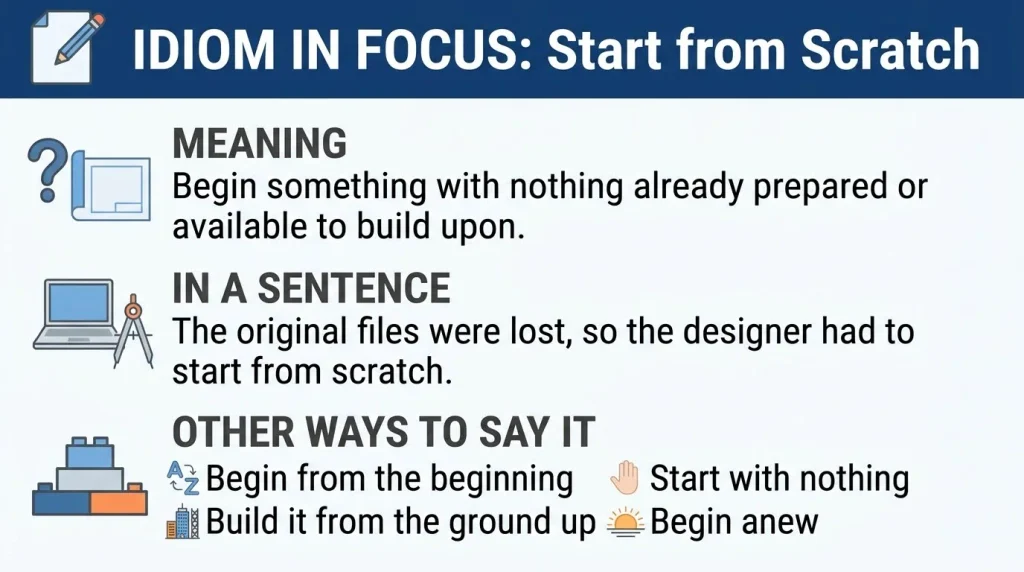
Meaning
Start from scratch means to begin something with nothing already prepared or available to build upon.
In a Sentence
The original files were lost, so the designer had to start from scratch.
Other Ways to Say It
- Begin from the beginning
- Build it from the ground up
- Start with nothing
- Begin anew
Explanation
“Scratch” creates the image of a starting line with no previous work behind it. Unlike a general new beginning, this idiom emphasizes having little or nothing to work with.
It can sound practical rather than emotional, making it useful for projects and problem-solving.
Best Use
It works especially well in work conversations, project discussions, technical writing, and everyday speech.
Get the Ball Rolling
Meaning
Get the ball rolling means to start an activity, discussion, project, or process so that it can continue moving forward.
In a Sentence
I sent the first email to get the ball rolling on our community project.
Other Ways to Say It
- Get things started
- Begin the process
- Set things going
- Kick things off
Explanation
The image is simple: once a ball begins rolling, it can keep moving. The idiom therefore suggests creating the initial momentum rather than completing the whole task.
It has a friendly, energetic tone and is common in everyday English.
Best Use
Use it in meetings, conversations, teamwork, emails, and informal professional communication.
Hit the Ground Running
Meaning
Hit the ground running means to begin something with energy, confidence, and immediate action rather than spending a long time getting ready.
In a Sentence
Our new manager hit the ground running, meeting clients and improving the schedule during her first week.
Other Ways to Say It
- Start strongly
- Get moving immediately
- Begin with energy
- Make an immediate impact
Explanation
The phrase creates a vivid image of someone landing on the ground and immediately running. It communicates speed, readiness, and momentum.
It is stronger than simply saying someone started because it suggests that the person became active very quickly.
Best Use
It is particularly natural in workplace conversations, interviews, biographies, sports writing, and professional settings.
Get Off the Ground
Meaning
Get off the ground means to successfully begin and start making progress, especially when an idea or project has faced difficulties getting started.
In a Sentence
Once we secured funding, the new educational program finally got off the ground.
Other Ways to Say It
- Get started
- Begin successfully
- Become operational
- Start making progress
Explanation
The expression compares a project with something that needs to rise from the ground before it can move forward. It focuses on overcoming the initial obstacles to a workable beginning.
It is often more useful than “start” when the beginning itself has required effort.
Best Use
This is a strong choice for business writing, project discussions, reports, conversations, and organizational contexts.
Set the Wheels in Motion
Meaning
Set the wheels in motion means to take the first actions that cause a process, plan, or series of events to begin.
In a Sentence
Signing the agreement set the wheels in motion for the construction of the new library.
Other Ways to Say It
- Start the process
- Put a plan into action
- Initiate events
- Get things underway
Explanation
The idiom creates the image of machinery beginning to move after its wheels have been activated. It emphasizes cause and momentum: one action starts a chain of further actions.
It often sounds more deliberate and serious than “get the ball rolling.”
Best Use
It suits formal conversations, reports, speeches, journalism, and professional writing.
Lay the Groundwork
Meaning
Lay the groundwork means to make the preparations or establish the basic conditions needed for something that will happen later.
In a Sentence
The research team spent six months laying the groundwork for the larger study.
Other Ways to Say It
- Build a foundation
- Prepare the way
- Make initial preparations
- Establish the basics
Explanation
The image comes from preparing a foundation before constructing a building. The idiom therefore describes a beginning that prepares for future progress, rather than an immediate launch.
It is useful when the early work may not be visible but is essential.
Best Use
Use it in essays, business writing, academic contexts, speeches, and strategic discussions.
Break New Ground
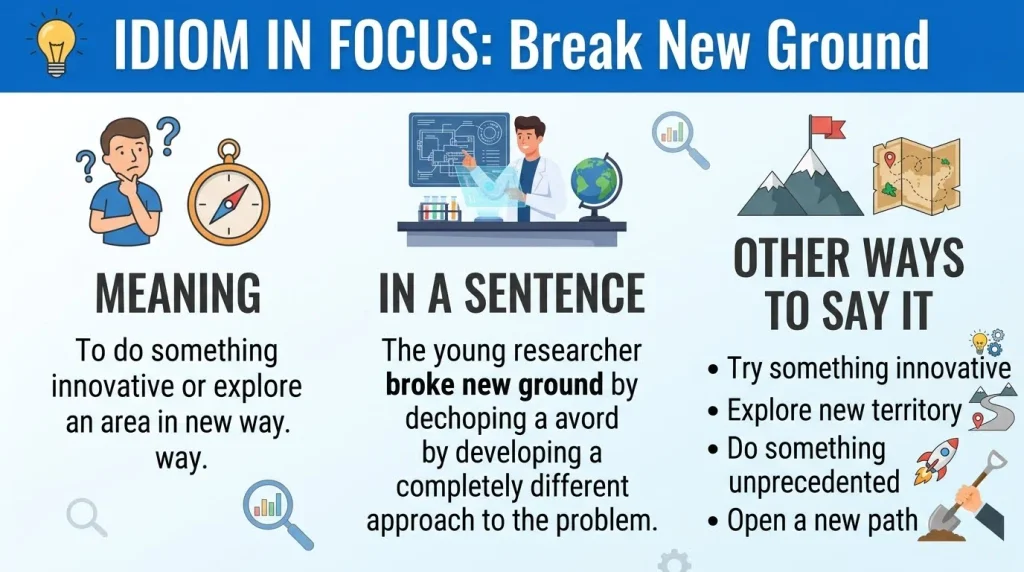
Meaning
Break new ground means to do something innovative or explore an area in a new way.
In a Sentence
The young researcher broke new ground by developing a completely different approach to the problem.
Other Ways to Say It
- Try something innovative
- Explore new territory
- Do something unprecedented
- Open a new path
Explanation
This idiom comes from the image of entering land that has not previously been cultivated or explored. It is not simply about starting; it emphasizes novelty and discovery.
Because of that, it works best when a beginning represents a new direction rather than an ordinary first step.
Best Use
It fits academic writing, journalism, speeches, creative nonfiction, and discussions of innovation.
Open a New Chapter
Meaning
Open a new chapter means to begin a new stage of life, work, or experience.
In a Sentence
Graduating from university opened a new chapter in Daniel’s life.
Other Ways to Say It
- Begin a new phase
- Enter a new stage
- Start a different chapter
- Move into a new period
Explanation
The metaphor compares life or experience with a book. Turning to a new chapter suggests that the story continues but takes a different direction.
This expression often has a reflective, emotional, or hopeful quality, so it is more poetic than a simple “start.”
Best Use
It works especially well in speeches, personal messages, social media captions, essays, and storytelling.
From the Get-Go
Meaning
From the get-go means from the very beginning.
In a Sentence
We agreed from the get-go that everyone would have a chance to share their ideas.
Other Ways to Say It
- From the start
- From the beginning
- Right from the beginning
- From day one
Explanation
This informal idiom places emphasis on the earliest point in an activity or relationship. It is useful when something has been true since the beginning, rather than describing the act of starting itself.
Its casual tone makes it sound natural in everyday conversation.
Best Use
Use it mainly in conversations, informal writing, blogs, social media, and friendly messages.
At the Outset
Meaning
At the outset means at the beginning of an event, process, project, or situation.
In a Sentence
At the outset, the team agreed that clear communication would be their main priority.
Other Ways to Say It
- At the beginning
- Initially
- At the start
- From the beginning
Explanation
Unlike some colorful idioms on this list, “at the outset” is a more formal idiomatic expression. It helps establish the starting point of a process clearly without adding dramatic imagery.
It is especially useful when you want polished, precise language.
Best Use
This expression is well suited to essays, reports, professional writing, presentations, and formal discussions.
Take the Plunge
Meaning
Take the plunge means to make a bold decision to begin something after hesitation or uncertainty.
In a Sentence
After months of planning, Elena finally took the plunge and opened her own studio.
Other Ways to Say It
- Take the leap
- Commit to the decision
- Go for it
- Make the move
Explanation
The phrase creates an image of someone jumping into deep water. It captures the moment when thinking ends and action begins, often despite some nervousness.
It is especially effective when a new beginning requires courage.
Best Use
Use it in personal stories, conversations, motivational writing, and speeches.
Dip Your Toes In
Meaning
Dip your toes in means to try something cautiously before becoming fully involved.
In a Sentence
Rather than changing careers immediately, Omar decided to dip his toes in by taking a weekend course.
Other Ways to Say It
- Try it cautiously
- Test the waters
- Ease into it
- Experiment first
Explanation
The image is of someone putting only their toes into water before deciding whether to step in. It communicates curiosity mixed with caution.
This makes it a useful contrast to “take the plunge,” which suggests a much bolder commitment.
Best Use
It works naturally in conversations, advice, personal writing, and discussions about new opportunities.
Cut Your Teeth
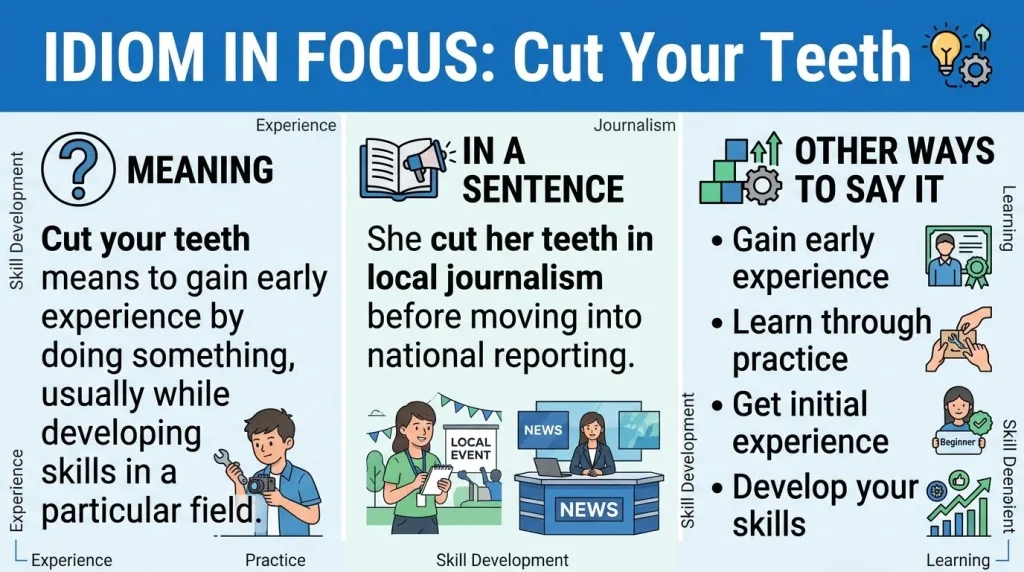
Meaning
Cut your teeth means to gain early experience by doing something, usually while developing skills in a particular field.
In a Sentence
She cut her teeth in local journalism before moving into national reporting.
Other Ways to Say It
- Gain early experience
- Learn through practice
- Get initial experience
- Develop your skills
Explanation
The phrase uses the image of a young child developing its first teeth. Figuratively, it suggests the early stage of learning and professional development.
It is not simply about beginning; it focuses on how a person grows through their first meaningful experiences.
Best Use
It is especially effective in career discussions, biographies, journalism, interviews, and professional writing.
Learn the Ropes
Meaning
Learn the ropes means to learn how a job, activity, organization, or system works.
In a Sentence
It took me a few weeks to learn the ropes at my new job.
Other Ways to Say It
- Learn how things work
- Get familiar with the process
- Master the basics
- Become accustomed to the role
Explanation
The expression is traditionally associated with learning how to handle ropes on a ship. Today, it describes the early learning period when someone is becoming comfortable with unfamiliar responsibilities.
It is practical and friendly rather than poetic.
Best Use
Use it in workplace conversations, mentoring, everyday speech, and informal professional writing.
Back to Square One
Meaning
Back to square one means returning to the beginning because an earlier attempt has failed or a plan has not worked.
In a Sentence
When the supplier rejected our design, we were back to square one.
Other Ways to Say It
- Start over
- Return to the beginning
- Go back to the starting point
- Begin again
Explanation
This expression does not describe an exciting new beginning. Instead, it captures the frustration of having to restart after losing progress.
That emotional difference makes it useful when the beginning is unwanted rather than hopeful.
Best Use
It works well in conversations, workplace discussions, problem-solving, storytelling, and informal writing.
Go Back to the Drawing Board
Meaning
Go back to the drawing board means to return to the planning stage because an idea, design, or solution has not worked.
In a Sentence
The prototype failed its safety test, so the engineers had to go back to the drawing board.
Other Ways to Say It
- Rework the plan
- Start the design again
- Rethink the approach
- Return to planning
Explanation
The image comes from returning to a board where a design or plan is drawn. It emphasizes rethinking and redesigning, not merely starting from nothing.
It can sound constructive even when a project has encountered a setback.
Best Use
This idiom is especially suitable for business, engineering, creative projects, meetings, and problem-solving conversations.
On the Ground Floor
Meaning
On the ground floor can figuratively mean being involved at the earliest stage of an organization, project, or development.
In a Sentence
Joining the startup on the ground floor gave Maya the opportunity to help shape its culture from the beginning.
Other Ways to Say It
- At an early stage
- From the beginning
- Near the start
- In the early development phase
Explanation
The expression uses a building as a metaphor. Being on the ground floor suggests being close to the foundation and early development of something.
It can imply opportunity as well as early involvement, particularly in business contexts.
Best Use
It works best in business conversations, career discussions, startup writing, and professional storytelling.
The Dawn of a New Era
Meaning
The dawn of a new era describes the beginning of a major period of change or a significant new phase.
In a Sentence
The launch of the new technology marked the dawn of a new era for the industry.
Other Ways to Say It
- The beginning of a new age
- A major new phase
- The start of a new period
- A turning point
Explanation
“Dawn” represents the first light of a new day, so the phrase creates a powerful image of something important emerging after darkness or an earlier period.
It is more dramatic than ordinary conversational expressions and can make writing feel inspirational or grand.
Best Use
This phrase is particularly effective in speeches, journalism, historical writing, storytelling, and inspirational content.
Exercise: Practice Using Idioms
1. Which idiom means to begin again with no previous work to rely on?
A. Learn the ropes
B. Start from scratch
C. Hit the ground running
D. Get the ball rolling
2. If someone begins a new job with immediate energy and action, which expression fits best?
A. Back to square one
B. Dip your toes in
C. Hit the ground running
D. At the outset
3. What does “turn over a new leaf” usually suggest?
A. Moving to a new location
B. Changing for the better
C. Learning a technical skill
D. Finishing an old project
4. Which idiom describes cautiously trying something before becoming fully involved?
A. Take the plunge
B. Break new ground
C. Dip your toes in
D. Set the wheels in motion
5. A manager sends the first email needed to begin a project. Which idiom best describes this action?
A. Get the ball rolling
B. Cut your teeth
C. Back to square one
D. Open a new chapter
6. Which expression emphasizes preparing the conditions for future progress?
A. From the get-go
B. Lay the groundwork
C. Take the plunge
D. Learn the ropes
7. If a failed plan must be redesigned, which idiom is most appropriate?
A. Go back to the drawing board
B. Open a new chapter
C. Break new ground
D. Hit the ground running
8. What does “from the get-go” mean?
A. After a long delay
B. Near the end
C. From the very beginning
D. After a major failure
9. Which idiom suggests making a bold decision despite hesitation?
A. Dip your toes in
B. Take the plunge
C. Learn the ropes
D. At the outset
10. A young reporter gains early professional experience at a small newspaper. Which idiom fits best?
A. Cut your teeth
B. Get off the ground
C. Turn over a new leaf
D. Set the wheels in motion
11. Which expression means returning to the beginning because an attempt failed?
A. On the ground floor
B. A fresh start
C. Back to square one
D. Break new ground
12. Which expression is the most formal way to refer to the beginning of a process?
A. From the get-go
B. At the outset
C. Get the ball rolling
D. Take the plunge
13. A startup employee joins while the company is still very small and helps shape its early development. Which phrase fits best?
A. On the ground floor
B. Back to square one
C. Cut your teeth
D. Start from scratch
14. Which phrase describes a beginning that represents a major historical or cultural change?
A. Learn the ropes
B. Dip your toes in
C. The dawn of a new era
D. Get the ball rolling
15. Which statement uses “get off the ground” correctly?
A. The team got off the ground by sleeping late.
B. The new program got off the ground after funding was approved.
C. She got off the ground to avoid learning the process.
D. They got off the ground after finishing everything.
Answers
- B — “Start from scratch” means beginning with no previous work or material to use.
- C — “Hit the ground running” describes starting with energy and immediate action.
- B — “Turn over a new leaf” refers to changing one’s behavior or direction for the better.
- C — “Dip your toes in” means trying something cautiously before fully committing.
- A — “Get the ball rolling” means taking the first action that gets a process moving.
- B — “Lay the groundwork” means making preparations that support future progress.
- A — “Go back to the drawing board” means returning to the planning stage after something fails.
- C — “From the get-go” means from the very beginning.
- B — “Take the plunge” suggests making a bold decision despite uncertainty or hesitation.
- A — “Cut your teeth” means gaining early experience while developing skills.
- C — “Back to square one” means returning to the starting point after an unsuccessful attempt.
- B — “At the outset” is a relatively formal expression meaning at the beginning.
- A — “On the ground floor” can describe involvement at an early stage of an organization or venture.
- C — “The dawn of a new era” describes the beginning of an important new period.
- B — “Get off the ground” means successfully begin and start making progress.
FAQs
What is an idiom for beginning?
There are many idioms for beginning, depending on the situation. “A fresh start” emphasizes a new opportunity, while “start from scratch” means beginning with nothing already prepared. “Get the ball rolling” focuses on starting an activity or process.
How do I create my own idiom?
Creating an original figurative expression starts with a clear image. Think about what a beginning feels or looks like, then connect it to a familiar object, action, or experience. A good expression should be easy to understand, memorable, and meaningfully connected to the idea.
What makes an idiom effective?
An effective idiom creates a mental picture while communicating an idea efficiently. It should add something beyond a plain statement, such as emotion, movement, contrast, humor, or atmosphere.
Can I use these idioms in everyday conversation?
Yes. Many of these expressions, including “get the ball rolling,” “start from scratch,” “learn the ropes,” and “hit the ground running,” are natural in everyday English. More dramatic phrases such as “the dawn of a new era” may sound better in speeches or creative writing.
What is the difference between an idiom and a simile?
An idiom is an established expression with a figurative meaning, such as “hit the ground running.” A simile directly compares two things using words such as “like” or “as.” For example, “The beginning was like a sunrise” is a simile rather than a conventional idiom.
Conclusion
A beginning can represent much more than the first moment of an event. It can be a fresh opportunity, a cautious experiment, a bold decision, a learning period, or a complete restart. The idioms in this guide give you different ways to express those meanings with more color and precision.
Choose an expression according to the feeling you want to communicate. Use “dip your toes in” when caution matters, “take the plunge” when courage is central, or “lay the groundwork” when preparation comes first. For more dramatic writing, “open a new chapter” or “the dawn of a new era” can create a stronger sense of possibility.
The best figurative language is not simply decorative it helps readers feel what a beginning means.

Oliver Whitcombe is a British writer and language enthusiast who has been fascinated by English expressions since childhood, when his grandmother told him he was “born with a silver spoon” and he spent a week trying to find it.
He created Idiom Looms to help learners and native speakers alike make sense of English idioms. Their origins, their meanings, and the moments they’re best used. His writing mixes plain explanations with a good dose of British wit.
Oliver lives in England, where he divides his time between writing, walking, and correcting everyone’s grammar (politely).