Have you ever made a mistake and struggled to explain it naturally? 20 Idioms for Mistakes With Real Examples helps you describe errors, regrets, and setbacks with greater confidence. These expressions make everyday English more vivid, memorable, and conversational.
Mistakes happen during business communication, meetings, scheduling, and project management. Learning related idioms can also strengthen English usage, grammar, and formal writing. Whether discussing time management, online booking, broadcasting, or a busy calendar, natural expressions can make communication clearer and more engaging.
This article explores 20 useful idioms connected with mistakes, errors, poor decisions, and learning experiences. Each expression includes a simple meaning, realistic example, alternative phrases, and practical usage guidance. You’ll discover how these idioms fit conversations, professional situations, storytelling, and everyday writing. By learning them in context, you can improve vocabulary, communication skills, and language consistency.
What Is an Idiom?
An idiom is a common expression whose meaning is different from the literal meaning of the individual words.
For example, “break the ice” does not usually mean physically breaking ice. It means to make people feel more comfortable when they first meet.
Another example is “hit the nail on the head,” which means to identify something exactly or make a very accurate point.
Idioms use figurative language to communicate an idea through an image, comparison, or familiar expression. This makes them different from literal statements. If someone says, “I made an error,” the meaning is direct. If they say, “I really dropped the ball,” they are using an image to describe a failure to handle something properly.
Why Use Idioms for Mistakes?
Talking about mistakes can sometimes feel uncomfortable. Idioms make it easier to describe what went wrong while adding emotion, humor, or personality to the conversation.
For example, “learn the hard way” can describe a mistake that taught someone an important lesson. “Have egg on your face” emphasizes embarrassment, while “drop the ball” focuses on failing to do something that was expected.
Idioms can help you:
- Express embarrassment without sounding overly serious.
- Make a story about a mistake more vivid.
- Explain an unsuccessful decision in a memorable way.
- Add humor to an otherwise awkward situation.
- Describe different kinds of errors more precisely.
- Make creative writing and storytelling more engaging.
- Communicate complicated feelings using familiar imagery.
The key is choosing an expression that matches the type and emotional weight of the mistake.
Quick List of 20 Idioms
- Put your foot in it
- Drop the ball
- Shoot yourself in the foot
- Jump the gun
- Bite off more than you can chew
- Learn the hard way
- Have egg on your face
- Miss the mark
- Get your wires crossed
- Get off on the wrong foot
- Fall flat on your face
- Make a mountain out of a molehill
- Cut corners
- Sweep something under the rug
- Bury your head in the sand
- Go down the wrong path
- To err is human
- A slip of the tongue
- Back to square one
- Own up to your mistakes
Put Your Foot in It
Read more:20 Idioms for Idiots With Real Examples
Meaning
“Put your foot in it” means to say or do something embarrassing, awkward, or inappropriate, often without intending to. It is especially useful for mistakes involving social situations or conversation.
In a Sentence
I really put my foot in it when I congratulated Sam on his promotion, only to discover that he had actually been passed over.
Other Ways to Say It
- Say something embarrassing
- Put yourself in an awkward situation
- Make a social blunder
- Say the wrong thing
Explanation
The expression creates a funny mental image of someone accidentally putting a foot where it does not belong. That image makes the embarrassment feel immediate and memorable.
It is particularly useful when the mistake involves words, manners, or social judgment rather than a technical error.
Best Use
This idiom works well in casual conversations, storytelling, personal messages, and humorous writing. It can sound playful rather than harsh.
Drop the Ball
Meaning
“Drop the ball” means to fail to do something you were responsible for, especially when other people were depending on you.
In a Sentence
I completely dropped the ball by forgetting to send the client the final report before the meeting.
Other Ways to Say It
- Fail to do your part
- Let someone down
- Miss an important responsibility
- Make a serious oversight
Explanation
The image comes from sports: a player who drops the ball loses an opportunity to make a successful play. Applied to everyday life, the expression suggests that someone had an opportunity or responsibility but failed to handle it.
It often carries a mild sense of disappointment rather than extreme condemnation.
Best Use
Use it in workplace conversations, sports discussions, casual speech, and everyday explanations of responsibility-related mistakes.
Shoot Yourself in the Foot
Meaning
“Shoot yourself in the foot” means to do something that unintentionally causes problems for yourself. The mistake often comes from your own decision or behavior.
In a Sentence
By insulting the interviewer during the discussion, he practically shot himself in the foot.
Other Ways to Say It
- Hurt your own chances
- Work against yourself
- Create your own problem
- Undermine yourself
Explanation
The expression creates a deliberately exaggerated image: instead of harming an opponent, someone harms themselves. That makes it effective for mistakes that are self-defeating.
It is stronger than simply saying someone made an error because it highlights the fact that the person’s own actions created the setback.
Best Use
It fits conversations, advice, commentary, workplace situations, and informal writing. It is generally too casual for very formal reports.
Jump the Gun
Meaning
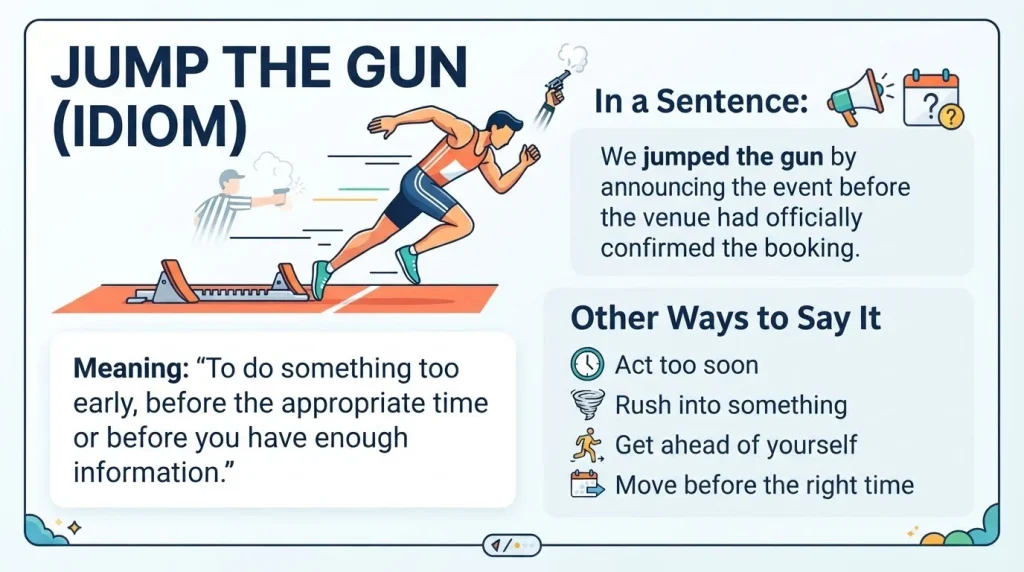
“Jump the gun” means to do something too early, before the appropriate time or before you have enough information.
In a Sentence
We jumped the gun by announcing the event before the venue had officially confirmed the booking.
Other Ways to Say It
- Act too soon
- Rush into something
- Get ahead of yourself
- Move before the right time
Explanation
The expression comes from the idea of starting a race before the starting signal. The image captures the problem clearly: the action itself may not be wrong, but the timing is.
It is useful for mistakes caused by impatience or premature decisions.
Best Use
Use it in business discussions, planning, conversations, journalism, and everyday situations involving poor timing.
Bite Off More Than You Can Chew
Meaning
“Bite off more than you can chew” means to take on more work, responsibility, or difficulty than you can realistically handle.
In a Sentence
I bit off more than I could chew when I agreed to organize the conference while managing three other projects.
Other Ways to Say It
- Take on too much
- Overcommit yourself
- Take on more than you can handle
- Overestimate your capacity
Explanation
The expression creates an easy-to-understand image: someone takes such a large bite that they cannot comfortably chew it. In figurative language, the “bite” represents a task or commitment.
It describes a mistake rooted in poor judgment, especially when someone fails to recognize their own limits.
Best Use
This idiom is useful in work conversations, school discussions, personal advice, and storytelling.
Learn the Hard Way
Meaning
“Learn the hard way” means to learn something through an unpleasant experience, mistake, or failure rather than through advice or preparation.
In a Sentence
I learned the hard way that saving a project only on one computer is a terrible idea.
Other Ways to Say It
- Learn from experience
- Discover through trial and error
- Learn through a painful lesson
- Find out through experience
Explanation
This expression focuses less on the mistake itself and more on the lesson that comes afterward. The “hard way” suggests that the experience involved difficulty, disappointment, or consequences.
It can turn a discussion about failure into a more constructive reflection about growth.
Best Use
It works especially well in personal stories, advice, educational writing, conversations, and motivational contexts.
Have Egg on Your Face
Meaning
“Have egg on your face” means to look foolish or embarrassed because of a mistake, especially after being confident about something that turned out to be wrong.
In a Sentence
After confidently announcing the wrong winner, the presenter had egg on his face when the official results were released.
Other Ways to Say It
- Look embarrassed
- Feel foolish
- Be publicly embarrassed
- End up looking silly
Explanation
The unusual image of having egg on your face represents visible embarrassment. The expression often carries a humorous tone, so it can soften the description of an awkward mistake.
It works particularly well when someone made a confident claim and then had to face the consequences.
Best Use
Use it in casual speech, humorous stories, entertainment writing, and informal commentary.
Miss the Mark
Meaning
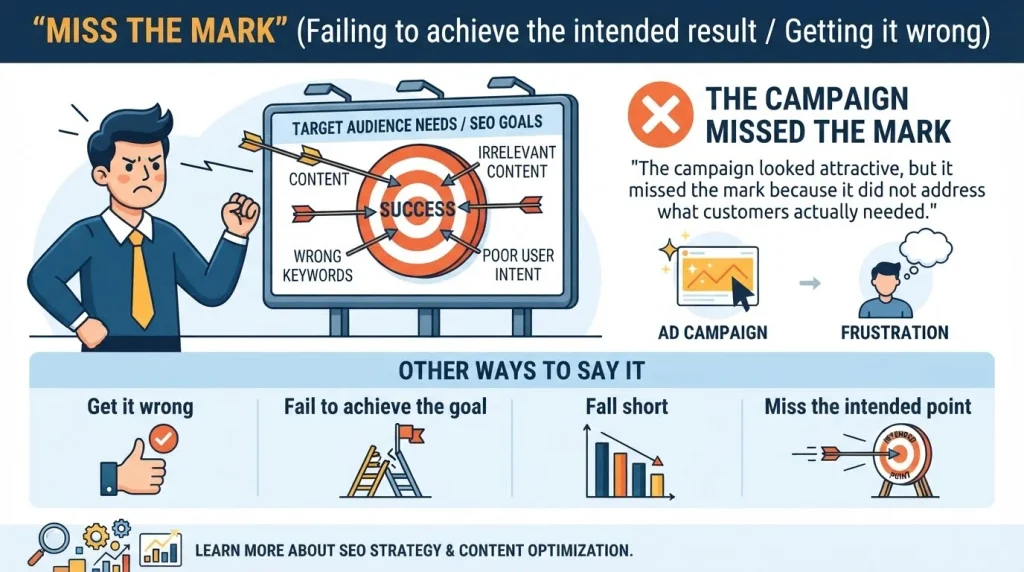
“Miss the mark” means to fail to achieve the intended result or to get something wrong.
In a Sentence
The campaign looked attractive, but it missed the mark because it did not address what customers actually needed.
Other Ways to Say It
- Get it wrong
- Fail to achieve the goal
- Fall short
- Miss the intended point
Explanation
The expression comes from the image of aiming at a target but failing to hit it. It is useful because it can describe many kinds of mistakes, including wrong decisions, unsuccessful attempts, and inaccurate interpretations.
Unlike some more humorous idioms, it can sound relatively neutral and professional.
Best Use
It works well in essays, business discussions, reviews, presentations, creative writing, and everyday conversation.
Get Your Wires Crossed
Meaning
“Get your wires crossed” means to misunderstand someone or become confused because information has not been communicated correctly.
In a Sentence
We got our wires crossed about the meeting time, so I arrived an hour before everyone else.
Other Ways to Say It
- Have a misunderstanding
- Get confused
- Miscommunicate
- Be on different pages
Explanation
The image suggests wires that should be connected correctly but have somehow become mixed up. It is a natural way to describe a communication mistake without blaming one person too strongly.
The expression is especially helpful when the error was accidental and both people may have misunderstood the situation.
Best Use
Use it in everyday conversations, workplace communication, emails, and friendly explanations. It is informal but widely understandable.
Get Off on the Wrong Foot
Meaning
“Get off on the wrong foot” means to begin a relationship, situation, or activity badly because of an early mistake or misunderstanding.
In a Sentence
I got off on the wrong foot with my new neighbor when I accidentally parked in front of his driveway.
Other Ways to Say It
- Start badly
- Begin with a misunderstanding
- Make a poor first impression
- Start on the wrong note
Explanation
The expression uses the image of beginning a journey with the wrong foot. It emphasizes that an early mistake can affect what happens afterward.
It does not necessarily mean the situation is permanently damaged; people can often recover and build a better relationship.
Best Use
This idiom suits personal messages, conversations, relationship advice, storytelling, and workplace situations involving first impressions.
Fall Flat on Your Face
Meaning
“Fall flat on your face” can literally describe falling, but figuratively it means to fail badly or suffer an embarrassing failure.
In a Sentence
His attempt to impress the audience with an unscripted joke fell flat on its face.
Other Ways to Say It
- Fail badly
- End in embarrassment
- Go terribly wrong
- Fail spectacularly
Explanation
The expression creates a dramatic physical image of someone falling forward and landing face-first. Figuratively, it emphasizes a very noticeable failure, often with an element of embarrassment.
Because of its dramatic tone, it is stronger and more colorful than simply saying something “did not work.”
Best Use
It works particularly well in storytelling, informal commentary, humorous writing, and conversations about failed attempts.
Make a Mountain Out of a Molehill
Meaning
“Make a mountain out of a molehill” means to treat a small problem or mistake as though it were a very serious one.
In a Sentence
The typo was minor, but the manager made a mountain out of a molehill and spent the entire afternoon discussing it.
Other Ways to Say It
- Overreact to a small problem
- Make too much of something
- Blow a small issue out of proportion
- Exaggerate a minor problem
Explanation
The expression compares a small molehill with a huge mountain. It shows how someone’s reaction can make a minor mistake seem much larger than it really is.
This idiom is useful when the problem is not necessarily the mistake itself but the excessive reaction to it.
Best Use
Use it in conversations, advice, essays, storytelling, and informal criticism. It can sound critical, so use it thoughtfully.
Cut Corners
Meaning
“Cut corners” means to do something in the easiest, cheapest, or quickest way by skipping steps or standards that should normally be followed.
In a Sentence
The contractor cut corners during the installation, and the poor workmanship became obvious within a few months.
Other Ways to Say It
- Take shortcuts
- Skip important steps
- Sacrifice quality
- Do something carelessly
Explanation
The phrase creates an image of taking a shortcut around a corner instead of following the proper route. Figuratively, it often describes a mistake caused by rushing, carelessness, or trying to save time or money.
Unlike an accidental slip, cutting corners can sometimes involve a deliberate choice.
Best Use
It is particularly appropriate in professional discussions, workplace writing, project management, construction, education, and quality-related conversations.
Sweep Something Under the Rug
Meaning
“Sweep something under the rug” means to hide, ignore, or avoid dealing with a problem or mistake instead of addressing it honestly.
In a Sentence
The team tried to sweep the reporting error under the rug, but the problem became impossible to ignore later.
Other Ways to Say It
- Hide a problem
- Ignore an issue
- Avoid dealing with a mistake
- Cover something up
Explanation
The image is simple: instead of cleaning up a mess, someone pushes it underneath a rug where it cannot immediately be seen. Figuratively, it describes avoiding responsibility or refusing to address a problem.
The expression often suggests that ignoring an issue will not make it disappear.
Best Use
It works well in workplace discussions, essays, journalism, storytelling, and conversations about accountability.
Bury Your Head in the Sand
Meaning
“Bury your head in the sand” means to deliberately ignore a problem because facing it feels uncomfortable, frightening, or difficult.
In a Sentence
You cannot bury your head in the sand after a mistake; the sooner you examine what went wrong, the easier it will be to fix.
Other Ways to Say It
- Ignore the problem
- Refuse to face reality
- Avoid the issue
- Turn a blind eye
Explanation
The expression creates the image of someone hiding their head in the ground instead of looking at danger. It describes avoidance rather than the original mistake.
This makes it different from “sweep something under the rug”: both involve avoidance, but this idiom emphasizes refusing to face an uncomfortable reality.
Best Use
Use it in advice, essays, discussions, persuasive writing, and serious conversations. It can sound critical or confrontational.
Go Down the Wrong Path
Meaning
“Go down the wrong path” means to make a series of choices that leads you away from the desired result or toward a problem.
In a Sentence
We went down the wrong path by designing the product before finding out what customers actually wanted.
Other Ways to Say It
- Take the wrong approach
- Make a poor choice
- Head in the wrong direction
- Follow an unsuitable course
Explanation
The expression compares decision-making to traveling along a path. Choosing the wrong path may not look like a major mistake at first, but it can gradually lead somewhere undesirable.
It is useful for describing strategic mistakes or a chain of poor decisions, rather than one isolated error.
Best Use
This expression fits essays, professional discussions, planning, storytelling, advice, and reflective writing.
To Err Is Human
Meaning
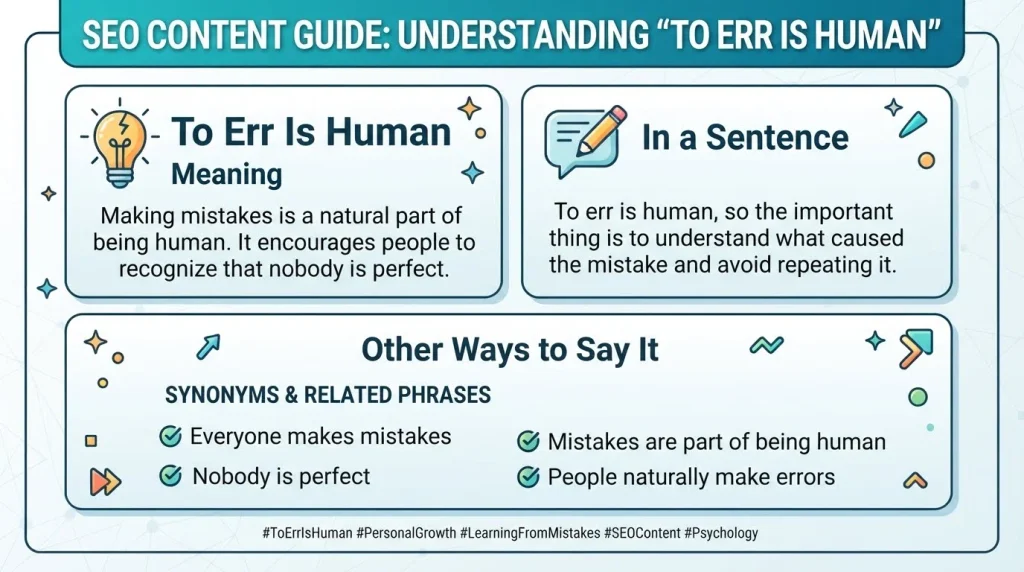
“To err is human” means that making mistakes is a natural part of being human. It encourages people to recognize that nobody is perfect.
In a Sentence
To err is human, so the important thing is to understand what caused the mistake and avoid repeating it.
Other Ways to Say It
- Everyone makes mistakes
- Nobody is perfect
- Mistakes are part of being human
- People naturally make errors
Explanation
This well-known saying presents mistakes from a compassionate and forgiving perspective. Rather than focusing on embarrassment or blame, it reminds us that imperfection is normal.
It can be particularly meaningful when someone is being unnecessarily hard on themselves after making an honest mistake.
Best Use
It works well in speeches, reflective writing, personal messages, education, advice, and supportive conversations.
A Slip of the Tongue
Meaning
“A slip of the tongue” is an accidental spoken mistake, such as saying the wrong word, name, or phrase.
In a Sentence
Calling my teacher by my brother’s name was just a slip of the tongue.
Other Ways to Say It
- A verbal mistake
- An accidental misstatement
- Saying the wrong thing
- A speaking error
Explanation
The expression treats speech almost like something that can physically “slip.” It is especially useful when the speaker did not intend to say something incorrectly.
The phrase can also soften the situation by suggesting that the mistake was accidental rather than deliberate.
Best Use
Use it in conversation, speeches, interviews, personal messages, and explanations of accidental verbal errors.
Back to Square One
Meaning
“Back to square one” means having to start again because a plan, attempt, or solution has failed.
In a Sentence
The prototype failed its safety test, so the engineers were back to square one.
Other Ways to Say It
- Start over
- Return to the beginning
- Begin again
- Go back to the drawing board
Explanation
The expression suggests returning to the starting position after progress has been lost. It is useful when a mistake has undone previous work or made a new attempt necessary.
It does not always imply total failure; sometimes going back to the beginning allows a better approach.
Best Use
It fits workplace discussions, project planning, problem-solving, education, storytelling, and everyday conversations.
Own Up to Your Mistakes
Meaning
“Own up to your mistakes” means to admit honestly that you made an error instead of hiding it, blaming someone else, or making excuses.
In a Sentence
She owned up to her mistake, explained what happened, and offered to correct the report.
Other Ways to Say It
- Admit your mistake
- Take responsibility
- Accept responsibility
- Acknowledge what went wrong
Explanation
This expression focuses on accountability rather than the mistake itself. “Own up” suggests openly accepting responsibility instead of avoiding it.
It is especially powerful when discussing how people should respond after something goes wrong.
Best Use
This expression works naturally in conversations, workplace advice, personal messages, leadership discussions, education, and reflective writing.
Exercise: Practice Using Idioms
Test your understanding of these expressions by choosing the best answer for each question.
Question 1
If someone “dropped the ball,” what did they most likely do?
A. Played a successful game
B. Failed to handle a responsibility
C. Finished a task early
D. Asked someone for help
Question 2
Maria accidentally revealed a friend’s surprise party plans. Which idiom best describes her mistake?
A. Back to square one
B. Cut corners
C. Put her foot in it
D. Bite off more than she could chew
Question 3
What does “jump the gun” mean?
A. Acting before the right moment
B. Refusing to accept responsibility
C. Committing a serious error
D. Beginning the process anew
Question 4
Someone accepts five difficult projects despite having no time to complete them. Which expression fits best?
A. Miss the mark
B. Have egg on your face
C. Get your wires crossed
D. Bite off more than they can chew
Question 5
Which situation best illustrates “learn the hard way”?
A. Reviewing the directions before starting
B. Gaining wisdom through an unpleasant error
C. Seeking guidance from a specialist
D. Finishing the job with success
Question 6
If two coworkers misunderstand each other’s instructions, they may say:
A. We got our wires crossed.
B. We cut corners.
C. We missed the boat.
D. We shot ourselves in the foot.
Question 7
What does “have egg on your face” mainly emphasize?
A. Anger
B. Confusion
C. Embarrassment
D. Determination
Question 8
A company creates an expensive advertisement that completely fails to connect with its target audience. Which idiom is most appropriate?
A. To err is human
B. Miss the mark
C. Put your foot in it
D. Sweep it under the rug
Question 9
Which sentence uses “cut corners” correctly?
A. We cut corners because we wanted to improve every detail.
B. He cut corners by carefully following every required step.
C. The builder cut corners by using cheaper materials and skipping checks.
D. She cut corners when she arrived exactly on time.
Question 10
If someone refuses to acknowledge an obvious problem, which idiom best describes their behavior?
A. Bury your head in the sand
B. Back to square one
C. Fall flat on your face
D. Jump the gun
Question 11
What does “back to square one” suggest?
A. The job has become less difficult
B. They have arrived at the last phase
C. Starting over is necessary
D. The issue has been successfully resolved
Question 12
Someone chooses a poor strategy and gradually moves farther away from their goal. Which expression fits best?
A. Have egg on your face
B. Go down the wrong path
C. A slip of the tongue
D. Drop the ball
Question 13
Which expression specifically describes an accidental spoken mistake?
A. A slip of the tongue
B. Cut corners
C. Shoot yourself in the foot
D. Make a mountain out of a molehill
Question 14
A small typo causes a manager to become extremely angry and treat it as a major disaster. Which idiom describes the manager’s reaction?
A. Learn the hard way
B. Get off on the wrong foot
C. Make a mountain out of a molehill
D. Own up to your mistakes
Question 15
What is the main idea behind “to err is human”?
A. Mistakes should always be hidden.
B. Only inexperienced people make mistakes.
C. Mistakes are a natural part of being human.
D. Every mistake has serious consequences.
Answers
- B — “Drop the ball” means failing to handle something you were responsible for.
- C — “Put your foot in it” describes an embarrassing or inappropriate social mistake.
- A — “Jump the gun” means acting before the appropriate time.
- D — “Bite off more than you can chew” means taking on more than you can realistically handle.
- B — “Learn the hard way” means gaining knowledge through an unpleasant experience or mistake.
- A — “Get your wires crossed” describes a misunderstanding or communication mix-up.
- C — “Have egg on your face” focuses on looking foolish or embarrassed after a mistake.
- B — “Miss the mark” means failing to achieve the intended goal or effect.
- C — “Cut corners” means skipping proper steps or standards to save time, effort, or money.
- A — “Bury your head in the sand” means deliberately avoiding an uncomfortable problem.
- C — “Back to square one” means having to start again after an unsuccessful attempt.
- B — “Go down the wrong path” describes following an approach that leads away from the desired result.
- A — “A slip of the tongue” is an accidental verbal mistake.
- C — “Make a mountain out of a molehill” means treating a small problem as much more serious than it is.
- C — “To err is human” reminds us that making mistakes is a normal part of being human.
FAQs
What is an idiom for mistakes?
There are many idioms for mistakes, and each emphasizes something different. “Drop the ball” describes failing to handle a responsibility, while “put your foot in it” describes an embarrassing social mistake. “Learn the hard way” focuses on the lesson that comes from an unpleasant error.
How do I create my own idiom?
A useful idiom usually creates a memorable mental image that represents an idea indirectly. Start with the feeling or situation you want to express, then think of an everyday object, action, or experience that could represent it. For example, a mistake that creates more problems could be compared with accidentally knocking over the first piece in a row of dominoes.
However, a newly invented expression may not be understood as an established idiom unless readers have enough context.
What makes an idiom effective?
An effective idiom is clear, memorable, relevant, and appropriate for its context. Strong figurative language gives readers an image that helps them understand an emotion, action, or situation quickly.
The best expression is not necessarily the most dramatic one. It should match the seriousness and tone of the mistake.
Can I use these idioms in everyday conversation?
Yes. Many of these expressions are natural in everyday spoken English, including “drop the ball,” “jump the gun,” “get your wires crossed,” and “learn the hard way.”
Some expressions, such as “to err is human,” can sound more reflective or formal. Others, such as “have egg on your face,” are more playful. Choose according to the situation.
What is the difference between an idiom and a simile?
An idiom is a familiar expression with a figurative meaning that may not be predictable from its individual words. For example, “drop the ball” means failing to handle a responsibility.
A simile directly compares two things using words such as “like” or “as.” For example, “The mistake spread like a crack in glass” is a simile. The two forms can both create imagery, but they work differently.
Conclusion
Mistakes can be frustrating, embarrassing, educational, or even funny, and the right idiom can help communicate exactly which feeling you mean. Expressions such as “put your foot in it,” “drop the ball,” and “learn the hard way” give ordinary descriptions more personality and context. Others, such as “to err is human,” remind us to respond to mistakes with patience rather than unnecessary blame.
When choosing an idiom, think about the kind of mistake you are describing, the emotion behind it, and the audience listening or reading. A playful expression may suit a personal story, while a more neutral phrase may work better in professional writing. Ultimately, the strongest language does more than label a mistake it helps people see, understand, and remember what happened.

Oliver Whitcombe is a British writer and language enthusiast who has been fascinated by English expressions since childhood, when his grandmother told him he was “born with a silver spoon” and he spent a week trying to find it.
He created Idiom Looms to help learners and native speakers alike make sense of English idioms. Their origins, their meanings, and the moments they’re best used. His writing mixes plain explanations with a good dose of British wit.
Oliver lives in England, where he divides his time between writing, walking, and correcting everyone’s grammar (politely).