
Have you ever struggled to find the right expression for someone leaving, moving forward, or changing direction? 20 Idioms for Going With Real Examples introduces natural phrases that make everyday English more expressive and memorable. These idioms can describe departure, progress, movement, and changing situations without sounding repetitive. They are useful for conversations, English usage, and creative expression. Learning them also helps you understand how native speakers communicate ideas beyond literal meanings.
These expressions can fit many practical situations, from meetings and business communication to travel plans and personal conversations. They may also appear when discussing scheduling, time management, an online booking, or a busy calendar. In professional settings, understanding idiomatic language can support clearer communication during project management and workplace discussions. The examples in this guide show how each phrase works naturally, helping you recognize its meaning, tone, and appropriate context.
Throughout this article, you will discover 20 useful idioms connected with going, movement, departure, and progress. Each expression includes a clear meaning, a realistic example, alternative ways to say it, and practical usage guidance. You will also see how these phrases work in formal writing, everyday speech, and different communication settings. Whether you are improving grammar, building vocabulary, or developing greater consistency in your English, these examples will help you use idioms confidently and naturally.
What Is an Idiom?
An idiom is a fixed expression whose overall meaning cannot always be understood by taking each word literally.
For example, “break the ice” does not mean physically breaking ice. It means to make people feel more comfortable in a new or awkward situation.
Another example is “hit the nail on the head,” which means to describe or identify something exactly correctly.
Idioms differ from literal statements because their words create a figurative meaning. Understanding that hidden meaning helps you recognize how native speakers use expressive language in everyday conversations and writing.
Why Use Idioms for Going?
Idioms can make the idea of going much more expressive than simply saying that someone moved, left, or continued.
They can help you:
- Express emotions about a journey, decision, or change.
- Make descriptions more vivid and memorable.
- Explain progress without using lengthy explanations.
- Add personality to conversations and storytelling.
- Make creative writing feel more natural and colorful.
- Describe whether something is improving, failing, changing, or moving quickly.
- Communicate complicated situations through a simple mental image.
For example, saying a project is “going downhill” immediately suggests that its condition is getting worse. Saying someone is “going places” suggests that person has a promising future. The right idiom can turn a plain statement into a picture the reader can understand instantly.
Quick List of 20 Idioms
- On the Go
- Go the Extra Mile
- Go with the Flow
- Go Places
- Go the Distance
- Go from Strength to Strength
- Go Downhill
- Go Uphill
- Go Against the Grain
- Go Out on a Limb
- Go Off the Rails
- Go Back to Square One
- Go Down in Flames
- Go Through the Roof
- Go Like Clockwork
- Go Pear-Shaped
- Go Down a Storm
- Go Cold Turkey
- Go Overboard
- Go All Out
On the Go
Read more:20 Idioms for Problems With Real Examples
Meaning
“On the go” describes someone or something that is active, busy, or constantly moving. It can suggest a fast-paced lifestyle in which there is little time to stop and rest.
In a Sentence
I’ve been on the go since sunrise, running errands and preparing for the evening event.
Other Ways to Say It
- Constantly busy
- Always moving
- In constant motion
- Keeping busy
Explanation
The expression creates an image of someone who is rarely sitting still. It works for both physical movement and a busy schedule.
It has a casual, energetic tone, making it especially natural in everyday conversation.
Best Use
Use “on the go” in conversations, personal messages, lifestyle writing, and informal descriptions of busy days.
Go the Extra Mile
Meaning
“Go the extra mile” means to make more effort than is expected in order to achieve something or help someone.
In a Sentence
Maya went the extra mile to make sure every guest felt welcome at the community event.
Other Ways to Say It
- Make an extra effort
- Put in additional work
- Do more than expected
- Give it your best effort
Explanation
The image comes from traveling farther than necessary. It suggests that simply reaching the destination is not enough; you willingly continue farther.
The expression carries an encouraging and positive feeling and often highlights dedication.
Best Use
It fits workplace communication, speeches, personal messages, essays, and conversations about effort or commitment.
Go with the Flow
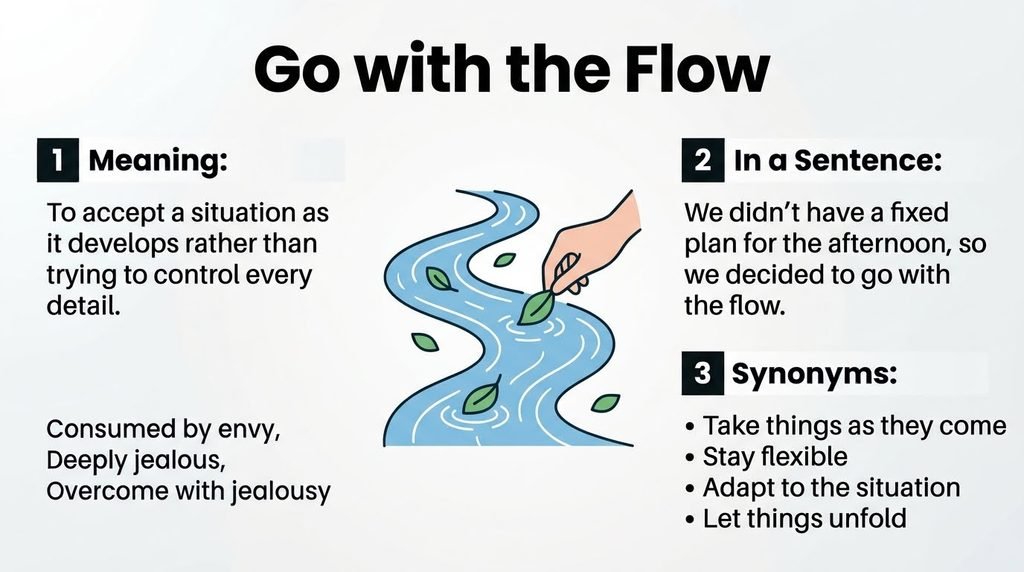
Meaning
“Go with the flow” means to accept a situation as it develops rather than trying to control every detail.
In a Sentence
We didn’t have a fixed plan for the afternoon, so we decided to go with the flow.
Other Ways to Say It
- Take things as they come
- Stay flexible
- Adapt to the situation
- Let things unfold
Explanation
The expression compares life to flowing water. Instead of fighting the current, you allow yourself to move with it.
It usually has a relaxed and flexible tone, although it can sometimes imply that someone is being less deliberate than usual.
Best Use
Use it in casual conversation, travel stories, personal writing, and discussions about flexibility.
Go Places
Meaning
“Go places” means to have the potential for future success or achievement.
In a Sentence
With his creativity and determination, I think Daniel is going to go places.
Other Ways to Say It
- Have a bright future
- Become successful
- Make a name for yourself
- Achieve great things
Explanation
Literally, going places suggests movement toward different destinations. Figuratively, it suggests moving toward success and opportunity.
It is usually warm, encouraging, and optimistic, particularly when talking about a young person or someone developing a talent.
Best Use
It works well in conversations, encouragement, speeches, school writing, and professional settings.
Go the Distance
Meaning
“Go the distance” means to continue until something is completed, especially when it requires endurance and determination.
In a Sentence
The first few months were difficult, but the team was determined to go the distance.
Other Ways to Say It
- See it through
- Stay the course
- Finish what you started
- Keep going until the end
Explanation
The expression creates the image of a person or team traveling all the way to a final destination.
It emphasizes persistence rather than speed, so it is useful when success depends on lasting through difficulties.
Best Use
Use it in motivational writing, speeches, sports discussions, personal conversations, and stories about perseverance.
Go from Strength to Strength
Meaning
“Go from strength to strength” means to continue improving and becoming more successful.
In a Sentence
After its successful launch, the small company went from strength to strength.
Other Ways to Say It
- Continue to improve
- Grow stronger
- Build on success
- Keep getting better
Explanation
This expression suggests a journey in which each successful stage provides a foundation for the next one.
Its tone is positive and complimentary, making it particularly useful when describing sustained progress.
Best Use
It works especially well in speeches, articles, professional writing, congratulations, and formal messages.
Go Downhill
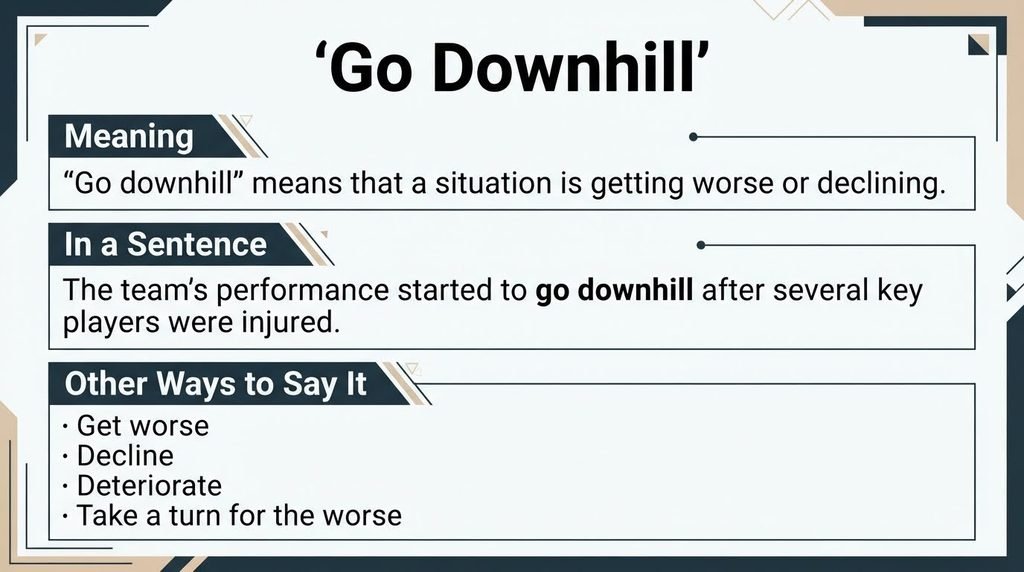
Meaning
“Go downhill” means that a situation is getting worse or declining.
In a Sentence
The team’s performance started to go downhill after several key players were injured.
Other Ways to Say It
- Get worse
- Decline
- Deteriorate
- Take a turn for the worse
Explanation
The expression uses the image of traveling downward. Moving downhill represents a decline from a better position to a worse one.
It often has a serious or negative tone, especially when discussing relationships, performance, health, or circumstances.
Best Use
Use it in conversations, essays, storytelling, reviews, and discussions of declining situations.
Go Uphill
Meaning
“Go uphill” can describe a situation becoming more difficult or requiring greater effort.
In a Sentence
Once funding became limited, keeping the project alive became an uphill struggle.
Other Ways to Say It
- Become more difficult
- Face a tough challenge
- Struggle to progress
- Fight an uphill battle
Explanation
Walking uphill requires more effort than walking on level ground. The figurative expression therefore communicates difficulty, resistance, and hard work.
It is generally serious and realistic, rather than cheerful.
Best Use
It fits essays, speeches, personal stories, motivational writing, and discussions of difficult goals.
Go Against the Grain
Meaning
“Go against the grain” means to behave or think in a way that conflicts with what is usual, expected, or accepted.
In a Sentence
Choosing a quiet rural life went against the grain for someone raised in a busy city.
Other Ways to Say It
- Go against convention
- Challenge the norm
- Take an unconventional path
- Do things differently
Explanation
The phrase comes from the idea of moving against the natural direction of wood grain, which requires more resistance.
It creates a strong image of independence and resistance to convention.
Best Use
Use it in essays, creative writing, conversations, profiles, and discussions about unconventional choices.
Go Out on a Limb
Meaning
“Go out on a limb” means to take a risk, especially by expressing an opinion or making a decision without knowing what will happen.
In a Sentence
I’ll go out on a limb and predict that this new approach will eventually succeed.
Other Ways to Say It
- Take a risk
- Take a chance
- Stick your neck out
- Make a bold move
Explanation
The expression creates the vivid image of someone walking onto a tree branch where there is less support and greater danger.
It often sounds bold, conversational, and slightly playful, particularly when someone makes a prediction.
Best Use
It works naturally in conversations, opinion pieces, storytelling, and informal professional discussions.
Go Off the Rails
Meaning
“Go off the rails” means to become uncontrolled, unsuccessful, or badly managed.
In a Sentence
The meeting went off the rails when everyone started arguing about unrelated issues.
Other Ways to Say It
- Get out of control
- Lose direction
- Go wrong
- Fall apart
Explanation
The image comes from a train leaving its tracks. Once it is off the rails, it is no longer following its intended route.
The expression can sound dramatic or informal, especially when describing plans, conversations, or behavior that suddenly becomes chaotic.
Best Use
Use it in conversation, storytelling, informal writing, and commentary about plans that have lost direction.
Go Back to Square One
Meaning
“Go back to square one” means to return to the beginning because previous efforts have failed or can no longer be used.
In a Sentence
The design failed the safety test, so the engineers had to go back to square one.
Other Ways to Say It
- Start again
- Return to the beginning
- Begin from scratch
- Start over
Explanation
The phrase suggests returning to the first position on a board or game after progress has been lost.
It communicates frustration and the need for a fresh start, but it does not necessarily mean that all future progress is impossible.
Best Use
It is especially useful in workplace conversations, problem-solving discussions, essays, and storytelling.
Go Down in Flames
Meaning
“Go down in flames” means to fail spectacularly or dramatically.
In a Sentence
Their ambitious business plan went down in flames after the main investor withdrew.
Other Ways to Say It
- Fail badly
- Collapse completely
- End in disaster
- Fail spectacularly
Explanation
The expression creates a dramatic picture of something falling while burning. It is much stronger than simply saying something failed.
Because of its vivid imagery, it often has a dramatic or humorous edge, depending on context.
Best Use
Use it in storytelling, informal commentary, creative writing, and dramatic descriptions of failure.
Go Through the Roof
Meaning
“Go through the roof” means to rise or increase extremely quickly, especially when describing prices, costs, or numbers.
In a Sentence
Housing costs have gone through the roof in that area over the past few years.
Other Ways to Say It
- Rise sharply
- Increase dramatically
- Skyrocket
- Soar
Explanation
The phrase imagines something rising so high that it breaks through a building’s roof.
It creates a powerful sense of extreme increase and is usually informal.
Best Use
It works best in conversations, news-style commentary, informal articles, and discussions of prices or rapidly increasing figures.
Go Like Clockwork
Meaning
“Go like clockwork” means that something happens smoothly, predictably, and without problems.
In a Sentence
Once everyone knew their roles, the entire event went like clockwork.
Other Ways to Say It
- Run smoothly
- Work perfectly
- Proceed without a hitch
- Go according to plan
Explanation
A clock is designed to operate in a regular and dependable way. Comparing an event to clockwork suggests that each part happens at the right time.
The expression has a positive, practical tone and focuses on smooth progress rather than excitement.
Best Use
Use it in workplace conversations, event descriptions, reports, stories, and everyday speech.
Go Pear-Shaped
Meaning
“Go pear-shaped” means that a plan or situation goes wrong or fails to develop as expected.
In a Sentence
Everything was organized perfectly, but the outdoor ceremony went pear-shaped when heavy rain arrived.
Other Ways to Say It
- Go wrong
- Go badly
- Fall apart
- Not go according to plan
Explanation
The phrase is especially associated with British informal English. Its unusual image makes a disappointing situation sound less severe and sometimes humorous.
It is generally casual and playful, so it may not suit very formal writing.
Best Use
Use it in informal conversations, humorous stories, blogs, and casual personal writing.
Go Down a Storm
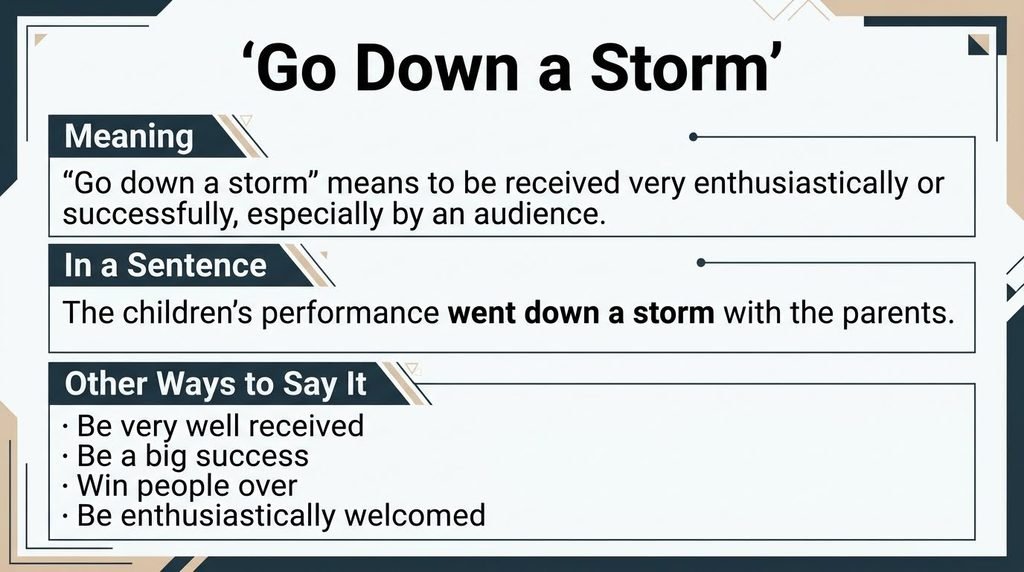
Meaning
“Go down a storm” means to be received very enthusiastically or successfully, especially by an audience.
In a Sentence
The children’s performance went down a storm with the parents.
Other Ways to Say It
- Be very well received
- Be a big success
- Win people over
- Be enthusiastically welcomed
Explanation
The expression creates the image of something making a powerful impact, like a storm arriving with energy.
It is strongly associated with British English and is generally informal.
Best Use
It works well in conversations, reviews, event reports, storytelling, and informal writing.
Go Cold Turkey
Meaning
“Go cold turkey” means to stop a habit or activity suddenly and completely, rather than reducing it gradually.
In a Sentence
After years of checking social media constantly, he decided to go cold turkey for a month.
Other Ways to Say It
- Stop abruptly
- Quit completely
- Give something up suddenly
- Make a clean break
Explanation
The expression is often used when someone makes a sudden, firm break from an established habit.
It is informal and emphatic, so it works better in casual communication than in highly formal writing.
Best Use
Use it in conversations, personal stories, informal articles, and discussions about changing habits.
Go Overboard
Meaning
“Go overboard” means to do or use too much of something, often because enthusiasm or emotion has gone beyond reasonable limits.
In a Sentence
We wanted to decorate the room, but we probably went overboard with the balloons.
Other Ways to Say It
- Go too far
- Overdo it
- Take something too far
- Become excessive
Explanation
The phrase originally evokes going beyond the side of a boat and into the water. Figuratively, it suggests crossing a sensible boundary.
It can sound playful, critical, or self-aware, depending on the situation.
Best Use
It is natural in everyday conversations, reviews, social media, personal writing, and informal advice.
Go All Out
Meaning
“Go all out” means to use maximum effort, energy, or resources to achieve something.
In a Sentence
For the final match, the team decided to go all out from the opening minute.
Other Ways to Say It
- Give it everything
- Try your hardest
- Give maximum effort
- Pull out all the stops
Explanation
The expression suggests holding nothing back. Instead of using only part of your energy or resources, you commit fully.
It has an energetic, determined, and enthusiastic tone.
Best Use
Use it in sports, conversations, motivational writing, celebrations, event planning, and informal professional communication.
Exercise: Practice Using Idioms
Test your understanding of these expressions with the questions below.
1. What does “on the go” usually mean?
A. Being asleep for most of the day
B. Being constantly active or busy
C. Refusing to travel anywhere
D. Waiting for someone else
2. If someone “goes the extra mile,” what are they doing?
A. Avoiding responsibility
B. Changing their destination
C. Making more effort than expected
D. Finishing earlier than planned
3. Which idiom means accepting circumstances as they develop?
A. Adapt to whatever happens
B. End in total failure
C. Take things to an extreme
D. Become increasingly difficult or challenging
4. If someone is said to “go places,” what does this suggest?
A. They often go on trips
B. Remaining indoors does not appeal to them
C. They show strong potential for future achievement
D. Relocating to a different city has become necessary
5. Which expression focuses most strongly on perseverance until the end?
A. Turn into a complete mess
B. Reach the finish despite difficulties
C. Decline in quality or condition
D. Quit a habit suddenly and completely
6. A business that continues improving is going “from strength to strength.” What does this mean?
A. Experiencing growing success
B. Relocating to another building
C. Suffering one setback after another
D. Cutting down the number of employees
7. Which idiom describes a situation that is becoming worse?
A. Give maximum effort
B. Achieve great success
C. Decline or get worse
D. Run smoothly and efficiently
8. If a decision “goes against the grain,” what does it do?
A. Follows a traditional approach
B. Challenges what is usual or expected
C. Solves a difficult problem
D. Produces an immediate success
9. What does “go out on a limb” suggest?
A. Taking a risk
B. Taking a vacation
C. Avoiding an opinion
D. Following instructions
10. If a project “goes off the rails,” what has happened?
A. Everything is arranged in perfect order
B. The entire process has been finished
C. Things have become chaotic and disorganized
D. The price has dropped considerably
11. When someone has to “go back to square one,” what do they need to do?
A. Celebrate success
B. Start again from the beginning
C. Increase their speed
D. Change their location
12. Which expression describes a spectacular failure?
A. End in complete failure
B. Skyrocket to an extremely high level
C. Create a major disturbance
D. Achieve great success in life
13. If prices “go through the roof,” what happens?
A. Stay exactly the same
B. Gradually become lower
C. Rise at a remarkable rate
D. Vanish from the marketplace
14. Which sentence uses “go like clockwork” correctly?
A. The meeting went like clockwork because everyone followed the schedule.
B. The meeting went like clockwork because everyone forgot the agenda.
C. The meeting went like clockwork after the plan completely failed.
D. The meeting went like clockwork when nobody knew what to do.
15. If someone “goes all out,” what are they doing?
A. Holding back their effort
B. Giving something maximum effort
C. Leaving before starting
D. Avoiding a difficult decision
Answers
- B — “On the go” describes someone who is constantly active, busy, or moving.
- C — “Go the extra mile” means making more effort than people normally expect.
- A — “Go with the flow” means accepting circumstances and adapting as they unfold.
- C — “Go places” suggests that someone has strong potential for future success.
- B — “Go the distance” emphasizes continuing until the end despite challenges.
- A — “Go from strength to strength” describes continued improvement or increasing success.
- C — “Go downhill” means that a situation is becoming worse.
- B — “Go against the grain” means acting or thinking contrary to convention or expectations.
- A — “Go out on a limb” means taking a risk, often by making a bold judgment or prediction.
- C — “Go off the rails” means that something has lost its intended direction or become uncontrolled.
- B — “Go back to square one” means returning to the beginning and starting again.
- A — “Go down in flames” describes a dramatic or spectacular failure.
- C — “Go through the roof” means to rise or increase extremely quickly.
- A — “Go like clockwork” means that something happens smoothly and according to plan.
- B — “Go all out” means using maximum effort, energy, or resources.
FAQs
What is an idiom for going?
An idiom for going is a figurative expression that uses the idea of movement, direction, or progress to communicate a broader meaning. Expressions such as “go the distance” and “go with the flow” describe persistence and flexibility rather than simple physical movement.
How do I create my own idiom?
Creating an effective original expression starts with a clear mental image. Think about the feeling or idea you want to communicate, then connect it to a familiar action, object, place, or experience. The comparison should be easy to understand without being overly literal.
What makes an idiom effective?
A strong idiom creates a clear image and a distinct meaning. It should add something that a plain statement does not provide, such as emotion, humor, emphasis, or personality. Context also matters because some idioms are informal while others sound more suitable for formal or literary writing.
Can I use these idioms in everyday conversation?
Yes. Many of these expressions are common in informal spoken English, including “on the go,” “go with the flow,” “go overboard,” and “go all out.” However, expressions such as “go pear-shaped” may be more regional, while some others may sound more natural in creative or formal writing.
What is the difference between an idiom and a simile?
An idiom has an established figurative meaning, while a simile directly compares two things using words such as “like” or “as.” For example, “go with the flow” is an idiom, whereas “move like a river” is a simile. Idioms are generally understood as set expressions within a language.
Conclusion
The idea of going can represent movement, progress, struggle, change, risk, success, or failure, and English idioms give each of these ideas a distinctive voice. Expressions such as “go the distance” emphasize persistence, while “go with the flow” suggests flexibility. “Go places” points toward potential, whereas “go downhill” signals decline. Choosing the right expression depends on the feeling and context you want to communicate.
Some idioms are perfect for casual conversations, while others work better in storytelling, speeches, essays, or creative writing. The strongest figurative language is not simply colorful; it makes the intended meaning clearer and more memorable. When you describe going, choose an image that matches the journey, direction, or emotion you want your reader to feel.

Margaret Saywell is an English author and editor who has spent more than fifteen years working with words teaching, proofreading, and writing about the quirks of the English language.
At Idiom Looms, Margaret gathers idioms from across the English-speaking world and weaves them into clear, practical guides. She loves digging into the history of a phrase and showing readers how a few well-chosen words can say far more than a long explanation.
She believes language should be enjoyed, not feared and that the best way to learn an idiom is to see it in action.