

What makes good advice memorable instead of easily forgotten? The right expression can turn a simple suggestion into a clear and meaningful message. In this guide, 20 Idioms for Advice With Real Examples explores natural expressions that help speakers and writers share guidance, wisdom, and practical suggestions with greater impact. These idioms can strengthen everyday conversations while improving English usage, grammar, and formal writing. They also help learners understand how figurative language works in real communication.
Advice appears in many settings, from personal conversations to professional business communication, meetings, and project management. You may discuss time management, create a calendar for important tasks, or explain plans involving scheduling and online booking. Even fields such as broadcasting rely on clear, memorable language. Learning relevant idioms makes these situations easier to understand and communicate with confidence.
Throughout this article, you will discover twenty useful idioms with real examples, simple meanings, and practical explanations. Each expression shows how native speakers use figurative language naturally and appropriately. You will also learn alternative phrases and suitable contexts for everyday speech, professional writing, and thoughtful conversations. By focusing on meaning, context, and consistency, these idioms can make your English more expressive, precise, and engaging.
What Is an Idiom?
An idiom is a common expression whose meaning is different from the literal meaning of the individual words.
For example, “break the ice” does not usually mean physically breaking ice. It means to make people feel more comfortable in a social situation.
Another example is “hit the nail on the head,” which means to describe something accurately or identify the main point.
Idioms are a form of figurative language. They create an image or comparison that communicates an idea more naturally than a literal statement. Their meanings are generally understood through common usage and context.
Why Use Idioms for Advice?
Advice often involves feelings, judgment, experience, or caution. Idioms can make those ideas easier to express.
A well-chosen expression can:
- Make practical guidance easier to remember.
- Add warmth to personal conversations.
- Express caution without sounding overly harsh.
- Turn an abstract idea into a clear mental image.
- Give creative writing more personality.
- Make speeches and essays more engaging.
- Communicate complicated feelings in a few familiar words.
For advice, context matters especially. Some expressions sound friendly and conversational, while others feel more serious, reflective, poetic, or cautionary.
Quick List of 20 Idioms for Advice
- A word to the wise
- Food for thought
- Take it with a grain of salt
- A rule of thumb
- Put your heads together
- Give it your best shot
- Learn the ropes
- On the right track
- Back to the drawing board
- Think outside the box
- Read between the lines
- Weigh your options
- Look before you leap
- Better safe than sorry
- Keep your cards close to your chest
- Hear it from the horse’s mouth
- Take the bull by the horns
- Don’t put all your eggs in one basket
- A stitch in time saves nine
- The ball is in your court
A Word to the Wise
Read more:20 Idioms for Useless With Real Examples
Meaning
“A word to the wise” introduces a piece of advice or a warning that someone should take seriously. The expression suggests that a sensible person will understand the importance of the advice without needing a long explanation.
In a Sentence
A word to the wise: check the contract carefully before signing anything.
Other Ways to Say It
- Here is a useful warning.
- Keep this in mind.
- A little advice for you.
- Take this advice seriously.
Explanation
The phrase creates a feeling of quiet caution and experience. It implies that the speaker is offering something valuable before a mistake happens.
It works particularly well when the advice is brief but important.
Best Use
Use it in conversations, speeches, personal messages, and storytelling. It can sound slightly old-fashioned, so it is less common in highly formal writing.
Food for Thought
Meaning
“Food for thought” describes an idea or piece of advice that gives someone something to think about. It does not demand an immediate decision.
In a Sentence
Her suggestion to spend less and save more gave me food for thought.
Other Ways to Say It
- Something to consider.
- An idea worth thinking about.
- Something to reflect on.
- A point worth considering.
Explanation
The expression compares an idea with food that nourishes the mind. It presents advice as something that can be considered slowly rather than accepted immediately.
Its tone is generally thoughtful and positive.
Best Use
It fits essays, speeches, discussions, presentations, and reflective conversations.
Take It with a Grain of Salt
Meaning
“Take it with a grain of salt” means to listen to information but remain skeptical or cautious about whether it is completely true.
In a Sentence
You can listen to his prediction, but take it with a grain of salt because he has been wrong before.
Other Ways to Say It
- Be skeptical about it.
- Don’t accept it blindly.
- Consider the source.
- Keep an open but cautious mind.
Explanation
The image suggests that a small amount of salt makes something easier to accept, creating a memorable way to express healthy skepticism.
This is especially useful when advice involves rumors, opinions, predictions, or uncertain information.
Best Use
It works naturally in everyday conversations, journalism-style writing, discussions, and informal advice.
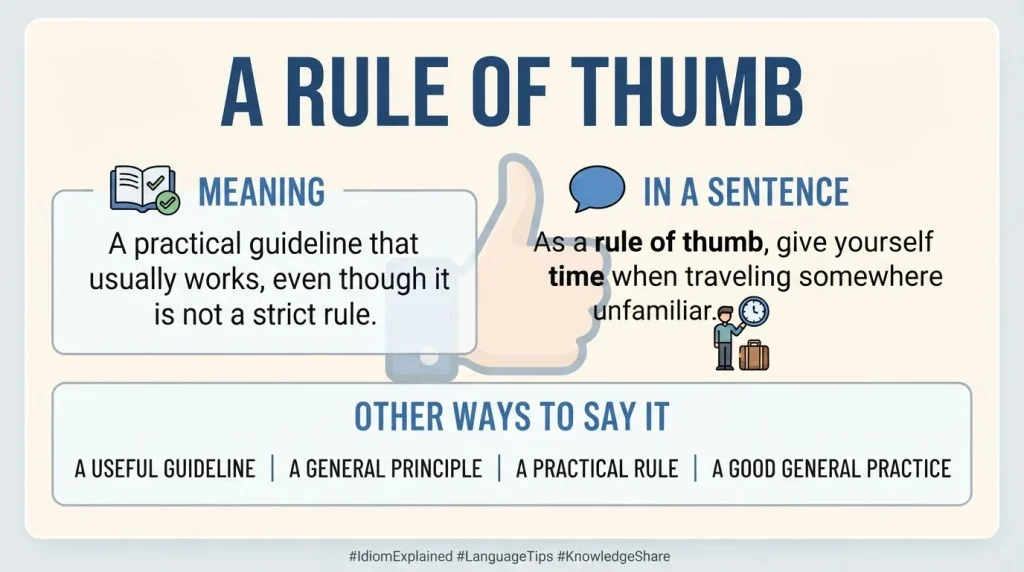
A Rule of Thumb
Meaning
“A rule of thumb” refers to a practical guideline that usually works, even though it is not a strict rule.
In a Sentence
As a rule of thumb, give yourself extra time when traveling somewhere unfamiliar.
Other Ways to Say It
- A useful guideline.
- A general principle.
- A practical rule.
- A good general practice.
Explanation
This idiom is useful because it separates practical wisdom from absolute rules. It tells the reader that the advice is helpful but may not apply perfectly in every situation.
That makes it particularly valuable for practical guidance.
Best Use
Use it in educational writing, workplace discussions, instructions, and everyday conversations.
Put Your Heads Together
Meaning
“Put your heads together” means to work with other people to think about a problem and find a solution.
In a Sentence
Let’s put our heads together and figure out how to make the project work.
Other Ways to Say It
- Work together on the problem.
- Share your ideas.
- Brainstorm together.
- Find a solution as a team.
Explanation
The expression creates the image of people bringing their knowledge and ideas together. As advice, it encourages cooperation instead of trying to solve everything alone.
Its tone is friendly and collaborative.
Best Use
It works well in team conversations, workplace settings, classrooms, and group problem-solving.
Give It Your Best Shot
Meaning
“Give it your best shot” means to make your strongest effort to succeed at something.
In a Sentence
You may not feel ready, but give it your best shot and learn from the experience.
Other Ways to Say It
- Do your best.
- Give it everything you’ve got.
- Make your best effort.
- Try as hard as you can.
Explanation
The phrase uses the image of taking a shot at a target. As advice, it encourages action and effort even when success is uncertain.
It has an upbeat, encouraging quality.
Best Use
Use it in personal encouragement, conversations, motivational messages, and speeches.
Learn the Ropes
Meaning
“Learn the ropes” means to learn how something works, especially by gaining practical experience.
In a Sentence
Give yourself time to learn the ropes before taking on the most difficult assignments.
Other Ways to Say It
- Learn how things work.
- Gain practical experience.
- Get familiar with the process.
- Learn the basics.
Explanation
The idiom comes from the idea of learning how to handle ropes on a ship. Today, it gives practical advice to people who are new to a job, activity, or situation.
It encourages patience rather than expecting immediate expertise.
Best Use
It fits workplace advice, mentoring, education, and everyday conversations.
On the Right Track
Meaning
“On the right track” means that someone is moving in a sensible or successful direction.
In a Sentence
Your plan is on the right track, but you may need to adjust the budget.
Other Ways to Say It
- Moving in the right direction.
- Making good progress.
- Following a sensible approach.
- Heading toward the right result.
Explanation
The expression compares progress with following a track toward a destination. It can encourage someone while still leaving room for improvement.
The tone is usually supportive and constructive.
Best Use
Use it in work discussions, education, coaching, personal advice, and progress reviews.
Back to the Drawing Board
Meaning
“Back to the drawing board” means starting to develop a new plan after an earlier attempt has failed or needs major changes.
In a Sentence
The first design did not solve the problem, so the team went back to the drawing board.
Other Ways to Say It
- Start the plan again.
- Rethink the approach.
- Try a new strategy.
- Go back to the planning stage.
Explanation
The phrase evokes an engineer or designer returning to a drawing board to create a revised plan. As advice, it can turn failure into an invitation to reconsider rather than simply give up.
It can sound practical rather than pessimistic.
Best Use
It works well in business, problem-solving, education, project discussions, and storytelling.
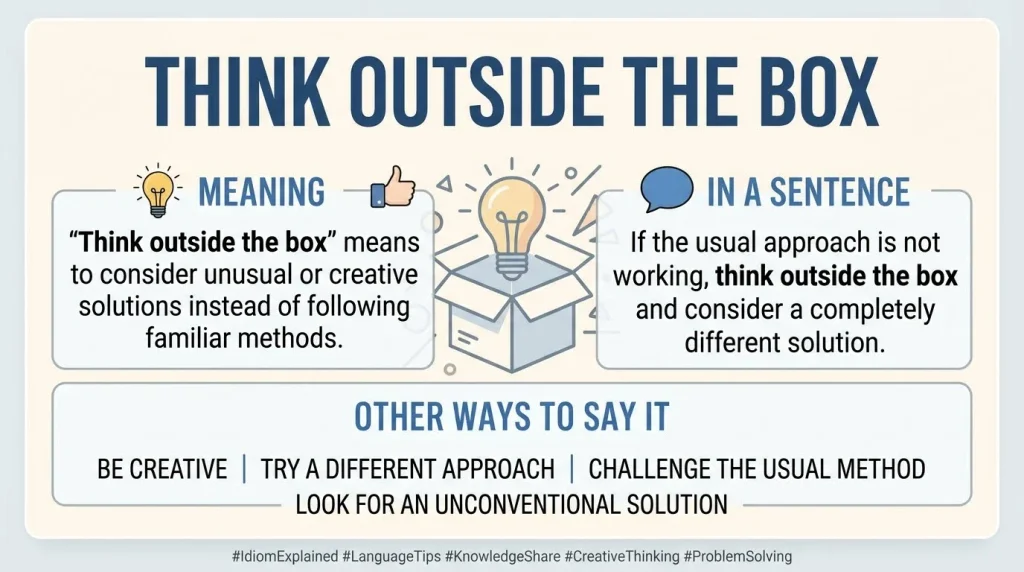
Think Outside the Box
Meaning
“Think outside the box” means to consider unusual or creative solutions instead of following familiar methods.
In a Sentence
If the usual approach is not working, think outside the box and consider a completely different solution.
Other Ways to Say It
- Be creative.
- Try a different approach.
- Challenge the usual method.
- Look for an unconventional solution.
Explanation
The “box” represents traditional thinking and familiar limits. The idiom encourages someone to step beyond those limits and explore new possibilities.
It is energetic and solution-focused.
Best Use
Use it in brainstorming, business discussions, creative writing, education, and motivational communication.
Read Between the Lines
Meaning
“Read between the lines” means to look beyond the obvious words and notice an implied or hidden meaning.
In a Sentence
Read between the lines of the message; he may be asking for help without saying so directly.
Other Ways to Say It
- Look for the hidden meaning.
- Pay attention to what is implied.
- Look beyond the obvious.
- Consider the underlying message.
Explanation
The image suggests that meaning can exist between the written lines, not only in the words themselves. As advice, it encourages careful observation and thoughtful interpretation.
It is particularly useful when communication is indirect.
Best Use
It works well in literary analysis, conversations, relationships, workplace communication, and storytelling.
Weigh Your Options
Meaning
“Weigh your options” means to carefully compare possible choices before making a decision.
In a Sentence
Before accepting the offer, weigh your options and consider what each choice will mean in the long term.
Other Ways to Say It
- Consider your choices.
- Compare the possibilities.
- Think through your alternatives.
- Evaluate your options.
Explanation
The expression compares decision-making with weighing objects to judge their value or importance. It encourages deliberate thinking instead of rushing into a choice.
The tone is practical and thoughtful.
Best Use
Use it in personal advice, professional discussions, essays, and decision-making conversations.
Look Before You Leap
Meaning
“Look before you leap” advises people to think carefully about the consequences before taking action.
In a Sentence
You may be excited about moving, but look before you leap and make sure you can afford the change.
Other Ways to Say It
- Think before you act.
- Consider the consequences.
- Don’t rush into it.
- Examine the situation first.
Explanation
The idiom creates a vivid image of someone checking where they will land before jumping. It gives advice about caution, preparation, and avoiding impulsive decisions.
It has a clear warning quality without necessarily sounding harsh.
Best Use
It fits conversations, personal messages, storytelling, and practical advice.
Better Safe Than Sorry
Meaning
“Better safe than sorry” means it is wiser to take reasonable precautions than to regret failing to do so later.
In a Sentence
Take an umbrella; better safe than sorry.
Other Ways to Say It
- It is better to be cautious.
- Take precautions.
- Don’t take unnecessary risks.
- Safety comes first.
Explanation
This expression emphasizes the value of preventing avoidable problems. It is especially effective when the precaution requires little effort but could prevent a larger problem.
Its tone is practical and reassuring.
Best Use
Use it in everyday conversations, safety advice, family messages, and practical writing.
Keep Your Cards Close to Your Chest
Meaning
“Keep your cards close to your chest” means to avoid revealing your plans, intentions, or information too quickly.
In a Sentence
If negotiations are still uncertain, keep your cards close to your chest until you know what the other side wants.
Other Ways to Say It
- Keep your plans private.
- Don’t reveal everything yet.
- Be discreet.
- Hold back some information.
Explanation
The idiom comes from card games, where holding cards close prevents other players from seeing them. As advice, it suggests discretion and strategic patience.
It can sound cautious or strategic rather than warm.
Best Use
It works best in business discussions, negotiations, strategy writing, and stories involving uncertainty.
Hear It from the Horse’s Mouth
Meaning
“Hear it from the horse’s mouth” means to get information directly from the person who knows about it rather than relying on secondhand reports.
In a Sentence
Don’t rely on rumors; hear it from the horse’s mouth and ask the manager directly.
Other Ways to Say It
- Get the information directly.
- Ask the source.
- Hear it firsthand.
- Verify it with the person involved.
Explanation
The unusual image makes the expression memorable. Its advice is simple: go to the original source when accuracy matters.
The phrase is informal and conversational.
Best Use
Use it in everyday conversation, informal advice, storytelling, and discussions about rumors or uncertain information.
Take the Bull by the Horns
Meaning
“Take the bull by the horns” means to face a difficult situation directly and take decisive action.
In a Sentence
Instead of avoiding the problem, take the bull by the horns and have an honest conversation.
Other Ways to Say It
- Face the problem directly.
- Take decisive action.
- Deal with it head-on.
- Take control of the situation.
Explanation
The idiom creates a bold image of grabbing a dangerous situation by the horns. It gives advice about courage and taking responsibility when avoiding a problem will not help.
Its tone is strong and motivational.
Best Use
It is effective in motivational speeches, personal advice, leadership writing, and storytelling.
Don’t Put All Your Eggs in One Basket
Meaning
“Don’t put all your eggs in one basket” advises against depending entirely on one option, plan, or source of success.
In a Sentence
Apply to several opportunities instead of relying on one; don’t put all your eggs in one basket.
Other Ways to Say It
- Keep your options open.
- Spread your risks.
- Have a backup plan.
- Don’t depend on one possibility.
Explanation
The image is easy to understand: if every egg is in one basket and the basket falls, everything is lost. The idiom encourages flexibility and preparation.
It is especially useful when discussing uncertain outcomes.
Best Use
Use it in financial discussions, career advice, planning, business, and everyday conversations.
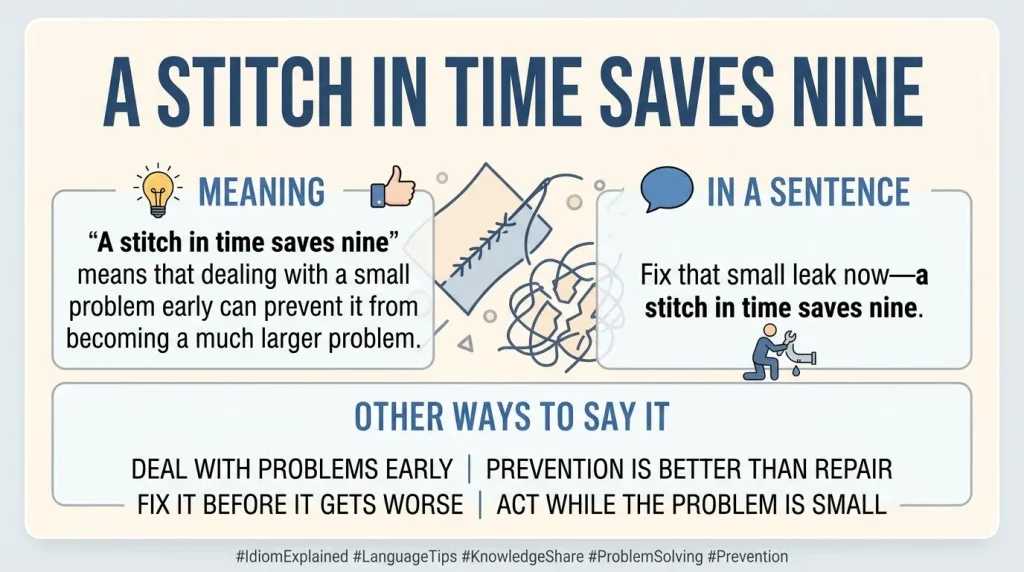
A Stitch in Time Saves Nine
Meaning
“A stitch in time saves nine” means that dealing with a small problem early can prevent it from becoming a much larger problem.
In a Sentence
Fix that small leak now—a stitch in time saves nine.
Other Ways to Say It
- Deal with problems early.
- Prevention is better than repair.
- Fix it before it gets worse.
- Act while the problem is small.
Explanation
The expression comes from sewing: repairing one small tear early may prevent the need for many more stitches later.
It gives practical advice about early action and prevention.
Best Use
It works well in practical advice, education, household guidance, workplace discussions, and storytelling.
The Ball Is in Your Court
Meaning
“The ball is in your court” means that it is now someone else’s turn to act, respond, or make a decision.
In a Sentence
I’ve explained the proposal and answered your questions; the ball is in your court now.
Other Ways to Say It
- It is your decision now.
- The next move is yours.
- It is up to you.
- You need to decide what happens next.
Explanation
The expression comes from sports, where the ball must be returned to the other side. As advice, it emphasizes personal responsibility and the need to make the next move.
Depending on context, it can sound neutral, encouraging, or slightly firm.
Best Use
Use it in business communication, negotiations, personal conversations, and decision-making situations.
Exercise: Practice Using Idioms
1. Someone advises you to be careful before accepting a risky opportunity. Which idiom fits best?
A. Put your heads together
B. Look before you leap
C. Learn the ropes
D. Food for thought
2. What does “food for thought” usually mean?
A. A meal shared with friends
B. A strict instruction
C. Something worth thinking about
D. A reason to avoid discussion
3. Which expression means to remain skeptical about information?
A. Take it with a grain of salt
B. Give it your best shot
C. On the right track
D. Take the bull by the horns
4. Your friend is new to a job. Which advice is most appropriate?
A. Keep your cards close to your chest
B. Learn the ropes
C. Read between the lines
D. Weigh your options
5. What does “weigh your options” encourage someone to do?
A. Make a decision immediately
B. Ignore possible consequences
C. Compare possible choices carefully
D. Ask someone else to decide
6. Which idiom encourages creative thinking?
A. Think outside the box
B. Better safe than sorry
C. Hear it from the horse’s mouth
D. A stitch in time saves nine
7. “The ball is in your court” means:
A. You have made the wrong decision.
B. Someone else has taken control.
C. You need to start over.
D. It is now your turn to act.
8. Which idiom suggests dealing with a small problem early?
A. A word to the wise
B. A stitch in time saves nine
C. Put your heads together
D. Give it your best shot
9. If someone says, “Don’t put all your eggs in one basket,” what are they advising?
A. Avoid taking every opportunity.
B. Depend on one reliable plan.
C. Keep alternative options available.
D. Finish one task before starting another.
10. Which expression means to understand an implied meaning?
A. Read between the lines
B. Learn the ropes
C. On the right track
D. Take the bull by the horns
11. Which idiom is most suitable for encouraging someone to face a difficult problem directly?
A. Food for thought
B. Take the bull by the horns
C. Take it with a grain of salt
D. Keep your cards close to your chest
12. What does “keep your cards close to your chest” suggest?
A. Reveal your plans immediately.
B. Avoid making any decisions.
C. Keep some information private.
D. Ask others for their opinions.
13. Which statement uses “a rule of thumb” correctly?
A. A rule of thumb means an unbreakable law.
B. A rule of thumb is a practical general guideline.
C. A rule of thumb describes a secret message.
D. A rule of thumb means starting a project again.
14. Someone tells you a rumor and advises you to “hear it from the horse’s mouth.” What should you do?
A. Ignore the rumor completely.
B. Tell the rumor to someone else.
C. Ask the original source directly.
D. Make a guess based on experience.
15. Which idiom best fits this situation: “The first plan failed, so the team needs to create a new approach”?
A. Back to the drawing board
B. Better safe than sorry
C. The ball is in your court
D. Give it your best shot
Answers
- B — “Look before you leap” advises careful consideration before taking action.
- C — “Food for thought” describes an idea that deserves reflection.
- A — “Take it with a grain of salt” means to remain cautious or skeptical.
- B — “Learn the ropes” means to become familiar with how something works.
- C — “Weigh your options” means to compare choices before deciding.
- A — “Think outside the box” encourages unconventional or creative thinking.
- D — “The ball is in your court” means the next action or decision is yours.
- B — “A stitch in time saves nine” emphasizes solving small problems before they grow.
- C — The expression recommends keeping alternatives instead of depending on one option.
- A — “Read between the lines” means to look for an implied or hidden meaning.
- B — “Take the bull by the horns” means to confront a difficult situation directly.
- C — The idiom advises keeping certain plans or information private.
- B — “A rule of thumb” is a practical general guideline, not an absolute rule.
- C — “Hear it from the horse’s mouth” means to get information directly from the source.
- A — “Back to the drawing board” means to return to planning after an approach fails.
FAQs
What is an idiom for advice?
An idiom for advice is a familiar figurative expression that can communicate guidance, caution, encouragement, or practical wisdom. Examples include “look before you leap” and “better safe than sorry.”
How do I create my own idiom?
Start with a clear idea, such as caution, patience, or courage. Then connect that idea to a strong, easy-to-picture image. The comparison should be understandable from context and should communicate more than a simple synonym.
What makes an idiom effective?
An effective idiom creates a clear mental image while communicating an idea naturally. It should fit the context, suit the audience, and add meaning rather than simply making a sentence sound unusual.
Can I use these idioms in everyday conversation?
Yes. Many of these expressions, including “give it your best shot,” “on the right track,” and “the ball is in your court,” are natural in everyday English. Others may sound more informal, traditional, or figurative depending on the situation.
What is the difference between an idiom and a simile?
An idiom is an established expression with a figurative meaning, such as “take the bull by the horns.” A simile directly compares two things using words such as “like” or “as,” such as “her advice was like a compass.”
Conclusion
Good advice does more than tell someone what to do. It can help them see a situation differently, recognize a risk, or find the confidence to take action. Idioms make that guidance more memorable by turning abstract ideas into familiar images.
Expressions such as “look before you leap,” “weigh your options,” and “think outside the box” each approach advice from a different angle. Some encourage caution, some promote creativity, and others support decisive action. The key is to choose an expression that genuinely matches your meaning and audience. Whether you are writing an essay, giving a speech, telling a story, or having a personal conversation, the strongest idiom is the one that makes your advice clear, natural, and memorable.

Margaret Saywell is an English author and editor who has spent more than fifteen years working with words teaching, proofreading, and writing about the quirks of the English language.
At Idiom Looms, Margaret gathers idioms from across the English-speaking world and weaves them into clear, practical guides. She loves digging into the history of a phrase and showing readers how a few well-chosen words can say far more than a long explanation.
She believes language should be enjoyed, not feared and that the best way to learn an idiom is to see it in action.



[…] Read more:20 Idioms for Advice With Real Examples […]