
Have you ever noticed how a simple phrase can make business communication sound more confident and engaging? The right expression can add clarity to meetings, emails, negotiations, and everyday workplace conversations. In this guide, 20 Idioms for Business With Real Examples introduces practical expressions that professionals and English learners can use naturally. These idioms can help you express ideas about planning, teamwork, success, challenges, deadlines, and decision-making without making your language sound forced. You will also see how context influences meaning, so each expression becomes easier to understand and remember.
Business English often connects with practical situations such as scheduling, time management, online booking, meetings, and project management. Even terms related to a calendar, broadcasting, or organizing appointments can appear in professional conversations. Learning relevant idioms gives you another way to describe these situations with greater personality and precision. Each example in this article focuses on natural English usage, showing how an expression works in a realistic sentence rather than presenting it as a phrase to memorize.
Whether you are improving workplace English, preparing formal messages, or developing stronger professional communication skills, these expressions can expand your vocabulary. The examples also help clarify grammar, meaning, tone, and appropriate context for formal writing and conversation. You will discover idioms that fit different business situations while learning how to use them with clarity and consistency. By the end, you should feel more comfortable recognizing figurative language and choosing expressions that make your professional English sound natural, polished, and purposeful.
What Is an Idiom?
An idiom is a common expression whose overall meaning cannot always be understood by taking each word literally.
For example, “break the ice” does not mean physically breaking ice. It means to make people feel more comfortable when they first meet.
Another example is “hit the nail on the head,” which means to identify or describe something exactly.
Idioms are different from literal statements because their intended meaning is figurative rather than word-for-word. They are especially useful when you want language to feel natural, expressive, and memorable.
Why Use Idioms for Business?
Business communication often involves abstract ideas such as success, risk, competition, money, teamwork, and change. Idioms can turn those ideas into images that are easier to understand.
A well-chosen business idiom can:
- Express a complicated idea in a few familiar words.
- Make professional conversations sound more natural.
- Add personality to presentations and speeches.
- Make business writing more memorable.
- Describe financial or workplace situations vividly.
- Help explain challenges, opportunities, and decisions.
- Add a conversational touch to otherwise formal communication.
However, context matters. Some idioms are perfectly natural in meetings and conversations, while others are better suited to creative writing, speeches, or informal business communication.
Quick List of 20 Business Idioms
- Get the ball rolling
- In the red
- In the black
- Go the extra mile
- Think outside the box
- Cut corners
- Back to the drawing board
- Move the goalposts
- Raise the bar
- Learn the ropes
- Climb the corporate ladder
- A win-win situation
- Bring something to the table
- Get down to brass tacks
- The bottom line
- Ahead of the curve
- A ballpark figure
- Keep something in the pipeline
- Red tape
- Weather the storm
Get the Ball Rolling
Meaning
Get the ball rolling means to start an activity, project, discussion, or business process.
The image comes from pushing a ball so that it begins moving. In business, it represents taking the first practical step.
In a Sentence
“Let’s get the ball rolling by agreeing on the project’s main goals.”
Other Ways to Say It
- Get started
- Begin the process
- Set things in motion
- Make a start
Explanation
This idiom creates a simple image of movement beginning after a period of preparation. It suggests action and momentum, rather than merely talking about an idea.
It works especially well when a team has discussed something for a while and is finally ready to act.
Best Use
Best for meetings, emails, presentations, and workplace conversations. It has a friendly, conversational tone.
In the Red
Read more:20 Idioms for For A Lot With Real Examples
Meaning
In the red means that a business is losing money or has financial difficulties.
The expression is associated with the traditional use of red ink to show negative financial figures.
In a Sentence
“After several months of declining sales, the company is still in the red.”
Other Ways to Say It
- Operating at a loss
- Losing money
- Facing a deficit
- Experiencing financial losses
Explanation
The idiom gives financial trouble a clear visual image: red figures signal a problem. It is concise and immediately communicates that expenses or losses are outweighing income.
Unlike some business idioms, this one has a specific financial meaning.
Best Use
Useful in business discussions, financial reporting, articles, and informal professional conversations. For highly formal financial documents, the literal term “operating at a loss” may be clearer.
In the Black
Meaning
In the black means that a business is making money or operating profitably.
It contrasts directly with “in the red,” suggesting that the financial figures are positive rather than negative.
In a Sentence
“Thanks to stronger sales this quarter, the company is finally back in the black.”
Other Ways to Say It
- Making a profit
- Financially healthy
- Operating profitably
- Turning a profit
Explanation
The phrase creates a useful visual contrast with financial figures written in black ink. It communicates positive financial performance without requiring a long explanation.
Because it is closely connected with accounting language, it fits naturally into many business conversations.
Best Use
Best for financial discussions, business articles, meetings, and informal reports. Use more direct financial language when precision is essential.
Go the Extra Mile
Meaning
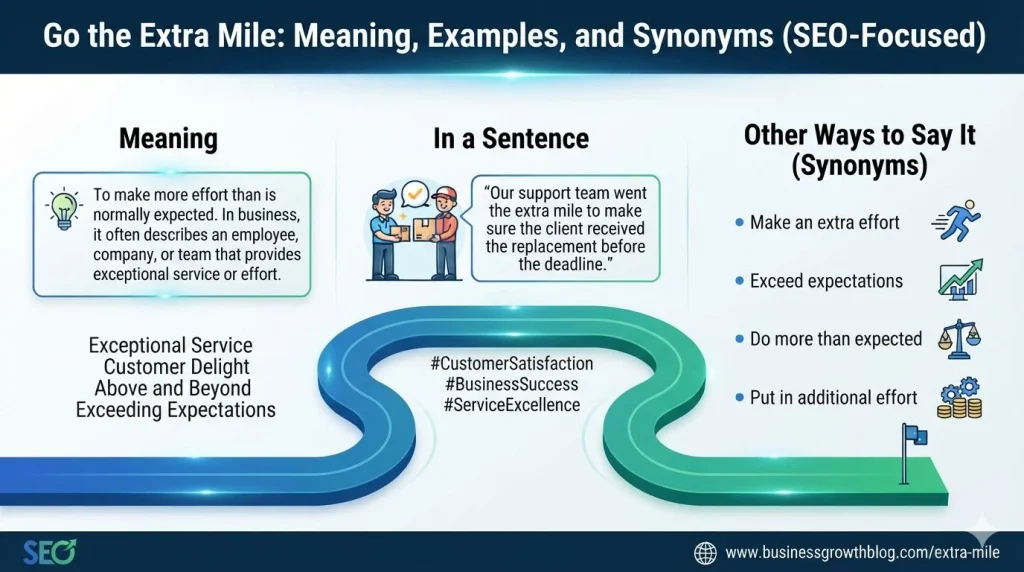
Go the extra mile means to make more effort than is normally expected.
In business, it often describes an employee, company, or team that provides exceptional service or effort.
In a Sentence
“Our support team went the extra mile to make sure the client received the replacement before the deadline.”
Other Ways to Say It
- Make an extra effort
- Exceed expectations
- Do more than expected
- Put in additional effort
Explanation
The expression creates the image of someone continuing beyond the expected stopping point. It suggests dedication, generosity, and commitment.
It can be especially effective when praising customer service or recognizing someone’s contribution.
Best Use
Ideal for employee recognition, customer service discussions, speeches, testimonials, and workplace conversations. It has a positive and encouraging tone.
Think Outside the Box
Meaning
Think outside the box means to approach a problem in a creative or unconventional way.
The “box” represents traditional thinking or familiar limitations.
In a Sentence
“We need to think outside the box if we want to attract customers in this crowded market.”
Other Ways to Say It
- Think creatively
- Try a different approach
- Challenge conventional thinking
- Explore new ideas
Explanation
The image suggests stepping beyond an invisible boundary that limits ordinary thinking. It communicates creativity and openness to new possibilities.
The expression is common in workplace language, although it can sound somewhat familiar or overused in formal business writing.
Best Use
Works well in brainstorming sessions, presentations, team discussions, and creative business conversations.
Cut Corners
Meaning
Cut corners means to do something in the easiest, cheapest, or fastest way by skipping important steps or standards.
It usually carries a negative meaning.
In a Sentence
“The company lost customer trust after it started cutting corners on product testing.”
Other Ways to Say It
- Take shortcuts
- Reduce standards
- Skip necessary steps
- Compromise quality
Explanation
The idiom creates the image of someone literally taking a shorter route by cutting across a corner. In business, it suggests saving time or money at the expense of quality or responsibility.
It is useful when discussing poor practices or avoidable mistakes.
Best Use
Best for workplace discussions, business journalism, storytelling, and persuasive writing. It is generally too informal for highly technical or legal documents.
Back to the Drawing Board
Meaning
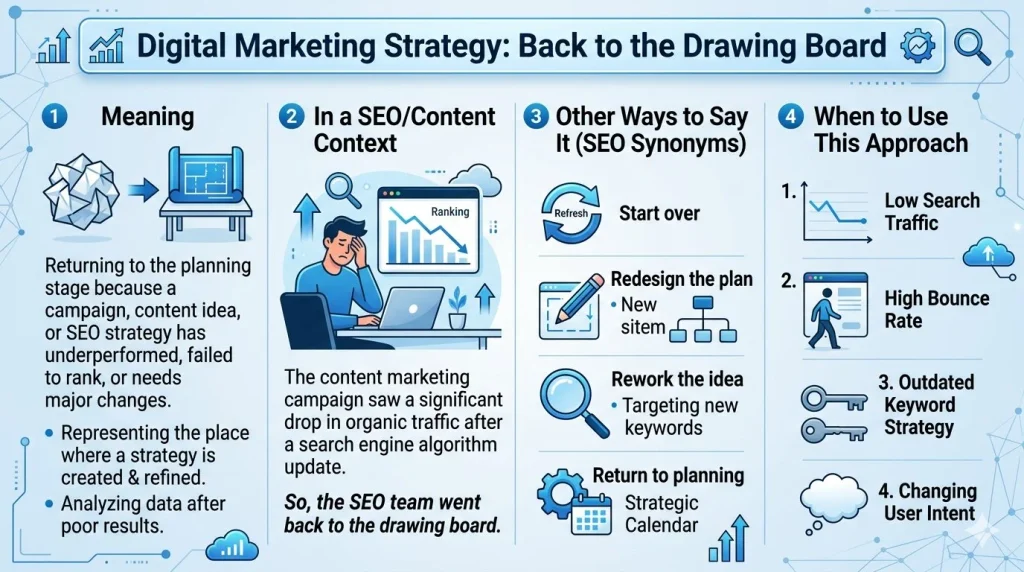
Back to the drawing board means returning to the planning stage because an idea, design, or plan has failed or needs major changes.
The drawing board represents the place where a plan is created and redesigned.
In a Sentence
“The prototype failed the safety test, so the engineers went back to the drawing board.”
Other Ways to Say It
- Start over
- Redesign the plan
- Rework the idea
- Return to planning
Explanation
This idiom creates a strong picture of professionals going back to their original plans to find a better solution. It acknowledges failure while emphasizing problem-solving and improvement.
It does not necessarily mean complete failure; sometimes a plan simply needs substantial revision.
Best Use
Excellent for project discussions, product development, presentations, and workplace storytelling.
Move the Goalposts
Meaning
Move the goalposts means to change the requirements, expectations, or conditions of a situation after they have already been established.
In a Sentence
“We agreed on three delivery milestones, but the client keeps moving the goalposts.”
Other Ways to Say It
- Change the requirements
- Shift the expectations
- Alter the conditions
- Change the rules
Explanation
The expression comes from sports, where moving the goalposts would make scoring harder. In business, it creates the image of trying to reach a target that keeps changing.
It often expresses frustration or unfairness.
Best Use
Useful in negotiations, project management discussions, workplace conversations, and opinion writing. It can sound critical, so use it carefully in sensitive professional situations.
Raise the Bar
Meaning
Raise the bar means to increase the standard or level of performance that people are expected to achieve.
In a Sentence
“The new service has raised the bar for customer support in our industry.”
Other Ways to Say It
- Set a higher standard
- Increase expectations
- Improve performance standards
- Set a new benchmark
Explanation
The image comes from a high-jump bar that athletes must clear. Raising it means making the challenge greater.
In business, the phrase communicates higher expectations, stronger quality, and improved performance.
Best Use
Best for presentations, marketing discussions, leadership communication, reviews, and professional speeches. It usually has an inspirational or complimentary tone.
Learn the Ropes
Meaning
Learn the ropes means to learn how a particular job, business, system, or organization works.
In a Sentence
“It took our new sales manager a few weeks to learn the ropes.”
Other Ways to Say It
- Learn how things work
- Become familiar with the job
- Gain experience
- Learn the basics
Explanation
The phrase is traditionally linked with learning how to handle ropes on a ship. The business meaning focuses on gaining practical knowledge through experience.
It is particularly useful when discussing new employees or people entering unfamiliar roles.
Best Use
Suitable for workplace conversations, onboarding discussions, mentoring, and informal professional writing. It is conversational rather than highly formal.
Climb the Corporate Ladder
Meaning
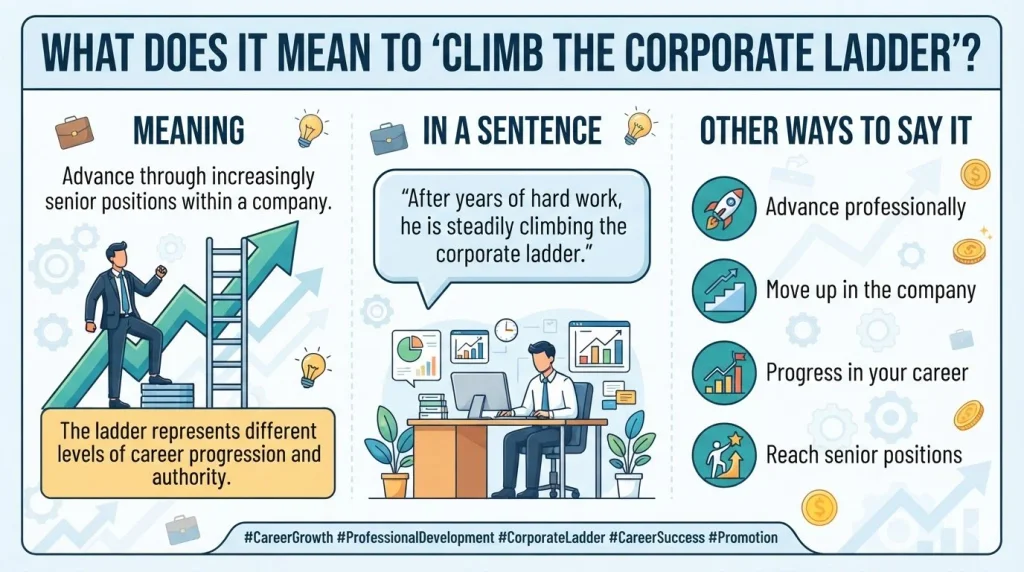
Climb the corporate ladder means to advance through increasingly senior positions within a company.
The ladder represents the different levels of career progression and authority.
In a Sentence
“After years of hard work, he is steadily climbing the corporate ladder.”
Other Ways to Say It
- Advance professionally
- Move up in the company
- Progress in your career
- Reach senior positions
Explanation
The ladder creates a clear image of moving upward from one professional level to another. It can suggest ambition, career growth, and increasing responsibility.
The phrase can be positive, although it may sound slightly critical when used to describe someone who is strongly focused on status.
Best Use
Works well in career articles, conversations, interviews, workplace storytelling, and personal development writing.
A Win-Win Situation
Meaning
A win-win situation describes an outcome in which all important parties benefit.
In a Sentence
“Offering flexible delivery options was a win-win situation because customers were happier and sales increased.”
Other Ways to Say It
- A mutually beneficial outcome
- Good for everyone involved
- A positive outcome for both sides
- A mutually rewarding arrangement
Explanation
The phrase comes from the idea that both sides of a competition can “win.” In business, it emphasizes cooperation rather than sacrifice.
It is especially useful when explaining a deal, partnership, or solution that benefits multiple parties.
Best Use
Ideal for negotiations, sales discussions, partnership proposals, presentations, and everyday professional conversations.
Bring Something to the Table
Meaning
Bring something to the table means to contribute a useful skill, idea, resource, experience, or advantage.
In a Sentence
“She brings years of technical experience to the table, which will strengthen the project.”
Other Ways to Say It
- Make a contribution
- Offer useful skills
- Add value
- Contribute expertise
Explanation
The image is of people sitting around a table and contributing something valuable to a shared discussion or decision. It highlights what a person can contribute, rather than simply who they are.
The expression is particularly effective when discussing teamwork and collaboration.
Best Use
Best for interviews, meetings, teamwork discussions, business profiles, and professional conversations.
Get Down to Brass Tacks
Meaning
Get down to brass tacks means to focus on the most important practical details of a matter.
In a Sentence
“We’ve discussed the general strategy; now let’s get down to brass tacks and talk about the budget.”
Other Ways to Say It
- Focus on the details
- Get to the main point
- Discuss the practical issues
- Get straight to business
Explanation
The exact origin of the phrase is uncertain, but its modern meaning is clear: stop discussing generalities and deal with the essentials.
It gives a conversation a sense of movement from broad ideas toward practical decisions.
Best Use
Good for meetings, negotiations, workplace conversations, and informal business writing. It has a distinctly conversational feel.
The Bottom Line
Meaning
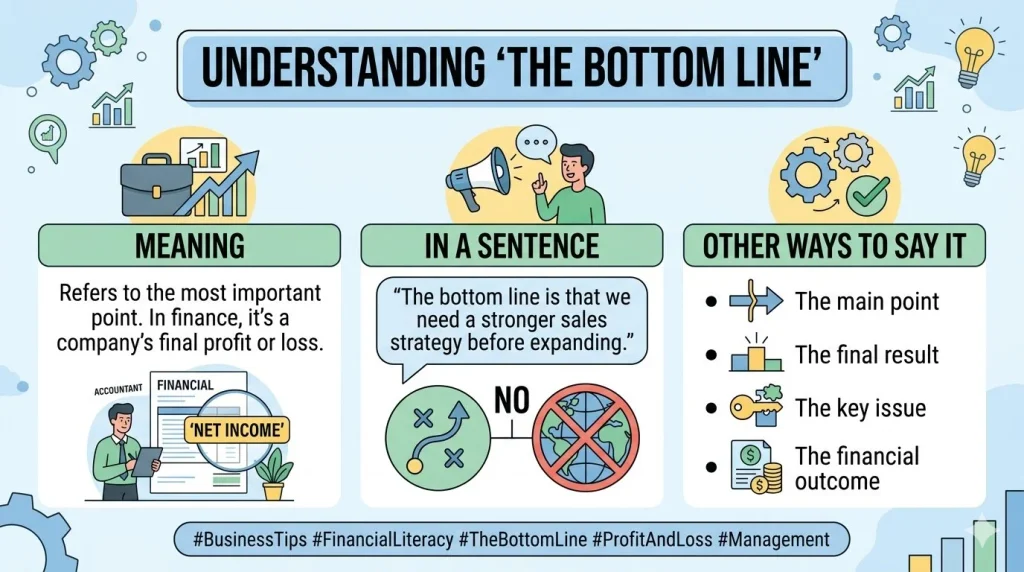
The bottom line refers to the most important point or, in financial contexts, a company’s final profit or loss.
In a Sentence
“The bottom line is that we need a stronger sales strategy before expanding.”
Other Ways to Say It
- The main point
- The final result
- The key issue
- The financial outcome
Explanation
The phrase comes from the final line of financial statements, where the overall result can be seen. Its broader meaning has become the essential fact or conclusion.
This makes it useful when a discussion has become too complicated and someone wants to return to the central issue.
Best Use
Works well in business meetings, presentations, reports, journalism, and everyday professional conversations. In formal financial contexts, it should be used precisely.
Ahead of the Curve
Meaning
Ahead of the curve means being more advanced, innovative, or prepared than competitors or the general market.
In a Sentence
“By investing in automation early, the company stayed ahead of the curve.”
Other Ways to Say It
- Ahead of competitors
- At the forefront
- Leading the market
- More advanced than others
Explanation
The “curve” represents the general level of progress or development. Being ahead of it suggests moving forward before others catch up.
The phrase is particularly effective when discussing innovation, technology, strategy, or changing consumer expectations.
Best Use
Suitable for business articles, presentations, marketing copy, strategy discussions, and professional speeches. It has an ambitious, forward-looking tone.
A Ballpark Figure
Meaning
A ballpark figure means an approximate number or estimate rather than an exact amount.
In a Sentence
“Can you give me a ballpark figure for the cost of redesigning the website?”
Other Ways to Say It
- Rough estimate
- Approximate amount
- General estimate
- Estimated range
Explanation
The expression comes from the idea of estimating something within a broad range, rather than identifying an exact number. It is useful when precision is not yet possible or necessary.
It also helps make requests for preliminary estimates sound less demanding.
Best Use
Excellent for meetings, budgeting conversations, negotiations, project planning, and informal business communication. Use exact figures when financial precision is required.
Keep Something in the Pipeline
Meaning
Keep something in the pipeline means to have a project, product, deal, idea, or plan being developed or prepared for future use.
In a Sentence
“We have several new products in the pipeline for next year.”
Other Ways to Say It
- Under development
- In progress
- Being prepared
- Planned for the future
Explanation
The image is of something moving through a pipeline toward completion. It suggests that an idea or project is not ready yet but is actively progressing.
This idiom is especially useful when a company has future projects that it cannot launch immediately.
Best Use
Commonly useful in business presentations, product announcements, investor communication, marketing discussions, and workplace conversations.
Red Tape
Meaning
Red tape refers to excessive rules, paperwork, procedures, or bureaucracy that make something unnecessarily difficult or slow.
In a Sentence
“The project was delayed for weeks because of government red tape.”
Other Ways to Say It
- Excessive bureaucracy
- Complicated procedures
- Administrative obstacles
- Unnecessary paperwork
Explanation
The expression creates an image of official paperwork being tied up with layers of restrictive procedures. It usually communicates frustration with unnecessary complexity.
Because it has a critical tone, it should be used thoughtfully when discussing specific organizations or authorities.
Best Use
Works well in opinion writing, business journalism, workplace conversations, and discussions about bureaucracy. It is less suitable for highly formal official documents.
Weather the Storm
Meaning
Weather the storm means to survive and manage a difficult period until conditions improve.
In a Sentence
“Although the market is uncertain, the company has enough reserves to weather the storm.”
Other Ways to Say It
- Survive the difficult period
- Get through the crisis
- Remain stable during hardship
- Endure challenging conditions
Explanation
The idiom compares a business challenge to a powerful storm. The company may not be able to control the conditions, but it can remain strong until the difficulty passes.
It is especially effective when talking about economic uncertainty, market pressure, or temporary setbacks.
Best Use
Best for leadership speeches, business articles, financial discussions, company updates, and motivational communication. Its tone is serious but hopeful.
Exercise: Practice Using Idioms
Choose the best answer for each question.
What does “get the ball rolling” mean in a business context?
A. Solving a financial problem
B. Starting a project or activity
C. Stopping a difficult negotiation
D. Calculating a company’s profits
Which idiom describes a business that is losing money?
A. Ahead of the curve
B. In the black
C. In the red
D. Raise the bar
A manager praises an employee for making more effort than expected. Which idiom fits best?
A. Go the extra mile
B. Cut corners
C. Move the goalposts
D. Learn the ropes
What does “think outside the box” encourage?
A. Following established procedures
B. Reducing the project budget
C. Avoiding difficult decisions
D. Considering creative approaches
Which sentence uses “cut corners” correctly?
A. The company cut corners to improve product quality.
B. The team cut corners by skipping important safety checks.
C. The manager cut corners to increase employee training.
D. The designer cut corners by adding more testing stages.
If a project fails and the team must redesign its original plan, what idiom fits?
A. Back to the drawing board
B. A ballpark figure
C. In the black
D. Bring something to the table
What does “move the goalposts” suggest?
A. Finishing a project early
B. Improving customer service
C. Changing expectations after they were established
D. Hiring additional employees
Which idiom means to increase a standard of performance?
A. Learn the ropes
B. Raise the bar
C. Get down to brass tacks
D. In the red
A new employee is learning how a company operates. Which expression is most appropriate?
A. Learn the ropes
B. Weather the storm
C. Move the goalposts
D. The bottom line
What does “climb the corporate ladder” describe?
A. Reducing company expenses
B. Moving between different industries
C. Advancing through higher positions in a company
D. Starting a company from scratch
Two companies create an agreement that benefits both sides. What is this?
A. A red tape problem
B. A win-win situation
C. A ballpark figure
D. A drawing board
If a candidate has valuable experience and skills to contribute, what can they “bring to the table”?
A. Additional value
B. A financial loss
C. A new obstacle
D. A corporate title
What does “get down to brass tacks” mean?
A. Avoid the central issue
B. Start a completely new project
C. Focus on the practical details
D. Increase a company’s profit
A manager asks for an approximate project cost. Which phrase is most suitable?
A. The bottom line
B. A ballpark figure
C. In the black
D. Ahead of the curve
A company has several products currently being developed for future release. Which idiom describes them?
A. In the pipeline
B. In the red
C. Cutting corners
D. Moving the goalposts
Answers
B — “Get the ball rolling” means to begin or set something in motion.
C — “In the red” describes a business experiencing financial losses.
A — “Go the extra mile” means making more effort than expected.
D — “Think outside the box” encourages creative or unconventional thinking.
B — Cutting corners means skipping important steps or reducing standards, often to save time or money.
A — “Back to the drawing board” means returning to the planning stage after a plan needs major changes.
C — “Move the goalposts” means changing requirements or expectations after they have already been set.
B — “Raise the bar” means increase the expected standard or level of performance.
A — “Learn the ropes” means learning how a job, system, or organization works.
C — “Climb the corporate ladder” describes career advancement through increasingly senior roles.
B — A win-win situation provides a beneficial result for all important parties.
A — Bringing something to the table means offering a useful contribution, skill, resource, or idea.
C — “Get down to brass tacks” means focusing on the essential practical details.
B — A ballpark figure is an approximate estimate, not an exact number.
A — Something “in the pipeline” is being developed or prepared for future use.
FAQs
What is an idiom for business?
A business idiom is a figurative expression commonly used to describe workplace situations, money, leadership, competition, projects, or professional relationships. Expressions such as “in the red” and “raise the bar” communicate business ideas through memorable images.
How do I create my own business idiom?
Start with a familiar image and connect it to a business idea. For example, an image of a road can represent progress, obstacles, or direction. The strongest expressions have a clear connection between the image and the idea they describe.
What makes a business idiom effective?
An effective idiom is easy to understand, relevant to the situation, and vivid without being confusing. It should add meaning rather than simply make a sentence sound decorative.
Can I use these idioms in everyday conversation?
Yes. Many of these expressions are natural in everyday professional conversations. However, some, such as “get down to brass tacks” or “think outside the box,” can sound informal or familiar, so more precise wording may be preferable in highly formal documents.
What is the difference between an idiom and a simile?
An idiom is an established expression with a figurative meaning, such as “weather the storm.” A simile directly compares two things using words such as “like” or “as,” such as “the business is like a ship in a storm.”
Conclusion
Business language does not always have to sound stiff or technical. The right idiom can turn an abstract idea into a clear mental picture, making communication easier to remember and more engaging. From “get the ball rolling” when a project begins to “weather the storm” during difficult times, these expressions describe different sides of professional life with energy and personality. Still, context matters: a colorful idiom may work beautifully in a presentation or conversation but feel too informal in a legal or financial document.
Choose expressions according to your audience, purpose, and tone. The best business idiom is not simply the most creative one it is the one that makes your intended meaning clear, natural, and memorable.

Eleanor Prose is a writer and English teacher with a soft spot for the phrases that trip us up. She has spent years helping students and professionals use idioms with confidence not just memorizing them, but understanding the culture and humor behind each one.
Through Idiom Looms, Eleanor explores the threads that connect language, history, and everyday conversation. Her goal is simple: to make English idioms clear, memorable, and actually fun to use.
She writes from a quiet desk surrounded by notebooks, and firmly believes there’s an idiom for every situation usually more than one.