
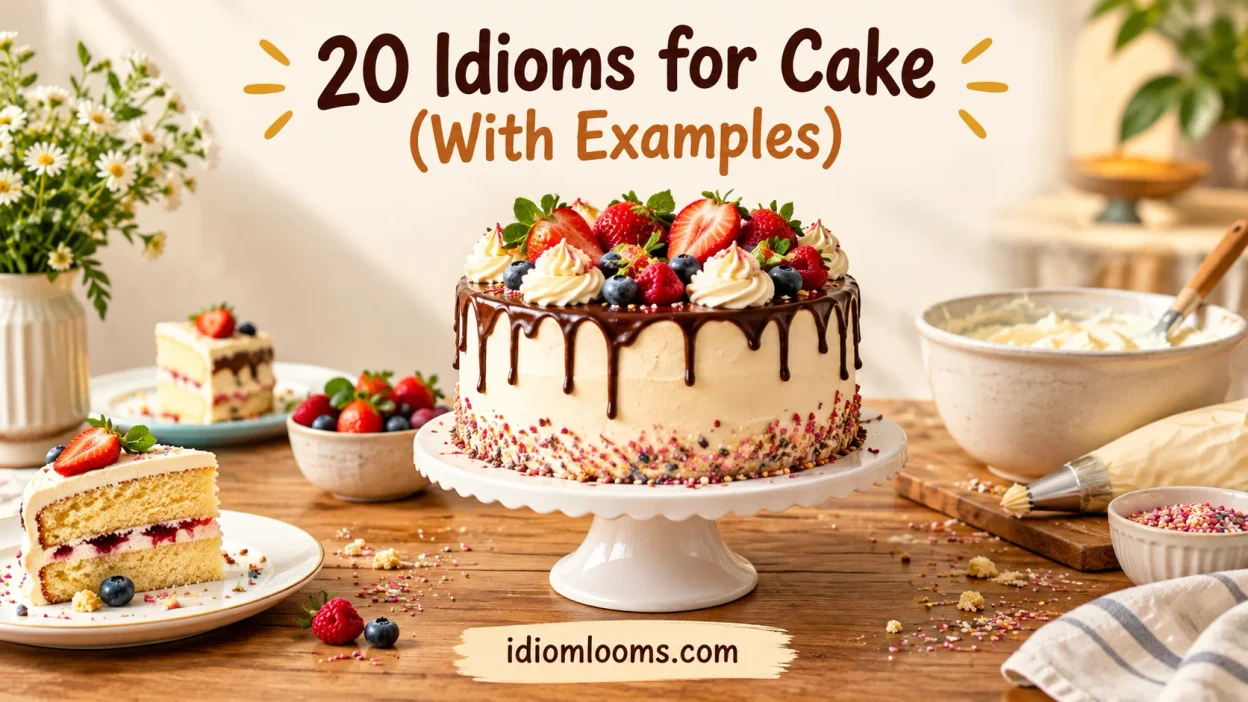
Have you ever noticed how a simple slice of cake can make a moment feel more special? The right expression can add flavor to your writing just as naturally as cake adds sweetness to a celebration. In this guide to 20 Idioms for Cake With Real Examples, you’ll discover useful English idioms, their figurative meanings, and natural examples that show how they work in real communication. These expressions can help you describe celebrations, success, ease, pleasure, and memorable moments with greater personality and clarity.
Whether you are writing a personal message, creating a story, or improving your English usage, understanding idiomatic expressions makes language more vivid. You’ll learn how each idiom fits different situations, from casual conversations and social posts to formal writing and everyday communication. The examples also make it easier to understand grammar, context, tone, and the difference between literal and figurative meaning without making the learning process feel complicated.
This article focuses on practical expressions you can confidently recognize and use. Each idiom is explained in simple language, followed by a natural sentence and alternative ways to express the same idea. You’ll also see how figurative language connects with consistency, clear communication, and effective expression. By the end, you’ll have a useful collection of idioms for describing cake-related ideas while strengthening your broader English vocabulary and communication skills.
What Is an Idiom?
An idiom is a familiar expression whose meaning cannot always be understood by taking every word literally.
For example, “break the ice” does not mean physically breaking ice. It means to make people feel more comfortable in a social situation. Similarly, “spill the beans” means to reveal a secret, not to drop beans on the floor.
Idioms add figurative meaning, imagery, and personality to ordinary language. They are especially useful when a simple statement feels too plain.
Why Use Idioms for Cake?
Cake naturally connects with ideas such as celebration, sweetness, reward, sharing, and enjoyment. Idioms can help express those ideas in a more memorable way.
For example, saying something is a “piece of cake” communicates that it is very easy. Saying something is the “icing on the cake” suggests an extra benefit that makes an already good situation even better.
These expressions can make descriptions more vivid, help explain abstract ideas, and give conversations a warm, playful, or creative tone. They are also useful in captions, storytelling, speeches, personal messages, and informal writing.
Quick List of 20 Idioms
- Piece of cake
- Icing on the cake
- Have your cake and eat it too
- Sell like hot cakes
- Take the cake
- Cakewalk
- A slice of the cake
- Cakes and ale
- Off your cake
- The cherry on top
- Sweet as pie
- Easy as pie
- As flat as a pancake
- Have a finger in every pie
- Pie in the sky
- A piece of the pie
- A feast for the eyes
- The icing on the pudding
- A labor of love
- Have your fill
Piece of Cake
Meaning
“Piece of cake” means that something is very easy to do. The expression compares an easy task with something as simple and enjoyable as eating a piece of cake.
In a Sentence
The math exercise looked difficult at first, but once I understood the formula, it was a piece of cake.
Other Ways to Say It
- Very easy
- No trouble at all
- A breeze
- Child’s play
Explanation
This is one of the most familiar cake-related idioms in English. The image is simple: eating cake usually requires very little effort. It therefore gives the idea of effortlessness in a friendly and slightly playful way.
Best Use
It works especially well in everyday conversations, informal writing, social media captions, and casual storytelling.
Icing on the Cake
Read more:20 Idioms for World With Real Examples
Meaning
“Icing on the cake” describes something extra that makes an already good situation even better.
In a Sentence
Getting the job was wonderful, and the generous vacation allowance was the icing on the cake.
Other Ways to Say It
- An added bonus
- The finishing touch
- An extra benefit
- The perfect addition
Explanation
The cake is already enjoyable, but icing adds another layer of pleasure. The expression therefore communicates an unexpected or additional benefit after something positive has already happened.
Best Use
Use it in conversations, personal stories, reviews, speeches, and informal writing when describing a welcome extra.
Have Your Cake and Eat It Too
Meaning
“Have your cake and eat it too” means wanting to enjoy two benefits that normally cannot exist together.
In a Sentence
You cannot work fewer hours and expect the same income forever—you cannot have your cake and eat it too.
Other Ways to Say It
- Want the best of both worlds
- Have it both ways
- Get everything you want
- Enjoy both advantages
Explanation
Once you eat a cake, you no longer have the whole cake. That simple image represents an impossible desire: keeping something while also consuming or using it. The expression often carries a mildly critical tone.
Best Use
It fits conversations, essays, advice, debates, and discussions about conflicting expectations.
Sell Like Hot Cakes
Meaning
If something “sells like hot cakes,” it sells very quickly and in large numbers.
In a Sentence
The bakery’s new chocolate cupcakes are selling like hot cakes this weekend.
Other Ways to Say It
- Sell very quickly
- Be in high demand
- Fly off the shelves
- Be extremely popular
Explanation
Fresh hot cakes are appealing because they are warm and ready to eat. The expression uses that image to describe something people eagerly buy. It creates a lively sense of strong demand and popularity.
Best Use
This idiom works naturally in business writing, conversations, marketing-related discussions, and product descriptions, although it remains informal.
Take the Cake
Meaning
“Take the cake” means to be the most remarkable, surprising, extreme, or sometimes ridiculous example of something.
In a Sentence
I have heard some strange excuses, but forgetting your own birthday party really takes the cake.
Other Ways to Say It
- Be the most surprising
- Go beyond everything else
- Be hard to beat
- Be the extreme example
Explanation
The expression suggests that someone or something deserves the prize—in this case, the cake. Depending on context, it can sound amused, sarcastic, impressed, or critical.
Best Use
It is best suited to informal conversation, humorous writing, storytelling, and playful commentary.
Cakewalk
Meaning
A “cakewalk” is something that is extremely easy to accomplish.
In a Sentence
After weeks of practice, the final performance was a cakewalk for the experienced pianist.
Other Ways to Say It
- Very easy
- A breeze
- Effortless
- No challenge
Explanation
The expression conveys the idea of moving through a task with little difficulty. Like “piece of cake,” it communicates ease, but “cakewalk” can sound slightly more colorful or emphatic.
Best Use
Use it mainly in informal conversation, sports discussions, storytelling, and casual writing.
A Slice of the Cake
Meaning
“A slice of the cake” refers to a share of money, success, benefits, or another desirable reward.
In a Sentence
Everyone who helped launch the business deserves a slice of the cake when profits are distributed.
Other Ways to Say It
- A share of the rewards
- A portion of the benefits
- A fair share
- Part of the success
Explanation
The mental image is straightforward: a whole cake is divided into slices, and each person receives a portion. Figuratively, it represents sharing something valuable among several people.
Best Use
It works particularly well in business conversations, discussions about rewards, and informal writing.
Cakes and Ale
Meaning
“Cakes and ale” is an older expression referring to the pleasures and enjoyments of life.
In a Sentence
After years of hard work, he finally wanted some cakes and ale—time to relax and enjoy himself.
Other Ways to Say It
- The pleasures of life
- Simple enjoyment
- Comfort and celebration
- Life’s good things
Explanation
This expression has an old-fashioned and literary flavor. Cakes and ale represent food, drink, celebration, and ordinary pleasures. It is more likely to appear in historical or literary writing than casual modern conversation.
Best Use
Use it in poetry, creative writing, historical contexts, or deliberately old-fashioned prose.
Off Your Cake
Meaning
In British informal English, “off your cake” can mean behaving in a foolish, confused, or crazy way.
In a Sentence
You must be off your cake if you think we can finish all that work in ten minutes.
Other Ways to Say It
- Acting crazy
- Not thinking clearly
- Being ridiculous
- Out of your mind
Explanation
This is a strongly informal British expression and should not be confused with descriptions of an actual cake. It can sound humorous but may also sound insulting depending on how it is used.
Best Use
It fits informal British conversation and humorous dialogue, rather than professional or formal writing.
The Cherry on Top
Meaning
“The cherry on top” means a final detail that makes an already good thing even more enjoyable or complete.
In a Sentence
The beautiful handwritten note was the cherry on top of an already thoughtful gift.
Other Ways to Say It
- The finishing touch
- An added bonus
- The final delight
- The perfect extra
Explanation
A cherry placed on top of a dessert represents a small but pleasing final touch. Unlike “icing on the cake,” this expression often emphasizes the finishing detail rather than a major additional benefit.
Best Use
It is excellent for personal messages, conversations, social media captions, and creative descriptions.
Sweet as Pie
Meaning
“Sweet as pie” describes someone who is very kind, pleasant, or affectionate.
In a Sentence
Our new neighbor was sweet as pie and brought us a homemade cake to welcome us.
Other Ways to Say It
- Very kind
- Extremely pleasant
- Gentle and caring
- Warm-hearted
Explanation
The sweetness of pie is used as an image for kindness and pleasant behavior. It has a warm, friendly tone and can sound especially natural when describing someone’s personality.
Best Use
Use it in casual conversation, character descriptions, personal writing, and friendly storytelling.
Easy as Pie
Meaning
“Easy as pie” means something is very easy to do.
In a Sentence
Once you learn how to decorate the cupcakes, making the design is easy as pie.
Other Ways to Say It
- Very simple
- A breeze
- No sweat
- Quite effortless
Explanation
Although the expression uses pie rather than cake, it belongs naturally in discussions about desserts and easy tasks. It creates a relaxed, playful image of something requiring little effort.
Best Use
It is most natural in casual conversation, children’s writing, lighthearted content, and informal explanations.
As Flat as a Pancake
Meaning
“As flat as a pancake” describes something that is extremely flat.
In a Sentence
After the heavy books were placed on it, the cardboard box was as flat as a pancake.
Other Ways to Say It
- Completely flat
- Flat as a board
- Very level
- Flattened out
Explanation
The expression creates an immediate visual comparison with a thin pancake. It is particularly useful when describing the shape or texture of something rather than its taste.
Best Use
It works well in storytelling, descriptive writing, children’s writing, and casual conversation.
Have a Finger in Every Pie
Meaning
To “have a finger in every pie” means to be involved in many different activities, projects, or affairs.
In a Sentence
Our manager has a finger in every pie, from product design to customer service.
Other Ways to Say It
- Be involved in everything
- Have many interests
- Be active in many areas
- Take part in many projects
Explanation
The image is humorous: someone reaching into many different pies suggests involvement in numerous matters. It can describe an energetic person, although it may sometimes imply meddling or excessive involvement.
Best Use
Use it in informal conversation, biographies, storytelling, and descriptions of busy personalities.
Pie in the Sky
Meaning
A “pie in the sky” is an appealing idea or promise that is unlikely to become reality.
In a Sentence
The plan to build a huge luxury bakery without any funding sounds like pie in the sky.
Other Ways to Say It
- Unrealistic dream
- Empty promise
- Impractical idea
- Far-fetched plan
Explanation
The image of a delicious pie floating impossibly in the sky suggests something desirable but out of reach. It often carries a skeptical or critical tone.
Best Use
It is useful in essays, discussions, opinion writing, and conversations about unrealistic plans.
A Piece of the Pie
Meaning
“A piece of the pie” means a share of something valuable, especially money, success, or opportunity.
In a Sentence
Several small businesses want a piece of the pie as tourism grows in the area.
Other Ways to Say It
- A share of the market
- A portion of the rewards
- A stake
- A share of the benefits
Explanation
The expression turns a whole pie into a symbol of a limited resource. Each person wants a portion, creating an image of competition and distribution.
Best Use
It is especially useful in business discussions, economics, workplace conversations, and informal writing.
A Feast for the Eyes
Meaning
Something that is “a feast for the eyes” is extremely attractive or visually pleasing.
In a Sentence
The elaborate wedding cake, covered with delicate sugar flowers, was a feast for the eyes.
Other Ways to Say It
- Visually stunning
- Beautiful to look at
- A visual delight
- Eye-catching
Explanation
A feast satisfies hunger, while something visually beautiful satisfies our sense of sight. This makes the expression particularly effective for describing beautifully decorated cakes and desserts.
Best Use
It works beautifully in food writing, photography captions, reviews, creative descriptions, and social media posts.
The Icing on the Pudding
Meaning
“The icing on the pudding” is a less common variation of the idea that an extra detail makes something already good even better.
In a Sentence
The excellent customer service was the icing on the pudding after an already enjoyable afternoon at the bakery.
Other Ways to Say It
- The finishing touch
- An added bonus
- The final enhancement
- A welcome extra
Explanation
The expression uses dessert imagery to describe an additional positive detail. It is less common than “icing on the cake,” so it may sound playful or unusual to many readers.
Best Use
It is better suited to creative writing and playful conversation than formal communication.
A Labor of Love
Meaning
A “labor of love” is work that requires time and effort but is done because the person genuinely cares about the result.
In a Sentence
Decorating the elaborate birthday cake took six hours, but it was a labor of love.
Other Ways to Say It
- Work done with care
- A heartfelt effort
- Something made with devotion
- Passionate work
Explanation
The expression focuses on the care behind the effort, not simply the finished cake. It is especially meaningful when someone spends considerable time making something special for another person.
Best Use
It works well in personal stories, social media captions, creative writing, speeches, and descriptions of handmade cakes.
Have Your Fill
Meaning
To “have your fill” means to have as much as you want or need of something.
In a Sentence
At the wedding reception, guests could have their fill of cake, fruit, and other desserts.
Other Ways to Say It
- Have plenty
- Enjoy as much as you want
- Eat your fill
- Get enough
Explanation
This expression conveys satisfaction and abundance. When used with cake, it creates a welcoming image of guests freely enjoying a generous dessert table.
Best Use
It works naturally in storytelling, food writing, invitations, and descriptions of celebrations.
Exercise: Practice Using Idioms
Choose the best answer for each question.
What does “piece of cake” mean?
A. A small dessert
B. A very easy task
C. A difficult challenge
D. A special celebration
Which expression describes an extra benefit that improves an already good situation?
A. Pie in the sky
B. Off your cake
C. Icing on the cake
D. Have your fill
What does “have your cake and eat it too” suggest?
ASomeone who enjoys eating dessert
C. A person who wants to share their food
D. Anyone who dislikes making choices
If a product “sells like hot cakes,” what does that mean?
AThe price is quite high
B. Making it requires a lot of effort
C. Only bakeries usually sell this item
D. Customers are buying it very quickly
Which idiom can describe the most extreme example of something?
A. Take the cake
B. Easy as pie
C. A labor of love
D. Have your fill
What does “a slice of the cake” usually represent figuratively?
A. A recipe
B. A share of something valuable
C. A dessert decoration
D. A difficult decision
Which expression is especially useful for describing a beautifully decorated cake?
A. Pie in the sky
B. Off your cake
C. A feast for the eyes
D. Have a finger in every pie
What does “off your cake” mean in informal British English?
A. Very hungry
B. Extremely successful
C. Acting foolish or crazy
D. Feeling relaxed
Which expression describes a final detail that adds extra pleasure?
A. The cherry on top
B. As flat as a pancake
C. A piece of the pie
D. Cakewalk
What does “cakewalk” mean?
A. A cake competition
B. A very easy task
C. A long journey
D. A difficult performance
Which expression describes an unrealistic or unlikely plan?
A. Sweet as pie
B. A labor of love
C. Pie in the sky
D. Take the cake
If someone “has a finger in every pie,” what are they doing?
A. Avoiding responsibility
B. Staying uninvolved
C. Working only with food
D. Being involved in many activities
Which expression best describes someone who is very kind?
A. Sweet as pie
B. Take the cake
C. Cakewalk
D. Pie in the sky
Which phrase means to enjoy as much as you want or need?
A. Sell like hot cakes
B. Have your fill
C. Have a finger in every pie
D. Icing on the pudding
Which statement uses figurative language rather than a literal meaning?
A. The cake is on the table.
B. She cut the cake into six pieces.
C. The project was a piece of cake.
D. He bought a chocolate cake.
Answers
B — “Piece of cake” means something is very easy.
C — “Icing on the cake” refers to an extra benefit that improves an already positive situation.
A — The expression means wanting to enjoy two advantages that cannot normally be enjoyed together.
D — “Sell like hot cakes” means something is selling very quickly.
A — “Take the cake” can describe the most remarkable, extreme, or surprising example.
B — “A slice of the cake” means receiving a share of something valuable.
C — “A feast for the eyes” describes something beautiful or visually impressive.
C — In informal British English, “off your cake” can mean acting foolish or crazy.
A — “The cherry on top” refers to a pleasing final detail or bonus.
B — A “cakewalk” is something that is very easy to accomplish.
C — “Pie in the sky” refers to an unrealistic or unlikely idea.
D — Having “a finger in every pie” means being involved in many different matters.
A — “Sweet as pie” describes someone who is very kind or pleasant.
B — “Have your fill” means to have as much as you want or need.
C — “Piece of cake” is figurative when it means that a task is easy, rather than referring to an actual dessert.
FAQs
What is an idiom for cake?
A cake-related idiom is an expression that uses cake, dessert, or food imagery to communicate a meaning beyond the literal words. “Piece of cake,” for example, means something is easy.
How do I create my own idiom for cake?
Start with a clear image associated with cake, such as sweetness, layers, decoration, sharing, or celebration. Then connect that image to an idea or emotion. However, a newly created comparison is better described as a metaphor or figurative expression unless it becomes an established expression.
What makes an idiom effective?
An effective idiom creates a clear mental picture while communicating an idea naturally. It should fit the context and be understandable to the intended audience.
Can I use these cake idioms in everyday conversation?
Yes. Expressions such as “piece of cake,” “icing on the cake,” “take the cake,” and “sell like hot cakes” can work naturally in informal conversation. Less common expressions may sound more literary, regional, or playful.
What is the difference between an idiom and a simile?
An idiom has an established figurative meaning, while a simile directly compares two things using words such as “like” or “as.” For example, “piece of cake” is an idiom, while “the cake was as soft as a cloud” is a simile.
Conclusion
Idioms give ordinary language an extra layer of meaning, personality, and imagery. When talking about cake, they can express much more than taste or appearance. “Piece of cake” captures ease, “icing on the cake” expresses an added benefit, and “a labor of love” highlights the care behind something handmade. Other expressions, such as “a feast for the eyes” and “the cherry on top,” help describe the beauty and finishing details of a special dessert.
The best expression depends on what you want to communicate humor, celebration, effort, generosity, beauty, or enjoyment. Choose imagery that fits your message naturally rather than forcing an idiom into a sentence. When the words match the feeling, even a simple description of cake can become memorable.

Margaret Saywell is an English author and editor who has spent more than fifteen years working with words teaching, proofreading, and writing about the quirks of the English language.
At Idiom Looms, Margaret gathers idioms from across the English-speaking world and weaves them into clear, practical guides. She loves digging into the history of a phrase and showing readers how a few well-chosen words can say far more than a long explanation.
She believes language should be enjoyed, not feared and that the best way to learn an idiom is to see it in action.


[…] Read more:20 Idioms for Cake With Real Examples […]