

Have you ever wanted to agree with someone without repeating the same simple words? 20 Idioms for Agreeing with Someone Real Examples introduces natural expressions that make agreement sound more confident, vivid, and conversational. Idioms can add personality to everyday English while helping speakers express support, approval, or shared opinions more naturally. Whether you are talking with friends, contributing to meetings, or improving your English usage, the right expression can make your response feel more fluent and precise.
In this guide, you will discover 20 useful idioms for showing that you agree with someone, along with clear meanings and real examples. Each expression is explained in straightforward language so you can understand its figurative meaning, tone, and appropriate context. The examples also show how these phrases can work in business communication, formal discussions, everyday conversations, and formal writing. You will learn how to choose expressions that fit the situation rather than forcing an idiom where a direct response works better.
Strong communication depends on more than grammar alone; it also requires clarity, consistency, and context. Although topics such as scheduling, time management, online booking, broadcasting, calendar planning, project management, and meetings may require different vocabulary, natural agreement phrases can still make professional communication smoother. By the end of this article, you will have practical expressions for agreeing with others while strengthening your grammar, vocabulary, and overall confidence in English.
What Is an Idiom?
An idiom is a fixed expression whose meaning is different from the literal meaning of the individual words.
For example, “break the ice” does not literally mean breaking frozen water. It means to make people feel more comfortable in a social situation.
Similarly, “see eye to eye” does not mean looking directly into another person’s eyes. It means to agree with someone or share the same opinion.
Idioms make language more colorful because they communicate ideas through images, comparisons, and familiar expressions rather than plain statements.
Why Use Idioms for Agreeing with Someone?
Idioms can make agreement sound more natural and expressive. Instead of repeatedly saying “I agree,” you can choose an expression that shows exactly how strongly or comfortably you agree.
For example, “we’re on the same page” suggests that two people share an understanding, while “meet halfway” suggests that both sides compromise to reach an agreement.
These expressions can help you:
- Express agreement naturally in conversations.
- Show shared understanding between people.
- Describe compromise when opinions are different.
- Make creative writing more vivid.
- Add personality to speeches and personal messages.
- Make abstract ideas such as cooperation easier to understand.
- Communicate subtle differences between complete agreement and partial agreement.
The key is to choose an expression that matches the situation rather than using every idiom as a replacement for “I agree.”
Quick List of 20 Idioms
- See eye to eye
- Be on the same page
- Sing from the same hymn sheet
- Be of one mind
- Speak the same language
- Sing the same tune
- Find common ground
- Meet halfway
- See things the same way
- Have a meeting of minds
- Come to terms
- Strike a deal
- Shake hands on it
- Be in accord
- Be on board with
- Go along with
- Split the difference
- With one voice
- Make common cause
- Bury the hatchet
See Eye to Eye
Meaning
“See eye to eye” means to agree with someone about an opinion, decision, or issue. It usually suggests that two people have a similar point of view.
In a Sentence
Although they disagreed about the details, the two managers saw eye to eye on the main goal.
Other Ways to Say It
- Agree completely
- Share the same opinion
- Have the same view
- Be in agreement
Explanation
The image is of two people looking directly at the same thing from the same level. It creates a sense of shared perspective and mutual understanding.
This is one of the most natural expressions for everyday agreement and can describe both personal and professional situations.
Best Use
Best for conversations, essays, workplace discussions, and storytelling. It is natural rather than overly poetic.
Be on the Same Page
Read more:20 Idioms for People With Real Examples
Meaning
“Be on the same page” means to have the same understanding, expectations, or opinion about something.
In a Sentence
Before we begin the project, let’s make sure we’re all on the same page about what needs to be done.
Other Ways to Say It
- Have the same understanding
- Agree about the plan
- Be in agreement
- Understand each other
Explanation
The phrase creates an image of several people looking at the same page of information. It is especially useful when agreement involves shared expectations rather than simply sharing an opinion.
Best Use
This expression works especially well in workplace conversations, meetings, teamwork, emails, and everyday speech.
Sing from the Same Hymn Sheet
Meaning
“Sing from the same hymn sheet” means that people are expressing the same ideas, following the same plan, or presenting a united position.
In a Sentence
The department leaders need to sing from the same hymn sheet when explaining the new policy to employees.
Other Ways to Say It
- Present a united view
- Agree on the message
- Be in agreement
- Follow the same approach
Explanation
The image comes from people singing the same song from the same sheet of music. It suggests coordination and unity, particularly when several people need to communicate the same position.
Best Use
It is especially suitable for British English, workplace discussions, political commentary, speeches, and organizational writing. It can sound slightly informal or colorful in formal American English.
Be of One Mind
Meaning
“Be of one mind” means that people share the same opinion or have reached the same conclusion.
In a Sentence
After a long discussion, the committee was of one mind about the proposed changes.
Other Ways to Say It
- Share the same opinion
- Agree completely
- Think alike
- Have a united view
Explanation
The expression creates the idea that several people are thinking as though they have one shared mind. It emphasizes strong unity rather than a casual agreement.
Best Use
This phrase fits formal writing, speeches, essays, storytelling, and serious discussions particularly well.
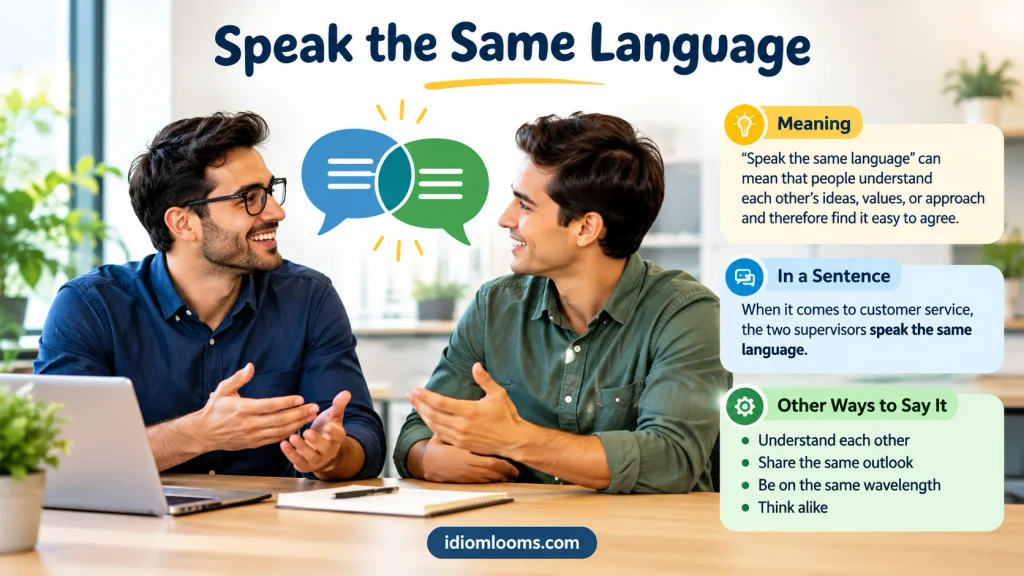
Speak the Same Language
Meaning
“Speak the same language” can mean that people understand each other’s ideas, values, or approach and therefore find it easy to agree.
In a Sentence
When it comes to customer service, the two supervisors speak the same language.
Other Ways to Say It
- Understand each other
- Share the same outlook
- Be on the same wavelength
- Think alike
Explanation
The expression uses language as a metaphor for shared understanding. Two people may not literally speak the same language, but they understand an issue in a similar way.
It can be particularly effective when agreement comes from shared priorities or values.
Best Use
Best for conversations, storytelling, business writing, and discussions about shared goals.
Sing the Same Tune
Meaning
“Sing the same tune” means to express the same opinion, message, or position as someone else.
In a Sentence
The two candidates are singing the same tune when it comes to improving public transportation.
Other Ways to Say It
- Give the same message
- Share the same position
- Agree on the issue
- Take the same stance
Explanation
The phrase creates the image of people singing the same melody. It highlights similarity in what people say rather than necessarily proving that they share every opinion.
Depending on context, it can be neutral or slightly skeptical.
Best Use
It works well in conversation, journalism, commentary, storytelling, and informal writing.
Find Common Ground
Meaning
“Find common ground” means to discover an opinion, interest, goal, or principle that two or more people share.
In a Sentence
They disagreed about the budget, but eventually found common ground on protecting essential services.
Other Ways to Say It
- Find something to agree on
- Reach mutual understanding
- Identify shared interests
- Find a compromise
Explanation
The expression imagines two people standing in different places and discovering a shared piece of ground between them.
It is particularly useful when people begin with different opinions but manage to find something they can agree on.
Best Use
Best for negotiations, diplomacy, essays, workplace discussions, political writing, and difficult conversations.
Meet Halfway
Meaning
“Meet halfway” means that both sides make concessions or adjustments to reach an agreement.
In a Sentence
I wanted to leave earlier, while my brother preferred a later time, so we met halfway and left at noon.
Other Ways to Say It
- Compromise
- Make concessions
- Find a middle ground
- Reach a compromise
Explanation
The image is simple: two people start from opposite sides and walk toward each other until they meet in the middle.
Unlike complete agreement, this idiom suggests that each person gives up something to create a workable solution.
Best Use
It is ideal for negotiations, personal conversations, relationships, business discussions, and conflict resolution.
See Things the Same Way
Meaning
“See things the same way” means to have a similar opinion, interpretation, or understanding of a situation.
In a Sentence
We don’t always agree on every detail, but we see things the same way when it comes to customer care.
Other Ways to Say It
- Share the same perspective
- Have a similar view
- Think alike
- Agree on the main point
Explanation
This expression treats opinions as different ways of looking at the same situation. It is softer than saying two people agree completely.
That makes it useful when people share a general opinion while still having minor differences.
Best Use
Best for everyday conversation, essays, reflective writing, and professional communication.
Have a Meeting of Minds
Meaning
“Have a meeting of minds” means that two or more people reach a shared understanding or agreement.
In a Sentence
After several rounds of discussion, the two sides finally had a meeting of minds.
Other Ways to Say It
- Reach an understanding
- Come to an agreement
- Find mutual understanding
- Agree on the essentials
Explanation
The phrase creates a picture of different minds coming together around one idea. It often suggests thoughtful agreement rather than an immediate “yes.”
It can sound more formal and deliberate than everyday expressions such as “we agree.”
Best Use
This expression works well in formal writing, negotiations, business discussions, legal contexts, and serious conversations.
Come to Terms
Meaning
“Come to terms” can mean reaching an agreement about conditions or details, especially after discussion or negotiation.
In a Sentence
After weeks of negotiation, the company and the supplier came to terms on a new contract.
Other Ways to Say It
- Reach an agreement
- Settle the details
- Agree on conditions
- Finalize an arrangement
Explanation
The expression often appears when agreement requires people to settle specific conditions or arrangements.
It can also have another meaning—accepting an unpleasant reality—so context matters.
Best Use
Best for business, contracts, negotiations, formal writing, and serious discussions.
Strike a Deal
Meaning
“Strike a deal” means to successfully reach an agreement, usually after negotiation.
In a Sentence
After several hours of discussion, the two companies struck a deal that satisfied both sides.
Other Ways to Say It
- Reach a deal
- Make an agreement
- Negotiate an arrangement
- Settle the matter
Explanation
The word “strike” gives the phrase energy, making an agreement sound like something successfully achieved after discussion.
It usually involves negotiation, rather than simply discovering that two people already have the same opinion.
Best Use
Best for business writing, negotiations, news-style writing, conversations, and storytelling.
Shake Hands on It
Meaning
“Shake hands on it” means to formally or informally confirm an agreement.
In a Sentence
We agreed on the price, shook hands on it, and arranged the delivery for Friday.
Other Ways to Say It
- Seal the agreement
- Confirm the deal
- Finalize the arrangement
- Agree officially
Explanation
The expression uses the familiar image of two people shaking hands after reaching an agreement.
It feels personal and decisive, making it stronger than simply saying that two people discussed an idea.
Best Use
Best for conversations, storytelling, informal negotiations, and scenes involving personal agreements.
Be in Accord
Meaning
“Be in accord” means to agree or be consistent with another person’s opinion, decision, or position.
In a Sentence
The researchers were in accord about the need for further testing.
Other Ways to Say It
- Be in agreement
- Be in harmony
- Share the same view
- Agree with one another
Explanation
“Accord” carries a sense of harmony and agreement. The expression is more formal than “see eye to eye,” so it can give writing a polished tone.
Best Use
Best for formal essays, reports, speeches, academic-style writing, and serious discussions.
Be on Board With
Meaning
“Be on board with” means to support, accept, or agree with an idea, plan, or proposal.
In a Sentence
I’m on board with the new schedule as long as everyone has enough time to prepare.
Other Ways to Say It
- Support the idea
- Agree with the plan
- Be willing to participate
- Approve of the proposal
Explanation
The expression compares support to being on a vehicle or ship that is moving in a shared direction.
It often communicates more than agreement: it suggests that someone is willing to support or participate in the plan.
Best Use
Excellent for workplace conversations, team meetings, casual speech, planning, and collaborative projects.
Go Along With
Meaning
“Go along with” means to accept, support, or agree to someone’s idea, suggestion, or decision.
In a Sentence
I wasn’t completely convinced at first, but I decided to go along with the team’s proposal.
Other Ways to Say It
- Agree to
- Accept
- Support
- Follow the suggestion
Explanation
This expression often suggests practical agreement rather than enthusiastic agreement. A person may go along with something because they accept it, even if it was not their first choice.
That subtle difference makes it useful when describing realistic conversations.
Best Use
Best for everyday conversation, storytelling, workplace situations, and informal writing.
Split the Difference
Meaning
“Split the difference” means reaching a compromise by choosing a middle point between two different positions, especially amounts, prices, or times.
In a Sentence
You want to pay $80 and I want $100, so let’s split the difference at $90.
Other Ways to Say It
- Compromise
- Meet in the middle
- Find a middle point
- Share the difference
Explanation
The expression turns disagreement into a simple image: divide the gap between two positions.
It is especially useful when the disagreement involves something measurable, such as money, distance, timing, or numbers.
Best Use
Best for negotiations, shopping, business conversations, everyday disagreements, and storytelling.
With One Voice
Meaning
“With one voice” means that a group expresses the same opinion or position collectively.
In a Sentence
The committee spoke with one voice in support of the proposed safety measures.
Other Ways to Say It
- United in opinion
- Collectively agree
- Present a united position
- Speak unanimously
Explanation
The phrase imagines many people producing one shared voice. It emphasizes unity within a group rather than agreement between only two individuals.
Its tone can feel strong, formal, and sometimes inspirational.
Best Use
Best for speeches, formal writing, group statements, public announcements, and inspirational contexts.
Make Common Cause
Meaning
“Make common cause” means to join with others because you share a goal, interest, or concern.
In a Sentence
The two community groups made common cause to protect the local park.
Other Ways to Say It
- Unite around a goal
- Join forces
- Work together
- Share a common purpose
Explanation
This expression goes beyond simply saying “I agree.” It suggests that people recognize a shared purpose and act together because of it.
It can describe cooperation between people who may disagree about other matters.
Best Use
Best for formal writing, social issues, historical writing, speeches, journalism, and storytelling.
Bury the Hatchet
Meaning
“Bury the hatchet” means to end a disagreement or conflict and make peace.
In a Sentence
After years of arguing, the two brothers finally buried the hatchet and began speaking regularly again.
Other Ways to Say It
- Make peace
- End the conflict
- Reconcile
- Put the disagreement behind you
Explanation
The image comes from the idea of putting away a weapon rather than continuing a fight. It does not simply mean agreeing on an opinion; it means choosing peace after conflict.
Because of its strong image, it can make storytelling more memorable.
Best Use
Best for storytelling, personal messages, conversations, creative writing, and discussions about reconciliation.
Exercise: Practice Using Idioms
Choose the best answer for each question.
What does “see eye to eye” mean?
A. Examining someone closely
B. Agreeing with someone
C. Avoiding a discussion
D. Changing someone’s opinion
Which expression suggests that people share the same understanding of a plan?
A. Bury the hatchet
B. Split the difference
C. Be on the same page
D. Strike a deal
Which idiom is especially associated with making a compromise?
A. Meet halfway
B. Speak the same language
C. Be of one mind
D. With one voice
If two groups “find common ground,” what have they done?
A. Started a competition
B. Found something they can agree on
C. Ended a friendship
D. Changed locations
Which expression means to confirm an agreement with a handshake?
A. Go along with
B. Be in accord
C. Shake hands on it
D. Sing the same tune
What does “be on board with” usually communicate?
A. Support for an idea or plan
B. Physical movement on a ship
C. Refusal to participate
D. Confusion about a decision
Which expression suggests that people share the same opinion within a group?
A. Split the difference
B. With one voice
C. Come to terms
D. Go along with
What does “split the difference” normally involve?
A. Choosing the first option
B. Refusing to negotiate
C. Choosing a middle point
D. Changing the subject
Which idiom can mean ending a long-standing conflict?
A. Bury the hatchet
B. See things the same way
C. Be on board with
D. Sing from the same hymn sheet
Which expression can suggest that people are presenting the same message?
A. Make common cause
B. Sing from the same hymn sheet
C. Shake hands on it
D. Meet halfway
What does “go along with” often suggest?
A. Accepting or supporting an idea
B. Completely rejecting a proposal
C. Starting an argument
D. Changing someone’s identity
Which expression is particularly suitable for describing a formal agreement after negotiation?
A. Come to terms
B. See eye to eye
C. Speak the same language
D. Bury the hatchet
What does “make common cause” emphasize?
A. Personal competition
B. Shared purpose and cooperation
C. Complete disagreement
D. Private decision-making
Which phrase means reaching an agreement after negotiation, often in business?
A. Be of one mind
B. See things the same way
C. Strike a deal
D. Speak the same language
Which statement correctly distinguishes “see eye to eye” from “meet halfway”?
A. Both always mean refusing to compromise.
B. “See eye to eye” suggests shared views, while “meet halfway” suggests compromise.
C. “Meet halfway” means complete agreement, while “see eye to eye” means conflict.
D. Both expressions refer only to business contracts.
Answers
- B — “See eye to eye” means to share the same opinion or agree with someone.
- C — “Be on the same page” refers to having the same understanding, expectations, or position.
- A — “Meet halfway” describes a compromise in which both sides make adjustments.
- B — Finding common ground means discovering something that different people can agree on.
- C — “Shake hands on it” refers to confirming or sealing an agreement.
- A — Being “on board with” something means supporting or accepting an idea, plan, or proposal.
- B — “With one voice” describes a group expressing a united position.
- C — “Split the difference” means choosing a middle point between two positions.
- A — “Bury the hatchet” means ending a conflict and making peace.
- B — “Sing from the same hymn sheet” suggests that people are communicating the same position or message.
- A — “Go along with” means accepting, supporting, or agreeing to something, sometimes without complete enthusiasm.
- A — “Come to terms” can mean reaching agreement about conditions or details.
- B — “Make common cause” emphasizes joining others around a shared goal or interest.
- C — “Strike a deal” means successfully reaching an agreement, usually through negotiation.
- B — “See eye to eye” suggests shared opinions, while “meet halfway” describes compromise.
FAQs
What is an idiom for agreeing with someone?
There are several useful expressions. “See eye to eye” is one of the clearest idioms for sharing the same opinion. “Be on the same page” emphasizes shared understanding, while “find common ground” suggests discovering something both sides can agree on.
How do I create my own idiom for agreement?
Start with an image that represents unity, cooperation, harmony, or shared direction. Then connect that image to the idea of agreement. For example, imagining people walking toward the same destination can suggest shared goals. However, a newly created phrase may be a metaphor or figurative expression rather than an established English idiom.
What makes an idiom effective?
An effective idiom creates a clear mental image while communicating an idea naturally. It should fit the context and add something beyond a plain statement. Good idioms are memorable because the image and meaning work together.
Can I use these idioms in everyday conversation?
Yes. Expressions such as “see eye to eye,” “on the same page,” “meet halfway,” “go along with,” and “on board with” are natural in everyday English. More formal expressions, such as “be in accord,” may fit better in professional or academic writing.
What is the difference between an idiom and a simile?
An idiom is a familiar expression with an established figurative meaning, such as “see eye to eye.” A simile directly compares two things using words such as “like” or “as,” as in “their ideas fit together like puzzle pieces.” Both can create imagery, but they work differently.
Conclusion
Idioms give ordinary agreement a richer voice. Instead of repeating “I agree,” you can use “see eye to eye” when people share a viewpoint, “be on the same page” when they share an understanding, or “meet halfway” when both sides compromise. Other expressions, such as “bury the hatchet” and “make common cause,” communicate reconciliation and cooperation rather than simple agreement.
The best expression depends on the situation and the feeling you want to create. In casual conversation, a familiar phrase may sound most natural; in creative writing, a stronger image can add personality and emotion. When you choose an idiom thoughtfully, your language becomes more memorable without becoming complicated. Ultimately, the strongest expression for agreeing with someone is the one that makes your meaning clear while capturing the relationship, mood, and context behind the agreement.




[…] Read more:20 Idioms for Agreeing with Someone Real Examples […]