

Have you ever noticed how running can describe far more than physical movement? The English language uses vivid expressions to capture urgency, progress, exhaustion, and everyday situations. In 20 Idioms for Running With Real Examples, you’ll discover natural phrases that make conversations and writing more expressive. These idioms also show how context shapes English usage, grammar, and meaning.
Running-related expressions can appear in conversations about scheduling, time management, meetings, and project management. They may also fit discussions about business communication, online booking, broadcasting, or a busy calendar. Learning these expressions helps you recognize figurative meaning and choose language that sounds natural rather than overly literal.
This guide explores 20 useful idioms with clear meanings, realistic examples, alternative expressions, and practical usage notes. You’ll also see which phrases suit formal writing, casual conversations, creative work, or professional settings. With focused examples and consistent practice, these expressions can strengthen your vocabulary, improve communication, and help you use idiomatic English with greater consistency.
What Is an Idiom?
An idiom is a word or phrase whose meaning is different from the literal meaning of the individual words.
For example, if someone says, “It’s raining cats and dogs,” they do not mean that animals are falling from the sky. They mean that it is raining very heavily.
Another example is “break the ice.” Literally, it sounds like someone is breaking frozen water. Figuratively, it means to make people feel more comfortable when they first meet.
Idioms differ from literal statements because they communicate an idea through figurative meaning, imagery, or cultural understanding rather than stating the idea directly.
Why Use Idioms for Running?
Running naturally connects with ideas such as speed, effort, competition, escape, determination, and movement. Idioms can help express these ideas in a more colorful way.
For example, saying someone is “running against the clock” creates a stronger sense of urgency than simply saying they are working quickly. Likewise, “hit the ground running” suggests beginning something with energy and immediate action.
These expressions can help you:
- Express the emotion behind running rather than just the physical action.
- Make descriptions more vivid through figurative imagery.
- Explain difficult or abstract situations using familiar comparisons.
- Give creative writing more personality.
- Make speeches and conversations more memorable.
- Describe pressure, urgency, determination, or exhaustion naturally.
- Add energy and movement to storytelling.
Quick List of 20 Idioms for Running
- Run like the wind
- Hit the ground running
- Run against the clock
- On the run
- Run for your life
- Run out of steam
- Run circles around someone
- Run a tight ship
- Run the gauntlet
- Run with the pack
- Run wild
- Run the show
- Run in circles
- Run into a brick wall
- Run on empty
- Run a mile
- Run the risk
- Run your legs off
- Make a run for it
- Keep the wheels turning
Run Like the Wind
Read more:20 Idioms for Understanding With Real Examples
Meaning
“Run like the wind” means to run extremely fast. The expression compares a person’s speed with the swift movement of the wind.
It can also be used playfully or figuratively when encouraging someone to move quickly.
In a Sentence
When the coach shouted that the race had started, Daniel ran like the wind toward the finish line.
Other Ways to Say It
- Run as fast as you can.
- Sprint at full speed.
- Move incredibly quickly.
- Race ahead.
Explanation
The image is simple but powerful: wind moves quickly and cannot easily be caught. Comparing a runner to the wind makes the action feel energetic and almost effortless.
It is usually informal and works well when the goal is to emphasize speed rather than endurance.
Best Use
This expression fits naturally in storytelling, casual conversation, children’s writing, sports descriptions, and playful messages. It can sound a little dramatic in formal professional writing.
Hit the Ground Running
Meaning
“Hit the ground running” means to start something with energy, confidence, and immediate action.
Although it contains the image of running, it is usually not about literal running. It describes someone who begins a task or situation without wasting time.
In a Sentence
Maya joined the new team on Monday and hit the ground running, completing her first major assignment by Wednesday.
Other Ways to Say It
- Get off to a fast start.
- Start with energy.
- Begin immediately.
- Get straight to work.
Explanation
The phrase creates the image of someone landing on the ground and immediately moving forward at speed. It communicates momentum and readiness.
It is particularly useful when describing a person who quickly becomes productive in a new situation.
Best Use
Use it in workplace conversations, essays, speeches, interviews, and everyday discussions. It is less suitable when a very formal tone is required.
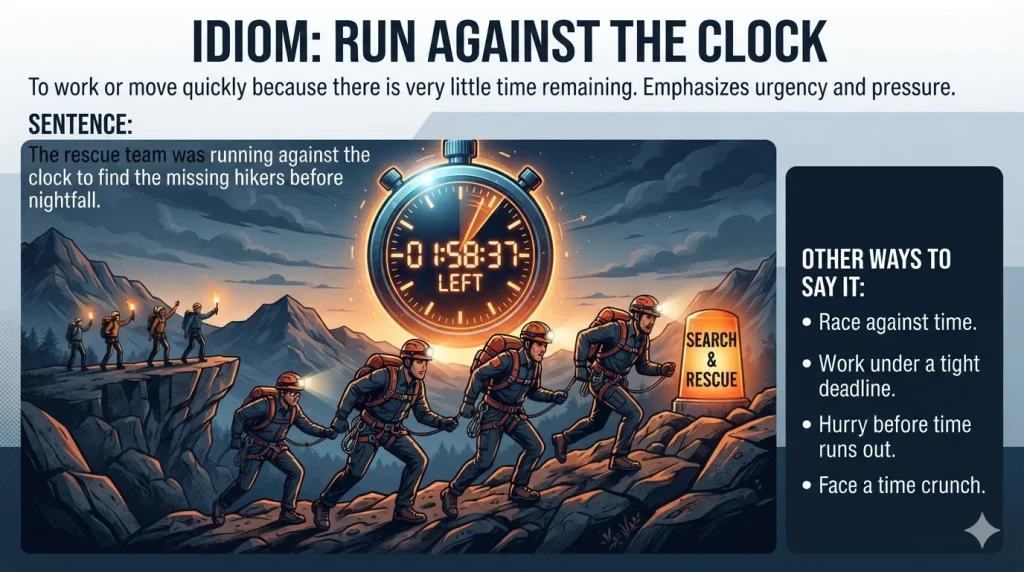
Run Against the Clock
Meaning
To “run against the clock” means to work or move quickly because there is very little time remaining.
The expression emphasizes urgency and pressure.
In a Sentence
The rescue team was running against the clock to find the missing hikers before nightfall.
Other Ways to Say It
- Race against time.
- Work under a tight deadline.
- Hurry before time runs out.
- Face a time crunch.
Explanation
The clock becomes an imaginary opponent. You are effectively racing time itself, which makes the situation feel urgent.
This expression is especially powerful when failure to finish quickly could have serious consequences.
Best Use
It works well in news-style writing, storytelling, speeches, workplace communication, and dramatic situations.
On the Run
Meaning
“On the run” has several meanings depending on context. It can describe someone who is moving from place to place, avoiding capture, or living a very busy and active lifestyle.
For a runner, the phrase can also suggest being constantly in motion.
In a Sentence
With three appointments before lunch, I spent the whole morning on the run.
Other Ways to Say It
- Constantly moving.
- Always on the go.
- Moving from place to place.
- Staying busy.
Explanation
The expression creates an image of someone who rarely stops. Its meaning depends heavily on context: “on the run” can sound energetic and busy, but it can also have a serious meaning when referring to someone escaping authorities.
Best Use
Use the expression carefully in conversation, storytelling, journalism, and informal writing. Context is important because the phrase can carry different meanings.
Run for Your Life
Meaning
“Run for your life” means to run as fast as possible because you believe you are in serious danger.
It can also be used humorously or dramatically when encouraging someone to move extremely quickly.
In a Sentence
When the old tree began to fall, everyone was told to run for their lives.
Other Ways to Say It
- Run as fast as possible.
- Get out of there quickly.
- Flee to safety.
- Move before it’s too late.
Explanation
This is a strongly dramatic expression because it connects running directly with survival and danger. The phrase immediately creates tension in a story.
In casual conversation, it may also be used jokingly, but its literal meaning is quite serious.
Best Use
It is particularly effective in fiction, dramatic storytelling, action scenes, and emotionally intense conversations. Avoid using it casually when the situation does not justify the dramatic tone.
Run Out of Steam
Meaning
To “run out of steam” means to lose energy, enthusiasm, strength, or motivation.
The expression does not usually describe literal running. Instead, it compares a person’s energy to a machine that can no longer produce enough steam to keep moving.
In a Sentence
I started the project with plenty of enthusiasm, but after several difficult weeks, I ran out of steam.
Other Ways to Say It
- Lose energy.
- Become exhausted.
- Lose motivation.
- Slow down.
Explanation
The steam-powered-machine image makes the idea of exhaustion easy to understand. Someone can begin with tremendous energy and gradually reach a point where they simply cannot keep going at the same pace.
It is useful for physical, mental, or emotional tiredness.
Best Use
This idiom works naturally in conversation, personal writing, essays, workplace discussions, and motivational contexts.
Run Circles Around Someone
Meaning
To “run circles around someone” means to perform much better than another person, especially because you are faster, more skilled, or more capable.
In a Sentence
The experienced chess player ran circles around his younger opponent during the tournament.
Other Ways to Say It
- Outperform someone.
- Be far more capable.
- Beat someone easily.
- Have a clear advantage.
Explanation
The image suggests one person moving around another so quickly that the other cannot keep up. It communicates a strong difference in skill, speed, or ability.
The expression can sound boastful or competitive, so it should be used with some awareness of tone.
Best Use
It fits casual conversation, sports commentary, storytelling, and competitive situations. It is generally too informal for highly diplomatic professional writing.
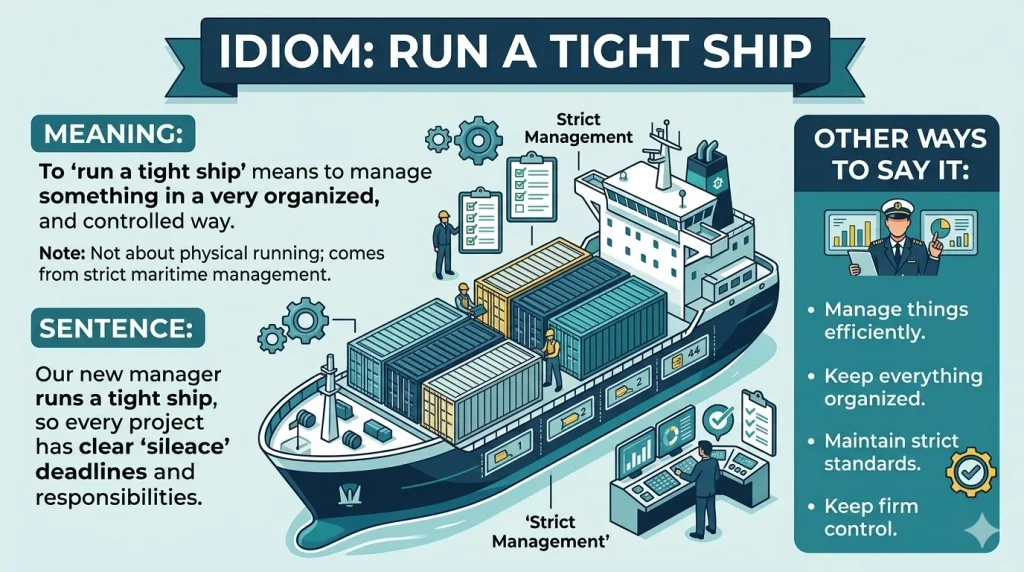
Run a Tight Ship
Meaning
To “run a tight ship” means to manage something in a very organized, disciplined, and controlled way.
The phrase is not normally about running physically. It comes from the image of a ship being operated efficiently under strict management.
In a Sentence
Our new manager runs a tight ship, so every project has clear deadlines and responsibilities.
Other Ways to Say It
- Manage things efficiently.
- Keep everything organized.
- Maintain strict standards.
- Keep firm control.
Explanation
The expression compares an organization to a ship that must be carefully managed to stay on course. It communicates discipline, order, and strong leadership.
It can be positive when praising organization, although it may sound slightly strict depending on context.
Best Use
Use it in workplace conversations, leadership discussions, storytelling, and informal professional communication.
Run the Gauntlet
Meaning
To “run the gauntlet” means to go through a difficult, dangerous, or unpleasant series of challenges.
It comes from an older practice involving a person passing between lines of people who attacked or struck them.
In a Sentence
Before the new product could launch, the design team had to run the gauntlet of inspections, revisions, and approvals.
Other Ways to Say It
- Face a series of challenges.
- Go through a difficult process.
- Navigate a tough ordeal.
- Endure repeated obstacles.
Explanation
The phrase carries a strong image of moving forward while facing challenge after challenge. It is much more intense than simply saying something was difficult.
Because of its dramatic historical imagery, it often adds weight to serious descriptions.
Best Use
It works especially well in journalism, storytelling, essays, speeches, and descriptions of difficult processes.
Run With the Pack
Meaning
To “run with the pack” means to follow the behavior, opinions, or choices of a group instead of acting independently.
The expression uses the image of animals moving together as a pack.
In a Sentence
Rather than run with the pack, Elena chose a different approach to solving the problem.
Other Ways to Say It
- Follow the crowd.
- Go along with the group.
- Follow the majority.
- Conform to the group.
Explanation
The pack represents group behavior and conformity. The expression can suggest belonging, but it often carries a slight critical tone when describing someone who does not think independently.
Best Use
Use it in essays, discussions about social behavior, storytelling, and reflective writing. It is less common in formal technical writing.
Run Wild
Meaning
To “run wild” means to behave without control or restraint. It can describe people, animals, emotions, ideas, or situations.
In a Sentence
Without anyone to enforce the rules, rumors began to run wild across the school.
Other Ways to Say It
- Spread without control.
- Become uncontrollable.
- Grow unchecked.
- Get out of hand.
Explanation
The expression creates the image of something breaking free and moving wherever it wants. It is especially effective for describing uncontrolled behavior, imagination, rumors, or emotions.
The tone can be playful or serious depending on what is running wild.
Best Use
It works well in creative writing, conversation, essays, storytelling, and descriptions of uncontrolled situations.
Run the Show
Meaning
To “run the show” means to be the person who is in charge and makes the important decisions.
In a Sentence
Although several people helped organize the event, Priya was clearly running the show.
Other Ways to Say It
- Be in charge.
- Take control.
- Lead the operation.
- Call the shots.
Explanation
The expression compares a situation to a performance in which someone is responsible for making everything happen. It gives the idea of leadership and control without sounding overly formal.
Best Use
This is a natural choice for everyday conversation, workplace discussions, storytelling, and informal descriptions of leadership.
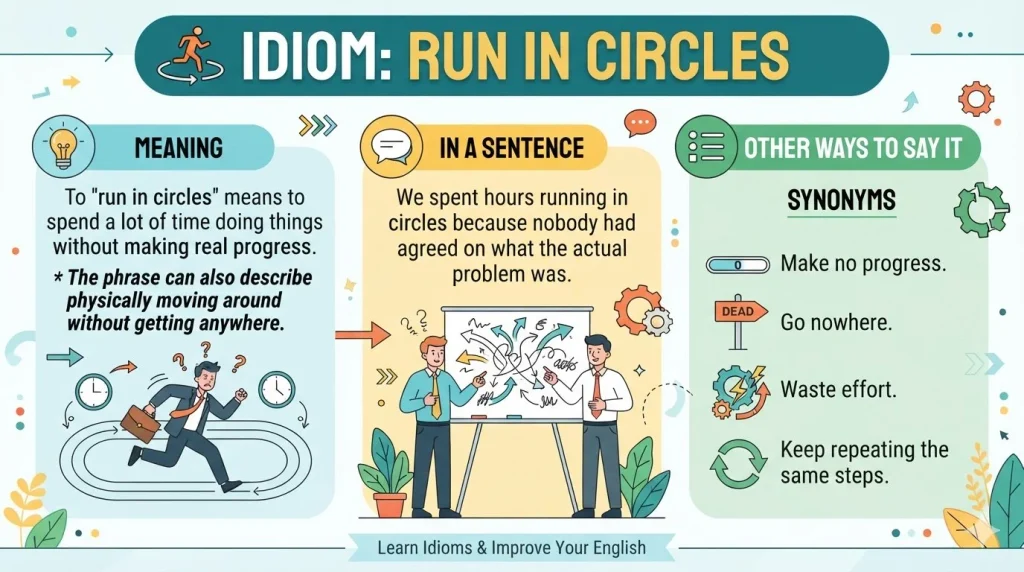
Run in Circles
Meaning
To “run in circles” means to spend a lot of time doing things without making real progress.
The phrase can also describe physically moving around without getting anywhere.
In a Sentence
We spent hours running in circles because nobody had agreed on what the actual problem was.
Other Ways to Say It
- Make no progress.
- Go nowhere.
- Waste effort.
- Keep repeating the same steps.
Explanation
The image is someone running continuously but returning to the same place. It captures the frustration of effort without progress.
This makes the expression particularly useful when describing confusing projects or repeated unsuccessful attempts.
Best Use
Use it in conversation, workplace writing, essays, personal reflections, and problem-solving discussions.
Run Into a Brick Wall
Meaning
To “run into a brick wall” means to encounter a major obstacle that prevents you from making further progress.
In a Sentence
We tried several ways to obtain the missing records, but eventually we ran into a brick wall.
Other Ways to Say It
- Hit an obstacle.
- Reach a dead end.
- Face a major barrier.
- Get stuck.
Explanation
The mental picture is immediate: you are moving forward until a solid brick wall suddenly stops you. It communicates frustration, resistance, and blocked progress.
Unlike “run in circles,” this expression focuses on an obstacle rather than repeated movement.
Best Use
It is useful in conversation, business writing, storytelling, essays, and discussions about difficult problems.
Run on Empty
Meaning
To “run on empty” means to continue functioning despite having very little energy or resources left.
It comes from the image of a vehicle continuing to travel when its fuel tank is nearly empty.
In a Sentence
After studying all night and working all day, I was running on empty by Friday evening.
Other Ways to Say It
- Have very little energy left.
- Be completely drained.
- Keep going despite exhaustion.
- Have almost no resources remaining.
Explanation
The vehicle-and-fuel comparison makes the meaning instantly recognizable. It suggests that someone is still moving, but their reserves are almost gone.
The phrase can refer to physical energy, emotional strength, money, time, or other limited resources.
Best Use
It works particularly well in personal messages, conversations, reflective writing, workplace discussions, and storytelling.
Run a Mile
Meaning
If you say someone would “run a mile” from something, you mean they would avoid it quickly because they dislike, fear, or strongly reject it.
In a Sentence
If you suggested another three-hour meeting, most people in the office would run a mile.
Other Ways to Say It
- Avoid it completely.
- Stay far away.
- Want nothing to do with it.
- Get away quickly.
Explanation
The expression humorously exaggerates avoidance by imagining someone literally running a long distance to escape. It often adds a playful or mildly sarcastic tone.
Best Use
It is best suited to casual conversation, humorous writing, social posts, and informal storytelling.
Run the Risk
Meaning
To “run the risk” means to do something that could result in an unwanted or dangerous outcome.
In a Sentence
If we leave this equipment outside overnight, we run the risk of damaging it in the rain.
Other Ways to Say It
- Take a chance.
- Risk an unwanted result.
- Expose yourself to danger.
- Put something at risk.
Explanation
Here, “run” suggests moving toward a possible consequence. The expression is less about physical movement and more about exposure to uncertainty or danger.
It is a practical expression that can describe both small everyday decisions and serious situations.
Best Use
This idiom fits professional writing, essays, advice, conversation, reports, and formal discussions particularly well.
Run Your Legs Off
Meaning
To “run your legs off” means to run or move around so much that you become extremely tired.
It can also be used figuratively for working very hard or constantly moving around.
In a Sentence
The volunteers ran their legs off all afternoon preparing the festival grounds.
Other Ways to Say It
- Work extremely hard.
- Wear yourself out.
- Keep moving all day.
- Exhaust yourself.
Explanation
The phrase uses deliberate exaggeration to make exhaustion vivid. Of course, nobody literally runs their legs off; the image emphasizes extreme effort and tiredness.
Its informal style gives it an energetic, conversational quality.
Best Use
Use it in casual conversation, storytelling, sports contexts, and lively personal writing.
Make a Run for It
Meaning
To “make a run for it” means to suddenly try to escape or get away quickly.
It can describe a serious escape or a playful attempt to leave a place before something happens.
In a Sentence
As soon as the gate opened, the children made a run for it, racing toward the playground.
Other Ways to Say It
- Make a quick escape.
- Dash away.
- Take the chance to leave.
- Flee quickly.
Explanation
The expression turns escape into a sudden burst of movement. It suggests quick decision-making, urgency, and a desire to get away.
Depending on context, it can sound adventurous, humorous, or tense.
Best Use
It works especially well in fiction, storytelling, casual conversation, action scenes, and humorous situations.
Keep the Wheels Turning
Meaning
“Keep the wheels turning” means to continue making progress or keep an activity, project, or process moving forward.
Although it is not specifically about running, it fits naturally with the broader idea of movement and continued effort.
In a Sentence
Even while the director was away, the staff kept the wheels turning and finished the preparations on time.
Other Ways to Say It
- Keep things moving.
- Maintain progress.
- Keep working.
- Prevent the process from stopping.
Explanation
The expression creates an image of wheels that must continue turning to keep something moving. It focuses less on speed and more on consistency and forward momentum.
It is useful when describing steady effort rather than a dramatic burst of activity.
Best Use
This expression is particularly effective in workplace communication, speeches, essays, project discussions, and motivational writing.
Exercise: Practice Using Idioms
Test your understanding of these running-related idioms and figurative expressions.
What does “hit the ground running” mean?
A. Falling while running
B. Launching something with energy and immediate action
C. Suddenly stopping work unexpectedly
D. Exercising outdoors
Which expression means to work under severe time pressure?
A. Going wild
B. Managing a tight ship
C. Racing against the clock
D. Traveling a mile
If someone “runs out of steam,” what has happened?
A. Feeling drained of energy or motivation
B. Accelerating their running pace
C. Discovering a new source of energy
D. Reaching their destination
Which expression describes someone who greatly outperforms another person?
A. Running on empty
B. Moving in circles
C. Facing the gauntlet
D. Outperforming someone with ease
What does “run in circles” usually suggest?
A. Training for a race
B. Making little or no progress
C. Traveling around the world
D. Exercising with friends
Which expression can describe someone who is avoiding capture or constantly moving?
A. On the run
B. Run the show
C. Run your legs off
D. Keep the wheels turning
What does “run the gauntlet” suggest?
A. Enjoying a peaceful walk
B. Beginning a new project
C. Facing a difficult series of challenges
D. Winning a simple competition
Which idiom describes something becoming uncontrolled?
A. Going wild
B. Managing a tight ship
C. Traveling a mile
D. Taking the risk
If a person “runs into a brick wall” while solving a problem, what happens?
A. Solving it immediately
B. Encountering a major obstacle
C. Choosing to run away
D. Finishing ahead of schedule
What does “run on empty” mean figuratively?
A. Having plenty of energy
B. Moving unusually quickly
C. Continuing despite having very little energy or resources
D. Refusing to start something
Which expression means to be in charge?
A. Fleeing for your life
B. Controlling the show
C. Racing against the clock
D. Speeding like the wind
If someone says they would “run a mile” from an idea, what do they mean?
A. Eagerly wanting to accept it
B. Choosing to avoid it
C. Preferring to study it carefully
D. Having already completed it
Which expression is most appropriate for a situation involving possible danger or an unwanted consequence?
A. Taking the risk
B. Following the pack
C. Going wild
D. Exhausting yourself completely
What does “make a run for it” mean?
A. Begin a long-term training program
B. Make a quick attempt to escape
C. Organize a sports competition
D. Walk slowly toward a destination
Which expression emphasizes continuing progress rather than stopping?
A. Run into a brick wall
B. Run out of steam
C. Keep the wheels turning
D. Run in circles
Answers
- B — “Hit the ground running” means to begin a task or situation with energy and immediate action.
- C — “Run against the clock” describes trying to finish something before time runs out.
- A — “Run out of steam” means to lose energy, enthusiasm, or motivation.
- D — “Run circles around someone” means to outperform them significantly.
- B — “Run in circles” describes making repeated efforts without achieving meaningful progress.
- A — “On the run” can describe someone who is constantly moving or avoiding capture.
- C — “Run the gauntlet” means to pass through or endure a series of difficult challenges.
- A — “Run wild” describes something that is no longer controlled or restrained.
- B — “Run into a brick wall” means to encounter an obstacle that blocks further progress.
- C — “Run on empty” means to continue despite having very little energy or resources left.
- B — “Run the show” means to be in charge and make important decisions.
- B — “Run a mile” can humorously describe avoiding something completely.
- A — “Run the risk” means to expose yourself to a possible negative result.
- B — “Make a run for it” means to make a quick attempt to escape or get away.
- C — “Keep the wheels turning” means to keep a process moving and maintain progress.
FAQs
What is an idiom for running?
An idiom for running is a familiar expression that uses running or movement as a figurative image. Examples include “run like the wind,” which emphasizes speed, and “hit the ground running,” which means to begin something energetically.
How do I create my own idiom?
Start with a clear idea, such as speed, exhaustion, urgency, escape, or persistence. Then connect that idea to a memorable image. A good figurative expression should make the reader picture something while still communicating a clear meaning.
What makes an idiom effective?
An effective idiom is clear, memorable, relevant, and natural in context. It should add meaning rather than simply replace an ordinary sentence with fancy wording.
Can I use these idioms in everyday conversation?
Yes. Many of these expressions, including “run out of steam,” “hit the ground running,” “run the show,” and “run against the clock,” are natural in everyday English. More dramatic expressions may be better suited to storytelling or creative writing.
What is the difference between an idiom and a simile?
An idiom has a recognized figurative meaning that may not be predictable from its individual words. A simile directly compares two things, usually with “like” or “as.” For example, “run like the wind” contains a direct comparison, while its meaning as an expression emphasizes extremely fast running.
Conclusion
Running can describe much more than physical movement. It can represent speed, urgency, determination, escape, exhaustion, competition, and progress. The right idiom allows you to communicate these ideas with stronger imagery and more personality.
Expressions such as “run like the wind” highlight speed, while “run out of steam” captures fading energy. “Run against the clock” creates urgency, and “keep the wheels turning” emphasizes steady progress. Each expression offers a slightly different way to talk about movement and the experiences connected with it.
When choosing an idiom, think about the feeling and context you want to create. A playful phrase may suit a casual conversation, while a dramatic expression may work better in a story. The strongest figurative language is not simply colorful it makes your meaning clearer and more memorable. When words start running, the right image can help your message go much farther.

Margaret Saywell is an English author and editor who has spent more than fifteen years working with words teaching, proofreading, and writing about the quirks of the English language.
At Idiom Looms, Margaret gathers idioms from across the English-speaking world and weaves them into clear, practical guides. She loves digging into the history of a phrase and showing readers how a few well-chosen words can say far more than a long explanation.
She believes language should be enjoyed, not feared and that the best way to learn an idiom is to see it in action.



[…] Read moe:20 Idioms for Running With Real Examples […]