

Have you ever noticed how ordinary cleaning can become a surprisingly vivid part of everyday conversation? The right expressions can make simple descriptions more natural and memorable. In this guide, 20 Idioms for Cleaning With Real Examples explores useful phrases that describe tidying, removing mess, organizing spaces, and keeping things in order. These idioms add personality to English usage while helping learners understand figurative language, context, and meaning beyond literal words. Whether you are writing casually or improving your vocabulary, these expressions can make your communication sound more fluent and confident.
Learning cleaning-related idioms can also strengthen practical language skills across different situations. You may encounter them while discussing scheduling, time management, household routines, workplace organization, or business communication. Some expressions can fit conversations about meetings, a busy calendar, or project management, while others work better in informal speech. Understanding their tone and context helps you choose language that feels appropriate rather than forced. The examples in this article show how each idiom works naturally in a complete sentence.
Throughout the article, you will discover 20 carefully explained idioms with clear meanings, realistic examples, alternative expressions, and practical usage guidance. You will also see how these phrases relate to grammar, formal writing, everyday conversation, and consistent communication. From describing a spotless room to talking about clearing away problems or unnecessary tasks, each expression offers a different shade of meaning. By the end, you will have a stronger grasp of cleaning idioms, their figurative meanings, and how to use them with consistency and confidence.
What Is a Idiom?
An idiom is a fixed expression whose meaning is different from the literal meaning of its individual words.
For example, “break the ice” does not usually mean physically breaking ice. It means to make people feel more comfortable in a new or awkward situation.
Similarly, “spill the beans” does not mean dropping beans on the floor. It means to reveal a secret.
Idioms add figurative language and imagery to everyday communication. They allow people to express complicated ideas, emotions, and situations in a short and memorable way.
Why Use Idioms for Cleaning?
Cleaning provides rich imagery for talking about much more than household chores. Words such as wash, wipe, sweep, clear, and clean can suggest honesty, renewal, organization, responsibility, and personal growth.
Using cleaning-related idioms can help you:
- Express emotions without explaining them at length.
- Make descriptions more vivid and memorable.
- Talk about fresh starts and second chances.
- Describe physical cleanliness in a colorful way.
- Explain personal or professional problems through familiar images.
- Add personality to conversations and storytelling.
- Make creative writing more expressive.
- Describe difficult situations using simple figurative language.
The key is choosing an expression that matches the intended meaning. Some cleaning idioms are playful and casual, while others can sound serious, emotional, or strongly critical.
Quick List of 20 Idioms
- Clean as a whistle
- Spick and span
- Squeaky clean
- Neat as a pin
- Clean house
- Make a clean sweep
- Clean up one’s act
- Come clean
- Wipe the slate clean
- Sweep something under the rug
- Air one’s dirty laundry
- Wash one’s dirty linen in public
- Wash one’s hands of something
- Get one’s hands dirty
- Clear the air
- Put one’s house in order
- Keep one’s nose clean
- Turn over a new leaf
- Dust off
- Out with the old, in with the new
Clean as a Whistle
Meaning
“Clean as a whistle” describes something that is extremely clean, spotless, or free from dirt. It can also describe a person whose behavior or record is completely honest and free from wrongdoing.
The expression creates an image of something bright, polished, and perfectly clear.
In a Sentence
After several hours of scrubbing, the kitchen was clean as a whistle.
Other Ways to Say It
- Spotlessly clean
- Immaculately clean
- Fresh and spotless
- As clean as can be
Explanation
The phrase uses the idea of a whistle producing a clear, sharp sound without obstruction. Figuratively, that sense of clarity and purity became associated with cleanliness.
It works especially well when you want to emphasize that cleaning has produced a noticeably spotless result.
Best Use
Best for conversations, storytelling, casual writing, and descriptive content. It has a friendly and slightly playful tone.
Spick and Span
Read more:20 Idioms for Time Passing With Real Examples
Meaning
“Spick and span” means extremely neat, clean, and well cared for. It is especially useful when describing a room, home, workplace, or appearance that looks freshly cleaned.
In a Sentence
The guest room looked spick and span before the visitors arrived.
Other Ways to Say It
- Neat and tidy
- Fresh and clean
- Immaculately kept
- Perfectly neat
Explanation
This expression creates a picture of something that has been carefully polished and arranged. It suggests more than simply removing dirt; it implies that everything looks orderly and well maintained.
Its cheerful sound also gives the expression a light, conversational quality.
Best Use
It fits everyday conversation, home descriptions, storytelling, and lifestyle writing. It may sound slightly old-fashioned in some settings, but it remains easily understood.
Squeaky Clean
Meaning
“Squeaky clean” means extremely clean. It can describe something physically spotless, but it can also refer to a person or organization with a clean reputation.
In a Sentence
By Saturday morning, every corner of the apartment was squeaky clean.
Other Ways to Say It
- Absolutely spotless
- Pristine
- Immaculate
- Completely clean
Explanation
The phrase creates a playful mental image of a freshly washed surface that seems so clean it could almost make a squeaking sound.
Because it can also describe an innocent reputation, it is useful when physical and figurative cleanliness overlap.
Best Use
Use it in casual conversation, blogs, advertisements, storytelling, and social media. Its tone is generally upbeat and informal.
Neat as a Pin
Meaning
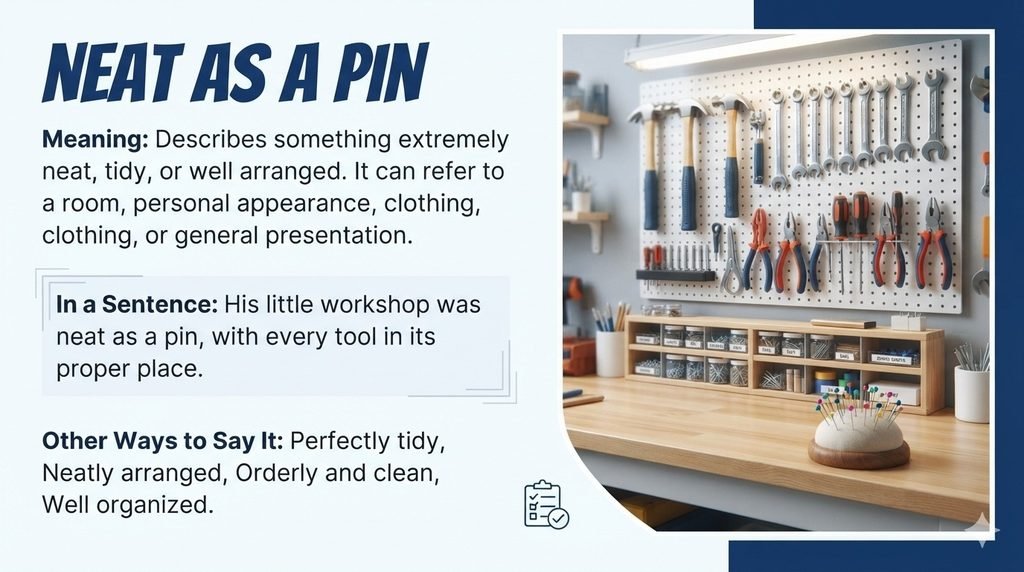
“Neat as a pin” describes something extremely neat, tidy, or well arranged. It can refer to a room, personal appearance, clothing, or general presentation.
In a Sentence
His little workshop was neat as a pin, with every tool in its proper place.
Other Ways to Say It
- Perfectly tidy
- Neatly arranged
- Orderly and clean
- Well organized
Explanation
The expression compares neatness with the small, precise appearance of a pin. The image suggests order, precision, and careful arrangement rather than simply the absence of dirt.
It is particularly useful when cleanliness and organization go together.
Best Use
It works naturally in conversation and descriptive writing, especially when describing rooms, clothing, offices, or personal presentation.
Clean House
Meaning
“Clean house” means to remove unwanted people, things, problems, or practices from a situation. While it can refer literally to cleaning a home, its common figurative meaning involves making major changes to improve a situation.
In a Sentence
The new manager decided to clean house and replace several outdated procedures.
Other Ways to Say It
- Make major changes
- Remove what is no longer useful
- Start over
- Clear out problems
Explanation
The image comes from thoroughly cleaning a house by removing things that are unwanted or unnecessary. Figuratively, it suggests decisive action and a thorough reset.
Because the expression can imply removing people from a team or organization, it may sound forceful.
Best Use
Best for business writing, conversations, news-style writing, and storytelling when discussing significant organizational change.
Make a Clean Sweep
Meaning
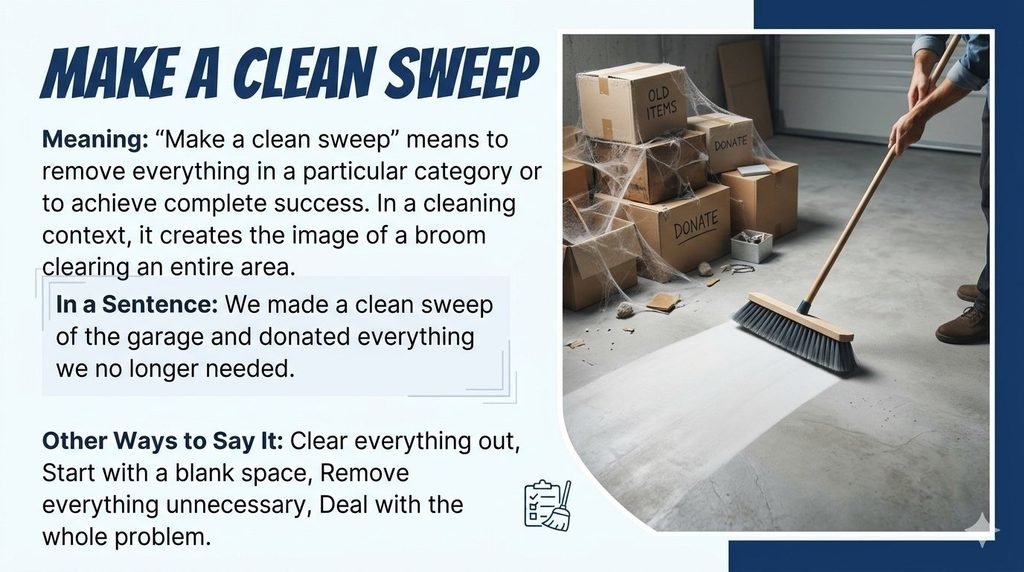
“Make a clean sweep” means to remove everything in a particular category or to achieve complete success. In a cleaning context, it creates the image of a broom clearing an entire area.
In a Sentence
We made a clean sweep of the garage and donated everything we no longer needed.
Other Ways to Say It
- Clear everything out
- Start with a blank space
- Remove everything unnecessary
- Deal with the whole problem
Explanation
The broom image gives this expression its sense of completeness. Nothing is left behind, whether the subject is clutter, unwanted practices, or even a competition.
Its meaning changes slightly depending on context, so surrounding words should make the intended sense clear.
Best Use
Use it in conversations, decluttering content, storytelling, sports discussions, and workplace writing.
Clean Up One’s Act
Meaning
“Clean up one’s act” means to improve one’s behavior, habits, or performance after behaving poorly or irresponsibly.
It suggests personal correction and responsibility, rather than physical cleaning.
In a Sentence
After receiving several warnings, he realized it was time to clean up his act.
Other Ways to Say It
- Improve one’s behavior
- Get back on track
- Shape up
- Make better choices
Explanation
The phrase treats bad habits as if they were a messy space that needs cleaning. The metaphor makes personal improvement feel concrete and easy to picture.
It can sound firm or mildly critical, particularly when one person tells another to change.
Best Use
Best for conversation, advice, storytelling, and informal writing. It is less suitable for highly formal communication.
Come Clean
Meaning
“Come clean” means to tell the truth about something that has been hidden, especially after keeping a secret or avoiding responsibility.
Here, cleaning represents honesty and removing deception.
In a Sentence
Eventually, she decided to come clean about what had really happened.
Other Ways to Say It
- Tell the truth
- Admit what happened
- Be honest
- Confess
Explanation
The expression creates the image of removing something dirty or hidden and exposing what is underneath. Figuratively, the “dirt” represents secrets, dishonesty, or concealed facts.
It is powerful because a physical cleaning image makes an abstract act of honesty easier to understand.
Best Use
Use it in conversations, storytelling, personal writing, and dramatic situations. It can carry a serious or emotional tone.
Wipe the Slate Clean
Meaning
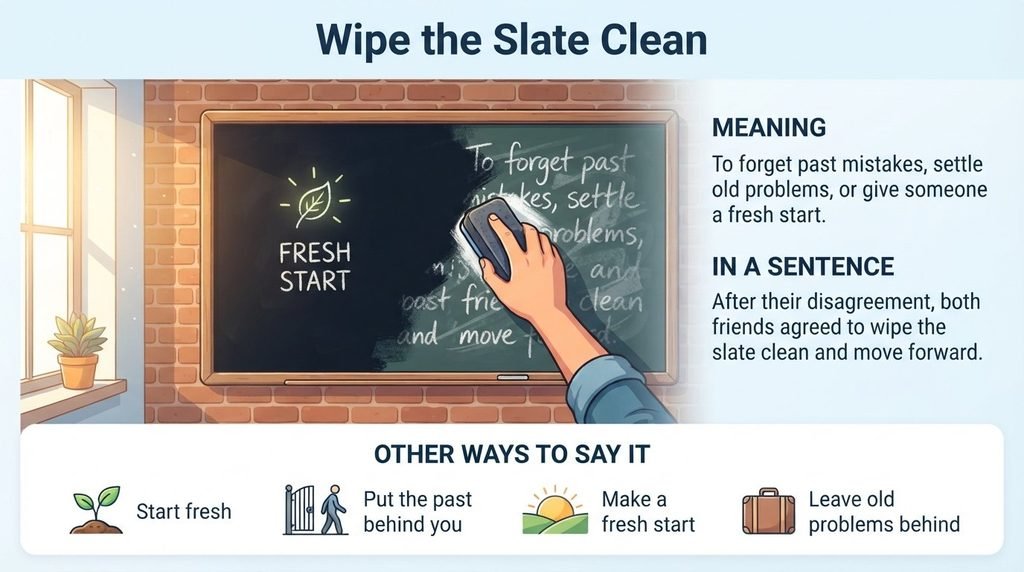
“Wipe the slate clean” means to forget past mistakes, settle old problems, or give someone a fresh start.
In a Sentence
After their disagreement, both friends agreed to wipe the slate clean and move forward.
Other Ways to Say It
- Start fresh
- Put the past behind you
- Make a fresh start
- Leave old problems behind
Explanation
The expression comes from the image of writing on a slate and then wiping it clean so that it can be used again.
That simple image makes the idea of forgiveness, renewal, and second chances especially clear.
Best Use
It works beautifully in personal messages, speeches, stories, reflective writing, and conversations about relationships.
Sweep Something Under the Rug
Meaning
“Sweep something under the rug” means to hide or ignore a problem instead of dealing with it properly.
In a Sentence
Ignoring the broken equipment would only sweep the problem under the rug.
Other Ways to Say It
- Hide the problem
- Avoid the issue
- Ignore what needs attention
- Cover something up
Explanation
The mental image is simple: someone sweeps dirt under a rug instead of actually removing it. The mess disappears from sight, but it has not really gone away.
This makes the idiom especially effective for describing avoidance.
Best Use
Best for conversations, essays, workplace discussions, opinion writing, and storytelling. It often carries a critical tone.
Air One’s Dirty Laundry
Meaning
“Air one’s dirty laundry” means to reveal private problems or embarrassing personal matters publicly.
The “dirty laundry” represents private issues that should normally remain private.
In a Sentence
The family chose to discuss their disagreement privately rather than air their dirty laundry online.
Other Ways to Say It
- Reveal private problems
- Make personal issues public
- Expose family matters
- Share embarrassing details
Explanation
Dirty clothes are normally washed privately. By turning laundry into a metaphor for personal problems, the idiom creates a memorable picture of private matters being displayed for others to see.
It is especially useful when discussing boundaries and public behavior.
Best Use
Use it in conversation, social media discussions, essays, and storytelling. It can sound judgmental, so choose it carefully.
Wash One’s Dirty Linen in Public
Meaning
“Wash one’s dirty linen in public” means to discuss private disagreements, family problems, or personal conflicts openly where other people can see or hear them.
It has a similar idea to airing one’s dirty laundry.
In a Sentence
The two business partners refused to wash their dirty linen in public and handled the dispute privately.
Other Ways to Say It
- Discuss private matters publicly
- Publicize a private dispute
- Expose personal problems
- Take a private conflict into public view
Explanation
The expression uses washing as a metaphor for dealing with unpleasant private matters. The unusual image of doing laundry publicly highlights the loss of privacy and discretion.
It is more common in some varieties of British English than in everyday American conversation.
Best Use
It works well in formal or semi-formal writing, journalism, commentary, and discussions about privacy.
Wash One’s Hands of Something
Meaning
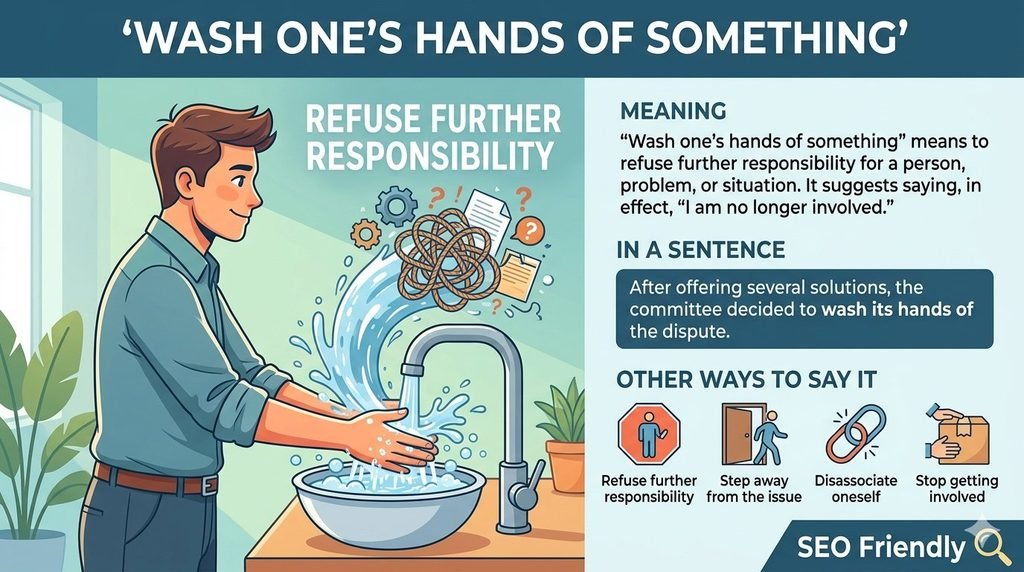
“Wash one’s hands of something” means to refuse further responsibility for a person, problem, or situation.
It suggests saying, in effect, “I am no longer involved.”
In a Sentence
After offering several solutions, the committee decided to wash its hands of the dispute.
Other Ways to Say It
- Refuse further responsibility
- Step away from the issue
- Disassociate oneself
- Stop getting involved
Explanation
The image of washing one’s hands suggests removing oneself from something unpleasant or troublesome. The figurative meaning is therefore about separating yourself from responsibility or involvement.
Depending on context, it can sound decisive, frustrated, or even dismissive.
Best Use
Use it in serious conversations, essays, storytelling, and discussions about responsibility.
Get One’s Hands Dirty
Meaning
“Get one’s hands dirty” means to do practical, difficult, or unpleasant work rather than simply watching from the sidelines.
It can refer literally to cleaning or physical labor, but it is often figurative.
In a Sentence
If we want the garden ready by Saturday, everyone will have to get their hands dirty.
Other Ways to Say It
- Do the hard work
- Get involved
- Work hands-on
- Take practical action
Explanation
The expression creates a direct physical image: real work can leave dirt on your hands. Figuratively, that dirt represents effort, participation, and willingness to handle difficult tasks.
It can have a positive tone when praising someone for being practical and hardworking.
Best Use
It is particularly effective in speeches, motivational writing, conversations, teamwork discussions, and storytelling.
Clear the Air
Meaning
“Clear the air” means to discuss a disagreement, misunderstanding, or uncomfortable issue openly so that tension can disappear.
In a Sentence
We met after work to clear the air and resolve the misunderstanding.
Other Ways to Say It
- Resolve a misunderstanding
- Talk things through
- Remove tension
- Set the record straight
Explanation
The expression compares emotional tension to cloudy or polluted air. Once the air is cleared, people can see and breathe more comfortably.
That makes it a natural way to describe conversations intended to restore openness and understanding.
Best Use
Best for conversations, personal messages, workplace communication, speeches, and relationship writing.
Put One’s House in Order
Meaning
“Put one’s house in order” means to organize one’s affairs, solve outstanding problems, or make necessary preparations.
The “house” may be literal, but it often represents a person’s life, responsibilities, or organization.
In a Sentence
Before starting the new project, I need to put my house in order and finish the work already on my desk.
Other Ways to Say It
- Get organized
- Sort out one’s affairs
- Put things in order
- Deal with unfinished business
Explanation
A well-ordered house suggests a well-managed life. The expression therefore turns physical organization into a metaphor for personal responsibility.
It can sound serious and purposeful, making it stronger than simply saying “tidy up.”
Best Use
It suits formal conversations, essays, speeches, personal reflection, and professional writing.
Keep One’s Nose Clean
Meaning
“Keep one’s nose clean” means to stay out of trouble and behave responsibly.
The expression does not usually refer to physical cleanliness. Instead, it suggests maintaining a clean personal record.
In a Sentence
He stayed focused on his work and made a point of keeping his nose clean.
Other Ways to Say It
- Stay out of trouble
- Behave responsibly
- Keep a clean record
- Avoid wrongdoing
Explanation
The expression creates a humorous picture of keeping even one’s nose free from dirt. Figuratively, the “clean” nose represents good behavior and avoiding trouble.
It has a casual, slightly old-fashioned flavor.
Best Use
Use it mainly in informal conversations, storytelling, and advice. It may sound too casual for formal professional writing.
Turn Over a New Leaf
Meaning
“Turn over a new leaf” means to begin behaving differently and make a fresh start, especially after making mistakes.
Although it is not specifically about household cleaning, it connects naturally with the broader idea of clearing away the past and beginning again.
In a Sentence
After months of poor habits, he decided to turn over a new leaf and create a healthier routine.
Other Ways to Say It
- Start fresh
- Make a fresh start
- Change one’s ways
- Leave the past behind
Explanation
The image comes from turning to a new page or leaf in a book. Nothing is literally washed, but the expression shares the emotional idea of renewal and a clean beginning.
It is especially helpful when cleaning represents personal transformation rather than physical tidiness.
Best Use
Best for personal writing, speeches, motivational messages, conversations, and storytelling.
Dust Off
Meaning
“Dust off” means to bring something old back into use or revisit something that has been neglected for some time.
The expression can be literal when removing dust, but its figurative meaning involves renewing an old idea, plan, skill, or project.
In a Sentence
We decided to dust off our old garden plans and finally start planting.
Other Ways to Say It
- Bring back into use
- Revisit an old idea
- Renew an old plan
- Give something another try
Explanation
The image is easy to picture: an old object sits unused until someone removes the dust and uses it again. Figuratively, the dust represents neglect or inactivity.
It works particularly well when cleaning symbolizes giving something forgotten a second life.
Best Use
Use it in creative writing, workplace conversations, planning discussions, and informal writing.
Out with the Old, In with the New
Meaning
“Out with the old, in with the new” expresses the idea of removing old things, habits, ideas, or systems and replacing them with something new.
It is closely connected to decluttering and renewal.
In a Sentence
We donated the furniture we no longer needed—out with the old, in with the new.
Other Ways to Say It
- Replace the old with the new
- Make a fresh start
- Clear away the outdated
- Embrace something new
Explanation
The expression creates a simple before-and-after picture: unwanted old things leave while new things take their place.
Its rhythm makes it particularly memorable, and it can describe both physical cleaning and symbolic change.
Best Use
It works well in home-improvement writing, social media, conversations, speeches, and creative descriptions of change.
Exercise: Practice Using Idioms
Test your understanding of cleaning-related idioms with these 15 questions.
What does “clean as a whistle” usually mean?
A. Very noisy
B. Extremely clean
C. Difficult to clean
D. Recently purchased
Which expression means to tell the truth about something previously hidden?
A. Come clean
B. Clean house
C. Dust off
D. Clear the air
If someone “sweeps a problem under the rug,” what are they doing?
A. Solving it quickly
B. Cleaning it carefully
C. Hiding or avoiding it
D. Explaining it publicly
Which idiom describes making a fresh start after past problems?
A. Get one’s hands dirty
B. Wipe the slate clean
C. Keep one’s nose clean
D. Air one’s dirty laundry
What does “clean up one’s act” mean?
A. Wash one’s clothes
B. Organize a room
C. Improve one’s behavior
D. Buy cleaning supplies
Which expression means to make private problems public?
A. Air one’s dirty laundry
B. Make a clean sweep
C. Put one’s house in order
D. Dust off
What does “clear the air” usually involve?
A. Opening a window
B. Cleaning an office
C. Avoiding a disagreement
D. Discussing a misunderstanding
If someone “gets their hands dirty,” what might they be doing figuratively?
A. Avoiding work
B. Doing practical or difficult work
C. Hiding a secret
D. Starting an argument
Which expression can mean removing unwanted people or practices from an organization?
A. Clean house
B. Turn over a new leaf
C. Squeaky clean
D. Keep one’s nose clean
What does “wash one’s hands of something” mean?
A. Clean up after an accident
B. Take complete responsibility
C. Refuse further involvement
D. Prepare for physical work
Which expression is most closely associated with being neat and well arranged?
A. Come clean
B. Neat as a pin
C. Wash one’s hands of something
D. Clear the air
A person who “keeps their nose clean” is generally trying to:
A. Stay out of trouble
B. Avoid cleaning
C. Work outdoors
D. Start a new project
Which idiom best describes discussing a private conflict openly in front of others?
A. Dust off
B. Make a clean sweep
C. Wash one’s dirty linen in public
D. Clean as a whistle
What does “put one’s house in order” usually mean figuratively?
A. Paint a house
B. Organize one’s affairs
C. Move to another home
D. Clean a kitchen
Which expression best describes replacing outdated things or ideas with new ones?
A. Out with the old, in with the new
B. Sweep something under the rug
C. Get one’s hands dirty
D. Come clean
Answers
- B — “Clean as a whistle” means extremely clean or spotless.
- A — “Come clean” means to tell the truth about something that was hidden.
- C — “Sweep something under the rug” means to hide or ignore a problem rather than deal with it.
- B — “Wipe the slate clean” means to leave past problems behind and begin again.
- C — “Clean up one’s act” means to improve one’s behavior or performance.
- A — “Air one’s dirty laundry” means to reveal private problems publicly.
- D — “Clear the air” means to discuss tension, conflict, or misunderstanding openly.
- B — “Get one’s hands dirty” means to become directly involved in practical or difficult work.
- A — “Clean house” can mean removing unwanted people, practices, or problems from an organization.
- C — “Wash one’s hands of something” means to stop accepting responsibility or involvement.
- B — “Neat as a pin” describes something extremely neat, tidy, or well arranged.
- A — “Keep one’s nose clean” means to stay out of trouble and behave responsibly.
- C — “Wash one’s dirty linen in public” means exposing private disagreements or problems publicly.
- B — “Put one’s house in order” means organizing one’s affairs or dealing with unfinished responsibilities.
- A — “Out with the old, in with the new” describes replacing old things or ideas with new ones.
FAQs
What is a idiom for Cleaning?
A cleaning-related idiom is an expression that uses ideas such as washing, sweeping, wiping, dirt, or order to communicate a literal or figurative meaning. Examples include “come clean,” “clean house,” and “wipe the slate clean.”
How do I create my own idiom?
Start with a clear mental image connected to cleaning, then connect that image to an emotion, action, or situation. However, a newly created expression is better described as a metaphorical phrase unless it becomes established through common use.
What makes a cleaning idiom effective?
An effective idiom creates an image that readers can understand quickly. Expressions such as “sweep it under the rug” work because almost everyone can picture hiding dirt instead of actually cleaning it.
Can I use these idioms in everyday conversation?
Yes. Many of these expressions, including “come clean,” “clear the air,” “clean up one’s act,” and “get one’s hands dirty,” are natural in everyday English. More traditional expressions may sound slightly old-fashioned depending on the speaker and context.
What is the difference between a idiom and a simile?
An idiom has an established figurative meaning that may not be predictable from its individual words. A simile directly compares two things using words such as “like” or “as.” For example, “neat as a pin” is a traditional comparison used idiomatically to describe exceptional neatness.
Conclusion
Cleaning-related idioms show how ordinary actions can represent much bigger ideas. Sweeping, washing, wiping, clearing, and organizing can become images for honesty, responsibility, forgiveness, personal growth, and fresh beginnings. Expressions such as “come clean” focus on truth, while “wipe the slate clean” suggests another chance. Others, such as “sweep something under the rug,” warn against ignoring problems.
The strongest figurative expression is not necessarily the most dramatic one. Choose language that fits your message, audience, and emotional tone. A playful idiom can make conversation warmer, while a more serious expression can add weight to an essay or speech. When used thoughtfully, cleaning idioms turn familiar images into memorable ways of expressing ideas and sometimes a simple image of a clean space can suggest an entirely new beginning.




[…] Read more:20 Idioms for Cleaning With Real Examples […]
[…] Read more:20 Idioms for Cleaning With Real Examples […]