
Have you ever noticed how quickly a day disappears while you are busy with work, plans, or conversations? The 20 Idioms for Time Passing With Real Examples in this guide will help you describe those moments naturally and vividly. Idioms can make ordinary ideas about time passing, change, waiting, and aging feel more expressive. They also add personality to everyday English usage without making your writing complicated.
Understanding these expressions can be especially useful when discussing scheduling, time management, meetings, or a busy calendar. They can also improve business communication, formal writing, and practical situations such as online booking and broadcasting. Each idiom carries its own tone, so learning the figurative meaning helps you choose the right expression for the situation. Clear examples also make grammar, context, and natural usage easier to understand.
In this article, you will explore 20 useful idioms related to time passing, along with real examples and simple explanations. You will learn how these expressions work in conversations, storytelling, professional communication, and creative writing. We will also look at alternative phrases, appropriate contexts, and subtle differences in meaning. With regular practice and consistency, these idioms can become a natural part of your vocabulary and help you express the passage of time with greater clarity and style.
What Is an Idiom?
An idiom is a phrase whose meaning is different from the literal meaning of the individual words.
For example, if someone says, “It’s raining cats and dogs,” they do not mean animals are falling from the sky. They mean that it is raining very heavily.
Similarly, “break the ice” does not literally mean breaking frozen water. It means starting a friendly conversation or helping people feel more comfortable.
Idioms are a form of figurative language. They allow speakers and writers to communicate ideas through familiar images rather than direct, literal descriptions.
Why Use Idioms for Time Passing?
Talking about time does not always mean giving a number of minutes, hours, or years. Sometimes we want to express how time feels.
Idioms can make time passing more vivid by showing whether it feels fast, slow, sudden, precious, or limited. For example, “time flies” suggests that time seems to move quickly, while “the sands of time” creates a more reflective image of moments gradually disappearing.
These expressions can help you:
- Express emotions connected with memories, aging, waiting, or change.
- Make descriptions of time more vivid and memorable.
- Explain an abstract idea through a familiar image.
- Add personality to everyday conversations.
- Give creative writing and storytelling a more expressive voice.
- Communicate complicated feelings about time in just a few words.
- Make speeches, essays, messages, and poetry sound less plain.
The key is choosing an expression that matches the feeling you want to communicate.
Quick List of 20 Idioms for Time Passing
- Time flies
- Time marches on
- In the blink of an eye
- Before you know it
- Time slips away
- The sands of time
- The clock is ticking
- A race against time
- Make up for lost time
- Kill time
- Pass the time
- Bide your time
- In no time
- In the nick of time
- At the eleventh hour
- Out of time
- Just in time
- Day in, day out
- Once in a blue moon
- Time waits for no one
Time flies
Meaning
“Time flies” means that time seems to pass very quickly, especially when you are enjoying yourself or deeply involved in something.
The image suggests that time has wings and moves away before you notice it. It often carries a feeling of surprise or mild disbelief about how quickly a period has ended.
In a Sentence
We talked for hours, but somehow time flies when you are with good friends.
Other Ways to Say It
- Time goes by quickly.
- The hours disappear.
- The day went by in a flash.
- It feels like no time has passed.
Explanation
This is one of the most natural expressions for describing fast-moving time. It works because the idea of time having wings creates an immediate mental picture.
It is especially effective when someone realizes that an enjoyable period has ended much sooner than expected.
Best Use
Best for everyday conversations, personal messages, storytelling, and informal writing. It sounds natural rather than overly poetic.
Time marches on
Meaning
“Time marches on” means that time continues to move forward regardless of what people do.
The word “marches” creates an image of something steady and unstoppable. The expression often suggests change, aging, or the movement of life.
In a Sentence
We may wish we could stay young forever, but time marches on.
Other Ways to Say It
- Time keeps moving forward.
- Life moves on.
- The years continue to pass.
- Time does not stop.
Explanation
Unlike “time flies,” this expression does not necessarily suggest that time is moving quickly. Instead, it emphasizes that time is persistent and unavoidable.
It can sound thoughtful or slightly serious when discussing growing older, changing circumstances, or important stages of life.
Best Use
A strong choice for speeches, reflective writing, essays, storytelling, and serious conversations.
In the blink of an eye
Read more:20 Idioms for Sleeping With Real Examples
Meaning
“In the blink of an eye” means that something happens extremely quickly or that a period of time seems to disappear almost instantly.
The comparison is with the tiny amount of time needed to blink. It emphasizes suddenness and speed.
In a Sentence
The children grew up in the blink of an eye, and suddenly they were leaving for college.
Other Ways to Say It
- In an instant.
- In a split second.
- Almost immediately.
- Before you could notice.
Explanation
The expression gives time a physical scale by comparing it with a blink. This makes a very short period easy to imagine.
It can be especially powerful when describing major changes that seem to happen faster than expected.
Best Use
Works particularly well in storytelling, personal reflections, emotional writing, and dramatic descriptions.
Before you know it
Meaning
“Before you know it” means that something will happen sooner than expected, often while someone is busy with other things.
It focuses on the unexpected speed of passing time.
In a Sentence
Keep enjoying these school years because before you know it, graduation will be here.
Other Ways to Say It
- Sooner than you expect.
- Before you realize it.
- In no time at all.
- Before long.
Explanation
This phrase creates a sense that time quietly moves forward while our attention is elsewhere. It is particularly useful when warning someone that an important date or event will arrive quickly.
The tone can be friendly, encouraging, nostalgic, or cautionary, depending on context.
Best Use
Ideal for conversations, advice, personal messages, speeches, and informal writing.
Time slips away
Meaning
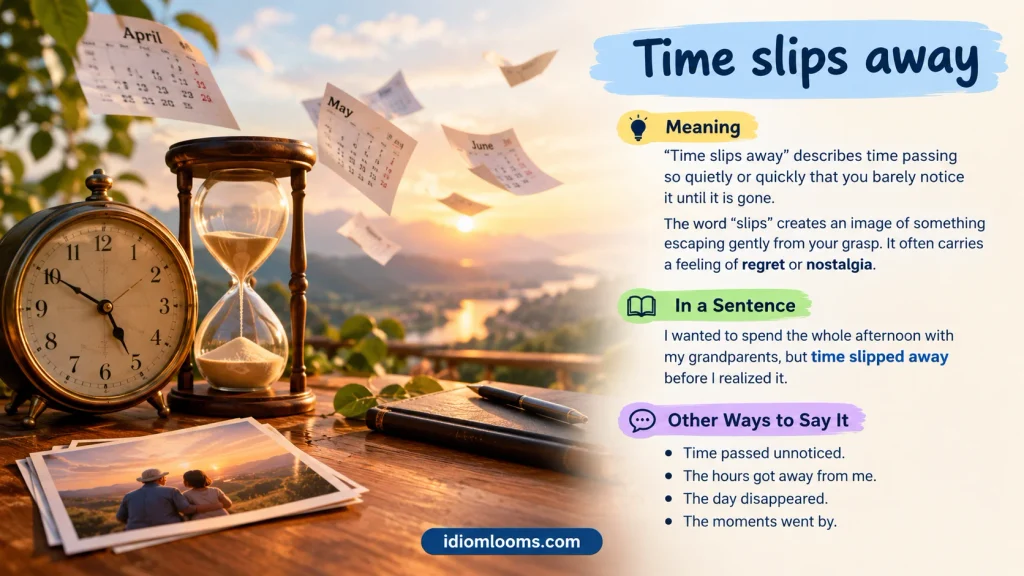
“Time slips away” describes time passing so quietly or quickly that you barely notice it until it is gone.
The word “slips” creates an image of something escaping gently from your grasp. It often carries a feeling of regret or nostalgia.
In a Sentence
I wanted to spend the whole afternoon with my grandparents, but time slipped away before I realized it.
Other Ways to Say It
- Time passed unnoticed.
- The hours got away from me.
- The day disappeared.
- The moments went by.
Explanation
This expression makes time feel almost physical, as though it can quietly escape while we are distracted. That makes it more emotional than a simple statement such as “time passed.”
It is particularly effective when talking about memories, missed opportunities, or cherished moments.
Best Use
Best suited to personal writing, poetry, storytelling, reflective essays, and heartfelt messages.
The sands of time
Meaning
“The sands of time” is a poetic expression for the gradual passing of time.
It compares time with grains of sand falling away, suggesting that individual moments are limited and impossible to recover.
In a Sentence
As the sands of time continue to fall, we learn to value the moments we have.
Other Ways to Say It
- The passage of time.
- The passing years.
- The flow of time.
- The years slipping away.
Explanation
This phrase creates a strong visual image: grains of sand steadily moving downward while there is nothing we can do to stop them.
Because of its poetic quality, it often carries a reflective, nostalgic, or philosophical tone.
Best Use
Especially effective in poetry, speeches, literary writing, memorial reflections, and emotional essays. It can sound too poetic for casual conversation.
The clock is ticking
Meaning
“The clock is ticking” means that time is running out and there is only a limited amount of time left to act.
The ticking clock represents urgency and approaching limits.
In a Sentence
We still have several chapters to edit, and the clock is ticking before the book goes to print.
Other Ways to Say It
- Time is running out.
- We are running short on time.
- The deadline is approaching.
- There is not much time left.
Explanation
This expression turns the passing of time into a sound we can imagine: tick, tick, tick. Each imagined tick suggests that another moment has disappeared.
It is more about limited time and urgency than simply noticing time passing.
Best Use
Useful in work conversations, speeches, storytelling, sports commentary, and situations involving deadlines.
A race against time
Meaning
“A race against time” describes a situation where someone must finish something before a deadline or before an important opportunity disappears.
It compares completing a task with trying to outrun time itself.
In a Sentence
Rescuers began a race against time as the storm moved toward the coastline.
Other Ways to Say It
- A struggle to meet the deadline.
- A desperate rush.
- A battle against the clock.
- A fight to finish in time.
Explanation
The phrase creates an energetic image of a person competing against something that cannot actually be stopped.
It is naturally associated with pressure, urgency, determination, and high stakes.
Best Use
Excellent for news-style writing, storytelling, speeches, action scenes, and serious situations.
Make up for lost time
Meaning
“Make up for lost time” means to try to compensate for time that was wasted, missed, or unavailable.
It suggests taking action to recover an opportunity that has already been delayed.
In a Sentence
After being away from home for several years, the brothers spent the summer together to make up for lost time.
Other Ways to Say It
- Catch up on what was missed.
- Recover lost ground.
- Make the most of the remaining time.
- Compensate for the delay.
Explanation
The expression treats time as something valuable that has been lost and can, at least partly, be compensated for through action.
It often has an emotional or determined quality when relationships, opportunities, or unfinished work are involved.
Best Use
Works well in conversations, personal writing, storytelling, business contexts, and reflective messages.
Kill time
Meaning
“Kill time” means to spend time doing something while waiting for another event or activity.
It does not literally mean harming time. It is an informal expression for occupying yourself during an unwanted or empty period.
In a Sentence
I read a few articles on my phone to kill time while waiting for the train.
Other Ways to Say It
- Pass the time.
- Keep yourself occupied.
- Fill the time.
- Do something while waiting.
Explanation
The expression is casual and slightly playful. It treats empty time as something that needs to be “killed” or used up.
It is generally practical rather than emotional, making it different from poetic expressions about memories or aging.
Best Use
Best for casual conversation, messages, travel situations, and everyday writing.
Pass the time
Meaning
“Pass the time” means to do something that makes a period of waiting or inactivity feel occupied.
It focuses on using time while waiting for something else to happen.
In a Sentence
She brought a crossword puzzle to pass the time during the long journey.
Other Ways to Say It
- Keep busy.
- Fill the time.
- Occupy yourself.
- Spend the waiting period.
Explanation
This phrase is straightforward and flexible. It does not necessarily suggest that time is moving quickly or slowly; it simply describes what someone does during an otherwise empty period.
That makes it useful in many ordinary situations.
Best Use
Suitable for everyday conversations, travel writing, instructions, personal messages, and informal essays.
Bide your time
Meaning
“Bide your time” means to wait patiently for the right moment to act.
It suggests that instead of rushing, someone is watching and waiting for a better opportunity.
In a Sentence
He decided to bide his time until the right opportunity appeared.
Other Ways to Say It
- Wait for the right moment.
- Be patient.
- Hold back for now.
- Wait strategically.
Explanation
This expression gives waiting a sense of purpose. The person is not simply doing nothing; they are choosing to wait until circumstances become more favorable.
It can sound strategic, patient, or slightly dramatic, depending on the situation.
Best Use
Particularly useful in storytelling, strategic discussions, literary writing, and serious conversations.
In no time
Meaning
“In no time” means very soon or after only a short amount of time.
It emphasizes that something is expected to happen quickly.
In a Sentence
Give the new routine a few days, and you will be comfortable with it in no time.
Other Ways to Say It
- Very soon.
- Before long.
- Quickly.
- In a short while.
Explanation
The phrase is concise and reassuring. It can make a future event feel close, especially when someone is worried that something will take too long.
Unlike more poetic expressions, it sounds completely natural in everyday speech.
Best Use
Best for casual conversation, encouragement, advice, and informal writing.
In the nick of time
Meaning
“In the nick of time” means something happens just before it would have been too late.
It describes perfectly timed action at the last possible moment.
In a Sentence
We reached the station in the nick of time and boarded just before the doors closed.
Other Ways to Say It
- Just before it was too late.
- At the last possible moment.
- Just in time.
- With seconds to spare.
Explanation
This expression creates a feeling of relief because the available time has almost completely disappeared.
It works particularly well when the outcome depends on arriving, acting, or finishing before a deadline or critical moment.
Best Use
Great for storytelling, everyday conversation, action scenes, and humorous accounts of close calls.
At the eleventh hour
Meaning
“At the eleventh hour” means doing something very late, usually close to a deadline or critical point.
The expression suggests that there is almost no time left.
In a Sentence
They reached an agreement at the eleventh hour, just before the contract expired.
Other Ways to Say It
- At the last minute.
- Very late in the process.
- Just before the deadline.
- At the final moment.
Explanation
The phrase is often used when someone delays action until there is very little time remaining. It can carry a slightly dramatic or critical tone.
It is useful when timing matters and the lateness itself is an important part of the story.
Best Use
Suitable for professional writing, journalism, storytelling, formal conversations, and discussions about deadlines.
Out of time
Meaning
“Out of time” means that no time remains to complete something or take an action.
It describes a moment when the available opportunity has completely run out.
In a Sentence
We wanted to review the final proposal again, but we were out of time.
Other Ways to Say It
- There is no time left.
- The deadline has passed.
- The opportunity is gone.
- We cannot wait any longer.
Explanation
This is a direct but still idiomatic expression. It emphasizes the final boundary of a period rather than the general movement of time.
Its tone can be serious, urgent, or decisive, depending on context.
Best Use
Useful in workplaces, examinations, competitions, speeches, conversations, and dramatic storytelling.
Just in time
Meaning
“Just in time” means something happens at exactly the right moment, before it becomes too late.
It often expresses relief, luck, or successful timing.
In a Sentence
The mechanic arrived just in time to stop the engine from being damaged further.
Other Ways to Say It
- Right on time.
- With perfect timing.
- Before it was too late.
- At exactly the right moment.
Explanation
“Just in time” is about successful timing rather than simply describing time passing. The expression works when a narrow window of opportunity is successfully met.
It often leaves the reader or listener with a sense of relief and satisfaction.
Best Use
Natural in everyday conversation, storytelling, work situations, travel, and practical writing.
Day in, day out
Meaning
“Day in, day out” means something happens repeatedly every day, often for a long period.
It emphasizes the steady passage of days and repetition over time.
In a Sentence
Day in, day out, the old shopkeeper opened his doors before sunrise.
Other Ways to Say It
- Every single day.
- Day after day.
- On a daily basis.
- Every day without a break.
Explanation
Rather than focusing on one fast or slow moment, this expression shows time passing through repetition and routine.
It can suggest dedication, boredom, persistence, or the unchanging rhythm of daily life.
Best Use
Useful in storytelling, essays, personal reflections, biographies, and descriptions of routines.
Once in a blue moon
Meaning
“Once in a blue moon” means something happens very rarely.
Although it does not directly describe time moving forward, it describes the long intervals between occasional events.
In a Sentence
We see our former classmates once in a blue moon, but our conversations always feel familiar.
Other Ways to Say It
- Very rarely.
- Once in a great while.
- Almost never.
- On rare occasions.
Explanation
The phrase creates an unusual image for something that does not happen often. Its focus is not speed but infrequency over a long period.
It usually sounds friendly and conversational rather than formal.
Best Use
Best for casual conversations, personal stories, social posts, and informal writing.
Time waits for no one
Meaning
“Time waits for no one” means that time continues moving forward regardless of whether we are ready.
It reminds us that opportunities can disappear because time cannot be stopped or persuaded to pause.
In a Sentence
We cannot keep postponing the trip forever; time waits for no one.
Other Ways to Say It
- Time keeps moving.
- We cannot stop the clock.
- Opportunities do not last forever.
- Make the most of the present.
Explanation
This expression has a strong reflective and motivational quality. It encourages people to act rather than endlessly postpone important decisions.
It can be especially meaningful when discussing relationships, dreams, aging, opportunities, or life changes.
Best Use
Particularly effective in speeches, inspirational writing, personal messages, essays, and reflective conversations.
Exercise: Practice Using Idioms
Test your understanding of idioms about time passing. Choose the best answer for each question.
1. What does “time flies” mean?
A. Time can move backward.
B. Time seems to pass quickly.
C. Time stops during enjoyable moments.
D. Time becomes difficult to measure.
2. Which expression suggests that time continues moving forward regardless of circumstances?
A. Kill time
B. In no time
C. Time waits for no one
D. Once in a blue moon
3. If someone reads a magazine while waiting for a bus, what might they be doing?
A. Killing time
B. Losing time
C. Marching time
D. Racing time
4. Which idiom describes waiting patiently for the right opportunity?
A. Out of time
B. Bide your time
C. In the blink of an eye
D. Just in time
5. What does “in the blink of an eye” emphasize?
A. Repetition
B. Delay
C. Speed
D. Patience
6. Which expression describes completing something at the last possible moment?
A. Day in, day out
B. In the nick of time
C. Time marches on
D. Pass the time
7. What does “the sands of time” mainly suggest?
A. Time gradually passing away
B. A long vacation
C. A busy daily schedule
D. A short waiting period
8. Someone says, “Before you know it, summer will be over.” What do they mean?
A. Summer will become longer.
B. Summer will be cancelled.
C. Summer will arrive unexpectedly.
D. Summer will end sooner than you may realize.
9. Which expression is most associated with urgency and a deadline?
A. The clock is ticking
B. Once in a blue moon
C. Day in, day out
D. Kill time
10. If a person returns to an old hobby after years away and spends extra time practicing, which idiom could describe the effort?
A. Out of time
B. Make up for lost time
C. In no time
D. Time flies
11. Which expression means something happens very rarely?
A. Time slips away
B. At the eleventh hour
C. Once in a blue moon
D. In the nick of time
12. “Day in, day out” mainly describes:
A. A sudden event
B. Repeated activity over many days
C. A missed deadline
D. A brief moment
13. Which sentence uses “just in time” correctly?
A. The train left just in time for three hours.
B. She arrived just in time to catch the final bus.
C. He just in time waited for the meeting.
D. The clock just in time passed slowly.
14. Which phrase means there is no time remaining?
A. Out of time
B. In no time
C. Time flies
D. Pass the time
15. Which expression is especially suitable for a reflective statement about making the most of life?
A. Kill time
B. Pass the time
C. Time waits for no one
D. Once in a blue moon
Answers
- B — “Time flies” means that time seems to pass very quickly.
- C — “Time waits for no one” expresses the idea that time keeps moving regardless of our wishes.
- A — “Kill time” means doing something to occupy yourself while waiting.
- B — “Bide your time” means to wait patiently for the right moment.
- C — “In the blink of an eye” emphasizes that something happens extremely quickly.
- B — “In the nick of time” means something happens just before it becomes too late.
- A — “The sands of time” presents time as gradually falling away, like grains of sand.
- D — “Before you know it” means something will happen sooner than you expect.
- A — “The clock is ticking” suggests that available time is running out.
- B — “Make up for lost time” means trying to compensate for time that was missed or lost.
- C — “Once in a blue moon” describes something that happens very rarely.
- B — “Day in, day out” refers to something happening repeatedly every day.
- B — “Just in time” means arriving or acting at the right moment before it is too late.
- A — “Out of time” means that no available time remains.
- C — “Time waits for no one” works well as a reflective reminder that life continues moving forward.
FAQs
What is an idiom for time passing?
An idiom for time passing is a figurative expression used to describe how time moves, feels, disappears, or becomes limited. Examples include “time flies,” “time slips away,” and “time marches on.”
How do I create my own idiom for time passing?
Start with a clear image that represents how time feels. You might imagine time as water flowing, sand falling, a road stretching ahead, or a clock moving forward. The image should communicate an idea rather than simply replace the word “time.”
What makes an idiom effective?
An effective idiom creates a clear mental picture while expressing a feeling or idea naturally. Strong figurative language should make the reader understand something more vividly, not make the message confusing.
Can I use these idioms in everyday conversation?
Yes. Expressions such as “time flies,” “in no time,” “before you know it,” “kill time,” and “just in time” are natural in everyday English. More poetic expressions, such as “the sands of time,” are usually better suited to creative or reflective writing.
What is the difference between an idiom and a simile?
An idiom has an established figurative meaning, such as “time flies,” where time is not literally flying. A simile directly compares two things using words such as “like” or “as,” such as “time passed like a speeding train.” Idioms are often familiar expressions, while similes can be created more freely.
Conclusion
Time can feel fast during joyful moments, slow while we wait, and strangely invisible when we look back on years gone by. The right idiom for time passing helps turn these different experiences into language that feels vivid and human. Expressions such as “time flies” capture speed, while “the sands of time” offers a more reflective image. Other phrases, including “bide your time” and “the clock is ticking,” show that the meaning of time depends heavily on context.
When choosing an idiom, think first about the feeling you want to communicate. Do you want to express urgency, nostalgia, patience, relief, or appreciation? The strongest figurative expression is not necessarily the most dramatic one it is the one that makes your intended meaning clear. After all, time keeps moving, and the words we use can help us notice what those passing moments mean.

Margaret Saywell is an English author and editor who has spent more than fifteen years working with words teaching, proofreading, and writing about the quirks of the English language.
At Idiom Looms, Margaret gathers idioms from across the English-speaking world and weaves them into clear, practical guides. She loves digging into the history of a phrase and showing readers how a few well-chosen words can say far more than a long explanation.
She believes language should be enjoyed, not feared and that the best way to learn an idiom is to see it in action.



[…] Read more:20 Idioms for Time Passing With Real Examples […]