

Want to make your English sound more natural when describing something good? The right idiom can add personality, emotion, and clarity to everyday communication. This guide to 20 Idioms for Good With Real Examples introduces useful expressions for praise, quality, success, kindness, and positive experiences. Each phrase comes with a clear meaning and practical example.
These idioms work across casual conversations, business communication, formal writing, and everyday English usage. You’ll discover how context matters when discussing meetings, scheduling, time management, and project management. The examples also show how grammar, tone, and consistency influence effective communication in different situations.
From online booking messages to broadcasting and calendar-related communication, these expressions can make language more engaging. You’ll learn when each idiom sounds professional, conversational, humorous, or expressive. By the end, you’ll have practical phrases for communicating positive ideas naturally and confidently.
What Is an Idiom?
An idiom is a fixed expression whose overall meaning is different from the literal meaning of the individual words.
For example, “break the ice” does not usually mean physically breaking ice. It means to make people feel more comfortable when they first meet.
Another example is “spill the beans.” Literally, this sounds like dropping beans, but idiomatically it means to reveal a secret.
Idioms make language more colorful, expressive, and memorable. Rather than stating an idea in a plain way, they allow speakers and writers to create a mental picture.
Why Use Idioms for Good?
Using idioms can help you express different kinds of goodness more precisely. The word “good” alone can describe many things, but an idiom can show exactly what makes something positive.
For example, “a cut above the rest” suggests outstanding quality, while “a heart of gold” focuses on kindness and generosity. “In good hands” communicates trust and confidence, whereas “worth its weight in gold” emphasizes great value.
These expressions can:
- Make descriptions more vivid and memorable.
- Help express positive emotions naturally.
- Give personality to conversations and personal messages.
- Make creative writing and storytelling more engaging.
- Explain different forms of goodness without repeating the word “good.”
- Add imagery and figurative language to essays, speeches, and other writing.
Quick List of 20 Idioms
- As good as gold
- A heart of gold
- A cut above the rest
- Cream of the crop
- Second to none
- In good hands
- Worth its weight in gold
- Go the extra mile
- A breath of fresh air
- Stand head and shoulders above the rest
- On the right track
- Have it made
- Come up roses
- Do someone proud
- Hit the nail on the head
- Best of both worlds
- Make all the difference
- Tip-top
- A feather in your cap
- Go over with a bang
As Good as Gold
Read more:20 Idioms for Cleaning With Real Examples
Meaning
“As good as gold” describes someone or something that is extremely good, well-behaved, reliable, or satisfactory. When used for a person, especially a child, it often suggests excellent behavior and trustworthiness.
In a Sentence
The children were as good as gold while their parents were busy preparing dinner.
Other Ways to Say It
- Very well-behaved
- Extremely good
- Dependable and pleasant
- A real pleasure to have around
Explanation
Gold traditionally represents something valuable and desirable, which gives this expression its positive force. When a person is called as good as gold, the phrase creates an image of someone whose behavior is consistently pleasing or trustworthy.
It is especially natural in everyday conversation and often has a warm, affectionate tone.
Best Use
This idiom works particularly well in conversations, personal messages, family stories, and informal writing. It is especially suitable when praising someone’s behavior.
A Heart of Gold
Meaning
“A heart of gold” describes someone who is deeply kind, generous, caring, and willing to help others. It focuses on a person’s inner goodness rather than appearance or achievement.
In a Sentence
Everyone in the neighborhood knew Mr. Ali had a heart of gold because he was always helping people in need.
Other Ways to Say It
- Deeply kind
- Very compassionate
- Generous by nature
- Kind-hearted
Explanation
The heart is commonly associated with emotions and character, while gold suggests great value. Together, the image presents kindness as something precious.
This expression is more personal and emotional than simply calling someone “good.” It is particularly effective when describing generosity or genuine concern for others.
Best Use
Use it in personal writing, storytelling, tributes, conversations, and heartfelt messages.

A Cut Above the Rest
Meaning
“A cut above the rest” describes someone or something that is noticeably better in quality than similar people or things.
In a Sentence
The new restaurant is a cut above the rest, especially when it comes to service and attention to detail.
Other Ways to Say It
- Better than most
- Clearly superior
- Outstanding among its peers
- Above average
Explanation
The expression creates an image of something being physically cut higher than everything else. That mental picture makes the idea of superior quality easy to remember.
Unlike expressions that simply mean “good,” this idiom suggests comparison. Something is good because it stands out from competing choices.
Best Use
It works well in reviews, conversations, essays, recommendations, and descriptive writing.
Cream of the Crop
Meaning
“Cream of the crop” refers to the best people or things in a particular group.
In a Sentence
After reviewing hundreds of applications, the company selected the cream of the crop for its graduate program.
Other Ways to Say It
- The very best
- Top-quality
- The finest available
- The best of the group
Explanation
Cream rises to the top of milk, so the expression creates a picture of the highest-quality part naturally separating from the rest.
It is stronger than simply saying something is good. It suggests that the subject belongs among the very best available options.
Best Use
Use this expression in informal writing, conversations, reviews, recommendations, and storytelling. It can sound slightly informal in highly formal documents.
Second to None
Meaning
“Second to none” means as good as anyone or anything else, and possibly the best.
In a Sentence
Her knowledge of local history is second to none.
Other Ways to Say It
- Among the very best
- Unmatched
- Exceptional
- Without equal
Explanation
The phrase literally suggests that nothing deserves to come before the subject in a ranking. It communicates confidence and excellence without directly saying “number one.”
Because it is concise and powerful, it can make praise sound particularly strong.
Best Use
This expression fits professional descriptions, speeches, reviews, promotional writing, and confident conversations. In marketing copy, however, it should be used thoughtfully rather than as an unsupported claim.
In Good Hands
Meaning
“In good hands” means that someone or something is being cared for or managed by a capable, trustworthy, and responsible person.
In a Sentence
You can relax while you’re away because your project is in good hands with Maria.
Other Ways to Say It
- Well cared for
- Safely managed
- In capable hands
- Being looked after properly
Explanation
The expression turns capable care into a simple physical image: your important matter has been placed into safe hands.
It does not necessarily mean that something is excellent itself. Instead, it expresses confidence that the person responsible will handle it well.
Best Use
It is especially natural in conversations, professional communication, customer service, personal messages, and reassuring situations.
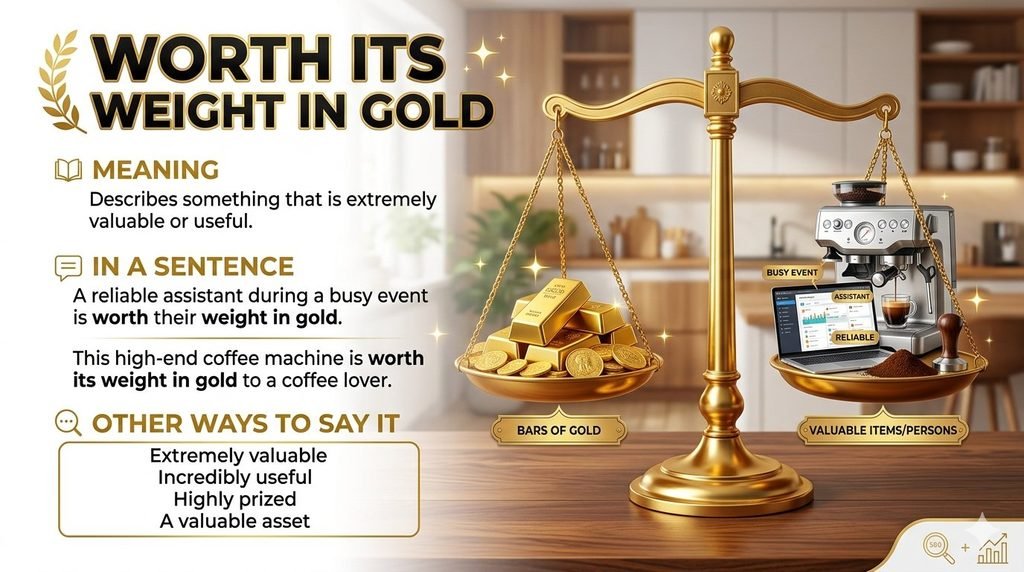
Worth Its Weight in Gold
Meaning
“Worth its weight in gold” describes something that is extremely valuable or useful.
In a Sentence
A reliable assistant during a busy event is worth their weight in gold.
Other Ways to Say It
- Extremely valuable
- Incredibly useful
- Highly prized
- A valuable asset
Explanation
The image compares the subject with gold, a traditional symbol of high value. The expression emphasizes usefulness or importance rather than ordinary goodness.
It can describe a person, skill, tool, piece of advice, or resource that becomes especially valuable in a particular situation.
Best Use
This idiom works naturally in conversations, workplace writing, storytelling, and personal recommendations.
Go the Extra Mile
Meaning
“Go the extra mile” means to make an additional effort beyond what is normally expected.
In a Sentence
The teacher went the extra mile to make sure every student understood the difficult lesson.
Other Ways to Say It
- Make an extra effort
- Do more than expected
- Put in additional work
- Take extra care
Explanation
The expression creates the image of someone continuing their journey beyond the expected stopping point. It therefore suggests effort, dedication, and willingness to do more.
This idiom is especially useful when the goodness of an action comes from effort rather than natural ability.
Best Use
Use it in workplace conversations, appreciation messages, essays, speeches, and stories about helpful behavior.
A Breath of Fresh Air
Meaning
“A breath of fresh air” describes someone or something that feels refreshingly different, positive, or enjoyable.
In a Sentence
The new manager was a breath of fresh air after years of the same routine.
Other Ways to Say It
- Refreshingly different
- A welcome change
- Rejuvenating
- A positive change
Explanation
Fresh air suggests relief after being in a stale or uncomfortable environment. The expression transfers that feeling to a person, idea, experience, or change.
It is not simply about being good. It suggests renewal, relief, and positive change.
Best Use
This phrase is effective in reviews, conversations, creative writing, social media, and personal descriptions.
Stand Head and Shoulders Above the Rest
Meaning
“Stand head and shoulders above the rest” means to be clearly better or more impressive than others.
In a Sentence
Among all the candidates, Jamal stood head and shoulders above the rest because of his experience and calm leadership.
Other Ways to Say It
- Clearly stand out
- Be far better than others
- Rise above the competition
- Be especially impressive
Explanation
The physical image is easy to picture: someone standing noticeably taller than everyone around them. That image becomes a metaphor for superior performance or quality.
It is stronger than merely saying someone did well because it involves direct comparison with others.
Best Use
It works well in reviews, speeches, essays, storytelling, and discussions about achievement or performance.
On the Right Track
Meaning
“On the right track” means making progress in the correct direction toward a desired result.
In a Sentence
Your first draft needs some changes, but you’re definitely on the right track.
Other Ways to Say It
- Moving in the right direction
- Making good progress
- Heading toward the right result
- Following a sensible approach
Explanation
The phrase compares progress with following a railway or road track toward a destination. Being on the right track means the direction is correct, even if the journey is not finished yet.
This makes it useful for situations where something is promising rather than already perfect.
Best Use
Use it in education, coaching, workplace discussions, feedback, conversations, and personal encouragement.

Have It Made
Meaning
“Have it made” means to be in a very fortunate, comfortable, or successful position.
In a Sentence
With a supportive team, flexible hours, and work he genuinely enjoys, Daniel feels like he has it made.
Other Ways to Say It
- Be in a fortunate position
- Have a comfortable situation
- Be set for success
- Be in an enviable position
Explanation
The expression suggests that the difficult work of achieving a desirable situation has already been successfully completed. It focuses on good circumstances and satisfaction.
It is usually casual and can sometimes sound playful or slightly envious, depending on context.
Best Use
It is best suited to casual conversations, storytelling, social media, and informal writing.
Come Up Roses
Meaning
“Come up roses” means that a situation turns out very well, especially after uncertainty or difficulty.
In a Sentence
We worried that the event would be a disaster, but everything came up roses in the end.
Other Ways to Say It
- Turn out well
- Work out beautifully
- Have a positive outcome
- End successfully
Explanation
The phrase uses roses as a symbol of beauty and favorable results. It is particularly interesting because the situation does not necessarily begin perfectly.
That makes it useful for describing a happy outcome after problems, doubts, or challenges.
Best Use
Use it in storytelling, informal conversations, personal writing, and creative prose. It has a somewhat colorful and informal feel.
Do Someone Proud
Meaning
“Do someone proud” means to perform or behave so well that another person feels pleased, honored, or proud.
In a Sentence
You represented the school brilliantly and really did your parents proud.
Other Ways to Say It
- Make someone proud
- Live up to expectations
- Represent someone well
- Give someone reason to feel proud
Explanation
This expression connects positive achievement with the emotions of someone who cares about the person achieving it. The focus is not only on doing something well but also on creating pride in others.
It often carries a warm, supportive feeling.
Best Use
It works particularly well in speeches, congratulations, family messages, school contexts, and personal conversations.
Hit the Nail on the Head
Meaning
“Hit the nail on the head” means to identify or describe something exactly correctly.
In a Sentence
When Priya said the real problem was poor communication, she hit the nail on the head.
Other Ways to Say It
- Get it exactly right
- Identify the real issue
- Be precisely correct
- Put it perfectly
Explanation
The literal image is of striking a nail directly on its head with a hammer. Figuratively, it represents accuracy and precision.
Although it does not mean “good” in a general sense, it is useful when “good” means correct, insightful, or effective.
Best Use
This idiom fits conversations, feedback, essays, discussions, workplace communication, and problem-solving situations.
Best of Both Worlds
Meaning
“Best of both worlds” describes a situation where someone gets the advantages of two different choices or circumstances.
In a Sentence
Working from home three days a week gives me the best of both worlds: flexibility and regular contact with my team.
Other Ways to Say It
- Get both advantages
- Enjoy the benefits of two options
- Combine the best features
- Have the ideal combination
Explanation
The expression imagines two different “worlds,” each offering something valuable. Having the best parts of both creates a particularly satisfying arrangement.
It is useful when discussing compromises that do not feel like sacrifices.
Best Use
Use it in conversations, essays, reviews, lifestyle writing, social media, and everyday explanations.
Make All the Difference
Meaning
“Make all the difference” means that something has a major positive effect on a situation or outcome.
In a Sentence
A few encouraging words can make all the difference when someone is having a difficult day.
Other Ways to Say It
- Have a major impact
- Change the outcome
- Be highly significant
- Improve the situation greatly
Explanation
The expression emphasizes the contrast between what happens with and without a particular action, decision, or factor. Something may seem small, yet its effect can be surprisingly important.
It is especially useful when describing how kindness, preparation, timing, or support can turn an ordinary situation into a better one.
Best Use
It works naturally in personal messages, speeches, advice, essays, conversations, and inspirational writing.
Tip-Top
Meaning
“Tip-top” means excellent, very good, or in very good condition.
In a Sentence
The hotel room was clean, comfortable, and absolutely tip-top when we arrived.
Other Ways to Say It
- Excellent
- First-rate
- In great condition
- Very good
Explanation
This short expression has a cheerful, informal sound. Its compact rhythm makes it easy to use when you want to praise something without sounding overly serious.
It generally describes quality, condition, or performance rather than someone’s moral character.
Best Use
“Tip-top” is best for casual conversation, friendly reviews, informal writing, and lighthearted descriptions. It may sound too informal for some professional documents.
A Feather in Your Cap
Meaning
“A feather in your cap” refers to an achievement that is a source of pride or adds to someone’s reputation.
In a Sentence
Winning the national science competition was a real feather in her cap.
Other Ways to Say It
- A proud achievement
- An accomplishment to celebrate
- Something to be proud of
- A notable success
Explanation
The expression comes from the old image of placing a feather in a hat as a sign of achievement or status. Today, it represents something that enhances a person’s record or reputation.
It is less about something simply being good and more about an accomplishment being worth celebrating.
Best Use
It fits conversations, biographies, speeches, essays, professional discussions, and storytelling.
Go Over With a Bang
Meaning
“Go over with a bang” means that an event is very successful, exciting, or enthusiastically received.
In a Sentence
The school’s annual talent show went over with a bang, and the audience stayed until the final performance.
Other Ways to Say It
- Be a great success
- Be enthusiastically received
- End on an exciting note
- Be a big hit
Explanation
The word “bang” creates an image of energy, excitement, and a memorable ending. The expression is therefore particularly suitable for events that finish with strong enthusiasm or celebration.
It is generally upbeat and informal rather than serious.
Best Use
Use it in event reports, conversations, storytelling, social media posts, and informal writing.
Exercise: Practice Using Idioms
Test your understanding of the expressions above. Choose the best answer for each question.
What does “as good as gold” usually suggest when describing a child?
A. The child is extremely wealthy.
B. The child is very well-behaved.
C. The child enjoys expensive toys.
D. The child is difficult to understand.
Which idiom describes someone who is especially kind and generous?
A. On the right track
B. Have it made
C. A heart of gold
D. Go over with a bang
If a product is “a cut above the rest,” what does that mean?
A. It is physically damaged.
B. It is difficult to use.
C. It is cheaper than everything else.
D. It is noticeably better than similar products.
Which expression describes the best members of a group?
A. Cream of the crop
B. A breath of fresh air
C. In good hands
D. Make all the difference
What does “second to none” communicate?
A. Something is unfinished.
B. Something is difficult to compare.
C. Something is among the very best.
D. Something is less useful than expected.
A patient is “in good hands” when the doctor is described this way. What does the phrase suggest?
A. The patient is holding something.
B. The patient is being cared for competently.
C. The patient has already recovered.
D. The patient has chosen an expensive treatment.
Which expression focuses on making an extra effort?
A. Go the extra mile
B. Come up roses
C. Tip-top
D. A feather in your cap
If a new colleague is “a breath of fresh air,” what is probably meant?
A. The colleague works outdoors.
B. The colleague speaks very quietly.
C. The colleague brings a refreshing change.
D. The colleague is unfamiliar with the workplace.
What does “on the right track” mean?
A. Someone has found a railway station.
B. Someone is progressing in the correct direction.
C. Someone has finished a difficult task.
D. Someone is avoiding responsibility.
Which idiom describes a situation that turns out very well after uncertainty?
A. Come up roses
B. Hit the nail on the head
C. A heart of gold
D. Second to none
If someone “did their parents proud,” what happened?
A. They embarrassed their parents.
B. They avoided their responsibilities.
C. They performed or behaved impressively.
D. They bought something for their parents.
What does “hit the nail on the head” mean figuratively?
A. Creating a very loud sound
B. Identifying something with complete accuracy
C. Finishing physical work in a short time
D. Expressing criticism about someone’s decision
Which expression describes receiving the advantages of two different options?
A. Worth its weight in gold
B. Best of both worlds
C. A feather in your cap
D. Tip-top
What does “make all the difference” emphasize?
A. A major effect on an outcome
B. A small physical change
C. An argument between people
D. A difference in appearance only
Which expression best describes a successful and exciting event?
A. In good hands
B. On the right track
C. Go over with a bang
D. Have it made
Answers
- B — “As good as gold” commonly describes someone who is very well-behaved and pleasant.
- C — “A heart of gold” describes a person whose character is especially kind and generous.
- D — “A cut above the rest” means noticeably better than comparable people or things.
- A — “Cream of the crop” refers to the highest-quality members of a group.
- C — “Second to none” means excellent and not inferior to anyone or anything comparable.
- B — Being “in good hands” means being cared for or managed by capable people.
- A — “Go the extra mile” means making more effort than normally expected.
- C — “A breath of fresh air” describes something or someone that brings welcome freshness or change.
- B — “On the right track” means moving in a sensible or correct direction.
- A — If things “come up roses,” they turn out successfully or favorably.
- C — To “do someone proud” means to behave or perform in a way that makes someone proud.
- B — “Hit the nail on the head” means to identify or express something exactly correctly.
- B — “Best of both worlds” means enjoying the advantages of two different choices or situations.
- A — “Make all the difference” means to have a major positive effect on the result.
- C — “Go over with a bang” describes an event that is very successful or enthusiastically received.
FAQs
What is an idiom for good?
An idiom for good is a figurative expression used to communicate quality, kindness, success, value, or positive results in a more colorful way than simply using the word “good.” Examples include “a heart of gold,” “a cut above the rest,” and “as good as gold.”
How do I create my own idiom?
Creating a completely new idiom requires a memorable image and a meaning that readers can understand from context. Start with the idea you want to express, such as kindness or excellence, then connect it to a strong visual image. However, newly invented expressions may not be immediately understood as idioms, so explain them when necessary.
What makes an idiom effective?
An effective idiom usually creates a clear mental picture while communicating an idea that would otherwise take more words to explain. It should fit the context naturally, have a recognizable meaning, and add something to the message rather than simply replacing an ordinary word.
Can I use these idioms in everyday conversation?
Yes. Many of these expressions, including “in good hands,” “go the extra mile,” “on the right track,” and “make all the difference,” are natural in everyday speech. Some, such as “tip-top,” are more informal, while others may sound more literary or expressive depending on the situation.
What is the difference between an idiom and a simile?
An idiom is an established expression whose meaning is generally understood figuratively, such as “a heart of gold.” A simile directly compares two things using words such as “like” or “as,” for example, “Her kindness is like a warm blanket.” Some figurative expressions can resemble comparisons, but an idiom usually has a recognized meaning that goes beyond its literal words.
Conclusion
The word “good” can describe many different qualities, from kindness and reliability to excellence, success, value, and positive change. These 20 idioms provide more expressive ways to communicate those ideas. A person can have “a heart of gold,” a product can be “a cut above the rest,” and a difficult situation can “come up roses.”
The best figurative expression depends on the exact feeling or message you want to convey. Choose an idiom that matches your context rather than adding one simply to make your writing sound clever. When used naturally, idioms can bring imagery, personality, and emotional depth to ordinary language. Whether you are writing an essay, telling a story, giving a speech, or having a conversation, the right expression can make a simple idea much more memorable.

Margaret Saywell is an English author and editor who has spent more than fifteen years working with words teaching, proofreading, and writing about the quirks of the English language.
At Idiom Looms, Margaret gathers idioms from across the English-speaking world and weaves them into clear, practical guides. She loves digging into the history of a phrase and showing readers how a few well-chosen words can say far more than a long explanation.
She believes language should be enjoyed, not feared and that the best way to learn an idiom is to see it in action.


[…] Read more:20 Idioms for Good With Real Examples […]