
Have you ever struggled to find the right words after making a mistake? 20 Idioms for Apology With Real Examples introduces natural expressions that make apologies sound sincere, thoughtful, and clear. These idioms help express regret, responsibility, forgiveness, and understanding while keeping communication natural.
Apologies appear in conversations, missed meetings, scheduling errors, and business communication. They also matter in online booking, broadcasting, formal writing, and everyday English usage. Learning these expressions can strengthen vocabulary, grammar, tone, and communication consistency across different situations.
This article explores 20 idioms for apology with meanings, realistic examples, and alternatives. You will discover expressions for casual conversations, professional messages, and creative writing. Although time management, calendar planning, and project management can prevent mistakes, knowing how to apologize remains an essential communication skill. These examples will help you choose the right expression with confidence in context.
What Is an Idiom?
An idiom is a word or phrase whose meaning is different from the literal meaning of the individual words. Idioms are a form of figurative language that make communication more colorful and expressive.
For example, if someone says, “I’m feeling under the weather,” they usually do not mean they are physically beneath the sky. They mean they are feeling unwell. Similarly, “break the ice” means to make people feel more comfortable in a social situation, not literally break ice.
When talking about apology, idiomatic expressions can communicate ideas such as accepting responsibility, feeling regret, showing humility, or repairing a relationship without stating everything in a plain, literal way.
Why Use Idioms for Apology?
Apologies often involve complicated emotions. A simple “I’m sorry” may be enough for a small mistake, but sometimes the speaker needs language that communicates humility and sincerity more strongly.
Idioms can help by:
- Expressing emotion: They can show regret, embarrassment, humility, or reconciliation.
- Making ideas vivid: Figurative images can make an apology easier to understand and remember.
- Explaining abstract feelings: Concepts such as guilt and responsibility can be difficult to describe directly.
- Adding personality: An idiomatic expression can make a message sound more natural and personal.
- Improving creative writing: Writers can use imagery to show a character’s remorse without simply stating it.
- Making conversations memorable: The right expression can communicate a complicated feeling in just a few words.
The key is context. A playful idiom may work between close friends but sound inappropriate in a serious professional apology.
Quick List of 20 Idioms for Apology
- Eat humble pie
- Swallow your pride
- Own up to your mistake
- Take the blame
- Fall on your sword
- Face the music
- Take your medicine
- Make amends
- Make it up to someone
- Clear the air
- Put things right
- Bury the hatchet
- Extend an olive branch
- Kiss and make up
- Make a clean breast of it
- Mea culpa
- Beg for forgiveness
- Hang your head
- Throw yourself on someone’s mercy
- Mend fences
Eat Humble Pie
Read more:20 Idioms for Victory With Real Examples
Meaning
Eat humble pie means to admit that you were wrong and accept the embarrassment that comes with it. The expression often suggests humility after making a mistake or being proven wrong.
In a Sentence
After accusing his colleague unfairly, Daniel had to eat humble pie and apologize in front of the team.
Other Ways to Say It
- Admit you were wrong
- Swallow your embarrassment
- Acknowledge your mistake
- Show humility
Explanation
This idiom creates an image of someone having to consume something unpleasant because they made a mistake. It emphasizes the uncomfortable but valuable act of admitting fault.
It can be especially effective when an apology follows an argument, incorrect accusation, or confident claim that turned out to be wrong.
Best Use
Best for: conversations, storytelling, essays, and informal personal writing.
It can sound slightly playful, so it may not be suitable for a highly formal apology.
Swallow Your Pride
Meaning
Swallow your pride means to put aside your ego and admit that you need to apologize or make peace. It suggests that pride is preventing someone from taking the first step.
In a Sentence
She swallowed her pride and called her brother after their argument.
Other Ways to Say It
- Put your ego aside
- Set aside your pride
- Take the first step
- Admit you were wrong
Explanation
The image here is of someone forcing down their pride so they can do what is more important. The expression works well because apologizing can sometimes feel difficult even when we know it is necessary.
It highlights the internal struggle behind an apology rather than the apology itself.
Best Use
Best for: personal messages, conversations, storytelling, and reflective writing.
It is natural in everyday English and does not usually sound overly formal.
Own Up to Your Mistake
Meaning
Own up to your mistake means to openly admit that you did something wrong instead of hiding, denying, or blaming someone else.
In a Sentence
Once Maya realized she had sent the wrong report, she owned up to her mistake and apologized to her manager.
Other Ways to Say It
- Admit your mistake
- Take responsibility
- Come clean
- Accept responsibility
Explanation
The word “own” suggests accepting something as your responsibility. In an apology, this expression communicates honesty and accountability.
Unlike expressions that focus mainly on embarrassment, this one emphasizes taking responsibility for what happened.
Best Use
Best for: workplace conversations, everyday speech, essays, and personal writing.
It is relatively informal but widely understandable.
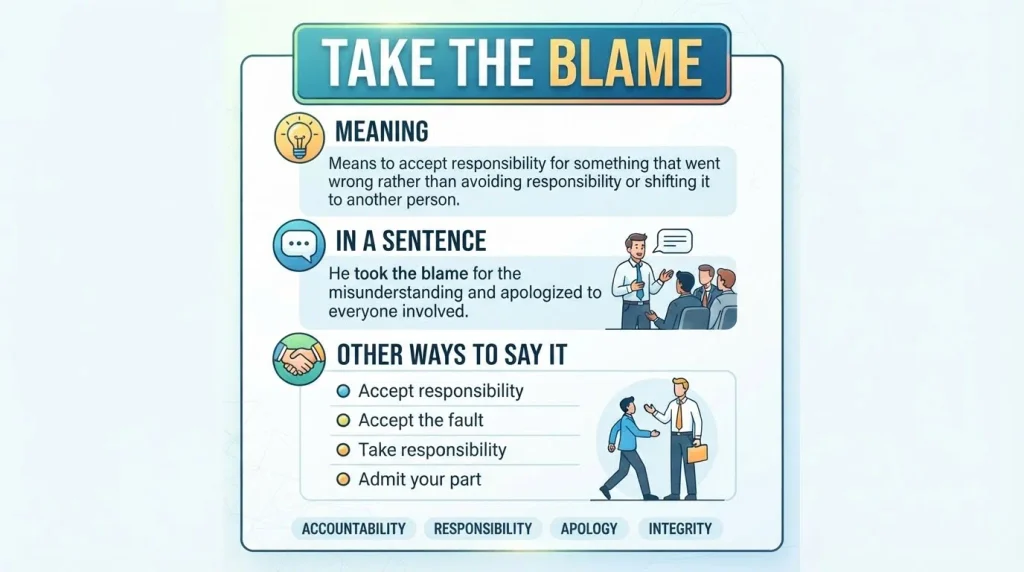
Take the Blame
Meaning
Take the blame means to accept responsibility for something that went wrong rather than avoiding responsibility or shifting it to another person.
In a Sentence
He took the blame for the misunderstanding and apologized to everyone involved.
Other Ways to Say It
- Accept responsibility
- Accept the fault
- Take responsibility
- Admit your part
Explanation
The expression presents blame almost like a physical burden that someone chooses to carry. In an apology, it can communicate accountability and maturity.
However, taking the blame does not always mean accepting all responsibility. Sometimes a person may simply be acknowledging their part in a larger problem.
Best Use
Best for: conversations, workplace situations, serious discussions, and narrative writing.
It works particularly well when several people were involved in a problem.
Fall on Your Sword
Meaning
Fall on your sword means to accept responsibility for a serious mistake, often when doing so may damage your reputation, position, or interests.
In a Sentence
The director fell on his sword after admitting that his decision had caused the project to fail.
Other Ways to Say It
- Accept full responsibility
- Take responsibility for the failure
- Admit serious fault
- Accept the consequences
Explanation
This is a dramatic idiom based on the image of someone deliberately sacrificing themselves on a sword. In modern usage, it usually means accepting blame or responsibility rather than literally sacrificing oneself.
Because of its dramatic tone, it can make an apology or admission sound particularly serious.
Best Use
Best for: journalism, storytelling, essays, dramatic writing, and discussions of serious mistakes.
It can sound too dramatic for a simple everyday apology.
Face the Music
Meaning
Face the music means to accept the unpleasant consequences of something you have done. In an apology, it can describe someone finally acknowledging their mistake and dealing with the consequences.
In a Sentence
After hiding the mistake for several days, he decided to face the music and apologize to his team.
Other Ways to Say It
- Face the consequences
- Accept what comes next
- Answer for your actions
- Deal with the results
Explanation
The expression creates a memorable image of someone standing directly before an unavoidable situation. It does not specifically mean “apologize,” but it fits situations where an apology is part of accepting responsibility.
The idiom is useful when the person must do more than say sorry—they must also deal with what happened.
Best Use
Best for: conversations, storytelling, essays, and informal commentary.
It is common enough for everyday speech.
Take Your Medicine
Meaning
Take your medicine means to accept an unpleasant consequence or difficult experience because it is deserved or unavoidable.
In a Sentence
I knew I had hurt his feelings, so I took my medicine, listened to his concerns, and apologized.
Other Ways to Say It
- Accept the consequences
- Deal with the outcome
- Face what you deserve
- Accept the punishment
Explanation
The expression compares an unpleasant consequence with medicine that must be taken despite its bad taste. In an apology, it can suggest that someone accepts criticism or consequences without complaining.
It is stronger than simply saying sorry because it includes the idea of accepting what follows the mistake.
Best Use
Best for: storytelling, conversations, reflective writing, and informal essays.
The expression is figurative and slightly conversational.
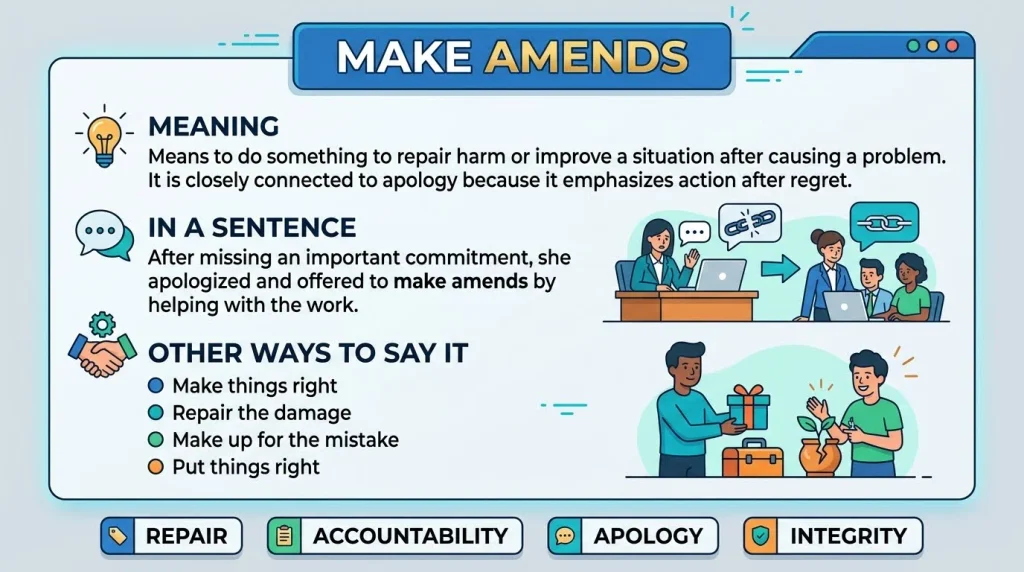
Make Amends
Meaning
Make amends means to do something to repair harm or improve a situation after causing a problem. It is closely connected to apology because it emphasizes action after regret.
In a Sentence
After missing an important commitment, she apologized and offered to make amends by helping with the work.
Other Ways to Say It
- Make things right
- Repair the damage
- Make up for the mistake
- Put things right
Explanation
An apology can acknowledge harm, but making amends suggests going one step further. The image is less about words and more about repairing something that has been damaged.
This makes the expression useful when a sincere apology needs to be supported by meaningful action.
Best Use
Best for: serious apologies, personal relationships, speeches, essays, and professional communication.
It can sound thoughtful and sincere without being overly dramatic.
Make It Up to Someone
Meaning
Make it up to someone means to do something kind or helpful to compensate for disappointing, hurting, or inconveniencing them.
In a Sentence
I’m sorry I missed your birthday dinner; let me make it up to you this weekend.
Other Ways to Say It
- Make up for it
- Compensate for the mistake
- Do something to make things better
- Make things right
Explanation
This expression focuses on repairing the relationship through action. It often follows an apology and suggests that the speaker wants to demonstrate regret rather than merely express it.
It is warmer and more personal than formal phrases about accepting responsibility.
Best Use
Best for: conversations, texts, personal messages, friendships, and family relationships.
It is especially natural when the speaker wants to offer a practical gesture.
Clear the Air
Meaning
Clear the air means to discuss a disagreement, misunderstanding, or uncomfortable issue openly so that tension can be reduced.
In a Sentence
I think we should clear the air and talk honestly about what happened.
Other Ways to Say It
- Talk things through
- Resolve the misunderstanding
- Set the record straight
- Have an honest conversation
Explanation
The image is of stale or cloudy air becoming clear after an honest conversation. It does not necessarily mean that one person is entirely at fault, so it is useful when both sides need to communicate.
An apology may be part of clearing the air, especially after a misunderstanding.
Best Use
Best for: conversations, workplace communication, friendships, storytelling, and personal messages.
It is generally neutral and approachable.
Put Things Right
Meaning
Put things right means to correct a mistake or repair a difficult situation.
In a Sentence
He knew an apology alone was not enough, so he did everything he could to put things right.
Other Ways to Say It
- Make things right
- Correct the problem
- Fix the situation
- Repair the damage
Explanation
The expression treats a problem as something that has been knocked out of place and needs to be restored. It is particularly useful when an apology is followed by practical action.
It can describe both small personal mistakes and more serious situations.
Best Use
Best for: conversations, essays, storytelling, and sincere personal apologies.
It has a calm, responsible tone.
Bury the Hatchet
Meaning
Bury the hatchet means to end a disagreement or conflict and become friendly or peaceful again.
In a Sentence
After years of arguing, the two brothers finally buried the hatchet and apologized to each other.
Other Ways to Say It
- Make peace
- End the conflict
- Reconcile
- Let bygones be bygones
Explanation
The traditional image suggests putting a weapon away so that fighting can stop. The expression is therefore about ending hostility, not simply saying sorry.
It works particularly well when an apology is part of a larger process of reconciliation.
Best Use
Best for: storytelling, speeches, essays, conversations, and descriptions of reconciliation.
It may sound slightly figurative or old-fashioned in very formal writing.
Extend an Olive Branch
Meaning
Extend an olive branch means to make a peaceful gesture toward someone after conflict or disagreement.
In a Sentence
After their argument, Liam extended an olive branch by sending a sincere message of apology.
Other Ways to Say It
- Offer peace
- Reach out
- Make a peace offering
- Take the first step toward reconciliation
Explanation
The olive branch is a long-standing symbol of peace and reconciliation. This idiom is especially useful when the speaker wants to emphasize the gesture of reaching out rather than simply admitting fault.
An olive branch can be an apology, an invitation to talk, or another peaceful gesture.
Best Use
Best for: speeches, essays, storytelling, formal commentary, and thoughtful personal writing.
It can sound more poetic than everyday “I’m sorry.”
Kiss and Make Up
Meaning
Kiss and make up means to stop arguing and become friendly again after a disagreement.
In a Sentence
They argued over something small, but by the evening they had kissed and made up.
Other Ways to Say It
- Make peace
- Reconcile
- Become friends again
- Resolve the argument
Explanation
This expression uses a playful image of reconciliation. It suggests that conflict has ended and the relationship has returned to a friendly state.
The phrase is often lighthearted, so it is best avoided when discussing a deeply serious or painful conflict.
Best Use
Best for: casual conversations, romantic relationships, humorous writing, and light storytelling.
It can sound playful rather than solemn.
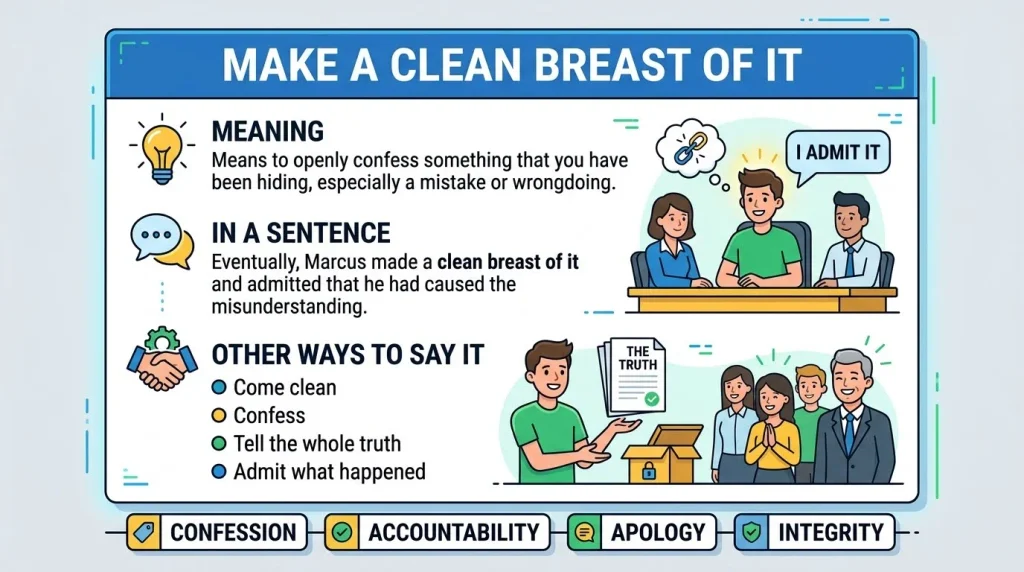
Make a Clean Breast of It
Meaning
Make a clean breast of it means to openly confess something that you have been hiding, especially a mistake or wrongdoing.
In a Sentence
Eventually, Marcus made a clean breast of it and admitted that he had caused the misunderstanding.
Other Ways to Say It
- Come clean
- Confess
- Tell the whole truth
- Admit what happened
Explanation
This idiom emphasizes honest confession. Before someone can offer a meaningful apology, they may first need to tell the truth about what they did.
The phrase is somewhat old-fashioned, but it can add character to historical fiction, storytelling, or literary writing.
Best Use
Best for: storytelling, literature, historical settings, essays, and dramatic writing.
For ordinary conversation, “come clean” is usually more natural.
Mea Culpa
Meaning
Mea culpa is a Latin expression meaning “my fault” or an acknowledgment that one is responsible for a mistake.
In a Sentence
“Mea culpa—I misunderstood your instructions and sent the wrong document.”
Other Ways to Say It
- My fault
- I was wrong
- I take responsibility
- I accept the blame
Explanation
Unlike many English idioms, mea culpa comes directly from Latin and is commonly used in English as a concise admission of fault. It can sound formal, literary, humorous, or slightly self-aware, depending on context.
It is useful when a short admission of responsibility is needed.
Best Use
Best for: journalism, essays, professional commentary, speeches, and witty conversation.
For a heartfelt personal apology, plain language may sound more sincere.
Beg for Forgiveness
Meaning
Beg for forgiveness means to ask someone very strongly to forgive you after you have hurt, disappointed, or offended them.
In a Sentence
Realizing how deeply his words had hurt her, he begged for forgiveness and promised to change his behavior.
Other Ways to Say It
- Ask sincerely for forgiveness
- Plead for another chance
- Ask to be forgiven
- Seek forgiveness
Explanation
This expression creates a picture of deep remorse and emotional urgency. It is much stronger than simply saying “I apologize.”
Because “beg” suggests desperation or intense emotion, the phrase should be used carefully rather than for minor mistakes.
Best Use
Best for: emotional storytelling, dramatic writing, personal reflections, and serious apologies.
In ordinary professional communication, “I sincerely apologize” is usually more appropriate.
Hang Your Head
Meaning
Hang your head means to show shame, embarrassment, sadness, or disappointment by lowering your head.
In a Sentence
After realizing how unfairly he had treated his friend, he hung his head and quietly apologized.
Other Ways to Say It
- Show shame
- Lower your head
- Feel ashamed
- Show remorse
Explanation
This expression focuses on visible emotion rather than the actual act of apologizing. The image of a lowered head communicates embarrassment or regret without requiring the writer to explain every feeling.
It is particularly useful for showing remorse in a story.
Best Use
Best for: creative writing, novels, storytelling, poetry, and emotional descriptions.
It can sound more literary than conversational.
Throw Yourself on Someone’s Mercy
Meaning
Throw yourself on someone’s mercy means to admit that you are in a vulnerable position and ask someone to be compassionate rather than punish you harshly.
In a Sentence
Knowing he had broken the agreement, the employee threw himself on his manager’s mercy and apologized honestly.
Other Ways to Say It
- Ask for mercy
- Plead for understanding
- Ask for compassion
- Appeal for forgiveness
Explanation
The expression creates a dramatic image of someone placing themselves completely in another person’s hands. It communicates vulnerability, dependence, and a strong desire for forgiveness.
Because of its dramatic quality, it is usually more effective in storytelling than in an ordinary apology.
Best Use
Best for: dramatic writing, storytelling, historical fiction, and humorous exaggeration.
Use it carefully because it can sound overly dramatic for a small mistake.
Mend Fences
Meaning
Mend fences means to repair a damaged relationship or restore friendly relations after disagreement or conflict.
In a Sentence
After months of tension, the neighbors decided to mend fences and apologized for the argument.
Other Ways to Say It
- Repair the relationship
- Reconcile
- Restore friendly relations
- Make peace
Explanation
The expression compares a strained relationship with a damaged fence that needs repair. It suggests gradual restoration, rather than a single apology solving everything immediately.
This makes it especially useful when rebuilding trust takes time.
Best Use
Best for: essays, speeches, journalism, storytelling, workplace discussions, and conversations.
It is a familiar expression and works in many contexts.
Exercise: Practice Using Idioms
Test your understanding of these expressions by choosing the best answer for each question.
What does “eat humble pie” mean?
A. Marking a success with a special celebration
B. Acknowledging that you made a mistake
C. Preventing a disagreement from escalating
D. Bringing amusement to another person
Which idiom means accepting responsibility for something that went wrong?
A. Take the blame
B. Kiss and make up
C. Clear the air
D. Bury the hatchet
Someone who “swallows their pride” is usually doing what?
A. Refusing to apologize
B. Becoming more confident
C. Putting aside their ego
D. Starting a disagreement
Which expression focuses on repairing harm through action?
A. Face the music
B. Make amends
C. Hang your head
D. Mea culpa
What does “clear the air” usually involve?
A. Avoiding a difficult subject
B. Ending a friendship
C. Changing the topic
D. Discussing an issue openly
Which expression describes ending a long-running conflict?
A. Bury the hatchet
B. Take your medicine
C. Make a clean breast of it
D. Eat humble pie
If someone “owns up to their mistake,” what are they doing?
A. Denying responsibility
B. Admitting what they did wrong
C. Asking someone else to apologize
D. Avoiding the consequences
Which expression is most associated with making a peaceful gesture after conflict?
A. Face the music
B. Take the blame
C. Extend an olive branch
D. Hang your head
What does “make it up to someone” suggest?
A. Compensating for a mistake with a helpful action
B. Pretending nothing happened
C. Refusing to discuss a problem
D. Accepting punishment without complaint
Which expression is especially dramatic and means accepting serious responsibility?
A. Kiss and make up
B. Fall on your sword
C. Clear the air
D. Mend fences
If someone “makes a clean breast of it,” what do they do?
A. Hide their feelings
B. Change the subject
C. Confess or tell the truth
D. Forgive another person
What does “mea culpa” communicate?
A. It was someone else’s fault
B. I need more information
C. Let’s forget the argument
D. My fault
Which expression means accepting unpleasant consequences?
A. Take your medicine
B. Extend an olive branch
C. Make amends
D. Kiss and make up
Which phrase best describes restoring a damaged relationship over time?
A. Throw yourself on someone’s mercy
B. Mend fences
C. Face the music
D. Hang your head
Which idiom is most playful and suggests that people have stopped arguing and become friendly again?
A. Take the blame
B. Make a clean breast of it
C. Kiss and make up
D. Fall on your sword
Answers
- B — “Eat humble pie” means admitting that you were wrong, often with some embarrassment.
- A — “Take the blame” means accepting responsibility for something that went wrong.
- C — “Swallow your pride” means putting aside your ego so you can do what is necessary, such as apologizing.
- B — “Make amends” means taking action to repair harm or correct a situation.
- D — “Clear the air” means discussing an uncomfortable issue openly to reduce tension or resolve a misunderstanding.
- A — “Bury the hatchet” means ending a conflict and making peace.
- B — “Own up to your mistake” means openly admitting that you did something wrong.
- C — “Extend an olive branch” means making a peaceful gesture toward someone after conflict.
- A — “Make it up to someone” means doing something to compensate for a mistake or hurt.
- B — “Fall on your sword” is a dramatic expression for accepting serious responsibility for a mistake.
- C — “Make a clean breast of it” means confessing or openly revealing the truth.
- D — “Mea culpa” is an admission meaning “my fault.”
- A — “Take your medicine” means accepting an unpleasant consequence or difficult outcome.
- B — “Mend fences” means repairing a damaged relationship or restoring friendly relations.
- C — “Kiss and make up” is a playful expression for ending an argument and becoming friendly again.
FAQs
What is an idiom for apology?
An idiom for apology is a figurative expression that can communicate regret, responsibility, humility, reconciliation, or a desire to repair harm. Examples include “eat humble pie,” “make amends,” and “swallow your pride.” Not every expression literally means “say sorry”; some describe the actions and emotions surrounding an apology.
How do I create my own idiom?
Creating an effective idiom starts with a clear image. Think about the feeling or idea you want to express, such as regret, humility, or reconciliation, and connect it to a memorable object, action, or situation. The comparison should feel natural rather than forced.
What makes an idiom effective?
A strong idiom creates a clear mental image while communicating an idea that would otherwise take more words to explain. It should be understandable from context and should add emotional or descriptive value rather than simply replacing an ordinary word.
Can I use these idioms in everyday conversation?
Yes, although some are more conversational than others. Expressions such as “swallow your pride,” “own up to your mistake,” “make it up to someone,” and “clear the air” can sound natural in everyday speech. More dramatic phrases such as “fall on your sword” may be better suited to storytelling or serious commentary.
What is the difference between an idiom and a simile?
An idiom has a commonly understood figurative meaning that may not be predictable from its individual words. A simile directly compares two things using words such as “like” or “as.” For example, “He swallowed his pride” is an idiomatic expression, while “Her apology was like a bridge over troubled water” is a simile.
Conclusion
The right expression can make an apology feel more thoughtful, vivid, and emotionally precise. The 20 idioms and idiomatic expressions in this guide show different sides of saying sorry—from admitting fault and accepting consequences to repairing relationships and offering peace. Some, such as “own up to your mistake,” work naturally in everyday conversations, while others, such as “fall on your sword” or “throw yourself on someone’s mercy,” create a more dramatic effect.
When choosing an idiom, always consider the relationship, situation, and emotional tone. A good expression should support the message rather than distract from it. Ultimately, the strongest apology is not the fanciest one it is the one that clearly communicates genuine regret, responsibility, and a willingness to make things right.




[…] Read more:20 Idioms for Apology With Real Examples […]