

What makes language memorable for young learners? The right expression can turn an ordinary thought into something vivid and engaging. 20 Idioms for Youth With Real Examples introduces useful phrases that help young people communicate naturally in everyday situations. These expressions can add personality, emotion, and clarity to conversations without making language complicated.
This guide explores idioms connected with youth, confidence, friendship, learning, growth, emotions, and everyday experiences. Each example shows how an idiom works in context, making English usage easier to understand and remember. You will also see how grammar, formal writing, and conversational English can differ in practical situations. Clear examples support better communication while building vocabulary and consistency.
Whether you are improving business communication, preparing meetings, managing a calendar, or learning time management, idiomatic language can strengthen expression. Even topics such as scheduling, online booking, broadcasting, and project management require clear English. This article provides practical examples that make these expressions easier to recognize, understand, and use confidently.
What Is an Idiom?
An idiom is a familiar expression whose overall meaning is different from the literal meaning of its individual words.
For example, if someone says, “I’m feeling under the weather,” they usually mean they feel unwell. They are not literally standing underneath the weather.
Similarly, “break the ice” means to make people feel more comfortable in a new or awkward situation. No actual ice needs to be broken.
Idioms make language more colorful, memorable, and expressive. Instead of describing an idea in a long, plain sentence, an idiom can communicate a familiar feeling through a short mental picture.
Why Use Idioms for Youth?
Youth involves more than simply being young. It can represent energy, curiosity, freedom, learning, risk-taking, ambition, and personal growth. Idioms allow writers and speakers to express these different sides of youth without relying on repetitive descriptions.
For example, saying that a young person is “wet behind the ears” highlights inexperience, while describing someone as “full of beans” emphasizes energy and enthusiasm.
Idioms can help you:
- Express the excitement and energy associated with youth.
- Describe inexperience without sounding overly critical.
- Make stories and creative writing more vivid.
- Explain emotional or personal growth in a memorable way.
- Add personality to conversations and speeches.
- Create stronger imagery in poems, essays, and personal messages.
- Communicate complicated feelings about growing older in simple language.
Quick List of 20 Idioms
- Spring chicken
- Young at heart
- In the prime of life
- Full of beans
- Wet behind the ears
- Green around the gills
- Learn the ropes
- Come of age
- Sow your wild oats
- The world is your oyster
- Kick up your heels
- Cut your teeth
- Have your whole life ahead of you
- A breath of fresh air
- Fresh out of school
- Young and restless
- In the bloom of youth
- A chip off the old block
- Go places
- Spread your wings
Spring chicken
Read more:20 Idioms for Appreciation With Real Examples
Meaning
“Spring chicken” is an informal expression for a young person, usually used in the negative phrase “no spring chicken” to say that someone is no longer young.
The expression can also create a playful contrast between youth and age.
In a Sentence
Although Grandpa jokes that he is no spring chicken, he still joins the teenagers for a game of basketball.
Other Ways to Say It
- Young person
- Young and energetic
- Still youthful
- In the younger generation
Explanation
The image of a young chicken makes the expression playful rather than serious. When used positively or humorously, it can draw attention to youthfulness and energy.
Because it is informal, it fits casual conversations and humorous writing better than formal academic writing.
Best Use
Best for conversations, humorous stories, personal writing, and lighthearted descriptions.
Young at heart
Meaning
To be young at heart means to have a youthful attitude, enthusiasm, or sense of wonder regardless of your actual age.
It focuses on attitude rather than age.
In a Sentence
Even after decades of teaching, Mr. Khan remains young at heart and gets excited whenever he discovers something new.
Other Ways to Say It
- Youthful in spirit
- Full of youthful enthusiasm
- Young in spirit
- Keeping a youthful outlook
Explanation
This expression separates physical age from emotional youth. Someone can be older but still curious, playful, adventurous, and optimistic.
It is especially useful when you want to describe the lasting spirit of youth rather than simply someone’s age.
Best Use
Works well in personal messages, speeches, essays, conversations, and inspirational writing.
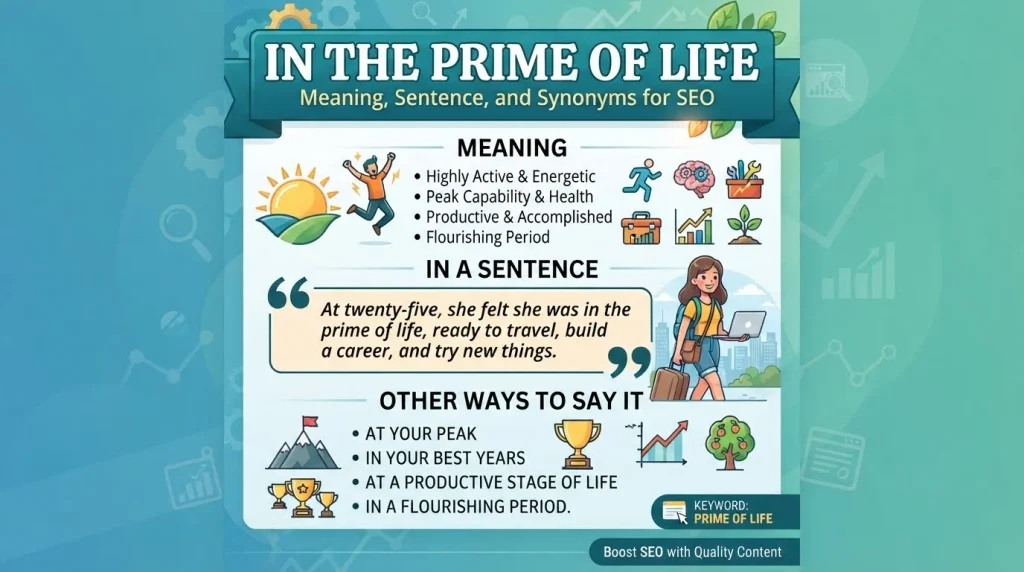
In the prime of life
Meaning
Being in the prime of life means being at a period when a person is especially active, capable, healthy, or productive.
The exact age associated with the phrase can vary depending on context.
In a Sentence
At twenty-five, she felt she was in the prime of life, ready to travel, build a career, and try new things.
Other Ways to Say It
- At your peak
- In your best years
- At a productive stage of life
- In a flourishing period
Explanation
This phrase presents youth or young adulthood as a period of strength, opportunity, and possibility. It does not necessarily mean someone is a teenager; it often refers more broadly to an active stage of life.
Its tone is more reflective than playful.
Best Use
Best suited to essays, speeches, reflective writing, biographies, and serious conversations.
Full of beans
Meaning
If someone is full of beans, they have a lot of energy, enthusiasm, or excitement.
It is often used to describe energetic children and young people.
In a Sentence
The students were full of beans after the final exam and immediately started planning their weekend trip.
Other Ways to Say It
- Full of energy
- Bursting with enthusiasm
- Energetic and lively
- Ready for action
Explanation
The expression creates a funny image of someone filled with so much energy that they cannot sit still. It captures the lively side of youth particularly well.
It is informal and cheerful, so it should not be used in highly formal writing.
Best Use
Great for conversation, storytelling, children’s writing, social posts, and playful descriptions.
Wet behind the ears
Meaning
Someone who is wet behind the ears is inexperienced or still new to something.
The expression often describes a young person who has not yet gained much practical experience.
In a Sentence
He was still wet behind the ears when he started his first job, but he quickly learned from his mistakes.
Other Ways to Say It
- Inexperienced
- New to the field
- Still learning
- Lacking experience
Explanation
The expression creates a memorable image of someone who is not yet fully seasoned by experience. It does not necessarily mean the person is unintelligent; it simply suggests that they have more to learn.
It can sound teasing, so consider the relationship between the speaker and listener.
Best Use
Useful in conversations, stories, workplace anecdotes, and informal writing.
Green around the gills
Meaning
“Green” can describe someone who is inexperienced or unfamiliar with a particular situation. In this expression, it suggests a lack of experience rather than physical youth itself.
In a Sentence
The young volunteers were a little green at first, but after a few weeks they handled the event confidently.
Other Ways to Say It
- New and inexperienced
- Still learning
- Not yet seasoned
- Unfamiliar with the work
Explanation
The expression can suggest that someone is new to an experience and still finding their feet. When applied to youth, it can highlight the learning stage rather than treating youth as a weakness.
Use it carefully because “green around the gills” can also be associated with looking or feeling sick, depending on context.
Best Use
Best for informal storytelling, conversations, and descriptions of beginners. For formal writing, “inexperienced” is usually clearer.
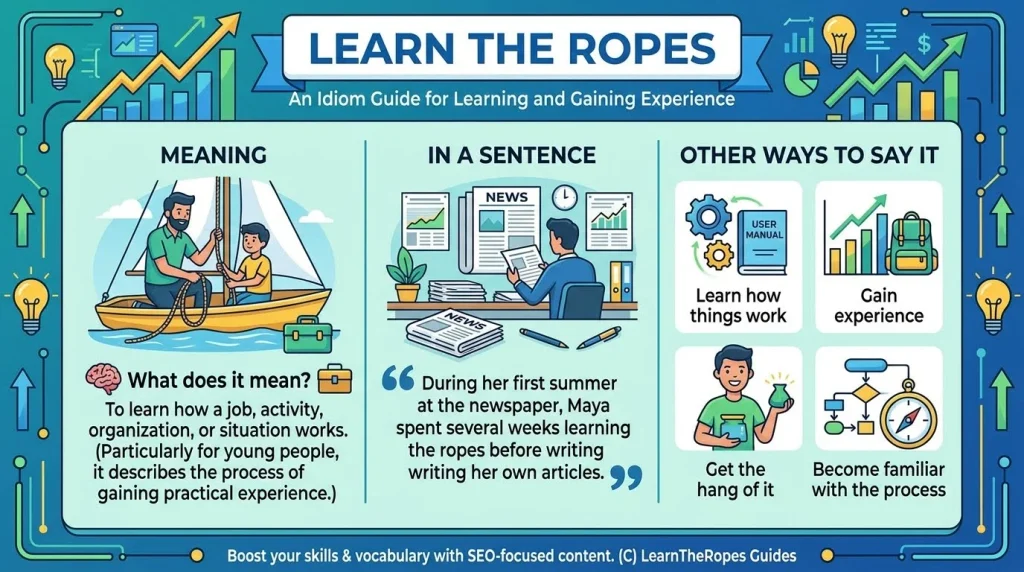
Learn the ropes
Meaning
To learn the ropes means to learn how a job, activity, organization, or situation works.
For young people, it often describes the process of gaining practical experience.
In a Sentence
During her first summer at the newspaper, Maya spent several weeks learning the ropes before writing her own articles.
Other Ways to Say It
- Learn how things work
- Gain experience
- Get the hang of it
- Become familiar with the process
Explanation
The expression comes from the idea of learning how to handle ropes and equipment, particularly in sailing. Today, it represents learning through experience.
It is useful when youth is being presented as a period of discovery and development.
Best Use
Works naturally in workplace conversations, stories, educational writing, and advice.
Come of age
Meaning
To come of age means to reach the stage of becoming an adult or to develop the maturity expected of an adult.
It can describe both a person’s development and a broader cultural or historical period.
In a Sentence
The novel follows a teenager as he comes of age and begins making difficult decisions for himself.
Other Ways to Say It
- Reach adulthood
- Grow into adulthood
- Become mature
- Enter adult life
Explanation
This expression captures youth as a transition rather than a fixed age. It suggests growing responsibilities, changing beliefs, and increasing independence.
It is more thoughtful and serious than playful expressions about youth.
Best Use
Especially effective in literature, essays, films, biographies, speeches, and storytelling.
Sow your wild oats
Meaning
To sow your wild oats means to behave in an adventurous, carefree, or sometimes rebellious way when young, often before settling into a more responsible lifestyle.
In a Sentence
He spent his twenties traveling from country to country, happily sowing his wild oats before settling down.
Other Ways to Say It
- Live a carefree life
- Have youthful adventures
- Enjoy your freedom
- Explore before settling down
Explanation
The expression uses farming imagery to represent a period of youthful experimentation and freedom. It can be playful, but it may also suggest behavior that is reckless or irresponsible.
Because of that nuance, it should be chosen with care.
Best Use
Good for personal stories, novels, biographies, humorous conversations, and reflective writing.
The world is your oyster
Meaning
“The world is your oyster” means that you have many opportunities available to you and can potentially achieve what you want.
It is particularly fitting when talking about young people beginning adult life.
In a Sentence
With her education, curiosity, and determination, the world is her oyster.
Other Ways to Say It
- Many opportunities are open to you
- You have a bright future
- Anything is possible
- The possibilities are endless
Explanation
The expression comes from Shakespeare and has developed into a common way of expressing possibility and opportunity. For youth, it suggests that the future has not yet been fully written.
Its tone is generally optimistic and encouraging.
Best Use
Excellent for graduation speeches, motivational writing, personal messages, essays, and conversations about the future.
Kick up your heels
Meaning
To kick up your heels means to relax, celebrate, have fun, or enjoy yourself freely.
It can describe the carefree side of youth.
In a Sentence
After months of studying, the graduates decided to kick up their heels and celebrate together.
Other Ways to Say It
- Have some fun
- Let loose
- Celebrate
- Enjoy yourself
Explanation
The phrase creates a lively picture of someone kicking their heels in excitement. It communicates joy, freedom, and celebration rather than youth itself.
It works particularly well when describing young people enjoying an important milestone.
Best Use
Best for casual conversations, celebrations, stories, social posts, and lighthearted writing.

Cut your teeth
Meaning
To cut your teeth on something means to gain your first important experience by working on or learning through it.
For young people, it can describe an early stage of education, work, art, sport, or another pursuit.
In a Sentence
The young filmmaker cut his teeth making short videos before directing his first feature.
Other Ways to Say It
- Gain early experience
- Get your first experience
- Start learning professionally
- Build your skills
Explanation
The expression compares professional or personal development to a baby getting its first teeth. It emphasizes early learning and experience.
Unlike “wet behind the ears,” it often carries a positive sense of progress.
Best Use
Useful in career writing, biographies, interviews, creative discussions, and professional conversations.
Have your whole life ahead of you
Meaning
If someone has their whole life ahead of them, they are young and have many years and possibilities still available.
The phrase often expresses hope, encouragement, or reflection.
In a Sentence
At eighteen, he had his whole life ahead of him and plenty of time to discover what truly mattered to him.
Other Ways to Say It
- Have a long future ahead
- Have many years ahead
- Have countless possibilities
- Be at the beginning of life
Explanation
This expression focuses on future possibility rather than present achievement. It can sound inspirational when encouraging a young person, but it can also feel emotional when discussing someone who has recently faced disappointment.
Context strongly affects its tone.
Best Use
Especially suitable for speeches, personal messages, essays, stories, and inspirational writing.
A breath of fresh air
Meaning
A breath of fresh air describes someone or something pleasantly new, refreshing, or different from what came before.
It can describe a young person whose ideas or energy bring a new perspective.
In a Sentence
The new student was a breath of fresh air, bringing creative ideas and genuine enthusiasm to the club.
Other Ways to Say It
- Refreshing presence
- Welcome change
- New perspective
- Fresh energy
Explanation
The expression compares a refreshing person or idea to clean air after being in a stuffy place. When connected with youth, it can highlight new thinking, enthusiasm, and creativity.
It does not mean “young” literally, so use it when the person’s freshness or perspective is the main point.
Best Use
Works well in professional writing, school contexts, conversations, reviews, essays, and storytelling.
Fresh out of school
Meaning
Someone who is fresh out of school has recently finished school or college and has little professional experience.
It is an informal expression often associated with young adults beginning their careers.
In a Sentence
Fresh out of school, Daniel was eager to prove himself in his first full-time job.
Other Ways to Say It
- Recently graduated
- A new graduate
- Just finished school
- New to the working world
Explanation
The word “fresh” suggests newness and a lack of experience. The expression can carry an optimistic tone when emphasizing enthusiasm, although it may also imply that someone still has much to learn.
It is clearer and more neutral than some playful idioms about inexperience.
Best Use
Useful in career conversations, biographies, workplace stories, interviews, and informal writing.
Young and restless
Meaning
“Young and restless” describes young people who are energetic, ambitious, dissatisfied with routine, or eager for change and excitement.
In a Sentence
Young and restless, the group refused to spend their summer sitting at home and planned a road trip instead.
Other Ways to Say It
- Restless and ambitious
- Eager for adventure
- Full of youthful energy
- Ready for change
Explanation
This expression combines two qualities often associated with youth: energy and impatience with limits. It can be positive when describing ambition, but it may also suggest impulsiveness or dissatisfaction.
It has a somewhat dramatic or literary feel.
Best Use
Good for creative writing, storytelling, personal essays, and descriptions of adventurous young people.
In the bloom of youth
Meaning
To be in the bloom of youth means to be in a youthful and flourishing stage of life.
It is a poetic expression rather than an everyday conversational phrase.
In a Sentence
The poet describes his characters in the bloom of youth, filled with hope before life’s difficulties begin to shape them.
Other Ways to Say It
- In youthful years
- In the freshness of youth
- In early adulthood
- At a youthful stage of life
Explanation
The word “bloom” compares youth to a flower at its most vibrant stage. It emphasizes freshness, beauty, vitality, and the sense that life is opening up.
Because of its poetic quality, it can sound too formal or literary for ordinary conversation.
Best Use
Best for poetry, literature, creative writing, speeches, and reflective essays.
A chip off the old block
Meaning
A chip off the old block describes a person who is noticeably similar to one of their parents in personality, behavior, appearance, or abilities.
It can be especially useful when describing a young person following a parent’s example.
In a Sentence
At sixteen, Amir was already a chip off the old block, repairing bicycles just like his father.
Other Ways to Say It
- Just like their parent
- Takes after a parent
- Follows the family tradition
- Shares a parent’s qualities
Explanation
The expression imagines a person as a small piece cut from the same block of wood as their parent. It creates a strong image of family resemblance or inherited traits.
It does not specifically mean youth, so it works best when family influence is part of the description.
Best Use
Useful in family stories, conversations, biographies, profiles, and humorous writing.
Go places
Meaning
If someone is told they will go places, it means they are expected to succeed or achieve important things in the future.
The expression is often used for talented or ambitious young people.
In a Sentence
Her coach believes she will go places if she continues working with the same discipline and confidence.
Other Ways to Say It
- Have a promising future
- Achieve great things
- Succeed in life
- Reach your potential
Explanation
The phrase turns success into a journey toward worthwhile destinations. It communicates potential, ambition, and hope for the future without predicting exactly what success will look like.
It is encouraging without being overly dramatic.
Best Use
Excellent for school writing, recommendations, conversations, speeches, coaching, and personal encouragement.
Spread your wings
Meaning
To spread your wings means to become more independent, explore new opportunities, and develop your abilities.
It is particularly appropriate for young people moving into a new stage of life.
In a Sentence
Moving away for university gave her the confidence to spread her wings and make decisions for herself.
Other Ways to Say It
- Become independent
- Explore new possibilities
- Step into the world
- Grow beyond your comfort zone
Explanation
The expression compares personal growth to a bird opening its wings and preparing to fly. It captures the freedom, courage, and uncertainty that can accompany growing up.
It is usually warm and encouraging, making it one of the most flexible expressions on this list.
Best Use
Ideal for graduation messages, speeches, personal letters, essays, storytelling, and conversations about independence.
Exercise: Practice Using Idioms
Test your understanding of the expressions above. Choose the best answer for each question.
What does “young at heart” mean?
A. Being physically younger than others
B. Having a youthful attitude or spirit
C. Being inexperienced at work
D. Being interested only in childhood
Which expression describes someone who has little experience?
A. The world is your oyster
B. Kick up your heels
C. Wet behind the ears
D. Spread your wings
Which idiom suggests that someone has many opportunities ahead?
A. The world is your oyster
B. Green around the gills
C. Cut your teeth
D. A chip off the old block
What does “full of beans” usually describe?
A. A person who cannot understand what is happening
B. An individual full of energy and enthusiasm
C. A person with extensive practical knowledge
D. Someone who is unwell or in poor health
Which expression means to gain early experience in an activity or profession?
A. Go places
B. Come of age
C. Cut your teeth
D. Sow your wild oats
Which phrase is especially associated with becoming an adult?
A. Come of age
B. A breath of fresh air
C. Kick up your heels
D. Full of beans
Someone who is “fresh out of school” has usually:
A. Returned to school after many years
B. Recently finished school or college
C. Started teaching children
D. Left school because of poor grades
Which expression means to enjoy yourself and celebrate?
A. Learn the ropes
B. Cut your teeth
C. Kick up your heels
D. Come of age
What does “sow your wild oats” suggest?
A. Spending a period of youthful adventure or experimentation
B. Learning a new practical skill
C. Becoming similar to a parent
D. Starting a formal education
Which expression emphasizes future potential and success?
A. Green around the gills
B. Go places
C. Wet behind the ears
D. Fresh out of school
What does “spread your wings” suggest?
A. Becoming more independent and exploring opportunities
B. Becoming physically stronger
C. Avoiding all new experiences
D. Copying a parent’s behavior
Which expression is most poetic and literary?
A. Full of beans
B. Fresh out of school
C. In the bloom of youth
D. Learn the ropes
A young employee who is “learning the ropes” is:
A. Preparing to leave the company
B. Learning how things work
C. Refusing to accept advice
D. Celebrating a promotion
What does “a chip off the old block” mean?
A. A young person who lives independently
B. Someone who is similar to a parent
C. A person who has many career options
D. Someone who is new to a workplace
Which sentence uses “the world is your oyster” correctly?
A. The world is your oyster because you forgot your homework.
B. She was the world is your oyster after losing her keys.
C. After graduation, he felt the world was his oyster.
D. They put the world in an oyster before dinner.
Answers
1. B — “Young at heart” refers to a youthful attitude, enthusiasm, or outlook rather than physical age.
2. C — “Wet behind the ears” describes someone who is inexperienced or new to something.
3. A — “The world is your oyster” expresses the idea that many opportunities are available.
4. B — “Full of beans” means full of energy, enthusiasm, or excitement.
5. C — “Cut your teeth” means to gain early experience while learning or developing a skill.
6. A — “Come of age” refers to reaching adulthood or developing adult maturity.
7. B — Someone fresh out of school has recently completed school or college and is often new to professional life.
8. C — “Kick up your heels” means to relax, celebrate, or have fun.
9. A — “Sow your wild oats” refers to a period of youthful freedom, adventure, or experimentation.
10. B — “Go places” suggests that someone has strong potential for future achievement.
11. A — “Spread your wings” means becoming more independent and exploring new possibilities.
12. C — “In the bloom of youth” is the most poetic expression among the choices.
13. B — “Learn the ropes” means learning how a particular job, activity, or situation works.
14. B — “A chip off the old block” describes someone who resembles a parent in qualities or behavior.
15. C — The sentence correctly uses “the world is your oyster” to express the many possibilities available after graduation.
FAQs
What is an idiom for youth?
An idiom for youth is an expression that can describe being young, growing up, gaining experience, enjoying freedom, or having future potential. Examples include “young at heart,” “come of age,” and “spread your wings.”
How do I create my own idioms?
Start with an idea you want to express, such as youthful energy or growing independence. Then connect that idea to a clear, memorable image. A strong figurative expression should suggest a meaning rather than simply replace one ordinary word with another.
What makes an idiom effective?
An effective idiom creates a recognizable mental picture and communicates an idea efficiently. It should fit the context and carry the right emotional tone. An expression that sounds natural in a conversation may not work equally well in a formal essay.
Can I use these idioms in everyday conversation?
Yes. Expressions such as “full of beans,” “wet behind the ears,” “learn the ropes,” “go places,” and “spread your wings” can sound natural in everyday speech. More poetic expressions, such as “in the bloom of youth,” are usually better suited to creative or reflective writing.
What is the difference between an idiom and a simile?
An idiom has a commonly understood figurative meaning, such as “learn the ropes,” which means learning how something works. A simile directly compares two things using words such as “like” or “as,” such as “young like a spring morning.” Idioms are established expressions, while similes can be created freely.
Conclusion
Youth can be described in many ways: energetic, uncertain, adventurous, inexperienced, hopeful, independent, or full of possibility. The right idiom allows you to capture one of these qualities with imagery and personality instead of relying on plain description. Expressions such as “full of beans” highlight energy, while “wet behind the ears” points to inexperience. Others, including “spread your wings” and “the world is your oyster,” focus on independence and opportunity.
The best expression depends on the feeling you want to communicate. A playful idiom can brighten a conversation, while a poetic one can add depth to a story or essay. Choose language that fits both your subject and your audience. When used thoughtfully, idioms can turn a simple description of youth into something vivid, memorable, and emotionally meaningful.

Eleanor Prose is a writer and English teacher with a soft spot for the phrases that trip us up. She has spent years helping students and professionals use idioms with confidence not just memorizing them, but understanding the culture and humor behind each one.
Through Idiom Looms, Eleanor explores the threads that connect language, history, and everyday conversation. Her goal is simple: to make English idioms clear, memorable, and actually fun to use.
She writes from a quiet desk surrounded by notebooks, and firmly believes there’s an idiom for every situation usually more than one.



[…] Read more:20 Idioms for Youth With Real Examples […]