
Sometimes, simply calling someone dumb does not fully express what you mean. English has many colorful idioms that can describe foolishness, poor judgment, confusion, or a lack of common sense without stating the idea in a plain, direct way. These expressions use figurative language to create memorable images, making conversations and writing more lively. Instead of saying someone is unintelligent, for example, you might say they are “not the sharpest tool in the shed.” The meaning is clear, but the image adds personality and often softens the statement with humor. In this article, you will learn 20 idioms that can describe dumb or foolish behavior, along with their meanings, examples, alternatives, and appropriate uses. You will also learn how context can change whether an expression sounds playful, rude, humorous, or serious.
What Is an Idiom?
An idiom is a phrase whose meaning cannot always be understood by taking each word literally. The words work together to communicate a familiar figurative idea.
For example, if someone says, “It’s raining cats and dogs,” they do not mean animals are falling from the sky. They mean it is raining very heavily.
Similarly, saying someone is “not the sharpest tool in the shed” does not mean the person is an actual tool. It is a humorous way of suggesting that the person is not very intelligent or perceptive.
Idioms make language more colorful because they communicate an idea through imagery, comparison, and shared cultural understanding.
Why Use Idioms for Dumb?
Idioms can make the idea of being dumb, foolish, or lacking good judgment easier to express in a memorable way. Rather than using the same direct word repeatedly, a speaker can choose an expression that matches the situation.
They can help you:
- Express criticism indirectly without using a blunt label.
- Add humor to a conversation about someone’s poor decision.
- Make a character’s dialogue sound more natural.
- Describe foolish behavior without repeating the word “dumb.”
- Add personality to storytelling and creative writing.
- Explain poor judgment through a memorable image.
- Show whether the speaker is being playful, sarcastic, annoyed, or serious.
Context matters, though. Some of these expressions are lighthearted, while others can sound insulting. The best choice depends on your relationship with the person and the situation.
Quick List of 20 Idioms
- Not the sharpest tool in the shed
- Not the brightest bulb in the box
- A few cards short of a full deck
- A few fries short of a Happy Meal
- One sandwich short of a picnic
- A few bricks short of a load
- The lights are on, but nobody’s home
- Thick as two short planks
- Not playing with a full deck
- Missing a few screws
- Off one’s rocker
- Out to lunch
- As thick as a brick
- Not firing on all cylinders
- A sandwich short of a picnic
- A couple of kangaroos loose in the top paddock
- The elevator doesn’t go all the way to the top
- Not the brightest crayon in the box
- One card short of a full deck
- A few peas short of a casserole
Not the Sharpest Tool in the Shed
Read more:20 Idioms for Daily Use With Real Examples
Meaning
This idiom describes someone who is not especially intelligent, clever, or quick-thinking. The image compares a person to a tool that is dull rather than sharp.
It is usually humorous rather than brutally direct, although it can still be insulting depending on the context.
In a Sentence
“He’s a nice guy, but he’s not the sharpest tool in the shed when it comes to technology.”
Other Ways to Say It
- Not very bright
- A little slow on the uptake
- Not the quickest thinker
- Lacking common sense
Explanation
A sharp tool is useful and effective, while a dull one is less capable of doing its job. That simple image makes the expression easy to understand.
It works especially well when describing ordinary foolishness rather than serious intellectual limitations.
Best Use
This expression fits casual conversations, humorous storytelling, and character dialogue. Avoid using it in formal or sensitive situations because it can still sound disrespectful.
Not the Brightest Bulb in the Box
Meaning
This idiom means someone is not particularly intelligent or perceptive. It uses a light bulb as an image for mental brightness.
In a Sentence
“You probably shouldn’t ask Mark to solve the puzzle—he’s not the brightest bulb in the box.”
Other Ways to Say It
- Not the brightest person
- A little slow
- Not especially clever
- Not quick on the uptake
Explanation
The comparison between brightness and intelligence is easy to visualize. A bright bulb suggests a sharp mind, while a dimmer bulb suggests weaker understanding.
The phrase usually carries a teasing or sarcastic tone rather than sounding completely serious.
Best Use
Use it in informal conversations, comedy, and playful descriptions. It is less appropriate when discussing someone’s abilities respectfully in a professional setting.
A Few Cards Short of a Full Deck
Meaning
This expression suggests that someone is missing something mentally or does not seem to be thinking normally. It can imply foolishness, eccentricity, or strange behavior.
In a Sentence
“After hearing his plan, I wondered if he was a few cards short of a full deck.”
Other Ways to Say It
- Not quite all there
- A little off
- Missing a few pieces
- Not thinking clearly
Explanation
A complete deck of playing cards has all the pieces needed for the game. Having several cards missing creates an amusing picture of something being incomplete.
Because it can imply more than simple stupidity, the expression may describe odd or irrational behavior as well.
Best Use
It works well in casual speech, humorous writing, and storytelling. Use caution because it can sound insulting when directed at a real person.
A Few Fries Short of a Happy Meal
Meaning
This playful expression means someone seems a little foolish, confused, or mentally incomplete.
In a Sentence
“Anyone who thinks that plan will work is a few fries short of a Happy Meal.”
Other Ways to Say It
- A little mixed up
- Not quite right
- Short on common sense
- A bit clueless
Explanation
The phrase creates a deliberately silly image: a familiar meal is missing some fries. That missing piece becomes a humorous metaphor for something being incomplete.
It is strongly informal and playful, so it is better suited to jokes than serious descriptions.
Best Use
Use it in humorous conversations, social posts, comedy, and informal storytelling.
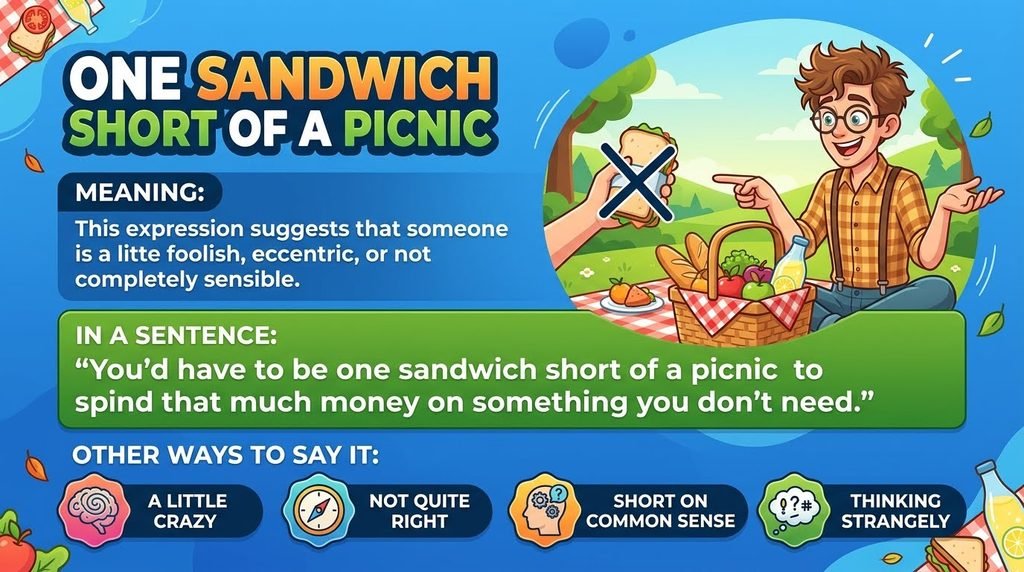
One Sandwich Short of a Picnic
Meaning
This expression suggests that someone is a little foolish, eccentric, or not completely sensible.
In a Sentence
“You’d have to be one sandwich short of a picnic to spend that much money on something you don’t need.”
Other Ways to Say It
- A little crazy
- Not quite right
- Short on common sense
- Thinking strangely
Explanation
A picnic normally includes several things, so imagining one missing sandwich creates a funny sense of incompleteness.
The expression is more playful than direct insults such as “dumb,” making it useful when humor is part of the message.
Best Use
It fits casual conversations, humorous stories, and playful criticism.
A Few Bricks Short of a Load
Meaning
This idiom describes someone as not quite intelligent or sensible, often in a humorous way.
In a Sentence
“He must be a few bricks short of a load if he thinks driving without fuel will get him anywhere.”
Other Ways to Say It
- Not very bright
- Missing some common sense
- A little slow
- Not thinking straight
Explanation
The mental image is of a truck or load that is incomplete because several bricks are missing. The missing bricks represent something missing in a person’s thinking.
It is colorful and memorable, but its tone is clearly teasing or insulting.
Best Use
Use it in informal speech, comedy, and fictional dialogue, rather than professional communication.
The Lights Are On, but Nobody’s Home
Meaning
This idiom suggests that someone is physically present but not thinking, responding, or paying attention.
In a Sentence
“I asked him three times whether he had finished the assignment, but the lights were on and nobody was home.”
Other Ways to Say It
- Not paying attention
- Completely distracted
- Not thinking
- Zoned out
Explanation
The phrase creates a vivid picture of a house that appears occupied because its lights are on, yet nobody answers the door.
It does not necessarily mean someone is unintelligent. It can describe a temporary moment of confusion, distraction, or mental absence.
Best Use
It works naturally in casual conversation, storytelling, and humorous descriptions.
Thick as Two Short Planks
Meaning
This British expression means someone is very foolish or not very intelligent.
In a Sentence
“He’s as thick as two short planks if he really believes that obvious scam.”
Other Ways to Say It
- Very foolish
- Not very bright
- Lacking sense
- Slow to understand
Explanation
The phrase uses “thick” in an older sense connected with being mentally dull. The comparison with two pieces of wood makes the insult more colorful.
It has a distinctly informal and often British flavor, so it may sound unusual in some varieties of English.
Best Use
It is best for British-style dialogue, humorous writing, and informal conversations.
Not Playing with a Full Deck
Meaning
This expression means someone is not thinking normally or may be behaving irrationally. It can also suggest foolishness.
In a Sentence
“Anyone who ignores that warning isn’t playing with a full deck.”
Other Ways to Say It
- Not thinking straight
- Not quite right
- Acting irrationally
- A little off
Explanation
The phrase compares someone’s mental state to a card game. If a player lacks a full deck, the game cannot proceed normally.
It can be humorous, but it may also carry a strongly judgmental tone, particularly when used to describe someone’s mental state.
Best Use
Use it mainly in informal speech and fictional dialogue, and avoid it when discussing real mental-health concerns.
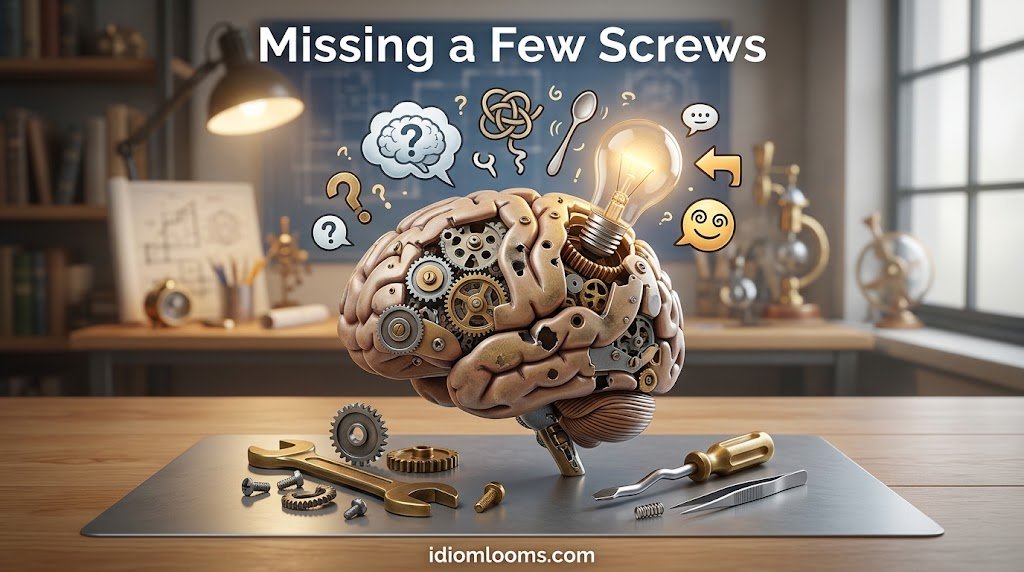
Missing a Few Screws
Meaning
This informal expression suggests that someone is acting foolishly, strangely, or irrationally.
In a Sentence
“You’d have to be missing a few screws to climb that tower without any safety equipment.”
Other Ways to Say It
- A little crazy
- Not thinking clearly
- Acting foolishly
- A bit off
Explanation
The expression imagines a machine that cannot work properly because some of its screws are missing. Applied to a person, it suggests their thinking is somehow incomplete or faulty.
It is usually playful or critical, depending on how it is delivered.
Best Use
It suits informal conversation, comedy, and exaggerated storytelling.
Off One’s Rocker
Meaning
“Off one’s rocker” traditionally means crazy, irrational, or behaving strangely. It can sometimes be used loosely for foolish behavior.
In a Sentence
“You’d have to be off your rocker to leave your wallet on the roof of your car.”
Other Ways to Say It
- Acting crazy
- Not thinking straight
- Out of one’s mind
- Behaving strangely
Explanation
The “rocker” refers to the curved supports beneath a rocking chair. The idiom creates an image of someone who has somehow moved away from a stable position.
It is more about irrational or eccentric behavior than low intelligence.
Best Use
It works best in casual speech, humorous writing, and exaggerated descriptions.
Out to Lunch
Meaning
When used figuratively, “out to lunch” can mean someone is confused, distracted, unaware, or behaving foolishly.
In a Sentence
“He was completely out to lunch during the meeting and missed the most important point.”
Other Ways to Say It
- Not paying attention
- Zoned out
- Distracted
- Not thinking clearly
Explanation
The literal phrase refers to being away for a meal, but its figurative meaning describes someone whose attention seems to be somewhere else.
It is useful because it can criticize someone’s behavior without directly calling them dumb.
Best Use
Use it in casual conversation, workplace dialogue, and humorous descriptions, provided the tone is appropriate.
As Thick as a Brick
Meaning
This expression is used to describe someone as very unintelligent or slow to understand something.
In a Sentence
“He can be as thick as a brick when it comes to reading social cues.”
Other Ways to Say It
- Very slow to understand
- Not very bright
- Dense
- Lacking understanding
Explanation
A brick is solid, heavy, and not flexible, which creates a humorous comparison with someone who seems unable to grasp an idea.
It is a blunt and insulting expression, so it should be used carefully.
Best Use
It is most suitable for informal dialogue, satire, and humorous storytelling.
Not Firing on All Cylinders
Meaning
This idiom means someone is not performing or thinking at their normal level. It can describe temporary tiredness, confusion, or poor concentration rather than permanent lack of intelligence.
In a Sentence
“I didn’t sleep last night, so I’m not firing on all cylinders today.”
Other Ways to Say It
- Not at my best
- Running low on energy
- Not thinking clearly
- A little foggy
Explanation
The expression comes from the image of an engine whose cylinders are not all working properly. The machine still runs, but it lacks full power.
That makes this a useful choice when someone is temporarily struggling mentally, rather than simply being called dumb.
Best Use
It works well in everyday conversations, workplace settings, personal messages, and informal writing.
A Sandwich Short of a Picnic
Meaning
This expression is a playful way to suggest that someone is not completely sensible or is behaving foolishly.
In a Sentence
“If he thinks we can finish all that work in ten minutes, he’s a sandwich short of a picnic.”
Other Ways to Say It
- Not being realistic
- A little foolish
- Short on common sense
- Thinking strangely
Explanation
The image is intentionally absurd: a picnic is prepared, but one important item is missing. That missing sandwich represents a missing piece of sensible thinking.
It is lighthearted, though it can still be perceived as an insult.
Best Use
Use it for humorous conversations, character dialogue, and playful storytelling.
A Couple of Kangaroos Loose in the Top Paddock
Meaning
This colorful Australian expression means someone is behaving strangely, irrationally, or foolishly.
In a Sentence
“You’d need a couple of kangaroos loose in the top paddock to think that was a sensible investment.”
Other Ways to Say It
- A little crazy
- Not thinking clearly
- Acting strangely
- Not quite right
Explanation
The expression uses an intentionally absurd rural image. Instead of describing a person’s mind directly, it imagines kangaroos running loose in a paddock.
Because of its regional flavor, it can add Australian character and humor to dialogue.
Best Use
It is particularly effective in Australian-flavored writing, comedy, storytelling, and informal dialogue.
The Elevator Doesn’t Go All the Way to the Top
Meaning
This humorous idiom suggests that someone is not very intelligent, sensible, or mentally sharp.
In a Sentence
“If he thinks the computer will work without being plugged in, the elevator doesn’t go all the way to the top.”
Other Ways to Say It
- Not very bright
- Missing some sense
- Not thinking clearly
- A little slow
Explanation
The image is of an elevator that stops before reaching the highest floor. Figuratively, it suggests someone’s thinking does not quite reach the expected level.
The phrase is playful and metaphorical, although it can still sound insulting.
Best Use
It works best in casual humor, storytelling, and fictional dialogue.
Not the Brightest Crayon in the Box
Meaning
This playful expression means someone is not especially intelligent or quick-thinking.
In a Sentence
“I like Jake, but he’s not the brightest crayon in the box when it comes to directions.”
Other Ways to Say It
- Not the quickest thinker
- A little slow
- Not very bright
- Easily confused
Explanation
The phrase extends the familiar idea that brightness represents intelligence. A box full of colorful crayons becomes a playful way to rank someone’s mental sharpness.
It sounds lighter and more humorous than a direct insult.
Best Use
Use it in casual conversations, social content, children’s-style humor, and light storytelling.
One Card Short of a Full Deck
Meaning
This expression describes someone as missing something mentally, often suggesting foolishness, odd thinking, or eccentric behavior.
In a Sentence
“After hearing his explanation, they wondered if he was one card short of a full deck.”
Other Ways to Say It
- Not quite all there
- A little eccentric
- Not thinking straight
- Missing something
Explanation
A card deck is supposed to contain a complete set. Removing one card makes it incomplete, which becomes a metaphor for someone’s thinking.
The expression can be humorous, but it may sound dismissive or insulting.
Best Use
It fits informal conversations, comic writing, and fictional dialogue.
A Few Peas Short of a Casserole
Meaning
This humorous expression suggests someone is a little foolish, confused, or incomplete in their thinking.
In a Sentence
“You’d be a few peas short of a casserole to believe that every problem can be solved with one quick trick.”
Other Ways to Say It
- A little clueless
- Not quite right
- Short on common sense
- Thinking poorly
Explanation
The expression creates a deliberately silly food image. A casserole that is missing several peas becomes a metaphor for something that is not quite complete.
It is more playful than harsh, making it useful when humor matters more than precision.
Best Use
It works particularly well in creative writing, comedy, playful social posts, and humorous dialogue.
Exercise: Practice Using Idioms
Choose the best answer for each question.
Which idiom describes someone who is not especially intelligent?
A. Out to lunch
B. Not the sharpest tool in the shed
C. Firing on all cylinders
D. Full of beans
What does “the lights are on, but nobody’s home” usually suggest?
A. A person has gone outside
B. An individual is resting peacefully
C. A listener is physically present but mentally distracted
D. The householder forgot to switch on a lamp
Which expression compares mental sharpness with a light source?
A. Not the brightest bulb in the box
B. One card short of a full deck
C. Off one’s rocker
D. Out to lunch
Which idiom is especially associated with Australian English?
A. Not the brightest crayon in the box
B. A few cards short of a full deck
C. A couple of kangaroos loose in the top paddock
D. Not firing on all cylinders
Which expression suggests that someone’s thinking is incomplete?
A. A few cards short of a full deck
B. Firing on all cylinders
C. Sharp as a tack
D. Right as rain
Which idiom can describe someone who is temporarily not performing at their best?
A. As thick as a brick
B. Not firing on all cylinders
C. A few bricks short of a load
D. One card short of a full deck
What is the figurative meaning of “out to lunch”?
A. Preparing a meal
B. Going to a restaurant
C. Being distracted or not thinking clearly
D. Finishing work early
Which expression uses a tool as its central image?
A. Not the sharpest tool in the shed
B. One sandwich short of a picnic
C. Off one’s rocker
D. Out to lunch
Which idiom uses a playing-card image?
A. Missing a few screws
B. Not the brightest bulb in the box
C. One card short of a full deck
D. Thick as two short planks
Which statement best explains why idioms are useful?
A. They always make language formal.
B. They replace every literal statement.
C. They add imagery and personality to communication.
D. They make every sentence shorter.
If someone is “off their rocker,” what does the expression usually imply?
A. They are repairing furniture.
B. They are behaving irrationally or strangely.
C. They are physically exercising.
D. They are sitting quietly.
Which expression is generally more playful than a direct insult such as “dumb”?
A. A few fries short of a Happy Meal
B. Completely incapable
C. Unintelligent person
D. Lacking intelligence
What does “thick as two short planks” mean?
A. Physically strong
B. Extremely intelligent
C. Very foolish or unintelligent
D. Extremely tired
Which sentence uses an idiom naturally?
A. “She was not firing on all cylinders after getting only three hours of sleep.”
B. “The cylinder fired on all cylinders because the person was dumb.”
C. “He ate an elevator because he was out to lunch.”
D. “The cards were intelligent because they were a full deck.”
Why should you consider context before using an idiom for dumb?
A. Idioms cannot be understood by anyone.
B. Some expressions can sound insulting or disrespectful.
C. Idioms are only used in poetry.
D. Idioms always have the same emotional tone.
Answers
- B — “Not the sharpest tool in the shed” humorously suggests that someone is not particularly intelligent or quick-thinking.
- C — “The lights are on, but nobody’s home” describes someone who is physically present but mentally distracted or unresponsive.
- A — “Not the brightest bulb in the box” connects brightness with intelligence.
- C — “A couple of kangaroos loose in the top paddock” is a colorful expression associated with Australian English.
- A — “A few cards short of a full deck” creates an image of something incomplete and applies it to someone’s thinking.
- B — “Not firing on all cylinders” can describe someone who is temporarily tired, distracted, or below their normal level of performance.
- C — Figuratively, “out to lunch” can mean distracted, confused, or not thinking clearly.
- A — “Not the sharpest tool in the shed” uses a tool as its central comparison.
- C — “One card short of a full deck” uses a missing playing card as a metaphor for incomplete or unusual thinking.
- C — Idioms make communication more vivid by using imagery and familiar figurative comparisons.
- B — “Off one’s rocker” traditionally suggests irrational, strange, or unreasonable behavior.
- A — “A few fries short of a Happy Meal” uses an intentionally silly image to make the criticism more playful.
- C — “Thick as two short planks” is an informal expression meaning very foolish or unintelligent.
- A — The sentence uses “not firing on all cylinders” naturally to describe temporary tiredness or reduced performance.
- B — Some idioms can be funny among friends but insulting in professional or sensitive situations.
FAQs
What is an idiom for dumb?
An idiom for dumb is a figurative expression used to describe foolishness, poor judgment, confusion, or a lack of intelligence without using a direct word such as “dumb.” Examples include “not the sharpest tool in the shed” and “not the brightest bulb in the box.”
How do I create my own idiom?
Start with a familiar image, object, or situation that can represent the idea you want to communicate. Then connect that image to the feeling or behavior. A strong idiom should be easy to picture, meaningful, and memorable rather than simply replacing one word with another.
What makes an idiom effective?
An effective idiom creates a clear mental picture while communicating an idea naturally. It should fit the context and add something that a literal statement may not provide, such as humor, emotion, personality, or emphasis.
Can I use these idioms in everyday conversation?
Yes, many of these expressions work well in informal conversation. However, several are mildly or strongly insulting. Expressions describing someone as unintelligent should be used carefully, especially around coworkers, strangers, or people in sensitive situations.
What is the difference between an idiom and a simile?
An idiom has a recognized figurative meaning that may not be predictable from its individual words. A simile usually makes a direct comparison using words such as “like” or “as.” For example, “not the brightest bulb in the box” is an idiomatic expression, while “he is as slow as a turtle” is a simile.
Conclusion
English offers many colorful ways to describe someone who seems dumb, foolish, confused, or short on common sense. Expressions such as “not the sharpest tool in the shed,” “a few cards short of a full deck,” and “the lights are on, but nobody’s home” show how figurative language can turn a simple idea into a memorable image.
The important thing is to choose an expression that matches your intended tone. Some idioms are playful and humorous, while others can sound blunt or insulting. Consider your audience, relationship, and setting before using one.
Whether you are writing dialogue, telling a story, creating a humorous post, or simply looking for a more colorful way to describe foolish behavior, the right idiom can give your words personality and impact. Sometimes, saying someone is “not the brightest bulb in the box” says far more than simply calling them dumb.




[…] Read more:20 Idioms for Dumb With Read Examples […]