

Have you ever needed the right words to describe someone who refuses to give up? 20 Idioms for Determination With Real Examples explores vivid expressions that capture persistence, courage, perseverance, and strong motivation. These idioms can make everyday English more expressive while helping readers communicate effort and ambition naturally.
Determination appears in many settings, from time management and project management to business communication, meetings, and formal writing. Understanding figurative expressions can also strengthen English usage, grammar, and consistency when describing goals, challenges, and achievements. Whether you are discussing scheduling, an online booking process, broadcasting, or a busy calendar, the right idiom can add personality and clarity.
In this guide, you will discover 20 useful idioms with real examples, clear meanings, alternative expressions, and practical explanations. Each phrase is presented in context, making it easier to understand its figurative meaning and everyday usage. You will also learn where these expressions fit naturally in conversations, essays, speeches, and professional communication.
What Is an Idiom?
An idiom is a fixed expression whose meaning is different from the literal meaning of the individual words.
For example, if someone says, “Break a leg!”, they usually are not asking you to injure yourself. The expression is traditionally used to wish someone good luck, especially before a performance.
Similarly, “spill the beans” does not literally mean dropping beans. It means to reveal a secret or disclose information.
Idioms are a form of figurative language. They make communication more colorful because they allow people to express ideas through familiar images rather than direct, literal statements.
When idioms are used to describe determination, they can make qualities such as persistence, courage, and resilience feel much more concrete.
Why Use Idioms for Determination?
Determination is an abstract quality. You can see its results, but you cannot physically see determination itself. Idioms help turn that invisible quality into something readers can imagine.
For example, saying that someone “stays the course” suggests that they continue toward a goal despite difficulties. Saying that they “leave no stone unturned” emphasizes their thorough effort and refusal to overlook an option.
Idioms can help you:
- Express emotion without explaining every feeling directly.
- Make descriptions of determination more vivid and memorable.
- Explain difficult ideas through familiar comparisons.
- Add personality to conversations and personal messages.
- Give speeches and essays more expressive language.
- Make creative writing and storytelling more engaging.
- Communicate qualities such as courage, persistence, resilience, and focus in a compact way.
The best expression depends on the kind of determination you want to emphasize. Some idioms suggest steady persistence, while others highlight bold action, endurance, or refusing to give up.
Quick List of 20 Idioms for Determination
- Stay the course
- Go the extra mile
- Keep your nose to the grindstone
- Leave no stone unturned
- Take the bull by the horns
- Bite the bullet
- Pull out all the stops
- Put your shoulder to the wheel
- Keep your eye on the ball
- Hang in there
- Never say die
- Weather the storm
- Go against the grain
- Stick to your guns
- Rise to the occasion
- Dig your heels in
- Go hell for leather
- Keep at it
- Where there’s a will, there’s a way
- Go the distance
Stay the Course
Read more:20 Idioms for Food With Real Examples
Meaning
“Stay the course” means to continue with a plan or goal despite difficulties, delays, or discouragement. It represents steady determination and commitment rather than giving up when progress becomes difficult.
In a Sentence
The training was exhausting, but Maya stayed the course and eventually completed the marathon.
Other Ways to Say It
- Keep going despite setbacks.
- Remain committed to the plan.
- Stick with it.
- Keep moving toward the goal.
Explanation
The expression comes from the idea of keeping a ship or traveler on its intended route instead of changing direction whenever conditions become difficult. It creates an image of maintaining direction under pressure.
It works especially well when determination means patience and consistency rather than dramatic action.
Best Use
Best for: speeches, essays, professional writing, conversations, and motivational messages.
The phrase sounds natural and fairly neutral, so it works in both everyday and more formal contexts.
Go the Extra Mile
Meaning
“Go the extra mile” means to make more effort than is normally expected. When used to describe determination, it highlights a willingness to do more than necessary to reach a goal.
In a Sentence
He went the extra mile to prepare for the exam, reviewing difficult topics long after his classmates had stopped studying.
Other Ways to Say It
- Put in extra effort.
- Do more than expected.
- Give it your all.
- Make an additional effort.
Explanation
The expression creates the image of continuing for another mile after you have already traveled the expected distance. Its strength comes from the idea of choosing extra effort rather than settling for the minimum.
It is useful when determination is demonstrated through dedication, service, work, or preparation.
Best Use
Best for: workplace writing, speeches, school essays, personal messages, and everyday conversation.
It has an encouraging and positive tone and is rarely too dramatic for ordinary situations.
Keep Your Nose to the Grindstone
Meaning
“Keep your nose to the grindstone” means to work steadily and seriously, especially for a long period. It describes persistent effort and disciplined concentration.
In a Sentence
If Daniel keeps his nose to the grindstone, he should finish the project before the deadline.
Other Ways to Say It
- Work steadily.
- Stay focused on the task.
- Keep working hard.
- Maintain consistent effort.
Explanation
A grindstone was traditionally used to sharpen or shape materials. The expression creates a strong image of someone keeping their attention close to demanding work.
Unlike some determination idioms that focus on courage, this one emphasizes hard work, discipline, and sustained effort.
Best Use
Best for: conversations, workplace situations, essays, and descriptions of someone who works persistently.
It is somewhat old-fashioned, but it remains understandable and useful in English.

Leave No Stone Unturned
Meaning
“Leave no stone unturned” means to make every possible effort to find something, solve a problem, or achieve a result. It suggests thorough determination.
In a Sentence
The investigators left no stone unturned while searching for the missing documents.
Other Ways to Say It
- Explore every possibility.
- Try every available option.
- Search thoroughly.
- Do everything possible.
Explanation
The literal image is of someone searching carefully by turning over every stone to make sure nothing is missed. That image makes the idiom particularly effective for situations involving careful investigation and persistence.
It does not simply mean working hard; it suggests refusing to overlook even a small possibility.
Best Use
Best for: storytelling, journalism, essays, professional writing, investigations, and serious conversations.
Its tone is usually serious and determined, making it less suitable for very casual situations.
Take the Bull by the Horns
Meaning
“Take the bull by the horns” means to confront a difficult or challenging situation directly instead of avoiding it. It emphasizes courageous determination and decisive action.
In a Sentence
Rather than waiting for someone else to solve the problem, Lena took the bull by the horns and spoke directly to the manager.
Other Ways to Say It
- Face the problem directly.
- Take charge.
- Confront the challenge.
- Deal with it head-on.
Explanation
The image is dramatic: taking hold of a bull’s horns means facing a dangerous situation directly. The expression therefore combines courage with determination.
Use it when someone does more than simply persist—they actively decide to confront a problem.
Best Use
Best for: speeches, storytelling, workplace conversations, motivational writing, and personal advice.
It has a bold, energetic quality and can sound slightly dramatic in very formal writing.
Bite the Bullet
Meaning
“Bite the bullet” means to face something difficult, unpleasant, or frightening with courage because it needs to be done.
In a Sentence
I was nervous about giving the presentation, but I bit the bullet and stepped onto the stage.
Other Ways to Say It
- Face the difficult task.
- Get it over with.
- Face the challenge bravely.
- Do what needs to be done.
Explanation
The expression is associated with enduring something painful or unpleasant without backing away. It presents determination as accepting discomfort and moving forward anyway.
This makes it different from “stay the course.” The focus here is not necessarily long-term persistence but the courage to confront an immediate unpleasant task.
Best Use
Best for: everyday conversation, personal stories, informal writing, and supportive messages.
It is conversational and slightly informal, so it may not fit highly formal academic prose.
Pull Out All the Stops
Meaning
“Pull out all the stops” means to use every available effort, resource, or method to achieve a desired result.
In a Sentence
The team pulled out all the stops to make the charity event successful.
Other Ways to Say It
- Use every possible resource.
- Make every effort.
- Give everything you have.
- Do everything possible.
Explanation
The expression comes from the controls of a pipe organ, where pulling out the stops allows more pipes to contribute to the sound. Figuratively, it suggests bringing every available resource into action.
It describes determination that is energetic and comprehensive rather than quiet or passive.
Best Use
Best for: speeches, event descriptions, storytelling, workplace communication, and promotional writing.
The expression can sound enthusiastic and dramatic, especially when describing a major effort.
Put Your Shoulder to the Wheel
Meaning
“Put your shoulder to the wheel” means to work hard and make a serious effort to accomplish something.
In a Sentence
Everyone put their shoulders to the wheel to get the community center ready before opening day.
Other Ways to Say It
- Work hard together.
- Put in serious effort.
- Get down to work.
- Commit yourself to the task.
Explanation
The expression creates an image of people physically pushing a heavy wheel to make it move. It represents effort, cooperation, and determination.
It is particularly useful when several people are working toward the same goal.
Best Use
Best for: speeches, community stories, workplace writing, historical-style writing, and motivational messages.
It has a somewhat traditional feel, but the meaning remains clear.
Keep Your Eye on the Ball
Meaning
“Keep your eye on the ball” means to stay focused on what matters and avoid distractions. For determination, it represents concentration and goal-focused thinking.
In a Sentence
There were plenty of distractions during the project, but Priya kept her eye on the ball and met the deadline.
Other Ways to Say It
- Stay focused.
- Keep your attention on the goal.
- Don’t lose sight of what matters.
- Remain concentrated.
Explanation
The phrase comes from sports, where watching the ball closely can be essential to successful play. Its figurative meaning has expanded to describe maintaining focus when other things compete for attention.
This idiom is especially useful when determination depends on mental discipline, not simply physical effort.
Best Use
Best for: conversations, workplace advice, sports writing, speeches, and educational writing.
It is familiar and natural in everyday English.
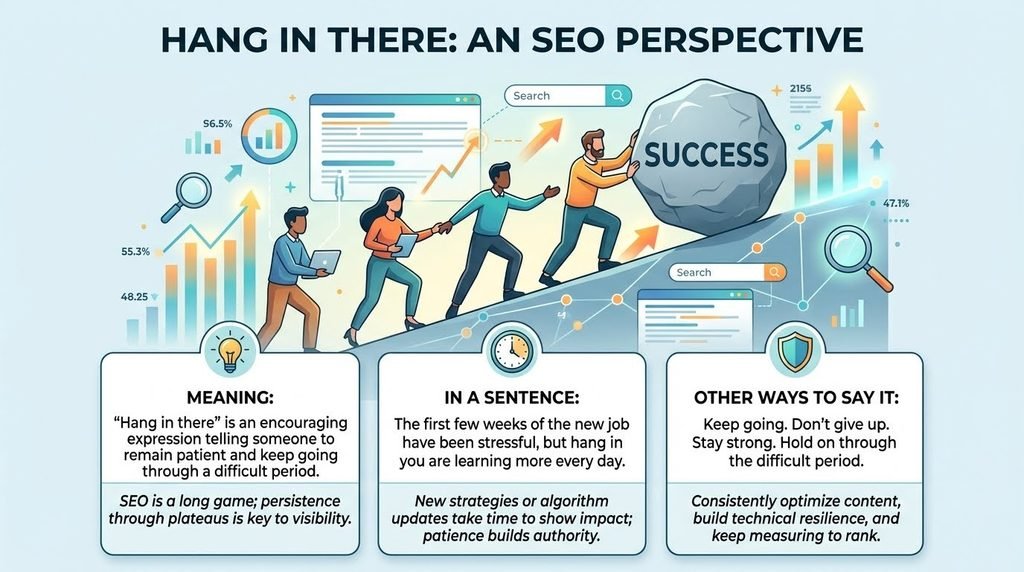
Hang in There
Meaning
“Hang in there” is an encouraging expression telling someone to remain patient and keep going through a difficult period.
In a Sentence
The first few weeks of the new job have been stressful, but hang in there—you are learning more every day.
Other Ways to Say It
- Keep going.
- Don’t give up.
- Stay strong.
- Hold on through the difficult period.
Explanation
The expression creates the simple image of someone holding on rather than letting go. Its emotional strength comes from encouragement and resilience.
Unlike “pull out all the stops,” it does not suggest using every possible resource. Instead, it offers reassurance during a difficult stretch.
Best Use
Best for: personal messages, conversations, supportive texts, social media posts, and informal encouragement.
It is distinctly conversational and warm.
Never Say Die
Meaning
“Never say die” means to refuse to admit defeat or give up hope, even when circumstances look unfavorable.
In a Sentence
The team was behind by ten points, but their captain never said die and kept encouraging everyone to fight until the final whistle.
Other Ways to Say It
- Never give up.
- Refuse to admit defeat.
- Keep fighting.
- Don’t lose hope.
Explanation
This expression presents determination as refusal to accept defeat. The image is almost like a person continuing to fight for a result when others believe the outcome is already decided.
It is especially effective when the odds appear unfavorable.
Best Use
Best for: sports writing, storytelling, motivational speeches, and dramatic personal accounts.
It has an energetic, old-fashioned quality and can sound more dramatic than ordinary conversation.
Weather the Storm
Meaning
“Weather the storm” means to survive and endure a difficult period until conditions improve. It describes resilience under pressure.
In a Sentence
The small business faced several difficult months but managed to weather the storm without closing.
Other Ways to Say It
- Get through the difficult period.
- Endure the hardship.
- Survive the challenge.
- Ride out the difficulties.
Explanation
The metaphor compares hardship to a severe storm. Instead of suggesting that a person can instantly defeat the problem, it emphasizes endurance, patience, and resilience until the difficult conditions pass.
This makes it especially useful for long-lasting challenges.
Best Use
Best for: business writing, personal stories, essays, speeches, and serious conversations.
The tone is generally serious and resilient, rather than playful.
Go Against the Grain
Meaning
“Go against the grain” means to act or think in a way that is different from what is usual, expected, or accepted.
In a Sentence
Choosing a less traditional career path went against the grain, but he was determined to build a life that suited him.
Other Ways to Say It
- Go against convention.
- Take an unconventional path.
- Challenge expectations.
- Do things differently.
Explanation
The expression comes from the physical idea of moving against the natural direction of wood grain. Figuratively, it suggests resistance to pressure, convention, or expectations.
This idiom describes a particular kind of determination: the courage to continue with your own choice when it differs from what others expect.
Best Use
Best for: essays, biographies, personal stories, creative writing, and discussions about independence.
It works especially well when determination involves individuality or resistance to convention.
Stick to Your Guns
Meaning
“Stick to your guns” means to maintain your position, decision, or beliefs despite pressure from others.
In a Sentence
The committee questioned her proposal repeatedly, but she stuck to her guns because she believed the plan was fair.
Other Ways to Say It
- Stand your ground.
- Hold your position.
- Remain firm.
- Stay true to your decision.
Explanation
The expression gives determination a sense of firmness under pressure. It does not necessarily mean that a person is physically working hard; instead, it highlights their refusal to abandon a position simply because others disagree.
That distinction makes it useful when determination is about conviction.
Best Use
Best for: conversations, debates, personal stories, opinion writing, and workplace situations.
It is informal and confident, so it may be less suitable for very formal academic writing.
Rise to the Occasion
Meaning
“Rise to the occasion” means to respond successfully and confidently when a difficult or important situation demands your best effort.
In a Sentence
When the lead speaker became ill, Farah rose to the occasion and delivered an excellent presentation with almost no preparation.
Other Ways to Say It
- Meet the challenge.
- Step up when needed.
- Perform well under pressure.
- Meet the demands of the situation.
Explanation
This expression describes determination that appears when circumstances demand it. Rather than focusing on long-term persistence, it emphasizes someone’s ability to find strength and capability at an important moment.
The phrase often carries a positive and inspirational tone.
Best Use
Best for: speeches, biographies, workplace writing, school essays, and stories about overcoming unexpected challenges.
It works well when a person is tested and responds with confidence.
Dig Your Heels In
Meaning
“Dig your heels in” means to refuse to change your position or give in. It can describe determination, but it may also suggest stubbornness or resistance.
In a Sentence
The residents dug their heels in and continued asking for a safer crossing near the school.
Other Ways to Say It
- Stand firm.
- Refuse to give in.
- Hold your ground.
- Resist pressure.
Explanation
The image is of someone pressing their heels into the ground so they cannot easily be moved. It conveys strong resistance.
However, context matters. The expression can sound admiring when someone is standing up for something important, but it can sound critical if the person seems unreasonable or stubborn.
Best Use
Best for: conversations, opinion pieces, storytelling, and informal writing.
Use it carefully when you want to distinguish determination from stubbornness.

Go Hell for Leather
Meaning
“Go hell for leather” means to move or work with extreme speed, energy, or intensity.
In a Sentence
With only an hour left before the deadline, the designers went hell for leather to finish the final revisions.
Other Ways to Say It
- Go all out.
- Work at full speed.
- Give maximum effort.
- Move with great intensity.
Explanation
This colorful expression suggests throwing yourself completely into an activity with little hesitation. It represents intense, energetic determination, rather than calm persistence.
It is particularly vivid when the situation involves urgency or a race against time.
Best Use
Best for: creative writing, storytelling, informal conversation, and lively descriptions.
It is more common in British English and can sound strongly informal or dramatic.
Keep at It
Meaning
“Keep at it” means to continue working on something instead of stopping, especially when improvement takes time.
In a Sentence
Your first few attempts at drawing may feel frustrating, but keep at it and your technique will improve.
Other Ways to Say It
- Keep trying.
- Continue working on it.
- Don’t stop practicing.
- Stay with the task.
Explanation
This is a simple but useful expression for persistent effort over time. It does not promise immediate success; instead, it encourages someone to continue despite slow progress.
Its simplicity makes it particularly effective in supportive conversations.
Best Use
Best for: everyday conversation, coaching, teaching, personal messages, and informal encouragement.
It is warm, practical, and easy to understand.
Where There’s a Will, There’s a Way
Meaning
“Where there’s a will, there’s a way” means that strong determination can help a person find a method of achieving something even when the path is difficult.
In a Sentence
There was no easy route to completing the project, but where there’s a will, there’s a way, and the volunteers eventually found a solution.
Other Ways to Say It
- Determination can overcome obstacles.
- Find a way to make it work.
- Strong commitment creates possibilities.
- Don’t let obstacles stop you.
Explanation
This traditional saying connects determination with problem-solving. The “will” represents a strong desire or commitment, while the “way” represents a practical route toward the goal.
It is optimistic, but it should not be interpreted as a guarantee that determination can remove every real-world limitation.
Best Use
Best for: motivational speeches, personal messages, essays, storytelling, and encouraging conversations.
Because it is a proverb-like expression, it can sound inspirational or somewhat traditional.
Go the Distance
Meaning
“Go the distance” means to continue until something is completed rather than stopping partway through. It can describe endurance, commitment, and long-term determination.
In a Sentence
She had already completed most of the training, and she was determined to go the distance and finish the qualification.
Other Ways to Say It
- See it through.
- Finish what you started.
- Make it to the end.
- Complete the journey.
Explanation
The expression comes from the idea of traveling or competing over a full distance. Figuratively, it creates an image of someone who keeps going until the finish line.
It differs from “go the extra mile” because the focus is not necessarily doing more than expected. Instead, it is about lasting until the end.
Best Use
Best for: sports, motivational writing, speeches, personal stories, and conversations about long-term goals.
Its tone is energetic and encouraging without being overly formal.
Exercise: Practice Using Idioms
Test your understanding of the expressions above. Choose the best answer for each question.
What does “stay the course” mean?
A. Change plans whenever problems appear
B. Continue with a plan despite difficulties
C. Finish a task before beginning another
D. Avoid difficult decisions
Which idiom describes making more effort than expected?
A. Weather the storm
B. Stick to your guns
C. Go against the grain
D. Go the extra mile
If someone “leaves no stone unturned,” what are they doing?
A. Exploring every possible option
B. Avoiding unnecessary work
C. Changing their original goal
D. Waiting for someone else to help
Which expression focuses on confronting a difficult situation directly?
A. Keep at it
B. Hang in there
C. Take the bull by the horns
D. Go the distance
What does “bite the bullet” suggest?
A. Celebrate an achievement
B. Accept and face something difficult
C. Refuse to listen to advice
D. Work faster than everyone else
Which idiom is most closely connected with staying focused on an important goal?
A. Keep your eye on the ball
B. Dig your heels in
C. Pull out all the stops
D. Never say die
If a person “weathers the storm,” what are they doing?
A. Avoiding responsibility
B. Starting a new project
C. Enduring a difficult period
D. Making a quick decision
Which expression can describe someone who maintains their position despite disagreement?
A. Rise to the occasion
B. Go hell for leather
C. Go the distance
D. Stick to your guns
Which idiom can suggest determination mixed with possible stubbornness?
A. Dig your heels in
B. Keep at it
C. Go the extra mile
D. Stay the course
What does “rise to the occasion” mean?
A. Leave a difficult situation
B. Perform well when circumstances demand it
C. Avoid taking responsibility
D. Delay a decision until later
Which expression is especially suitable for encouraging someone who is struggling but should continue?
A. Go against the grain
B. Pull out all the stops
C. Hang in there
D. Leave no stone unturned
If a person “goes hell for leather,” how are they likely to act?
A. Slowly and cautiously
B. Quietly and without urgency
C. Without making much effort
D. With great speed and intensity
Which expression means to continue working on something even when progress is slow?
A. Keep at it
B. Bite the bullet
C. Take the bull by the horns
D. Go against the grain
What does “where there’s a will, there’s a way” emphasize?
A. Success always happens quickly
B. Determination can help someone find a solution
C. People should never change their plans
D. Every challenge can be avoided
Which idiom emphasizes reaching the end of a demanding journey or task?
A. Pull out all the stops
B. Keep your nose to the grindstone
C. Go the distance
D. Stick to your guns
Answers
- B — “Stay the course” means to continue following a plan even when difficulties arise.
- D — “Go the extra mile” means to make more effort than is normally expected.
- A — “Leave no stone unturned” suggests examining every possibility and overlooking nothing important.
- C — “Take the bull by the horns” means to confront a difficult situation directly and decisively.
- B — “Bite the bullet” means to face something unpleasant or difficult with courage.
- A — “Keep your eye on the ball” means to stay focused on what matters and avoid distractions.
- C — “Weather the storm” means to endure and survive a difficult period.
- D — “Stick to your guns” means to remain firm in your position despite pressure or disagreement.
- A — “Dig your heels in” means to resist changing your position and can imply stubbornness as well as determination.
- B — “Rise to the occasion” describes responding successfully when a challenging situation requires your best effort.
- C — “Hang in there” is an informal way of encouraging someone to remain patient and keep going.
- D — “Go hell for leather” means to act or work with extreme speed and intensity.
- A — “Keep at it” encourages continued effort, especially when improvement takes time.
- B — “Where there’s a will, there’s a way” expresses the idea that strong determination can help someone find a route around an obstacle.
- C — “Go the distance” emphasizes continuing until the end of a demanding task, journey, or challenge.
FAQs
What is an idiom for determination?
An idiom for determination is a figurative expression that communicates persistence, courage, focus, resilience, or commitment through an image or comparison. Examples include “stay the course,” “keep at it,” and “go the distance.”
How do I create my own idiom for determination?
Start with the quality you want to express, such as persistence or courage, and connect it to a strong, understandable image. For example, you might imagine someone climbing a steep mountain to represent continuing toward a difficult goal. A good figurative expression should communicate an idea rather than simply replace the word “determination.”
What makes an idiom effective?
An effective idiom creates a clear mental image while communicating a recognizable idea. It should fit naturally into the sentence and match the tone of the situation. The best expression also adds something beyond a plain statement, such as emotional force, humor, drama, or vivid imagery.
Can I use these idioms in everyday conversation?
Yes. Expressions such as “hang in there,” “keep at it,” “go the extra mile,” and “keep your eye on the ball” are natural in everyday English. Others, such as “go hell for leather,” may sound more informal, colorful, regional, or dramatic, so context matters.
What is the difference between an idiom and a simile?
An idiom has an established figurative meaning that may not be predictable from its individual words. A simile usually makes a direct comparison using words such as “like” or “as.” For example, “stay the course” is an idiom, while “he was as determined as a mountain climber facing a steep peak” is a simile.
Conclusion
Idioms can turn the abstract idea of determination into something vivid and memorable. Instead of simply telling readers that someone is persistent, you can show that they stay the course, keep at it, weather the storm, or go the distance. Each expression highlights a slightly different side of determination, from patience and focus to courage, resilience, and bold action.
The key is to choose an idiom that matches the situation and the feeling you want to communicate. A serious essay may call for a calm expression such as “stay the course,” while a personal message might sound warmer with “hang in there.” Used thoughtfully, figurative language can make ordinary descriptions much more expressive. True determination is often revealed not by how easy the journey is, but by the choice to keep moving when it becomes difficult.

Oliver Whitcombe is a British writer and language enthusiast who has been fascinated by English expressions since childhood, when his grandmother told him he was “born with a silver spoon” and he spent a week trying to find it.
He created Idiom Looms to help learners and native speakers alike make sense of English idioms. Their origins, their meanings, and the moments they’re best used. His writing mixes plain explanations with a good dose of British wit.
Oliver lives in England, where he divides his time between writing, walking, and correcting everyone’s grammar (politely).



[…] 20 Idioms for Determination With Real Examples […]