

Have you ever understood an idea but struggled to express it naturally in English? 20 Idioms for Students With Real Examples introduces useful expressions that make everyday communication more vivid and memorable. Students can use idioms to strengthen English usage, improve grammar, and add personality to conversations and writing. These expressions also help learners understand how native speakers communicate ideas beyond literal meanings.
Learning idioms becomes even more valuable when students manage busy academic routines. Whether you are planning a calendar, improving scheduling skills, practicing time management, or preparing for meetings and presentations, the right expressions can make communication clearer. Idioms can also appear in business communication, online booking, broadcasting, and project management, making them useful beyond the classroom.
In this guide, you will discover 20 practical idioms with real examples, simple meanings, alternative expressions, and usage explanations. Each example shows how an idiom works naturally in context. You will also see how these expressions support formal writing, confident speaking, and consistent English practice. With regular use, students can build stronger vocabulary and develop greater consistency in everyday communication.
What Is an Idiom?
An idiom is a phrase whose meaning is different from the literal meaning of the individual words. People understand the phrase as a whole because it has a commonly recognized figurative meaning.
For example, “break the ice” does not usually mean physically breaking ice. It means to make people feel more comfortable when they first meet.
Another example is “spill the beans.” It does not mean dropping beans on the floor. It means revealing a secret or giving away information.
Idioms are a form of figurative language. They add imagery and personality to communication, making an ordinary idea easier to picture or remember.
Why Use Idioms for Students?
Student life includes learning, pressure, friendship, teamwork, mistakes, achievements, and personal growth. Idioms can give these experiences a stronger voice.
They can help students:
- Express emotions without lengthy explanations.
- Make school experiences sound more vivid and relatable.
- Explain abstract ideas through familiar images.
- Add personality to essays and creative writing.
- Make presentations and speeches more memorable.
- Understand expressions commonly used in everyday English.
- Communicate complicated feelings in a short phrase.
- Develop a stronger understanding of figurative language.
The key is to choose an idiom that genuinely fits the situation. A formal academic essay may call for more careful language, while a personal reflection or conversation can often use idioms more freely.
Quick List of 20 Idioms for Students
- Hit the books
- Burn the midnight oil
- Learn the ropes
- Get the hang of it
- Learn by heart
- Keep your nose to the grindstone
- Put your thinking cap on
- Think outside the box
- Be on the same page
- Go the extra mile
- Rise to the occasion
- Bite the bullet
- Back to the drawing board
- Keep your eye on the ball
- A piece of cake
- Pull an all-nighter
- In hot water
- Under the weather
- Call it a day
- By the book
Hit the Books
Read more:20 Idioms for Task With Real Examples
Meaning
“Hit the books” means to start studying seriously, usually with focused effort. The phrase creates a playful image of someone energetically getting down to their textbooks or study materials.
In a Sentence
I have a chemistry exam tomorrow, so I need to hit the books tonight.
Other Ways to Say It
- Start studying seriously
- Get down to studying
- Study hard
- Focus on my schoolwork
Explanation
The expression uses “hit” in a figurative sense rather than meaning physical contact. It suggests getting to work with energy and determination.
It is especially natural when talking about exams, homework, revision, or an upcoming academic deadline.
Best Use
Best for: Conversations, personal messages, student blogs, informal writing, and social media.
It is casual and friendly, so it may sound less appropriate in a highly formal academic paper.
Burn the Midnight Oil
Meaning
“Burn the midnight oil” means to work or study late into the night. It communicates long hours and sustained effort, often because an important task needs to be completed.
In a Sentence
Several students were burning the midnight oil to finish their research projects before Friday.
Other Ways to Say It
- Study late into the night
- Work late
- Stay up studying
- Put in extra hours
Explanation
The image comes from the old practice of using oil lamps for light while working at night. The phrase therefore carries a sense of late-night effort and persistence.
It can suggest dedication, although it may also hint that someone has left a task until late.
Best Use
Best for: Conversations, storytelling, personal essays, and informal academic writing.
Use it when the important detail is that the work continues late into the night.

Learn the Ropes
Meaning
“Learn the ropes” means to learn how something works, especially when you are new to a situation. For students, it can describe becoming familiar with a new school, course, activity, or responsibility.
In a Sentence
During my first week at college, I spent most of my time learning the ropes.
Other Ways to Say It
- Learn how things work
- Get familiar with the system
- Find your way around
- Become accustomed to the routine
Explanation
The expression comes from sailing, where knowing the ropes was an important practical skill. Today, it creates an image of gaining the knowledge needed to handle a new environment.
It works particularly well when describing a student’s transition into unfamiliar surroundings.
Best Use
Best for: Conversations, orientation stories, personal essays, and student discussions.
It has a relaxed, conversational tone.
Get the Hang of It
Meaning
“Get the hang of it” means to gradually understand how to do something or become comfortable with a new skill. It emphasizes learning through practice.
In a Sentence
At first, solving algebraic equations confused me, but I eventually got the hang of it.
Other Ways to Say It
- Figure it out
- Learn how to do it
- Become comfortable with it
- Get used to it
Explanation
The phrase describes the moment when something that once seemed difficult starts to make sense. It is useful for showing progress rather than instant mastery.
That makes it especially suitable for talking about new subjects, software, sports, instruments, or study techniques.
Best Use
Best for: Everyday conversation, reflective writing, classroom discussions, and informal messages.
Learn by Heart
Meaning
“Learn by heart” means to memorize something so well that you can repeat it without looking at the original material.
In a Sentence
We had to learn the poem by heart before our literature presentation.
Other Ways to Say It
- Memorize it
- Commit it to memory
- Know it from memory
- Memorize it thoroughly
Explanation
The phrase connects memory with the heart, creating an image of knowledge becoming deeply stored within you. It communicates strong memorization, rather than simply understanding an idea.
It is particularly useful for poems, speeches, formulas, vocabulary, quotations, and passages.
Best Use
Best for: School conversations, literature discussions, essays, and descriptions of study habits.
In some varieties of English, “learn by heart” is more common than “memorize.”
Keep Your Nose to the Grindstone
Meaning
“Keep your nose to the grindstone” means to work steadily and seriously without being distracted. It suggests consistent concentration and effort.
In a Sentence
If I keep my nose to the grindstone this semester, I should be able to complete my assignments on time.
Other Ways to Say It
- Stay focused
- Keep working hard
- Stay committed to the task
- Work steadily
Explanation
This idiom creates a strong physical image of someone working so closely and continuously that their nose is almost against a grindstone.
The expression can sound determined, but it may also imply hard work with little time for distraction or relaxation.
Best Use
Best for: Conversations, motivational writing, personal reflections, and storytelling.
Because it is somewhat old-fashioned, it can add character to informal writing.
Put Your Thinking Cap On
Meaning
“Put your thinking cap on” means to start thinking carefully, creatively, or deeply about a problem.
In a Sentence
We couldn’t solve the puzzle at first, so our teacher told us to put our thinking caps on.
Other Ways to Say It
- Think carefully
- Use your imagination
- Think hard
- Work out the problem
Explanation
The phrase creates a playful image of putting on a special cap that helps the brain work. It makes serious thinking sound lighthearted and approachable.
It is especially effective when a student needs to solve a difficult problem or generate a creative idea.
Best Use
Best for: Classroom conversations, children’s writing, educational content, puzzles, and playful speeches.
It is usually more casual than formal.

Think Outside the Box
Meaning
“Think outside the box” means to consider unusual, creative, or unconventional solutions instead of following the most obvious approach.
In a Sentence
The science project became much more interesting when our team thought outside the box and designed a different experiment.
Other Ways to Say It
- Think creatively
- Try a different approach
- Explore new ideas
- Look beyond the obvious
Explanation
The “box” represents familiar limits or conventional thinking. Stepping outside it suggests breaking away from expected solutions.
For students, this idiom works particularly well when discussing projects, problem-solving, creativity, or innovative ideas.
Best Use
Best for: Presentations, classroom discussions, essays, project descriptions, and motivational writing.
It is widely understood and can work in both casual and professional contexts.
Be on the Same Page
Meaning
“Be on the same page” means that people share the same understanding, expectations, or plan.
In a Sentence
Before starting our group presentation, we met to make sure everyone was on the same page.
Other Ways to Say It
- Have the same understanding
- Agree on the plan
- Share the same expectations
- Be in agreement
Explanation
The phrase creates the image of several people looking at the same page of information. It is particularly useful when students are collaborating and need to coordinate their ideas.
Unlike some academic idioms, this one sounds very natural in everyday conversation.
Best Use
Best for: Group projects, classroom conversations, teamwork, presentations, and emails.
It can be used in both informal and workplace settings.
Go the Extra Mile
Meaning
“Go the extra mile” means to make more effort than is normally expected. For students, it can describe putting additional care into an assignment, helping a classmate, or preparing thoroughly.
In a Sentence
Maya went the extra mile by checking every source before submitting her research paper.
Other Ways to Say It
- Make an extra effort
- Do more than expected
- Put in additional effort
- Give something extra
Explanation
The expression presents effort as a journey in which someone continues farther than necessary. It communicates initiative, care, and willingness to do more.
It is strongest when the extra effort has a clear purpose rather than simply meaning “work hard.”
Best Use
Best for: Essays, recommendations, personal reflections, speeches, and conversations.
It can sound encouraging and positive.
Rise to the Occasion
Meaning
“Rise to the occasion” means to respond successfully when a difficult, important, or unexpected situation requires you to perform well.
In a Sentence
I was nervous about leading the debate, but I rose to the occasion and spoke with confidence.
Other Ways to Say It
- Meet the challenge
- Perform well under pressure
- Step up when needed
- Handle the situation successfully
Explanation
The phrase suggests that a person rises to meet the demands of a particular moment. It carries a feeling of courage and capability.
For students, it is useful when describing exams, competitions, presentations, leadership roles, or unexpected responsibilities.
Best Use
Best for: Speeches, personal essays, storytelling, achievement descriptions, and motivational writing.
It has a positive and inspirational tone.
Bite the Bullet
Meaning
“Bite the bullet” means to face something difficult or unpleasant with courage rather than avoiding it.
In a Sentence
I was nervous about asking for feedback, but I decided to bite the bullet and speak to my professor.
Other Ways to Say It
- Face the challenge
- Do what must be done
- Face the difficult task
- Push through the discomfort
Explanation
The phrase creates a dramatic image of enduring something painful or frightening by showing courage. In student life, it can describe facing a difficult assignment, conversation, exam, or responsibility.
It is not necessarily about enjoying the task; it is about deciding to confront it.
Best Use
Best for: Informal conversations, personal reflections, storytelling, and motivational messages.
It is fairly casual and can sound dramatic in formal writing.
Back to the Drawing Board
Meaning
“Back to the drawing board” means returning to the planning stage after an idea, attempt, or project has not worked as expected.
In a Sentence
Our first bridge design collapsed during testing, so we went back to the drawing board.
Other Ways to Say It
- Start planning again
- Rework the idea
- Try a new approach
- Return to the planning stage
Explanation
The image comes from an engineer or designer returning to a drawing board to create a revised plan. It presents failure as a step toward improvement rather than the end of the process.
That makes it especially useful for student projects and experiments.
Best Use
Best for: Science projects, design assignments, presentations, project reports, and conversations about mistakes.
It can have a constructive rather than negative tone when used to show learning.
Keep Your Eye on the Ball
Meaning
“Keep your eye on the ball” means to remain focused on the important goal or task instead of becoming distracted.
In a Sentence
There were plenty of distractions during exam week, but I tried to keep my eye on the ball and follow my study schedule.
Other Ways to Say It
- Stay focused
- Keep your attention on the goal
- Avoid distractions
- Concentrate on what matters
Explanation
The expression comes from sports, where watching the ball carefully is essential. Applied to studying, it creates a clear image of maintaining attention on the target.
It is useful when the main issue is focus rather than the amount of effort involved.
Best Use
Best for: Motivational conversations, speeches, student advice, personal writing, and teamwork.
It is energetic and practical rather than poetic.
A Piece of Cake
Meaning
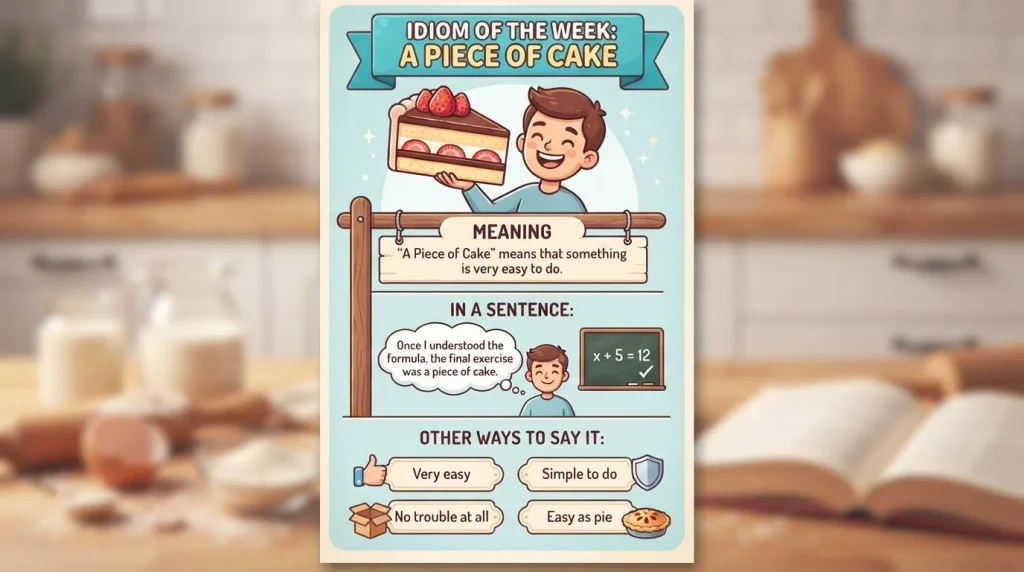
“A piece of cake” means that something is very easy to do.
In a Sentence
Once I understood the formula, the final exercise was a piece of cake.
Other Ways to Say It
- Very easy
- Simple to do
- No trouble at all
- Easy as pie
Explanation
The phrase compares an easy task with something pleasant and simple to eat. It communicates ease and confidence.
However, students should use it carefully because a task that feels easy to one person may be difficult for another.
Best Use
Best for: Informal conversations, classroom discussions, friendly messages, and casual storytelling.
It is playful and should generally be avoided in highly formal academic writing.
Pull an All-Nighter
Meaning
“Pull an all-nighter” means to stay awake all night, usually to study, work, or complete an assignment.
In a Sentence
I had so much work to finish that I ended up pulling an all-nighter before the deadline.
Other Ways to Say It
- Stay up all night
- Work through the night
- Study until morning
- Spend the night working
Explanation
The expression is direct and informal, but its figurative quality comes from treating an entire night of wakefulness as something a person can “pull” through.
It describes a specific behavior, not necessarily a positive study strategy, so it can also carry a sense of exhaustion or poor planning.
Best Use
Best for: Conversations, personal stories, social media, and informal student writing.
It is less suitable for formal academic work.
In Hot Water
Meaning
“In hot water” means to be in trouble because of something you have done or a situation you have become involved in.
In a Sentence
After missing three project deadlines, the student found himself in hot water with his instructor.
Other Ways to Say It
- In trouble
- Facing consequences
- In a difficult situation
- In a difficult spot
Explanation
The phrase creates an uncomfortable image of being surrounded by hot water. Its figurative meaning is being in trouble or facing an unpleasant situation.
For students, it can describe missed deadlines, broken rules, misunderstandings, or academic responsibilities that have been neglected.
Best Use
Best for: Informal conversations, storytelling, humorous writing, and student examples.
It is conversational and can soften a serious situation slightly.
Under the Weather
Meaning
“Under the weather” means feeling ill, tired, or generally unwell.
In a Sentence
I was feeling under the weather, so I stayed home instead of attending the afternoon study session.
Other Ways to Say It
- Feeling unwell
- Feeling sick
- Not feeling my best
- Feeling poorly
Explanation
The idiom creates an image of someone affected by unpleasant weather. Its tone is generally mild and conversational, rather than dramatic.
It can be useful when a student wants to explain a minor illness without making the statement sound overly serious.
Best Use
Best for: Everyday conversation, messages to classmates, informal emails, and personal writing.
For a formal absence notice, “I am unwell” is usually clearer.
Call It a Day
Meaning
“Call it a day” means to stop working on something because you have finished enough for the moment or it is time to take a break.
In a Sentence
We had completed most of the presentation, so we decided to call it a day and finish the final slide tomorrow.
Other Ways to Say It
- Stop working for now
- Finish for today
- Take a break
- Wrap things up
Explanation
The phrase treats the end of a work session as the official end of the day’s effort. It can communicate completion, relief, or the sensible decision to pause.
For students, it can be helpful when describing study sessions or group work.
Best Use
Best for: Conversations, group-project discussions, personal messages, and informal writing.
It is relaxed and usually not appropriate for formal academic prose.
By the Book
Meaning
“By the book” means following rules, instructions, procedures, or established standards exactly.
In a Sentence
Our laboratory group followed the safety instructions by the book during the experiment.
Other Ways to Say It
- Follow the rules
- Follow the instructions exactly
- Follow proper procedures
- Do things according to the rules
Explanation
The “book” represents an official set of instructions or rules. The phrase communicates careful compliance and attention to procedure.
This makes it particularly useful when discussing laboratory work, examinations, school policies, or structured assignments.
Best Use
Best for: Conversations, project descriptions, workplace preparation, and practical writing.
It can sound professional as well as conversational, depending on the context.
Exercise: Practice Using Idioms
Choose the best answer for each question.
What does “hit the books” mean?
A. Arranging books on a shelf
B. Getting serious about studying
C. Purchasing new textbooks
D. Shutting a textbook
Which idiom describes learning how something works when you are new to it?
A. Learn the ropes
B. Call it a day
C. Bite the bullet
D. In hot water
A student stays awake until morning to finish an assignment. Which expression fits best?
A. Be on the same page
B. Rise to the occasion
C. Pull an all-nighter
D. A piece of cake
What does “get the hang of it” suggest?
A. Forgetting how to do something
B. Becoming comfortable with a skill
C. Avoiding a difficult task
D. Finishing work immediately
Which idiom means memorizing something thoroughly?
A. Learn by heart
B. Go the extra mile
C. Think outside the box
D. Call it a day
A group discusses its project until everyone understands the plan. What idiom describes this?
A. Under the weather
B. In hot water
C. On the same page
D. Burn the midnight oil
Which idiom best describes finding an unconventional solution to a school problem?
A. Think outside the box
B. By the book
C. Hit the books
D. Learn the ropes
A student gives more effort than the assignment requires. Which idiom fits?
A. Bite the bullet
B. Go the extra mile
C. Call it a day
D. Under the weather
What does “rise to the occasion” mean?
A. Leave a difficult situation
B. Avoid taking responsibility
C. Perform successfully when challenged
D. Stop working before a deadline
Which expression means facing something unpleasant with courage?
A. A piece of cake
B. Bite the bullet
C. Be on the same page
D. Learn by heart
A science experiment fails, so the students redesign their approach. Which idiom fits?
A. Back to the drawing board
B. Burn the midnight oil
C. In hot water
D. Keep your eye on the ball
What does “keep your eye on the ball” mean in a study context?
A. Watch a sports game
B. Avoid doing difficult work
C. Stay focused on the important goal
D. Finish every task immediately
Which idiom means something is very easy?
A. A piece of cake
B. In hot water
C. Pull an all-nighter
D. Keep your nose to the grindstone
A student has broken a school rule and may face consequences. Which idiom is most appropriate?
A. Get the hang of it
B. In hot water
C. Think outside the box
D. Go the extra mile
Which sentence uses “by the book” correctly?
A. The student ate the instructions by the book.
B. The textbook was sitting by the book.
C. The team followed the competition rules by the book.
D. The student drew a book by the book.
Answers
1. B — “Hit the books” means to start studying seriously.
2. A — “Learn the ropes” means becoming familiar with how a new situation works.
3. C — “Pull an all-nighter” means staying awake throughout the night to work or study.
4. B — “Get the hang of it” describes gradually learning how to do something.
5. A — “Learn by heart” means memorizing something thoroughly.
6. C — Being “on the same page” means having the same understanding or expectations.
7. A — “Think outside the box” means approaching a problem creatively or unconventionally.
8. B — “Go the extra mile” means making more effort than is normally expected.
9. C — To “rise to the occasion” means to perform successfully when circumstances demand it.
10. B — “Bite the bullet” means facing something difficult or unpleasant with courage.
11. A — “Back to the drawing board” means returning to planning after an approach has not worked.
12. C — “Keep your eye on the ball” means staying focused on the main goal.
13. A — “A piece of cake” describes something that is very easy.
14. B — Being “in hot water” means being in trouble or facing consequences.
15. C — “By the book” means following rules or instructions exactly.
FAQs
What is an idiom for students?
An idiom for students is an established figurative expression that can naturally describe learning, studying, school experiences, challenges, teamwork, or academic progress. Examples include “hit the books,” “learn the ropes,” and “go the extra mile.”
How do I create my own idiom?
Creating a completely new idiom is possible, but it is usually better to begin with a clear comparison or mental image. Think about the feeling or experience you want to describe, then connect it with a memorable image. Remember that a newly created phrase may not be understood as an idiom until people begin using it consistently.
What makes an idiom effective?
An effective idiom has a clear figurative meaning, memorable imagery, and a natural connection to the situation. It should add something to the message rather than simply replace an ordinary word.
Can I use these idioms in everyday conversation?
Yes. Many of these expressions, including “hit the books,” “get the hang of it,” “on the same page,” and “call it a day,” are natural in everyday conversation. Some, such as “put your thinking cap on,” have a more playful tone.
What is the difference between an idiom and a simile?
An idiom is an established expression whose overall meaning is understood figuratively, such as “hit the books.” A simile directly compares two things using words such as “like” or “as,” as in “The classroom was as quiet as a library.” Both can create imagery, but they work differently.
Conclusion
Idioms can turn familiar student experiences into memorable expressions. Studying for an exam can become “hitting the books,” working late can mean “burning the midnight oil,” and successfully handling a difficult presentation can be described as “rising to the occasion.” Each phrase adds a particular image and feeling that a plain statement may not capture as effectively.
The best idiom depends on the message and audience. A playful expression may work beautifully in conversation but feel too casual in a formal essay. Likewise, a dramatic phrase can be powerful when telling a personal story but unnecessary in a straightforward explanation. For students, learning these expressions is not just about memorizing phrases; it is about understanding how English communicates ideas creatively. Choose the image that fits your meaning, and your words can make the learning experience much more vivid.

Oliver Whitcombe is a British writer and language enthusiast who has been fascinated by English expressions since childhood, when his grandmother told him he was “born with a silver spoon” and he spent a week trying to find it.
He created Idiom Looms to help learners and native speakers alike make sense of English idioms. Their origins, their meanings, and the moments they’re best used. His writing mixes plain explanations with a good dose of British wit.
Oliver lives in England, where he divides his time between writing, walking, and correcting everyone’s grammar (politely).



[…] Read more:20 Idioms for Students With Real Examples […]