Have you ever struggled to describe how tired you feel without repeating the same words? 20 Idioms for Sleep With Real Examples introduces natural expressions that make conversations about rest, tiredness, and bedtime more vivid. These idioms can help you describe deep sleep, exhaustion, relaxation, or staying awake in engaging ways. You will discover practical expressions with clear meanings and realistic examples. Each phrase also shows how English usage, grammar, and context can affect its meaning.
Sleep-related expressions appear in everyday conversations, personal messages, storytelling, and formal writing. They can also add clarity when discussing time management, scheduling, or a busy calendar. In professional settings, natural language can support business communication, meetings, and project management. Even topics such as online booking and broadcasting may involve conversations about timing, availability, or rest. Learning these expressions helps you communicate naturally while maintaining consistency and clarity.
In this guide, you will explore 20 useful idioms connected with sleep, tiredness, rest, and wakefulness. Each expression includes a simple meaning, a realistic example, alternative ways to say it, and practical usage guidance. The examples make it easier to understand figurative language, context, and idiomatic meaning. Whether you are improving everyday English, preparing for writing tasks, or expanding your vocabulary, these expressions can make your communication more natural, precise, and memorable.
What Is an Idiom?
An idiom is a fixed expression whose meaning is different from the literal meaning of the individual words.
For example, if someone says, “It’s raining cats and dogs,” they do not mean that animals are falling from the sky. They mean that it is raining very heavily.
Similarly, “break the ice” does not literally mean breaking frozen water. It means to make people feel more comfortable in a social situation.
Idioms are a form of figurative language. They add imagery and personality to communication, allowing people to express familiar ideas in a more memorable way.
Why Use Idioms for Sleep?
Talking about sleep does not always have to sound straightforward. Instead of saying, “I am very tired,” you might say that you are ready to hit the hay. Instead of simply saying, “He fell asleep quickly,” you could say that he was out like a light.
Sleep idioms can help you:
- Express feelings such as tiredness, comfort, frustration, or relief.
- Make descriptions more vivid and memorable.
- Add personality to everyday conversations.
- Make stories and creative writing more colorful.
- Describe different kinds of sleep without repeating the same words.
- Explain the difference between falling asleep, sleeping deeply, staying awake, and getting extra rest.
- Communicate familiar experiences in a short and expressive way.
The best expression depends on the situation. Some sleep idioms sound perfectly natural in conversation, while others are more playful, informal, or poetic.
Quick List of 20 Sleep Idioms
- Hit the Hay
- Hit the Sack
- Catch Some Zs
- Sleep Like a Log
- Sleep Like a Baby
- Count Sheep
- Forty Winks
- Nod Off
- Drift Off
- Doze Off
- Out Like a Light
- Dead to the World
- Saw Logs
- Sleep Tight
- Beauty Sleep
- Lose Sleep Over Something
- Not Sleep a Wink
- Sleep On It
- Sleep In
- Sleep Like a Top
Hit the Hay
Read more:20 Idioms for Regret With Real Examples
Meaning
Hit the hay means to go to bed or go to sleep. It is an informal expression often used when someone is tired and ready to end the day.
The phrase creates an old-fashioned image of someone going to rest on a bed filled with hay. Today, it is simply a friendly way of saying that it is time for bed.
In a Sentence
“I’ve got an early meeting tomorrow, so I’m going to hit the hay.”
Other Ways to Say It
- Go to bed
- Turn in for the night
- Head to bed
- Call it a night
Explanation
The expression works because “hit” suggests moving toward something quickly, while “hay” creates an old-fashioned image of a simple bed. It usually communicates that someone is tired and ready to sleep.
It is casual and conversational, so it fits friendly conversations better than formal writing.
Best Use
Use it in casual conversations, personal messages, stories, and informal social media posts.
Hit the Sack
Meaning
Hit the sack means to go to bed or go to sleep. It is very similar in meaning to “hit the hay” and is generally informal.
In a Sentence
“Everyone is exhausted after the trip, so I think we should hit the sack.”
Other Ways to Say It
- Go to bed
- Head off to bed
- Turn in
- Call it a night
Explanation
The word “sack” gives the expression a rough, informal image of a bed or sleeping place. The phrase emphasizes the decision to go to bed rather than the quality of the sleep itself.
It has a relaxed, everyday tone and can sound especially natural among friends.
Best Use
It works well in casual speech, dialogue, text messages, and informal storytelling.
Catch Some Zs
Meaning
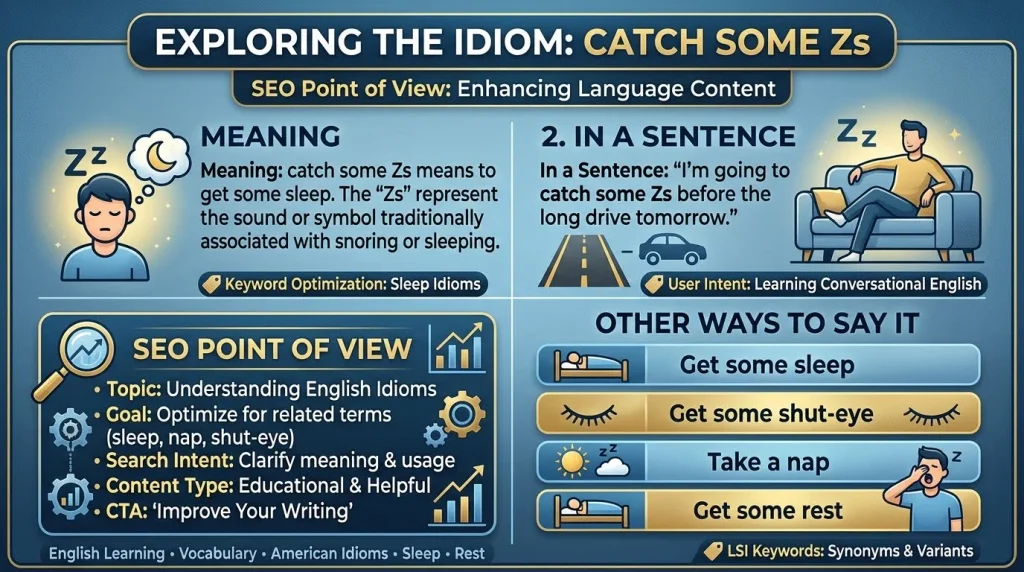
Catch some Zs means to get some sleep. The “Zs” represent the sound or symbol traditionally associated with snoring or sleeping.
In a Sentence
“I’m going to catch some Zs before the long drive tomorrow.”
Other Ways to Say It
- Get some sleep
- Get some shut-eye
- Take a nap
- Get some rest
Explanation
The expression creates a playful mental picture of sleeping sounds floating through the air. It is lighthearted rather than serious.
Because it is informal, it can make a simple statement about sleep sound more relaxed and conversational.
Best Use
Use it in casual conversations, humorous writing, texts, captions, and friendly messages.
Sleep Like a Log
Meaning
Sleep like a log means to sleep very deeply and soundly, usually without waking up easily.
A log does not move, react, or wake up, so the comparison suggests someone who is completely still and deeply asleep.
In a Sentence
“After hiking all afternoon, I slept like a log.”
Other Ways to Say It
- Sleep deeply
- Sleep soundly
- Sleep very heavily
- Be in a deep sleep
Explanation
The image is simple: a log lies completely still. Comparing a sleeping person to one suggests deep, uninterrupted sleep.
This expression is useful when the important detail is not simply that someone slept, but that they slept very soundly.
Best Use
It fits conversation, storytelling, personal writing, and informal descriptions.
Sleep Like a Baby
Meaning
Sleep like a baby means to sleep very peacefully and deeply.
Although babies can actually wake frequently, the idiom focuses on the familiar image of a peaceful, comfortable sleeping child.
In a Sentence
“The room was so quiet that I slept like a baby.”
Other Ways to Say It
- Sleep peacefully
- Sleep soundly
- Have a restful night
- Sleep deeply
Explanation
This idiom connects sleep with an image of comfort, innocence, and peace. It usually has a warm and positive feeling.
The phrase is common in everyday English, although its meaning is figurative rather than a literal description of how babies sleep.
Best Use
Use it in everyday conversations, personal messages, storytelling, and warm descriptions.
Count Sheep
Meaning
Count sheep refers to a traditional method of trying to fall asleep by imagining and counting sheep one after another.
It is often used humorously when someone is having difficulty falling asleep.
In a Sentence
“I couldn’t fall asleep last night, so I ended up counting sheep.”
Other Ways to Say It
- Try to fall asleep
- Lie awake trying to sleep
- Try to relax before bed
- Toss and turn
Explanation
The expression creates a memorable picture of someone quietly counting imaginary sheep while lying in bed. It is particularly useful for describing an attempt to fall asleep rather than successful sleep.
The phrase often carries a playful tone.
Best Use
It works especially well in humorous conversations, children’s writing, storytelling, and lighthearted descriptions.
Forty Winks
Meaning
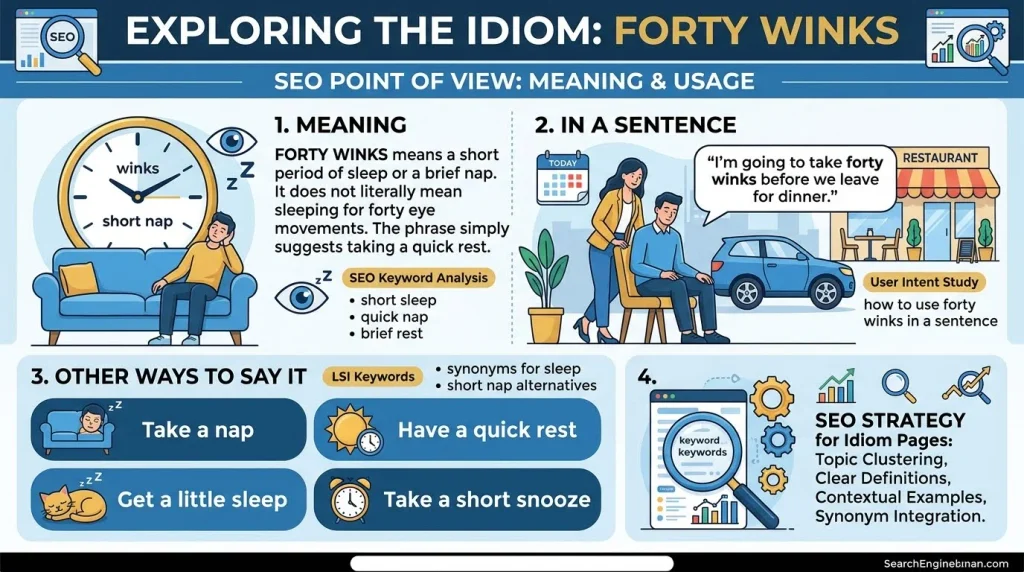
Forty winks means a short period of sleep or a brief nap.
It does not literally mean sleeping for only forty eye movements. The phrase simply suggests taking a quick rest.
In a Sentence
“I’m going to take forty winks before we leave for dinner.”
Other Ways to Say It
- Take a nap
- Have a quick rest
- Get a little sleep
- Take a short snooze
Explanation
The expression gives a short nap a playful, almost whimsical name. It is useful when someone needs a little sleep rather than a full night’s rest.
It may sound slightly old-fashioned in some contexts, but it remains understandable and expressive.
Best Use
Use it in casual conversation, humorous writing, storytelling, and playful descriptions.
Nod Off
Meaning
Nod off means to fall asleep unintentionally or gradually, especially while sitting somewhere.
It often describes someone becoming sleepy without deliberately deciding to go to bed.
In a Sentence
“I nodded off on the sofa while watching the movie.”
Other Ways to Say It
- Doze off
- Fall asleep
- Drift into sleep
- Drop off
Explanation
The word “nod” creates the image of someone’s head slowly dropping as they become sleepy. It works particularly well for brief or accidental sleep.
Unlike “hit the hay,” it focuses on the moment of falling asleep.
Best Use
It is natural in everyday conversations, stories, and descriptions of tired people.
Drift Off
Meaning
Drift off means to gradually fall asleep. It suggests a smooth, gentle transition from being awake to being asleep.
In a Sentence
“Soft music was playing as I slowly drifted off to sleep.”
Other Ways to Say It
- Fall asleep gradually
- Slip into sleep
- Doze off
- Ease into sleep
Explanation
“Drift” suggests slow, effortless movement, almost as if someone were floating away. That makes this expression softer and more peaceful than expressions describing sudden sleep.
It is especially effective when the setting is calm or relaxing.
Best Use
Use it in personal writing, storytelling, reflective prose, poetry, and calm everyday descriptions.
Doze Off
Meaning
Doze off means to fall into a light or brief sleep, often without intending to.
It commonly describes someone who becomes sleepy while sitting, reading, watching television, or traveling.
In a Sentence
“I was so tired that I dozed off during the train ride.”
Other Ways to Say It
- Nod off
- Take a light nap
- Fall asleep briefly
- Snooze
Explanation
The expression usually suggests light or temporary sleep, rather than a long, deep night’s rest. It is therefore useful when someone falls asleep for only a short time.
It sounds natural and informal in everyday English.
Best Use
It works well in conversation, storytelling, travel writing, and personal messages.
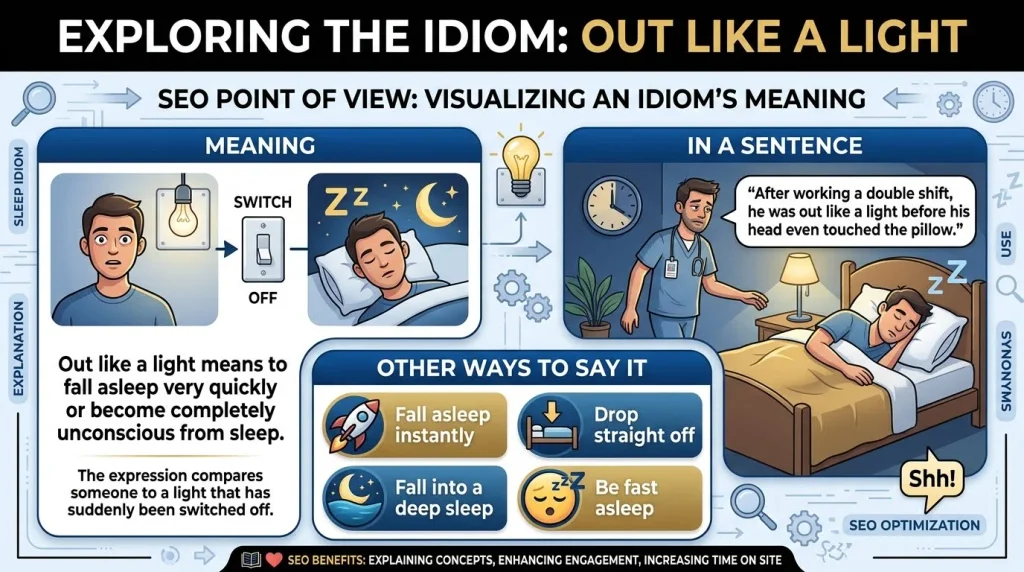
Out Like a Light
Meaning
Out like a light means to fall asleep very quickly or become completely unconscious from sleep.
The expression compares someone to a light that has suddenly been switched off.
In a Sentence
“After working a double shift, he was out like a light before his head even touched the pillow.”
Other Ways to Say It
- Fall asleep instantly
- Drop straight off
- Fall into a deep sleep
- Be fast asleep
Explanation
The image of a light being switched off communicates suddenness. Unlike “sleep like a log,” which focuses on deep sleep, this expression often emphasizes how quickly someone falls asleep.
It is vivid and informal.
Best Use
Use it in conversation, humorous stories, personal anecdotes, and informal writing.
Dead to the World
Meaning
Dead to the world means to be completely asleep and unaware of what is happening around you.
It can also describe someone who is so deeply asleep that they do not notice sounds or activity nearby.
In a Sentence
“The children were dead to the world after their long day at the park.”
Other Ways to Say It
- Fast asleep
- Completely asleep
- Deeply asleep
- Unaware of everything around you
Explanation
This is a strong expression because “dead” creates an image of total unawareness, not literal death. It emphasizes the depth of someone’s sleep.
Because of that strong wording, it can sound dramatic or humorous depending on context.
Best Use
It is best for informal conversation, storytelling, humorous writing, and dramatic descriptions.
Saw Logs
Meaning
Saw logs is a humorous expression meaning to sleep noisily, especially while snoring.
The phrase compares loud snoring to the sound of a saw cutting through wood.
In a Sentence
“My brother was sawing logs all night, so nobody in the room slept well.”
Other Ways to Say It
- Snore loudly
- Sleep noisily
- Snore away
- Make loud sleeping noises
Explanation
The comparison works through sound imagery. A saw cutting through a log can make a rough, repetitive noise, which resembles loud snoring.
It is playful rather than polite in every situation, so consider your audience.
Best Use
It works best in humorous conversation, informal storytelling, jokes, and playful descriptions.
Sleep Tight
Meaning
Sleep tight is a friendly expression used when wishing someone a good night’s sleep.
It does not literally mean that someone should sleep tightly. It communicates the idea of sleeping comfortably and safely.
In a Sentence
“Good night, everyone. Sleep tight!”
Other Ways to Say It
- Sleep well
- Have a good night
- Rest well
- Have a peaceful night
Explanation
The expression has a warm and caring tone, making it feel more personal than simply saying “good night.” It is commonly used when saying goodbye to someone before bedtime.
It can sound especially affectionate when spoken to family or close friends.
Best Use
Use it in personal messages, family conversations, bedtime dialogue, and warm storytelling.
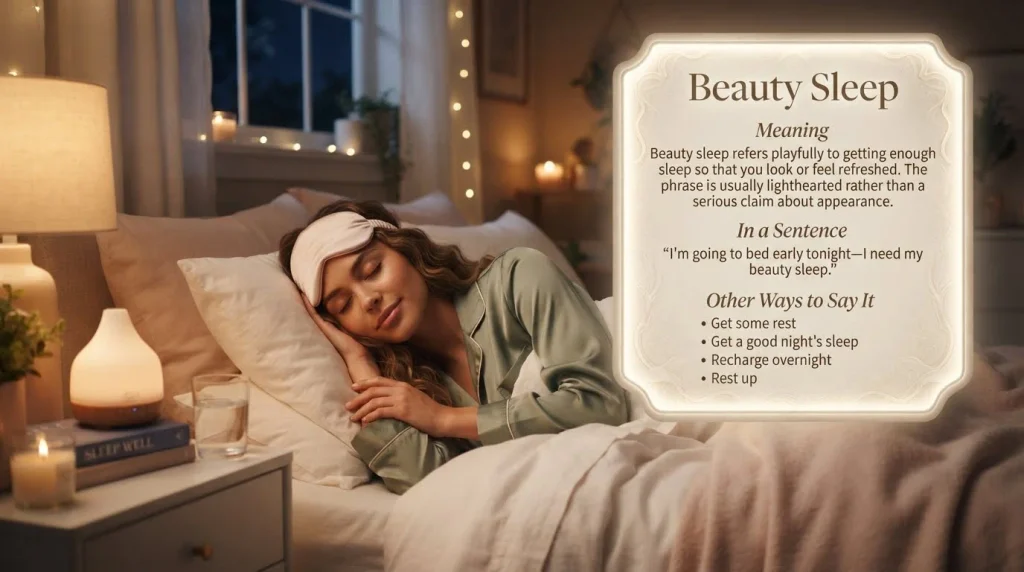
Beauty Sleep
Meaning
Beauty sleep refers playfully to getting enough sleep so that you look or feel refreshed.
The phrase is usually lighthearted rather than a serious claim about appearance.
In a Sentence
“I’m going to bed early tonight—I need my beauty sleep.”
Other Ways to Say It
- Get some rest
- Get a good night’s sleep
- Recharge overnight
- Rest up
Explanation
The expression connects sleep with looking refreshed and well-rested. It is often used humorously when someone wants to protect their bedtime.
It is a playful phrase and is generally more suitable for casual situations than formal writing.
Best Use
Use it in friendly conversations, humorous captions, personal messages, and lighthearted dialogue.
Lose Sleep Over Something
Meaning
Lose sleep over something means to worry about something so much that it affects your ability to sleep.
It describes stress, anxiety, or excessive concern.
In a Sentence
“Don’t lose sleep over one small mistake; you can fix it tomorrow.”
Other Ways to Say It
- Worry about something
- Stress over something
- Be troubled by something
- Let something keep you awake
Explanation
The idiom connects emotional worry with a physical consequence: not being able to rest. It is especially effective because it shows how strongly a problem can affect someone.
Unlike many sleep idioms, this one describes an emotional state rather than sleep itself.
Best Use
It fits conversations, advice, essays, personal messages, and serious storytelling.
Not Sleep a Wink
Meaning
Not sleep a wink means not sleeping at all or getting almost no sleep.
A “wink” here refers figuratively to a very brief moment of sleep.
In a Sentence
“I didn’t sleep a wink because I was worried about the exam.”
Other Ways to Say It
- Stay awake all night
- Get no sleep
- Have a sleepless night
- Be awake until morning
Explanation
The expression uses a tiny amount of sleep as the comparison point. If you do not sleep even a “wink,” you have essentially had no sleep.
It is especially useful when you want to emphasize just how little someone slept.
Best Use
Use it in everyday conversations, personal stories, essays, and descriptions of stressful nights.
Sleep On It
Meaning
Sleep on it means to wait until the next day before making an important decision.
The idea is that getting a night’s rest may give you time and mental space to think clearly.
In a Sentence
“I’m not sure whether I should accept the offer, so I’ll sleep on it.”
Other Ways to Say It
- Think it over
- Take some time to decide
- Give it some thought
- Decide tomorrow
Explanation
This idiom uses sleep as a metaphor for taking a pause before deciding. The phrase does not mean that the person will literally sleep on top of the decision.
It is useful when emotions are strong or a decision deserves careful consideration.
Best Use
It works naturally in conversations, advice, workplace discussions, personal messages, and everyday decision-making.
Sleep In
Meaning
Sleep in means to sleep later than usual, especially in the morning.
It often happens when someone does not have to wake up early for work, school, or another responsibility.
In a Sentence
“It’s Saturday, so I’m planning to sleep in and enjoy a slow morning.”
Other Ways to Say It
- Wake up late
- Stay in bed longer
- Get extra sleep
- Have a late start
Explanation
This expression focuses on when someone wakes up, rather than how deeply they sleep. It often suggests comfort, relaxation, or freedom from an early schedule.
It is common and natural in everyday English.
Best Use
Use it in casual conversation, personal messages, travel writing, lifestyle content, and social media captions.
Sleep Like a Top
Meaning
Sleep like a top means to sleep very deeply and peacefully.
The expression compares deep, steady sleep to a spinning top moving smoothly and steadily.
In a Sentence
“After spending the day outdoors, I slept like a top.”
Other Ways to Say It
- Sleep soundly
- Sleep deeply
- Sleep peacefully
- Have a restful night
Explanation
The image suggests steady, uninterrupted rest. It is similar to “sleep like a log,” but it offers a slightly different image and can sound more playful or old-fashioned.
It may be more familiar in some varieties of English than others.
Best Use
It works best in informal conversation, storytelling, playful writing, and descriptive prose.
Exercise: Practice Using Idioms
Test yourself with these 15 questions. Choose the answer that best fits the meaning or context.
Question 1
What does “hit the hay” mean?
A. Stay awake working until very late
B. Turn in for the night
C. Tidy up the sleeping area
D. Rise from sleep at an early hour
Question 2
Which idiom means to sleep very deeply?
A. Sleep in
B. Sleep on it
C. Count sheep
D. Sleep like a log
Question 3
Someone falls asleep unintentionally while sitting on a sofa. Which expression fits best?
A. Nod off
B. Sleep tight
C. Hit the hay
D. Sleep on it
Question 4
What does “catch some Zs” mean?
A. Study late
B. Take a walk
C. Get some sleep
D. Wake up suddenly
Question 5
Which expression describes trying to fall asleep by imagining and counting animals?
A. Saw logs
B. Count sheep
C. Sleep in
D. Lose sleep over something
Question 6
“I was so exhausted that I was out like a light.”
What does this mean?
A. Darkness filled the entire room
B. Someone switched the light off
C. The speaker suddenly came out of sleep
D. The speaker drifted off almost instantly
Question 7
Which idiom means to take time before making a decision?
A. Sleep on it
B. Hit the sack
C. Catch some Zs
D. Sleep like a top
Question 8
Which sentence uses “lose sleep over something” correctly?
A. I lost sleep over my favorite pillow.
B. I lost sleep over the new blanket’s color.
C. I wouldn’t lose sleep over one small error.
D. I lost sleep over going to bed early.
Question 9
What does “not sleep a wink” suggest?
A. Sleeping very comfortably
B. Getting almost no sleep
C. Taking a short afternoon nap
D. Sleeping later than usual
Question 10
Which idiom is a warm way to wish someone a good night’s sleep?
A. Saw logs
B. Dead to the world
C. Sleep tight
D. Count sheep
Question 11
A person sleeps later than usual because it is their day off. Which expression is most appropriate?
A. Sleep in
B. Nod off
C. Lose sleep over something
D. Sleep on it
Question 12
Which expression is mainly used humorously to describe loud snoring?
A. Sleep like a baby
B. Saw logs
C. Forty winks
D. Beauty sleep
Question 13
Which sentence uses “sleep like a baby” figuratively?
A. The baby slept in the crib.
B. The baby learned to walk.
C. After the long journey, I slept like a baby.
D. The baby cried during the night.
Question 14
Which expression means taking a short period of sleep?
A. Forty winks
B. Dead to the world
C. Sleep on it
D. Sleep tight
Question 15
Which statement best explains why sleep idioms are useful?
A. They make every sentence more formal.
B. They replace all ordinary sleep vocabulary.
C. They add imagery and personality to communication.
D. They always make writing humorous.
Answers
- B — “Hit the hay” is an informal way to say go to bed or go to sleep.
- D — “Sleep like a log” describes very deep, sound sleep.
- A — “Nod off” means to fall asleep unintentionally or gradually, often while sitting.
- C — “Catch some Zs” is a playful expression meaning get some sleep.
- B — “Count sheep” refers to the traditional imagined activity of counting sheep while trying to fall asleep.
- D — “Out like a light” emphasizes falling asleep very quickly.
- A — “Sleep on it” means to wait and think about a decision before deciding.
- C — “Lose sleep over something” means to worry about something so much that it affects your rest.
- B — “Not sleep a wink” means to get almost no sleep.
- C — “Sleep tight” is a warm expression used to wish someone a good night’s sleep.
- A — “Sleep in” means sleep later than usual, particularly in the morning.
- B — “Saw logs” humorously compares loud snoring with the sound of cutting wood.
- C — “Sleep like a baby” figuratively means to sleep peacefully or soundly.
- A — “Forty winks” means a short sleep or nap.
- C — Idioms make communication more vivid, expressive, and memorable without requiring long explanations.
FAQs
What is an idiom for sleep?
An idiom for sleep is a figurative expression that describes sleeping, falling asleep, waking later, needing rest, or worrying about something that affects sleep. Examples include “hit the hay,” “catch some Zs,” and “sleep like a log.”
How do I create my own sleep idiom?
Start with a familiar image that clearly connects with the feeling you want to describe. For example, deep sleep might be compared with something still, quiet, or heavy, while restless sleep could be connected with movement or noise. A good figurative expression should be easy to understand from its imagery.
What makes a sleep idiom effective?
An effective idiom creates a clear mental picture while communicating a recognizable idea. It should also fit the tone of the situation. A playful expression such as “catch some Zs” may work well in conversation, while a more descriptive phrase may suit poetry or creative writing.
Can I use these sleep idioms in everyday conversation?
Yes. Many of these expressions are natural in everyday English. “Hit the hay,” “catch some Zs,” “sleep in,” “nod off,” and “sleep on it” are particularly useful in informal conversations. Some expressions, such as “saw logs,” have a more humorous tone.
What is the difference between a sleep idiom and a simile?
A sleep idiom is an established expression whose overall meaning may not be literal, such as “hit the hay.” A simile directly compares two things using words such as “like” or “as.” For example, “He slept like a log” is a simile that has also become a familiar idiomatic expression.
Conclusion
Sleep may seem like an ordinary subject, but English gives us many creative ways to describe it. Expressions such as “hit the hay,” “catch some Zs,” “sleep like a log,” “drift off,” and “sleep on it” can communicate much more than the simple word “sleep.” They can show tiredness, comfort, deep rest, worry, hesitation, humor, or the need for a break.
The key is to choose an expression that matches your intended meaning and audience. Some idioms are casual and playful, while others work better in reflective or descriptive writing. Used thoughtfully, figurative language can make even a simple sentence feel more vivid and memorable. When you choose the right sleep idiom, you do more than describe rest you give the reader a clearer picture of the feeling behind it.

Margaret Saywell is an English author and editor who has spent more than fifteen years working with words teaching, proofreading, and writing about the quirks of the English language.
At Idiom Looms, Margaret gathers idioms from across the English-speaking world and weaves them into clear, practical guides. She loves digging into the history of a phrase and showing readers how a few well-chosen words can say far more than a long explanation.
She believes language should be enjoyed, not feared and that the best way to learn an idiom is to see it in action.