
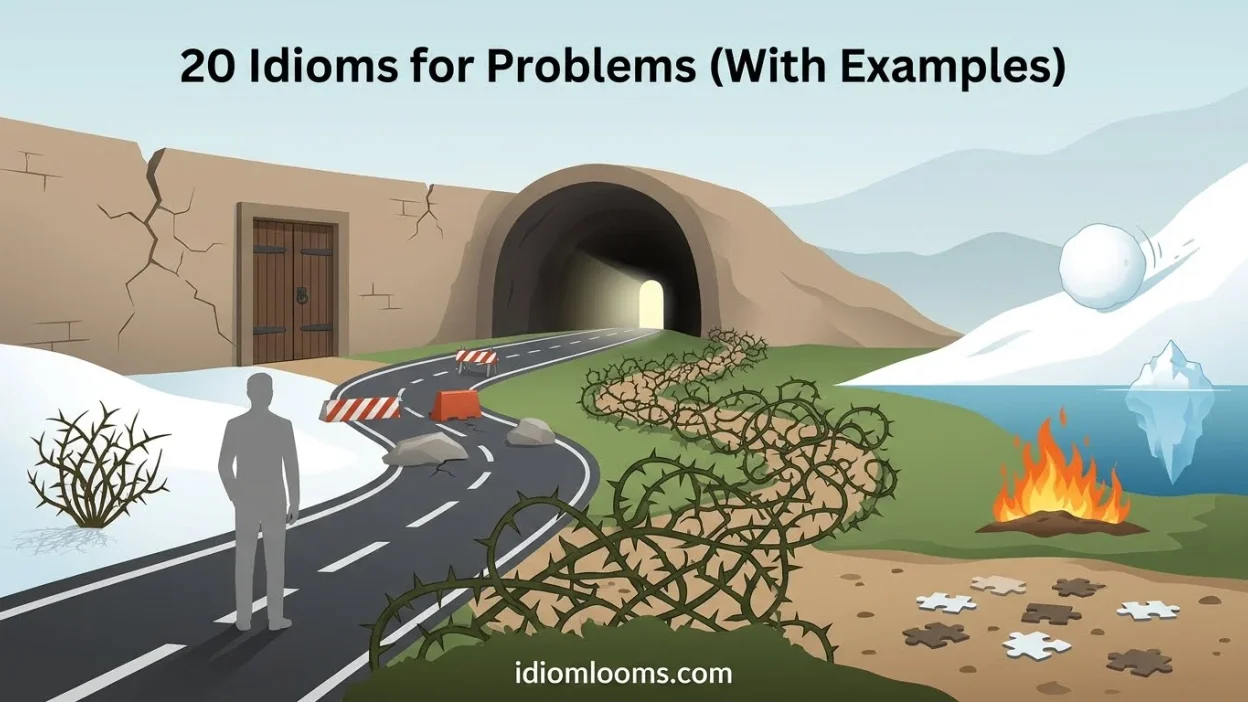
What do you say when a difficult situation suddenly gets in your way? The 20 Idioms for Problems With Real Examples will help you describe challenges, setbacks, pressure, and difficult moments more naturally. English idioms can make everyday conversations more expressive while adding personality to your writing. They are useful when discussing personal struggles, workplace challenges, unexpected obstacles, or complicated situations. Each expression in this guide explains its figurative meaning and shows how it works in real English.
Understanding idioms for problems can also strengthen English usage, grammar, and formal writing. These expressions can make business communication, meetings, and professional conversations sound clearer and more natural. They may also appear when discussing scheduling, time management, online booking, broadcasting, or project management challenges. Learning the right phrase for each situation helps you communicate ideas with greater consistency and confidence.
In this guide, you will discover 20 practical idioms connected with problems and difficult situations. Each idiom includes a clear meaning, a realistic example sentence, alternative expressions, and guidance on the best context for using it. Whether you are writing an article, preparing for a conversation, managing a calendar, or improving professional English, these examples will make figurative language easier to understand. By the end, you will have a useful collection of expressions for describing problems naturally and effectively.
What Is an Idiom?
An idiom is a common expression whose meaning is different from the literal meaning of the individual words.
For example, if someone says, “I’m feeling under the weather,” they usually do not mean that they are physically underneath the sky. The idiom means that they feel unwell.
Another example is “break the ice.” It does not literally mean breaking frozen water. It means making people feel more comfortable in a new or awkward situation.
Idioms are a form of figurative language. They use familiar images, comparisons, or situations to communicate an idea in a way that is often more memorable than a plain statement.
Why Use Idioms for Problems?
Problems come in many forms. Some are small annoyances, while others are complicated, stressful, or difficult to escape. Idioms help us show these differences without explaining everything in a long sentence.
For example, calling a problem a “thorn in your side” suggests an ongoing irritation. Saying you are “between a rock and a hard place” communicates that both available choices are unpleasant. Describing an issue as “a can of worms” warns that dealing with one problem may uncover several more.
Idioms can help you:
- Express emotions such as frustration, worry, pressure, or hope.
- Make descriptions more vivid and memorable.
- Explain complicated or abstract situations through familiar images.
- Add personality to conversations and storytelling.
- Make essays and creative writing more expressive when used appropriately.
- Communicate a difficult idea in just a few familiar words.
- Show the nature of a problem, rather than simply saying that a problem exists.
Quick List of 20 Idioms for Problems
- A thorn in your side
- Open a can of worms
- A stumbling block
- An uphill battle
- A vicious cycle
- A Catch-22
- A double-edged sword
- The tip of the iceberg
- Open Pandora’s box
- The elephant in the room
- Between a rock and a hard place
- A snowball effect
- Add fuel to the fire
- Paper over the cracks
- Back to the drawing board
- In hot water
- Bite the bullet
- A light at the end of the tunnel
- Lose sleep over something
- Get out of hand
A Thorn in Your Side
Read more:20 Idioms for Hard With Real Examples
Meaning
A thorn in your side describes a person, situation, or problem that causes repeated annoyance, frustration, or difficulty.
The image comes from a thorn that keeps irritating you. The problem may not completely stop you, but it remains bothersome and difficult to ignore.
In a Sentence
The unreliable software has been a thorn in our side throughout the entire project.
Other Ways to Say It
- A constant annoyance
- An ongoing problem
- A persistent obstacle
- Something that keeps causing trouble
Explanation
A thorn is small, but its sharp point can cause continuous discomfort. That makes this idiom useful for problems that are persistent rather than catastrophic.
It works especially well when an issue keeps returning or continues to interfere with progress. The expression has a slightly dramatic but natural conversational tone.
Best Use
This idiom works well in conversations, essays, storytelling, workplace discussions, and opinion writing. It is less suitable for highly formal reports where plain language may be preferable.
Open a Can of Worms
Meaning
Open a can of worms means to start dealing with a problem or question that leads to many more complications.
The image suggests opening a container and discovering that it is full of worms that are difficult to control or organize.
In a Sentence
Changing the old contract could open a can of worms involving several departments.
Other Ways to Say It
- Create more complications
- Uncover more problems
- Make the situation more complicated
- Raise a whole new set of issues
Explanation
This idiom is especially effective when one seemingly simple issue has hidden consequences. It warns that solving one problem may expose several others.
It can also suggest that a person might regret starting the discussion because the situation becomes harder to manage than expected.
Best Use
Use it in conversations, workplace discussions, articles, storytelling, and informal essays. Because it is fairly conversational, it may sound too casual in some highly formal documents.

A Stumbling Block
Meaning
A stumbling block is an obstacle that makes it difficult to make progress or achieve a goal.
The image comes from something lying in your path that causes you to stumble. It does not necessarily end your journey, but it gets in your way.
In a Sentence
Lack of reliable data became a major stumbling block in the research project.
Other Ways to Say It
- An obstacle
- A barrier
- A roadblock
- A difficulty
Explanation
This idiom focuses on the obstructive nature of a problem. It is useful when the main issue is not necessarily disastrous but prevents progress.
Unlike some more dramatic idioms, “stumbling block” can sound relatively professional and measured.
Best Use
It fits naturally in essays, professional communication, academic writing, speeches, and everyday conversation.
An Uphill Battle
Meaning
An uphill battle describes a situation that is very difficult to succeed in, especially because the obstacles seem greater than the advantages.
The image is of trying to climb a steep hill while fighting against gravity.
In a Sentence
Convincing the committee to change the policy will be an uphill battle.
Other Ways to Say It
- A difficult struggle
- A tough challenge
- A hard fight
- A demanding task
Explanation
The phrase creates a strong image of moving forward while facing resistance. It suggests that success is possible, but considerable effort will be required.
It is particularly useful when describing long-term challenges rather than quick or minor problems.
Best Use
This idiom works well in speeches, essays, news-style writing, motivational writing, workplace conversations, and storytelling.
A Vicious Cycle
Meaning
A vicious cycle is a situation in which one problem causes another, which then makes the original problem worse.
Instead of moving toward a solution, the situation keeps repeating itself.
In a Sentence
Late payments create cash-flow problems, and those cash-flow problems lead to more late payments, creating a vicious cycle.
Other Ways to Say It
- A destructive pattern
- A repeating problem
- A downward spiral
- A cycle of difficulties
Explanation
The circular image is important here. The problem does not simply happen once; it feeds itself.
This idiom is particularly useful for explaining situations involving connected causes and consequences. It makes an abstract pattern easier to visualize.
Best Use
Use it in essays, educational writing, professional discussions, journalism, speeches, and everyday conversation.
A Catch-22
Meaning
A Catch-22 is a difficult situation in which you cannot solve a problem because the solution depends on something that the problem itself prevents.
In simple terms, you are trapped by contradictory conditions.
In a Sentence
I need work experience to get the job, but I need the job to gain work experience—it’s a real Catch-22.
Other Ways to Say It
- A no-win situation
- A difficult paradox
- An impossible dilemma
- A frustrating contradiction
Explanation
This idiom describes problems that seem to have no practical way out because each requirement conflicts with another.
It is often used humorously or with frustration. The expression is especially effective when explaining bureaucratic, institutional, or complicated personal situations.
Best Use
It works well in conversation, opinion writing, essays, workplace discussions, and storytelling. It is less appropriate when the audience may not be familiar with the expression.
A Double-Edged Sword
Meaning
A double-edged sword describes something that has both advantages and disadvantages. It can help solve one problem while creating another.
The image comes from a sword with sharp edges on both sides.
In a Sentence
Working from home can be a double-edged sword because it offers flexibility but can also blur the boundary between work and personal time.
Other Ways to Say It
- A mixed blessing
- A trade-off
- A benefit with drawbacks
- Something with two sides
Explanation
This expression is useful when a situation cannot be described as simply good or bad. One side may provide a solution while another side introduces a new difficulty.
It encourages readers or listeners to think about the full consequences of a decision.
Best Use
Use it in essays, speeches, discussions, analysis, professional writing, and thoughtful conversations.
The Tip of the Iceberg
Meaning
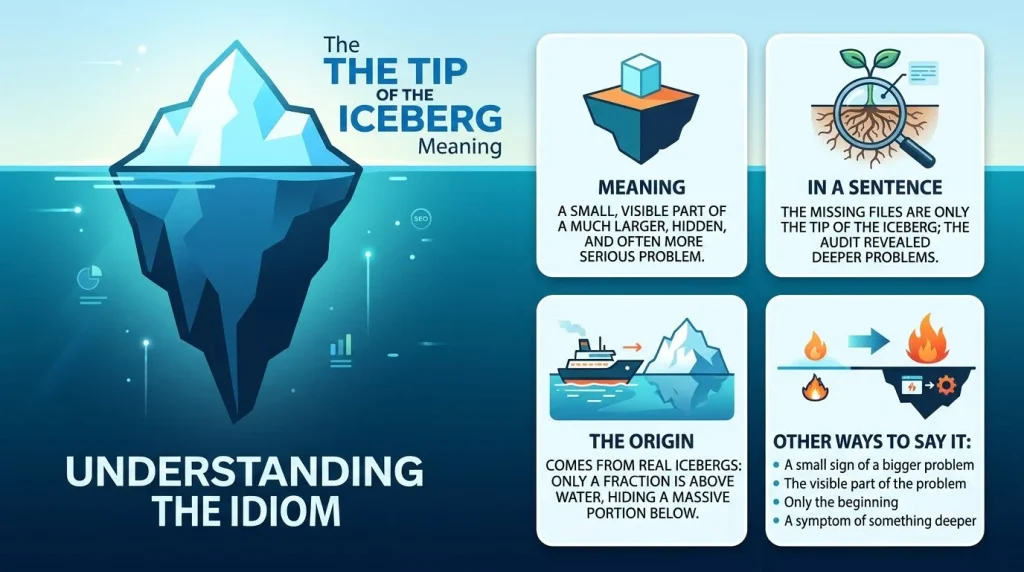
The tip of the iceberg refers to a small, visible part of a much larger and often more serious problem.
The image comes from an iceberg: only a small portion is visible above the water, while most of it remains hidden underneath.
In a Sentence
The missing files are only the tip of the iceberg; the audit has revealed much deeper problems.
Other Ways to Say It
- A small sign of a bigger problem
- The visible part of the problem
- Only the beginning
- A symptom of something deeper
Explanation
This idiom is powerful because it contrasts what people can see with what remains hidden.
It is ideal when a minor issue is actually evidence of broader difficulties. The image immediately suggests that the situation may be much larger than it first appears.
Best Use
It works especially well in journalism, essays, reports, speeches, investigations, and serious conversations.
Open Pandora’s Box
Meaning
Open Pandora’s box means to do something that creates many unexpected problems or complications that are difficult to control afterward.
The expression comes from the ancient Greek story of Pandora, whose box released troubles into the world when it was opened.
In a Sentence
Ignoring the safety rules may open Pandora’s box and create problems we cannot easily reverse.
Other Ways to Say It
- Trigger a chain of problems
- Create unforeseen complications
- Set off new difficulties
- Unleash a series of problems
Explanation
This expression has a dramatic quality. It suggests that once a particular action is taken, there may be no easy way to return to the previous situation.
It is stronger than simply saying that something “may cause problems,” so it should be reserved for situations with potentially broad consequences.
Best Use
It fits storytelling, opinion pieces, speeches, essays, discussions, and dramatic writing. It can sound somewhat literary in casual conversation.
The Elephant in the Room
Meaning
The elephant in the room is an obvious and important problem that everyone knows about but people are avoiding or refusing to discuss.
The image is deliberately exaggerated: imagine a huge elephant standing in a room while everyone pretends not to notice it.
In a Sentence
The team’s declining performance is the elephant in the room, but nobody wants to discuss the real reason.
Other Ways to Say It
- An obvious issue nobody addresses
- An unspoken problem
- A difficult subject everyone avoids
- The issue no one wants to mention
Explanation
The humor of the image makes the expression memorable. It emphasizes the strange contrast between a very obvious problem and people’s unwillingness to acknowledge it.
The idiom often carries a tone of frustration, criticism, or gentle humor.
Best Use
Use it in conversations, opinion writing, speeches, workplace discussions, articles, and social commentary.
Between a Rock and a Hard Place
Meaning
Between a rock and a hard place describes being stuck between two difficult choices or unpleasant situations.
Whichever option you choose, there is likely to be a serious drawback.
In a Sentence
We were between a rock and a hard place: cancel the event and disappoint everyone, or continue and risk losing money.
Other Ways to Say It
- In a no-win situation
- Faced with two bad choices
- In a difficult dilemma
- Caught between two difficult options
Explanation
The image is simple and physical: there is something solid on one side and something equally difficult on the other. There is no comfortable escape.
This idiom focuses on decision-making problems rather than problems with only one obvious cause.
Best Use
It works naturally in conversation, storytelling, personal writing, speeches, and essays.
A Snowball Effect
Meaning
A snowball effect happens when a small problem or action grows larger and more serious over time.
The image comes from a snowball rolling downhill and gathering more snow as it moves.
In a Sentence
Missing one deadline created a snowball effect, with every unfinished task making the next deadline harder to meet.
Other Ways to Say It
- A chain reaction
- A growing problem
- An escalating situation
- One thing leading to another
Explanation
The strength of this idiom lies in its sense of gradual growth. The original problem may be small, but failing to address it allows the consequences to build.
It is useful when explaining how minor mistakes or delays can eventually become major difficulties.
Best Use
Use it in essays, business discussions, educational writing, speeches, and everyday conversation.
Add Fuel to the Fire
Meaning
Add fuel to the fire means to do or say something that makes an already difficult or tense situation even worse.
The image is of adding fuel to a fire and causing the flames to grow.
In a Sentence
Arguing with the frustrated customers only added fuel to the fire.
Other Ways to Say It
- Make matters worse
- Escalate the situation
- Increase the tension
- Pour oil on the fire
Explanation
This idiom is strongly connected with conflict and emotional tension. It suggests that a problem is already burning and someone’s actions make it more intense.
It can describe words, actions, decisions, or events that increase an existing problem.
Best Use
It is especially natural in conversations, storytelling, news commentary, social situations, and conflict-related writing.
Paper Over the Cracks
Meaning
Paper over the cracks means to hide or temporarily cover a problem instead of properly solving its underlying cause.
The image comes from covering cracks in a wall so they are less visible without actually repairing the damage.
In a Sentence
Cutting corners on maintenance may paper over the cracks, but the building will eventually need proper repairs.
Other Ways to Say It
- Hide the problem
- Cover up the weakness
- Treat the symptoms
- Avoid the underlying issue
Explanation
This idiom is useful when someone applies a temporary fix instead of dealing with the real cause.
It often carries a critical tone because the surface may look better while the underlying problem remains.
Best Use
It works particularly well in essays, workplace discussions, political commentary, reports, and analytical writing.
Back to the Drawing Board
Meaning
Back to the drawing board means that an idea, plan, or solution has failed, so you need to start planning again.
The image comes from returning to the place where a design or plan is first developed.
In a Sentence
The prototype failed the safety test, so the engineers are back to the drawing board.
Other Ways to Say It
- Start again
- Rethink the plan
- Develop a new approach
- Go back to the planning stage
Explanation
Unlike idioms that focus on frustration alone, this expression emphasizes what happens after a solution fails.
It can suggest disappointment, but it also carries an important sense of possibility: the next attempt may work better.
Best Use
Use it in business, engineering, education, creative projects, conversations, and problem-solving discussions.
In Hot Water
Meaning
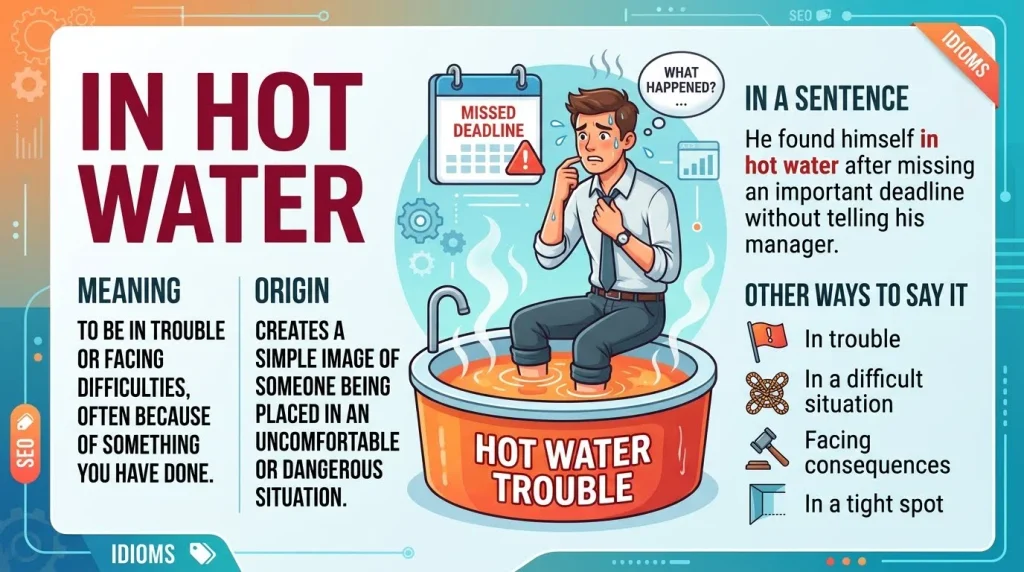
In hot water means to be in trouble or facing difficulties, often because of something you have done.
The phrase creates a simple image of someone being placed in an uncomfortable or dangerous situation.
In a Sentence
He found himself in hot water after missing an important deadline without telling his manager.
Other Ways to Say It
- In trouble
- In a difficult situation
- Facing consequences
- In a tight spot
Explanation
This is a relatively light and conversational way to describe trouble. It can refer to personal, professional, social, or practical difficulties.
Because it often sounds less severe than “in serious danger,” it is useful when the situation is uncomfortable but not necessarily catastrophic.
Best Use
It is best suited to everyday conversation, informal writing, storytelling, and light workplace communication.
Bite the Bullet
Meaning
Bite the bullet means to face a difficult or unpleasant situation with courage, especially when there is no easy alternative.
The expression suggests accepting something painful rather than avoiding it.
In a Sentence
We knew the repairs would be expensive, so we decided to bite the bullet and fix the problem properly.
Other Ways to Say It
- Face the problem
- Do what needs to be done
- Accept the difficult choice
- Confront the situation
Explanation
This idiom is less about describing the problem itself and more about responding to it bravely.
It suggests that avoiding the issue will not help, so it is time to accept the unpleasant reality and take action.
Best Use
It works well in conversation, motivational writing, speeches, personal messages, and practical discussions.
A Light at the End of the Tunnel
Meaning
A light at the end of the tunnel represents hope after a long or difficult period.
The tunnel symbolizes hardship, while the light suggests that the difficult period may finally be approaching its end.
In a Sentence
After months of delays, the project is finally moving again, and we can see a light at the end of the tunnel.
Other Ways to Say It
- A sign of hope
- An end in sight
- Better days ahead
- A hopeful outcome
Explanation
This idiom gives a problem a hopeful dimension. Instead of focusing only on the difficulty, it emphasizes the possibility that the struggle will eventually end.
It can make serious writing feel more encouraging without pretending that the problem is easy.
Best Use
It is especially effective in speeches, personal messages, motivational writing, storytelling, and supportive conversations.
Lose Sleep Over Something
Meaning
To lose sleep over something means to worry about a problem so much that it affects your peace of mind.
The expression is usually figurative, although serious worry can sometimes genuinely interfere with sleep.
In a Sentence
Try not to lose sleep over one small mistake; you can correct it tomorrow.
Other Ways to Say It
- Worry about something
- Stress over an issue
- Be deeply concerned
- Let something weigh on your mind
Explanation
This expression connects a problem with its emotional effect. It shows that an issue is occupying someone’s thoughts even when they should be resting.
It is useful when the focus is on anxiety rather than the practical details of the problem.
Best Use
Use it in personal conversations, supportive messages, storytelling, and informal writing. It has a warm, conversational quality.
Get Out of Hand
Meaning
Get out of hand means that a situation becomes difficult to control.
A problem may start small but gradually become more chaotic, intense, or serious.
In a Sentence
The disagreement started calmly, but it quickly got out of hand.
Other Ways to Say It
- Become uncontrollable
- Escalate
- Get worse
- Go beyond control
Explanation
This idiom focuses on loss of control rather than the original cause of the problem. It can describe arguments, expenses, crowds, workloads, emotions, or other situations.
It is a common and flexible expression, making it useful when a situation changes from manageable to difficult.
Best Use
It works naturally in everyday conversation, storytelling, workplace communication, news writing, and social situations.
Exercise: Practice Using Idioms
Choose the best answer for each question.
What does “a thorn in your side” usually describe?
A. A pleasant surprise
B. A persistent annoyance
C. A sudden opportunity
D. A successful plan
Which idiom describes a problem that may reveal many additional problems?
A. Bite the bullet
B. In hot water
C. Open a can of worms
D. A light at the end of the tunnel
If something is a “stumbling block,” what does it do?
A. It helps you finish quickly.
B. It creates an obstacle to progress.
C. It hides a successful solution.
D. It guarantees failure.
What does “an uphill battle” suggest?
A. The situation will require significant effort.
B. The problem has already been solved.
C. The task is completely impossible.
D. The situation is becoming more relaxing.
Which idiom describes a pattern in which one problem causes another and the cycle continues?
A. A vicious cycle
B. The elephant in the room
C. Bite the bullet
D. Back to the drawing board
A “Catch-22” is best described as:
A. A problem caused by an unexpected accident
B. A situation involving two equally good choices
C. A situation trapped by contradictory conditions
D. A problem that disappears with time
If something is “a double-edged sword,” what does it have?
A. Only negative consequences
B. Both benefits and drawbacks
C. No practical value
D. A hidden solution
What does “the tip of the iceberg” suggest?
A. The visible problem may be only a small part of a larger one.
B. The problem is completely harmless.
C. The situation has already ended.
D. The solution is immediately obvious.
What does it mean to “open Pandora’s box”?
A. Resolving multiple issues in one attempt
B. Steering clear of a challenging discussion
C. Bringing up numerous unforeseen complications
D. Going back to a previous solution
If something is “the elephant in the room,” what is happening?
A. Everyone is discussing a minor issue.
B. An obvious problem is being avoided.
C. A difficult task has been completed.
D. A problem has become easier to control.
Someone who is “between a rock and a hard place” is:
A. Choosing between two pleasant opportunities
B. Stuck between two difficult choices
C. Looking for a simple answer
D. Avoiding all responsibility
What does a “snowball effect” describe?
A. A problem that gradually grows larger
B. A problem that immediately disappears
C. A decision that has no consequences
D. A solution that works perfectly the first time
If someone’s actions “add fuel to the fire,” they:
A. Calm the situation
B. Solve the underlying problem
C. Make an existing problem worse
D. Hide the problem successfully
What does “back to the drawing board” mean?
A. Marking an achievement with a celebration
B. Giving up on a project for good
C. Developing a fresh plan after a setback
D. Overlooking a serious cautionary signal
If a person is “in hot water,” they are usually:
A. In trouble
B. Very relaxed
C. Completely successful
D. Feeling physically cold
Answers
- B — “A thorn in your side” describes something that repeatedly causes irritation or difficulty.
- C — “Open a can of worms” means starting something that leads to additional complications.
- B — A “stumbling block” is an obstacle that prevents or slows progress.
- A — “An uphill battle” suggests that success will require considerable effort because the circumstances are difficult.
- A — A “vicious cycle” occurs when problems cause one another and continue reinforcing the pattern.
- C — A “Catch-22” is a difficult situation in which contradictory conditions make it hard or impossible to escape.
- B — A “double-edged sword” has both positive and negative effects.
- A — “The tip of the iceberg” means the visible problem is only a small part of a larger situation.
- C — “Open Pandora’s box” means triggering or uncovering many unexpected problems or complications.
- B — “The elephant in the room” is an obvious issue that people avoid discussing.
- B — Being “between a rock and a hard place” means facing two difficult choices or situations.
- A — A “snowball effect” describes something that grows progressively larger or more serious.
- C — “Add fuel to the fire” means making an existing conflict or problem worse.
- C — “Back to the drawing board” means starting the planning process again after an approach fails.
- A — Being “in hot water” means being in trouble or facing difficulties.
FAQs
What is an idiom for problems?
An idiom for problems is a figurative expression that describes difficulty, conflict, obstacles, worry, or complicated situations through an image or comparison. Examples include “a stumbling block,” “a vicious cycle,” and “between a rock and a hard place.”
How do I create my own idiom?
Creating an original figurative expression starts with identifying the exact feeling or situation you want to communicate. Then choose a clear physical image that represents it. For example, if you want to describe a problem that keeps returning, you might imagine a door that keeps swinging open. However, newly invented expressions may not function as established idioms unless other speakers adopt and understand them.
What makes an idiom effective?
An effective idiom creates a clear mental picture while communicating an idea naturally. It should fit the situation, be understandable from context, and add something beyond a plain statement. The best expressions make a complicated feeling or situation easier to picture and remember.
Can I use these idioms in everyday conversation?
Yes. Many of these expressions, including “in hot water,” “get out of hand,” “bite the bullet,” and “open a can of worms,” are natural in everyday English. More dramatic expressions, such as “open Pandora’s box,” may sound more literary depending on the context.
What is the difference between an idiom and a simile?
An idiom is an established expression whose overall meaning is understood beyond its literal words. A simile directly compares two things, usually with words such as “like” or “as.” For example, “He is in hot water” is an idiom meaning he is in trouble, while “The problem spread like wildfire” is a simile comparing the speed of the problem to the spread of fire.
Conclusion
Problems can be frustrating, confusing, stressful, or even overwhelming, but the right figurative expression can make them much easier to describe. The 20 idioms in this article offer different perspectives: “a thorn in your side” highlights persistent irritation, “a vicious cycle” shows how problems reinforce one another, and “between a rock and a hard place” captures the pressure of difficult choices. Other expressions, such as “a light at the end of the tunnel,” bring hope to challenging situations.
The key is to choose an idiom that matches the feeling and context rather than using figurative language simply for decoration. A well chosen expression can make an ordinary sentence more vivid, memorable, and human. When problems are difficult to explain directly, the right image can sometimes say what plain words cannot.

Eleanor Prose is a writer and English teacher with a soft spot for the phrases that trip us up. She has spent years helping students and professionals use idioms with confidence not just memorizing them, but understanding the culture and humor behind each one.
Through Idiom Looms, Eleanor explores the threads that connect language, history, and everyday conversation. Her goal is simple: to make English idioms clear, memorable, and actually fun to use.
She writes from a quiet desk surrounded by notebooks, and firmly believes there’s an idiom for every situation usually more than one.


[…] Read more:20 Idioms for Problems With Real Examples […]
[…] Read more:20 Idioms for Problems With Real Examples […]