
Have you ever struggled to describe a situation when the answer simply is not clear? 20 Idioms for Uncertainty With Real Examples introduces natural expressions that help you communicate doubt, hesitation, and unpredictable situations more effectively. These idioms add depth to everyday English usage while making conversations sound more fluent and expressive. They can also strengthen grammar, vocabulary, and confidence when discussing unclear outcomes.
Uncertainty appears in many settings, from personal conversations to business communication, meetings, and project management. The right expression can explain hesitation without making your message sound vague or repetitive. These phrases can also fit discussions about scheduling, time management, a changing calendar, or online booking plans. In creative contexts such as broadcasting, storytelling, and formal writing, idiomatic language can make ideas more engaging while maintaining clarity and consistency.
In this guide, you will explore 20 useful idioms related to uncertainty, along with clear meanings and real examples. Each expression is explained in simple language so you can understand its figurative meaning, tone, and practical use. You will also discover alternative phrases and suitable contexts for using each idiom naturally. Whether you are improving vocabulary, refining professional communication, or developing stronger descriptive writing, these expressions can help you express uncertainty with greater precision and confidence.
What Is an Idiom?
An idiom is a fixed expression whose meaning is different from the literal meaning of its individual words.
For example, if someone says, “It’s raining cats and dogs,” they do not mean animals are falling from the sky. They mean that it is raining very heavily.
Similarly, “break the ice” does not literally mean breaking frozen water. It means to make people feel more comfortable when they first meet.
Idioms are a form of figurative language. They allow speakers and writers to communicate ideas, emotions, and situations through familiar images rather than direct statements.
Why Use Idioms for Uncertainty?
Uncertainty can be difficult to describe because it is often an abstract emotional state. You may feel unsure about a decision, uncertain about someone’s intentions, or unable to predict what comes next.
Idioms make these situations easier to picture.
They can help you:
- Express doubt or hesitation naturally.
- Give an unclear situation a vivid image.
- Describe complicated feelings in a few words.
- Make essays, stories, and speeches more memorable.
- Add personality to everyday conversations.
- Show the difference between mild doubt and serious uncertainty.
- Make creative writing more expressive without becoming overly complicated.
The right expression can also reveal how the uncertainty feels. Being “on the fence” suggests hesitation, while being “in the dark” suggests a lack of information. “In uncharted waters” emphasizes the unfamiliar nature of a situation.
Quick List of 20 Idioms
- p in the air
- On the fence
- In two minds
- In limbo
- UWait and see
- Play it by ear
- Hedge your bets
- Keep your options open
- In the dark
- At sea
- In uncharted waters
- A question mark
- A wild card
- Touch and go
- On shaky ground
- Back and forth
- Time will tell
- Read the tea leaves
- Not know which way the wind will blow
- Leave someone hanging
Up in the Air
Read more:20 Idioms for Achievement With Real Examples
Meaning
When something is up in the air, it has not been decided, settled, or confirmed yet. The expression creates the image of something floating without a definite place to land.
In a Sentence
Our travel plans are still up in the air because we have not received confirmation from the airline.
Other Ways to Say It
- Still undecided
- Not settled yet
- Still uncertain
- Yet to be determined
Explanation
This idiom works well when the outcome depends on a future decision or event. It communicates open-ended uncertainty without necessarily suggesting that anything is going wrong.
The expression is common enough for everyday speech, so it usually sounds natural rather than overly poetic.
Best Use
Best for: Conversations, emails, workplace discussions, essays, and everyday writing.
On the Fence
Meaning
Being on the fence means being unable or unwilling to choose between two options. It suggests hesitation and indecision.
In a Sentence
I’m still on the fence about accepting the offer because both choices have advantages.
Other Ways to Say It
- Undecided
- Hesitating over a choice
- Unsure which option to choose
- Torn between two choices
Explanation
The image is simple: someone sitting on a fence has not moved to either side. That makes this idiom particularly effective for decisions involving two competing possibilities.
It is generally casual and conversational, although it can also work in informal professional writing.
Best Use
Best for: Conversations, personal messages, opinion pieces, and informal essays.
In Two Minds
Meaning
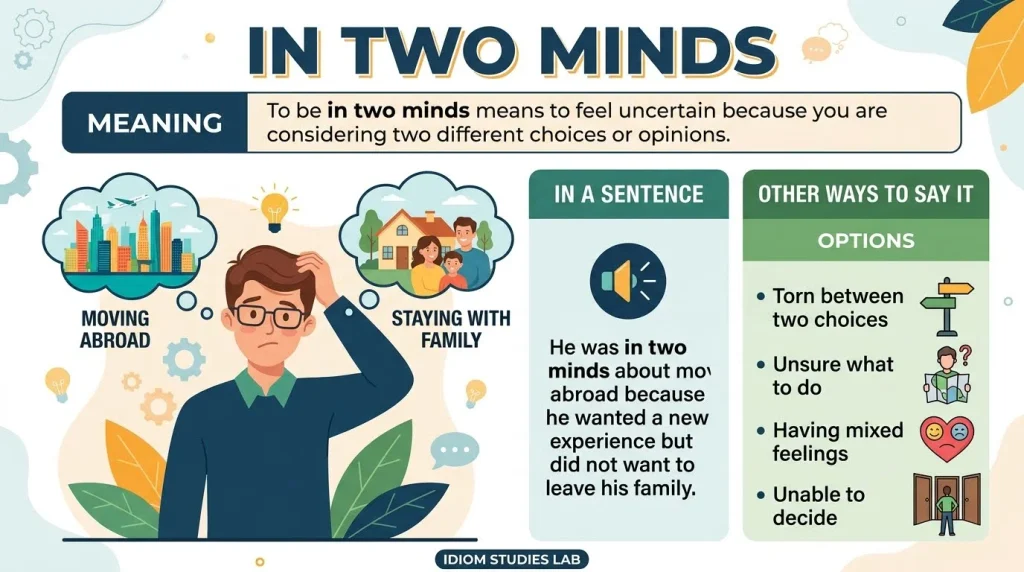
To be in two minds means to feel uncertain because you are considering two different choices or opinions.
In a Sentence
He was in two minds about moving abroad because he wanted a new experience but did not want to leave his family.
Other Ways to Say It
- Torn between two choices
- Unsure what to do
- Having mixed feelings
- Unable to decide
Explanation
This idiom presents uncertainty as an internal disagreement between two thoughts. It is especially useful when someone wants two different things at the same time.
The expression is more common in British English than in American English, where “of two minds” is also understood.
Best Use
Best for: Personal writing, conversations, storytelling, and reflective essays.
In Limbo
Meaning
Being in limbo means being in an uncertain state where you cannot move forward because you are waiting for something to be decided or resolved.
In a Sentence
After the company postponed the announcement, the employees were left in limbo for several weeks.
Other Ways to Say It
- In an uncertain position
- Waiting for a decision
- In a state of suspension
- Stuck between stages
Explanation
“In limbo” suggests more than ordinary doubt. It often describes a situation where progress has stopped and someone has little control over what happens next.
It can carry a serious or frustrating tone, making it useful when uncertainty has become emotionally or practically difficult.
Best Use
Best for: Essays, journalism, workplace communication, storytelling, and serious conversations.
Wait and See
Meaning
Wait and see means to delay making a judgment or decision until more information becomes available.
In a Sentence
We don’t know whether the new policy will work, so for now, we’ll wait and see.
Other Ways to Say It
- See what happens
- Wait for more information
- Hold off for now
- Let events unfold
Explanation
Unlike some uncertainty idioms, “wait and see” does not necessarily express fear or confusion. Instead, it suggests a patient response to an unknown outcome.
It is straightforward and natural, making it one of the easiest expressions to use in everyday English.
Best Use
Best for: Conversations, advice, discussions, and informal writing.
Play It by Ear
Meaning
To play it by ear means to deal with a situation as it develops rather than making a firm plan in advance.
In a Sentence
We haven’t decided what to do after lunch; we’ll play it by ear depending on the weather.
Other Ways to Say It
- Decide as you go
- Take things as they come
- Stay flexible
- Make plans later
Explanation
The idiom comes from the idea of responding to music without relying on written notes. Applied to uncertainty, it suggests flexibility instead of rigid planning.
It usually has a relaxed tone. It can imply that uncertainty is manageable rather than frightening.
Best Use
Best for: Casual conversations, travel plans, social situations, and storytelling.
Hedge Your Bets
Meaning
To hedge your bets means to reduce your risk by preparing for more than one possible outcome.
In a Sentence
She applied to several universities to hedge her bets in case her first choice did not accept her.
Other Ways to Say It
- Protect yourself against risk
- Prepare for different outcomes
- Keep a backup plan
- Cover both possibilities
Explanation
The expression comes from betting and suggests that you do not place all your confidence in one outcome. It describes practical uncertainty management rather than simple confusion.
The phrase can sometimes sound strategic or calculating, so it works best when discussing decisions, risks, or competing possibilities.
Best Use
Best for: Business discussions, decision-making, financial contexts, and everyday advice.
Keep Your Options Open
Meaning
To keep your options open means not committing to one choice because you want the freedom to consider other possibilities later.
In a Sentence
I’m not signing a long-term contract yet because I want to keep my options open.
Other Ways to Say It
- Avoid committing too soon
- Leave alternatives available
- Stay flexible
- Preserve your choices
Explanation
This expression frames uncertainty as something that can provide freedom and flexibility. Rather than treating indecision as a weakness, it can suggest that someone is wisely waiting before making a commitment.
It is particularly useful when several future paths remain possible.
Best Use
Best for: Career discussions, relationships, planning, negotiations, and everyday conversation.
In the Dark
Meaning
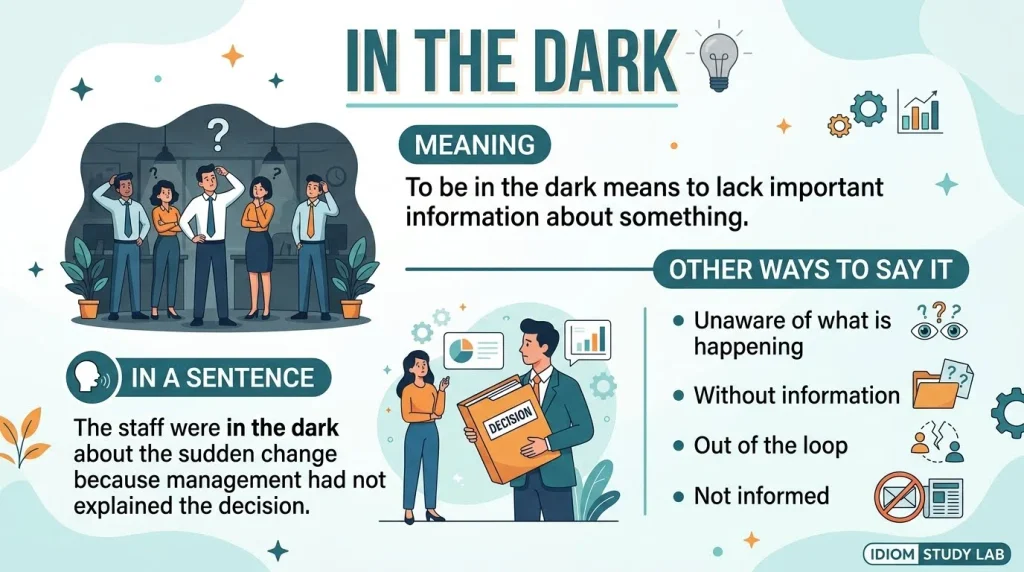
To be in the dark means to lack important information about something.
In a Sentence
The staff were in the dark about the sudden change because management had not explained the decision.
Other Ways to Say It
- Unaware of what is happening
- Without information
- Out of the loop
- Not informed
Explanation
The image of darkness suggests that a person cannot clearly see what is happening around them. Here, uncertainty comes from missing information, not necessarily from having two choices.
This idiom can sound serious when people are deliberately excluded from important information.
Best Use
Best for: Conversations, workplace situations, news writing, and personal stories.
At Sea
Meaning
To be at sea means to feel confused, uncertain, or unsure about what to do.
In a Sentence
Without clear instructions, the new team felt at sea during their first week.
Other Ways to Say It
- Confused
- Unsure how to proceed
- Lost
- Without direction
Explanation
The expression creates the image of someone surrounded by a large ocean without a clear direction. It captures the feeling of being lost in uncertainty.
It is more expressive than simply saying “confused,” so it can add personality to descriptive writing.
Best Use
Best for: Creative writing, storytelling, speeches, and expressive conversations.
In Uncharted Waters
Meaning
Being in uncharted waters means entering a situation that is unfamiliar and for which there is little previous experience or guidance.
In a Sentence
Launching the technology without any previous market data put the company in uncharted waters.
Other Ways to Say It
- Enter unfamiliar territory
- Face a new situation
- Move into unknown territory
- Deal with something unprecedented
Explanation
This idiom comes from the image of sailors exploring waters that have not been mapped. It communicates uncertainty caused by unfamiliar circumstances.
It is particularly effective when someone is facing a challenge for the first time.
Best Use
Best for: Speeches, essays, business writing, journalism, and storytelling.
A Question Mark
Meaning
When something is described as a question mark, it means its outcome, status, or meaning remains uncertain.
In a Sentence
His future with the team remains a question mark after the contract negotiations stalled.
Other Ways to Say It
- An open question
- Still uncertain
- Yet to be decided
- An unresolved issue
Explanation
The question mark is a familiar symbol of uncertainty. Using it figuratively turns an unknown outcome into a clear visual idea.
This expression often sounds concise and slightly dramatic, especially when discussing an unresolved future.
Best Use
Best for: Journalism, sports writing, essays, commentary, and conversations.
A Wild Card
Meaning
A wild card is an unpredictable person, event, or factor that could significantly change the outcome of a situation.
In a Sentence
The weather is the wild card in our plans for the outdoor event.
Other Ways to Say It
- An unpredictable factor
- An unknown variable
- A surprise element
- An unexpected possibility
Explanation
The expression comes from cards that can take on different values in certain games. In everyday language, it describes something whose behavior or effect is difficult to predict.
It is especially useful when most parts of a situation are understood but one factor could change everything.
Best Use
Best for: Sports commentary, business discussions, planning, news writing, and casual conversation.
Touch and Go
Meaning
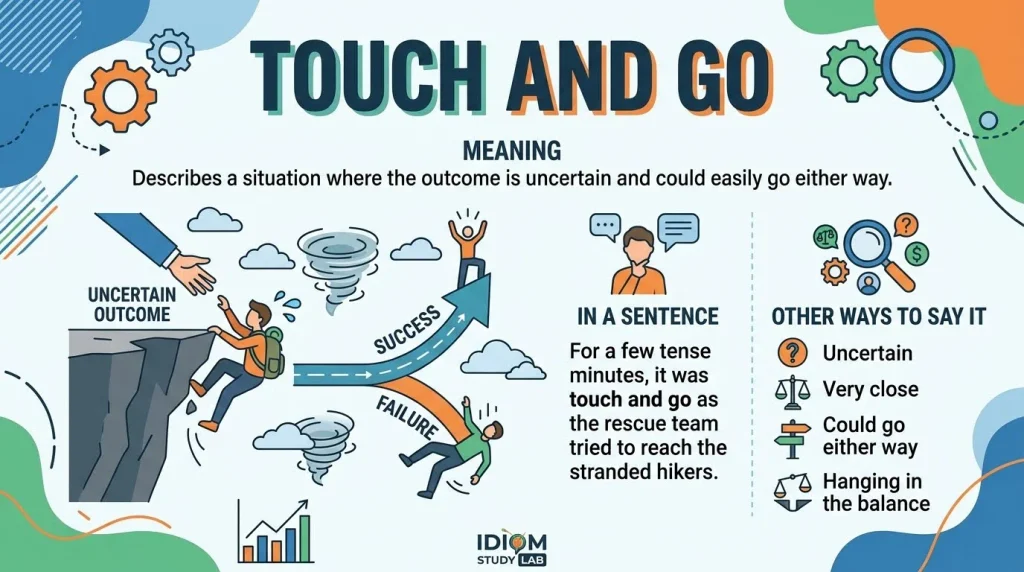
Touch and go describes a situation where the outcome is uncertain and could easily go either way.
In a Sentence
For a few tense minutes, it was touch and go as the rescue team tried to reach the stranded hikers.
Other Ways to Say It
- Uncertain
- Very close
- Could go either way
- Hanging in the balance
Explanation
This idiom often carries a sense of tension and risk. It suggests that a positive or negative outcome is both possible and that circumstances could change quickly.
Because of its dramatic tone, it is stronger than simply saying something is undecided.
Best Use
Best for: Storytelling, sports, dramatic situations, journalism, and tense conversations.
On Shaky Ground
Meaning
To be on shaky ground means to be in an unstable or uncertain position.
In a Sentence
Without reliable evidence, the argument was on shaky ground.
Other Ways to Say It
- In an unstable position
- Lacking a solid foundation
- Vulnerable
- Not secure
Explanation
The image is of standing on ground that may shift beneath your feet. It communicates uncertainty mixed with instability or weakness.
This expression can describe arguments, relationships, plans, agreements, or situations where the foundation is unreliable.
Best Use
Best for: Essays, debates, professional writing, conversations, and analytical contexts.
Back and Forth
Meaning
Back and forth describes repeated movement, discussion, or changes between two positions. In uncertain situations, it can suggest ongoing hesitation or disagreement.
In a Sentence
There was a lot of back and forth before the committee finally agreed on a proposal.
Other Ways to Say It
- Repeated discussion
- Going between alternatives
- Changing positions
- Continued negotiation
Explanation
The phrase creates an image of movement from one side to another. It works particularly well when uncertainty is active and ongoing, rather than simply waiting for an answer.
Unlike “on the fence,” it often involves repeated changes or exchanges.
Best Use
Best for: Conversations, workplace situations, negotiations, storytelling, and informal writing.
Time Will Tell
Meaning
Time will tell means that the truth or outcome will become clear in the future.
In a Sentence
We cannot know whether the decision was wise yet; time will tell.
Other Ways to Say It
- The future will reveal the answer
- We will find out eventually
- Only time can show
- The outcome will become clear later
Explanation
This expression accepts uncertainty rather than trying to eliminate it immediately. It suggests that future events will provide the evidence needed to understand what is true or successful.
It often sounds calm, thoughtful, and slightly reflective.
Best Use
Best for: Conversations, essays, speeches, reflective writing, and conclusions.
Read the Tea Leaves
Meaning
To read the tea leaves means to look for clues and try to predict what is likely to happen.
In a Sentence
Investors are reading the tea leaves to determine whether the market may recover.
Other Ways to Say It
- Look for clues
- Try to predict the future
- Interpret signs
- Read between the lines
Explanation
The expression refers to the old practice of interpreting patterns left by tea leaves in a cup. Today, it is usually used figuratively for making predictions from limited evidence.
It can be playful or slightly skeptical, especially when the future is difficult to predict with confidence.
Best Use
Best for: Commentary, journalism, business discussions, storytelling, and informal writing.
Not Know Which Way the Wind Will Blow
Meaning
To not know which way the wind will blow means to be uncertain about how a situation, opinion, or decision will develop.
In a Sentence
The candidates are waiting to see which way public opinion will blow because no one knows which way the wind will blow yet.
Other Ways to Say It
- Not know what will happen
- Be unsure of the direction
- Wait for circumstances to change
- Be uncertain about the outcome
Explanation
The wind can change direction without warning, making it a useful image for unpredictable circumstances. This idiom emphasizes changing conditions and uncertain direction.
It can be particularly effective when people’s opinions, events, or external circumstances are shifting.
Best Use
Best for: Political or social commentary, storytelling, essays, and conversations about changing circumstances.
Leave Someone Hanging
Meaning
To leave someone hanging means to make someone wait for an answer, decision, response, or conclusion.
In a Sentence
Please don’t leave me hanging—let me know whether you accepted the invitation.
Other Ways to Say It
- Keep someone waiting
- Leave someone without an answer
- Delay a response
- Leave something unresolved
Explanation
This expression focuses on the emotional experience of uncertainty. The person waiting does not know what will happen and cannot move forward until an answer arrives.
It is usually informal and conversational, often carrying a mild sense of frustration.
Best Use
Best for: Conversations, messages, social situations, and informal storytelling.
Exercise: Practice Using Idioms
Choose the best answer for each question.
1. If a decision is “up in the air,” what does that mean?
A. It has already been announced.
B. It has not been settled yet.
C. It has been completely forgotten.
D. It is impossible to discuss.
2. Someone who is “on the fence” is usually:
A. Certain about a decision.
B. Angry about a decision.
C. Unable to choose between options.
D. Unaware that a decision exists.
3. Which idiom best describes someone who lacks important information?
A. In the dark
B. Touch and go
C. Time will tell
D. Hedge your bets
4. What does “play it by ear” suggest?
A. Follow a strict plan.
B. Avoid making any decision.
C. Change the subject.
D. Decide as circumstances develop.
5. Which expression describes entering a situation that is unfamiliar?
A. In two minds
B. In uncharted waters
C. Leave someone hanging
D. Back and forth
6. If something is a “wild card,” it is:
A. Completely predictable.
B. Already understood.
C. An unpredictable factor.
D. A settled decision.
7. What does “in limbo” suggest?
A. Being in a settled position.
B. Being stuck in an uncertain state.
C. Making a quick decision.
D. Finding a perfect solution.
8. Which sentence uses “hedge your bets” correctly?
A. We hedged our bets by preparing two possible plans.
B. We hedged our bets because the answer was obvious.
C. She hedged her bets by refusing to consider alternatives.
D. They hedged their bets after the decision was finalized.
9. “Time will tell” suggests that:
A. The answer must be given immediately.
B. The past already provides all the evidence.
C. Future events will reveal the outcome.
D. Nobody should think about the issue.
10. Which idiom suggests that a situation is unstable?
A. On shaky ground
B. Wait and see
C. A question mark
D. Keep your options open
11. If someone is “at sea,” they may be:
A. Traveling by boat.
B. Confused about what to do.
C. Certain about their next step.
D. Waiting for good news.
12. What does “read the tea leaves” mean figuratively?
A. Follow written instructions.
B. Make a decision without thinking.
C. Look for clues about what may happen.
D. Avoid predicting anything.
13. Which idiom best describes repeated movement between two positions?
A. Back and forth
B. In the dark
C. A wild card
D. In limbo
14. If someone says, “Don’t leave me hanging,” what are they asking for?
A. More uncertainty.
B. A quick change of subject.
C. An answer or response.
D. A completely different plan.
15. Which expression best fits a tense situation where the outcome could easily go either way?
A. Keep your options open
B. Touch and go
C. Wait and see
D. In two minds
Answers
- B — “Up in the air” means that something remains undecided or unsettled.
- C — Being “on the fence” means being unable to choose between alternatives.
- A — Someone “in the dark” does not have important information about a situation.
- D — “Play it by ear” means responding to circumstances instead of following a fixed plan.
- B — “In uncharted waters” describes entering an unfamiliar situation without much previous guidance.
- C — A “wild card” is an unpredictable person, event, or factor.
- B — “In limbo” describes a state in which progress or resolution is suspended.
- A — “Hedge your bets” means preparing for different outcomes to reduce risk.
- C — “Time will tell” means that future events will eventually reveal the answer.
- A — “On shaky ground” describes something unstable, weak, or uncertain.
- B — Being “at sea” can mean feeling confused, lost, or unsure how to proceed.
- C — “Read the tea leaves” means interpreting clues to predict what might happen.
- A — “Back and forth” describes repeated movement or changes between positions.
- C — “Leave someone hanging” means making someone wait for a response or conclusion.
- B — “Touch and go” describes a tense situation in which either outcome is possible.
FAQs
What is an idiom for uncertainty?
An idiom for uncertainty is a figurative expression that communicates doubt, indecision, unpredictability, lack of information, or an unresolved outcome. Examples include “up in the air,” “on the fence,” and “in limbo.”
How do I create my own idiom?
Start with the feeling or situation you want to describe. Then connect it to a clear, memorable image. For example, uncertainty about a new experience can be compared with sailing into “uncharted waters.” Effective figurative language should make the underlying idea easier to picture.
What makes an idiom effective?
A strong idiom creates a recognizable mental image while communicating a specific idea. It should also fit the tone and context. “Play it by ear” feels relaxed, while “on shaky ground” can sound more serious.
Can I use these idioms in everyday conversation?
Yes. Many of these expressions, including “up in the air,” “on the fence,” “wait and see,” “play it by ear,” and “in the dark,” are natural in everyday English. More expressive phrases such as “in uncharted waters” may be especially suitable for speeches or creative writing.
What is the difference between an idiom and a simile?
An idiom is a familiar expression with a figurative meaning that cannot always be understood literally, such as “on the fence.” A simile directly compares two things using words such as “like” or “as,” such as “The situation is like walking through fog.” Both can create imagery, but they work differently.
Conclusion
Uncertainty can feel vague, complicated, or difficult to put into words. The right idiom gives that feeling a clear image and recognizable shape. You can be “on the fence” when you cannot decide, “in the dark” when information is missing, “in limbo” when you are waiting for a resolution, or “in uncharted waters” when you are facing something completely unfamiliar. Each expression highlights a different side of uncertainty, so choosing the right one depends on what you want your reader or listener to feel.
Use these expressions naturally rather than forcing them into every sentence. The strongest figurative language is not simply colorful it helps people understand the uncertainty more clearly. Sometimes, when the answer cannot yet be known, the most honest phrase is also the simplest: time will tell.

Margaret Saywell is an English author and editor who has spent more than fifteen years working with words teaching, proofreading, and writing about the quirks of the English language.
At Idiom Looms, Margaret gathers idioms from across the English-speaking world and weaves them into clear, practical guides. She loves digging into the history of a phrase and showing readers how a few well-chosen words can say far more than a long explanation.
She believes language should be enjoyed, not feared and that the best way to learn an idiom is to see it in action.


[…] Read more:20 Idioms for Uncertainty With Real Examples […]