
Have you ever struggled to make your words stand out and keep someone fully engaged? The 20 Idioms for Attention With Real Examples in this guide will help you express focus, interest, awareness, and engagement naturally. These expressions can make everyday English more vivid while strengthening English usage, grammar, and formal writing.
Attention matters in many settings, from business communication and meetings to broadcasting and online conversations. The right idiom can describe careful listening, focused thinking, or someone noticing important details. You will also see how these expressions fit naturally into scheduling, time management, calendar planning, online booking, and project management contexts.
Each idiom includes a clear meaning, a practical example, alternative expressions, and helpful usage guidance. This approach makes learning easier while supporting consistency and confident communication. Whether you are writing an essay, preparing professional content, or improving everyday English, these examples show how to use attention-related idioms naturally and effectively.
What Is an Idiom?
An idiom is a commonly used expression whose meaning cannot always be understood by taking its words literally.
For example, “break the ice” does not mean physically breaking ice. It means to make people feel more comfortable in a social situation. Similarly, “spill the beans” means to reveal a secret rather than literally dropping beans.
Idioms are a form of figurative language. They give ordinary ideas a memorable image or expression. When used well, they can make conversations, essays, stories, speeches, and personal messages feel more natural and expressive.
Why Use Idioms for Attention?
Attention is an abstract idea, but idioms give it something we can picture. They allow us to describe how strongly someone is paying attention, what has attracted their interest, or whether they are listening carefully.
For example, “all ears” creates an image of someone completely ready to listen. “Keep your eyes peeled” suggests careful observation and alertness, while “catch someone’s eye” describes something that quickly attracts notice.
Using these expressions can:
- Make descriptions more vivid and memorable.
- Express different levels of interest or concentration.
- Give conversations a more natural, conversational quality.
- Add personality to creative writing.
- Help explain an abstract feeling through imagery.
- Make speeches and storytelling more engaging.
- Communicate subtle differences between noticing, listening, watching, and concentrating.
Quick List of 20 Idioms
- All ears
- Catch someone’s eye
- Keep your eyes peeled
- Pay close attention
- Have an eye for
- Keep an ear out
- Lend an ear
- Turn a deaf ear
- Have eyes only for
- Hang on every word
- Sit up and take notice
- Take notice
- Have someone’s ear
- Keep your eyes on the ball
- Zero in on
- Focus on
- Draw attention to
- Hold someone’s attention
- Lose sight of
- Have your eye on
All Ears
Read more:20 Idioms for Worried With Real Examples
Meaning
All ears means being completely ready and willing to listen. The expression suggests that a person is giving someone their full attention because they are interested in what is being said.
In a Sentence
“Tell me what happened—I’m all ears.”
Other Ways to Say It
- I’m listening carefully.
- You have my full attention.
- I’m listening.
- Go ahead; I’m listening.
Explanation
The phrase creates a playful image of someone becoming nothing but ears because listening is their only concern. It is especially useful when someone wants to encourage another person to speak freely.
The expression is informal and friendly, so it works particularly well in conversations and personal messages.
Best Use
Best for everyday conversations, storytelling, friendly messages, and dialogue.
Catch Someone’s Eye
Meaning
To catch someone’s eye means to attract someone’s attention, often because something is interesting, attractive, unusual, or noticeable.
In a Sentence
“The bright red sign caught my eye as I walked past the shop.”
Other Ways to Say It
- Attract someone’s attention.
- Get noticed.
- Stand out.
- Grab someone’s attention.
Explanation
This idiom turns attention into a visual image: something seems to reach out and capture a person’s gaze. It is useful when attention happens quickly or naturally, rather than through deliberate concentration.
It can describe people, objects, signs, clothing, advertisements, or anything visually noticeable.
Best Use
Especially effective in descriptions, conversations, travel writing, and storytelling.
Keep Your Eyes Peeled
Meaning
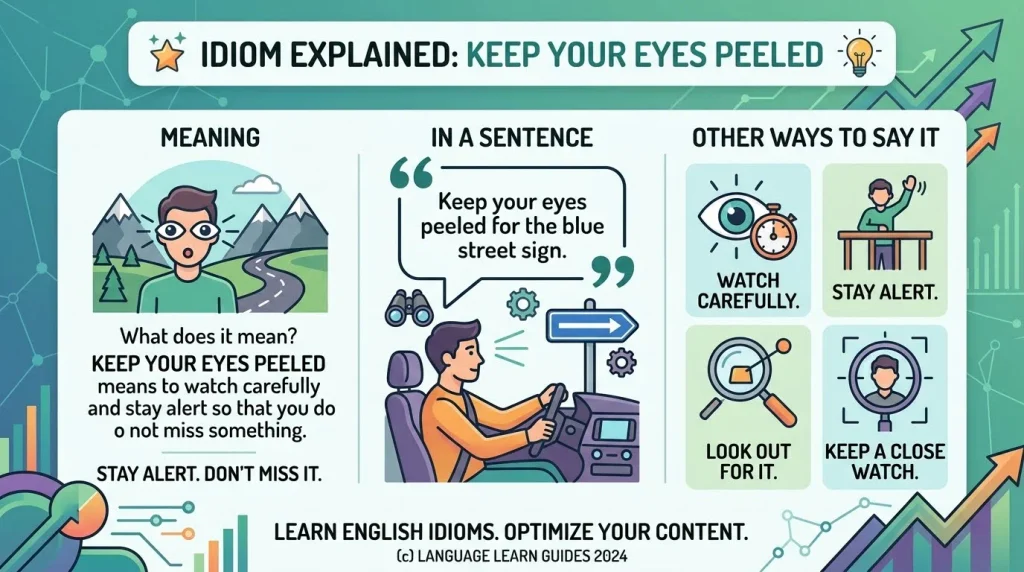
Keep your eyes peeled means to watch carefully and stay alert so that you do not miss something.
In a Sentence
“Keep your eyes peeled for the blue street sign.”
Other Ways to Say It
- Watch carefully.
- Stay alert.
- Look out for it.
- Keep a close watch.
Explanation
The unusual image of “peeled” eyes emphasizes careful observation. It suggests that the person should actively look around rather than casually glance at something.
Although the wording is playful, the meaning can be quite serious when someone needs to notice an important detail.
Best Use
Works well in conversations, instructions, travel situations, stories, and informal writing.
Pay Close Attention
Meaning
To pay close attention means to concentrate carefully on something so that you understand or notice important details.
In a Sentence
“Please pay close attention to the safety instructions before starting.”
Other Ways to Say It
- Listen carefully.
- Focus closely.
- Take careful notice.
- Concentrate on the details.
Explanation
Unlike some colorful idioms, this expression is straightforward and practical. The word “pay” suggests that attention is something valuable that we deliberately give.
It is less figurative than many expressions on this list, but it remains a useful attention-related idiomatic expression in everyday English.
Best Use
Best for classrooms, instructions, speeches, professional communication, and serious conversations.
Have an Eye for
Meaning
To have an eye for something means to have a natural ability to notice and recognize its quality, beauty, or important details.
In a Sentence
“Maria has an eye for unusual interior designs.”
Other Ways to Say It
- Have a good sense for.
- Notice details easily.
- Be skilled at recognizing quality.
- Have good visual judgment.
Explanation
This expression describes more than ordinary attention. It suggests selective and informed observation. Someone with an eye for detail notices things that other people may overlook.
It is often associated with design, art, fashion, photography, writing, and other creative fields.
Best Use
Ideal for creative writing, professional praise, conversations, portfolios, and workplace descriptions.
Keep an Ear Out
Meaning
To keep an ear out means to listen carefully for a particular sound, piece of information, or announcement.
In a Sentence
“Keep an ear out for the announcement about the delayed train.”
Other Ways to Say It
- Listen for it.
- Stay alert for a sound.
- Watch for an announcement.
- Listen carefully.
Explanation
The phrase creates the image of someone keeping one ear ready to detect something important. Unlike “all ears,” it usually involves waiting for specific information rather than listening to an entire conversation.
It is relaxed and conversational.
Best Use
Useful in everyday speech, instructions, travel situations, and informal messages.
Lend an Ear
Meaning
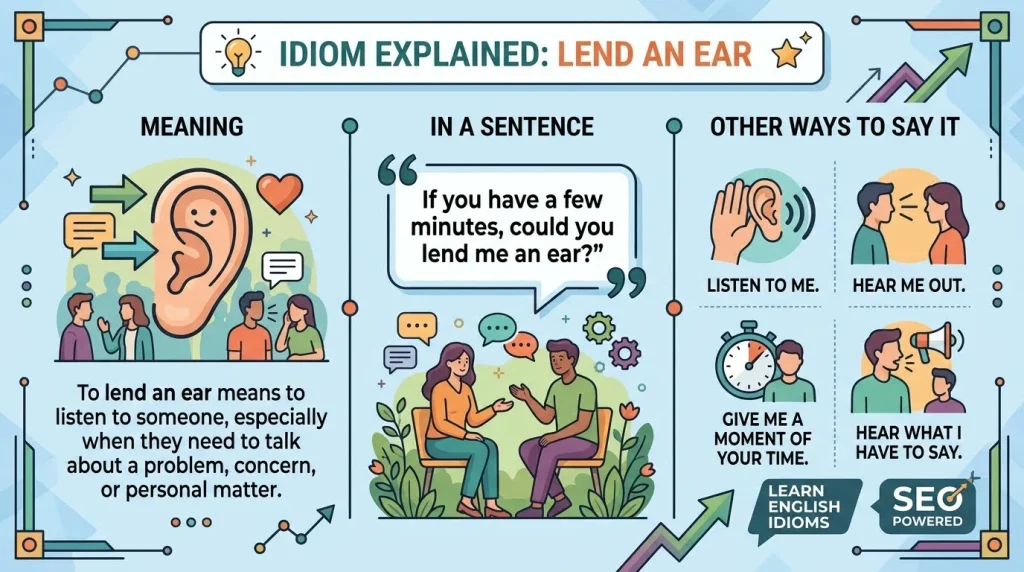
To lend an ear means to listen to someone, especially when they need to talk about a problem, concern, or personal matter.
In a Sentence
“If you have a few minutes, could you lend me an ear?”
Other Ways to Say It
- Listen to me.
- Hear me out.
- Give me a moment of your time.
- Hear what I have to say.
Explanation
The expression treats attention almost like something that can be temporarily lent to another person. It often carries a warm or sympathetic tone.
It is more expressive than simply saying “listen,” although it can sound somewhat literary depending on the situation.
Best Use
Particularly suitable for personal conversations, storytelling, reflective writing, and emotional messages.
Turn a Deaf Ear
Meaning
To turn a deaf ear means to deliberately ignore something, especially a request, warning, complaint, or appeal for help.
In a Sentence
“The manager couldn’t turn a deaf ear to repeated safety complaints.”
Other Ways to Say It
- Ignore a request.
- Refuse to listen.
- Pay no attention.
- Dismiss a concern.
Explanation
The expression creates a strong image of someone deliberately turning away from something they should hear. It often implies intentional indifference, not simply a lack of concentration.
Because it can sound critical, use it carefully when describing a person’s behavior.
Best Use
Strong in essays, criticism, serious discussions, journalism, and persuasive writing.
Have Eyes Only for
Meaning
To have eyes only for someone or something means to be so interested, attracted, or devoted to it that everything else seems less important.
In a Sentence
“During the presentation, he seemed to have eyes only for the new prototype.”
Other Ways to Say It
- Be completely focused on.
- Be strongly attracted to.
- Give all your attention to.
- Be fascinated by.
Explanation
This expression suggests that a person’s gaze and attention are directed toward one particular target. It can be romantic when used about people, but it can also describe intense interest in an object, goal, or activity.
The surrounding context determines whether it sounds romantic, enthusiastic, or simply focused.
Best Use
Works in romantic writing, storytelling, conversations, and expressive descriptions.
Hang on Every Word
Meaning
To hang on every word means to listen with intense interest because you do not want to miss anything being said.
In a Sentence
“The audience hung on every word as the speaker revealed the final details.”
Other Ways to Say It
- Listen intently.
- Listen with great interest.
- Follow every detail.
- Be completely absorbed.
Explanation
The image suggests that listeners are figuratively holding onto each word because every part matters to them. It communicates strong engagement, not merely polite listening.
The expression can make a scene feel dramatic or emotionally charged.
Best Use
Excellent for storytelling, speeches, reviews, creative writing, and dramatic descriptions.
Sit Up and Take Notice
Meaning
To sit up and take notice means to suddenly become more interested or attentive because something important, surprising, or impressive has happened.
In a Sentence
“When the small company won the major contract, investors sat up and took notice.”
Other Ways to Say It
- Pay serious attention.
- Become interested.
- Take something seriously.
- Start noticing.
Explanation
The phrase creates a physical image of someone suddenly sitting upright because something has captured their attention. It is especially useful for describing a change from casual awareness to serious interest.
It often works well when an event makes people reconsider someone or something.
Best Use
Suitable for articles, essays, business writing, storytelling, and conversations.
Take Notice
Meaning
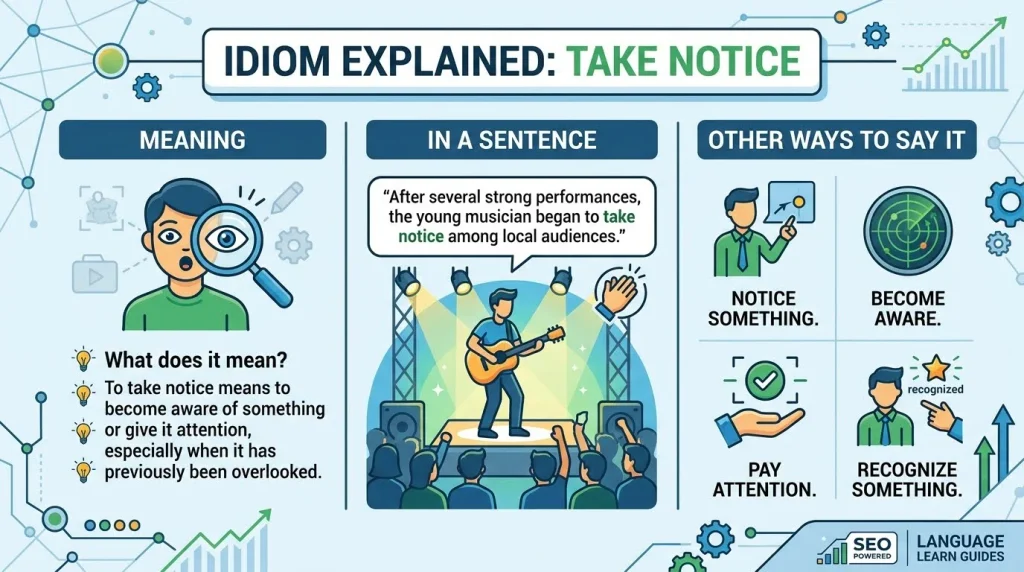
To take notice means to become aware of something or give it attention, especially when it has previously been overlooked.
In a Sentence
“After several strong performances, the young musician began to take notice among local audiences.”
Other Ways to Say It
- Notice something.
- Become aware.
- Pay attention.
- Recognize something.
Explanation
This expression emphasizes the transition from not noticing to noticing. It can describe an individual becoming aware of something or a wider group beginning to recognize a person, idea, or development.
Its tone is generally neutral and flexible.
Best Use
Useful in essays, articles, storytelling, and everyday conversation.
Have Someone’s Ear
Meaning
To have someone’s ear means to have their attention, especially because they are willing to listen to your opinions, suggestions, or concerns.
In a Sentence
“Because of her experience, she has the director’s ear when new ideas are discussed.”
Other Ways to Say It
- Have someone’s attention.
- Have someone’s trust.
- Be listened to.
- Have influence with someone.
Explanation
This expression goes beyond simply getting attention. It can suggest that a person has earned a trusted opportunity to speak and be heard.
It is often used in professional, political, organizational, or influential settings.
Best Use
Best for professional writing, workplace conversations, leadership discussions, and formal commentary.
Keep Your Eyes on the Ball
Meaning
To keep your eyes on the ball means to remain focused on the task, goal, or important issue instead of becoming distracted.
In a Sentence
“We have a tight deadline, so let’s keep our eyes on the ball and finish the project.”
Other Ways to Say It
- Stay focused.
- Keep your goal in mind.
- Avoid distractions.
- Stay on task.
Explanation
The expression comes from sports, where watching the ball helps a player respond correctly. In everyday language, the “ball” represents the main objective or priority.
It is energetic and practical, making it particularly effective when encouraging concentration.
Best Use
Great for workplace communication, coaching, motivational speeches, and everyday conversations.
Zero In On
Meaning
To zero in on something means to focus closely on a particular person, problem, detail, or target.
In a Sentence
“The detective zeroed in on one detail that everyone else had overlooked.”
Other Ways to Say It
- Focus closely on.
- Concentrate on.
- Target.
- Examine carefully.
Explanation
The phrase creates an image of narrowing attention until one specific target is clearly in focus. It suggests deliberate and concentrated attention rather than casual observation.
It is especially useful when someone moves from considering many possibilities to concentrating on one.
Best Use
Works well in journalism, essays, investigations, business discussions, and analytical writing.
Focus On
Meaning
To focus on something means to direct your attention toward it and avoid being distracted by less important matters.
In a Sentence
“For the next hour, I’m going to focus on finishing this report.”
Other Ways to Say It
- Concentrate on.
- Give attention to.
- Center your attention on.
- Work closely on.
Explanation
“Focus on” is one of the clearest expressions for deliberate attention. It does not create a highly unusual image, but its strength is its precision and versatility.
It can describe mental concentration, study, work, discussion, or personal priorities.
Best Use
Appropriate for almost any context, including academic, professional, personal, and everyday communication.
Draw Attention To
Meaning
To draw attention to something means to make people notice it or deliberately point it out.
In a Sentence
“The report draws attention to several problems in the current system.”
Other Ways to Say It
- Point out.
- Highlight.
- Bring attention to.
- Make people notice.
Explanation
This expression describes attention as something that can be pulled toward a particular subject. It is useful when a speaker or writer intentionally wants an audience to notice an issue.
It can be neutral, persuasive, or critical depending on context.
Best Use
Particularly useful in essays, reports, presentations, speeches, journalism, and professional writing.
Hold Someone’s Attention
Meaning
To hold someone’s attention means to keep them interested and focused instead of allowing them to become distracted or bored.
In a Sentence
“The storyteller knew exactly how to hold the children’s attention.”
Other Ways to Say It
- Keep someone interested.
- Keep someone engaged.
- Maintain someone’s focus.
- Keep someone listening.
Explanation
The expression treats attention as something that can be held in place. It is particularly useful when discussing communication, entertainment, teaching, or storytelling.
It highlights sustained attention rather than a brief moment of interest.
Best Use
Excellent for education, presentations, speeches, storytelling, marketing discussions, and creative writing.
Lose Sight Of
Meaning
To lose sight of something can mean to stop seeing it physically, but it can also mean to stop remembering or concentrating on an important idea, goal, or priority.
In a Sentence
“While trying to meet the deadline, we must not lose sight of the project’s main purpose.”
Other Ways to Say It
- Forget about.
- Lose focus on.
- Overlook.
- Stop keeping in mind.
Explanation
This idiom connects physical vision with mental awareness. Losing sight of an idea means allowing it to fade from your attention.
That makes it especially powerful when discussing goals, values, responsibilities, or priorities.
Best Use
Well suited to essays, speeches, professional writing, motivational messages, and serious conversations.
Have Your Eye On
Meaning
To have your eye on something means to be watching, considering, wanting, or planning to obtain it.
In a Sentence
“I’ve had my eye on that camera for months.”
Other Ways to Say It
- Be interested in.
- Be considering.
- Keep watching.
- Have your attention on.
Explanation
The phrase suggests that someone’s attention remains directed toward a particular target over time. It can communicate interest, intention, or desire, depending on context.
It is common in everyday English and sounds natural rather than overly poetic.
Best Use
Best for casual conversations, shopping discussions, personal writing, and everyday messages.
Exercise: Practice Using Idioms
Choose the best answer for each question.
Which idiom means “to listen very carefully”?
A. Turn a deaf ear
B. All ears
C. Lose sight of
D. Draw attention to
If a colorful poster “catches your eye,” what happens?
A. You ignore the poster.
B. You remove the poster.
C. The poster attracts your attention.
D. You memorize the poster.
What does “keep your eyes peeled” suggest?
A. Stay alert and watch carefully.
B. Stop looking around.
C. Close your eyes briefly.
D. Avoid noticing details.
Which expression describes deliberately ignoring a request?
A. Have an eye for
B. Lend an ear
C. Have someone’s ear
D. Turn a deaf ear
Someone who “has an eye for design” is usually good at:
A. Avoiding creative work
B. Noticing visual quality and details
C. Speaking very loudly
D. Ignoring colors
What does “keep an ear out” mean?
A. Wait and listen for something.
B. Stop listening completely.
C. Speak without thinking.
D. Turn away from a speaker.
Which idiom suggests intense interest in everything someone says?
A. Take notice
B. Have your eye on
C. Hang on every word
D. Lose sight of
If someone “sits up and takes notice,” what has happened?
A. They have fallen asleep.
B. They have become suddenly more attentive.
C. They have stopped listening.
D. They have forgotten the issue.
What does “have someone’s ear” usually suggest?
A. Someone is willing to listen to you.
B. Someone refuses to hear you.
C. Someone is physically nearby.
D. Someone has lost concentration.
In “keep your eyes on the ball,” what does the ball represent figuratively?
A. A distraction
B. A mistake
C. The main goal or priority
D. A conversation
What does “zero in on” mean?
A. Move away from a subject
B. Focus closely on a specific target
C. Forget an important detail
D. Make a subject less noticeable
Which expression is especially suitable for making people notice an important issue?
A. Draw attention to
B. Turn a deaf ear
C. Have eyes only for
D. Lose sight of
If a teacher can “hold the students’ attention,” the students are:
A. Becoming distracted immediately
B. Staying interested and focused
C. Leaving the classroom
D. Ignoring the lesson
In the sentence “Don’t lose sight of your goal,” what does the idiom mean?
A. Don’t physically look away.
B. Don’t forget or lose focus on your goal.
C. Don’t change your eyesight.
D. Don’t watch the goal closely.
What does “have your eye on” usually express?
A. Interest or intention toward something
B. Complete disinterest
C. Refusal to listen
D. Physical exhaustion
Answers
- B — “All ears” means being ready and eager to listen carefully.
- C — If something catches your eye, it attracts your attention.
- A — “Keep your eyes peeled” means to watch carefully and stay alert.
- D — “Turn a deaf ear” means deliberately refusing to listen or pay attention.
- B — Having an eye for something means being naturally good at noticing its qualities or details.
- A — “Keep an ear out” means listening for a particular sound or piece of information.
- C — “Hang on every word” describes listening with intense interest.
- B — The expression means becoming suddenly more interested or attentive.
- A — Having someone’s ear means having their attention and willingness to listen.
- C — The “ball” represents the main goal, task, or priority.
- B — “Zero in on” means to concentrate closely on a particular target or issue.
- A — “Draw attention to” means deliberately making something noticeable.
- B — Holding someone’s attention means keeping them interested and focused.
- B — “Lose sight of” can mean forgetting or losing focus on an important goal or idea.
- A — “Have your eye on” often means being interested in, considering, or wanting something.
FAQs
What is an idiom for attention?
An idiom for attention is an expression that communicates noticing, listening, watching, concentrating, or becoming interested in a figurative or established way. Examples include “all ears,” “catch someone’s eye,” and “keep your eyes peeled.”
How do I create my own idioms?
Start with the idea you want to express, then connect it to a strong, familiar image. For example, if you want to describe intense concentration, imagine someone narrowing their vision toward one specific target. However, newly invented expressions may not function as established idioms unless people actually adopt and understand them over time.
What makes an idiom effective?
An effective idiom is clear, memorable, and appropriate for its context. A strong expression gives readers or listeners an image that helps them understand an emotion, action, or idea quickly.
Can I use these idioms in everyday conversation?
Yes. Expressions such as “all ears,” “catch someone’s eye,” “keep an ear out,” and “have your eye on” are natural in everyday English. Others, such as “turn a deaf ear,” may sound more serious or critical depending on the situation.
What is the difference between an idiom and a simile?
An idiom has an established figurative meaning, such as “all ears” meaning ready to listen. A simile directly compares two things using words such as “like” or “as,” such as “her attention was like a spotlight.” Not every creative comparison is an idiom.
Conclusion
The right expression can turn the simple idea of attention into something much more vivid. Instead of repeatedly saying that someone is listening, noticing, watching, or concentrating, you can use phrases such as “all ears,” “catch someone’s eye,” “zero in on,” or “hold someone’s attention” to communicate a more specific feeling.
The key is to choose an expression that matches the situation. Some idioms sound casual and conversational, while others are better suited to serious writing, storytelling, or speeches. Think about whether you want to show curiosity, concentration, alertness, interest, or deliberate focus.
Used thoughtfully, figurative language can make your writing and conversations feel more natural and memorable. The strongest idiom is not necessarily the most colorful one it is the one that makes your intended meaning immediately clear.

Margaret Saywell is an English author and editor who has spent more than fifteen years working with words teaching, proofreading, and writing about the quirks of the English language.
At Idiom Looms, Margaret gathers idioms from across the English-speaking world and weaves them into clear, practical guides. She loves digging into the history of a phrase and showing readers how a few well-chosen words can say far more than a long explanation.
She believes language should be enjoyed, not feared and that the best way to learn an idiom is to see it in action.



[…] Read more:20 Idioms for Attention With Real Examples […]