
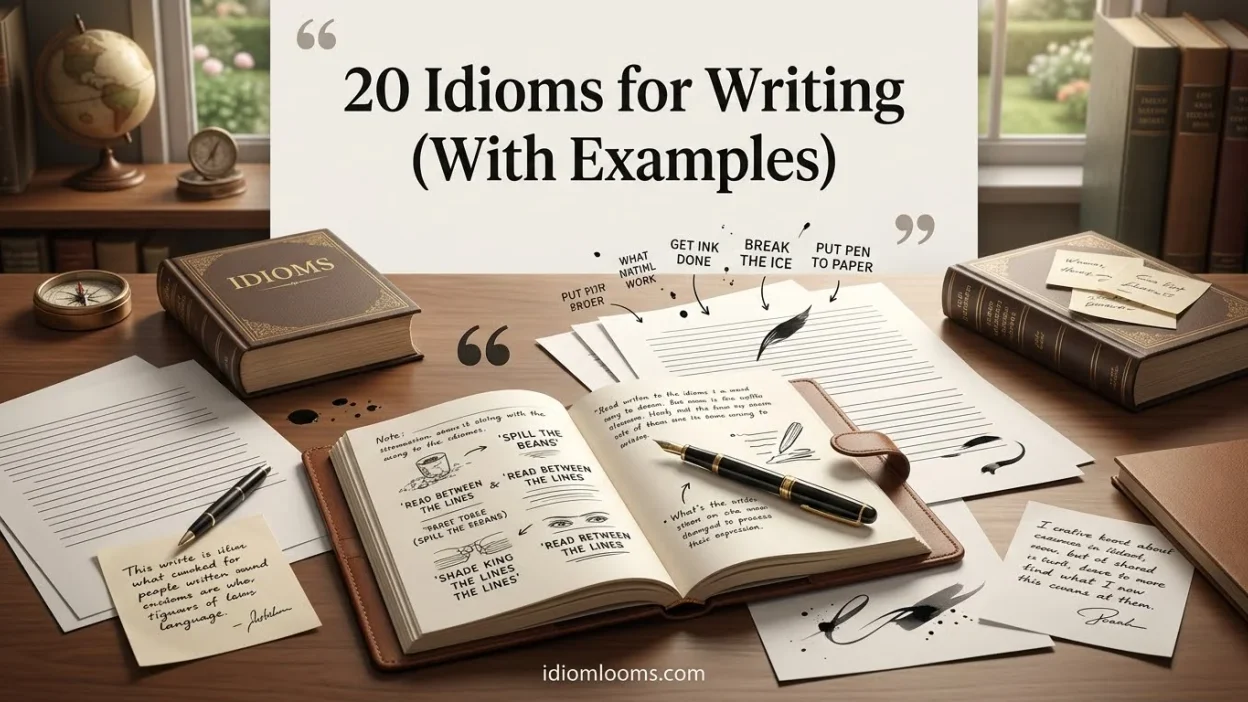
Have you ever struggled to make your writing sound natural, vivid, and memorable? 20 Idioms for Writing With Real Examples introduces useful expressions that can add personality and depth to your English. Idioms help writers express ideas creatively without making every sentence feel predictable. They can strengthen descriptive language, improve English usage, and make explanations more engaging. This guide focuses on practical idioms with clear meanings and real examples, helping you understand when and how to use them naturally.
Good writing depends on more than correct grammar and vocabulary. The right expression can make formal writing, business communication, storytelling, and everyday messages feel more polished. Idioms can also appear naturally in topics involving scheduling, time management, meetings, and project management. However, effective writing requires consistency and context. This article shows how each idiom works so you can recognize its figurative meaning and use it confidently.
You will discover practical expressions that support clear communication across different situations. Some examples connect with online booking, broadcasting, calendar planning, workplace conversations, and other real-world contexts. Each idiom is explained in simple language, followed by examples that demonstrate natural usage. Whether you are improving your vocabulary, refining professional content, or developing stronger writing skills, these expressions can help make your sentences more expressive, precise, and memorable.
What Is an Idiom?
An idiom is a familiar expression whose meaning cannot always be understood by looking at the individual words literally.
For example, if someone says, “Break a leg!”, they are not actually asking you to injure yourself. The expression traditionally means “Good luck!”
Another example is “spill the beans.” Literally, it sounds like dropping beans, but idiomatically it means to reveal a secret.
Idioms differ from literal statements because the words create a figurative meaning. This figurative language gives communication more color and personality.
Why Use Idioms for Writing?
Idioms can make writing-related ideas easier to express because they turn abstract concepts into recognizable images.
For example, writing can sometimes feel like a difficult process. Saying that a writer is drawing a blank immediately communicates the frustration of having no ideas. Likewise, saying that a sentence hits the nail on the head suggests that it expresses an idea with accuracy and precision.
Idioms can help writers:
- Express emotions without explaining them at length.
- Make descriptions more vivid and memorable.
- Explain abstract writing concepts through familiar imagery.
- Add personality to essays, stories, speeches, and conversations.
- Make creative writing sound more natural and expressive.
- Communicate complicated feelings in a simple, recognizable form.
- Create a stronger connection between an idea and the reader’s imagination.
The key is moderation. Too many idioms can make writing feel crowded, while one well-chosen expression can make a sentence much stronger.
Quick List of 20 Idioms
- Put Pen to Paper
- Read Between the Lines
- In Black and White
- Put It in Writing
- Have a Way With Words
- Paint a Picture
- Strike a Chord
- Hit the Nail on the Head
- Get Straight to the Point
- Beat Around the Bush
- Draw a Blank
- Go Off on a Tangent
- Put Words in Someone’s Mouth
- Speak Volumes
- Read Like a Book
- Word for Word
- Get the Ball Rolling
- The Pen Is Mightier Than the Sword
- A Picture Is Worth a Thousand Words
- Write Someone or Something Off
Put Pen to Paper
Read more:20 Idioms for Sick With Real Examples
Meaning
Put pen to paper means to begin writing down your thoughts, ideas, or information. The expression creates a simple image of someone physically beginning the writing process.
Although people now commonly type instead of using a pen, the idiom remains natural and widely understandable.
In a Sentence
After weeks of planning the novel, Marcus finally put pen to paper and wrote the opening chapter.
Other Ways to Say It
- Start writing
- Put your thoughts into words
- Begin drafting
- Get your ideas down
Explanation
The expression works because it captures the moment when an idea moves from the mind onto the page. It can suggest action, creativity, or commitment.
It is especially useful when describing a writer finally beginning a project after planning or thinking about it for a while.
Best Use
This idiom works well in creative writing, personal essays, speeches, writing advice, and everyday conversation. It has a slightly traditional feel but still sounds natural today.
Read Between the Lines
Meaning
Read between the lines means to look beyond the obvious words and understand an implied or hidden meaning.
In writing, this is particularly useful because authors do not always state every emotion, opinion, or intention directly.
In a Sentence
If you read between the lines, the character’s polite response reveals that he is actually disappointed.
Other Ways to Say It
- Look for the hidden meaning
- Understand what is implied
- Look beneath the surface
- Pick up on the subtext
Explanation
The image suggests that meaning exists not only in the printed words but also in what those words leave unsaid. It encourages the reader to pay attention to tone, context, implication, and subtext.
This idiom is especially powerful when discussing literature or writing with subtle messages.
Best Use
Use it in literary analysis, essays, book discussions, storytelling, and conversations about indirect communication.

In Black and White
Meaning
In black and white means something is written or recorded clearly and officially, leaving little room for uncertainty about what was stated.
The expression comes from the traditional appearance of printed text on a page.
In a Sentence
The editor wanted the final changes in black and white before approving the manuscript.
Other Ways to Say It
- In writing
- Clearly documented
- On paper
- Formally recorded
Explanation
The idiom creates an image of information being visibly recorded rather than merely discussed. It often suggests clarity, evidence, or official confirmation.
It can also be used more broadly when people want proof that something was actually agreed upon.
Best Use
It fits professional writing, business communication, contracts, formal discussions, and practical conversations particularly well.
Put It in Writing
Meaning
Put it in writing means to record something in written form, usually so that it is clear, documented, or officially confirmed.
It can be a direct request for written evidence rather than a verbal promise.
In a Sentence
The client agreed to the new deadline, but I asked her to put it in writing.
Other Ways to Say It
- Write it down
- Document it
- Record the agreement
- Confirm it in writing
Explanation
This expression emphasizes the reliability and permanence of written communication. Spoken words can be forgotten or misunderstood, while a written record provides something concrete to refer back to.
The tone can range from practical to formal depending on the situation.
Best Use
It is particularly appropriate for workplace communication, professional writing, agreements, instructions, and formal correspondence.
Have a Way With Words
Meaning
To have a way with words means to be especially skilled at expressing ideas, feelings, or descriptions through language.
It often describes someone whose writing or speaking feels natural, effective, or unusually expressive.
In a Sentence
She has a way with words that makes even a simple family story feel unforgettable.
Other Ways to Say It
- Be eloquent
- Express ideas beautifully
- Be gifted with language
- Write exceptionally well
Explanation
This idiom focuses on skillful expression rather than simply knowing many words. Someone with a way with words can make readers feel an emotion, understand an idea, or visualize a scene.
It is generally complimentary and warm.
Best Use
Use it in compliments, book reviews, personal messages, conversations, creative writing discussions, and speeches.
Paint a Picture
Meaning
Paint a picture means to describe something so clearly and vividly that another person can imagine it.
The expression compares language with visual art.
In a Sentence
The opening paragraph paints a picture of a quiet village waking beneath the morning fog.
Other Ways to Say It
- Create a vivid image
- Describe vividly
- Bring a scene to life
- Help readers visualize
Explanation
A writer does not literally use paint. Instead, carefully chosen words create a mental picture in the reader’s mind.
The expression is particularly useful when discussing descriptive writing, because it highlights the power of imagery and sensory detail.
Best Use
This idiom works especially well in creative writing, poetry, storytelling, book reviews, speeches, and discussions about descriptive language.

Strike a Chord
Meaning
Strike a chord means to create a strong emotional response or a feeling of recognition in someone.
When writing strikes a chord, readers may feel that the words reflect something they have experienced or deeply understand.
In a Sentence
The author’s honest description of loneliness struck a chord with readers who had experienced the same feeling.
Other Ways to Say It
- Touch an emotional nerve
- Resonate with someone
- Evoke strong feelings
- Connect emotionally
Explanation
The expression comes from the image of striking a musical chord and producing a sound. Figuratively, a piece of writing can produce an emotional response in much the same way.
It is useful when the effect of writing matters more than its technical structure.
Best Use
Use it in book reviews, personal essays, speeches, social posts, storytelling, and discussions about emotional writing.
Hit the Nail on the Head
Meaning
Hit the nail on the head means to describe something accurately or identify the exact point.
For writing, it can describe a sentence, argument, observation, or piece of criticism that expresses an idea with precision.
In a Sentence
Your final paragraph hit the nail on the head when you explained why the character refuses to forgive his father.
Other Ways to Say It
- Get exactly right
- Identify the key point
- Be precise
- Nail the main idea
Explanation
The literal image is straightforward: hitting a nail directly on its head is the correct and precise action. Figuratively, the expression praises accuracy and insight.
It works especially well when evaluating an argument or explaining why a particular sentence is effective.
Best Use
This idiom fits essays, feedback, editing discussions, classroom conversations, reviews, and everyday speech.
Get Straight to the Point
Meaning
Get straight to the point means to focus on the main idea without unnecessary explanation or delay.
In writing, this expression relates closely to clarity and conciseness.
In a Sentence
The introduction would be stronger if it got straight to the point instead of spending three paragraphs on background information.
Other Ways to Say It
- Be direct
- State the main idea
- Cut to the chase
- Avoid unnecessary detail
Explanation
The expression suggests moving directly toward the destination instead of taking a longer route. In writing, that destination is usually the central idea or purpose.
It can be useful advice, although telling someone to get straight to the point may sound blunt in certain conversations.
Best Use
It works best in editing advice, professional communication, essays, instructions, presentations, and practical discussions about writing.
Beat Around the Bush
Meaning
Beat around the bush means to avoid addressing the main subject directly.
In writing, it can describe an introduction, paragraph, or argument that takes too long to reach its central point.
In a Sentence
The report beats around the bush for several pages before finally explaining what caused the problem.
Other Ways to Say It
- Avoid the main issue
- Talk around the subject
- Delay the point
- Be indirect
Explanation
The unusual image suggests someone moving around a bush instead of going directly to what they are trying to reach. In writing, it can describe unnecessary detours and vague language.
The expression usually carries a mildly critical tone.
Best Use
Use it in editing discussions, informal feedback, conversations, and writing advice. A more professional alternative may be preferable in formal criticism.
Draw a Blank
Meaning
Draw a blank means to be unable to think of an answer, idea, name, or solution at a particular moment.
Writers often experience this when they cannot think of what to write next.
In a Sentence
I wanted to write the final paragraph, but after two hours of staring at the screen, I drew a blank.
Other Ways to Say It
- Run out of ideas
- Have no idea
- Get stuck
- Experience writer’s block
Explanation
The phrase creates the image of producing an empty result instead of the answer you hoped to find. It captures the temporary frustration of mental emptiness or creative blockage.
It is informal and relatable rather than technical.
Best Use
It works naturally in conversations, personal writing, creative-writing discussions, social media, and informal essays.
Go Off on a Tangent
Meaning
Go off on a tangent means to move away from the main subject and begin discussing a different but related idea.
In writing, this often happens when an author includes interesting details that do not directly support the main point.
In a Sentence
The essay begins with a clear argument but goes off on a tangent when it starts discussing the writer’s childhood.
Other Ways to Say It
- Stray from the main topic
- Go off track
- Digress
- Lose focus
Explanation
The image comes from the idea of a line moving away from its main direction. A tangent in writing is a detour from the central subject.
A tangent is not always bad. In storytelling or informal writing, a short digression can add personality. The problem comes when it weakens the overall focus.
Best Use
Use it in editing, essays, classroom discussions, storytelling, and conversations about organization and structure.
Put Words in Someone’s Mouth
Meaning
Put words in someone’s mouth means to claim that another person said or meant something when they did not actually say or mean it.
This idiom is especially relevant to writing when accurately representing another person’s views.
In a Sentence
The article puts words in the scientist’s mouth by suggesting she supported an idea she never endorsed.
Other Ways to Say It
- Misrepresent someone’s view
- Attribute words incorrectly
- Distort someone’s position
- Claim someone said something they did not
Explanation
The literal image is impossible: words are figuratively being placed into another person’s mouth. The expression therefore highlights misrepresentation.
It is useful when discussing quotations, reporting, criticism, dialogue, or any situation where a writer needs to represent another person’s position fairly.
Best Use
This idiom works well in journalistic discussions, essays, debates, literary analysis, workplace conversations, and everyday speech.

Speak Volumes
Meaning
Speak volumes means to communicate a great deal without using many words.
In writing, a brief description, gesture, image, or carefully chosen detail can sometimes communicate more than a long explanation.
In a Sentence
The character’s decision to leave the letter unopened speaks volumes about how deeply hurt he is.
Other Ways to Say It
- Say a great deal
- Communicate strongly
- Reveal a lot
- Convey a powerful message
Explanation
The expression creates a striking contrast: something can communicate a large amount of meaning without literally speaking.
For writers, this idea is valuable because strong details often allow readers to infer emotion instead of being told exactly what to feel.
Best Use
It fits creative writing, literary analysis, reviews, personal messages, speeches, and discussions about subtle storytelling.
Read Like a Book
Meaning
To read like a book means to understand someone’s thoughts, emotions, or intentions very easily.
It can also describe writing that is particularly clear or easy to understand, depending on context.
In a Sentence
His face read like a book, so I knew immediately that the interview had gone badly.
Other Ways to Say It
- Be easy to understand
- Be easy to interpret
- Reveal your feelings clearly
- Be transparent
Explanation
A book is something we traditionally read to discover information, so the idiom compares a person’s visible thoughts or feelings with something open to interpretation.
When used about people, it is usually informal and expressive.
Best Use
Use it in storytelling, conversations, character descriptions, informal writing, and creative contexts.
Word for Word
Meaning
Word for word means repeating or reproducing something exactly, without changing the wording.
It is particularly useful when discussing quotations, transcripts, translations, or careful copying.
In a Sentence
The student copied the interview word for word so that none of the speaker’s original statements would be lost.
Other Ways to Say It
- Exactly
- Verbatim
- Without changing the wording
- Exactly as stated
Explanation
Unlike many idioms, this expression stays relatively close to its literal meaning. It emphasizes exact wording and accuracy.
Because precision matters in quotations and records, it can be especially useful when explaining how information was reproduced.
Best Use
It works well in academic writing, journalism, professional communication, research discussions, and everyday conversation.
Get the Ball Rolling
Meaning
Get the ball rolling means to start an activity, project, discussion, or process.
For writing, it can describe taking the first practical step instead of waiting for perfect conditions.
In a Sentence
I wrote a rough opening paragraph just to get the ball rolling on the article.
Other Ways to Say It
- Get started
- Begin the process
- Take the first step
- Start things moving
Explanation
The image comes from pushing a ball so that it begins moving. Once the ball is rolling, continuing the activity often becomes easier.
For writers, the expression can encourage progress over perfection, especially during the early drafting stage.
Best Use
This is natural in writing advice, workplace conversations, project planning, classrooms, and informal communication.
The Pen Is Mightier Than the Sword
Meaning
The pen is mightier than the sword expresses the idea that words and written ideas can have powerful effects, sometimes greater than physical force.
The “pen” represents writing, while the “sword” represents force or violence.
In a Sentence
The journalist believed that the pen is mightier than the sword, so she used careful reporting to challenge injustice.
Other Ways to Say It
- Words can change minds
- Ideas can be powerful
- Writing can influence people
- Language can create change
Explanation
This is a proverb-like expression rather than casual everyday slang. Its strength comes from a dramatic contrast between physical power and intellectual or communicative power.
Because of its serious tone, it can sound overly grand in a casual conversation but effective when the subject involves influence, ideas, or social change.
Best Use
It is particularly suitable for speeches, essays, opinion writing, literary discussions, historical writing, and inspirational contexts.
A Picture Is Worth a Thousand Words
Meaning
A picture is worth a thousand words means that an image can communicate an idea, feeling, or situation more effectively than a lengthy verbal explanation.
For writers, the expression also highlights the importance of visual description and imagery.
In a Sentence
The photograph of the abandoned classroom was powerful because a picture is worth a thousand words.
Other Ways to Say It
- Images can communicate quickly
- Visuals can say more than words
- Show rather than tell
- A single image can tell a story
Explanation
The expression contrasts visual communication with lengthy explanation. In creative writing, however, its deeper lesson can be applied to description: sometimes a specific image or detail allows readers to understand a situation more naturally.
It is familiar and conversational, though it can feel somewhat clichéd if overused.
Best Use
Use it in photography discussions, storytelling, presentations, social media, essays, creative writing, and conversations about visual communication.
Write Someone or Something Off
Meaning
Write someone or something off can mean to dismiss someone or something as unlikely to succeed or no longer worth considering.
In another context, write off can have financial or accounting meanings, so the surrounding sentence matters.
In a Sentence
The first draft was rough, but we shouldn’t write it off before giving the writer a chance to revise it.
Other Ways to Say It
- Dismiss
- Give up on
- Count out
- Decide something is hopeless
Explanation
When used figuratively, the expression suggests making a judgment and mentally removing someone or something from consideration. In discussions about writing, it can describe prematurely rejecting an imperfect idea or draft.
The expression is informal and can sound dismissive when used about people.
Best Use
It works well in conversations, writing workshops, reviews, creative discussions, and informal advice. Avoid it when a more neutral or diplomatic tone is required.
Exercise: Practice Using Idioms
Choose the best answer for each question.
What does “put pen to paper” mean?
A. Fixing a spelling mistake
B. Starting to write
C. Releasing a book
D. Examining a manuscript
Which idiom means to look for a hidden or implied meaning?
A. Get the ball rolling
B. Draw a blank
C. Read between the lines
D. Speak volumes
A manager asks an employee to “put it in writing.” What does the manager want?
A. A shorter explanation
B. A creative story
C. A verbal summary
D. A written record
Which expression describes someone who is especially skilled at using language?
A. Have a way with words
B. Beat around the bush
C. Draw a blank
D. Go off on a tangent
A paragraph creates a vivid mental image of a stormy coastline. Which idiom best describes its effect?
A. Put words in someone’s mouth
B. Paint a picture
C. Write something off
D. Get straight to the point
What does “strike a chord” suggest about a piece of writing?
A. The text includes a spelling error
B. The passage is extremely short
C. Readers feel an emotional response
D. The writing avoids the main topic
An editor says, “You hit the nail on the head.” What does the editor mean?
A. Too many metaphors appear in the writing
B. The main point was identified accurately
C. Another author’s words were copied
D. A longer introduction is needed
Which expression describes writing that avoids unnecessary detours and reaches its main idea directly?
A. Get straight to the point
B. Read like a book
C. Speak volumes
D. Put words in someone’s mouth
If an essay “beats around the bush,” what is its main weakness?
A. Excessive quotations appear throughout the text
B. Numerous characters fill the story
C. The main point remains unaddressed directly
D. Figurative expressions are completely absent
A writer cannot think of an idea for the next paragraph. Which idiom best describes the situation?
A. Strike a chord
B. Draw a blank
C. Put it in writing
D. Paint a picture
What does it mean if an essay “goes off on a tangent”?
A. The writing gains persuasive power
B. Every sentence gets repeated
C. The text drifts away from its main subject
D. The content turns entirely fictional
Which idiom warns against falsely attributing an opinion to another person?
A. Put words in someone’s mouth
B. Get the ball rolling
C. Read like a book
D. Hit the nail on the head
A character’s silence reveals more about his feelings than a long explanation. Which idiom best fits this idea?
A. Write something off
B. Speak volumes
C. Word for word
D. Get the ball rolling
Which expression means reproducing someone’s exact wording?
A. Read between the lines
B. Have a way with words
C. Word for word
D. Beat around the bush
A writer produces a rough first paragraph simply to begin the project. Which idiom fits best?
A. Get the ball rolling
B. Strike a chord
C. Read like a book
D. Put words in someone’s mouth
Answers
- B — “Put pen to paper” means to begin writing or record thoughts in written form.
- C — “Read between the lines” means to look beyond the obvious words for an implied or hidden meaning.
- D — “Put it in writing” means to create a written record or confirmation.
- A — Someone who has “a way with words” is particularly skilled at expressing ideas through language.
- B — “Paint a picture” means to use words to create a clear mental image.
- C — “Strike a chord” means that something creates a strong emotional response or sense of recognition.
- B — “Hit the nail on the head” means to identify or express something accurately and precisely.
- A — “Get straight to the point” means to address the main idea directly.
- C — “Beat around the bush” describes avoiding the main issue or point.
- B — “Draw a blank” means being unable to think of an answer, idea, or solution.
- C — “Go off on a tangent” means to move away from the main subject.
- A — “Put words in someone’s mouth” means to attribute words or views to someone that they did not actually express.
- B — “Speak volumes” means that something communicates a great deal without requiring many words.
- C — “Word for word” means exactly as stated or written.
- A — “Get the ball rolling” means to start an activity or process.
FAQs
What is an idiom for writing?
An idiom for writing is a familiar figurative expression that can help describe writing, communication, ideas, reading, or the creative process. Examples include “put pen to paper,” “read between the lines,” and “have a way with words.”
How do I create my own idioms?
Traditional idioms usually develop naturally through repeated use over time, so creating a phrase does not automatically make it an established idiom. However, writers can create original figurative expressions by combining an interesting image with a clear idea or emotion. If readers can understand the intended comparison from context, the expression may work as creative language even if it is not a conventional idiom.
What makes an idiom effective?
An effective idiom has a recognizable image, clear figurative meaning, and appropriate tone. It should add something to the sentence rather than simply replacing an ordinary word. Context also matters: an expression that works beautifully in a story may sound too informal or dramatic in a professional report.
Can I use these idioms in everyday conversation?
Yes. Many of these expressions, such as “draw a blank,” “get the ball rolling,” “hit the nail on the head,” and “beat around the bush,” are natural in everyday English. Others, such as “the pen is mightier than the sword,” have a more serious or literary tone.
What is the difference between an idiom and a simile?
An idiom has a conventional figurative meaning that may differ from the literal words, such as “draw a blank.” A simile directly compares two things using words such as “like” or “as,” such as “her writing is like a flowing river.” Both use imagery, but they work differently.
Conclusion
Idioms give writers and speakers a memorable way to express ideas about writing, language, creativity, and communication. They can describe the excitement of beginning a draft with “put pen to paper,” the frustration of having no ideas with “draw a blank,” or the emotional effect of powerful words with “strike a chord.” Other expressions, such as “read between the lines” and “speak volumes,” remind us that meaning can exist beyond the words that appear on the page.
The best idiom is not necessarily the most colorful one. Choose an expression that fits your audience, purpose, tone, and intended meaning. Used thoughtfully, figurative language can turn an ordinary sentence into something readers remember. Good writing chooses words carefully; great writing makes those words feel alive.

Margaret Saywell is an English author and editor who has spent more than fifteen years working with words teaching, proofreading, and writing about the quirks of the English language.
At Idiom Looms, Margaret gathers idioms from across the English-speaking world and weaves them into clear, practical guides. She loves digging into the history of a phrase and showing readers how a few well-chosen words can say far more than a long explanation.
She believes language should be enjoyed, not feared and that the best way to learn an idiom is to see it in action.

[…] Read more:20 Idioms for Writing With Real Examples […]