

What if the right phrase could make an ordinary situation instantly more vivid? 20 Idioms for Situations With Real Examples explores natural expressions that help describe everyday circumstances with greater clarity and personality. Whether you are discussing scheduling, time management, meetings, or unexpected events, the right idiom can make your English sound more natural. These expressions also add flexibility to business communication, conversations, and practical writing.
In this guide, you will discover 20 useful idioms for situations, each explained through clear meanings and realistic examples. You will see how figurative language works in contexts such as online booking, broadcasting, calendar planning, and project management. Every example focuses on natural English usage, helping you understand when an expression fits and when a simpler phrase may work better.
The goal is practical learning, not memorizing disconnected phrases. You will explore idioms through context while strengthening your understanding of grammar, formal writing, conversational English, and consistency in communication. By the end, you will have a useful collection of expressions for describing challenges, changes, opportunities, and everyday circumstances with confidence.
What Is an Idiom?
An idiom is a familiar expression whose meaning is different from the literal meaning of its individual words.
For example, if someone says, “I’m feeling under the weather,” they usually do not mean that they are physically underneath clouds or rain. They mean that they are feeling unwell.
Similarly, “break the ice” does not normally mean breaking actual ice. It means to make people feel more comfortable in a new or awkward social situation.
Idioms are a form of figurative language. They create mental pictures that communicate an idea, feeling, or situation in a short and memorable way.
Why Use Idioms for Situations?
Situations can involve many layers: pressure, uncertainty, conflict, opportunity, change, or relief. A carefully chosen idiom can capture one of those layers more effectively than a plain description.
Idioms can help you:
- Express emotions without explaining them at length.
- Make descriptions more vivid and memorable.
- Turn an abstract idea into a clear mental picture.
- Give essays, stories, and speeches more personality.
- Communicate complicated circumstances in a familiar way.
- Make everyday conversations sound more natural.
- Add emotional weight to creative writing and storytelling.
The key is to choose an expression that matches the situation. An idiom about being trapped is very different from one about overcoming trouble, even though both may describe difficult circumstances.
Quick List of 20 Idioms
- A sticky situation
- In hot water
- Between a rock and a hard place
- A Catch-22
- A blessing in disguise
- At a crossroads
- In the same boat
- Out of the woods
- Back to square one
- Walking on eggshells
- A gray area
- The elephant in the room
- The tip of the iceberg
- Open a can of worms
- The last straw
- An uphill battle
- Throw a wrench in the works
- Go with the flow
- Weather the storm
- Every cloud has a silver lining
A Sticky Situation
Read more:20 Idioms for Funny With Real Examples
Meaning
A sticky situation is a difficult, awkward, or complicated circumstance that is not easy to resolve.
The word “sticky” creates the image of being caught in something that holds you in place. It suggests that getting out of the situation may require care and patience.
In a Sentence
After accidentally sending the private message to the entire team, Daniel found himself in a sticky situation.
Other Ways to Say It
- A difficult situation
- An awkward predicament
- A complicated problem
- A tricky circumstance
Explanation
This idiom is useful when a situation is troublesome without necessarily being disastrous. It can describe social mistakes, workplace problems, misunderstandings, or uncomfortable choices.
Its tone is usually informal and conversational, so it fits everyday speech especially well.
Best Use
Use “a sticky situation” in conversations, storytelling, personal writing, and informal messages. It can also work in light creative writing when you want to describe trouble without making it sound overly dramatic.
In Hot Water
Meaning
To be in hot water means to be in trouble because of something you have done or because of a difficult circumstance.
The image of being surrounded by hot water suggests discomfort, pressure, and trouble.
In a Sentence
The employee knew he was in hot water after missing an important deadline without telling his manager.
Other Ways to Say It
- Be in trouble
- Be in difficulty
- Face consequences
- Be in a difficult position
Explanation
This expression often suggests that someone has caused or contributed to their own problem. It can be serious, but it is also commonly used in a light or humorous way.
Unlike “a sticky situation,” “in hot water” often carries a stronger sense of consequences.
Best Use
It works particularly well in everyday conversations, informal storytelling, humorous writing, and discussions about mistakes or rule-breaking.
Between a Rock and a Hard Place
Meaning
Being between a rock and a hard place means facing two difficult choices where neither option seems good.
The image is straightforward: one obstacle is behind you while another is directly ahead, leaving little room to escape.
In a Sentence
I was between a rock and a hard place: cancel the trip and disappoint everyone, or go and risk missing the exam.
Other Ways to Say It
- Face two difficult choices
- Be caught in a dilemma
- Have no easy option
- Be in a difficult position
Explanation
This idiom is especially effective when a situation involves a painful decision rather than a simple problem.
It helps readers visualize someone trapped between two undesirable outcomes. The expression is common enough for everyday conversation but vivid enough for narrative writing.
Best Use
Use it in conversations, essays, speeches, stories, and situations involving difficult decisions.
A Catch-22
Meaning
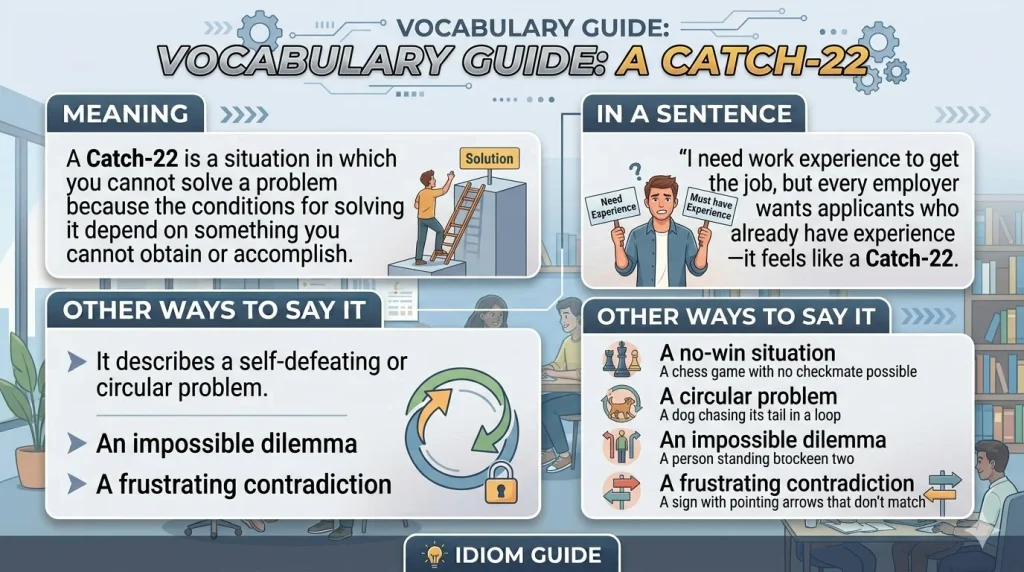
A Catch-22 is a situation in which you cannot solve a problem because the conditions for solving it depend on something you cannot obtain or accomplish.
It describes a self-defeating or circular problem.
In a Sentence
I need work experience to get the job, but every employer wants applicants who already have experience—it feels like a Catch-22.
Other Ways to Say It
- A no-win situation
- A circular problem
- An impossible dilemma
- A frustrating contradiction
Explanation
This expression is particularly useful for complicated systems, rules, and circumstances where every possible route seems to lead back to the same obstacle.
It is more specific than simply saying “difficult situation.” The problem is not only difficult; its own requirements make it difficult to escape.
Best Use
It works well in conversations, essays, journalism-style writing, workplace discussions, and explanations of frustrating circumstances.
A Blessing in Disguise
Meaning
A blessing in disguise is something that initially seems bad or disappointing but later turns out to have a positive result.
The “disguise” represents the fact that the benefit is hidden at first.
In a Sentence
Missing that flight was a blessing in disguise because the later flight led to a chance meeting with my future business partner.
Other Ways to Say It
- An unexpected benefit
- A hidden advantage
- A fortunate setback
- Something good that came from difficulty
Explanation
This idiom changes the emotional perspective of a situation. What first appears negative may eventually reveal an opportunity.
It is naturally hopeful and reflective, making it useful when looking back on an experience with the benefit of hindsight.
Best Use
Use it in personal stories, encouraging conversations, speeches, essays, and reflective writing.
At a Crossroads
Meaning
To be at a crossroads means to reach a point where an important decision or change must be made.
The image comes from a place where roads meet and a traveler must choose which direction to take.
In a Sentence
After finishing college, Maya felt she was at a crossroads and had to decide whether to continue studying or start working.
Other Ways to Say It
- Face an important decision
- Reach a turning point
- Stand at a critical moment
- Decide which direction to take
Explanation
This expression is about more than an ordinary choice. It often suggests that the decision could shape what happens next.
It has a thoughtful and slightly poetic quality, which makes it especially effective when describing personal growth, careers, relationships, or major changes.
Best Use
It fits personal writing, speeches, essays, storytelling, and serious conversations particularly well.
In the Same Boat
Meaning
To be in the same boat means to be in the same difficult or challenging situation as another person.
The boat represents a shared circumstance, meaning everyone aboard is dealing with the same conditions.
In a Sentence
We are all in the same boat, so instead of blaming one another, let’s work together to finish the project.
Other Ways to Say It
- Face the same problem
- Be in the same situation
- Share the same difficulty
- Deal with the same circumstances
Explanation
The strength of this idiom is its sense of shared experience. It can make a difficult situation feel less isolating because other people are experiencing it too.
It can also encourage cooperation rather than blame.
Best Use
Use it in conversations, teamwork, speeches, workplace communication, and supportive messages.
Out of the Woods
Meaning
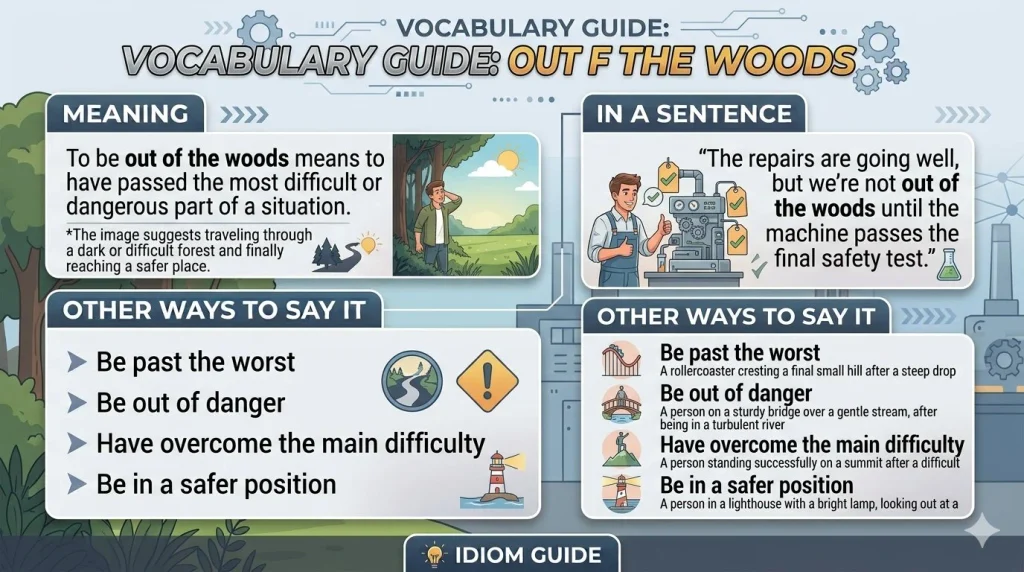
To be out of the woods means to have passed the most difficult or dangerous part of a situation.
The image suggests traveling through a dark or difficult forest and finally reaching a safer place.
In a Sentence
The repairs are going well, but we’re not out of the woods until the machine passes the final safety test.
Other Ways to Say It
- Be past the worst
- Be out of danger
- Have overcome the main difficulty
- Be in a safer position
Explanation
This expression is often used when a problem has improved but some uncertainty remains.
That nuance makes it useful because saying “we’re not out of the woods yet” communicates cautious optimism rather than premature confidence.
Best Use
It works naturally in conversations, workplace discussions, project updates, storytelling, and situations involving recovery or progress.
Back to Square One
Meaning
Going back to square one means returning to the beginning after an attempt to solve a problem has failed or produced no useful result.
The image suggests returning to the starting point of a game or process.
In a Sentence
The first design failed the safety test, so the engineers were back to square one.
Other Ways to Say It
- Start over
- Return to the beginning
- Begin again
- Lose previous progress
Explanation
This idiom captures the frustration of losing progress. It does not necessarily mean that every effort was wasted, but the current solution is no longer workable.
It is direct, familiar, and easy to understand in practical contexts.
Best Use
Use it in conversations, project discussions, problem-solving situations, business writing, and informal explanations.
Walking on Eggshells
Meaning
To be walking on eggshells means to behave extremely carefully because you are worried that something you say or do could upset someone or make a situation worse.
The fragile eggs create an image of careful movement and emotional tension.
In a Sentence
Everyone was walking on eggshells around the manager after the argument in yesterday’s meeting.
Other Ways to Say It
- Tread carefully
- Be extremely cautious
- Avoid upsetting someone
- Handle a situation delicately
Explanation
This idiom is particularly powerful for interpersonal situations. It communicates more than caution; it suggests fear of triggering a negative reaction.
It can describe family disagreements, tense workplaces, friendships, or other emotionally sensitive circumstances.
Best Use
It is most natural in conversations, personal writing, relationship discussions, and storytelling.
A Gray Area
Meaning
A gray area is a situation where the answer, rule, or distinction is unclear and cannot easily be classified as completely right or wrong.
The color gray represents the space between clear extremes.
In a Sentence
Whether employees should answer work messages during their holidays remains a gray area in the company’s policy.
Other Ways to Say It
- An unclear situation
- An uncertain matter
- An ambiguous case
- A matter open to interpretation
Explanation
This expression is useful when a situation does not have a straightforward answer.
Unlike idioms that focus on emotional difficulty, “a gray area” emphasizes uncertainty, interpretation, or lack of clear boundaries.
Best Use
Use it in essays, professional discussions, policy conversations, academic writing, and everyday speech.
The Elephant in the Room
Meaning
The elephant in the room is an obvious and important problem or subject that everyone knows about but nobody wants to discuss.
The imagined elephant is so large that ignoring it seems almost impossible.
In a Sentence
The falling sales were the elephant in the room during the meeting, but nobody wanted to discuss them.
Other Ways to Say It
- An obvious unspoken issue
- A problem everyone is avoiding
- An uncomfortable subject
- An issue no one wants to address
Explanation
The humor of the image makes the expression memorable. It draws attention to the contrast between something extremely obvious and everyone’s unwillingness to acknowledge it.
The phrase can sound direct, so it may be unsuitable when a very diplomatic tone is required.
Best Use
It works well in conversations, opinion writing, speeches, workplace discussions, and storytelling.
The Tip of the Iceberg
Meaning
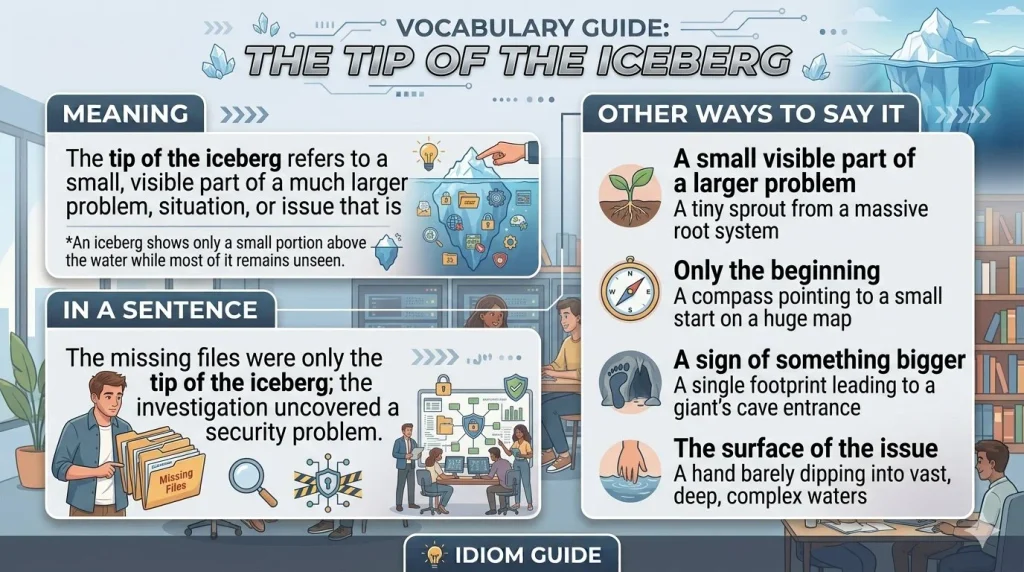
The tip of the iceberg refers to a small, visible part of a much larger problem, situation, or issue that is mostly hidden.
An iceberg shows only a small portion above the water while most of it remains unseen.
In a Sentence
The missing files were only the tip of the iceberg; the investigation uncovered a much larger security problem.
Other Ways to Say It
- A small visible part of a larger problem
- Only the beginning
- A sign of something bigger
- The surface of the issue
Explanation
This expression emphasizes hidden depth. It tells the reader that what they can currently see does not represent the full situation.
It is especially effective when a small discovery reveals the possibility of a much larger problem.
Best Use
Use it in journalism-style writing, essays, investigations, reports, conversations, and storytelling.
Open a Can of Worms
Meaning
To open a can of worms means to create a new set of complicated, difficult, or troublesome problems by dealing with an issue.
The image suggests opening a container and unexpectedly discovering many problems that are difficult to control.
In a Sentence
Changing the old agreement could open a can of worms because several other departments might demand the same changes.
Other Ways to Say It
- Create new complications
- Make matters more complicated
- Raise a host of problems
- Start a chain of difficulties
Explanation
This idiom often carries a warning. It suggests that an apparently simple action could lead to many additional problems.
It is informal and colorful, so it should be avoided in highly formal documents unless the tone allows figurative language.
Best Use
Use it in conversations, informal workplace discussions, blogs, storytelling, and explanatory writing.
The Last Straw
Meaning
The last straw is the final problem or annoyance that makes someone unable or unwilling to tolerate a situation any longer.
The image comes from the idea that one final small addition can make an already overloaded burden finally collapse.
In a Sentence
The broken heating system was the last straw, and the tenants decided they had to move.
Other Ways to Say It
- The final breaking point
- The final annoyance
- The point of no return
- The final problem someone can tolerate
Explanation
This idiom usually describes a situation where many smaller problems have already accumulated.
The final event may seem minor by itself, but it becomes decisive because it comes after everything else.
Best Use
It works well in conversations, personal stories, opinion pieces, and emotionally charged storytelling.
An Uphill Battle
Meaning
An uphill battle is a situation that requires a great deal of effort because the circumstances make success difficult.
The image of walking uphill represents resistance, effort, and slow progress.
In a Sentence
Convincing the committee to change a policy was an uphill battle, but the team eventually won enough support.
Other Ways to Say It
- A difficult struggle
- A challenging task
- A hard fight
- A demanding effort
Explanation
This idiom focuses on difficulty and persistence rather than complete hopelessness.
An uphill battle can be won, which gives the expression a subtle sense of determination and possibility.
Best Use
It fits speeches, essays, motivational writing, conversations, biographies, and stories about overcoming obstacles.
Throw a Wrench in the Works
Meaning
To throw a wrench in the works means to cause a problem that disrupts a plan, process, or activity.
The image comes from putting a tool into machinery and preventing it from working smoothly.
In a Sentence
The sudden supplier shortage threw a wrench in the works and delayed the entire launch.
Other Ways to Say It
- Disrupt the plan
- Cause an unexpected problem
- Interfere with progress
- Complicate the process
Explanation
This idiom is ideal for unexpected events that interfere with something already planned.
It creates a mechanical image of smooth progress suddenly being interrupted, making the expression easy to visualize.
Best Use
Use it in conversations, workplace communication, project discussions, storytelling, and informal writing.
Go With the Flow
Meaning
To go with the flow means to accept circumstances as they develop instead of trying to control every detail.
The flow suggests moving naturally with changing conditions rather than constantly resisting them.
In a Sentence
We had planned to visit three towns, but the weather changed, so we decided to go with the flow.
Other Ways to Say It
- Adapt to circumstances
- Take things as they come
- Stay flexible
- Adjust your plans
Explanation
Unlike many idioms on this list, this expression describes a flexible response to a situation rather than the situation itself.
It often has a relaxed, positive tone, although in some contexts it can suggest that someone is being too passive.
Best Use
It is especially natural in conversations, travel stories, personal messages, and informal advice.
Weather the Storm
Meaning
To weather the storm means to survive and continue through a difficult period until conditions improve.
The storm represents trouble, uncertainty, or hardship, while surviving it suggests resilience.
In a Sentence
The company reduced unnecessary spending to weather the storm during the difficult economic period.
Other Ways to Say It
- Get through a difficult period
- Survive the hardship
- Endure the crisis
- Stay strong through trouble
Explanation
This idiom carries a strong sense of endurance and resilience. It does not promise that the problem will disappear immediately; instead, it focuses on continuing until better conditions arrive.
The expression is both practical and somewhat poetic.
Best Use
Use it in speeches, motivational writing, business discussions, essays, conversations, and stories about perseverance.
Every Cloud Has a Silver Lining
Meaning
Every cloud has a silver lining means that even a difficult or disappointing situation may contain something positive.
The cloud represents trouble, while the bright edge suggests hope hidden inside hardship.
In a Sentence
Losing the competition was disappointing, but every cloud has a silver lining: it showed me exactly what I needed to improve.
Other Ways to Say It
- Look for the positive side
- Find something good in a bad situation
- See the opportunity in difficulty
- There is often a bright side
Explanation
This proverb encourages a hopeful perspective without denying that something went wrong.
It works particularly well when someone is trying to recover emotionally from disappointment and find meaning in the experience.
Best Use
It is suitable for encouraging conversations, personal messages, speeches, reflective writing, and motivational content. It can sound somewhat traditional or poetic in casual conversation.
Exercise: Practice Using Idioms
Choose the best answer for each question.
What does “in hot water” mean?
A. Feeling physically warm
B. Being in trouble
C. Taking a relaxing bath
D. Preparing for a difficult journey
Which idiom describes a situation involving two equally difficult choices?
A. Out of the woods
B. A blessing in disguise
C. Between a rock and a hard place
D. Go with the flow
Which expression describes a problem that initially seems negative but later produces a positive result?
A. A blessing in disguise
B. The last straw
C. A gray area
D. Back to square one
Someone has reached an important point where they must decide which direction to take. Which idiom fits best?
A. In the same boat
B. At a crossroads
C. In hot water
D. The tip of the iceberg
Which idiom suggests that several people share the same difficult situation?
A. Weather the storm
B. An uphill battle
C. In the same boat
D. A Catch-22
“We aren’t out of the woods yet” suggests that:
A. The journey has become enjoyable
B. The situation is completely finished
C. Someone has entered a dangerous forest
D. The worst may be over, but problems remain
Which idiom means returning to the beginning after an unsuccessful attempt?
A. Back to square one
B. Open a can of worms
C. Go with the flow
D. The elephant in the room
A person is extremely careful because they fear upsetting someone. Which expression is most appropriate?
A. Every cloud has a silver lining
B. Walking on eggshells
C. An uphill battle
D. The tip of the iceberg
What does “a gray area” describe?
A. A clearly defined rule
B. A pleasant surprise
C. An uncertain or unclear situation
D. A problem that has already ended
What is “the elephant in the room”?
A. A secret opportunity
B. A minor disagreement
C. A difficult journey
D. An obvious issue that people avoid discussing
If a small discovery reveals a much larger hidden problem, which idiom fits best?
A. The tip of the iceberg
B. In the same boat
C. Go with the flow
D. The last straw
What does “open a can of worms” suggest?
A. Solve a difficult problem quickly
B. Create additional complications
C. Find a hidden opportunity
D. Return to an earlier decision
Which expression describes the final problem that makes someone lose patience?
A. A sticky situation
B. A Catch-22
C. The last straw
D. Weather the storm
Which idiom emphasizes a difficult struggle that requires persistence?
A. An uphill battle
B. A blessing in disguise
C. A gray area
D. Go with the flow
What does “weather the storm” mean?
A. Predict bad weather
B. Avoid every difficult situation
C. Survive a difficult period
D. Change plans whenever circumstances change
Answers
- B — “In hot water” means being in trouble or difficulty.
- C — “Between a rock and a hard place” describes two difficult choices with no easy option.
- A — A “blessing in disguise” is something that looks negative at first but later proves beneficial.
- B — “At a crossroads” describes an important decision or turning point.
- C — “In the same boat” means sharing the same situation or difficulty.
- D — “Out of the woods” means the worst part may have passed, but the situation is not completely safe yet.
- A — “Back to square one” means starting again from the beginning.
- B — “Walking on eggshells” means behaving very carefully to avoid upsetting someone.
- C — A “gray area” is something unclear, ambiguous, or open to interpretation.
- D — “The elephant in the room” is an obvious issue that people avoid addressing.
- A — “The tip of the iceberg” describes a visible part of a much larger hidden issue.
- B — To “open a can of worms” means to create or uncover additional complications.
- C — “The last straw” is the final problem that becomes impossible to tolerate.
- A — “An uphill battle” describes a difficult struggle requiring significant effort.
- C — To “weather the storm” means to endure and survive a difficult period.
Frequently Asked Questions About Idioms for Situations
What is an idiom for situations?
An idiom for situations is a figurative expression that helps describe a particular circumstance, especially its difficulty, uncertainty, emotional quality, or outcome. Expressions such as “a sticky situation,” “at a crossroads,” and “weather the storm” can communicate ideas more vividly than literal descriptions.
How do I create my own idiom?
Creating an original idiom involves connecting an idea with a clear, memorable image. Think about what the situation feels like physically or visually. However, newly invented expressions may not be understood immediately, so established idioms are usually better when your goal is clear everyday communication.
What makes an idiom effective?
An effective idiom has a recognizable meaning, creates a useful mental image, and fits the context. The best choice also matches the tone of the situation. For example, “a Catch-22” suits a circular problem, while “a blessing in disguise” suits an unexpected positive outcome.
Can I use these idioms in everyday conversation?
Yes. Many of these expressions are common in everyday English, including “in hot water,” “in the same boat,” “back to square one,” and “go with the flow.” More poetic expressions may sound better in speeches, stories, or reflective writing than in formal professional documents.
What is the difference between an idiom and a simile?
An idiom is an established expression with a figurative meaning, such as “walking on eggshells.” A simile directly compares two things using words such as “like” or “as.” For example, “The situation was like walking on eggshells” is a simile using the idiom as its comparison.
Conclusion
The right idiom can turn an ordinary description of a situation into something clearer, more vivid, and easier to remember. Expressions such as “between a rock and a hard place” show the pressure of difficult choices, while “a blessing in disguise” offers a more hopeful way to view an unexpected setback. Other idioms highlight uncertainty, shared challenges, hidden problems, persistence, or the need to adapt.
The most effective choice depends on the message you want to communicate. Think about the emotion, context, and underlying idea before choosing an expression. An idiom should clarify your meaning rather than make it confusing. Whether you are writing a story, preparing a speech, completing an essay, or simply talking with someone, thoughtful figurative language can make your description much more expressive. Sometimes, the right few words can make a complicated situation suddenly come into focus.

Margaret Saywell is an English author and editor who has spent more than fifteen years working with words teaching, proofreading, and writing about the quirks of the English language.
At Idiom Looms, Margaret gathers idioms from across the English-speaking world and weaves them into clear, practical guides. She loves digging into the history of a phrase and showing readers how a few well-chosen words can say far more than a long explanation.
She believes language should be enjoyed, not feared and that the best way to learn an idiom is to see it in action.



[…] Read more:20 Idioms for Situations With Real Examples […]