
Have you ever struggled to sound natural while answering an IELTS question? 20 Idioms for IELTS With Real Examples introduces useful expressions that can make your English more fluent and engaging. Learning idioms also strengthens English usage, vocabulary, and confidence when expressing ideas clearly.
This guide explains each idiom through real examples, simple meanings, and practical contexts. You will learn how expressions can fit conversations, business communication, meetings, and formal writing without sounding forced. Clear attention to grammar and consistency will help you use them accurately.
You will also see idioms connected with scheduling, time management, online booking, broadcasting, calendar planning, and project management. Instead of memorizing phrases blindly, focus on meaning, context, and natural usage. This approach can help you communicate with greater precision and confidence in IELTS tasks.
What Is an Idiom?
An idiom is a fixed expression whose intended meaning is different from the literal meaning of the words.
For example, “break the ice” does not mean physically breaking ice. It means to make people feel more relaxed when they first meet.
Another example is “hit the nail on the head,” which means to describe or identify something exactly.
Idioms are a form of figurative language. They create mental pictures and can communicate an idea more naturally than a plain literal statement. In IELTS, an idiom is useful when it fits the context and you understand how to use it correctly.
Why Use Idioms for IELTS?
Idioms can give your IELTS Speaking answers a more natural and expressive quality when they are used appropriately.
They can help you:
- Express emotions without explaining them in a long sentence.
- Make personal experiences more vivid and memorable.
- Describe difficult or abstract situations through familiar images.
- Add personality to your answers.
- Make storytelling more engaging.
- Explain challenges, opportunities, relationships, and experiences clearly.
- Show that you can use English flexibly rather than relying only on basic expressions.
The key is quality over quantity. One well-placed idiom is usually more effective than several memorized expressions forced into an answer.
Quick List of 20 Idioms
- Break the ice
- Go the extra mile
- Hit the nail on the head
- A piece of cake
- Once in a blue moon
- Under the weather
- Cost an arm and a leg
- Bite the bullet
- Get the ball rolling
- See eye to eye
- On the same page
- A blessing in disguise
- When it rains, it pours
- The tip of the iceberg
- Burn the midnight oil
- Learn the ropes
- Put yourself in someone’s shoes
- Keep your chin up
- A breath of fresh air
- In hot water
Break the Ice
Read more:20 Idioms for Going With Real Examples
Meaning
Break the ice means to make people feel more comfortable in a new or awkward social situation.
The image comes from breaking through a barrier so that interaction can begin more easily.
In a Sentence
“I told a funny story at the beginning of the meeting to break the ice.”
Other Ways to Say It
- Start a conversation
- Make people feel comfortable
- Ease the tension
- Get people talking
Explanation
Meeting strangers can sometimes feel uncomfortable at first. This idiom describes the small action that helps everyone relax and communicate.
It works particularly well when discussing meeting new people, school, travel, work, parties, or public events.
Best Use
This is a natural choice for IELTS Speaking, especially when talking about friendships, social events, classmates, colleagues, or meeting someone for the first time. It is conversational rather than highly formal.
Go the Extra Mile
Meaning
Go the extra mile means to make an additional effort beyond what is normally expected.
It suggests dedication, willingness, and extra effort.
In a Sentence
“My teacher always went the extra mile to help students understand difficult topics.”
Other Ways to Say It
- Make an extra effort
- Do more than expected
- Put in additional effort
- Take extra steps
Explanation
The expression creates an image of someone continuing their journey even after they have already done what was required.
It is especially useful when discussing teachers, employees, parents, customer service, education, or personal goals.
Best Use
Use it naturally in IELTS Speaking when describing a helpful person, a hardworking colleague, an excellent teacher, or a situation where someone made an unusual effort.
Hit the Nail on the Head
Meaning
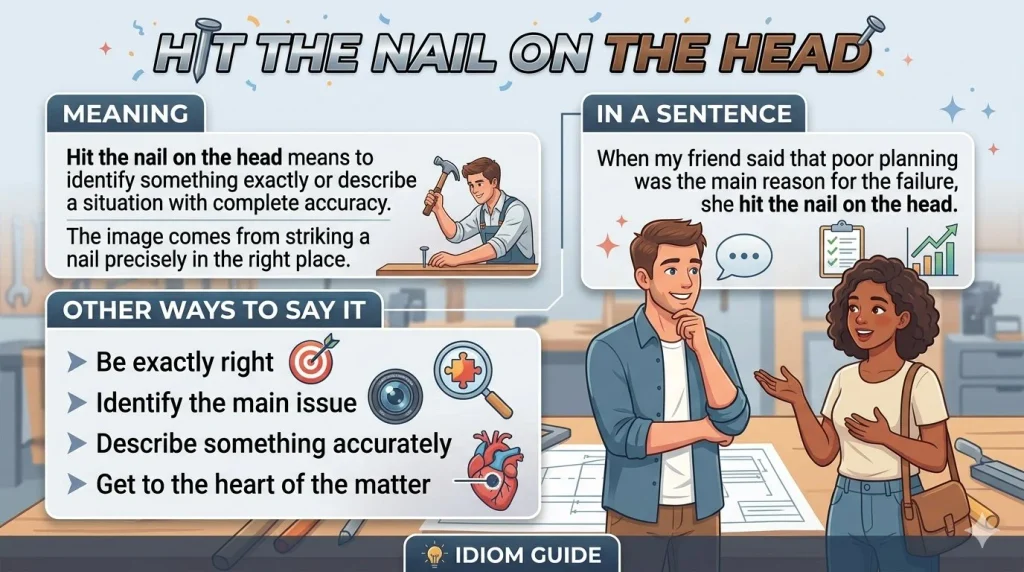
Hit the nail on the head means to identify something exactly or describe a situation with complete accuracy.
The image comes from striking a nail precisely in the right place.
In a Sentence
“When my friend said that poor planning was the main reason for the failure, she hit the nail on the head.”
Other Ways to Say It
- Be exactly right
- Identify the main issue
- Describe something accurately
- Get to the heart of the matter
Explanation
This idiom is useful when someone makes an accurate observation or explains the real cause of a problem.
It can make an IELTS answer sound more confident and conversational, particularly when giving an opinion or evaluating an issue.
Best Use
It fits IELTS Speaking Part 3 particularly well when discussing opinions, causes, problems, or social issues. It is less suitable for very formal academic writing.
A Piece of Cake
Meaning
A piece of cake means that something is very easy to do.
The expression compares an easy task with something enjoyable and effortless.
In a Sentence
“Once I understood the basic rules, using the new software was a piece of cake.”
Other Ways to Say It
- Very easy
- Simple to do
- No trouble at all
- Easy as anything
Explanation
This is a cheerful and informal expression for something that requires little effort.
Because it is casual, it can make an answer sound relaxed and natural. However, it should not be used when you need a formal academic tone.
Best Use
It works best in IELTS Speaking, especially when describing hobbies, technology, school tasks, cooking, sports, or something you learned quickly.
Once in a Blue Moon
Meaning
Once in a blue moon means something happens very rarely.
It creates a memorable picture of an unusual or uncommon event.
In a Sentence
“I eat fast food only once in a blue moon because I prefer home-cooked meals.”
Other Ways to Say It
- Very rarely
- Hardly ever
- On rare occasions
- Not very often
Explanation
This idiom adds color to a statement about frequency. Instead of simply saying “rarely,” it gives the listener a stronger sense that something almost never happens.
It is useful for talking about habits, entertainment, travel, food, shopping, and social activities.
Best Use
Use it in conversational IELTS answers when discussing how often you do something. It is informal but widely understandable.
Under the Weather
Meaning
Under the weather means feeling slightly ill, tired, or physically unwell.
It usually suggests a minor illness rather than a serious medical condition.
In a Sentence
“I stayed home yesterday because I was feeling under the weather.”
Other Ways to Say It
- Feel unwell
- Feel sick
- Feel poorly
- Not feel like yourself
Explanation
The phrase gives the impression that someone is temporarily affected by unpleasant conditions.
It is a friendly everyday expression and can make a personal story sound more natural without sounding overly dramatic.
Best Use
This idiom fits IELTS Speaking topics about health, daily routines, school, work, and missed activities. For formal medical or academic writing, “feel unwell” is usually clearer.

Cost an Arm and a Leg
Meaning
Cost an arm and a leg means something is extremely expensive.
The exaggerated image emphasizes a very high price.
In a Sentence
“That apartment is beautiful, but it costs an arm and a leg to rent.”
Other Ways to Say It
- Be extremely expensive
- Cost a fortune
- Be very costly
- Be overpriced
Explanation
The expression uses exaggeration to make the idea of a high price more vivid.
It is particularly useful when comparing the cost of housing, travel, education, technology, restaurants, or luxury goods.
Best Use
This is best for IELTS Speaking and informal conversation. Avoid it in formal academic writing unless the context deliberately allows an informal expression.
Bite the Bullet
Meaning
Bite the bullet means to face a difficult, unpleasant, or uncomfortable situation with courage and determination.
The phrase suggests enduring something painful rather than avoiding it.
In a Sentence
“I was nervous about giving the presentation, but I decided to bite the bullet and do it.”
Other Ways to Say It
- Face the challenge
- Deal with the situation
- Gather your courage
- Do something difficult
Explanation
This idiom works because it captures the moment when someone stops avoiding a problem and decides to confront it.
It is useful when describing exams, difficult decisions, public speaking, work challenges, or personal goals.
Best Use
Use it in IELTS Speaking when telling a story about overcoming fear or dealing with something difficult. Its tone is determined and conversational.
Get the Ball Rolling
Meaning
Get the ball rolling means to start an activity, process, discussion, or project.
The image is of a ball beginning to move and continuing forward.
In a Sentence
“We had a short meeting to get the ball rolling on our community project.”
Other Ways to Say It
- Get started
- Begin the process
- Start things moving
- Take the first step
Explanation
The idiom suggests that beginning is often the most important step. Once the process starts, other actions can follow naturally.
It works well for topics involving projects, teamwork, education, events, businesses, and community activities.
Best Use
It is suitable for IELTS Speaking, especially when describing how a project or activity began. It can also appear in informal professional communication.
See Eye to Eye
Meaning
See eye to eye means to agree with someone about an opinion, decision, or issue.
The expression suggests two people looking at something from the same perspective.
In a Sentence
“My brother and I don’t always see eye to eye, but we respect each other’s opinions.”
Other Ways to Say It
- Agree completely
- Share the same opinion
- Be in agreement
- Have similar views
Explanation
This idiom is particularly helpful when discussing relationships and disagreements.
It does not necessarily mean two people agree about everything. It can refer to agreement on a particular subject or decision.
Best Use
Use it in IELTS Speaking when discussing family, friends, colleagues, politics, education, or social issues. It sounds natural and conversational.
On the Same Page
Meaning
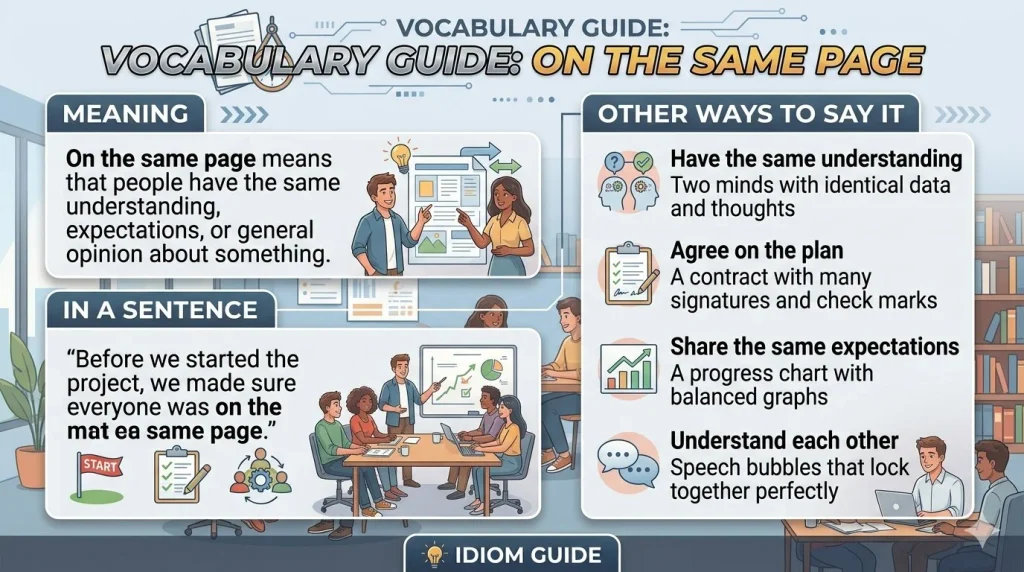
On the same page means that people have the same understanding, expectations, or general opinion about something.
In a Sentence
“Before we started the project, we made sure everyone was on the same page.”
Other Ways to Say It
- Have the same understanding
- Agree on the plan
- Share the same expectations
- Understand each other
Explanation
Unlike “see eye to eye,” this expression often focuses on shared understanding or coordination, rather than simply having the same opinion.
It creates the image of several people looking at the same page and therefore understanding the same information.
Best Use
It works well in IELTS Speaking topics involving teamwork, education, work, planning, and communication. It is more informal than “reach a common understanding.”
A Blessing in Disguise
Meaning
A blessing in disguise describes something that initially seems bad or disappointing but eventually produces a positive result.
The “disguise” represents the hidden benefit.
In a Sentence
“Missing that flight was a blessing in disguise because it gave me time to discover a beautiful town near the airport.”
Other Ways to Say It
- An unexpected benefit
- A positive outcome from a setback
- Something good that seemed bad at first
- A fortunate accident
Explanation
This idiom is powerful because it captures mixed emotions. Something can be disappointing at first while becoming valuable later.
It is excellent for personal stories involving missed opportunities, changes, mistakes, or unexpected experiences.
Best Use
This works especially well in IELTS Speaking Part 2, where you may need to tell a story about an experience that changed your perspective.
When It Rains, It Pours
Meaning
When it rains, it pours means that several problems or events often seem to happen at the same time.
It uses heavy rain as a metaphor for a sudden accumulation of difficulties.
In a Sentence
“My laptop broke, I missed my bus, and then I lost my wallet—when it rains, it pours.”
Other Ways to Say It
- Problems came all at once
- One problem followed another
- Everything happened at the same time
- Trouble seemed to pile up
Explanation
This expression is useful for describing a period when one difficulty quickly leads to another.
The weather image makes the situation more vivid and gives the sentence an emotional, slightly dramatic quality.
Best Use
Use it for storytelling and personal experiences in IELTS Speaking. It is generally too informal for formal academic writing.
The Tip of the Iceberg
Meaning
The tip of the iceberg refers to a small, visible part of a much larger or more complicated situation.
An iceberg may show only a small section above water while most of it remains hidden below.
In a Sentence
“The complaints we heard were only the tip of the iceberg; the company had much deeper problems.”
Other Ways to Say It
- A small part of a larger problem
- Only the beginning
- The visible part of the issue
- A sign of something much bigger
Explanation
This idiom is especially effective when discussing complex problems.
It helps listeners understand that what they can see does not represent the full scale of an issue.
Best Use
It can work well in IELTS Speaking Part 3, particularly when discussing environmental, social, technological, or economic problems. It can also be used in less formal argumentative writing.
Burn the Midnight Oil
Meaning
Burn the midnight oil means to work or study late into the night.
The expression comes from the old practice of using oil lamps for lighting.
In a Sentence
“I had an important exam the next morning, so I burned the midnight oil to review my notes.”
Other Ways to Say It
- Study late
- Work late into the night
- Stay up working
- Spend the night studying
Explanation
This idiom creates a clear picture of someone continuing to work after normal hours.
It can communicate hard work, pressure, determination, or preparation, depending on the context.
Best Use
It is useful in IELTS Speaking when discussing education, exams, work habits, deadlines, or ambitious goals. It has a slightly traditional and informal feel.
Learn the Ropes
Meaning
Learn the ropes means to learn how a job, activity, system, or situation works.
The expression comes from learning how to handle ropes and equipment on a sailing ship.
In a Sentence
“It took me a few weeks to learn the ropes at my new job.”
Other Ways to Say It
- Learn how things work
- Become familiar with a task
- Get used to the system
- Gain practical experience
Explanation
The idiom emphasizes the learning process rather than simply gaining information.
It is especially useful when describing a new school, workplace, hobby, technology, or responsibility.
Best Use
This is a good conversational expression for IELTS Speaking topics about jobs, education, new experiences, and learning skills.
Put Yourself in Someone’s Shoes
Meaning
Put yourself in someone’s shoes means to imagine what another person is experiencing or feeling.
The shoes represent another person’s position or circumstances.
In a Sentence
“Before criticizing the student, the teacher tried to put herself in his shoes.”
Other Ways to Say It
- Imagine being in their position
- Try to understand their feelings
- Consider their perspective
- See things from their point of view
Explanation
This idiom expresses empathy. It encourages people to consider circumstances from another person’s perspective before making a judgment.
It is particularly valuable when discussing disagreements, relationships, social problems, or difficult decisions.
Best Use
Use it in IELTS Speaking Part 3 when discussing empathy, society, parenting, education, workplace relationships, or conflict. It sounds natural but remains meaningful.
Keep Your Chin Up
Meaning
Keep your chin up means to remain positive and hopeful during a difficult period.
The image suggests physically keeping your head raised instead of looking defeated.
In a Sentence
“My friend told me to keep my chin up after I didn’t get the job I wanted.”
Other Ways to Say It
- Stay positive
- Don’t lose hope
- Stay strong
- Remain optimistic
Explanation
This expression has a supportive and encouraging tone.
It works particularly well when describing how someone responds to disappointment or how you encourage a friend who is facing a difficult situation.
Best Use
It is most natural in personal stories, conversations, supportive messages, and IELTS Speaking. It is informal and should be avoided in highly formal academic contexts.
A Breath of Fresh Air
Meaning
A breath of fresh air describes someone or something that feels refreshing, new, different, or pleasantly positive.
The image compares a welcome change to breathing clean, fresh air.
In a Sentence
“The new manager was a breath of fresh air because he encouraged everyone to share ideas.”
Other Ways to Say It
- A refreshing change
- Something pleasantly different
- A welcome change
- A new perspective
Explanation
This idiom carries a positive and uplifting feeling. It is useful when an experience, person, idea, or change breaks away from something repetitive or dull.
It can add warmth to descriptions of people and situations without becoming overly poetic.
Best Use
It works nicely in IELTS Speaking when describing a person, workplace, teacher, city, activity, or new idea that made a positive difference.
In Hot Water
Meaning
In hot water means to be in trouble or facing criticism because of something you have done.
The phrase creates an image of being stuck in an uncomfortable situation.
In a Sentence
“He was in hot water after forgetting to submit the important report.”
Other Ways to Say It
- Be in trouble
- Face criticism
- Be in a difficult situation
- Get into trouble
Explanation
This is a straightforward idiom for a situation involving mistakes, consequences, or criticism.
It is more expressive than simply saying “be in trouble,” while still being easy to understand from context.
Best Use
Use it in IELTS Speaking when telling a story about a mistake, workplace problem, school incident, or misunderstanding. It is informal and conversational.
Exercise: Practice Using Idioms
Choose the best answer for each question.
Which idiom means “to make people feel more comfortable when they first meet”?
A. Burn the midnight oil
B. Break the ice
C. Bite the bullet
D. Learn the ropes
If something happens “once in a blue moon,” how often does it happen?
A. Every day
B. Very quickly
C. Very rarely
D. At a fixed time
What does “go the extra mile” mean?
A. When, To travel somewhere far away
B. How To make more effort than expected?
C. To finish something immediately
D. To avoid unnecessary work
Someone says that a friend’s explanation “hit the nail on the head.” What do they mean?
A. The explanation was exactly right.
B. Now, The explanation was very confusing.
C. The explanation was too long.
D. The explanation was completely unrelated.
Which sentence uses “a piece of cake” correctly?
A. The difficult journey was a piece of cake because it lasted ten days.
B. She bought a piece of cake before starting her exam.
C. After practicing for weeks, the basic task was a piece of cake.
D. The cake was difficult because it was a piece of cake.
What does “under the weather” usually mean?
A. Feeling slightly unwell
B. Traveling during a storm
C. Feeling extremely excited
D. Working outdoors
If something “costs an arm and a leg,” what does that suggest?
A. It is difficult to carry.
B. It is extremely expensive.
C. It is dangerous to use.
D. It is unusually small.
What does “bite the bullet” suggest?
A. Avoiding an unpleasant situation
B. Celebrating an achievement
C. Facing something difficult with determination
D. Changing your plans unexpectedly
If a team wants to “get the ball rolling,” what should it do?
A. Stop working temporarily
B. Begin the activity or process
C. Replace all team members
D. Review the final result
Two people “see eye to eye” about a subject. What does this mean?
A. They completely disagree.
B. They have not discussed it.
C. They have similar or matching views.
D. They are avoiding the subject.
What does “on the same page” usually describe?
A. The People having the same understanding or expectations
B. Now, People reading different books
C. After, People working completely alone
D. People changing their opinions frequently
A difficult event turns out to be “a blessing in disguise.” What happened?
A. The event remained completely negative.
B. The event was secretly planned.
C. The event was positive from the beginning.
D. Something that seemed bad eventually brought a benefit.
What does “the tip of the iceberg” suggest?
A. A problem has completely disappeared.
B. Only a small visible part of a larger situation is being seen.
C. A situation is easier than expected.
D. Something happens very rarely.
If a student “burns the midnight oil,” what are they probably doing?
A. Studying or working late
B. Taking an afternoon break
C. Going on vacation
D. Preparing a meal
What does “put yourself in someone’s shoes” encourage you to do?
A. Borrow another person’s belongings
B. Change your appearance
C. Consider another person’s perspective or feelings
D. Avoid talking to another person
Answers
- B — “Break the ice” means to make people feel more relaxed when meeting or interacting for the first time.
- C — “Once in a blue moon” describes something that happens very rarely.
- B — “Go the extra mile” means to make more effort than people normally expect.
- A — “Hit the nail on the head” means to identify or explain something exactly.
- C — “A piece of cake” describes something that is very easy to do.
- A — “Under the weather” means feeling slightly ill or unwell.
- B — “Cost an arm and a leg” means something is extremely expensive.
- C — “Bite the bullet” means facing something unpleasant or difficult with courage.
- B — “Get the ball rolling” means to begin an activity, process, or project.
- C — “See eye to eye” means to agree or have similar views about something.
- A — “On the same page” means people share the same understanding, expectations, or general plan.
- D — “A blessing in disguise” refers to something that seems negative initially but eventually produces a positive result.
- B — “The tip of the iceberg” means the visible part represents only a small part of a much larger situation.
- A — “Burn the midnight oil” means to work or study late into the night.
- C — “Put yourself in someone’s shoes” means to imagine and understand another person’s perspective or feelings.
Frequently Asked Questions About Idioms for IELTS
What is an idiom for IELTS?
An idiom for IELTS is a natural English expression that can help you communicate an idea in a more expressive and conversational way, particularly during the Speaking test. Examples include “break the ice,” “go the extra mile,” and “once in a blue moon.”
How do I create my own idiom?
Most common idioms develop naturally through language and culture rather than being deliberately invented for an exam. Instead of trying to create a new idiom for IELTS, learn established expressions and understand their meaning, tone, grammar, and context.
What makes an idiom effective?
An effective idiom is accurate, relevant, natural, and appropriate for the situation. It should make your meaning clearer or more vivid rather than simply being added to make an answer sound advanced.
Can I use these idioms in everyday conversation?
Yes. Most of these expressions are useful in everyday spoken English. However, some are quite informal, so expressions such as “a piece of cake” or “in hot water” may not be suitable for every formal situation.
What is the difference between an idiom and a simile?
An idiom is an established expression with a figurative meaning, such as “break the ice.” A simile directly compares two things using words such as “like” or “as,” for example, “The city is like a sleeping giant.” Idioms are generally fixed expressions, while similes can be created more freely.
Conclusion
Using idioms in IELTS can make your spoken English more natural, vivid, and personal, but successful communication is more important than using as many expressions as possible. Choose an idiom because it genuinely fits your meaning, not simply because you memorized it for the test. Expressions such as “bite the bullet,” “a blessing in disguise,” and “put yourself in someone’s shoes” can help you tell stories, explain experiences, and discuss opinions with greater personality.
Pay attention to context and tone, especially when moving between casual conversation and formal writing. The best idiom is not the most complicated one it is the one that communicates your idea clearly and naturally. With regular practice, these expressions can become a useful part of your English vocabulary for IELTS and beyond.

Eleanor Prose is a writer and English teacher with a soft spot for the phrases that trip us up. She has spent years helping students and professionals use idioms with confidence not just memorizing them, but understanding the culture and humor behind each one.
Through Idiom Looms, Eleanor explores the threads that connect language, history, and everyday conversation. Her goal is simple: to make English idioms clear, memorable, and actually fun to use.
She writes from a quiet desk surrounded by notebooks, and firmly believes there’s an idiom for every situation usually more than one.



[…] Read more:20 Idioms for IELTS With Real Examples […]