
Have you ever struggled to describe that sudden moment when something completely unexpected happens? The right expression can make that feeling much more vivid. In this guide, 20 Idioms for Surprise With Real Examples introduces natural phrases for expressing shock, amazement, disbelief, and unexpected reactions. These idioms help you add personality to everyday conversations, storytelling, and English usage. They also make your language sound more expressive without relying on repetitive words like “surprised” or “shocked.”
Understanding idioms for surprise can improve both casual and professional communication. You may encounter them during meetings, business communication, broadcasting, or informal conversations. They can also appear in formal writing, creative content, and spoken English. Although topics such as scheduling, time management, online booking, calendar planning, and project management seem unrelated, clear English helps communicate unexpected changes effectively. Learning the figurative meaning behind each expression makes these phrases easier to recognize and use naturally.
This article explains each idiom in simple language and provides real examples to show how it works in context. You will learn the meaning, tone, and appropriate situations for using each expression. The examples also support better grammar, natural sentence structure, and consistency in everyday English. Whether you are improving vocabulary, preparing for conversations, or developing stronger writing skills, these expressive idioms can help you communicate surprise with greater clarity and confidence.
What Is an Idiom?
An idiom is a group of words that has a meaning understood by fluent speakers beyond the words’ literal definitions.
For example, if someone says, “It’s raining cats and dogs,” they do not mean animals are falling from the sky. They mean that it is raining very heavily.
Similarly, “break the ice” does not mean physically breaking ice. It means to make people feel more comfortable in a new or awkward situation.
Idioms make language more colorful and expressive. They allow speakers and writers to communicate feelings, situations, and ideas through familiar images rather than plain statements.
Why Use Idioms for Surprise?
Surprise can take many forms. You might feel pleasantly amazed, suddenly shocked, completely confused, or so stunned that you cannot speak. A simple phrase such as “I was surprised” does not always capture that difference.
Idioms help add those missing shades of meaning.
They can make your description of surprise:
- More emotional by showing how strongly you reacted.
- More vivid by creating a memorable mental picture.
- More conversational in everyday speech.
- More engaging in stories and creative writing.
- More precise when ordinary words do not capture the reaction.
- More memorable in speeches, personal messages, and storytelling.
For example, saying someone was “caught off guard” suggests that the surprise happened before they were prepared. Saying they were “gobsmacked” suggests a much stronger reaction.
The best expression depends on the kind and intensity of surprise you want to communicate.
Quick List of 20 Idioms for Surprise
- Taken aback
- Caught off guard
- Out of the blue
- A bolt from the blue
- Do a double take
- Knock someone for six
- Knock someone sideways
- Leave someone speechless
- Have your jaw drop
- Eyes pop out of your head
- Stop someone in their tracks
- Floor someone
- Gobsmacked
- At a loss for words
- Blow someone away
- Catch someone by surprise
- Turn the tables
- See something coming
- Knock your socks off
- Take someone by storm
Taken Aback
Read more:20 Idioms for Special With Real Examples
Meaning
To be taken aback means to feel suddenly surprised, shocked, or slightly confused by something unexpected. It often suggests that you need a moment to process what has happened.
In a Sentence
I was taken aback when my quiet colleague suddenly announced that he was leaving the company.
Other Ways to Say It
- Be surprised
- Be startled
- Be caught by surprise
- Be shocked
Explanation
The expression suggests that an unexpected event has temporarily disrupted your normal reaction. It can describe both pleasant and unpleasant surprise, although the context determines the emotional tone.
It is especially useful when someone is momentarily unsettled rather than completely shocked.
Best Use
Best for: conversations, essays, storytelling, and professional writing.
It sounds natural and polished without being overly dramatic.
Caught Off Guard
Meaning
To be caught off guard means to be surprised by something when you are not prepared for it.
In a Sentence
The reporter’s unexpected question caught the politician off guard, and he paused before answering.
Other Ways to Say It
- Be unprepared
- Be caught by surprise
- Be taken by surprise
- Not see it coming
Explanation
This expression focuses on lack of preparation rather than surprise alone. The image is of someone being approached before they have had time to defend themselves or prepare an answer.
It works particularly well when an unexpected question, event, decision, or problem leaves someone temporarily uncertain.
Best Use
Best for: conversations, news-style writing, workplace situations, and storytelling.
It can sound serious or casual depending on the situation.
Out of the Blue
Meaning
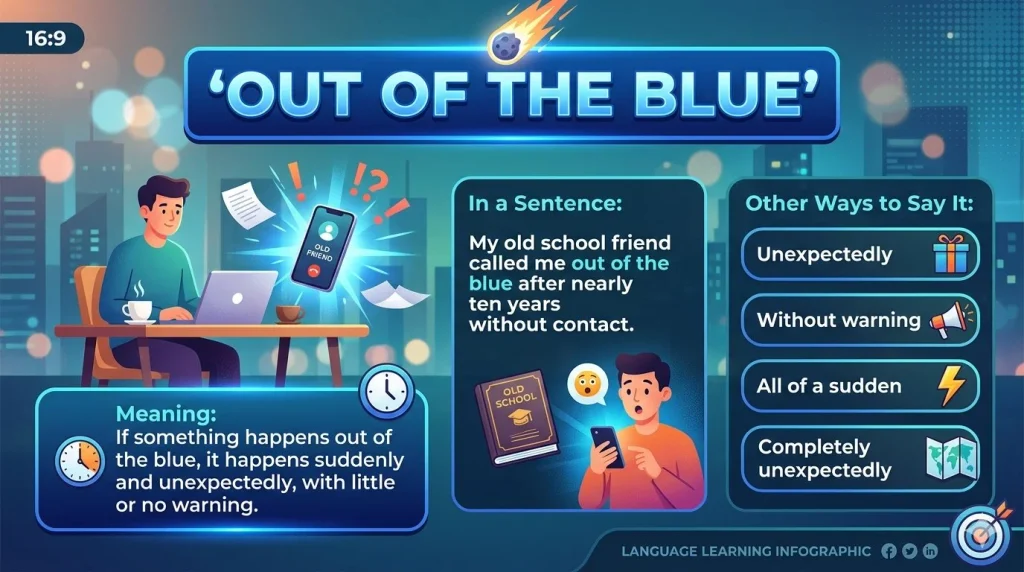
If something happens out of the blue, it happens suddenly and unexpectedly, with little or no warning.
In a Sentence
My old school friend called me out of the blue after nearly ten years without contact.
Other Ways to Say It
- Unexpectedly
- Without warning
- All of a sudden
- Completely unexpectedly
Explanation
The expression creates an image of something appearing from a clear, empty sky. It emphasizes the unexpected timing of an event rather than the emotional reaction itself.
It is especially effective when the surprise seems to come from nowhere.
Best Use
Best for: everyday conversation, personal stories, social media posts, and informal writing.
It is one of the more natural choices for casual English.
A Bolt from the Blue
Meaning
A bolt from the blue describes something extremely unexpected and often shocking.
In a Sentence
The sudden announcement of the team’s cancellation was a bolt from the blue for everyone involved.
Other Ways to Say It
- A complete shock
- A sudden surprise
- A bombshell
- Unexpected news
Explanation
The image comes from a flash of lightning appearing in an otherwise clear sky. It suggests an event that arrives suddenly and has a powerful emotional effect.
Unlike “out of the blue,” this expression often carries a stronger sense of shock or dramatic impact.
Best Use
Best for: serious conversations, journalism, storytelling, and dramatic writing.
It has a slightly more literary or traditional feel than some everyday expressions.
Do a Double Take
Meaning
To do a double take means to look at something again because you were so surprised that you initially could not believe what you saw.
In a Sentence
I did a double take when I saw my childhood teacher working behind the café counter.
Other Ways to Say It
- Look twice
- Take a second look
- Look again in surprise
- Check what you just saw
Explanation
The expression creates a funny and familiar visual image: you see something unexpected, move on for a moment, and then quickly look back.
It is especially useful for visual surprises involving people, objects, places, or unusual situations.
Best Use
Best for: conversations, humorous stories, social media, and creative writing.
It usually has a light or playful tone.
Knock Someone for Six
Meaning
To knock someone for six means to shock, surprise, or emotionally overwhelm someone completely.
In a Sentence
Hearing that she had won the scholarship knocked her for six.
Other Ways to Say It
- Shock someone
- Stun someone
- Leave someone overwhelmed
- Take someone completely by surprise
Explanation
This expression comes from cricket, where scoring six runs from one hit is a powerful achievement. Figuratively, it suggests that an event has hit someone with great force.
It is particularly expressive when the surprise has a strong emotional effect.
Best Use
Best for: British English, informal conversation, personal stories, and lively writing.
It may sound unfamiliar to some American English speakers, so context can help.
Knock Someone Sideways
Meaning
To knock someone sideways means to surprise or shock someone so strongly that they are temporarily overwhelmed.
In a Sentence
The unexpected inheritance knocked him sideways, and he needed several days to process the news.
Other Ways to Say It
- Shock someone deeply
- Stun someone
- Leave someone reeling
- Take someone completely by surprise
Explanation
The expression imagines surprise as a physical force powerful enough to push someone sideways. It communicates more than ordinary surprise; it suggests that the news has disrupted someone’s emotional balance.
It can be used for good or bad news.
Best Use
Best for: storytelling, informal conversation, personal writing, and dramatic descriptions.
It is more vivid than simply saying “surprised.”
Leave Someone Speechless
Meaning
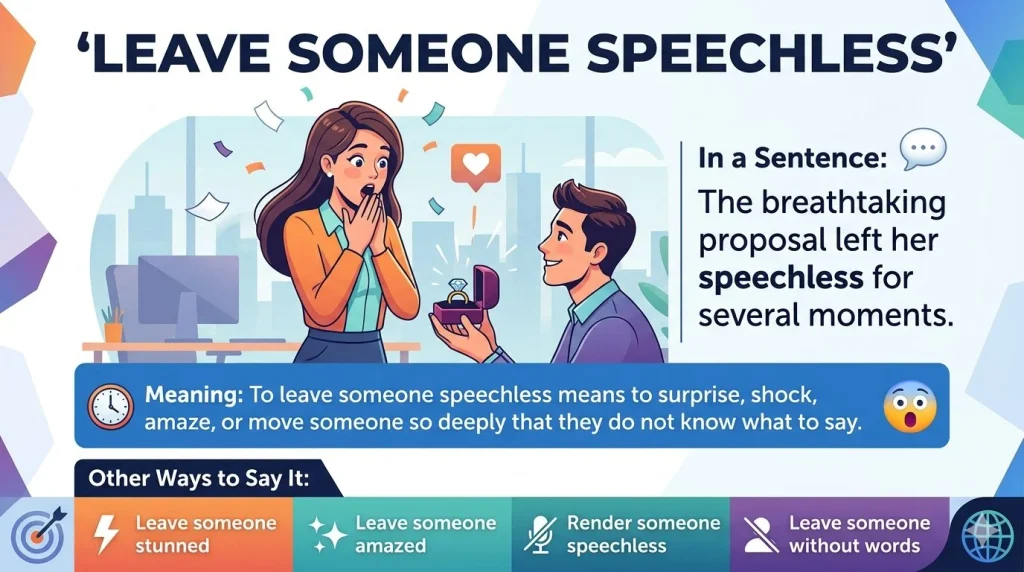
To leave someone speechless means to surprise, shock, amaze, or move someone so deeply that they do not know what to say.
In a Sentence
The breathtaking proposal left her speechless for several moments.
Other Ways to Say It
- Leave someone stunned
- Leave someone amazed
- Render someone speechless
- Leave someone without words
Explanation
This expression focuses on the absence of a verbal reaction. The surprise is so strong that words seem to disappear.
The context can make it warm, romantic, emotional, shocking, or even humorous.
Best Use
Best for: personal messages, speeches, romantic writing, storytelling, and emotional moments.
It works especially well when the reaction matters as much as the surprising event.
Have Your Jaw Drop
Meaning
To have your jaw drop means to react with extreme surprise or amazement.
In a Sentence
My jaw dropped when the curtain opened and revealed the enormous stage.
Other Ways to Say It
- Be amazed
- Be stunned
- Be astonished
- Be shocked
Explanation
The expression comes from the physical reaction people may have when something is astonishing: their mouth opens in surprise.
It creates an immediate, visual picture of strong amazement and is usually more dramatic than simply saying “I was surprised.”
Best Use
Best for: informal conversation, storytelling, social media, and creative writing.
It has a lively, visual quality and is generally unsuitable for very formal writing.
Eyes Pop Out of Your Head
Meaning
If your eyes pop out of your head, you are extremely surprised or amazed by what you see.
In a Sentence
His eyes nearly popped out of his head when he saw the size of the birthday cake.
Other Ways to Say It
- Stare in amazement
- Look shocked
- Be astonished
- Be amazed by what you see
Explanation
This is an exaggerated expression based on a cartoon-like image of someone’s eyes becoming enormous with surprise.
Because the image is intentionally dramatic, it works best for strong visual reactions and often adds humor.
Best Use
Best for: casual conversation, humorous writing, children’s stories, and lively storytelling.
Avoid it when a restrained or professional tone is needed.
Stop Someone in Their Tracks
Meaning
To stop someone in their tracks means to make someone suddenly stop what they are doing because something is shocking, surprising, impressive, or emotionally powerful.
In a Sentence
The unexpected sight of snow in the middle of summer stopped us in our tracks.
Other Ways to Say It
- Stop someone suddenly
- Shock someone into stopping
- Make someone pause
- Halt someone in surprise
Explanation
The phrase creates a physical image of someone walking forward and suddenly coming to a complete stop. The surprise is strong enough to interrupt their movement or train of thought.
It can also describe something powerful or impressive, not only something shocking.
Best Use
Best for: storytelling, travel writing, speeches, and descriptive prose.
It is especially effective when the surprise interrupts an ongoing action.
Floor Someone
Meaning
To floor someone means to shock or surprise them so greatly that they are temporarily unable to respond normally.
In a Sentence
The news that he had been accepted into his dream university floored him.
Other Ways to Say It
- Stun someone
- Shock someone
- Leave someone amazed
- Knock someone over emotionally
Explanation
The expression creates the image of someone being so affected by surprise that they are figuratively knocked to the floor.
It can describe positive or negative shock, depending on the context.
Best Use
Best for: informal conversation, storytelling, personal writing, and dramatic situations.
It is expressive rather than formal.
Gobsmacked
Meaning
Gobsmacked means extremely surprised or astonished, often to the point that you do not know what to say.
In a Sentence
I was absolutely gobsmacked when they told me the painting had sold for that much.
Other Ways to Say It
- Amazed
- Astonished
- Stunned
- Completely shocked
Explanation
This informal expression is strongly associated with British English. It describes a reaction of complete astonishment, often with a sense of disbelief.
Its unusual sound gives it personality, making it more colorful than the simple word “surprised.”
Best Use
Best for: informal British English, conversations, humorous writing, and lively storytelling.
It is generally too casual for formal academic or business writing.

At a Loss for Words
Meaning
To be at a loss for words means you cannot think of what to say because you are surprised, shocked, touched, confused, or overwhelmed.
In a Sentence
When everyone stood up to applaud him, he was at a loss for words.
Other Ways to Say It
- Unable to speak
- Not know what to say
- Be speechless
- Struggle to find words
Explanation
This expression focuses on the difficulty of putting a strong reaction into words. Surprise is only one possible reason; deep emotion or gratitude can create the same reaction.
It is therefore more flexible than expressions that specifically mean shock.
Best Use
Best for: speeches, personal messages, emotional writing, conversations, and heartfelt storytelling.
It often sounds warm and sincere.
Blow Someone Away
Meaning
To blow someone away means to surprise, impress, or amaze someone enormously.
In a Sentence
The young musician’s performance blew everyone away.
Other Ways to Say It
- Amaze someone
- Impress someone greatly
- Astonish someone
- Leave someone impressed
Explanation
The expression imagines an experience as such a powerful force that it can figuratively blow someone away.
It usually describes positive surprise or admiration, rather than unpleasant shock.
Best Use
Best for: conversations, reviews, social media, creative writing, and enthusiastic reactions.
It is informal and energetic.
Catch Someone by Surprise
Meaning
To catch someone by surprise means to do or reveal something that someone was not expecting.
In a Sentence
The sudden change in plans caught us by surprise, but we quickly adjusted.
Other Ways to Say It
- Surprise someone
- Catch someone unexpectedly
- Take someone by surprise
- Come as a surprise
Explanation
This expression directly highlights the gap between what someone expected and what actually happened.
It can describe small surprises as well as major unexpected events, so it is one of the most flexible choices on this list.
Best Use
Best for: everyday conversation, essays, workplace communication, and storytelling.
It is appropriate in both casual and relatively formal contexts.
Turn the Tables
Meaning
To turn the tables means to unexpectedly reverse a situation so that the person who seemed to have the advantage loses it and the other person gains control.
In a Sentence
Everyone expected the underdog to lose, but two quick goals turned the tables in the second half.
Other Ways to Say It
- Reverse the situation
- Change the balance
- Gain the upper hand
- Reverse the outcome
Explanation
This idiom does not simply mean “surprise.” Its special meaning is unexpected reversal.
The image suggests physically turning a table around and changing the arrangement of a situation. It is useful when the surprising element is a sudden change in who has the advantage.
Best Use
Best for: sports writing, storytelling, debates, business discussions, and dramatic narratives.
Use it when surprise comes from a reversal rather than unexpected news alone.
See Something Coming
Meaning
To see something coming means to anticipate an event before it happens. When you say you didn’t see it coming, you mean the event was completely unexpected.
In a Sentence
I knew the meeting might be difficult, but I didn’t see that question coming.
Other Ways to Say It
- Expect something
- Anticipate something
- Predict what will happen
- Be prepared for something
Explanation
The expression uses the image of seeing an event approaching before it reaches you. The negative form, “I didn’t see it coming,” is especially useful for describing surprise.
It emphasizes the absence of warning or anticipation.
Best Use
Best for: everyday conversation, storytelling, personal writing, and informal explanations.
The phrase is particularly natural when describing an unexpected moment after it has happened.
Knock Your Socks Off
Meaning
To knock your socks off means to surprise, impress, or amaze you greatly.
In a Sentence
Wait until you see the finished room—it’ll knock your socks off.
Other Ways to Say It
- Amaze you
- Impress you greatly
- Blow you away
- Leave you stunned
Explanation
This playful expression creates an exaggerated picture of an experience being so powerful that it could literally knock your socks off.
It generally communicates positive excitement and amazement, rather than fear or bad news.
Best Use
Best for: casual conversation, advertising-style copy, social media, entertainment, and enthusiastic recommendations.
It is deliberately informal and playful.
Take Someone by Storm
Meaning
To take someone by storm means to impress, excite, or captivate people very strongly and quickly.
In a Sentence
The new performer took the audience by storm with his first appearance.
Other Ways to Say It
- Captivate people
- Make a powerful impression
- Win people over quickly
- Create a strong impact
Explanation
This expression comes from the image of a storm arriving with great force. In figurative language, it describes something that suddenly captures attention and makes a strong impression.
Unlike “caught off guard,” the emphasis here is often on the powerful effect something has on an audience or group.
Best Use
Best for: entertainment writing, reviews, speeches, storytelling, and promotional language.
It is usually positive and energetic rather than shocking.
Exercise: Practice Using Idioms
Test yourself before checking the answers. Pay attention not only to the meaning of each expression, but also to the context and emotional intensity.
Question 1
If a friend calls you unexpectedly after ten years without contact, which expression best describes the timing?
A. Turn the tables
B. Out of the blue
C. Take someone by storm
D. Knock your socks off
Question 2
Which idiom means that someone was surprised because they were not prepared?
A. Caught off guard
B. Blow someone away
C. Do a double take
D. Take someone by storm
Question 3
You see your favorite actor unexpectedly working at a local café and look again because you cannot believe it. Which expression fits best?
A. Floor someone
B. A bolt from the blue
C. Do a double take
D. Turn the tables
Question 4
Which expression usually describes a very strong reaction of astonishment in informal British English?
A. See something coming
B. Catch someone by surprise
C. At a loss for words
D. Gobsmacked
Question 5
Someone receives wonderful news and is so overwhelmed that they cannot immediately speak. Which expression is most suitable?
A. Leave someone speechless
B. Turn the tables
C. Out of the blue
D. See something coming
Question 6
Which expression specifically suggests that an event was extremely unexpected and shocking?
A. Knock your socks off
B. A bolt from the blue
C. Take someone by storm
D. Do a double take
Question 7
A breathtaking performance impresses the entire audience. Which expression best fits?
A. Catch someone by surprise
B. Caught off guard
C. Blow someone away
D. At a loss for words
Question 8
Which expression describes a situation where the advantage unexpectedly changes from one side to another?
A. Have your jaw drop
B. Turn the tables
C. Out of the blue
D. Gobsmacked
Question 9
What does “I didn’t see it coming” usually mean?
A. I did not notice the person approaching.
B. I was watching something else.
C. I was expecting the event.
D. I did not expect the event to happen.
Question 10
Which expression creates a humorous, exaggerated image of extreme surprise?
A. Eyes pop out of your head
B. Catch someone by surprise
C. Taken aback
D. See something coming
Question 11
A manager asks an employee an unexpected question during a meeting, and the employee needs a moment to respond. Which idiom fits best?
A. Knock your socks off
B. Caught off guard
C. Take someone by storm
D. Turn the tables
Question 12
Which expression is most appropriate for a positive experience that greatly impresses someone?
A. Blow someone away
B. A bolt from the blue
C. Knock someone sideways
D. Caught off guard
Question 13
Which statement correctly describes “taken aback”?
A. Someone becomes prepared for an event.
B. Someone deliberately reverses a situation.
C. Someone is suddenly surprised or unsettled.
D. Someone impresses a large audience.
Question 14
Which expression is most strongly associated with playful, informal language?
A. Knock your socks off
B. At a loss for words
C. Caught by surprise
D. Taken aback
Question 15
Which sentence uses an expression correctly?
A. I did a double take because I expected exactly the same thing.
B. The surprise announcement caught everyone off guard.
C. We saw the result coming, so it was completely out of the blue.
D. The predictable ending was a bolt from the blue.
Answers
- B — “Out of the blue” describes something that happens suddenly and without warning.
- A — “Caught off guard” means being surprised when you are not prepared.
- C — “Do a double take” means looking again because something seems unexpectedly surprising.
- D — “Gobsmacked” is an informal expression, especially common in British English, for being extremely surprised.
- A — “Leave someone speechless” means the emotional reaction is so strong that the person cannot immediately find words.
- B — “A bolt from the blue” describes an event that is highly unexpected and often shocking.
- C — “Blow someone away” usually expresses strong positive amazement or admiration.
- B — “Turn the tables” means to unexpectedly reverse the balance or advantage in a situation.
- D — “I didn’t see it coming” means the speaker did not expect the event.
- A — “Eyes pop out of your head” uses an exaggerated, humorous image of extreme surprise.
- B — “Caught off guard” is appropriate because the employee was not prepared for the unexpected question.
- A — “Blow someone away” is commonly used for something that greatly impresses or amazes someone.
- C — “Taken aback” means suddenly surprised, shocked, or unsettled.
- A — “Knock your socks off” is playful, exaggerated, and informal.
- B — The sentence correctly uses “caught everyone off guard” to describe an unexpected announcement.
FAQs
What is an idiom for surprise?
An idiom for surprise is a figurative expression used to describe an unexpected reaction or event. Examples include “caught off guard,” “taken aback,” “out of the blue,” and “do a double take.” Each expression emphasizes a slightly different type of surprise.
How do I create my own idiom for surprise?
You can create an original figurative expression by connecting surprise with a strong visual image, unexpected movement, or emotional reaction. However, a newly created phrase may not be a recognized English idiom. If you are writing creatively, that can still be effective as long as the meaning is clear from context.
What makes an idiom effective?
An effective idiom creates a clear mental image while communicating an idea efficiently. For surprise, the strongest expressions often show what the reaction feels like rather than merely naming the emotion.
Can I use these idioms in everyday conversation?
Yes. Many of these expressions, such as “out of the blue,” “caught off guard,” “do a double take,” and “blow me away,” sound natural in everyday conversation. More dramatic expressions may be better suited to storytelling or informal situations.
What is the difference between an idiom and a simile?
An idiom is a familiar expression whose meaning is not necessarily literal, such as “out of the blue.” A simile directly compares two things using words such as “like” or “as,” for example, “His reaction was like a bolt of lightning.” Both can create imagery, but they work differently.
Conclusion
Surprise is not a single emotion. It can be mild, joyful, shocking, confusing, overwhelming, or deeply moving. That is why using the right idiom for surprise can make a description much more precise and memorable. Expressions such as “caught off guard” emphasize a lack of preparation, while “out of the blue” focuses on unexpected timing. Others, such as “gobsmacked” and “have your jaw drop,” highlight the strength of the reaction.
When choosing an idiom, think about what you really want your reader or listener to feel. A playful expression may suit a casual story, while a more restrained phrase may work better in an essay or professional setting. The strongest figurative language is not simply dramatic it communicates the intended feeling clearly. With the right expression, even a simple moment of surprise can become vivid and memorable.




[…] Read more:20 Idioms for Surprise With Real Examples […]