

Have you ever struggled to describe why a person, moment, or experience feels truly special? The right expression can make an ordinary sentence feel warmer, clearer, and more memorable. In this guide, 20 Idioms for Special With Real Examples introduces useful expressions that add personality and figurative meaning to everyday English. Each idiom is explained in simple language, with practical examples that show how native speakers use these phrases naturally.
Understanding these expressions can also strengthen English usage, grammar, and formal writing. Idioms help you communicate appreciation, uniqueness, importance, and emotional value without relying on repetitive descriptions. Whether you are writing a personal message, preparing a speech, creating content, or improving everyday conversations, the examples will help you recognize the difference between literal and idiomatic language. You will also see how context affects meaning and tone.
This article focuses on practical expressions rather than complicated vocabulary. You will explore idioms suitable for business communication, meetings, personal writing, storytelling, and creative expression, while avoiding unrelated uses such as scheduling, time management, online booking, broadcasting, calendar planning, or project management unless they naturally fit the context. With clear explanations and realistic sentences, these examples make learning easier and encourage consistency in your English. By the end, you will have a useful collection of expressions for describing people, moments, ideas, and experiences that stand out as truly special.
What Is an Idiom?
An idiom is a word or phrase whose meaning is different from the literal meaning of the individual words. Idioms are a form of figurative language that allow people to communicate ideas in a more vivid or expressive way.
For example, if someone says, “He hit the nail on the head,” they usually do not mean that the person literally struck a nail. They mean that the person was exactly right.
Another example is “She is a breath of fresh air.” This does not mean she is literally air. It suggests that her personality or presence feels refreshing, pleasant, and welcome.
Literal language states something directly. Idiomatic language uses an image, comparison, or familiar expression to communicate a deeper idea.
Why Use Idioms for Special?
Calling something “special” can be accurate, but sometimes the word feels too simple for what you really mean. Idiomatic expressions give you more ways to show why something is special.
They can help you:
- Express affection without sounding repetitive.
- Make descriptions more vivid and memorable.
- Explain why a person or experience stands apart from others.
- Add emotional depth to personal writing.
- Give creative writing stronger imagery.
- Make speeches and messages more engaging.
- Communicate admiration in a natural way.
- Describe rare qualities without relying on the same adjective.
For example, saying “My grandfather is special” is sincere, but “My grandfather is one in a million” communicates a stronger sense of rarity and affection.
The best expression depends on the kind of “special” you mean. Something can be special because it is rare, valuable, emotionally important, impressive, refreshing, or unforgettable.
Quick List of 20 Idioms
- One in a million
- One of a kind
- Cut from a different cloth
- In a league of your own
- Stand head and shoulders above
- Few and far between
- Worth your weight in gold
- A rare gem
- The cream of the crop
- A breath of fresh air
- Have a special place in your heart
- Close to your heart
- The apple of your eye
- The jewel in the crown
- The icing on the cake
- Go the extra mile
- Go above and beyond
- Make your mark
- Steal the show
- Light up the room
One in a Million
Read more:20 Idioms for Smart Person With Real Examples
Meaning
One in a million describes someone or something that is extremely rare, unusual, or valuable. It suggests that among countless possibilities, this particular person or thing is remarkably special.
In a Sentence
My old teacher was one in a million; she could make even the most difficult lessons feel exciting.
Other Ways to Say It
- Truly exceptional
- Rare and remarkable
- Incredibly special
- Hard to find
Explanation
The expression creates an image of one extraordinary person among a million others. It is especially useful when you want to express warm admiration rather than simply praise a skill or achievement.
It often carries a personal, affectionate tone and works particularly well when describing someone whose personality makes them difficult to replace.
Best Use
Use this expression in personal messages, conversations, tributes, social media captions, and informal speeches. It can sound especially warm when thanking someone for being an unusually kind or memorable person.
One of a Kind
Meaning
One of a kind means that something or someone is unique and has qualities that cannot easily be found elsewhere.
In a Sentence
There is something one of a kind about the little bookstore tucked away on that quiet street.
Other Ways to Say It
- Completely unique
- Truly unique
- Unlike anything else
- In a class of its own
Explanation
This expression focuses on uniqueness rather than rarity alone. Something one of a kind does not merely happen infrequently; it has a combination of qualities that makes it distinctly itself.
It works for people, objects, places, experiences, and even ideas.
Best Use
It fits naturally in conversation, creative writing, product descriptions, personal writing, and social media. It can be affectionate, admiring, or playful depending on the context.
Cut from a Different Cloth
Meaning
Cut from a different cloth describes someone whose character, abilities, attitude, or way of thinking is noticeably different from other people.
In a Sentence
While everyone else followed the usual path, Daniel was cut from a different cloth and built his own way forward.
Other Ways to Say It
- Different from the rest
- Made differently
- A different breed
- Has a distinctive character
Explanation
The image comes from clothing made from different pieces of fabric. If someone is “cut from a different cloth,” their qualities seem to come from a distinctly different source.
The expression can suggest admiration, individuality, or simply a noticeable difference. The surrounding context determines whether the difference sounds positive.
Best Use
This phrase works especially well in storytelling, profiles, biographies, conversations, and creative writing. It is less formal than a phrase such as “distinctive individual.”
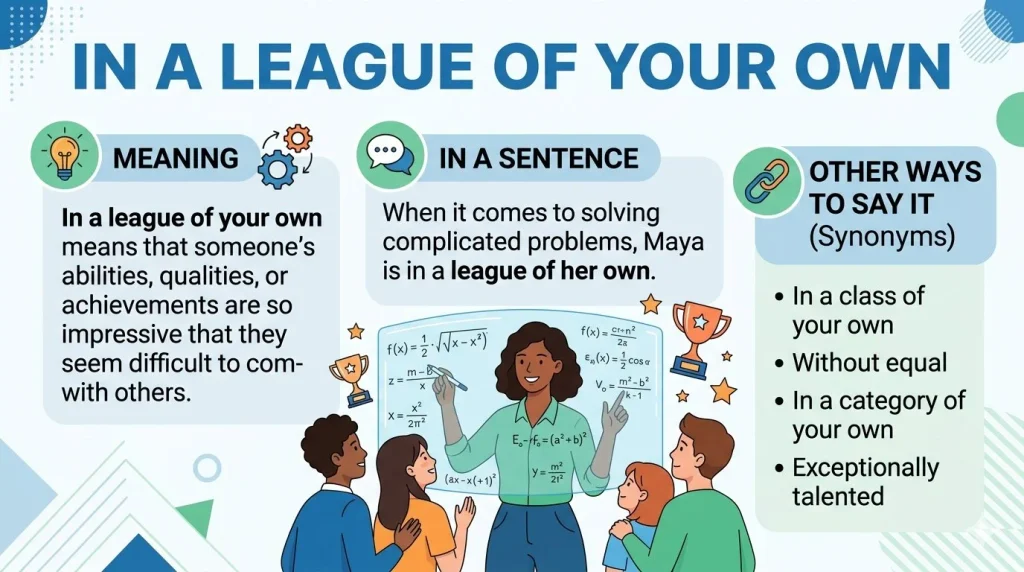
In a League of Your Own
Meaning
In a league of your own means that someone’s abilities, qualities, or achievements are so impressive that they seem difficult to compare with others.
In a Sentence
When it comes to solving complicated problems, Maya is in a league of her own.
Other Ways to Say It
- In a class of your own
- Without equal
- In a category of your own
- Exceptionally talented
Explanation
The expression uses the idea of a league or competitive group. Being in your own league suggests that ordinary comparisons no longer seem adequate.
It is usually strongly positive and can emphasize excellence, talent, creativity, or achievement.
Best Use
Use it for compliments, speeches, sports discussions, professional praise, and creative descriptions. Because it can sound emphatic, it is best reserved for genuinely impressive situations.
Stand Head and Shoulders Above
Meaning
Stand head and shoulders above means to be noticeably better, more impressive, or more outstanding than others.
In a Sentence
Of all the projects displayed at the exhibition, hers stood head and shoulders above the rest.
Other Ways to Say It
- Rise above the others
- Outshine the competition
- Be clearly superior
- Stand apart
Explanation
The expression creates a visual picture of someone being physically taller than everyone around them. Figuratively, it means their quality or achievement rises noticeably above the surrounding group.
Unlike “one of a kind,” this expression usually involves a comparison with others.
Best Use
It is particularly effective in reviews, essays, professional writing, speeches, competitions, and discussions about achievement. It tends to sound more confident and evaluative than emotional.
Few and Far Between
Meaning
Few and far between describes things that are uncommon or difficult to find because there are very few of them.
In a Sentence
Genuine friendships that survive every change in life are few and far between.
Other Ways to Say It
- Rare
- Uncommon
- Hard to come by
- Not often found
Explanation
The phrase creates a picture of things being widely separated from one another. When special people or moments are few and far between, they feel more precious because they are not encountered regularly.
It is useful when the main idea is scarcity rather than superiority.
Best Use
Use it in conversation, essays, reflective writing, storytelling, and personal observations. It can carry a thoughtful or slightly nostalgic tone.
Worth Your Weight in Gold
Meaning
Worth your weight in gold describes someone or something that is extremely valuable or useful.
In a Sentence
A dependable friend who stays calm during a crisis is worth their weight in gold.
Other Ways to Say It
- Extremely valuable
- Invaluable
- Worth a fortune
- Precious to have
Explanation
The expression compares a person’s value with the value of gold, a traditional symbol of wealth and worth. It emphasizes practical or personal value rather than uniqueness.
It can describe people, advice, experience, skills, information, or opportunities.
Best Use
This idiom works well in everyday conversation, workplace discussions, personal messages, and informal writing. It is warm but not necessarily romantic.
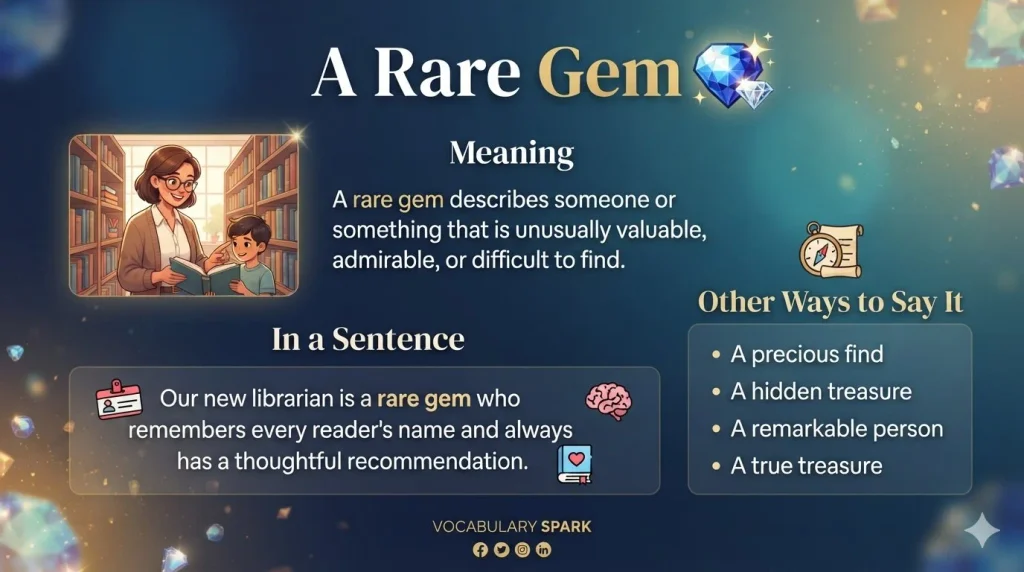
A Rare Gem
Meaning
A rare gem describes someone or something that is unusually valuable, admirable, or difficult to find.
In a Sentence
Our new librarian is a rare gem who remembers every reader’s name and always has a thoughtful recommendation.
Other Ways to Say It
- A precious find
- A hidden treasure
- A remarkable person
- A true treasure
Explanation
The expression compares the subject to a rare gemstone, combining ideas of beauty, scarcity, and value. It works particularly well when several positive qualities come together.
Calling someone a rare gem usually feels warmer and more personal than simply calling them “excellent.”
Best Use
It is ideal for personal messages, tributes, storytelling, reviews, creative writing, and social media. The phrase has a slightly poetic quality but remains easy to understand.
The Cream of the Crop
Meaning
The cream of the crop refers to the best people or things in a particular group.
In a Sentence
The scholarship brought together the cream of the crop from schools across the region.
Other Ways to Say It
- The very best
- The best of the bunch
- Top-notch
- The finest
Explanation
The expression comes from the idea that the cream rises to the top and is considered the finest part. Figuratively, it identifies the strongest or highest-quality members of a group.
Unlike “one of a kind,” it does not mean something is unique. Several people can be the cream of the crop.
Best Use
Use it in informal writing, conversations, reviews, competitions, and descriptions of high-quality groups. It can sound enthusiastic and celebratory.
A Breath of Fresh Air
Meaning
A breath of fresh air describes someone or something that feels refreshing, pleasant, or different from what came before.
In a Sentence
After weeks of stressful meetings, her cheerful attitude was a breath of fresh air.
Other Ways to Say It
- Refreshing change
- A welcome change
- Something uplifting
- A refreshing presence
Explanation
The image is simple: fresh air feels good when you have been surrounded by stale or unpleasant air. Figuratively, the expression describes a welcome change in atmosphere, personality, style, or approach.
It does not necessarily mean the subject is rare or superior. Its special quality comes from being refreshing.
Best Use
This expression is natural in everyday conversation, reviews, workplace discussions, personal writing, and social media. It usually sounds positive and friendly.
Have a Special Place in Your Heart
Meaning
To have a special place in your heart means to be emotionally important to you and remembered with particular affection.
In a Sentence
That small coastal town will always have a special place in my heart because I spent my happiest childhood summers there.
Other Ways to Say It
- Mean a lot to me
- Be close to my heart
- Hold a special meaning for me
- Be deeply cherished
Explanation
This expression connects emotional importance with the heart as a symbol of love and feeling. It is less about being objectively unusual and more about having personal meaning.
The phrase can describe people, places, memories, traditions, experiences, or possessions.
Best Use
It is especially effective in personal messages, farewell notes, tributes, speeches, captions, letters, and reflective writing. It has a warm and emotional tone.
Close to Your Heart
Meaning
Close to your heart describes something that is deeply meaningful, important, or emotionally valued.
In a Sentence
Helping young readers discover books has always been close to his heart.
Other Ways to Say It
- Deeply meaningful
- Very important to me
- Dear to me
- Personally meaningful
Explanation
The phrase uses the heart as a symbol of deep personal feeling. It can describe a cause, memory, person, place, belief, or activity that matters greatly to someone.
Compared with “special place in your heart,” this expression often works particularly well for causes and values, not only relationships.
Best Use
Use it in speeches, essays, interviews, personal writing, fundraising messages, and conversations about meaningful causes. It often sounds sincere and heartfelt.
The Apple of Your Eye
Meaning
The apple of your eye refers to someone who is especially loved, cherished, or treasured.
In a Sentence
His youngest grandson quickly became the apple of his eye.
Other Ways to Say It
- Someone dearly loved
- A treasured person
- The favorite
- A beloved person
Explanation
This traditional idiom expresses strong affection and special attention. It is often associated with a beloved child or family member, although it can be used more broadly.
The phrase has a warm, affectionate feeling and can sound slightly old-fashioned in some contexts.
Best Use
It works naturally in family stories, conversations, personal writing, storytelling, and affectionate descriptions. It may sound less suitable for formal professional writing.
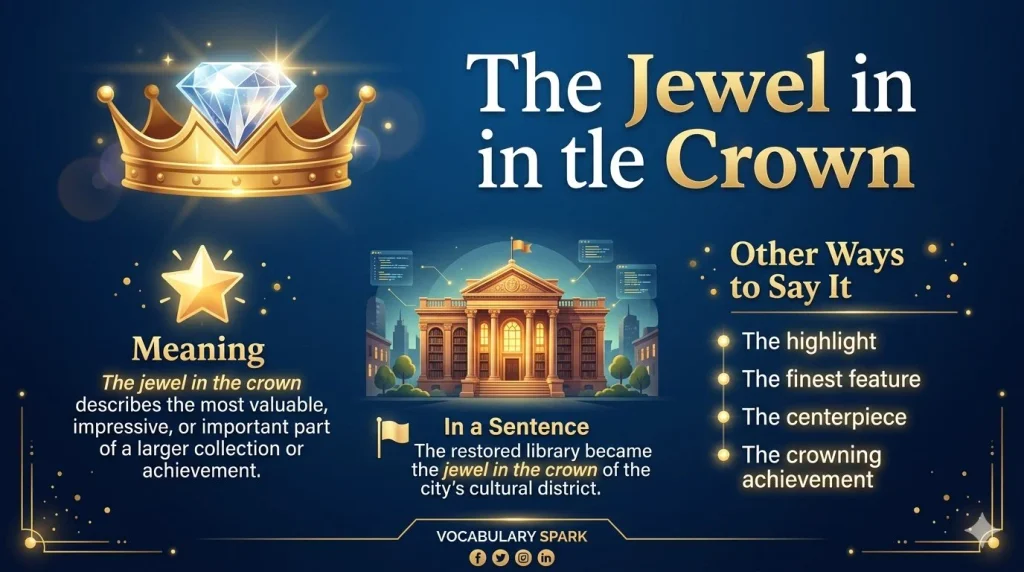
The Jewel in the Crown
Meaning
The jewel in the crown describes the most valuable, impressive, or important part of a larger collection or achievement.
In a Sentence
The restored library became the jewel in the crown of the city’s cultural district.
Other Ways to Say It
- The highlight
- The finest feature
- The centerpiece
- The crowning achievement
Explanation
The image comes from a crown whose jewel is its most striking and valuable feature. The expression is useful when something special stands out within a larger whole.
It emphasizes prominence and value rather than emotional affection.
Best Use
Use it in reviews, travel writing, essays, speeches, journalism-style writing, and descriptions of projects or collections. It often sounds polished and slightly formal.
The Icing on the Cake
Meaning
The icing on the cake describes something extra that makes an already good situation even better.
In a Sentence
Winning the award was wonderful, but having my family there to celebrate with me was the icing on the cake.
Other Ways to Say It
- An added bonus
- The perfect finishing touch
- An extra delight
- A welcome addition
Explanation
A cake can already be enjoyable, but icing adds another attractive and pleasant element. Figuratively, the expression describes a small or additional benefit that improves an already positive situation.
It should not normally be used to describe the main reason something is special.
Best Use
This is a natural choice for casual conversation, personal stories, celebrations, social media posts, and informal writing. It has a cheerful, relaxed tone.
Go the Extra Mile
Meaning
Go the extra mile means to make an additional effort beyond what is normally expected.
In a Sentence
The shop owner went the extra mile to find a replacement part before the weekend.
Other Ways to Say It
- Make an extra effort
- Do more than expected
- Put in extra work
- Take an additional step
Explanation
The expression suggests traveling farther than the minimum distance required. When someone goes the extra mile, what makes them special is their willingness to give more effort.
It focuses on behavior and dedication rather than personality alone.
Best Use
It is especially useful in workplace communication, customer-service writing, recommendations, speeches, and everyday conversation. It is usually positive and practical.
Go Above and Beyond
Meaning
Go above and beyond means to do considerably more than is expected or required.
In a Sentence
The volunteers went above and beyond to make sure every guest felt welcome.
Other Ways to Say It
- Exceed expectations
- Do more than required
- Make an exceptional effort
- Give extra support
Explanation
This expression emphasizes exceptional effort or service. It is closely related to “go the extra mile,” but it can sound somewhat stronger when describing someone who significantly exceeds expectations.
It is especially useful when the special quality comes from action rather than natural talent.
Best Use
Use it in professional praise, recommendations, thank-you messages, speeches, workplace feedback, and formal appreciation. It is more suitable for professional settings than some of the more poetic expressions on this list.
Make Your Mark
Meaning
Make your mark means to have a noticeable and lasting effect or to become recognized for something you have done.
In a Sentence
The young architect hopes to make her mark by designing buildings that serve the whole community.
Other Ways to Say It
- Leave an impression
- Make a difference
- Leave your legacy
- Become recognized
Explanation
The phrase creates an image of leaving a visible mark behind. It suggests that someone’s actions or achievements matter enough to be remembered.
It is especially useful when describing ambition, contribution, achievement, or lasting influence.
Best Use
It fits speeches, essays, biographies, career writing, storytelling, and motivational messages. The tone is usually ambitious and inspirational.
Steal the Show
Meaning
Steal the show means to attract the most attention because of an especially impressive, entertaining, or memorable performance.
In a Sentence
The quietest performer unexpectedly stole the show with a brilliant final song.
Other Ways to Say It
- Take center stage
- Attract everyone’s attention
- Be the highlight
- Outshine the others
Explanation
The expression comes from the idea of one performer receiving so much attention that they seem to take the audience’s attention away from everyone else.
It is lively and dramatic, making it useful when something special becomes the memorable highlight of an event.
Best Use
Use it in entertainment writing, storytelling, conversations, event recaps, social media captions, and informal reviews. It has an energetic and playful tone.
Light Up the Room
Meaning
Light up the room describes someone whose presence immediately makes a place feel happier, warmer, or more energetic.
In a Sentence
Whenever Grandpa walks through the door, he seems to light up the room with his stories and laughter.
Other Ways to Say It
- Brighten the atmosphere
- Lift everyone’s spirits
- Bring warmth to a place
- Make everyone feel happier
Explanation
The expression uses light as a symbol of joy, warmth, and positive energy. It suggests that a person’s presence changes the emotional atmosphere around them.
It is particularly effective for describing friendly, cheerful, charismatic, or emotionally uplifting people.
Best Use
This expression works beautifully in personal messages, tributes, social media captions, speeches, storytelling, and creative writing. It is warm and affectionate rather than formal.
Exercise: Practice Using Idioms
Test your understanding of these expressions by choosing the best answer for each question.
1. What does “one in a million” usually mean?
A. Very expensive
B. Extremely rare or special
C. Difficult to understand
D. Found everywhere
2. Which expression describes something completely unique?
A. One of a kind
B. Icing on the cake
C. Go the extra mile
D. Few and far between
3. If someone is “cut from a different cloth,” what does it suggest?
A. Dressing unusually
B. Working with clothing
C. Standing out from others
D. Appearing difficult to meet
4. Which expression suggests that someone is exceptionally talented compared with others?
A. Close to your heart
B. In a league of your own
C. A breath of fresh air
D. The apple of your eye
5. “Few and far between” emphasizes that something is:
A. Rare
B. Expensive
C. Colorful
D. New
6. If a friend is “worth their weight in gold,” what does this mean?
A. They are wealthy.
B. They are physically strong.
C. They are extremely valuable.
D. They enjoy collecting gold.
7. Which expression compares someone to something precious and unusual?
A. A rare gem
B. Make your mark
C. Steal the show
D. Go above and beyond
8. What does “the cream of the crop” describe?
A. The newest members of a group
B. The most expensive items
C. The best members or examples in a group
D. A group that works on farms
9. A new colleague brings enthusiasm and a refreshing attitude to a tired workplace. Which expression fits best?
A. The jewel in the crown
B. A breath of fresh air
C. The apple of your eye
D. Few and far between
10. If a place “has a special place in your heart,” what does that mean?
A. You visit it every day.
B. It is physically close to you.
C. It is personally and emotionally meaningful.
D. It is considered expensive.
11. Which expression is most strongly associated with someone who is dearly loved?
A. The apple of your eye
B. Make your mark
C. Stand head and shoulders above
D. The icing on the cake
12. A beautiful building is the most impressive feature in a large cultural complex. Which expression fits best?
A. Go the extra mile
B. The jewel in the crown
C. One in a million
D. Light up the room
13. You already received excellent news, and then you receive an unexpected bonus. What expression could describe the bonus?
A. Cut from a different cloth
B. The icing on the cake
C. In a league of your own
D. Close to your heart
14. An employee completes a task and then does considerably more than expected to help customers. Which expression fits best?
A. Go above and beyond
B. Few and far between
C. One of a kind
D. The apple of your eye
15. Which expression suggests that someone’s actions will leave a lasting impression or contribution?
A. A rare gem
B. A breath of fresh air
C. Make your mark
D. The icing on the cake
Answers
- B — “One in a million” describes someone or something unusually rare and special.
- A — “One of a kind” means completely unique or unlike anything else.
- C — “Cut from a different cloth” suggests that someone’s character or approach is noticeably different from others.
- B — “In a league of your own” means your ability or quality is exceptional compared with others.
- A — “Few and far between” describes something uncommon or rarely encountered.
- C — “Worth your weight in gold” means extremely valuable or useful.
- A — “A rare gem” compares someone or something to a precious and uncommon gemstone.
- C — “The cream of the crop” refers to the best people or things in a particular group.
- B — “A breath of fresh air” describes someone or something that feels refreshing and welcome.
- C — Having a special place in your heart means something has deep personal or emotional importance.
- A — “The apple of your eye” refers to someone who is especially loved or cherished.
- B — “The jewel in the crown” describes the most impressive or valuable part of a larger whole.
- B — “The icing on the cake” is an extra benefit that makes an already good situation even better.
- A — “Go above and beyond” means to do substantially more than is expected or required.
- C — “Make your mark” means to have a noticeable or lasting effect.
FAQs
What is an idiom for special?
There are several ways to express the idea of something being special. “One in a million,” “one of a kind,” “a rare gem,” and “in a league of your own” are useful choices. The best expression depends on whether you mean rare, unique, valuable, impressive, or emotionally meaningful.
How do I create my own idiom?
Start with the quality you want to describe, such as rarity, affection, uniqueness, or excellence. Then think of a concrete image that represents that quality. A strong figurative expression should create a clear mental picture while still making sense from context.
What makes an idiom effective?
An effective idiom is clear, memorable, and appropriate for the situation. It should add something that a plain statement does not. Good figurative language helps readers or listeners feel the idea rather than simply receive information about it.
Can I use these idioms in everyday conversation?
Yes. Expressions such as one in a million, one of a kind, a breath of fresh air, and go the extra mile are natural in everyday English. More poetic expressions may be better suited to personal messages, storytelling, or creative writing.
What is the difference between an idiom and a simile?
An idiom is an established expression whose figurative meaning may not be obvious from its individual words. A simile directly compares two things using words such as “like” or “as.” For example, “She is a breath of fresh air” is an idiomatic expression, while “She is like a breath of fresh air” is a direct comparison using “like.”
Conclusion
Describing something as special does not have to mean repeating the same adjective again and again. Idioms give you a richer vocabulary for expressing rarity, affection, uniqueness, excellence, and emotional importance. A person may be one in a million, a place may have a special place in your heart, or an achievement may make its mark. Each expression highlights a slightly different kind of value.
The key is to choose language that matches your meaning. Use warm expressions for personal messages, vivid ones for storytelling, and more polished expressions for essays or speeches. When the image fits the feeling, figurative language can turn a simple into something much more memorable. Sometimes, the right words can show exactly why something or someone is truly special.

Eleanor Prose is a writer and English teacher with a soft spot for the phrases that trip us up. She has spent years helping students and professionals use idioms with confidence not just memorizing them, but understanding the culture and humor behind each one.
Through Idiom Looms, Eleanor explores the threads that connect language, history, and everyday conversation. Her goal is simple: to make English idioms clear, memorable, and actually fun to use.
She writes from a quiet desk surrounded by notebooks, and firmly believes there’s an idiom for every situation usually more than one.


[…] Read more:20 Idioms for Special With Real Examples […]