

Have you ever faced a situation that changed without warning? The 20 Idioms for Unexpected With Real Examples explores expressive phrases for describing surprises, sudden changes, and unplanned events. These idioms help you communicate reactions clearly while adding figurative language and personality to everyday English.
Unexpected moments can appear during scheduling, meetings, online booking, or project management. They can also affect time management, business communication, broadcasting, and a busy calendar. Learning suitable idioms makes your English usage more natural and helps you express uncertainty, surprise, and sudden developments with greater precision.
This guide presents 20 useful idioms with clear meanings, practical examples, and alternative expressions. You will also discover how context influences grammar, formal writing, conversations, and creative expression. With consistent practice, these phrases can improve communication, strengthen consistency, and make your English sound more confident and engaging.
What Is an Idiom?
An idiom is a word or phrase whose meaning cannot always be understood simply by looking at the individual words.
For example, “break the ice” does not literally mean breaking frozen water. It means to make people feel more comfortable when they first meet.
Similarly, “spill the beans” does not mean dropping beans. It means to reveal information, especially information that was supposed to remain secret.
Idioms are different from literal statements because they use figurative language. Their value comes from the image or idea they create rather than from the exact dictionary meaning of every word.
Why Use Idioms for Unexpected?
Unexpected situations are often difficult to describe with ordinary words because surprise can take many forms. Something can be pleasant, shocking, confusing, disruptive, exciting, or even life-changing.
Idioms make these differences easier to express. For example:
- “Out of the blue” suggests something happened suddenly and without warning.
- “Caught off guard” focuses on being unprepared.
- “Throw a curveball” suggests an unexpected complication or challenge.
- “A twist of fate” can describe an unforeseen change in circumstances.
- “Drop a bombshell” emphasizes surprising or shocking information.
These expressions add imagery, emotion, and personality to communication. They can make creative writing more vivid, help a speech sound natural, and give everyday conversations a stronger sense of feeling.
Quick List of 20 Idioms
- Out of the blue
- A bolt from the blue
- Catch someone off guard
- Take someone by surprise
- Come out of left field
- Come out of nowhere
- Throw someone a curveball
- Blindside someone
- Spring something on someone
- Pull the rug out from under someone
- A twist of fate
- A rude awakening
- Drop a bombshell
- Throw a spanner in the works
- Upset the apple cart
- Stop someone in their tracks
- Shake things up
- Rock the boat
- Turn the tables
- When pigs fly
Out of the Blue
Read more:20 Idioms for Accident With Real Examples
Meaning
“Out of the blue” means something happens suddenly and unexpectedly, with little or no warning. The expression creates the image of something appearing from a clear sky.
In a Sentence
The old school friend called me out of the blue after nearly ten years without contact.
Other Ways to Say It
- Without warning
- Unexpectedly
- All of a sudden
- With no notice
Explanation
This is one of the most natural ways to describe an event that seems to arrive from nowhere. It works especially well when the speaker did not have any reason to expect what happened.
The expression can describe good, bad, or neutral surprises. Its tone is generally conversational and flexible.
Best Use
Use it in everyday conversations, personal stories, emails, social posts, and informal writing. It sounds natural rather than overly poetic.
A Bolt from the Blue
Meaning
“A bolt from the blue” describes something extremely sudden and surprising, especially news or an event that causes a strong emotional reaction.
In a Sentence
The announcement that the company would close was a bolt from the blue for everyone on the team.
Other Ways to Say It
- A complete shock
- A sudden surprise
- A stunning development
- A shocking turn of events
Explanation
The image comes from a lightning bolt appearing unexpectedly in an otherwise clear sky. Compared with “out of the blue,” this expression often carries a stronger sense of shock.
It is particularly effective when an unexpected event has serious emotional or practical consequences.
Best Use
It works well in journalistic writing, storytelling, essays, speeches, and serious personal accounts. It can sound slightly more dramatic than ordinary conversation.
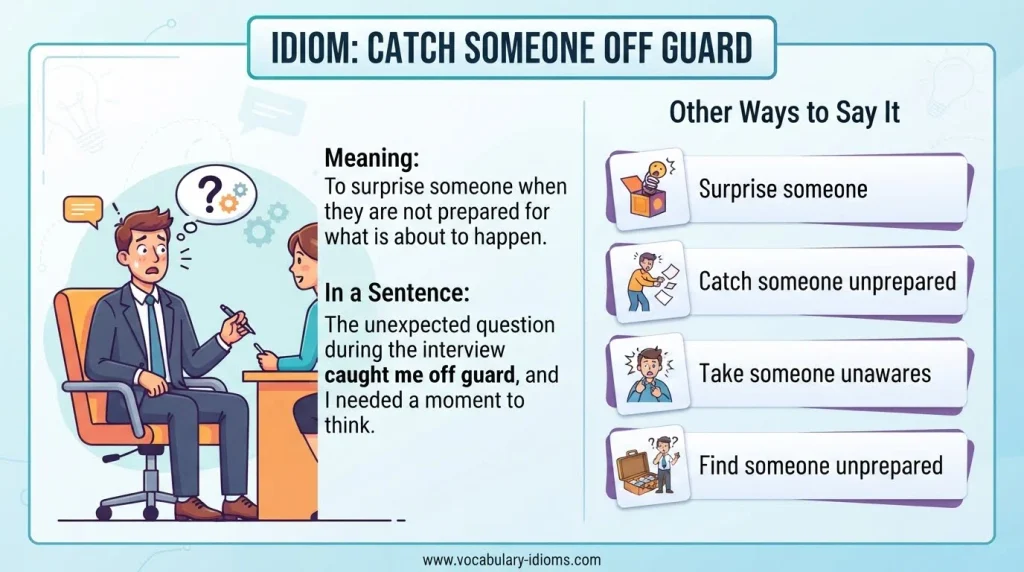
Catch Someone Off Guard
Meaning
To “catch someone off guard” means to surprise someone when they are not prepared for what is about to happen.
In a Sentence
The unexpected question during the interview caught me off guard, and I needed a moment to think.
Other Ways to Say It
- Surprise someone
- Catch someone unprepared
- Take someone unawares
- Find someone unprepared
Explanation
This idiom focuses less on the event itself and more on the person’s lack of preparation. Someone may know that surprises are possible but still be unready when one arrives.
It is useful when you want to show a person’s immediate reaction rather than simply describe an unexpected event.
Best Use
Use it in conversations, workplace situations, interviews, stories, and personal writing.
Take Someone by Surprise
Meaning
To “take someone by surprise” means to make someone feel surprised because they did not expect something to happen.
In a Sentence
Her decision to leave the project took everyone by surprise.
Other Ways to Say It
- Surprise someone
- Catch someone unexpectedly
- Take someone unawares
- Catch someone by surprise
Explanation
This is a straightforward and highly adaptable expression. It can describe a pleasant surprise, an uncomfortable development, or a major decision.
Unlike expressions that emphasize shock, this one can remain relatively neutral and calm.
Best Use
It fits everyday speech, professional communication, essays, reports, and storytelling.
Come Out of Left Field
Meaning
“Come out of left field” means something appears unexpectedly or from an unusual direction, often because it seems unrelated to what was happening before.
In a Sentence
His suggestion that we cancel the entire project came out of left field.
Other Ways to Say It
- Come unexpectedly
- Come from nowhere
- Be completely unexpected
- Come from an unlikely direction
Explanation
The expression comes from baseball, where left field is one part of the playing field. In ordinary English, it has developed a figurative meaning for an idea, question, event, or comment that seems surprising or unrelated.
It often carries a slightly playful tone.
Best Use
This expression works especially well in informal conversations, commentary, storytelling, and creative writing. It may sound too casual for some formal documents.
Come Out of Nowhere
Meaning
“Come out of nowhere” describes something that happens or appears very suddenly, with no obvious warning or preparation.
In a Sentence
A strong wind came out of nowhere and forced the hikers to turn back.
Other Ways to Say It
- Appear suddenly
- Arrive unexpectedly
- Happen without warning
- Seem to appear from nowhere
Explanation
The expression creates a strong sense of sudden arrival. It is particularly useful when an event seems to develop faster than anyone can react to it.
It can describe weather, opportunities, problems, comments, people, or events.
Best Use
Use it naturally in conversations, stories, sports commentary, travel writing, and informal descriptions.
Throw Someone a Curveball
Meaning
To “throw someone a curveball” means to present an unexpected problem, question, change, or situation that forces the person to adjust.
In a Sentence
The sudden change in the deadline threw the whole team a curveball.
Other Ways to Say It
- Present an unexpected challenge
- Complicate things
- Introduce a surprise
- Give someone an unexpected problem
Explanation
The expression comes from baseball, where a curveball changes direction as it approaches the batter. Figuratively, it suggests that someone expected one thing but suddenly had to deal with something different.
The image is especially effective for unexpected challenges rather than simple surprises.
Best Use
It is useful in workplace conversations, sports writing, personal stories, speeches, and informal communication.

Blindside Someone
Meaning
To “blindside someone” means to surprise or shock someone with something they did not see coming, often in a difficult or unpleasant way.
In a Sentence
The sudden resignation of the department head blindsided the staff.
Other Ways to Say It
- Shock someone
- Catch someone completely unprepared
- Hit someone unexpectedly
- Take someone by surprise
Explanation
The word “blindside” suggests that something comes from a direction a person cannot see. As a result, the idiom often carries a stronger and more negative emotional tone than a simple statement that something was unexpected.
It is especially effective when the person feels vulnerable or suddenly affected.
Best Use
Use it in personal stories, workplace discussions, news-style writing, and serious conversations. It may sound too strong for a minor surprise.
Spring Something on Someone
Meaning
To “spring something on someone” means to suddenly tell or present something to a person without giving them time to prepare.
In a Sentence
They sprang the new schedule on us just before the meeting ended.
Other Ways to Say It
- Tell someone unexpectedly
- Present something without warning
- Surprise someone with something
- Give someone sudden news
Explanation
This expression emphasizes the timing of the surprise. It often suggests that someone could have benefited from advance notice.
The tone can range from mildly annoyed to strongly critical depending on the situation.
Best Use
It fits conversations, workplace situations, personal messages, and informal writing.
Pull the Rug Out from Under Someone
Meaning
To “pull the rug out from under someone” means to suddenly remove a person’s support, security, opportunity, or expectation, leaving them in a difficult position.
In a Sentence
Losing the funding at the final stage pulled the rug out from under the entire research team.
Other Ways to Say It
- Remove someone’s support
- Leave someone without a safety net
- Undermine someone’s plans
- Take away someone’s security
Explanation
The mental image is simple: someone is standing securely on a rug, and another person suddenly pulls it away. Figuratively, the expression describes an unexpected development that destabilizes someone’s situation.
It usually carries a serious or negative tone.
Best Use
Use it in storytelling, essays, workplace discussions, journalism, and serious personal writing.
A Twist of Fate
Meaning
“A twist of fate” describes an unexpected change in circumstances that seems to alter the direction of someone’s life or situation.
In a Sentence
By a twist of fate, the person who had planned to leave the city ended up finding a new career there.
Other Ways to Say It
- An unexpected turn
- A surprising change in circumstances
- An unforeseen development
- An unexpected stroke of fate
Explanation
This expression gives an unexpected event a more dramatic and reflective quality. It often suggests that circumstances, rather than careful planning, changed the outcome.
It can describe fortunate, unfortunate, or bittersweet developments.
Best Use
It is especially effective in creative writing, biographies, storytelling, speeches, and reflective essays.
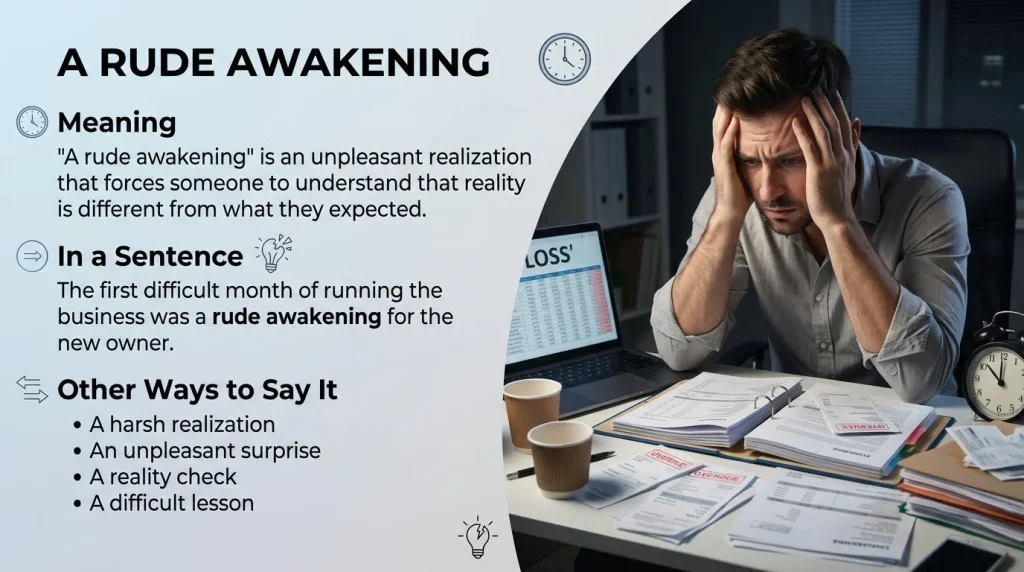
A Rude Awakening
Meaning
“A rude awakening” is an unpleasant realization that forces someone to understand that reality is different from what they expected.
In a Sentence
The first difficult month of running the business was a rude awakening for the new owner.
Other Ways to Say It
- A harsh realization
- An unpleasant surprise
- A reality check
- A difficult lesson
Explanation
The expression does not simply mean that something was unexpected. It suggests that the unexpected truth is uncomfortable or disappointing.
The image is similar to being woken suddenly from sleep, except the “awakening” is an awareness of reality.
Best Use
It works well in essays, personal stories, advice writing, conversations, and reflective pieces.
Drop a Bombshell
Meaning
To “drop a bombshell” means to reveal very surprising or shocking news, often suddenly.
In a Sentence
The manager dropped a bombshell when she announced that the entire department would be reorganized.
Other Ways to Say It
- Reveal shocking news
- Make a stunning announcement
- Break surprising news
- Deliver a major surprise
Explanation
The word “bombshell” creates an image of something explosive arriving without warning. The expression therefore carries a dramatic and emotional tone.
It is best reserved for news that is genuinely significant rather than for ordinary surprises.
Best Use
Use it in storytelling, informal commentary, headlines, dramatic writing, and conversations about major news.
Throw a Spanner in the Works
Meaning
To “throw a spanner in the works” means to cause an unexpected problem that disrupts a plan or process.
In a Sentence
The equipment failure threw a spanner in the works just as the event was about to begin.
Other Ways to Say It
- Disrupt the plan
- Create an unexpected problem
- Put a complication in the way
- Derail the process
Explanation
The image comes from putting a physical tool into machinery and preventing it from working properly. Figuratively, the “spanner” is an unforeseen complication.
This expression focuses on disruption, rather than surprise alone.
Best Use
It is particularly common in British English and works well in conversations, workplace writing, project discussions, and informal storytelling.
Upset the Apple Cart
Meaning
To “upset the apple cart” means to disturb an existing arrangement or plan, often by introducing an unexpected change.
In a Sentence
The sudden policy change upset the apple cart just when everyone thought the negotiations were settled.
Other Ways to Say It
- Disrupt the arrangement
- Disturb the plan
- Throw things into confusion
- Change the established order
Explanation
The traditional image is a cart filled with apples suddenly being overturned, scattering everything. The expression therefore suggests disorder caused by a change or disruption.
It can be playful or serious depending on the situation.
Best Use
Use it in informal writing, conversations, opinion pieces, storytelling, and discussions about plans or established arrangements.
Stop Someone in Their Tracks
Meaning
To “stop someone in their tracks” means to make someone suddenly stop what they are doing, often because of shock, surprise, fear, or amazement.
In a Sentence
The unexpected sight of snow in midsummer stopped us in our tracks.
Other Ways to Say It
- Stop someone suddenly
- Leave someone stunned
- Halt someone immediately
- Make someone freeze
Explanation
The expression creates a physical image of someone moving forward and suddenly coming to a complete stop. It can describe a literal pause or a powerful emotional reaction.
It is especially vivid when the unexpected event is striking or dramatic.
Best Use
It works beautifully in storytelling, novels, travel writing, speeches, and personal anecdotes.
Shake Things Up
Meaning
To “shake things up” means to introduce changes that make a situation different, less predictable, or more active.
In a Sentence
The new coach decided to shake things up by changing the team’s usual strategy.
Other Ways to Say It
- Make major changes
- Change the routine
- Introduce something different
- Break up the usual pattern
Explanation
Unlike expressions that suggest an unwanted surprise, this idiom can be positive, neutral, or negative. It often describes deliberate change rather than something that happens completely by accident.
The image suggests physically shaking a stable arrangement so that its parts move around.
Best Use
Use it in business conversations, sports, creative writing, social commentary, and casual speech.
Rock the Boat
Meaning
To “rock the boat” means to disturb a stable situation or cause trouble by introducing a change, disagreement, or challenge.
In a Sentence
Nobody wanted to rock the boat by questioning the agreement at the last minute.
Other Ways to Say It
- Disturb the peace
- Challenge the existing arrangement
- Cause disruption
- Create tension
Explanation
The image is of people sitting in a boat and someone deliberately making it unstable. The idiom is often used when an unexpected action might disturb an otherwise settled situation.
It can imply that stability is valued, even if the existing arrangement is not perfect.
Best Use
It is common in everyday conversations, workplace discussions, politics, group situations, and informal writing.
Turn the Tables
Meaning
To “turn the tables” means to unexpectedly change a situation so that the person who seemed to have the advantage loses that advantage, while someone else gains control.
In a Sentence
The underdog turned the tables in the final minutes and won the match.
Other Ways to Say It
- Reverse the situation
- Change the balance of power
- Gain the advantage
- Reverse the outcome
Explanation
The phrase creates the image of a table being physically turned around, changing the positions of the people around it. Figuratively, it describes an unexpected reversal.
It is especially useful when the surprise involves competition, conflict, or changing fortunes.
Best Use
Use it in sports writing, storytelling, speeches, business discussions, and dramatic narratives.
When Pigs Fly
Meaning
“When pigs fly” is a humorous idiom used to say that something is extremely unlikely or practically impossible to happen.
In a Sentence
He says he’ll finish the entire project tonight—when pigs fly.
Other Ways to Say It
- Not likely
- Not in a million years
- Over my dead body
- That seems impossible
Explanation
The expression uses an intentionally ridiculous image: pigs flying through the air. It is not really describing an unexpected event; instead, it describes something so unlikely that its occurrence would itself be astonishing and unexpected.
Its tone is usually playful, humorous, or sarcastic.
Best Use
It works best in casual conversations, humorous writing, dialogue, and playful social media content. Avoid it in serious professional communication.
Exercise: Practice Using Idioms
Choose the best answer for each question.
1. What does “out of the blue” usually mean?
ary bhai suru ka words change doooooooooooooooo
A. A well-organized plan made in advance
B. An unforeseen event that occurs without warning
C. A daily routine that happens regularly
D. An activity requiring an extended period of time
2. If a question catches you off guard, what does that mean?
A. The perfect answer was already prepared by you.
B. You completely ignored what the question asked.
C. Being unprepared for the question caught you off guard.
D. The question was actually asked by you.
3. Which expression best describes a serious unexpected announcement?
A. Drop a bombshell
B. Rock the boat
C. Shake things up
D. When pigs fly
4. “Throw someone a curveball” suggests that someone has:
A. Received an ordinary task
B. Been given an expected reward
C. Faced an unexpected challenge
D. Finished a difficult project
5. Which expression focuses on an unpleasant realization about reality?
A. Come out of nowhere
B. A rude awakening
C. Out of the blue
D. Turn the tables
6. If an event “comes out of left field,” it is usually:
A. Completely ordinary
B. Carefully scheduled
C. Unexpected or unusual
D. Extremely expensive
7. What does “blindside someone” generally suggest?
A. Surprise someone, often unpleasantly
B. Help someone prepare
C. Give someone extra time
D. Encourage someone to continue
8. Which idiom describes an unexpected disruption to a plan?
A. A twist of fate
B. Throw a spanner in the works
C. When pigs fly
D. Stop someone in their tracks
9. “Pull the rug out from under someone” suggests that:
A. Someone has gained extra support
B. Someone has been given more time
C. Someone’s security or support has suddenly been removed
D. Someone has solved a problem
10. Which expression can describe an unexpected reversal in a competition?
A. Turn the tables
B. Spring something on someone
C. A bolt from the blue
D. Rock the boat
11. What does “spring something on someone” emphasize?
A. Giving someone plenty of warning
B. Presenting something suddenly
C. Making a permanent decision
D. Avoiding a difficult conversation
12. Which idiom is often used humorously to describe something extremely unlikely?
A. A rude awakening
B. A twist of fate
C. When pigs fly
D. Drop a bombshell
13. If something “stops you in your tracks,” what is the likely effect?
A. Causes you to stop unexpectedly
B. Encourages you to pick up the pace
C. Allows you to forget about something
D. Leaves you feeling fully prepared
14. Which expression is especially associated with British English for an unexpected complication?
A. Throw a spanner in the works
B. Come out of left field
C. Turn the tables
D. Out of the blue
15. Which sentence uses an idiom appropriately?
A. The unexpected call came out of the blue after years of silence.
B. The unexpected call rocked the apple cart into the sky.
C. The unexpected call was a curveball because the telephone was round.
D. The unexpected call happened when pigs flew yesterday.
Answers
- B — “Out of the blue” describes something that happens suddenly and without warning.
- C — Being caught off guard means being surprised when you were not prepared.
- A — “Drop a bombshell” refers to revealing shocking or highly surprising information.
- C — “Throw someone a curveball” means to give them an unexpected challenge or complication.
- B — “A rude awakening” is an unpleasant realization that reality is different from what someone expected.
- C — “Come out of left field” describes something unexpected, unusual, or seemingly unrelated.
- A — “Blindside someone” usually means to surprise or shock them unexpectedly, often negatively.
- B — “Throw a spanner in the works” means to introduce a problem that disrupts a plan or process.
- C — The idiom describes suddenly removing someone’s support, security, or expected advantage.
- A — “Turn the tables” means to reverse a situation so that the balance of advantage changes.
- B — “Spring something on someone” means to present or announce something without giving them time to prepare.
- C — “When pigs fly” humorously describes something considered extremely unlikely or impossible.
- A — “Stop someone in their tracks” means to make someone stop suddenly because of surprise, shock, fear, or amazement.
- A — “Throw a spanner in the works” is a well-known British English expression for causing an unexpected complication.
- A — The sentence uses “out of the blue” naturally to describe an unexpected call.
FAQs
What is an idiom for unexpected?
There are several useful idioms for unexpected situations. “Out of the blue” is a common choice for something that happens suddenly and without warning. Other options include “catch someone off guard,” “come out of nowhere,” and “a bolt from the blue.” The best choice depends on whether you want to emphasize surprise, lack of preparation, shock, or disruption.
How do I create my own idiom?
Creating an original figurative expression usually involves connecting an idea to a clear and memorable image. Think about what unexpected feels like: a sudden change in direction, an object appearing from nowhere, or a stable situation suddenly becoming unstable. However, newly invented expressions may not function as established idioms until people actually adopt and understand them.
What makes an idiom effective?
An effective idiom creates a strong mental picture while communicating an idea efficiently. It should have a recognizable figurative meaning and fit naturally into its context. A good expression also adds something beyond a plain synonym, such as humor, emotion, drama, or personality.
Can I use these idioms in everyday conversation?
Yes. Expressions such as “out of the blue,” “caught off guard,” “take someone by surprise,” and “come out of nowhere” are natural in everyday English. More dramatic expressions, such as “drop a bombshell,” may be better when the situation genuinely involves major or shocking news.
What is the difference between an idiom and a simile?
An idiom is an established expression with a figurative meaning, such as “pull the rug out from under someone.” A simile directly compares two things using words such as “like” or “as,” such as “the surprise hit him like a wave.” A simile can be created freely, while an idiom generally has a recognized figurative meaning.
Conclusion
Unexpected experiences are easier to describe when language captures more than the basic fact that something was surprising. The 20 expressions in this guide offer different shades of meaning, from the sudden arrival suggested by “out of the blue” to the disruption of “throw a spanner in the works” and the reversal expressed by “turn the tables.”
The key is to choose an idiom that matches the situation. A light surprise may call for a casual expression, while a painful shock may need something more dramatic. In creative writing, figurative language can also give an unexpected moment a stronger image and emotional impact.
Use these expressions thoughtfully, and let the imagery support the feeling you want to communicate. Sometimes the most memorable description is the one that makes an unexpected moment feel instantly visible.

Margaret Saywell is an English author and editor who has spent more than fifteen years working with words teaching, proofreading, and writing about the quirks of the English language.
At Idiom Looms, Margaret gathers idioms from across the English-speaking world and weaves them into clear, practical guides. She loves digging into the history of a phrase and showing readers how a few well-chosen words can say far more than a long explanation.
She believes language should be enjoyed, not feared and that the best way to learn an idiom is to see it in action.


[…] Read more:20 Idioms for Unexpected With Real Examples […]
[…] Read more:20 Idioms for Unexpected With Real Examples […]