

Have you ever spent hours planning something, only to realize that your effort was getting nowhere? When a task produces no useful result, the right idiom for futility can express that frustration far better than a plain statement. In this guide, 20 Idioms for Futility With Real Examples explores memorable expressions that describe pointless effort, wasted energy, failed attempts, and actions with little or no result. These phrases add personality to everyday English usage while helping writers communicate difficult ideas with greater precision and imagery.
Understanding these expressions can also improve communication in practical situations. Whether you are discussing scheduling, time management, business communication, or project management, the right idiomatic expression can make an explanation clearer and more engaging. You may encounter these ideas while arranging meetings, updating a calendar, handling online booking, or explaining why a particular plan failed. Each idiom in this article includes a clear meaning, a natural example, alternative expressions, and helpful context, making the phrases easier to understand and use correctly.
The examples also show how figurative language works across formal writing, workplace conversations, storytelling, and everyday speech. You will learn how to recognize the difference between literal meaning and idiomatic meaning, choose expressions that suit the situation, and use them with greater consistency. Along the way, the article connects futility with wasted effort, unsuccessful plans, repeated actions, and unproductive decisions. By the end, you will have practical expressions that make your English more descriptive, natural, and expressive without sacrificing clarity.
What Is an Idiom?
An idiom is a phrase whose meaning cannot always be understood by taking its words literally. It communicates an idea through a familiar expression, image, or comparison.
For example, “break the ice” does not literally mean breaking frozen water. It means to make people feel more comfortable in a social situation. Likewise, “spill the beans” means to reveal a secret, not to drop beans on the floor.
Idioms differ from literal statements because their figurative meaning is more important than the individual words.
Why Use Idioms for Futility?
Idioms make the idea of futility easier to picture. Instead of simply saying that an effort is useless, you can describe someone as spinning their wheels, chasing their tail, or beating a dead horse.
These expressions can help you:
- Express frustration or disappointment.
- Make an abstract idea more vivid.
- Give creative writing stronger imagery.
- Explain complicated feelings in a few words.
- Add personality to everyday conversations.
- Make essays, speeches, and stories more memorable.
- Show different kinds of pointless or wasted effort.
The best expression depends on the situation. Some idioms suggest repeated effort, others suggest impossible goals, and some emphasize misdirected effort.
Quick List of 20 Idioms for Futility
- Beating a dead horse
- Flogging a dead horse
- Spinning your wheels
- Banging your head against a wall
- Tilting at windmills
- Chasing your tail
- Going around in circles
- Pushing a rope
- A fool’s errand
- A wild-goose chase
- A dead end
- Barking up the wrong tree
- Casting pearls before swine
- Pouring water into a sieve
- Ploughing the sand
- Emptying the ocean with a spoon
- Carrying coals to Newcastle
- Building castles in the air
- Sowing seeds on stony ground
- Much ado about nothing
Beating a Dead Horse
Read more:20 Idioms for Crazy With Real Examples
Meaning
“Beating a dead horse” means continuing to discuss, pursue, or try to change something that is already settled or cannot produce a result.
The image is deliberately exaggerated: a dead horse cannot respond to further effort, so continuing to beat it achieves nothing.
In a Sentence
We have already rejected that proposal twice, so beating a dead horse will not change the decision.
Other Ways to Say It
- Keep pushing a lost cause
- Keep arguing over something settled
- Waste effort on a hopeless matter
- Keep trying after the opportunity is gone
Explanation
This idiom works because its unusual image makes pointless persistence instantly understandable. It is especially useful when someone keeps repeating the same argument or trying to revive an unsuccessful idea.
It is generally informal and blunt, so it may not be appropriate in very formal or sensitive situations.
Best Use
Best for conversations, opinion writing, workplace discussions, and informal essays when you want to emphasize repeated, unproductive effort.
Flogging a Dead Horse
Meaning
“Flogging a dead horse” has essentially the same core meaning as “beating a dead horse”: trying to achieve something that is already impossible or pointless.
“Flogging” is more common in British English and can give the expression a slightly different regional flavor.
In a Sentence
Trying to persuade the committee after the final vote would be flogging a dead horse.
Other Ways to Say It
- Pursue a lost cause
- Keep fighting a hopeless battle
- Waste your energy
- Try to revive a failed idea
Explanation
The expression creates a strong image of effort continuing after usefulness has disappeared. It can describe arguments, projects, campaigns, or attempts to reverse a decision.
Because it sounds vivid and somewhat dramatic, it works better in informal or expressive language than in highly formal reports.
Best Use
Useful in British English, conversations, commentary, and creative writing.
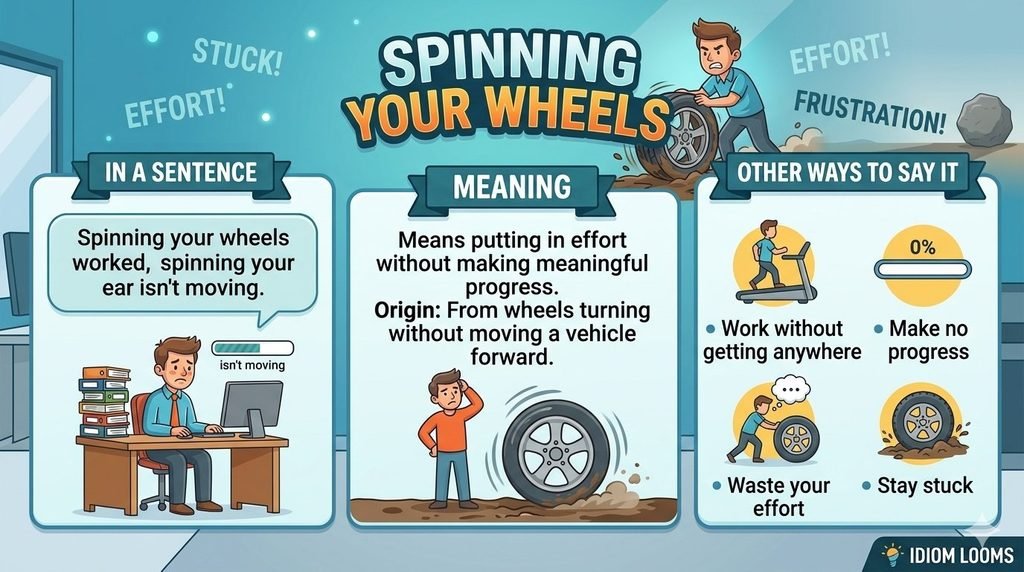
Spinning Your Wheels
Meaning
“Spinning your wheels” means putting in effort without making meaningful progress.
The image comes from wheels turning without moving a vehicle forward.
In a Sentence
I spent the entire afternoon reorganizing the files, but I was really just spinning my wheels.
Other Ways to Say It
- Make no progress
- Waste your effort
- Stay stuck
- Work without getting anywhere
Explanation
This idiom is particularly effective when someone is busy but unproductive. Unlike some expressions of futility, it does not necessarily mean the goal is impossible; the person simply is not moving toward it.
It has a casual, modern conversational feel.
Best Use
Best for workplace conversations, personal reflection, advice, and everyday speech.
Banging Your Head Against a Wall
Meaning
“Banging your head against a wall” describes repeatedly trying to solve a problem or change a situation despite getting nowhere.
The image suggests painful effort that produces no useful result.
In a Sentence
Trying to explain the same mistake to him again felt like banging my head against a wall.
Other Ways to Say It
- Fight a losing battle
- Keep struggling without progress
- Exhaust yourself for nothing
- Push against an impossible obstacle
Explanation
The physical image communicates both frustration and exhaustion. It is stronger than simply saying that something is difficult because it suggests that repeated effort is becoming pointless.
This is a familiar informal expression and should generally be avoided in very formal writing.
Best Use
Excellent for personal messages, conversations, storytelling, and emotional writing.
Tilting at Windmills
Meaning
“Tilting at windmills” means fighting imaginary, unrealistic, or impossible enemies or problems.
The expression comes from Miguel de Cervantes’s Don Quixote, in which Don Quixote mistakes windmills for giants.
In a Sentence
His campaign to eliminate every minor inconvenience from city life sometimes feels like tilting at windmills.
Other Ways to Say It
- Fight an impossible battle
- Pursue an unrealistic cause
- Attack imaginary problems
- Chase an ideal that cannot be achieved
Explanation
This expression adds a literary and slightly humorous quality to the idea of futility. It is particularly useful when someone is passionately fighting something that may not actually be the enemy they imagine.
It can be critical, but it may also describe idealism sympathetically.
Best Use
Best for essays, literary writing, commentary, speeches, and thoughtful conversations.
Chasing Your Tail
Meaning
“Chasing your tail” means being busy with repeated actions without actually making progress.
The image comes from an animal repeatedly running after its own tail.
In a Sentence
We kept changing the schedule and then changing it back, so we were just chasing our tails.
Other Ways to Say It
- Go nowhere
- Keep going in circles
- Waste time
- Stay trapped in repetition
Explanation
The expression emphasizes frantic or repetitive effort rather than an impossible goal. Someone may be working hard, but their actions simply lead back to where they started.
It has a casual and slightly humorous tone.
Best Use
Works especially well in conversations, workplace situations, stories, and informal writing.
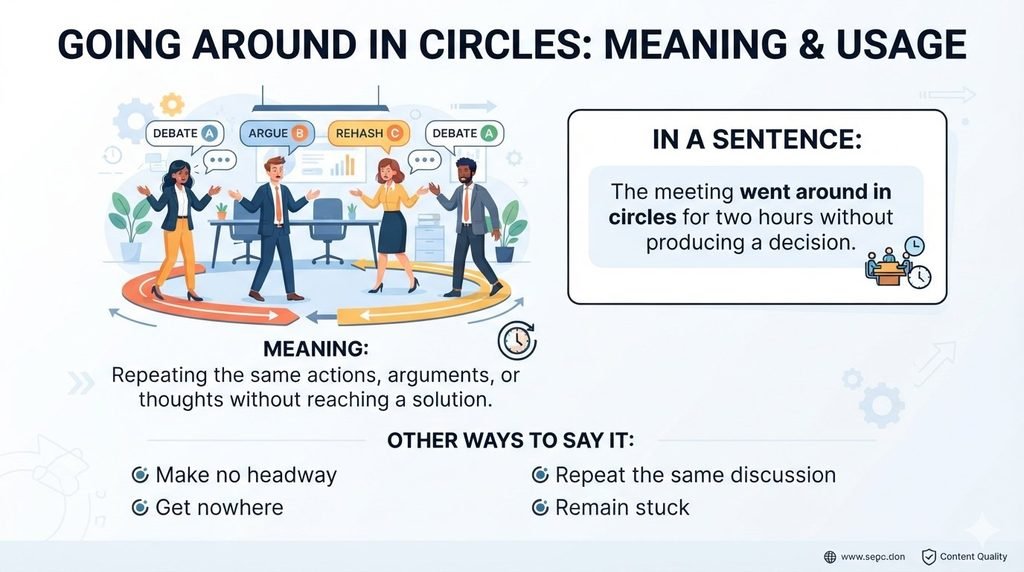
Going Around in Circles
Meaning
“Going around in circles” means repeating the same actions, arguments, or thoughts without reaching a solution.
In a Sentence
The meeting went around in circles for two hours without producing a decision.
Other Ways to Say It
- Make no headway
- Get nowhere
- Repeat the same discussion
- Remain stuck
Explanation
The circular image suggests movement without forward progress. It is useful when the problem is not necessarily impossible, but the people involved cannot move beyond the same point.
This expression is natural and widely suitable for everyday communication.
Best Use
Ideal for conversations, meetings, essays, workplace writing, and problem-solving discussions.
Pushing a Rope
Meaning
“Pushing a rope” describes trying to make something happen when your effort cannot effectively move it forward.
A rope is flexible, so pushing it does not work in the same way as pushing a solid object.
In a Sentence
Trying to force customers to care about a product they do not want is like pushing a rope.
Other Ways to Say It
- Force the impossible
- Try to move something that will not respond
- Fight against resistance
- Use effort where effort cannot help
Explanation
The expression creates a simple but powerful picture of misdirected effort. It suggests that the problem is not a lack of energy but the fact that the chosen approach cannot produce the desired movement.
It is less common than some everyday idioms and can feel particularly vivid in explanatory writing.
Best Use
Useful in business discussions, strategy writing, advice, and analytical conversations.
A Fool’s Errand
Meaning
“A fool’s errand” is a task that is pointless, impractical, or unlikely to succeed.
The expression often suggests that someone has been sent to do something foolish or fruitless.
In a Sentence
Searching the entire building for a document that was already destroyed would be a fool’s errand.
Other Ways to Say It
- A pointless task
- A wasted journey
- A hopeless assignment
- A fruitless effort
Explanation
Unlike expressions focused on repeated effort, this phrase can describe a task that is misguided from the beginning. It carries a mildly dismissive tone.
It is useful when the assignment itself seems unreasonable rather than merely difficult.
Best Use
Best for conversations, storytelling, essays, and descriptive writing.
A Wild-Goose Chase
Meaning
“A wild-goose chase” refers to a long or complicated search that is unlikely to produce the desired result.
In a Sentence
The investigation turned into a wild-goose chase after we followed several false leads.
Other Ways to Say It
- A fruitless search
- A pointless pursuit
- A misleading trail
- A wasted search
Explanation
The expression creates the image of someone chasing something elusive and difficult to catch. It is particularly suited to situations involving false clues, distractions, or misleading information.
It does not necessarily mean that the person was foolish; the search may simply have been sent in the wrong direction.
Best Use
Great for stories, conversations, mystery writing, journalism, and informal explanations.
A Dead End
Meaning
“A dead end” describes a situation, path, or line of thought that cannot lead to a useful result or further progress.
In a Sentence
We explored several possible explanations, but that theory turned out to be a dead end.
Other Ways to Say It
- A blocked path
- A fruitless direction
- A point with no way forward
- An unproductive approach
Explanation
The road image makes the meaning immediately clear: you can travel toward the destination, only to discover that the path stops.
Unlike more humorous idioms, “dead end” can work comfortably in serious and professional contexts.
Best Use
Appropriate for essays, research discussions, professional writing, conversations, and storytelling.
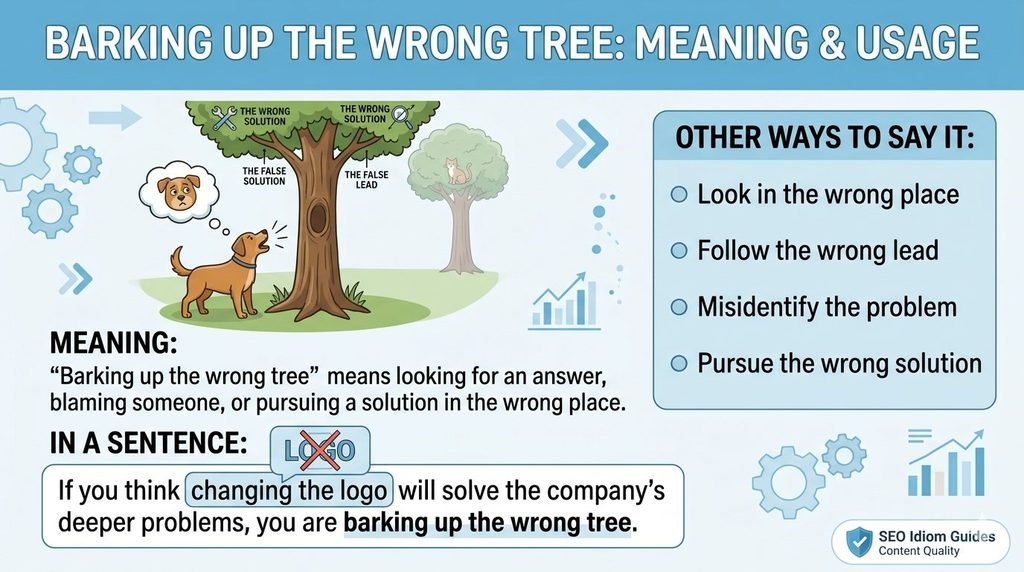
Barking Up the Wrong Tree
Meaning
“Barking up the wrong tree” means looking for an answer, blaming someone, or pursuing a solution in the wrong place.
In a Sentence
If you think changing the logo will solve the company’s deeper problems, you are barking up the wrong tree.
Other Ways to Say It
- Look in the wrong place
- Follow the wrong lead
- Misidentify the problem
- Pursue the wrong solution
Explanation
The image is of a dog barking at a tree where it expects something to be, even though its target is somewhere else. The expression focuses on misdirected effort rather than effort that is inherently impossible.
It is usually informal and can sound mildly humorous.
Best Use
Useful in conversations, advice, debates, workplace discussions, and informal writing.
Casting Pearls Before Swine
Meaning
“Casting pearls before swine” means offering something valuable to people who will not appreciate, understand, or value it.
In a Sentence
Explaining every detail of the rare manuscript to an audience that had no interest in it felt like casting pearls before swine.
Other Ways to Say It
- Waste something valuable on an unreceptive audience
- Give good advice where it will be ignored
- Offer value to people who do not appreciate it
- Spend effort on an unwilling audience
Explanation
The contrast between pearls and swine creates a memorable picture of valuable things being offered where they are unlikely to be appreciated.
The expression has biblical origins and can sound old-fashioned, judgmental, or literary. Use it carefully when describing other people.
Best Use
Best for literary writing, essays, speeches, and reflective commentary, rather than casual professional communication.
Pouring Water Into a Sieve
Meaning
“Pouring water into a sieve” describes making an effort that cannot produce a lasting result because the result immediately disappears.
In a Sentence
Trying to teach him the material without changing his study habits was like pouring water into a sieve.
Other Ways to Say It
- Waste effort
- Lose results immediately
- Try to hold what cannot be held
- Work without lasting effect
Explanation
A sieve cannot retain water, so the image represents effort with no lasting outcome. It is especially useful when something may appear to work temporarily but cannot hold the result.
The expression is more poetic and less common in everyday American English than some of the other choices here.
Best Use
Effective in poetry, creative writing, reflective essays, and expressive descriptions.
Ploughing the Sand
Meaning
“Ploughing the sand” means working hard at something that will not hold the desired result or produce useful progress.
In a Sentence
Without enough water for the crops, preparing that dry field felt like ploughing the sand.
Other Ways to Say It
- Work without results
- Struggle against unsuitable conditions
- Labor in vain
- Put effort into barren ground
Explanation
The image of a farmer ploughing sand suggests hard work applied to an unsuitable situation. It is more literary than conversational and gives futility a sense of wasted labor.
The phrase works especially well when the environment or circumstances make success unlikely.
Best Use
Best suited to poetry, essays, literary writing, and dramatic storytelling.
Emptying the Ocean With a Spoon
Meaning
“Emptying the ocean with a spoon” is an expressive idiomatic image for attempting a task so enormous that the available effort is hopelessly inadequate.
In a Sentence
Trying to repair decades of environmental damage in a single weekend felt like emptying the ocean with a spoon.
Other Ways to Say It
- Take on an impossible task
- Try to solve an enormous problem with tiny resources
- Fight overwhelming odds
- Attempt the impossible
Explanation
The contrast between a tiny spoon and a vast ocean makes the imbalance immediately visible. The problem may be real and worthwhile, but the available method or resources are far too small.
This is strongly figurative and dramatic, making it better for expressive writing than ordinary business language.
Best Use
Excellent for speeches, essays, storytelling, poetry, and motivational or critical writing.
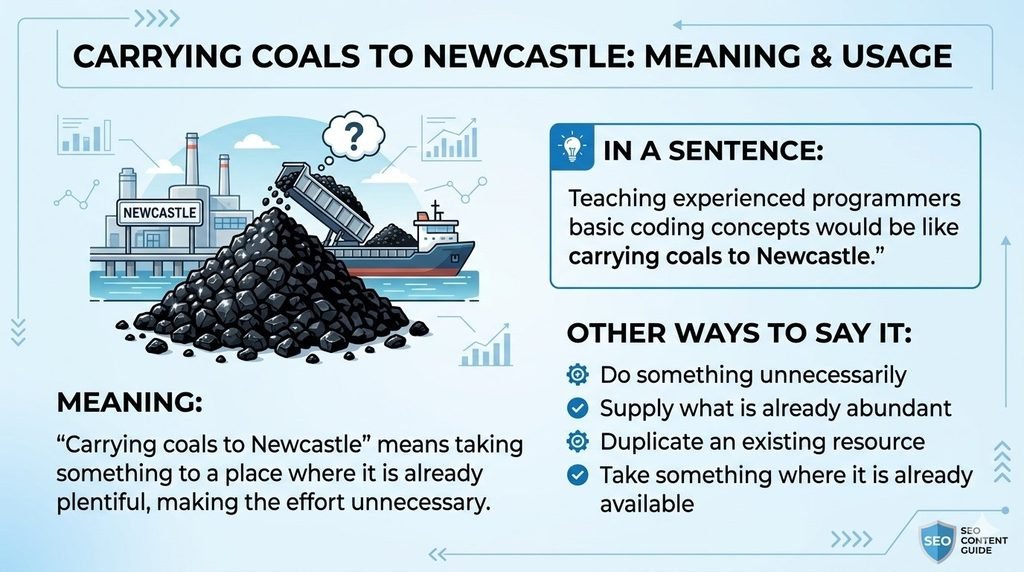
Carrying Coals to Newcastle
Meaning
“Carrying coals to Newcastle” means taking something to a place where it is already plentiful, making the effort unnecessary.
In a Sentence
Teaching experienced programmers basic coding concepts would be like carrying coals to Newcastle.
Other Ways to Say It
- Do something unnecessarily
- Supply what is already abundant
- Duplicate an existing resource
- Take something where it is already available
Explanation
The expression comes from Newcastle’s historical association with coal. Carrying coal there would have been unnecessary because coal was already abundant.
It describes pointless or redundant effort, rather than an impossible task.
Best Use
Useful in British English, essays, conversations, and commentary, especially when discussing unnecessary duplication.
Building Castles in the Air
Meaning
“Building castles in the air” means creating unrealistic plans, dreams, or expectations without a practical foundation.
In a Sentence
Without a budget or a workable plan, their grand business proposal was little more than building castles in the air.
Other Ways to Say It
- Dream without a plan
- Pursue unrealistic hopes
- Imagine an impractical future
- Build an unrealistic vision
Explanation
The image of a magnificent castle floating in the air captures something beautiful but unsupported by reality. It does not always mean the dream is worthless; rather, the dream lacks a solid foundation.
The phrase can sound poetic, critical, or gently cautionary.
Best Use
Works well in essays, speeches, creative writing, conversations, and reflective pieces.
Sowing Seeds on Stony Ground
Meaning
“Sowing seeds on stony ground” describes putting effort into something that lacks the conditions needed for that effort to succeed.
In a Sentence
Trying to convince the hostile audience to reconsider its position felt like sowing seeds on stony ground.
Other Ways to Say It
- Invest effort where it cannot take root
- Give advice that will not be accepted
- Work in an unreceptive environment
- Plant effort where it cannot grow
Explanation
The agricultural image suggests that seeds need suitable soil to grow. When the ground is hard and stony, even careful planting may produce little or nothing.
This is a poetic and metaphorical expression, making it especially powerful when describing rejected ideas, advice, or emotional effort.
Best Use
Best for poetry, essays, speeches, storytelling, and reflective writing.
Much Ado About Nothing
Meaning
“Much ado about nothing” describes a great deal of excitement, concern, argument, or activity over something that has little real importance.
In a Sentence
The entire argument over which font to use became much ado about nothing.
Other Ways to Say It
- Make a big issue out of nothing
- Create unnecessary fuss
- Make mountains out of molehills
- Make a needless commotion
Explanation
This expression focuses on unnecessary activity rather than failed effort. People may be very busy and emotional, but the underlying issue does not justify all the attention.
It comes from the title of William Shakespeare’s comedy and can sound witty or literary.
Best Use
Useful in essays, commentary, conversations, reviews, and humorous writing.
Exercise: Practice Using Idioms
Choose the best answer for each question.
What does “spinning your wheels” usually mean?
A. Moving very quickly
B. Working hard without making progress
C. Preparing for a journey
D. Changing direction suddenly
Which idiom best describes repeatedly arguing about an issue that has already been settled?
A. Building castles in the air
B. A wild-goose chase
C. Beating a dead horse
D. Carrying coals to Newcastle
Which expression suggests that someone is pursuing the wrong explanation or person?
A. Barking up the wrong tree
B. Ploughing the sand
C. Pushing a rope
D. A dead end
What image is created by “emptying the ocean with a spoon”?
A. Careful preparation
B. A simple solution
C. A successful shortcut
D. An enormous task with inadequate effort
Which expression describes offering something valuable to people who will not appreciate it?
A. Going around in circles
B. Casting pearls before swine
C. A fool’s errand
D. Chasing your tail
If a research idea leads nowhere, which expression is most appropriate?
A. A dead end
B. Building castles in the air
C. Carrying coals to Newcastle
D. Much ado about nothing
Which idiom focuses on repeated activity without forward movement?
A. A wild-goose chase
B. Sowing seeds on stony ground
C. Going around in circles
D. Tilting at windmills
What does “a fool’s errand” describe?
A. A rewarding assignment
B. A pointless or impractical task
C. A difficult but necessary job
D. A secret mission
Which expression is particularly associated with fighting unrealistic or imaginary problems?
A. Pushing a rope
B. Chasing your tail
C. Tilting at windmills
D. A dead end
What does “carrying coals to Newcastle” emphasize?
A. Unnecessary duplication
B. A dangerous journey
C. A difficult search
D. An impossible dream
Which phrase best describes working in conditions where effort cannot take root or succeed?
A. Much ado about nothing
B. Sowing seeds on stony ground
C. Barking up the wrong tree
D. Beating a dead horse
Which expression is most closely connected with a fruitless search involving misleading clues?
A. A wild-goose chase
B. Pushing a rope
C. Ploughing the sand
D. Building castles in the air
Someone spends hours arguing about a tiny issue that does not matter. Which idiom fits best?
A. Emptying the ocean with a spoon
B. A dead end
C. Much ado about nothing
D. Flogging a dead horse
Which idiom suggests unrealistic plans without a practical foundation?
A. Building castles in the air
B. Casting pearls before swine
C. Chasing your tail
D. Carrying coals to Newcastle
Which statement demonstrates the figurative meaning of an idiom?
A. “The road ended at the river.”
B. “The mechanic repaired the wheel.”
C. “The team was spinning its wheels despite working all day.”
D. “The dog chased its tail in the garden.”
Answers
- B — “Spinning your wheels” means making an effort without achieving meaningful progress.
- C — “Beating a dead horse” describes continuing an argument or effort that can no longer achieve anything useful.
- A — “Barking up the wrong tree” means pursuing the wrong person, explanation, or solution.
- D — The image shows a huge task being attempted with an extremely inadequate tool.
- B — “Casting pearls before swine” means offering something valuable where it will not be appreciated.
- A — A “dead end” is a path or approach that cannot lead to further progress.
- C — “Going around in circles” describes repeated activity without reaching a solution.
- B — A “fool’s errand” is a pointless, impractical, or fruitless task.
- C — “Tilting at windmills” refers to fighting unrealistic or imaginary enemies or problems.
- A — “Carrying coals to Newcastle” means taking something somewhere it is already plentiful.
- B — “Sowing seeds on stony ground” represents effort made where the conditions do not allow it to succeed.
- A — A “wild-goose chase” is a fruitless pursuit, often involving false leads.
- C — “Much ado about nothing” describes excessive concern or activity over something insignificant.
- A — “Building castles in the air” refers to unrealistic dreams or plans without a practical foundation.
- C — The sentence uses “spinning its wheels” figuratively to describe effort without progress.
FAQs
What is an idiom for futility?
An idiom for futility is a figurative expression that communicates pointless effort, wasted energy, lack of progress, or an unlikely outcome. Examples include “beating a dead horse,” “spinning your wheels,” and “tilting at windmills.”
How do I create my own idiom for futility?
Start with a clear physical image that represents useless effort. Think about actions that cannot work, such as trying to push something that cannot be pushed or trying to fill something that cannot hold what you put into it. Then connect that image to the abstract idea of futility.
What makes an idiom effective?
A strong idiom creates an image that readers can understand quickly while adding an emotional or contextual layer. The best expressions are memorable, relevant, and natural rather than simply replacing one word with another.
Can I use these idioms in everyday conversation?
Yes, many of them are natural in everyday English. “Spinning your wheels,” “going around in circles,” “barking up the wrong tree,” and “beating a dead horse” are especially conversational. More literary expressions, such as “sowing seeds on stony ground,” may sound more poetic.
What is the difference between an idiom and a simile?
An idiom has an established figurative meaning, while a simile directly compares two things using words such as “like” or “as.” For example, “spinning your wheels” is an idiomatic expression, while “the effort was like pushing a mountain” is a simile.
Conclusion
Idioms give the idea of futility much more shape and feeling than a simple statement such as “the effort was useless.” Beating a dead horse highlights pointless persistence, spinning your wheels captures wasted activity, and barking up the wrong tree shows misdirected effort. Other expressions reveal different shades of the same broad idea, from unrealistic dreams to unnecessary work and impossible tasks.
When choosing an idiom, think about the exact kind of futility you want to communicate. Is someone repeating a failed action, following the wrong path, fighting an impossible battle, or investing effort where it cannot succeed? The right image can make your meaning clearer and more memorable. Ultimately, effective figurative language does more than decorate a sentence—it helps readers see the futility behind the effort.

Margaret Saywell is an English author and editor who has spent more than fifteen years working with words teaching, proofreading, and writing about the quirks of the English language.
At Idiom Looms, Margaret gathers idioms from across the English-speaking world and weaves them into clear, practical guides. She loves digging into the history of a phrase and showing readers how a few well-chosen words can say far more than a long explanation.
She believes language should be enjoyed, not feared and that the best way to learn an idiom is to see it in action.


[…] Read more:20 Idioms for Futility With Real Examples […]