

Have you ever wanted to say goodbye without sounding too plain or repetitive? 20 Idioms for Goodbye With Real Examples introduces expressive phrases that make farewells more natural, memorable, and engaging. These idioms can add warmth, humor, emotion, or finality to everyday English usage and business communication.
This guide explains 20 idioms for goodbye with clear meanings, natural examples, and practical alternatives. You will see how these expressions fit conversations, meetings, formal writing, speeches, and friendly messages. Each example helps you understand the grammar, tone, and context behind the phrase.
Goodbye expressions can also support clearer scheduling, time management, calendar planning, and project management communication. They may even appear in online booking messages or broadcasting scripts. By learning their meanings and appropriate contexts, you can communicate with greater clarity and consistency.
What Is an Idiom?
An idiom is a familiar expression whose meaning is different from the literal meaning of its individual words.
For example, if someone says, “Break a leg,” they usually are not asking another person to injure themselves. The expression means good luck, especially before a performance.
Similarly, “spill the beans” does not literally mean dropping beans. It means to reveal a secret.
Idioms use figurative language, shared images, and cultural understanding to communicate ideas in a memorable way. Because their meaning is not always literal, readers and listeners understand them through context.
When talking about goodbye, idiomatic expressions can turn a simple departure into something warmer, more emotional, dramatic, hopeful, or reflective.
Why Use Idioms for Goodbye?
A simple “goodbye” can be perfectly appropriate, but sometimes it does not express everything you feel. Idiomatic language gives a farewell more personality and emotional depth.
For example, “go our separate ways” can suggest that two people are beginning different journeys. “Close the chapter” can describe leaving an important period of life behind, while “until we meet again” carries a sense of hope.
These expressions can help you:
- Express emotion without explaining every feeling directly.
- Make a farewell more vivid and memorable.
- Describe an ending through imagery and symbolism.
- Add warmth to personal messages and conversations.
- Give speeches and stories a more natural human voice.
- Express complicated feelings such as sadness mixed with hope.
- Make creative writing more descriptive.
- Show that a goodbye is temporary, permanent, professional, romantic, or symbolic.
The best expression depends on the situation. A poetic farewell may sound beautiful in a letter but overly dramatic in a quick workplace conversation.
Quick List of 20 Idioms for Goodbye
- Part ways
- Bid farewell
- Take one’s leave
- Go our separate ways
- Part company
- Say one’s goodbyes
- Until we meet again
- See you around
- So long
- Bid adieu
- Make a clean break
- Close the chapter
- Turn the page
- Move on
- Leave it behind
- Close the door on something
- Take one’s final bow
- Ride off into the sunset
- Sign off
- Kiss something goodbye
Part Ways
Read more:20 Idioms for Good With Real Examples
Meaning
Part ways means to separate from someone and continue on different paths. It can describe a physical goodbye, but it can also refer to people ending a relationship, partnership, or period of cooperation.
The expression emphasizes separation and different directions rather than the simple act of saying goodbye.
In a Sentence
After years of working together, the two business partners decided to part ways on friendly terms.
Other Ways to Say It
- Go in different directions
- Separate
- Go our own ways
- Say goodbye and leave
Explanation
The image behind this expression is simple: two people are traveling together until their paths divide. It works especially well when a goodbye represents a change in direction.
Unlike a casual “see you later,” it can suggest that the separation may be significant or long-lasting. It can also sound neutral and mature when describing the end of a professional relationship.
Best Use
Best for conversations, workplace communication, storytelling, and personal writing. It works particularly well when describing a meaningful separation without making the situation overly dramatic.
Bid Farewell
Meaning
Bid farewell means to say goodbye, usually in a somewhat formal, respectful, or emotional way.
The verb “bid” here means to express or offer, so the phrase essentially means to offer someone a farewell.
In a Sentence
The students gathered outside the school to bid farewell to their retiring teacher.
Other Ways to Say It
- Say goodbye
- Offer a farewell
- Take leave
- Say farewell
Explanation
This expression has a more formal and ceremonial feeling than simply saying “goodbye.” It creates the impression of an important departure rather than a quick everyday exit.
Because of its slightly formal tone, it can add dignity to speeches, ceremonies, stories, and heartfelt messages.
Best Use
Use it in farewell speeches, formal writing, ceremonies, stories, and emotional messages. It may sound a little formal for casual texting.
Take One’s Leave
Meaning
Take one’s leave means to leave a place or depart from someone, often after saying goodbye.
It emphasizes the act of departing politely rather than the emotion behind the goodbye.
In a Sentence
After thanking his hosts for the wonderful evening, Daniel took his leave.
Other Ways to Say It
- Take leave
- Depart
- Say goodbye and go
- Excuse oneself
Explanation
This expression carries a polite, traditional tone. It paints a picture of someone formally preparing to leave after spending time with others.
It is not usually emotional by itself. Instead, it focuses on courtesy and departure, making it useful when describing someone leaving a gathering or conversation.
Best Use
It works best in formal writing, storytelling, historical settings, and polite descriptions. In everyday conversation, “I should get going” will usually sound more natural.
Go Our Separate Ways
Meaning
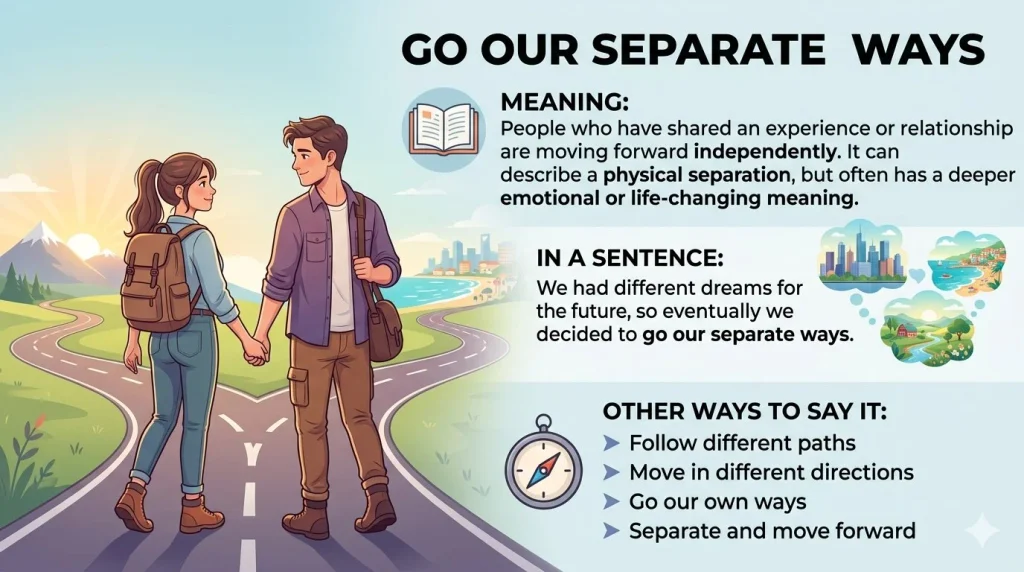
Go our separate ways means that people who have shared an experience or relationship are moving forward independently.
It can describe a physical separation, but it often has a deeper emotional or life-changing meaning.
In a Sentence
We had different dreams for the future, so eventually we decided to go our separate ways.
Other Ways to Say It
- Follow different paths
- Move in different directions
- Go our own ways
- Separate and move forward
Explanation
The expression creates an image of travelers reaching a point where their roads divide. That makes it particularly effective for describing life transitions and emotional goodbyes.
It can sound thoughtful rather than bitter, especially when people separate while still respecting one another.
Best Use
Best for personal messages, reflective writing, relationship stories, speeches, and conversations about major life changes.
Part Company
Meaning
Part company means to separate from someone, either physically or because of a disagreement or difference in opinion.
The expression can describe an ordinary departure, but it may also suggest that two people no longer share the same path or viewpoint.
In a Sentence
We enjoyed the evening together before finally parting company at the station.
Other Ways to Say It
- Separate
- Go our own ways
- Leave one another
- Disagree and separate
Explanation
“Part company” has a slightly formal or polished sound. It can be useful when a goodbye involves more than simply walking away.
In some contexts, it suggests disagreement, so the surrounding sentence matters. If you want a warm farewell, another expression may be more suitable.
Best Use
It fits formal conversation, essays, journalism, storytelling, and descriptions of professional or personal separation.
Say One’s Goodbyes
Meaning
Say one’s goodbyes means to tell people goodbye before leaving.
It is straightforward but can carry emotional weight depending on the situation.
In a Sentence
Before boarding the train, Maya hugged her family and said her goodbyes.
Other Ways to Say It
- Say farewell
- Say goodbye
- Take leave of everyone
- Give everyone a farewell
Explanation
This expression focuses directly on the human moment of farewell. It often suggests that someone is taking time to acknowledge the people they are leaving.
It can be neutral, affectionate, or deeply emotional depending on the context.
Best Use
Use it in everyday conversation, personal writing, stories, travel situations, and emotional farewell scenes.
Until We Meet Again
Meaning
Until we meet again is a farewell expression that suggests the goodbye is not necessarily permanent.
It combines separation with hope for another meeting.
In a Sentence
“Take care of yourself, and until we meet again,” he said before leaving.
Other Ways to Say It
- See you again
- Until next time
- See you when our paths cross again
- We’ll meet again someday
Explanation
This phrase creates a gentle sense of anticipation. Rather than treating goodbye as a final ending, it leaves the door open for another encounter.
It has a warm, sentimental, and sometimes poetic quality, so it can be more expressive than an ordinary “see you later.”
Best Use
It works beautifully in farewell cards, speeches, letters, personal messages, stories, and sentimental conversations.
See You Around
Meaning
See you around is a casual way of saying goodbye when you expect that you may see the person again but do not have a specific meeting planned.
It communicates friendly uncertainty about when the next meeting will happen.
In a Sentence
“I’m heading home now. See you around!”
Other Ways to Say It
- See you later
- Catch you later
- See you sometime
- Take care
Explanation
Unlike a serious farewell, this expression feels light and relaxed. It suggests that the goodbye is not overly formal or emotional.
It is especially natural when leaving friends, classmates, coworkers, neighbors, or acquaintances.
Best Use
Best for casual conversations, texts, friendly messages, and everyday situations. It is generally too informal for a solemn farewell speech.
So Long
Meaning
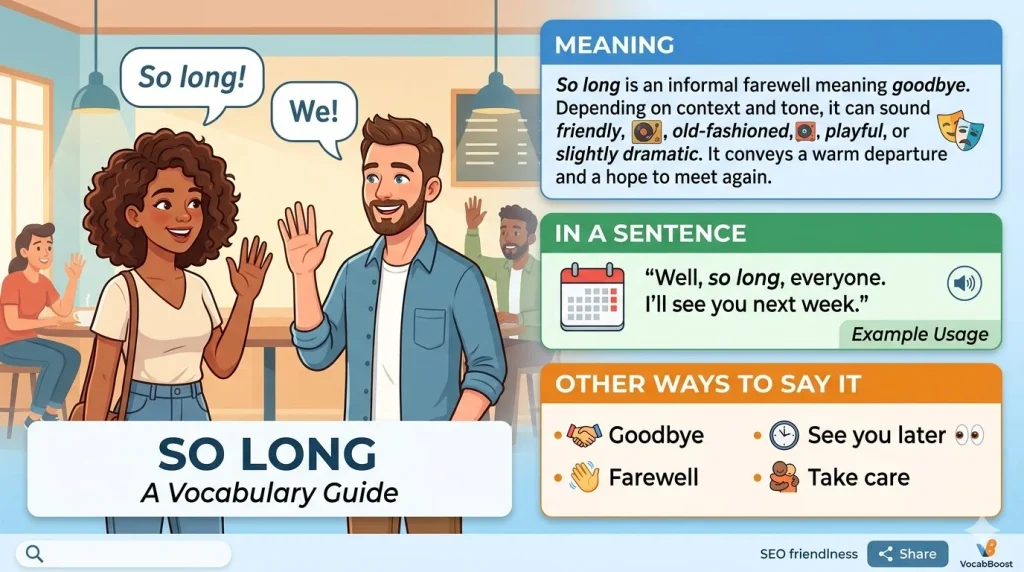
So long is an informal farewell meaning goodbye. Depending on context and tone, it can sound friendly, old-fashioned, playful, or slightly dramatic.
In a Sentence
“Well, so long, everyone. I’ll see you next week.”
Other Ways to Say It
- Goodbye
- See you later
- Farewell
- Take care
Explanation
“So long” has a distinctive conversational flavor. It can sound charmingly old-fashioned in modern English, which can make it useful for dialogue and character development.
Its meaning is usually simple, but its tone depends heavily on who says it and how.
Best Use
Use it in casual dialogue, storytelling, humorous writing, and playful farewells. It is less common in formal professional communication.
Bid Adieu
Meaning
Bid adieu means to say goodbye. “Adieu” comes from French and has traditionally been used in English as a more literary or elegant word for farewell.
In a Sentence
With one final look at the old house, he bid adieu to the place where he had grown up.
Other Ways to Say It
- Say farewell
- Say goodbye
- Take leave
- Leave for good
Explanation
This expression has a distinctly literary and dramatic flavor. It can make a farewell feel important, memorable, or almost theatrical.
Because it is less common in everyday speech, using it casually can sound deliberately playful or old-fashioned.
Best Use
It is particularly effective in creative writing, poetry, humorous dialogue, dramatic speeches, and literary descriptions.
Make a Clean Break
Meaning
Make a clean break means to end a relationship, situation, habit, or period of life decisively and without continuing unnecessary connections.
It is a goodbye with a strong sense of finality and independence.
In a Sentence
After years of returning to the same unhealthy situation, she decided to make a clean break and start over.
Other Ways to Say It
- End things completely
- Cut ties
- Start fresh
- Leave it behind for good
Explanation
The word “clean” creates the image of something being separated neatly rather than left partly connected. This makes the expression stronger than an ordinary farewell.
It can sound serious, determined, or even emotionally tough, depending on the circumstances.
Best Use
Best for personal reflection, relationship discussions, self-improvement writing, storytelling, and serious conversations.
Close the Chapter
Meaning
Close the chapter means to finish an important period, experience, relationship, or stage of life and prepare to move forward.
It treats life like a book made up of different chapters.
In a Sentence
Graduation felt like the perfect moment to close the chapter on my school years.
Other Ways to Say It
- Finish a chapter
- Bring a period to an end
- Leave that stage behind
- Prepare for a new beginning
Explanation
This expression creates one of the clearest images for an emotional goodbye: a person finishes reading one chapter before beginning another.
It does not necessarily suggest sadness. Instead, it often carries a mixture of reflection, acceptance, and hope.
Best Use
Use it in graduation speeches, personal essays, farewell messages, social media captions, and reflective writing.
Turn the Page
Meaning
Turn the page means to leave a past experience behind and move forward into something new.
The expression suggests that an ending is also an opportunity for a fresh beginning.
In a Sentence
It was difficult to leave the old job, but I was ready to turn the page and try something different.
Other Ways to Say It
- Move forward
- Start a new chapter
- Begin again
- Leave the past behind
Explanation
The book image makes the expression especially memorable. When one page ends, another is waiting.
This makes it useful for goodbyes that involve personal growth, change, recovery, or a new stage of life rather than simple physical departure.
Best Use
It works especially well in speeches, essays, inspirational writing, farewell messages, and personal reflections.
Move On
Meaning
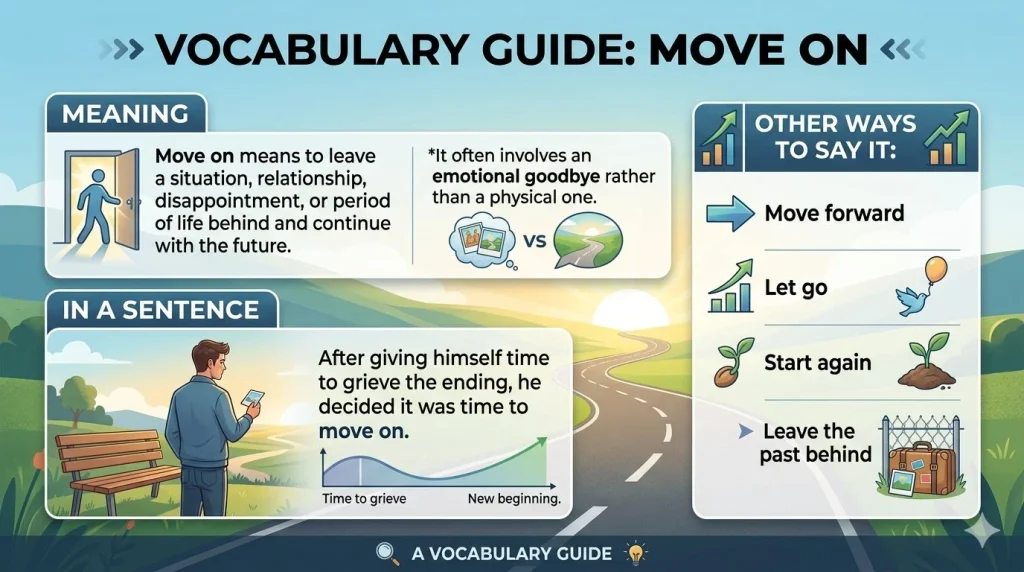
Move on means to leave a situation, relationship, disappointment, or period of life behind and continue with the future.
It often involves an emotional goodbye rather than a physical one.
In a Sentence
After giving himself time to grieve the ending, he decided it was time to move on.
Other Ways to Say It
- Move forward
- Let go
- Start again
- Leave the past behind
Explanation
“Move on” is one of the most natural expressions for an emotional farewell. It recognizes that saying goodbye can involve accepting change and continuing with life.
It is simple enough for everyday conversation but meaningful enough for personal writing.
Best Use
Best for conversations, advice, personal messages, essays, storytelling, and discussions about emotional change.
Leave It Behind
Meaning
Leave it behind means to stop carrying something from the past into the future. The “something” may be a place, memory, relationship, mistake, or difficult period.
In a Sentence
She thanked everyone for the memories and decided to leave the disappointment behind.
Other Ways to Say It
- Let it go
- Put it in the past
- Move forward
- Stop looking back
Explanation
The expression creates the image of walking forward while allowing something to remain behind you. That makes it particularly effective for emotional goodbyes.
It can suggest acceptance and freedom, although the tone may become dismissive if used toward someone else’s feelings.
Best Use
Use it in personal reflections, inspirational writing, stories, conversations, and messages about overcoming the past.
Close the Door on Something
Meaning
Close the door on something means to end an opportunity, relationship, situation, or period and choose not to return to it.
It suggests a deliberate and often final goodbye.
In a Sentence
After years of uncertainty, he finally closed the door on the old business and focused on his new career.
Other Ways to Say It
- End the matter
- Put it behind you
- Walk away
- Bring it to a close
Explanation
The expression creates a strong physical image: a person leaves a room and closes the door behind them. That image gives the farewell a sense of decision and finality.
It is stronger than simply saying “move on,” because it suggests deliberately ending the possibility of going back.
Best Use
Best for serious conversations, essays, professional situations, personal writing, and stories involving decisive endings.
Take One’s Final Bow
Meaning
Take one’s final bow is a figurative expression meaning to make a final appearance or leave a stage, career, role, or public position.
It comes from the tradition of performers bowing to an audience at the end of a performance.
In a Sentence
After four decades in the theater, the actor took his final bow before a standing audience.
Other Ways to Say It
- Make a final appearance
- End one’s career
- Give a final performance
- Say a final farewell
Explanation
This expression carries a dramatic and ceremonial image. The “stage” can be literal, but it can also represent a career, public role, or important period of life.
It is especially powerful when a goodbye feels significant or symbolic.
Best Use
Ideal for speeches, biographies, entertainment writing, retirement announcements, storytelling, and poetic farewells.
Ride Off Into the Sunset
Meaning
Ride off into the sunset is a figurative expression associated with leaving after an adventure or important story, often with the suggestion of a satisfying or hopeful ending.
The image comes strongly from Western films and stories, where a character may ride toward the horizon after completing an adventure.
In a Sentence
After completing his final project, he handed over the company and rode off into the sunset, ready for a quieter life.
Other Ways to Say It
- Leave for a new beginning
- Walk away after success
- Head toward a new life
- Leave the story behind
Explanation
Few goodbye expressions create such a vivid visual scene. You can almost picture someone disappearing toward a glowing horizon.
It usually has a playful, cinematic, optimistic, or slightly humorous tone rather than a solemn one.
Best Use
Use it in creative writing, social media captions, storytelling, humorous farewells, and lighthearted announcements. Avoid it when the situation requires a serious or deeply respectful tone.
Sign Off
Meaning
Sign off can mean to finish a communication, broadcast, letter, message, or appearance. As a farewell expression, it suggests that someone is bringing a communication to an end.
In a Sentence
“Thanks for listening, and I’ll sign off for tonight. Take care, everyone.”
Other Ways to Say It
- Wrap up
- End the message
- Say goodbye
- Finish for now
Explanation
This expression has a practical, communication-focused image. It works particularly well when the goodbye happens at the end of a message, broadcast, presentation, or online interaction.
Unlike “part ways,” it does not necessarily suggest an emotional separation. It simply marks the end of communication.
Best Use
Best for emails, broadcasts, podcasts, presentations, professional communication, online messages, and casual digital conversations.
Kiss Something Goodbye
Meaning
Kiss something goodbye means to accept that you will probably lose something or will no longer have it.
It is usually figurative and often carries a tone of finality, disappointment, warning, or humor.
In a Sentence
If we miss the last train, we can kiss our plans for dinner goodbye.
Other Ways to Say It
- Say goodbye to it
- Give it up
- Accept that it is gone
- Forget about getting it
Explanation
The expression uses the familiar act of a farewell kiss to create a playful metaphor for losing something. It is not usually about saying goodbye to a person directly.
Its tone can range from humorous to serious, depending on what is being lost.
Best Use
It works best in casual conversation, humorous writing, social media, storytelling, and informal messages. It is generally unsuitable for solemn or professional farewells.
Exercise: Practice Using Idioms
Choose the best answer for each question.
What does “part ways” usually mean?
A. Traveling together
B. Separating and continuing independently
C. Becoming closer friends
D. Returning to the same place
Which expression suggests that two people are following different paths?
A. Sign off
B. So long
C. Bid farewell
D. Go our separate ways
Which expression has a more formal and respectful tone?
A. Bid farewell
B. See you around
C. So long
D. Kiss something goodbye
What does “take one’s leave” mean?
A. Declining an invitation
B. Changing your decision
C. Leaving someone or somewhere
D. Remaining longer than expected
Which expression is especially suitable for a casual goodbye?
A. Take one’s final bow
B. Close the door on something
C. See you around
D. Make a clean break
What idea does “until we meet again” communicate?
A. Hope for another meeting
B. Anger about a disagreement
C. A professional promotion
D. Immediate reconciliation
Which expression describes ending a connection decisively?
A. See you around
B. Make a clean break
C. So long
D. Sign off
“Close the chapter” compares life to what?
A. A journey by train
B. A stage performance
C. A written book
D. A road through a city
Which expression suggests beginning a new stage after leaving the past behind?
A. Turn the page
B. Part company
C. Take one’s leave
D. Bid adieu
What does “move on” usually suggest?
A. Staying in exactly the same situation
B. Returning to an old problem
C. Continuing forward after an ending
D. Refusing to say goodbye
Which expression can describe leaving a difficult past behind?
A. Leave it behind
B. See you around
C. Bid farewell
D. Sign off
What does “close the door on something” imply?
A. Decorating a room
B. Ending something and choosing not to return to it
C. Waiting for an invitation
D. Starting a conversation
Which expression is especially dramatic or ceremonial?
A. So long
B. See you around
C. Take one’s final bow
D. Sign off
“Ride off into the sunset” generally creates what kind of feeling?
A. Cinematic and hopeful
B. Strictly professional
C. Angry and threatening
D. Confused and uncertain
What does “kiss something goodbye” mean?
A. Welcoming something new
B. Celebrating a reunion
C. Accepting that something will probably be lost
D. Promising to return soon
Answers
- B — “Part ways” means to separate and continue in different directions.
- D — “Go our separate ways” directly describes people following different paths.
- A — “Bid farewell” has a more formal and respectful tone than casual expressions such as “see you around.”
- C — “Take one’s leave” means to depart after taking leave of someone.
- C — “See you around” is a relaxed, everyday way to say goodbye.
- A — “Until we meet again” suggests that another meeting may happen in the future.
- B — “Make a clean break” suggests ending a connection or situation decisively.
- C — “Close the chapter” uses the image of a book to represent the end of a life stage or experience.
- A — “Turn the page” suggests leaving one stage behind and beginning another.
- C — “Move on” means to continue forward after an ending or difficult experience.
- A — “Leave it behind” means to stop carrying something from the past into the future.
- B — “Close the door on something” suggests bringing it to an end and not returning to it.
- C — “Take one’s final bow” has a dramatic, ceremonial connection to a final performance or appearance.
- A — “Ride off into the sunset” creates a cinematic image of leaving after an adventure and beginning a new stage.
- C — “Kiss something goodbye” means accepting that something will probably be lost or unavailable.
FAQs
What is an idiom for Goodbye?
An idiom for goodbye is a familiar figurative expression that communicates departure, separation, finality, or moving forward in a more vivid way than simply saying “goodbye.” Examples include “part ways,” “take one’s leave,” and “turn the page.”
How do I create my own idiom for Goodbye?
Start with the feeling you want to express. Think about a strong image connected to leaving, distance, journeys, doors, books, stages, or changing paths. Then connect that image to the emotional idea behind the farewell. The strongest figurative expressions are easy to picture and have a clear purpose.
What makes a Goodbye idiom effective?
An effective expression should communicate more than simple departure. It might show hope, sadness, finality, freedom, change, or acceptance. It should also fit the situation and sound natural in context.
Can I use these Goodbye expressions in everyday conversation?
Yes, although some are more conversational than others. Expressions such as “see you around,” “so long,” “part ways,” and “move on” can work naturally in everyday speech. More literary phrases such as “bid adieu” or “take one’s final bow” are better suited to particular contexts.
What is the difference between a Goodbye idiom and a simile?
An idiom has a recognized figurative meaning that people understand as an expression, while a simile directly compares two things using words such as “like” or “as.” For example, “turn the page” can figuratively mean moving beyond a past experience, while “goodbye felt like closing a heavy door” is a simile created for a specific comparison.
Conclusion
A goodbye can be brief, emotional, hopeful, final, or full of possibility. The right idiomatic expression helps communicate the feeling behind the farewell, not just the act of leaving. Expressions such as “part ways” and “go our separate ways” emphasize separation, while “until we meet again” leaves room for hope. Others, such as “turn the page,” “close the chapter,” and “move on,” describe the emotional process of leaving one stage behind.
When choosing an expression, always consider the tone and situation. A casual goodbye may call for “see you around,” while a retirement speech may benefit from “take one’s final bow.” The strongest figurative language is not necessarily the most dramatic it is the expression that makes the intended feeling clear. Sometimes goodbye is simply an ending; other times, it is the first step toward a new beginning.

Eleanor Prose is a writer and English teacher with a soft spot for the phrases that trip us up. She has spent years helping students and professionals use idioms with confidence not just memorizing them, but understanding the culture and humor behind each one.
Through Idiom Looms, Eleanor explores the threads that connect language, history, and everyday conversation. Her goal is simple: to make English idioms clear, memorable, and actually fun to use.
She writes from a quiet desk surrounded by notebooks, and firmly believes there’s an idiom for every situation usually more than one.


[…] Read more:20 Idioms for Goodbye With Real Examples […]