

Ever wondered how to say goodbye without sounding repetitive? Idioms for leaving can add emotion, personality, and natural expression to everyday English. This guide to 20 Idioms for Leaving With Real Examples explores practical phrases for saying goodbye, departing suddenly, ending activities, or moving on. Each expression includes a clear meaning and realistic example to help you understand its English usage.
The right phrase depends on the situation. In scheduling, time management, meetings, and business communication, precise language makes conversations smoother. Some idioms suit casual speech, while others work better in storytelling, messages, or formal writing. Understanding context also helps you maintain clarity and consistency when choosing expressions.
You will also see how leaving-related idioms connect with a calendar, online booking, broadcasting, and project management. With practical examples and simple explanations, this guide makes figurative language easier to understand. Explore these 20 idioms for leaving and use them confidently.
What Is an Idiom?
An idiom is a familiar expression whose meaning is different from the literal meaning of the individual words. Idioms often create a mental picture that helps communicate an idea or feeling more memorably.
For example, “break the ice” does not mean physically breaking ice. It means starting a conversation or making people feel more comfortable.
Likewise, “hit the road” does not mean striking a road. It means to leave or begin a journey.
The difference between an idiom and a literal statement is important: a literal statement says exactly what the words mean, while an idiom communicates an understood figurative meaning.
Why Use Idioms for Leaving?
Leaving can carry many different emotions. You might be leaving happily, reluctantly, suddenly, permanently, or simply stepping away from a situation. Idioms help show these differences.
For example, “make tracks” can make an ordinary departure sound active and purposeful, while “leave someone in the lurch” describes the negative effect of abandoning someone who needs help.
These expressions can help you:
- Express emotion without explaining every detail.
- Make descriptions more vivid and memorable.
- Give personality to conversations and personal messages.
- Add imagery to stories, speeches, and creative writing.
- Describe both physical departure and emotional withdrawal.
- Communicate complicated situations in a short, familiar expression.
The key is choosing an idiom that matches the specific kind of leaving you want to describe.
Quick List of 20 Idioms for Leaving
- Hit the road
- Make tracks
- Take one’s leave
- Make one’s exit
- Head for the hills
- Clear out
- Walk away
- Move on
- Cut and run
- Slip away
- Bow out
- Pack one’s bags
- Pull up stakes
- See oneself out
- Show someone the door
- Kick someone to the curb
- Leave someone in the lurch
- Leave high and dry
- Say goodbye
- On one’s way
Hit the Road
Read more:20 Idioms for IELTS With Real Examples
Meaning
“Hit the road” means to leave a place or start a journey. It is casual and energetic, often suggesting that someone is ready to get moving.
In a Sentence
We had enjoyed the evening, but it was getting late, so we decided to hit the road.
Other Ways to Say It
- Get going
- Set off
- Head out
- Leave now
Explanation
The expression creates an image of someone getting onto a road and beginning a journey. It usually sounds casual and friendly, rather than formal.
It works particularly well when the departure is active or planned rather than sad or reluctant.
Best Use
Best for everyday conversations, informal storytelling, travel writing, and friendly messages. Avoid it in highly formal business writing.
Make Tracks
Meaning
“Make tracks” means to leave or move away, often with a sense of urgency or purpose.
In a Sentence
We should make tracks if we want to reach the station before the last train.
Other Ways to Say It
- Get moving
- Head off
- Get going
- Set out
Explanation
The phrase suggests leaving a trail behind as you move. It gives a departure a feeling of movement and determination, making it more colorful than simply saying “leave.”
It can be useful when someone needs to depart promptly.
Best Use
This idiom fits informal speech, storytelling, travel scenes, and playful writing.
Take One’s Leave
Meaning
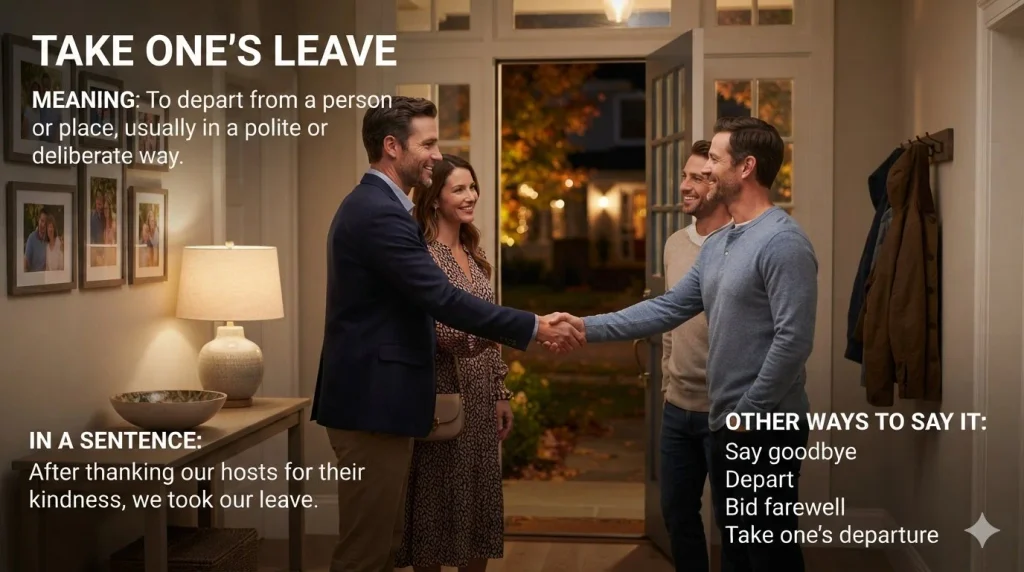
“Take one’s leave” means to depart from a person or place, usually in a polite or deliberate way.
In a Sentence
After thanking our hosts for their kindness, we took our leave.
Other Ways to Say It
- Say goodbye
- Depart
- Bid farewell
- Take one’s departure
Explanation
This expression has a more polite and traditional tone than casual phrases such as “head out.” It often suggests that someone is leaving respectfully after spending time with others.
Because of its formal flavor, it can sound especially natural in literary or ceremonial contexts.
Best Use
Best for formal conversations, speeches, historical writing, storytelling, and polished prose.
Make One’s Exit
Meaning
“Make one’s exit” means to leave a place or situation. It can be neutral, dramatic, humorous, or theatrical depending on context.
In a Sentence
He quietly made his exit before the argument became any worse.
Other Ways to Say It
- Leave
- Depart
- Slip out
- Walk away
Explanation
The word “exit” gives the expression a slight dramatic or deliberate quality. It can describe an ordinary departure, but writers often use it when the timing or manner of leaving matters.
It is particularly effective when someone wants to emphasize the way a person leaves.
Best Use
Useful in storytelling, creative writing, commentary, and conversations when a departure has some significance.
Head for the Hills
Meaning
“Head for the hills” means to leave quickly, usually to escape danger, trouble, or an unpleasant situation.
In a Sentence
When the storm warning came, everyone decided to head for the hills.
Other Ways to Say It
- Get away quickly
- Run for safety
- Make a quick escape
- Get out of there
Explanation
The expression creates a vivid picture of people rushing toward the hills to get away from danger. It is often dramatic or humorous, so it does not always describe a literal emergency.
The idiom works best when the reason for leaving is strong enough to make a quick escape feel natural.
Best Use
Best for informal conversation, humorous writing, storytelling, and dramatic scenes.
Clear Out
Meaning
“Clear out” means to leave a place, often quickly. Depending on the situation, it can also mean removing people or things from a place.
In a Sentence
The shop was closing, so we cleared out before the lights were turned off.
Other Ways to Say It
- Leave
- Get out
- Move along
- Vacate the place
Explanation
“Clear out” is direct and informal. It can sound impatient or forceful when used as a command, so tone matters.
As a description of your own departure, however, it can simply mean that you left.
Best Use
Best for casual conversation, dialogue, humorous writing, and informal storytelling.
Walk Away
Meaning
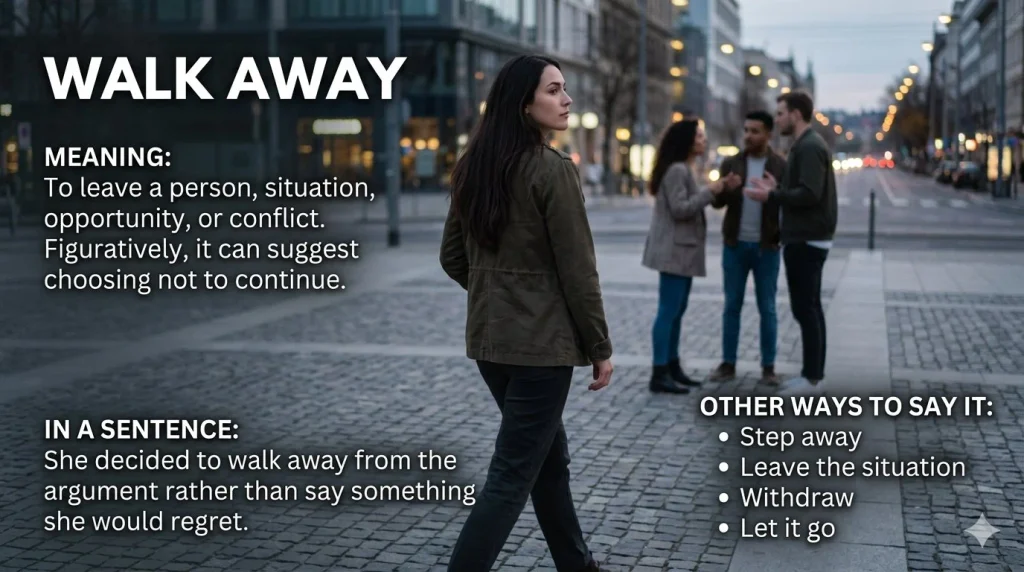
“Walk away” means to leave a person, situation, opportunity, or conflict. Figuratively, it can suggest choosing not to continue.
In a Sentence
She decided to walk away from the argument rather than say something she would regret.
Other Ways to Say It
- Step away
- Leave the situation
- Withdraw
- Let it go
Explanation
This phrase is powerful because physical movement becomes a symbol of emotional or practical withdrawal. It can suggest self-control, acceptance, rejection, or independence.
Its meaning depends heavily on context.
Best Use
Excellent for personal writing, conversations, motivational messages, essays, and emotional storytelling.
Move On
Meaning
“Move on” means to leave something behind and continue with life or a new situation. It is often emotional rather than physical.
In a Sentence
It took time, but eventually he was ready to move on after the difficult experience.
Other Ways to Say It
- Let go
- Start again
- Continue forward
- Put the past behind you
Explanation
Unlike an idiom describing a physical departure, “move on” often focuses on emotional progress. It suggests accepting that something has ended and directing attention toward what comes next.
It can sound supportive, reflective, or encouraging.
Best Use
Best for personal messages, conversations, essays, speeches, and reflective writing.
Cut and Run
Meaning
“Cut and run” means to leave suddenly to avoid a difficult, dangerous, or unpleasant situation, often without dealing with the consequences.
In a Sentence
Instead of fixing the problem, the manager chose to cut and run.
Other Ways to Say It
- Flee
- Run away
- Make a quick escape
- Abandon the situation
Explanation
The expression suggests an abrupt escape rather than a thoughtful departure. It often carries a negative or critical tone, implying that the person left when responsibility called for staying.
That judgmental nuance makes it different from neutral expressions such as “head out.”
Best Use
Useful in informal conversation, opinion writing, storytelling, and criticism.
Slip Away
Meaning
“Slip away” means to leave quietly or unnoticed. It can also describe something disappearing gradually.
In a Sentence
He decided to slip away before anyone noticed that he had left the party.
Other Ways to Say It
- Sneak out
- Quietly leave
- Depart unnoticed
- Ease away
Explanation
The word “slip” suggests gentle, almost invisible movement. It creates an image of someone leaving without drawing attention.
The expression can also feel soft or poetic, especially when describing time, memories, or opportunities disappearing.
Best Use
Best for storytelling, creative writing, personal messages, and quiet social situations.
Bow Out
Meaning
“Bow out” means to withdraw from an activity, position, competition, or situation, usually voluntarily.
In a Sentence
After years of performing, the actor decided to bow out of the production.
Other Ways to Say It
- Step down
- Withdraw
- Retire
- Leave the activity
Explanation
The expression comes from the image of a performer taking a final bow before leaving the stage. It therefore carries a sense of graceful withdrawal or conclusion.
It often sounds more respectful than simply saying someone quit.
Best Use
Especially suitable for professional contexts, public announcements, sports, entertainment, and formal commentary.
Pack One’s Bags
Meaning
“Pack one’s bags” means to prepare to leave, especially by gathering belongings before moving away or ending a stay.
In a Sentence
After receiving the news, he knew it was time to pack his bags and start somewhere new.
Other Ways to Say It
- Get ready to leave
- Prepare to move
- Gather your things
- Leave town
Explanation
The physical act of packing becomes a symbol of departure and change. Depending on context, it can suggest excitement, frustration, independence, or finality.
It is often especially expressive when leaving means starting a new chapter.
Best Use
Works well in conversations, novels, personal writing, travel stories, and emotional messages.
Pull Up Stakes
Meaning
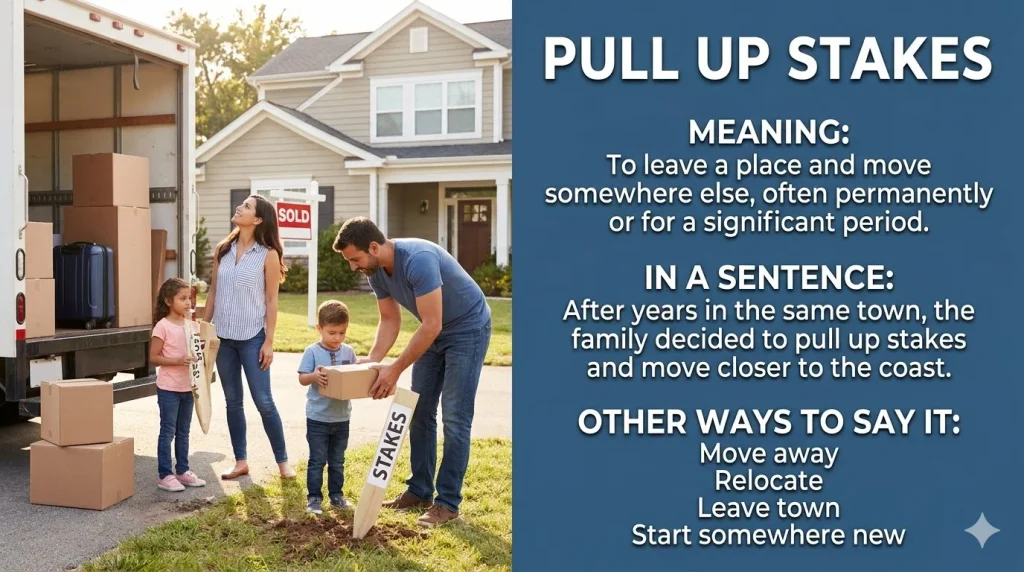
“Pull up stakes” means to leave a place and move somewhere else, often permanently or for a significant period.
In a Sentence
After years in the same town, the family decided to pull up stakes and move closer to the coast.
Other Ways to Say It
- Move away
- Relocate
- Leave town
- Start somewhere new
Explanation
The expression comes from the old practice of pulling up stakes used to mark a camp or property. The image suggests ending your connection to one place and moving on.
It has a traditional, slightly old-fashioned flavor.
Best Use
Best for storytelling, historical writing, novels, and descriptive prose. It may sound less natural in very casual modern conversation.
See Oneself Out
Meaning
“See oneself out” means to leave without needing someone to accompany you to the door. It can also be used sarcastically.
In a Sentence
I know you’re busy, so I’ll see myself out.
Other Ways to Say It
- I’ll leave
- I’ll head out
- I’ll let you get back to work
- I’ll make my way out
Explanation
The phrase is often polite, but context can give it a humorous or slightly awkward edge. Someone may say it after realizing they have interrupted another person’s time.
It is a good example of how tone changes an otherwise simple expression.
Best Use
Best for everyday conversation, informal messages, dialogue, and humorous situations.
Show Someone the Door
Meaning
“Show someone the door” means to tell or force someone to leave, especially because their behavior is unacceptable or their presence is no longer wanted.
In a Sentence
The manager finally showed the disruptive customer the door.
Other Ways to Say It
- Ask someone to leave
- Remove someone
- Send someone away
- Dismiss someone
Explanation
The “door” represents the boundary between staying and leaving. The expression usually carries a firm or negative tone, especially when someone has been removed from a place.
It is stronger than simply saying someone departed.
Best Use
Useful in informal conversation, storytelling, workplace scenarios, and dramatic writing.
Kick Someone to the Curb
Meaning
“Kick someone to the curb” means to reject, dismiss, or end a relationship with someone. It is often blunt and emotionally charged.
In a Sentence
After months of being treated badly, she finally kicked the toxic business partner to the curb.
Other Ways to Say It
- Cut ties with someone
- Dismiss someone
- End the relationship
- Send someone packing
Explanation
The image is intentionally harsh: someone is being pushed aside as though they no longer belong. Because of this, the idiom often sounds dramatic, informal, and critical.
It should be avoided when a gentle or diplomatic tone is needed.
Best Use
Best for casual conversation, opinion pieces, dramatic storytelling, and humorous or strongly emotional writing.
Leave Someone in the Lurch
Meaning
“Leave someone in the lurch” means to abandon someone when they need help or support, leaving them in a difficult situation.
In a Sentence
When his colleague failed to show up for the presentation, he left the team in the lurch.
Other Ways to Say It
- Abandon someone
- Leave someone without support
- Let someone down
- Leave someone struggling
Explanation
This idiom is not simply about physical departure. Its focus is on the consequences of leaving someone without the help they expected.
It is useful when the emotional or practical impact of abandonment matters more than the act of going away.
Best Use
Best for workplace discussions, essays, conversations, storytelling, and situations involving responsibility.
Leave High and Dry
Meaning
“Leave someone high and dry” means to abandon someone without the help, resources, or support they need.
In a Sentence
The sudden cancellation left the travelers high and dry with no easy way home.
Other Ways to Say It
- Leave someone stranded
- Abandon someone
- Leave someone without help
- Leave someone stuck
Explanation
The expression creates a striking image of being stranded somewhere dry, exposed, and unable to move forward. It often communicates helplessness and frustration.
It is particularly effective when someone’s departure or withdrawal creates a serious practical problem.
Best Use
Useful in conversation, journalism-style writing, storytelling, and explanations of difficult situations.
Say Goodbye
Meaning
“Say goodbye” means to acknowledge someone’s departure or the end of something. Although partly literal, it can become an idiomatic expression when used symbolically for giving something up or accepting an ending.
In a Sentence
It was difficult to say goodbye to the old house where we had made so many memories.
Other Ways to Say It
- Bid farewell
- Take leave
- Part ways
- Say farewell
Explanation
The expression carries emotional weight because goodbye often marks a change, separation, or ending. It can refer to people, places, routines, opportunities, or chapters of life.
Its simplicity makes it flexible, while context supplies the emotion.
Best Use
Excellent for personal messages, speeches, poetry, storytelling, farewell notes, and reflective writing.
On One’s Way
Meaning
“On one’s way” means that someone is leaving or traveling toward a destination. It can also suggest that departure is already underway.
In a Sentence
Don’t worry about me; I’m on my way home now.
Other Ways to Say It
- Heading out
- On the way
- Leaving now
- On the journey
Explanation
This expression is useful because it can describe both the act of leaving and the journey that follows. It often sounds natural, neutral, and reassuring.
Unlike more dramatic idioms, it works comfortably in everyday communication.
Best Use
Best for everyday conversations, texts, travel situations, personal messages, and informal writing.
Exercise: Practice Using Idioms
Choose the best answer for each question.
Which idiom means to leave and begin a journey?
A. Leave high and dry
B. Hit the road
C. Bow out
D. See oneself out
Which expression suggests leaving quietly without attracting attention?
A. Slip away
B. Pull up stakes
C. Hit the road
D. Show someone the door
What does “bow out” usually mean?
A. Arriving without warning
B. Starting a competitive event
C. Leaving gracefully and respectfully
D. Traveling to another country
Which idiom describes abandoning someone who needs help?
A. Make tracks
B. Move on
C. Take one’s leave
D. Leave someone in the lurch
What does “cut and run” suggest?
A. Leaving suddenly to avoid trouble
B. Leaving politely after dinner
C. Moving permanently to another country
D. Saying goodbye to a friend
Which expression is most likely to sound formal or traditional?
A. Clear out
B. Take one’s leave
C. Cut and run
D. Hit the road
If someone decides to “move on” after a painful experience, what does it usually mean?
A. They physically walk to another building.
B. They begin accepting the past and continue with life.
C. They immediately travel somewhere new.
D. They ask another person to leave.
Which idiom can describe someone being forced to leave?
A. Show someone the door
B. Make one’s exit
C. On one’s way
D. Say goodbye
What does “pull up stakes” usually suggest?
A. Taking a short walk
B. Leaving a place and relocating
C. Leaving a conversation quietly
D. Ending a meeting early
Which expression has a particularly harsh and informal tone?
A. Take one’s leave
B. On one’s way
C. Kick someone to the curb
D. Make one’s exit
If a guest says, “I’ll see myself out,” what do they probably mean?
A. They will wait for an invitation.
B. They will leave without needing an escort.
C. They have lost their way.
D. They want someone to drive them home.
Which idiom describes leaving someone without the support they need?
A. Leave high and dry
B. Make tracks
C. Bow out
D. Hit the road
Which expression is especially appropriate when someone leaves an activity or position voluntarily?
A. Clear out
B. Head for the hills
C. Bow out
D. Kick someone to the curb
Which phrase can describe leaving quickly because of danger or trouble?
A. Say goodbye
B. Head for the hills
C. Take one’s leave
D. On one’s way
Which statement uses “walk away” figuratively?
A. He walked away from the café and crossed the street.
B. She walked away from the table to get some water.
C. He decided to walk away from the argument instead of escalating it.
D. They walked away from the station together.
Answers
- B — “Hit the road” means to leave or begin a journey.
- A — “Slip away” suggests leaving quietly or unnoticed.
- C — “Bow out” means to withdraw from an activity, position, or situation, often gracefully.
- D — “Leave someone in the lurch” means abandoning someone when they need help.
- A — “Cut and run” suggests making a sudden escape to avoid trouble or responsibility.
- B — “Take one’s leave” has a more formal and traditional tone.
- B — “Move on” commonly means leaving the past behind and continuing with life.
- A — “Show someone the door” means to tell or force someone to leave.
- B — “Pull up stakes” means leaving a place and relocating.
- C — “Kick someone to the curb” is notably blunt, informal, and emotionally strong.
- B — “See myself out” means leaving without requiring someone to accompany the speaker.
- A — “Leave high and dry” means leaving someone without necessary help or support.
- C — “Bow out” is appropriate when someone voluntarily withdraws from an activity or position.
- B — “Head for the hills” suggests escaping quickly from danger or trouble.
- C — “Walk away” can figuratively mean withdrawing from an argument or difficult situation.
FAQs
What is an idiom for leaving?
An idiom for leaving is a figurative expression used to describe departure, withdrawal, escape, abandonment, or moving forward. Examples include “hit the road,” “make tracks,” and “bow out.”
How do I create my own idiom for leaving?
Start with the specific feeling or situation you want to express. Think about a strong mental image connected to departure, such as closing a door, ending a journey, or stepping away from conflict. Then connect that image to the idea of leaving in a memorable way.
What makes an idiom effective?
An effective idiom creates a clear image while communicating a recognizable idea. It should feel natural in context, add meaning rather than decoration, and match the tone of the situation.
Can I use these idioms in everyday conversation?
Yes. Expressions such as “hit the road,” “make tracks,” “move on,” and “on my way” can sound natural in informal conversation. More traditional phrases such as “take one’s leave” may sound formal or literary depending on the setting.
What is the difference between an idiom and a simile?
An idiom is a familiar expression with a figurative meaning, such as “hit the road.” A simile directly compares two things using words such as “like” or “as,” as in “he left like a frightened rabbit.” Not every figurative expression is an idiom.
Conclusion
The best idioms for leaving do more than replace the word “leave.” They show how, why, and with what feeling someone departs. “Hit the road” feels energetic and casual, while “slip away” suggests a quiet departure. “Move on” focuses on emotional progress, whereas “leave someone in the lurch” highlights the consequences of abandonment.
Choosing the right expression depends on your message and audience. A playful conversation may welcome “hit the road,” while a serious personal reflection may benefit from “move on.” More formal situations may call for “take one’s leave” or “bow out.” When used thoughtfully, figurative language can turn an ordinary description of leaving into something clearer, more memorable, and more emotionally meaningful. Sometimes, the right words can make even a goodbye feel like the beginning of a new journey.

Margaret Saywell is an English author and editor who has spent more than fifteen years working with words teaching, proofreading, and writing about the quirks of the English language.
At Idiom Looms, Margaret gathers idioms from across the English-speaking world and weaves them into clear, practical guides. She loves digging into the history of a phrase and showing readers how a few well-chosen words can say far more than a long explanation.
She believes language should be enjoyed, not feared and that the best way to learn an idiom is to see it in action.



[…] Read more:20 Idioms for Leaving With Real Examples […]