
Have you ever wanted to say thank you without using the same words every time? 20 Idioms for Thank You With Real Examples introduces natural expressions that make gratitude sound warmer, more personal, and memorable. These idiomatic expressions can help you show appreciation in everyday conversations, messages, speeches, and professional settings. Learning them also improves English usage, grammar, and natural communication.
From friendly conversations to business communication, the right expression can make appreciation feel genuine. These idioms can also fit formal writing, meetings, project management discussions, and professional messages. While scheduling, calendar planning, online booking, and even broadcasting may seem unrelated, clear language and consistency matter across every communication setting.
In this guide, you will discover 20 useful idioms, their meanings, and real examples showing how each expression works. You will also learn when to use them naturally and which alternatives suit different situations. The goal is simple: help you express gratitude with greater confidence, clarity, and personality.
What Is an Idiom?
An idiom is a phrase whose meaning cannot always be understood by taking the individual words literally. It communicates an idea through a familiar expression, image, or comparison.
For example, if someone says, “Break a leg,” they are not literally asking you to injure yourself. The expression means “good luck,” especially before a performance.
Similarly, “You made my day” does not usually mean that someone created an entire day. It means that something they did made you feel especially happy or appreciated.
Idioms are different from literal statements because their intended meaning goes beyond the exact words. They can make everyday communication more colorful and expressive.
Why Use Idioms for Thank You?
A plain “thank you” is always useful, but figurative expressions can communicate a deeper feeling of appreciation.
Idioms can help you:
- Express stronger emotions when ordinary thanks feel too small.
- Make gratitude more vivid and memorable.
- Turn an abstract feeling into a clear mental image.
- Add personality to personal messages and conversations.
- Make creative writing and speeches sound more expressive.
- Show whether your gratitude is warm, playful, emotional, or serious.
- Communicate complicated feelings in a short, familiar phrase.
For example, saying “I owe you one” suggests that you appreciate someone’s help and would like to return the favor. Saying “from the bottom of my heart” communicates much deeper emotion. The best expression depends on the relationship, situation, and feeling you want to convey.
Quick List of 20 Idioms for Thank You
- Much obliged
- I owe you one
- You made my day
- From the bottom of my heart
- I can’t thank you enough
- I’m in your debt
- A debt of gratitude
- My hat’s off to you
- Tip my hat to you
- You came through for me
- You went the extra mile
- You saved the day
- Lend a hand
- You’ve got my back
- Words fail me
- I can’t put it into words
- Take my hat off to you
- You have my heartfelt thanks
- My heartfelt appreciation
- I am forever grateful
Much Obliged
Read more:20 Idioms for Surprise With Real Examples
Meaning
Much obliged is a traditional way of saying thank you. It means that you are grateful for someone’s help, kindness, or favor.
The expression has a slightly old-fashioned or formal flavor, although it can still sound natural in certain conversations. It communicates polite appreciation without being overly emotional.
In a Sentence
“Much obliged for helping me carry those boxes upstairs.”
Other Ways to Say It
- I really appreciate it.
- Thanks very much.
- I’m very grateful.
- Thank you kindly.
Explanation
The phrase creates the image of someone feeling genuinely indebted by another person’s kindness. It is especially useful when you want to acknowledge a favor politely.
It can sound charming or slightly old-fashioned, so it may work better in certain conversations than in casual texting.
Best Use
Best for: polite conversations, storytelling, traditional dialogue, and situations where a slightly formal or old-fashioned tone feels appropriate.
I Owe You One
Meaning
I owe you one means that you are thankful for someone’s help and intend to return the favor someday.
It expresses gratitude with a sense of friendly reciprocity rather than deep emotion.
In a Sentence
“You covered my shift when I was stuck in traffic—I owe you one!”
Other Ways to Say It
- I’ll return the favor.
- I owe you a favor.
- Let me make it up to you.
- I’ll get you back sometime.
Explanation
This expression turns gratitude into a small social promise. Instead of simply saying thanks, you acknowledge that the other person helped you and suggest that you will help them in return.
It is friendly, relaxed, and common in everyday situations.
Best Use
Best for: casual conversations, messages to friends, workplace favors, and informal situations.
You Made My Day
Meaning
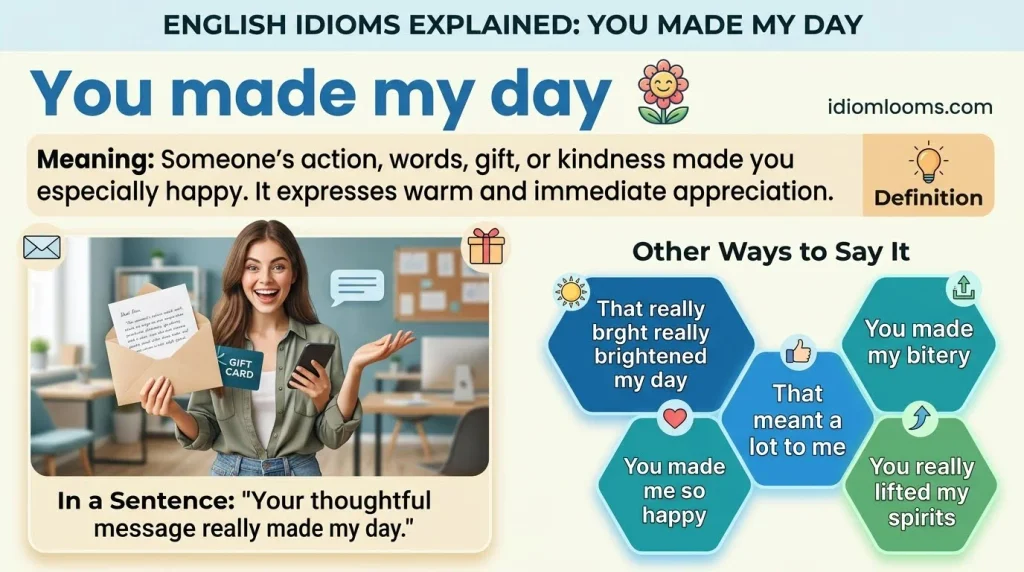
You made my day means that someone’s action, words, gift, or kindness made you especially happy.
It expresses warm and immediate appreciation.
In a Sentence
“Your thoughtful message really made my day.”
Other Ways to Say It
- That really brightened my day.
- You made me so happy.
- That meant a lot to me.
- You really lifted my spirits.
Explanation
The phrase creates a simple but powerful image: someone’s kindness has transformed an ordinary day into a much better one.
It does not necessarily describe a huge favor. Even a small compliment or thoughtful gesture can make someone’s day.
Best Use
Best for: personal messages, conversations, social media, thank-you notes, and friendly exchanges.
From the Bottom of My Heart
Meaning
From the bottom of my heart means that your gratitude is deeply sincere and emotionally meaningful.
It suggests that your thanks come from your deepest feelings, rather than being a routine response.
In a Sentence
“From the bottom of my heart, thank you for staying beside me when I needed support.”
Other Ways to Say It
- With all my heart.
- I sincerely thank you.
- My deepest thanks.
- I am truly grateful.
Explanation
The heart is commonly associated with strong emotions, so this expression makes gratitude feel personal and heartfelt.
It is much more emotional than a casual “thanks,” making it especially appropriate when someone’s support has had a meaningful impact.
Best Use
Best for: heartfelt letters, speeches, personal messages, important thank-you notes, and emotional occasions.
I Can’t Thank You Enough
Meaning
I can’t thank you enough means that ordinary words of thanks do not seem sufficient to express how grateful you are.
It communicates very strong appreciation.
In a Sentence
“I can’t thank you enough for helping me prepare for the interview.”
Other Ways to Say It
- I am incredibly grateful.
- Thank you so much for everything.
- I don’t know how to repay you.
- I am deeply thankful.
Explanation
The expression intentionally uses exaggeration to show that the speaker feels their gratitude is too great for a simple thank-you.
It is flexible and can sound natural in both everyday conversations and more emotional situations.
Best Use
Best for: personal conversations, messages, letters, professional favors, and situations involving significant help.
I’m in Your Debt
Meaning
I’m in your debt means that you feel you owe someone because they have done something especially helpful or generous for you.
The “debt” is usually figurative, not financial.
In a Sentence
“You put in a good word for me when it mattered most; I’m truly in your debt.”
Other Ways to Say It
- I owe you a great deal.
- I am deeply grateful.
- I owe you big time.
- I won’t forget what you did.
Explanation
The expression compares gratitude to owing a debt. The image suggests that someone’s kindness has created an obligation that the grateful person does not take lightly.
It can sound serious, respectful, or even dramatic depending on the context.
Best Use
Best for: meaningful favors, serious conversations, professional situations, and moments when someone’s help was particularly important.
A Debt of Gratitude
Meaning
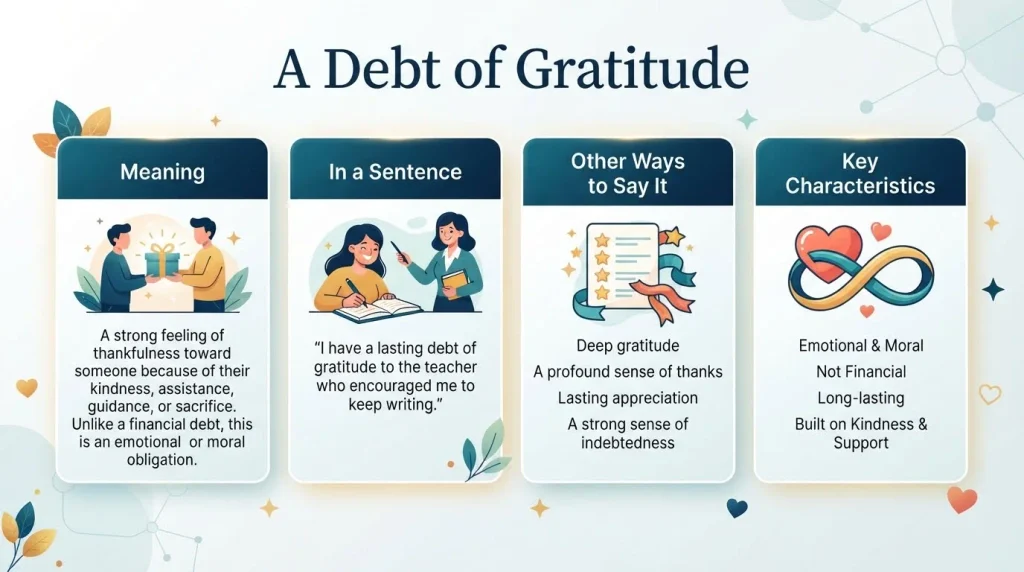
A debt of gratitude describes a strong feeling of thankfulness toward someone because of their kindness, assistance, guidance, or sacrifice.
Unlike a financial debt, this is an emotional or moral obligation.
In a Sentence
“I have a lasting debt of gratitude to the teacher who encouraged me to keep writing.”
Other Ways to Say It
- Deep gratitude
- A profound sense of thanks
- Lasting appreciation
- A strong sense of indebtedness
Explanation
The phrase gives gratitude a sense of weight and permanence. It suggests that the person’s contribution was important enough to be remembered for a long time.
It is more formal than many expressions on this list.
Best Use
Best for: speeches, essays, formal acknowledgments, biographies, tributes, and serious personal writing.
My Hat’s Off to You
Meaning
My hat’s off to you is an idiomatic way to express admiration, respect, or congratulations. It can also serve as a form of thanks when someone’s effort deserves special recognition.
The phrase communicates respectful appreciation.
In a Sentence
“You managed to organize the entire event in two days—my hat’s off to you.”
Other Ways to Say It
- I really admire what you did.
- You have my respect.
- Well done.
- I applaud your effort.
Explanation
The expression comes from the traditional gesture of taking one’s hat off as a sign of respect. The mental image makes the appreciation feel ceremonial and sincere.
It is not simply a synonym for “thank you,” so use it when admiration is an important part of your message.
Best Use
Best for: praise, congratulations, speeches, storytelling, friendly admiration, and acknowledging someone’s impressive effort.
Tip My Hat to You
Meaning
Tip my hat to you means to show respect, admiration, or appreciation for someone’s achievement or behavior.
It carries the image of a polite gesture of recognition and respect.
In a Sentence
“I tip my hat to you for finding such a thoughtful solution to the problem.”
Other Ways to Say It
- I salute you.
- I respect what you did.
- I commend you.
- I applaud you.
Explanation
The expression is visual: imagine someone slightly lifting or tipping their hat to acknowledge another person’s accomplishment.
It often communicates admiration more strongly than ordinary gratitude.
Best Use
Best for: compliments, achievements, friendly praise, speeches, and creative writing.
You Came Through for Me
Meaning
You came through for me means that someone helped when you genuinely needed support, especially at an important or difficult moment.
It expresses gratitude for reliable help when it mattered.
In a Sentence
“I was completely overwhelmed, and you came through for me when I needed someone to help.”
Other Ways to Say It
- You were there for me.
- You helped when I needed you.
- You didn’t let me down.
- You really supported me.
Explanation
The phrase suggests that someone successfully responded to a need or challenge. It carries a feeling of relief, trust, and appreciation.
It works particularly well when someone’s help arrived at a crucial moment.
Best Use
Best for: friendships, teamwork, personal messages, workplace conversations, and stories about overcoming difficulties.
You Went the Extra Mile
Meaning
You went the extra mile means that someone made more effort than was expected or required.
When used as thanks, it recognizes extraordinary effort and thoughtfulness.
In a Sentence
“Thank you for staying late to make sure everything was ready—you really went the extra mile.”
Other Ways to Say It
- You did more than expected.
- You made an extra effort.
- You went above and beyond.
- You put in extra work.
Explanation
The expression creates the image of someone continuing beyond the point where they could reasonably have stopped. It emphasizes that their contribution was above the ordinary.
It is especially useful when thanking someone for effort rather than simply for an outcome.
Best Use
Best for: workplace appreciation, customer service, teamwork, professional messages, and personal recognition.
You Saved the Day
Meaning
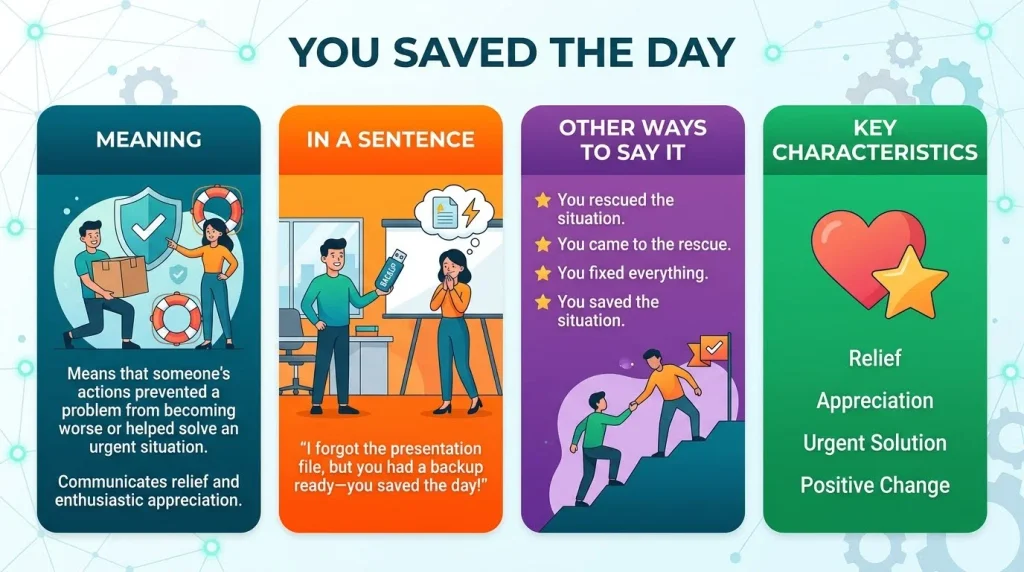
You saved the day means that someone’s actions prevented a problem from becoming worse or helped solve an urgent situation.
As a thank-you expression, it communicates relief and enthusiastic appreciation.
In a Sentence
“I forgot the presentation file, but you had a backup ready—you saved the day!”
Other Ways to Say It
- You rescued the situation.
- You came to the rescue.
- You fixed everything.
- You saved the situation.
Explanation
The phrase creates a dramatic image of someone arriving at exactly the right moment to solve a problem.
It is usually playful or enthusiastic rather than formal, so it works best when the situation has a clear challenge or crisis.
Best Use
Best for: casual conversations, teamwork, storytelling, workplace chats, and humorous thank-you messages.
Lend a Hand
Meaning
Lend a hand means to help someone. When used in a thank-you context, it recognizes the person’s willingness to provide practical assistance.
The expression focuses on help and cooperation.
In a Sentence
“Thanks for lending a hand with the decorations; we could never have finished on time without you.”
Other Ways to Say It
- Give me a hand.
- Help out.
- Offer some help.
- Pitch in.
Explanation
The phrase uses the image of physically offering a hand to someone who needs assistance. It turns an abstract idea—helping—into a simple, familiar picture.
It is warm and informal.
Best Use
Best for: everyday conversations, teamwork, family situations, friendly messages, and community activities.
You’ve Got My Back
Meaning
You’ve got my back means that someone supports, protects, or looks out for you when you need them.
It expresses gratitude for loyalty and dependable support.
In a Sentence
“Thanks for speaking up for me in that meeting; I know you’ve got my back.”
Other Ways to Say It
- You always support me.
- I know I can count on you.
- You’re there when I need you.
- You look out for me.
Explanation
The expression uses the idea of protecting someone’s back. It suggests that the speaker feels safe, supported, and not alone.
Because it is informal, it is best suited to relationships where trust and familiarity already exist.
Best Use
Best for: friendships, close colleagues, family conversations, personal messages, and informal social media posts.
Words Fail Me
Meaning
Words fail me means that you are so moved, surprised, grateful, or overwhelmed that you cannot find enough words to express your feelings.
In a thank-you context, it suggests deep emotion beyond ordinary language.
In a Sentence
“After everything you’ve done for our family, words fail me.”
Other Ways to Say It
- I don’t know what to say.
- I am speechless.
- I can’t express how grateful I am.
- I am overwhelmed with gratitude.
Explanation
This expression turns the inability to speak into part of the message. The image suggests that the emotion is too powerful for ordinary words.
It can be sincere, dramatic, or poetic depending on the situation.
Best Use
Best for: heartfelt messages, speeches, emotional letters, tributes, and meaningful personal moments.
I Can’t Put It Into Words
Meaning
I can’t put it into words means that your feelings are difficult to express clearly through language.
When thanking someone, it communicates gratitude that feels larger than a simple verbal response.
In a Sentence
“I can’t put it into words how much your kindness meant to me during that difficult week.”
Other Ways to Say It
- I can’t express it properly.
- I don’t know how to describe my gratitude.
- There are no words for how I feel.
- I struggle to express how thankful I am.
Explanation
The phrase highlights the limits of language. It is useful when the speaker wants to emphasize that their appreciation is deep, complicated, or intensely emotional.
It is more expressive than a routine thank-you.
Best Use
Best for: personal letters, emotional conversations, speeches, heartfelt posts, and creative writing.
Take My Hat Off to You
Meaning
Take my hat off to you means that you respect, admire, or congratulate someone for something they have done.
Like similar hat-related expressions, it can express admiration alongside appreciation.
In a Sentence
“You kept working until the project was finished, even when things went wrong. I take my hat off to you.”
Other Ways to Say It
- I admire you.
- You have my respect.
- I commend you.
- I applaud your determination.
Explanation
The expression comes from the traditional gesture of removing one’s hat to show respect. That physical image gives the phrase a sense of honor and recognition.
It is stronger when you are thanking someone for an achievement, sacrifice, or impressive effort.
Best Use
Best for: praise, storytelling, informal speeches, congratulations, and acknowledging determination.
You Have My Heartfelt Thanks
Meaning
You have my heartfelt thanks means that you have someone’s sincere and deeply felt gratitude.
The word heartfelt emphasizes that the appreciation is genuine rather than merely polite.
In a Sentence
“You have my heartfelt thanks for supporting the community project from the beginning.”
Other Ways to Say It
- Please accept my sincere thanks.
- You have my deepest gratitude.
- I sincerely appreciate your help.
- Thank you from my heart.
Explanation
This expression combines direct gratitude with emotional sincerity. It creates the impression of appreciation that is genuine, thoughtful, and deeply felt.
It sounds more formal than “thanks a lot,” making it suitable for meaningful written communication.
Best Use
Best for: thank-you letters, formal acknowledgments, speeches, tributes, and sincere personal messages.
My Heartfelt Appreciation
Meaning
My heartfelt appreciation communicates sincere and emotionally meaningful gratitude for someone’s kindness, effort, or support.
It emphasizes deep appreciation rather than a quick expression of thanks.
In a Sentence
“Please accept my heartfelt appreciation for all the time and care you gave to the project.”
Other Ways to Say It
- My sincere appreciation
- My deepest thanks
- My genuine gratitude
- I deeply appreciate your efforts
Explanation
The phrase gives appreciation an emotional center by pairing it with “heartfelt.” It suggests that the speaker has taken time to recognize the value of another person’s contribution.
It is polished and somewhat formal.
Best Use
Best for: professional correspondence, acknowledgments, formal notes, speeches, and written appreciation.
I Am Forever Grateful
Meaning
I am forever grateful means that you expect your gratitude to remain for a very long time.
It communicates lasting appreciation for something especially meaningful.
In a Sentence
“You encouraged me to believe in myself when I had almost given up, and I am forever grateful.”
Other Ways to Say It
- I will always be grateful.
- I will never forget your kindness.
- Your help will stay with me.
- I will always remember what you did.
Explanation
The word “forever” gives the expression a strong sense of permanence. It suggests that the person’s kindness has become part of a lasting memory or important life experience.
Because it is emotionally strong, it should be reserved for situations where the gratitude is genuinely significant.
Best Use
Best for: heartfelt letters, tributes, important personal messages, speeches, and emotional storytelling.
Exercise: Practice Using Idioms
Test your understanding of these expressions by choosing the best answer for each question.
Question 1
If someone says, “I owe you one,” what do they usually mean?
A. They borrowed money from you.
B. They are grateful and will return the favor.
C. They want you to leave.
D. They have forgotten your help.
Question 2
Which expression suggests that someone’s kindness made you especially happy?
A. I’m in your debt.
B. Lend a hand.
C. You made my day.
D. A debt of gratitude.
Question 3
Which expression is most appropriate for describing gratitude that is very deeply felt?
A. From the bottom of my heart
B. Lend a hand
C. You saved the day
D. I owe you one
Question 4
What does “you went the extra mile” communicate?
A. A person traveled a great distance.
B. Someone showed up later than expected.
C. An individual decided to alter their plans.
D. A person put in more effort than expected.
Question 5
Which expression is most closely connected with admiration and respect?
A. I can’t thank you enough.
B. My hat’s off to you.
C. You made my day.
D. I am forever grateful.
Question 6
If someone says, “You came through for me,” what are they thanking you for?
A. Giving them directions
B. Arriving early
C. Helping when they really needed support
D. Buying them a gift
Question 7
Which expression suggests that someone’s help prevented a difficult situation from becoming worse?
A. You saved the day.
B. Much obliged.
C. My heartfelt appreciation.
D. I can’t put it into words.
Question 8
What does “you’ve got my back” communicate?
A. Someone has taken something temporarily for use.
B. An individual is positioned behind another person.
C. You must accept blame for an error.
D. You offer dependable help and assistance.
Question 9
Which expression may sound slightly old-fashioned or traditional?
A. You’ve got my back.
B. Much obliged.
C. You saved the day.
D. You made my day.
Question 10
What does “words fail me” suggest in a thank-you message?
A. The speaker has forgotten the person’s name.
B. The speaker does not want to respond.
C. The speaker is too moved to express the feeling easily.
D. The speaker is angry.
Question 11
Which expression focuses particularly on returning a favor?
A. I owe you one.
B. From the bottom of my heart.
C. Words fail me.
D. My heartfelt appreciation.
Question 12
Which expression is most likely to suit a formal acknowledgment?
A. You’ve got my back.
B. You saved the day.
C. Lend a hand.
D. A debt of gratitude.
Question 13
Someone helped you solve an urgent problem at work. Which expression would naturally show enthusiastic appreciation?
A. You saved the day.
B. I am forever grateful.
C. My heartfelt appreciation.
D. Much obliged.
Question 14
Which expression communicates that your gratitude may last for a very long time?
A. I owe you one.
B. I am forever grateful.
C. You made my day.
D. Lend a hand.
Question 15
Which sentence uses an expression naturally?
A. “I owe you one because you are standing one.”
B. “You went the extra mile by doing less than expected.”
C. “Your thoughtful message made my day.”
D. “Words fail me because I have many words.”
Answers
- B — “I owe you one” means you appreciate someone’s help and intend to return the favor.
- C — “You made my day” means someone’s action made you especially happy.
- A — “From the bottom of my heart” emphasizes deeply sincere emotion.
- D — “Going the extra mile” means making more effort than expected.
- B — “My hat’s off to you” expresses admiration or respect, often alongside appreciation.
- C — “You came through for me” means the person provided needed support at an important moment.
- A — “You saved the day” suggests that someone’s actions solved or prevented a difficult situation.
- D — “You’ve got my back” means someone is dependable and supportive.
- B — “Much obliged” has a somewhat traditional or old-fashioned tone.
- C — “Words fail me” means the speaker feels unable to express the depth of their emotion.
- A — “I owe you one” specifically suggests returning a favor.
- D — “A debt of gratitude” has a formal tone and works well in acknowledgments and serious writing.
- A — “You saved the day” naturally conveys enthusiastic thanks after someone fixes an urgent problem.
- B — “I am forever grateful” communicates lasting appreciation.
- C — “Your thoughtful message made my day” uses the expression naturally and clearly.
FAQs
What is an idiom for Thank You?
An idiom for Thank You is a familiar figurative expression used to communicate gratitude, appreciation, admiration, or recognition. Examples include “I owe you one,” “You made my day,” and “I can’t thank you enough.”
How do I create my own idiom for Thank You?
Start with the feeling you want to express, such as relief, admiration, affection, or deep gratitude. Then connect that feeling to a clear mental image. A good figurative expression should make the reader understand the emotion without becoming confusing.
What makes an idiom effective?
An effective idiom is clear, memorable, relevant, and emotionally appropriate. It should create an understandable image while adding something that a plain statement may not communicate.
Can I use these idioms in everyday conversation?
Yes, although the level of formality varies. Expressions such as “I owe you one,” “You made my day,” and “You came through for me” sound natural in casual conversation. More formal phrases such as “a debt of gratitude” may be better suited to speeches or writing.
What is the difference between an idiom and a simile?
An idiom is a familiar expression whose intended meaning differs from its literal wording. A simile directly compares two things using words such as “like” or “as.” For example, “You made my day” is an idiomatic expression, while “Your kindness was like sunshine” is a simile.
Conclusion
The right expression of gratitude can do more than say “thank you.” It can show warmth, respect, relief, admiration, or deep emotional appreciation. Expressions such as “I owe you one” fit casual favors, while “from the bottom of my heart” or “I am forever grateful” can express something much more personal.
When choosing an idiom for Thank You, think about the relationship, the situation, and the emotion behind your message. A playful expression may work beautifully with a friend, while a formal phrase may be better for a speech or professional note. The strongest figurative language is not necessarily the most dramatic; it is the expression that communicates your real feeling clearly and naturally.
Whether your gratitude is for a small kindness or life changing support, thoughtful words can make the person who helped you feel genuinely valued.

Margaret Saywell is an English author and editor who has spent more than fifteen years working with words teaching, proofreading, and writing about the quirks of the English language.
At Idiom Looms, Margaret gathers idioms from across the English-speaking world and weaves them into clear, practical guides. She loves digging into the history of a phrase and showing readers how a few well-chosen words can say far more than a long explanation.
She believes language should be enjoyed, not feared and that the best way to learn an idiom is to see it in action.


[…] Read more:20 Idioms for Thank You With Real Examples […]