

What does it mean to have an edge when an opportunity appears? 20 Idioms for Advantage With Real Examples explores colorful expressions for describing benefits, opportunities, strengths, and favorable situations. These idioms can make English usage more natural while adding clarity to everyday conversations and formal writing.
This article presents 20 useful idioms with clear meanings, real examples, explanations, and alternative phrases. You will learn how these expressions describe gaining an edge, making smart use of opportunities, or enjoying a favorable position. They can also support business communication, meetings, presentations, and project management.
Understanding these expressions can strengthen vocabulary and improve grammar and communication. Some examples connect naturally with scheduling, time management, online booking, broadcasting, and a calendar. With regular practice and consistency, you can use these idioms confidently and make your English more expressive.
What Is an Idiom?
An idiom is a familiar expression whose meaning is different from the literal meaning of its individual words. Idioms are a form of figurative language that help people communicate ideas in a vivid, compact way.
For example, “break the ice” does not usually mean physically breaking ice. It means to make people feel more comfortable in a new or awkward situation.
Likewise, “have the upper hand” does not mean literally holding a hand above someone else’s. It means being in a stronger or more advantageous position.
Idioms work because readers and listeners understand the image behind the expression rather than interpreting every word literally.
Why Use Idioms for Advantage?
Talking about an advantage does not always mean discussing competition or winning. An advantage might come from preparation, timing, knowledge, experience, opportunity, or a favorable position.
Idioms help express these differences naturally. For example:
- “Have a leg up” suggests an early or useful advantage.
- “Hold all the cards” suggests having strong control or bargaining power.
- “Have an ace up your sleeve” suggests keeping a valuable advantage hidden.
- “Strike while the iron is hot” focuses on using an opportunity at the right moment.
These expressions make descriptions more visual and memorable. They can also help writers communicate complicated ideas about competition, opportunity, strategy, and success without lengthy explanations.
Quick List of 20 Idioms for Advantage
- Have the upper hand
- Have a leg up
- Get a head start
- Have the edge
- Be ahead of the game
- Hold all the cards
- Have an ace up your sleeve
- Have the inside track
- Tip the scales
- Have something in your favor
- Come out on top
- Gain ground
- Turn the tables
- Play your cards right
- Have a trump card
- Make hay while the sun shines
- Strike while the iron is hot
- Be one step ahead
- Have a feather in your cap
- Get the jump on someone
Have the Upper Hand
Read more:20 Idioms for Thank You With Real Examples
Meaning
Have the upper hand means to be in a stronger or more advantageous position than someone else. It often suggests that a person has greater control, influence, or power in a situation.
In a Sentence
After several successful negotiations, the company had the upper hand when it was time to discuss the final contract.
Other Ways to Say It
- Be in a stronger position
- Have the advantage
- Hold the advantage
- Be in control
Explanation
The image comes from being physically positioned higher than another person, which suggests greater control. The expression works especially well when two sides are competing, negotiating, or trying to influence an outcome.
It can sound strategic and slightly competitive, so it is less suitable for situations that call for a gentle or purely cooperative tone.
Best Use
Best for business discussions, negotiations, competitions, debates, and storytelling.
Have a Leg Up
Meaning
Have a leg up means to have an advantage that makes success easier or puts you ahead of others.
In a Sentence
Her previous experience with the software gave her a leg up when she started the new job.
Other Ways to Say It
- Have an advantage
- Be ahead
- Start from a stronger position
- Have an early benefit
Explanation
The expression creates the image of someone climbing or stepping upward with one leg already raised. It suggests a useful boost rather than complete control.
It is usually informal and friendly, making it a natural choice when discussing education, careers, sports, or competition.
Best Use
Works well in everyday conversation, career advice, education, sports, and informal writing.
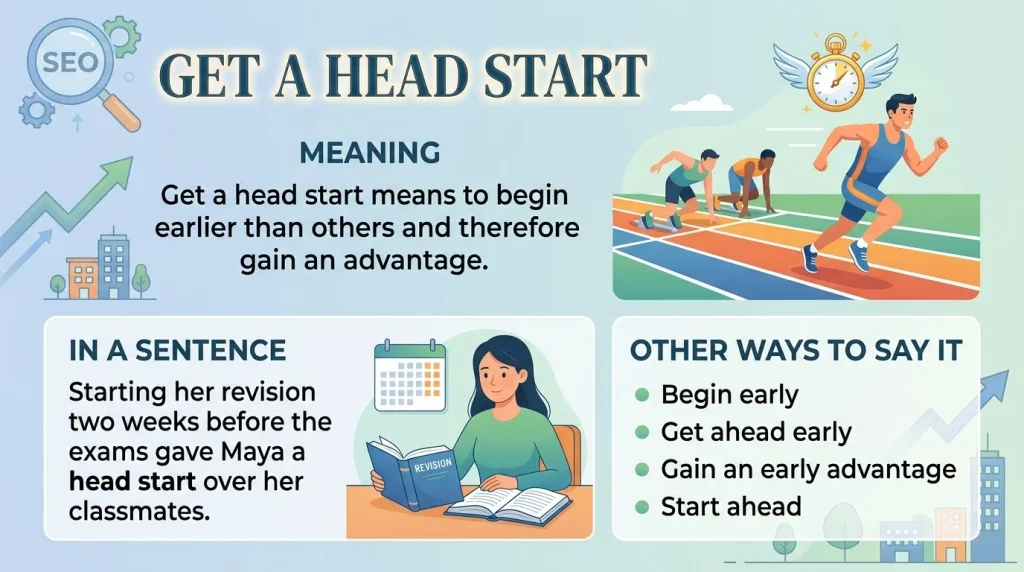
Get a Head Start
Meaning
Get a head start means to begin earlier than others and therefore gain an advantage.
In a Sentence
Starting her revision two weeks before the exams gave Maya a head start over her classmates.
Other Ways to Say It
- Begin early
- Get ahead early
- Gain an early advantage
- Start ahead
Explanation
The image comes from a race in which one participant begins farther ahead of the others. The expression emphasizes timing and preparation rather than superior ability.
It is particularly useful when an advantage comes from acting sooner.
Best Use
Best for study plans, projects, races, business, personal goals, and everyday conversation.
Have the Edge
Meaning
Have the edge means to possess a small but meaningful advantage over someone or something else.
In a Sentence
The home team has the edge because its players know the field so well.
Other Ways to Say It
- Have a slight advantage
- Be in a better position
- Have the upper hand
- Hold an advantage
Explanation
An “edge” suggests a narrow difference that can make one side more likely to succeed. Unlike stronger expressions about complete control, this idiom often describes a modest advantage.
That makes it useful when you want to avoid exaggerating the situation.
Best Use
Suitable for sports, business, competitions, analysis, and conversations.
Be Ahead of the Game
Meaning
Be ahead of the game means to be better prepared, more informed, or further along than others.
In a Sentence
By organizing his schedule before the semester began, Daniel was already ahead of the game.
Other Ways to Say It
- Be well prepared
- Stay ahead
- Be one step ahead
- Have an early advantage
Explanation
The phrase uses the image of a game to describe progress and preparation. Someone ahead of the game has already anticipated what is coming.
It often carries a positive and practical tone rather than an aggressive one.
Best Use
Ideal for work, studying, planning, productivity advice, and casual conversation.
Hold All the Cards
Meaning
Hold all the cards means to have the strongest position because you control the important options or information.
In a Sentence
With several buyers interested in the property, the seller held all the cards.
Other Ways to Say It
- Have complete control
- Have strong bargaining power
- Be in command
- Have the advantage
Explanation
The idiom comes from card games, where holding valuable cards can give a player considerable power. It suggests more than simply having an advantage; it implies having many of the important choices or resources.
Because of its strong imagery, it can make a negotiation or strategic situation feel more dramatic.
Best Use
Best for negotiations, business, storytelling, strategy, and competitive situations.
Have an Ace Up Your Sleeve
Meaning
Have an ace up your sleeve means to have a secret plan, skill, resource, or advantage that can be revealed when needed.
In a Sentence
The team looked nervous, but its coach clearly had an ace up his sleeve for the final round.
Other Ways to Say It
- Have a secret weapon
- Have a surprise advantage
- Keep a useful option in reserve
- Have a hidden resource
Explanation
The image comes from the idea of secretly keeping an ace hidden in a sleeve during a card game. It communicates surprise, strategy, and hidden potential.
The expression is often playful or dramatic and works best when the advantage has not yet been revealed.
Best Use
Excellent for stories, speeches, sports commentary, conversations, and dramatic writing.
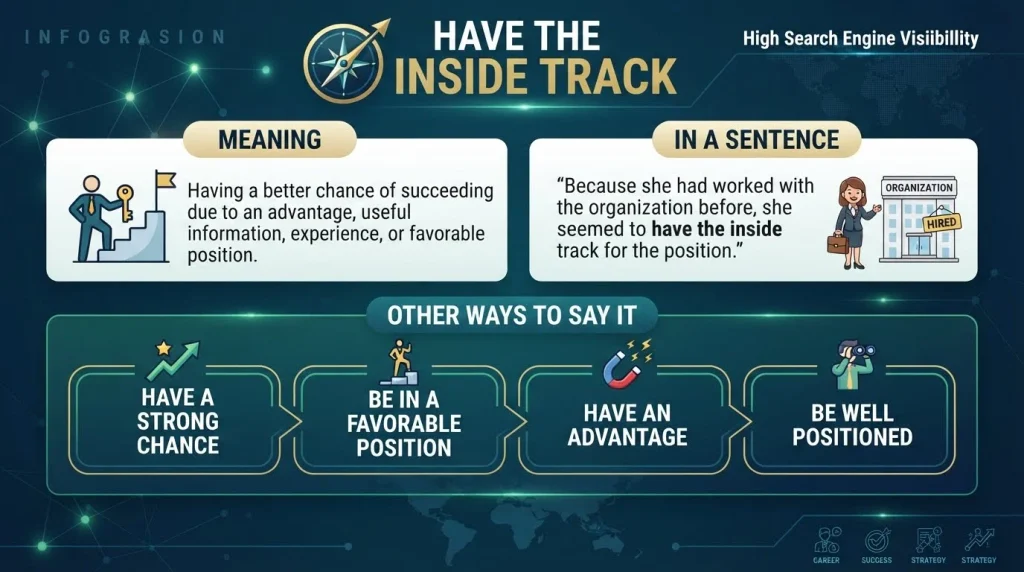
Have the Inside Track
Meaning
Have the inside track means to have a better chance of succeeding because of an advantage, useful information, experience, or favorable position.
In a Sentence
Because she had worked with the organization before, she seemed to have the inside track for the position.
Other Ways to Say It
- Have a strong chance
- Be in a favorable position
- Have an advantage
- Be well positioned
Explanation
The expression comes from racing, where the inside route can provide a favorable position. Today, it can describe someone who has better prospects or useful access.
It can sound slightly strategic, especially when relationships or information give someone an advantage.
Best Use
Useful in careers, business, politics, competitions, and informal analysis.
Tip the Scales
Meaning
Tip the scales means to influence a situation enough to make one side more likely to succeed.
In a Sentence
Her years of experience tipped the scales in her favor during the final selection.
Other Ways to Say It
- Shift the balance
- Influence the outcome
- Give someone an advantage
- Change the balance
Explanation
The phrase creates the image of balanced scales moving toward one side. It is especially useful when several factors are being considered and one final factor changes the outcome.
The expression can sound serious and analytical without being overly formal.
Best Use
Works well in essays, decision-making discussions, competitions, business, and formal conversation.
Have Something in Your Favor
Meaning
Have something in your favor means to possess a condition, fact, quality, or circumstance that improves your chances of success.
In a Sentence
He did not have much experience, but his strong communication skills were in his favor.
Other Ways to Say It
- Have an advantage
- Have circumstances on your side
- Benefit from something
- Have a positive factor
Explanation
This expression emphasizes that one or more circumstances are helping someone. It does not necessarily mean the person is winning or has control.
Because it is straightforward and flexible, it fits both everyday speech and more formal writing.
Best Use
Best for essays, applications, discussions, evaluations, and everyday communication.
Come Out on Top
Meaning
Come out on top means to finish in the best position after a competition, challenge, or difficult situation.
In a Sentence
Both companies faced a difficult year, but the smaller firm came out on top.
Other Ways to Say It
- Finish first
- Succeed
- Win in the end
- End up ahead
Explanation
The expression creates a simple image of one person or side ending up above the others. It focuses more on the final result than on the advantage that existed at the beginning.
It can sound confident, celebratory, or competitive depending on the context.
Best Use
Good for sports, business, personal challenges, competitions, and storytelling.
Gain Ground
Meaning
Gain ground means to make progress and reduce the distance between yourself and a competitor, or to move into a stronger position.
In a Sentence
The new restaurant is gaining ground quickly after introducing a more affordable menu.
Other Ways to Say It
- Make progress
- Catch up
- Become more competitive
- Move ahead
Explanation
The image comes from advancing across physical territory. In figurative language, gaining ground means improving your position.
Unlike an expression such as “hold all the cards,” it suggests gradual progress rather than immediate control.
Best Use
Useful in business, sports, campaigns, projects, competitions, and news-style writing.
Turn the Tables
Meaning
Turn the tables means to reverse a situation so that someone who was previously at a disadvantage gains the advantage.
In a Sentence
The debate seemed one-sided at first, but her final argument turned the tables.
Other Ways to Say It
- Reverse the situation
- Change the balance of power
- Gain the upper hand
- Reverse the advantage
Explanation
The phrase creates the vivid image of physically turning a table around and changing the situation. It is especially powerful when there is a dramatic reversal of fortune.
It adds energy to narratives because the reader can immediately sense that the balance has changed.
Best Use
Excellent for storytelling, sports, debates, dramatic writing, and personal accounts.
Play Your Cards Right
Meaning
Play your cards right means to make smart choices and handle a situation carefully so that you can gain an advantage or achieve a desired result.
In a Sentence
If you play your cards right, you could turn this temporary opportunity into a permanent position.
Other Ways to Say It
- Make smart decisions
- Use the situation wisely
- Handle things carefully
- Take advantage of the opportunity
Explanation
The expression comes from card games, where success depends partly on how well a player uses the cards available to them. It emphasizes strategy, judgment, and timing.
It usually sounds conversational and encouraging rather than formal.
Best Use
Best for advice, conversations, career situations, negotiations, and informal writing.

Have a Trump Card
Meaning
Have a trump card means to possess a powerful advantage or resource that can defeat another option or change the outcome.
In a Sentence
The opposing team seemed stronger, but our captain had a trump card: an unexpected change in strategy.
Other Ways to Say It
- Have a decisive advantage
- Have a powerful option
- Hold a winning resource
- Have a secret advantage
Explanation
A trump card comes from card games in which a particular card has greater power than others. Figuratively, it represents a decisive resource or argument.
It is stronger than simply saying someone has an advantage because the hidden or final resource may completely change the situation.
Best Use
Suitable for negotiations, debates, competitions, strategy discussions, and dramatic writing.
Make Hay While the Sun Shines
Meaning
Make hay while the sun shines means to take advantage of a favorable opportunity while it is available.
In a Sentence
The shop is attracting large crowds this month, so the owners are making hay while the sun shines.
Other Ways to Say It
- Take advantage of the opportunity
- Use the good moment
- Act while conditions are favorable
- Make the most of your chance
Explanation
The expression comes from farming: hay needs suitable dry weather to be made successfully. The image reminds us that good opportunities may not last forever.
It has a traditional, slightly folksy tone and is often used as practical advice.
Best Use
Best for advice, business, personal opportunities, speeches, and conversational English.
Strike While the Iron Is Hot
Meaning
Strike while the iron is hot means to act at the right moment while conditions are favorable.
In a Sentence
The audience loved the first product, so the company struck while the iron was hot and released a follow-up quickly.
Other Ways to Say It
- Act at the right time
- Seize the moment
- Take advantage of momentum
- Act while the opportunity lasts
Explanation
The expression comes from metalworking, where iron is easiest to shape while it is hot. The figurative meaning focuses on timing and momentum.
It works particularly well when waiting could cause a valuable opportunity to disappear.
Best Use
Useful in business, career advice, entrepreneurship, speeches, and everyday conversation.
Be One Step Ahead
Meaning
Be one step ahead means to anticipate what is likely to happen and prepare before others do.
In a Sentence
By preparing answers to the likely objections, the negotiator stayed one step ahead.
Other Ways to Say It
- Stay ahead
- Anticipate problems
- Be better prepared
- Think ahead
Explanation
The image is simple: one person has already moved forward while another is still behind. The phrase emphasizes foresight and preparation rather than luck.
It is useful when the advantage comes from thinking about what may happen next.
Best Use
Works well in work, studying, planning, strategy, conversations, and motivational writing.
Have a Feather in Your Cap
Meaning
Have a feather in your cap means to have an achievement, success, or experience that brings credit or distinction.
In a Sentence
Winning the regional competition was another feather in her cap after years of hard work.
Other Ways to Say It
- Have an achievement to be proud of
- Add to your accomplishments
- Earn recognition
- Have a notable success
Explanation
The expression comes from the old image of placing a feather in one’s cap as a sign of achievement. It does not describe a competitive advantage directly; instead, it highlights an accomplishment that strengthens someone’s reputation or position.
Its tone is generally positive and slightly colorful.
Best Use
Good for personal achievements, professional profiles, speeches, biographies, and celebratory writing.
Get the Jump on Someone
Meaning
Get the jump on someone means to gain an advantage by acting before another person has a chance to respond.
In a Sentence
The startup got the jump on its competitors by launching the service several months earlier.
Other Ways to Say It
- Get ahead of someone
- Act first
- Gain an early advantage
- Beat someone to an opportunity
Explanation
The phrase suggests moving quickly before another person can react. Its central idea is speed creating an advantage.
It has an informal, energetic quality and can make competitive situations sound more dynamic.
Best Use
Best for business, sports, competition, casual conversation, and storytelling.
Exercise: Practice Using Idioms
Choose the best answer for each question.
1. If a company “has the upper hand,” what does that mean?
A. It has moved to a higher building.
B. It is in a stronger position.
C. It has stopped competing.
D. It has changed its schedule.
2. Which idiom describes an advantage gained by starting early?
A. Hold all the cards
B. Turn the tables
C. Have a trump card
D. Get a head start
3. Someone with “an ace up their sleeve” probably has:
A. A hidden advantage or plan
B. A serious problem
C. A lack of preparation
D. A public announcement
4. If one factor “tips the scales,” what happens?
A. The situation becomes less important.
B. Both sides become equal.
C. One side gains an advantage.
D. The competition ends immediately.
5. Which idiom best describes someone who is gradually becoming more competitive?
A. Hold all the cards
B. Gain ground
C. Have a feather in your cap
D. Play your cards right
6. “Turn the tables” is most appropriate when:
A. Someone buys a new table.
B. A person avoids competition.
C. Nothing changes in a situation.
D. A disadvantage is reversed into an advantage.
7. Which expression suggests that someone has several powerful options under their control?
A. Get the jump on someone
B. Be one step ahead
C. Hold all the cards
D. Gain ground
8. “Make hay while the sun shines” encourages someone to:
A. Use a favorable opportunity while it lasts
B. Wait until conditions become difficult
C. Avoid making decisions
D. Prepare for an unrelated problem
9. If a student is “ahead of the game,” the student is probably:
A. Uninterested in studying
B. Better prepared than necessary
C. Falling behind classmates
D. Finished with school permanently
10. Which idiom focuses most directly on acting at the right moment?
A. Have a feather in your cap
B. Have the inside track
C. Come out on top
D. Strike while the iron is hot
11. What does “have the edge” usually suggest?
A. Having a small but useful advantage
B. Having no competition
C. Losing an important opportunity
D. Being completely defeated
12. Which sentence uses “play your cards right” correctly?
A. She played her cards right by making careful decisions during the negotiation.
B. He played his cards right because the cards were made of paper.
C. They played their cards right by throwing them away.
D. We played our cards right because the table was wooden.
13. What does “come out on top” focus on most strongly?
A. Starting earlier than everyone else
B. Having a secret plan
C. Achieving the strongest final position
D. Preparing for an uncertain future
14. If someone “has the inside track” for a job, what does the phrase suggest?
A. They are unlikely to be considered.
B. They have a favorable position or strong chance.
C. They have rejected the job.
D. They have never heard about the position.
15. Which idiom best describes gaining an advantage by acting before competitors?
A. Have something in your favor
B. Have a feather in your cap
C. Get the jump on someone
D. Come out on top
Answers
- B — “Have the upper hand” means to be in a stronger or more advantageous position.
- D — “Get a head start” describes gaining an advantage by beginning before others.
- A — An “ace up your sleeve” is a hidden plan, resource, or advantage.
- C — “Tip the scales” means to influence the balance in favor of one side.
- B — “Gain ground” means to make progress and move into a stronger position.
- D — “Turn the tables” describes reversing a situation so that the weaker side gains an advantage.
- C — “Hold all the cards” suggests having strong control or bargaining power.
- A — “Make hay while the sun shines” means to take advantage of favorable conditions while they last.
- B — Being “ahead of the game” means being prepared or further along than others.
- D — “Strike while the iron is hot” emphasizes acting when conditions are favorable.
- A — “Have the edge” usually means having a small but meaningful advantage.
- A — “Play your cards right” means to make smart decisions and handle a situation strategically.
- C — “Come out on top” focuses on succeeding or finishing in the strongest position.
- B — “Have the inside track” means having a favorable position or a better chance of success.
- C — “Get the jump on someone” means gaining an advantage by acting before them.
FAQs
What is an idiom for advantage?
An idiom for advantage is a figurative expression that describes having, gaining, protecting, or using a favorable position. Examples include “have the upper hand,” “have a leg up,” and “get a head start.”
How do I create my own idiom?
Start with a familiar image that represents the idea you want to express. Connect that image to the concept of advantage through timing, preparation, control, opportunity, or strategy. A good figurative expression should create a clear mental picture without becoming confusing.
What makes an idiom effective?
An effective idiom has a recognizable image, clear figurative meaning, and useful context. It should add something to the sentence rather than simply replace an ordinary word.
Can I use these idioms in everyday conversation?
Yes. Many of these expressions, such as “have the edge,” “have a leg up,” “get a head start,” and “be one step ahead,” sound natural in everyday English. More traditional expressions such as “make hay while the sun shines” may sound more colorful or old-fashioned.
What is the difference between an idiom and a simile?
An idiom has an established figurative meaning, while a simile directly compares two things using words such as “like” or “as.” For example, “have the upper hand” is an idiom, while “an advantage is like a head start in a race” is a simile.
Conclusion
Idioms can turn the simple idea of an advantage into something much more vivid. Whether someone has the upper hand, gains ground, holds all the cards, or gets a head start, each expression highlights a different kind of favorable position. Some idioms focus on preparation, while others emphasize timing, hidden strengths, control, or a dramatic change in fortune.
The best expression depends on the situation and the feeling you want to create. For everyday conversation, choose familiar phrases that sound natural. For creative writing or storytelling, a more colorful expression can add energy and imagery. Most importantly, use figurative language because it makes your meaning clearer, stronger, or more memorable not simply because it sounds impressive. A well chosen idiom can make the idea of advantage feel less abstract and much easier to picture.



[…] Read more:20 Idioms for Advantage With Real Examples […]