
Have you ever felt so worried that ordinary words could not fully describe your emotions? The 20 Idioms for Anxious With Real Examples in this article will help you express worry, nervousness, fear, and uncertainty more naturally. English idioms can make emotional descriptions more vivid while adding personality to everyday conversations. Instead of repeatedly saying “I am worried,” you can use expressive phrases that communicate your feelings with greater precision. These expressions are useful in English usage, conversations, storytelling, and formal writing when the context feels appropriate.
Understanding anxious-related idioms can also improve communication in practical situations. Whether you are discussing scheduling, time management, business communication, online booking, meetings, or a busy calendar, emotional language often makes your message clearer. You may also encounter these expressions while discussing project management, deadlines, presentations, or unexpected changes. Learning their figurative meanings helps you recognize natural English and understand how native speakers describe stressful situations.
Throughout this guide, you will explore 20 carefully selected idioms connected with anxiety and worry. Each expression includes a clear meaning, a real example, alternative ways to say it, and guidance on when to use it. You will also learn important differences in tone, context, grammar, and everyday usage. By the end, you should feel more confident using descriptive language and figurative expressions with accuracy and consistency.
What Is an Idiom?
An idiom is a familiar expression whose meaning is different from the literal meaning of its individual words. Idioms often create a mental picture that communicates an idea quickly and memorably.
For example, “break the ice” does not literally mean breaking ice. It means to make people feel more comfortable in a new or awkward situation. Likewise, “hit the books” means to study seriously, not physically hit books.
Idioms are a form of figurative language. They make communication more expressive by connecting an abstract idea with a recognizable image or situation.
Why Use Idioms for Anxious Feelings?
Anxiety can be difficult to describe because it may involve several feelings at once: fear, uncertainty, tension, restlessness, or anticipation. Idioms give these emotions a more concrete shape.
For example, saying someone is “on edge” suggests constant tension, while “butterflies in the stomach” creates an image of nervous excitement. These expressions can:
- Make emotional descriptions more vivid and memorable.
- Help explain feelings that are difficult to describe literally.
- Add personality to everyday conversations.
- Give creative writing stronger imagery and emotional depth.
- Show different shades of anxiety, from mild nervousness to intense distress.
- Help speakers communicate a complicated emotional state in just a few words.
Quick List of 20 Idioms
- On Edge
- Have Butterflies in Your Stomach
- A Bundle of Nerves
- A Nervous Wreck
- Have the Jitters
- Sweat Bullets
- Jump Out of Your Skin
- On Pins and Needles
- Bite Your Nails
- Have Your Heart in Your Mouth
- Lose Sleep Over Something
- Get Cold Feet
- Wait for the Other Shoe to Drop
- Keep Someone on Tenterhooks
- Have a Pit in Your Stomach
- Walk on Eggshells
- Be Scared Stiff
- Feel the Walls Closing In
- Have a Lump in Your Throat
- Be Shaking in Your Boots
On Edge
Read more:20 Idioms for Winning With Real Examples
Meaning
Being on edge means feeling tense, nervous, or unable to relax because you are worried about what might happen.
In a Sentence
After hearing strange noises outside, Maya was on edge for the rest of the evening.
Other Ways to Say It
- Feel tense
- Be nervous
- Be uneasy
- Be unable to relax
Explanation
This expression compares anxiety with being physically close to an edge, where even a small movement could cause trouble. It captures a state of constant alertness and tension rather than simple nervousness.
Best Use
“On edge” works especially well in everyday conversations, storytelling, and personal writing. It is natural enough for both casual and fairly serious situations.
Have Butterflies in Your Stomach
Meaning
To have butterflies in your stomach means to feel nervous or excited, especially before an important event.
In a Sentence
I had butterflies in my stomach while waiting for my name to be called for the interview.
Other Ways to Say It
- Feel nervous
- Have nervous excitement
- Feel a flutter of nerves
- Have a nervous stomach
Explanation
The expression creates the unusual image of butterflies fluttering inside your stomach. It is often gentler than expressions describing severe anxiety and can include excitement as well as nervousness.
Best Use
This idiom is particularly useful for conversations, personal messages, school writing, and stories involving interviews, performances, dates, competitions, or other anticipated events.
A Bundle of Nerves
Meaning
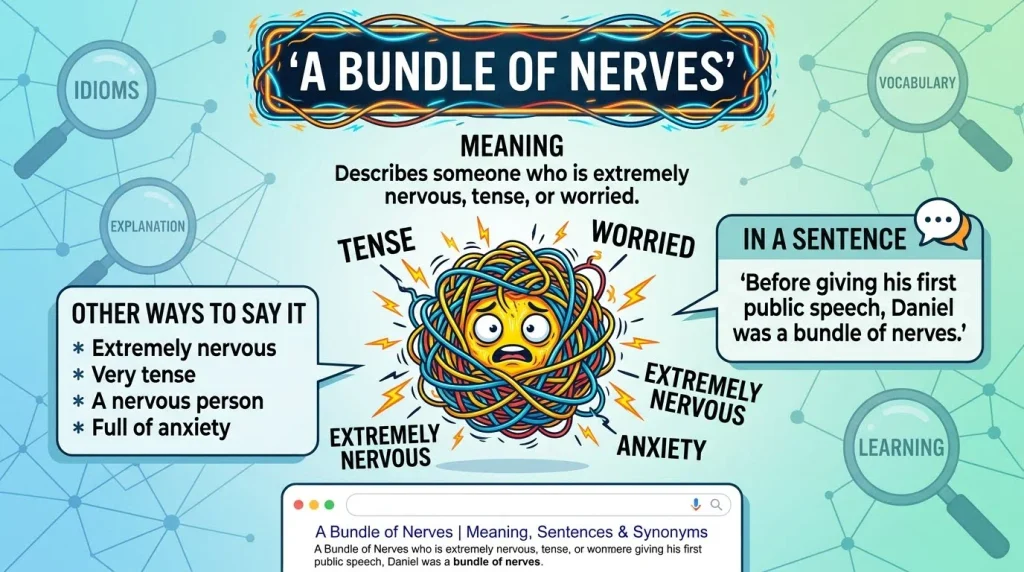
A bundle of nerves describes someone who is extremely nervous, tense, or worried.
In a Sentence
Before giving his first public speech, Daniel was a bundle of nerves.
Other Ways to Say It
- Extremely nervous
- Very tense
- A nervous person
- Full of anxiety
Explanation
The phrase imagines nerves as though they were tangled together in one bundle. It emphasizes visible or intense nervousness, making the person’s emotional state easy to picture.
Best Use
It fits naturally in conversation and storytelling. The expression is informal and expressive, so it may sound less suitable in highly formal professional writing.
A Nervous Wreck
Meaning
A nervous wreck is someone who is extremely worried, stressed, or emotionally overwhelmed.
In a Sentence
She was a nervous wreck while waiting to hear whether her application had been accepted.
Other Ways to Say It
- Extremely anxious
- Emotionally overwhelmed
- Very distressed
- Beside oneself with worry
Explanation
“Wreck” suggests a person who has been emotionally worn down by stress. The expression communicates strong anxiety, rather than ordinary pre-event nerves.
Best Use
Use it in informal conversation, personal stories, and dramatic descriptions. Because it is quite strong, it should not be used for a person who is only mildly nervous.
Have the Jitters
Meaning
To have the jitters means to feel nervous, restless, or shaky, often before something important happens.
In a Sentence
I always get the jitters before flying, even though I know the journey is routine.
Other Ways to Say It
- Feel shaky
- Feel nervous
- Have nervous energy
- Be restless
Explanation
The word “jitters” suggests small, uncontrollable feelings of nervous energy. It is especially effective when anxiety shows itself through restlessness or physical uneasiness.
Best Use
This informal idiom works well in casual conversations, travel stories, and personal writing. It usually describes moderate nervousness rather than deep fear.
Sweat Bullets
Meaning
To sweat bullets means to feel extremely nervous, frightened, or worried about a situation.
In a Sentence
I was sweating bullets when I realized I had left my passport at home.
Other Ways to Say It
- Be extremely nervous
- Panic
- Be terrified
- Be under intense pressure
Explanation
This dramatic expression uses an exaggerated image of sweating something as alarming as bullets. It conveys intense anxiety and pressure, often with a sense of urgency.
Best Use
It is best suited to informal conversation, storytelling, and humorous or dramatic writing. It can sound too casual for formal reports.
Jump Out of Your Skin
Meaning
To jump out of your skin means to be extremely startled, frightened, or nervous.
In a Sentence
That sudden crash made me jump out of my skin.
Other Ways to Say It
- Be startled
- Be frightened
- Jump in surprise
- Be badly shaken
Explanation
The image is deliberately exaggerated: the person’s reaction is so strong that it seems as though they might physically jump out of their own skin. It emphasizes sudden fear or shock.
Best Use
This colorful expression is useful in stories, conversations, and humorous descriptions. It usually works better for a sudden scare than for long-lasting anxiety.
On Pins and Needles
Meaning
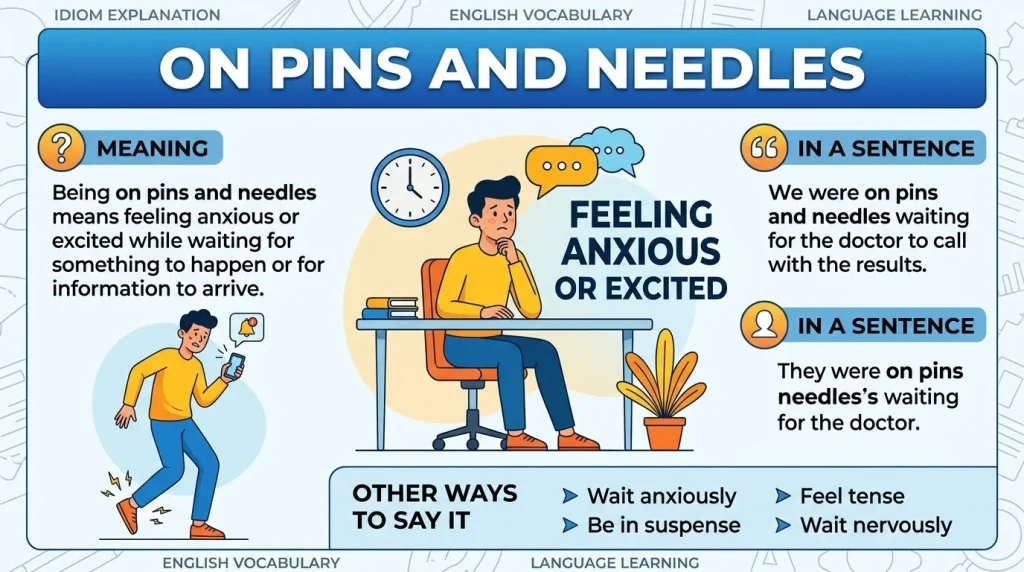
Being on pins and needles means feeling anxious or excited while waiting for something to happen or for information to arrive.
In a Sentence
We were on pins and needles waiting for the doctor to call with the results.
Other Ways to Say It
- Wait anxiously
- Be in suspense
- Feel tense
- Wait nervously
Explanation
The expression creates a physical image of sitting or standing on sharp pins and needles, making it difficult to stay comfortable. It captures the restlessness of anxious waiting particularly well.
Best Use
It is effective in conversation, storytelling, personal writing, and suspenseful situations.
Bite Your Nails
Meaning
To bite your nails means to show nervousness or worry through the habit of biting your fingernails.
In a Sentence
He was biting his nails as the final minutes of the match ticked away.
Other Ways to Say It
- Fidget nervously
- Worry
- Feel tense
- Show signs of anxiety
Explanation
Unlike many idioms, this expression is connected to a real nervous habit. The image immediately shows visible anxiety, especially when someone is waiting for an uncertain outcome.
Best Use
It works well in everyday conversation, fiction, and descriptive writing when you want to show rather than simply tell that someone is anxious.
Have Your Heart in Your Mouth
Meaning
To have your heart in your mouth means to feel extremely nervous, frightened, or anxious about what is happening.
In a Sentence
My heart was in my mouth as the climber reached for the final handhold.
Other Ways to Say It
- Feel terrified
- Be frightened
- Feel a surge of fear
- Be extremely anxious
Explanation
The phrase gives anxiety a physical shape by imagining the heart rising into the mouth. It creates a strong sense of fear and suspense, especially when something important could go wrong.
Best Use
This idiom is particularly effective in storytelling and dramatic writing, though it can also appear naturally in conversation.
Lose Sleep Over Something
Meaning
To lose sleep over something means to worry about it so much that it interferes with your ability to relax or sleep.
In a Sentence
Try not to lose sleep over one mistake in the presentation.
Other Ways to Say It
- Worry constantly about
- Obsess over
- Be troubled by
- Keep thinking about
Explanation
The expression connects emotional worry with a very familiar consequence: difficulty sleeping. It works especially well when anxiety continues long after the original situation has ended.
Best Use
Use it in advice, conversations, personal messages, and reflective writing. It can also sound reassuring when telling someone not to worry excessively.
Get Cold Feet
Meaning
To get cold feet means to suddenly become nervous or afraid about doing something you had already decided to do.
In a Sentence
She nearly got cold feet before stepping onto the stage, but she went ahead with the performance.
Other Ways to Say It
- Have second thoughts
- Lose your nerve
- Become hesitant
- Back away from something
Explanation
The phrase suggests that fear has made someone hesitate at the last moment. It is especially useful for anxiety connected to a decision or action, rather than general worry.
Best Use
It works naturally in conversations and stories about performances, major decisions, commitments, challenges, or risky choices.
Wait for the Other Shoe to Drop
Meaning
To wait for the other shoe to drop means to remain anxious because you expect another unpleasant event to happen.
In a Sentence
After receiving one troubling email, he spent the afternoon waiting for the other shoe to drop.
Other Ways to Say It
- Expect more bad news
- Wait anxiously
- Fear what comes next
- Anticipate another problem
Explanation
The expression comes from the imagined sound of a second shoe dropping after the first one has already fallen. It captures anticipatory anxiety—the uncomfortable feeling that something else may go wrong.
Best Use
This idiom is especially useful in conversation, personal essays, and storytelling when uncertainty follows an already difficult event.
Keep Someone on Tenterhooks
Meaning
To keep someone on tenterhooks means to leave someone in a state of nervous suspense because they do not know what will happen next.
In a Sentence
The delayed announcement kept everyone on tenterhooks all morning.
Other Ways to Say It
- Keep someone in suspense
- Keep someone anxious
- Leave someone waiting
- Keep someone uncertain
Explanation
The expression describes a state of stretched, uncomfortable tension. It emphasizes suspense caused by uncertainty, making it useful when a person is waiting for a decision, result, or announcement.
Best Use
It fits storytelling, journalism, conversations, and suspenseful writing. It is somewhat more literary than “nervous.”
Have a Pit in Your Stomach
Meaning
To have a pit in your stomach means to experience a heavy, uncomfortable feeling caused by fear, worry, or dread.
In a Sentence
I had a pit in my stomach when I saw the principal waiting outside the classroom.
Other Ways to Say It
- Feel a sinking feeling
- Feel uneasy
- Feel dread
- Have a heavy feeling
Explanation
The image suggests that worry has created a hollow or heavy space inside the stomach. It communicates dread and emotional discomfort more strongly than simple nervous excitement.
Best Use
This expression works especially well in personal writing, fiction, conversations, and emotional storytelling.
Walk on Eggshells
Meaning
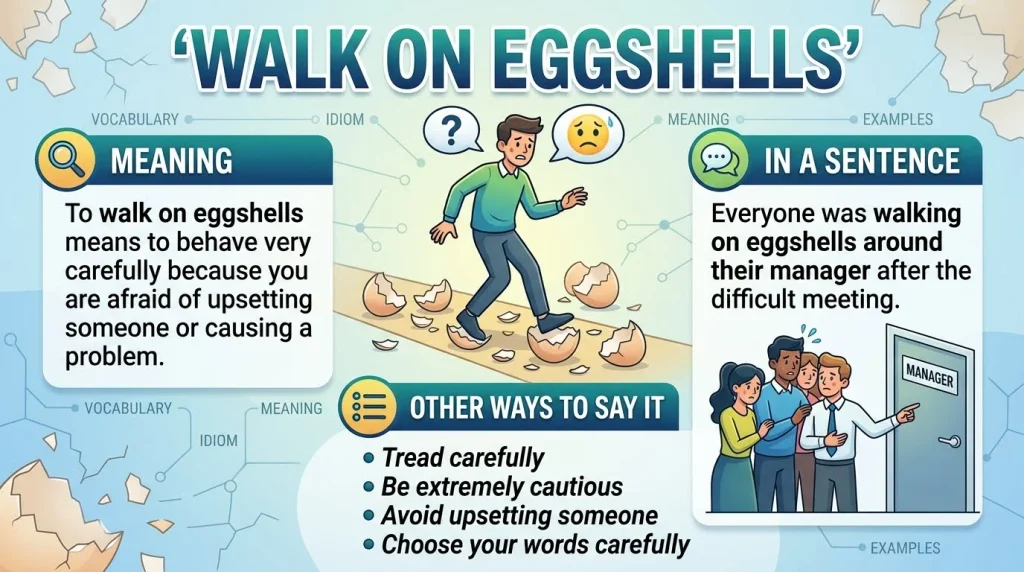
To walk on eggshells means to behave very carefully because you are afraid of upsetting someone or causing a problem.
In a Sentence
Everyone was walking on eggshells around their manager after the difficult meeting.
Other Ways to Say It
- Tread carefully
- Be extremely cautious
- Avoid upsetting someone
- Choose your words carefully
Explanation
The mental picture is of walking over fragile eggs without breaking them. It describes anxiety caused by a sensitive situation, especially when another person’s reaction feels unpredictable.
Best Use
Use it in conversations, relationship discussions, workplace stories, and personal essays. It is about social or interpersonal tension rather than anxiety in general.
Be Scared Stiff
Meaning
To be scared stiff means to be extremely frightened and unable to react normally.
In a Sentence
The unexpected alarm left everyone scared stiff for a few seconds.
Other Ways to Say It
- Be terrified
- Be frightened out of your wits
- Freeze with fear
- Be extremely scared
Explanation
“Stiff” suggests becoming rigid or frozen because of fear. The expression is intentionally dramatic and communicates intense fear rather than mild nervousness.
Best Use
It is most natural in informal conversations, fiction, dramatic stories, and humorous descriptions.
Feel the Walls Closing In
Meaning
To feel the walls closing in means to feel increasingly trapped, overwhelmed, or anxious as pressure builds.
In a Sentence
With three deadlines approaching, I began to feel the walls closing in.
Other Ways to Say It
- Feel overwhelmed
- Feel trapped
- Feel mounting pressure
- Feel increasingly anxious
Explanation
The image of walls moving inward creates a powerful sense of having less and less room to cope. It works well when anxiety comes from pressure, responsibilities, or an overwhelming situation.
Best Use
This expression is particularly effective in creative writing, personal reflection, storytelling, and emotional descriptions. It is more dramatic than ordinary conversational language.
Have a Lump in Your Throat
Meaning
To have a lump in your throat means to feel a tight or difficult sensation in the throat because of strong emotion, nervousness, sadness, or the urge to cry.
In a Sentence
I had a lump in my throat before saying goodbye to my family.
Other Ways to Say It
- Feel choked up
- Feel emotional
- Struggle to speak
- Have a tight throat
Explanation
The expression turns an emotional reaction into a physical image. Although it can describe sadness, it can also show nervousness or emotional tension, especially when speaking is difficult.
Best Use
It works well in personal messages, speeches, fiction, and emotional storytelling. It is usually more expressive than a plain statement such as “I felt nervous.”
Be Shaking in Your Boots
Meaning
To be shaking in your boots means to be extremely frightened or nervous.
In a Sentence
The thought of facing the angry crowd had him shaking in his boots.
Other Ways to Say It
- Be terrified
- Be trembling with fear
- Be extremely nervous
- Be frightened
Explanation
The exaggerated image of someone trembling so much that even their boots shake makes the emotion vivid. It conveys strong fear with a playful or dramatic tone.
Best Use
This idiom is best for informal conversation, storytelling, humor, and dramatic writing. It may sound too playful for a serious or professional discussion of anxiety.
Exercise: Practice Using Idioms
Choose the best answer for each question.
What does “on edge” mean?
A. Experiencing relief when hearing positive news
B. Struggling to stay calm because of worry
C. Having low energy after physical effort
D. Taking pride in a personal success
Which idiom describes nervous excitement before an important event?
A. Walk on eggshells
B. Lose sleep over something
C. Have a pit in your stomach
D. Have butterflies in your stomach
If someone is “a bundle of nerves,” how do they probably feel?
A. Extremely nervous
B. Completely relaxed
C. Slightly bored
D. Very confident
Which expression suggests that someone is extremely worried or emotionally overwhelmed?
A. Get cold feet
B. Bite your nails
C. A nervous wreck
D. Break the ice
What does “have the jitters” usually describe?
A. Experiencing drowsiness
B. Becoming anxious and unable to relax
C. Holding a grudge against another person
D. Having plenty of physical strength
Which idiom best fits someone who is waiting anxiously for important news?
A. Jump out of your skin
B. Be scared stiff
C. Have cold feet
D. Be on pins and needles
“Sweat bullets” is generally used to describe:
A. Intense nervousness or fear
B. Physical exercise
C. Extreme happiness
D. Calm concentration
What does “get cold feet” mean?
A. Become physically cold
B. Forget an important task
C. Become nervous about doing something
D. Finish something earlier than expected
Someone who is “walking on eggshells” is probably:
A. Moving very slowly
B. Trying not to upset someone
C. Preparing for a journey
D. Feeling unusually cheerful
What does “wait for the other shoe to drop” communicate?
A. Expect another unpleasant event
B. Prepare to leave immediately
C. Wait for someone to arrive
D. Look for something that was lost
Which idiom focuses on anxiety caused by pressure or feeling trapped?
A. Have butterflies in your stomach
B. Bite your nails
C. Feel the walls closing in
D. Have your heart in your mouth
What does “lose sleep over something” suggest?
A. Celebrate something all night
B. Worry about something excessively
C. Become physically exhausted
D. Sleep through an important event
Which expression can describe a visible nervous habit?
A. Bite your nails
B. Keep someone on tenterhooks
C. Get cold feet
D. Be scared stiff
Which idiom describes being left in nervous suspense?
A. Have a lump in your throat
B. Keep someone on tenterhooks
C. Sweat bullets
D. Jump out of your skin
Which sentence uses figurative language correctly?
A. “I had butterflies in my stomach” means actual insects were inside me.
B. “I got cold feet” means my shoes became cold.
C. “I was on edge” means I was standing on the edge of a building.
D. “I had a pit in my stomach” means I felt deep uneasiness or dread.
Answers
- B — “On edge” means feeling tense, nervous, or unable to relax.
- D — “Have butterflies in your stomach” describes nervous or excited anticipation.
- A — A “bundle of nerves” is someone experiencing strong nervousness.
- C — A “nervous wreck” describes someone who is extremely worried or emotionally overwhelmed.
- B — “Have the jitters” means feeling nervous, restless, or shaky.
- D — Being “on pins and needles” means waiting with nervous anticipation or suspense.
- A — “Sweat bullets” is an informal, exaggerated way to describe intense fear or nervousness.
- C — “Get cold feet” means becoming nervous or hesitant about something you intended to do.
- B — “Walk on eggshells” means behaving carefully to avoid upsetting someone.
- A — “Wait for the other shoe to drop” means expecting another unpleasant development.
- C — “Feel the walls closing in” conveys increasing pressure, anxiety, or a sense of being trapped.
- B — “Lose sleep over something” means worrying about it so much that it affects your rest.
- A — Nail-biting is a common visible sign of nervousness, and the phrase is often used figuratively to describe anxious waiting.
- B — “Keep someone on tenterhooks” means keeping them in a state of suspense or uncertainty.
- D — A “pit in your stomach” is a figurative way to describe a heavy feeling of worry, dread, or uneasiness.
FAQs
What is an idiom for anxious?
There are many idioms that can describe anxious feelings. “On edge,” “have butterflies in your stomach,” “on pins and needles,” and “have the jitters” are useful for everyday nervousness. Stronger expressions include “sweat bullets” and “a nervous wreck.”
How do I create my own idiom for anxious feelings?
Start with a physical sensation, familiar situation, or strong image connected to anxiety. Then use that image to represent the emotion. For example, an image of a tightly wound spring could suggest someone who is tense and ready to snap. The comparison should be easy for readers to understand from context.
What makes an idiom effective?
An effective idiom creates a clear mental picture while communicating an idea that may otherwise be difficult to explain. It should feel natural, understandable, and appropriate for the situation rather than simply sounding unusual.
Can I use these idioms in everyday conversation?
Yes. Many of these expressions, including “on edge,” “get cold feet,” “bite your nails,” and “have butterflies in your stomach,” are natural in everyday English. More dramatic expressions such as “shaking in your boots” may sound playful or exaggerated.
What is the difference between an idiom and a simile?
An idiom is an established expression whose meaning is not necessarily literal, such as “get cold feet.” A simile directly compares two things using words such as “like” or “as.” For example, “His anxiety was like a storm” is a simile rather than an established idiom.
Conclusion
Anxious feelings can range from mild nervous anticipation to overwhelming fear, and the right idiom helps communicate that difference. Expressions such as “butterflies in your stomach” suggest nervous excitement, while “a nervous wreck” conveys much stronger distress. Others, such as “walk on eggshells” and “wait for the other shoe to drop,” show the situations that can create anxiety.
The best figurative language does more than replace the word “anxious.” It gives the reader or listener a picture, sensation, or emotional experience to connect with. When choosing an idiom, consider the intensity and context of the feeling you want to express. A well-chosen expression can turn a simple statement about anxiety into language that feels immediate, vivid, and human.

Eleanor Prose is a writer and English teacher with a soft spot for the phrases that trip us up. She has spent years helping students and professionals use idioms with confidence not just memorizing them, but understanding the culture and humor behind each one.
Through Idiom Looms, Eleanor explores the threads that connect language, history, and everyday conversation. Her goal is simple: to make English idioms clear, memorable, and actually fun to use.
She writes from a quiet desk surrounded by notebooks, and firmly believes there’s an idiom for every situation usually more than one.

[…] Read more:20 Idioms for Anxious With Real Examples […]