

Have you ever noticed how natural speakers make simple ideas sound more expressive? The 20 Idioms for Speaking With Real Examples in this guide can make your conversations more engaging. These expressions add clarity, emotion, and personality to everyday English usage. They help you communicate ideas naturally while avoiding repetitive or overly plain language.
Idioms appear in business communication, meetings, formal writing, and casual conversations. You may also encounter them during scheduling, time management, online booking, or project management discussions. Learning their figurative meaning can strengthen your grammar, vocabulary, and conversational consistency across different situations.
This article presents twenty useful idioms with real examples, clear meanings, and practical explanations. You will discover how each expression works in natural speaking contexts. Examples also connect idioms with broadcasting, calendar discussions, and professional communication, helping you understand when each phrase sounds appropriate.
What Is a Idiom?
An idiom is a phrase whose meaning is different from the literal meaning of the individual words.
For example, “break the ice” does not usually mean physically breaking ice. It means to make people feel more comfortable in a new or awkward situation.
Another example is “hit the nail on the head,” which means to say or identify something exactly correctly.
Idioms are a form of figurative language. They create mental pictures or associations that make ordinary communication more expressive.
Why Use Idioms for Speaking?
Idioms can make descriptions of speaking much more vivid and memorable. They help us communicate qualities that may otherwise require several sentences to explain.
For example, saying someone “speaks from the heart” immediately suggests sincerity and genuine emotion. Saying a person “beats around the bush” suggests that they avoid saying what they really mean.
When talking about speaking, idioms can help you:
- Express confidence, honesty, or emotion.
- Describe someone’s communication style.
- Make conversations more colorful.
- Add personality to stories and essays.
- Explain complicated social situations simply.
- Create stronger imagery in creative writing.
- Make speeches and presentations more memorable.
Quick List of 20 Idioms
- Have a silver tongue
- Speak from the heart
- Beat around the bush
- Get straight to the point
- Speak your mind
- Put your foot in your mouth
- Have a way with words
- Talk a blue streak
- Keep something under your hat
- Spill the beans
- Let the cat out of the bag
- Bite your tongue
- Speak volumes
- Read between the lines
- Get your point across
- Talk shop
- Talk someone’s ear off
- Put words in someone’s mouth
- Actions speak louder than words
- Have the last word
Have a Silver Tongue
Read more:20 Idioms for Sick With Real Examples
Meaning
To have a silver tongue means to be extremely persuasive and skilled at speaking. The expression often suggests that someone can use charming or clever language to influence others.
In a Sentence
The lawyer had a silver tongue and managed to explain the complicated case in a remarkably convincing way.
Other Ways to Say It
- Be persuasive
- Be a smooth talker
- Have a gift for persuasion
- Speak very convincingly
Explanation
The image of a silver tongue suggests that someone’s words are polished, attractive, and effective. It can be positive when describing a talented speaker, but it may also hint that someone is persuasive enough to talk others into things.
Best Use
This idiom works well in storytelling, character descriptions, conversations, and creative writing. It can sound slightly dramatic in ordinary speech.
Speak from the Heart
Meaning
To speak from the heart means to say something with genuine emotion and sincerity rather than simply choosing convenient words.
In a Sentence
During his wedding speech, he spoke from the heart and thanked everyone who had supported him.
Other Ways to Say It
- Speak sincerely
- Be heartfelt
- Speak honestly
- Express genuine feelings
Explanation
The “heart” represents deep personal emotion, so this expression gives speech an emotional quality. It works especially well when someone’s words are honest, personal, or deeply felt.
Best Use
Use it naturally in personal messages, speeches, emotional conversations, wedding speeches, and reflective writing.
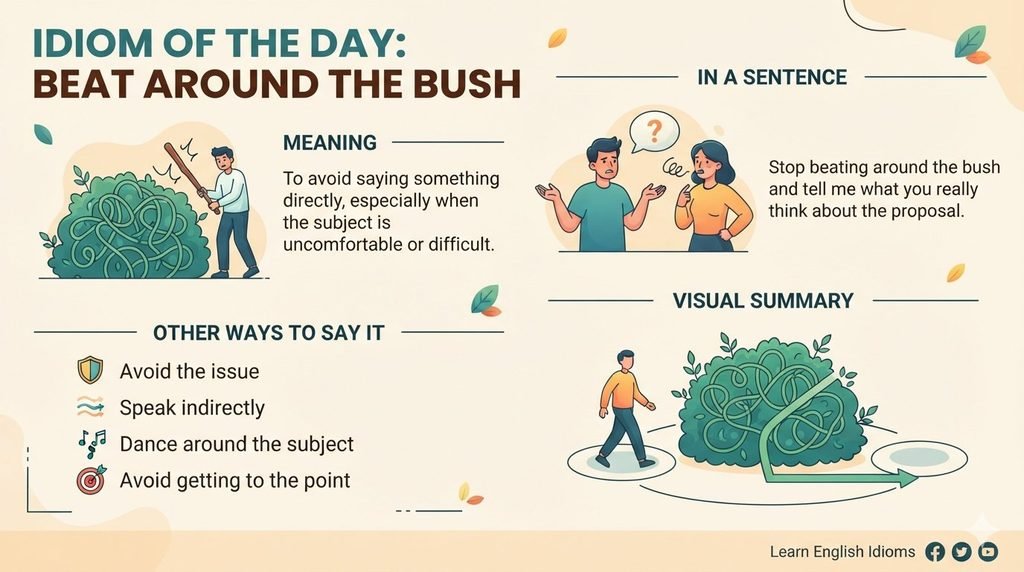
Beat Around the Bush
Meaning
To beat around the bush means to avoid saying something directly, especially when the subject is uncomfortable or difficult.
In a Sentence
Stop beating around the bush and tell me what you really think about the proposal.
Other Ways to Say It
- Avoid the issue
- Speak indirectly
- Dance around the subject
- Avoid getting to the point
Explanation
The expression creates the amusing image of someone walking around a bush instead of going directly to it. It suggests hesitation, avoidance, or indirect communication.
Best Use
This is common in everyday conversations and can also work in informal writing. It usually sounds direct and slightly impatient.
Get Straight to the Point
Meaning
To get straight to the point means to say the important thing without unnecessary details or delays.
In a Sentence
We only have ten minutes, so let’s get straight to the point and discuss the main problem.
Other Ways to Say It
- Get to the point
- Be direct
- Cut to the chase
- Say what you mean
Explanation
This expression emphasizes clarity and efficiency. Unlike “beat around the bush,” it describes someone who avoids unnecessary discussion and focuses quickly on the central idea.
Best Use
It fits meetings, presentations, conversations, instructions, and professional communication particularly well.
Speak Your Mind
Meaning
To speak your mind means to express your honest opinion openly instead of keeping your thoughts to yourself.
In a Sentence
She isn’t afraid to speak her mind when she believes a decision is unfair.
Other Ways to Say It
- Give your honest opinion
- Say what you think
- Be outspoken
- Voice your feelings
Explanation
The phrase connects speaking with personal honesty and independence. It can describe someone confident enough to express an unpopular opinion.
Best Use
It works well in everyday conversation, character descriptions, personal writing, and discussions about opinions.
Put Your Foot in Your Mouth
Meaning
To put your foot in your mouth means to say something embarrassing, inappropriate, or insensitive, often without intending to cause offense.
In a Sentence
I really put my foot in my mouth when I asked about her new job, only to learn that she had just been fired.
Other Ways to Say It
- Say the wrong thing
- Make an embarrassing remark
- Put your foot in it
- Say something awkward
Explanation
The image is intentionally humorous: instead of putting your foot where it belongs, you somehow put it in your mouth. It captures the feeling of instant embarrassment after saying something you wish you had kept to yourself.
Best Use
This is especially natural in casual conversations and humorous storytelling.
Have a Way with Words
Meaning
To have a way with words means to be especially good at expressing ideas, feelings, or descriptions through language.
In a Sentence
My grandfather had a way with words that made even ordinary family stories fascinating.
Other Ways to Say It
- Be articulate
- Express yourself beautifully
- Be eloquent
- Have a gift for language
Explanation
This idiom praises someone’s natural communication ability. It does not necessarily mean the person is persuasive; instead, it highlights their ability to choose and arrange words effectively.
Best Use
It works beautifully in compliments, creative writing, essays, reviews, and conversations about writers or speakers.
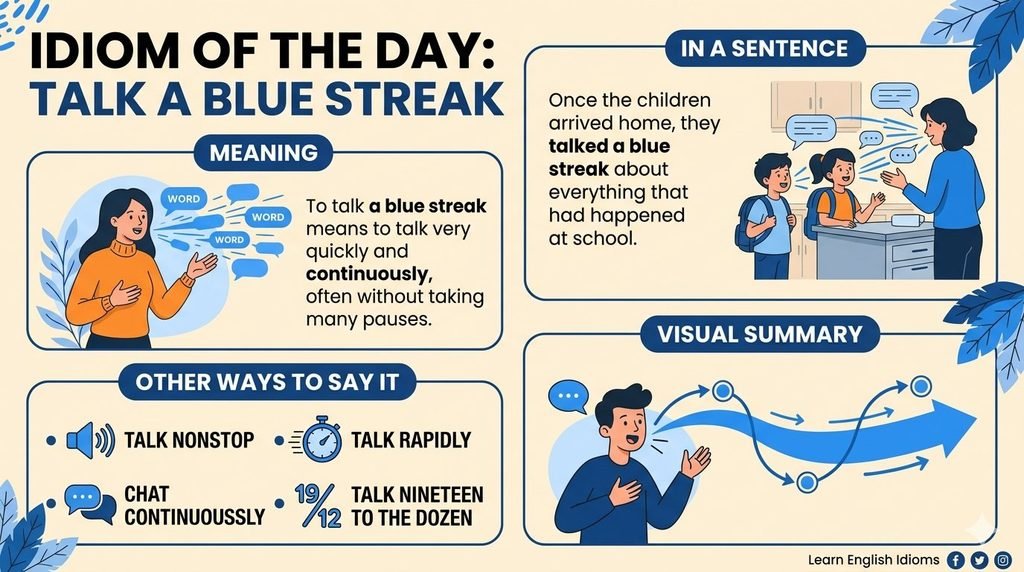
Talk a Blue Streak
Meaning
To talk a blue streak means to talk very quickly and continuously, often without taking many pauses.
In a Sentence
Once the children arrived home, they talked a blue streak about everything that had happened at school.
Other Ways to Say It
- Talk nonstop
- Talk rapidly
- Chat continuously
- Talk nineteen to the dozen
Explanation
The phrase creates a lively impression of fast, energetic speech. It often has a playful tone rather than a critical one.
Best Use
Use it in casual conversation, humorous writing, and storytelling, especially when describing an energetic or excited speaker.
Keep Something Under Your Hat
Meaning
To keep something under your hat means to keep information secret or private.
In a Sentence
Keep the surprise party under your hat until Saturday.
Other Ways to Say It
- Keep it secret
- Keep it to yourself
- Keep it confidential
- Don’t tell anyone
Explanation
The expression uses the image of hiding information under a hat. It suggests quietly protecting a secret rather than sharing it with others.
Best Use
This informal idiom is useful in friendly conversations, storytelling, and situations involving surprises or confidential information.
Spill the Beans
Meaning
To spill the beans means to reveal secret or private information, often accidentally or prematurely.
In a Sentence
Nobody was supposed to know about the trip, but Jake spilled the beans at dinner.
Other Ways to Say It
- Reveal the secret
- Give the game away
- Let the secret out
- Tell the truth about something hidden
Explanation
The expression creates a playful image of beans being scattered so they cannot easily be gathered again. Once the secret is “spilled,” the information is out.
Best Use
It is especially natural in informal conversations and lighthearted situations.
Let the Cat Out of the Bag
Meaning
To let the cat out of the bag means to accidentally reveal a secret or hidden piece of information.
In a Sentence
Maya let the cat out of the bag when she mentioned the surprise vacation in front of Dad.
Other Ways to Say It
- Reveal a secret
- Give away the secret
- Let something slip
- Give the secret away
Explanation
The strange mental image makes this idiom memorable. It usually suggests that the speaker did not intend to reveal the information, making it slightly different from deliberately telling someone a secret.
Best Use
Use it in informal speech, humorous stories, and casual writing.
Bite Your Tongue
Meaning
To bite your tongue means to stop yourself from saying something, usually because it might be rude, hurtful, or unhelpful.
In a Sentence
I wanted to criticize his decision, but I bit my tongue because it wasn’t the right time.
Other Ways to Say It
- Hold your tongue
- Keep quiet
- Say nothing
- Restrain yourself
Explanation
The physical image is impossible to miss: instead of allowing words to escape, you metaphorically stop them by biting your tongue. It communicates self-control in speech.
Best Use
It fits everyday conversations, personal reflections, storytelling, and situations involving emotional restraint.
Speak Volumes
Meaning
To speak volumes means to communicate a strong message or reveal a lot without requiring many words.
In a Sentence
The silence between the two friends spoke volumes about how deeply they had been hurt.
Other Ways to Say It
- Say a lot without words
- Reveal a great deal
- Communicate strongly
- Tell its own story
Explanation
This idiom is especially interesting because speaking does not have to involve actual speech. A person’s silence, expression, behavior, or reaction can communicate something powerful.
Best Use
It works especially well in creative writing, essays, storytelling, and emotional descriptions.
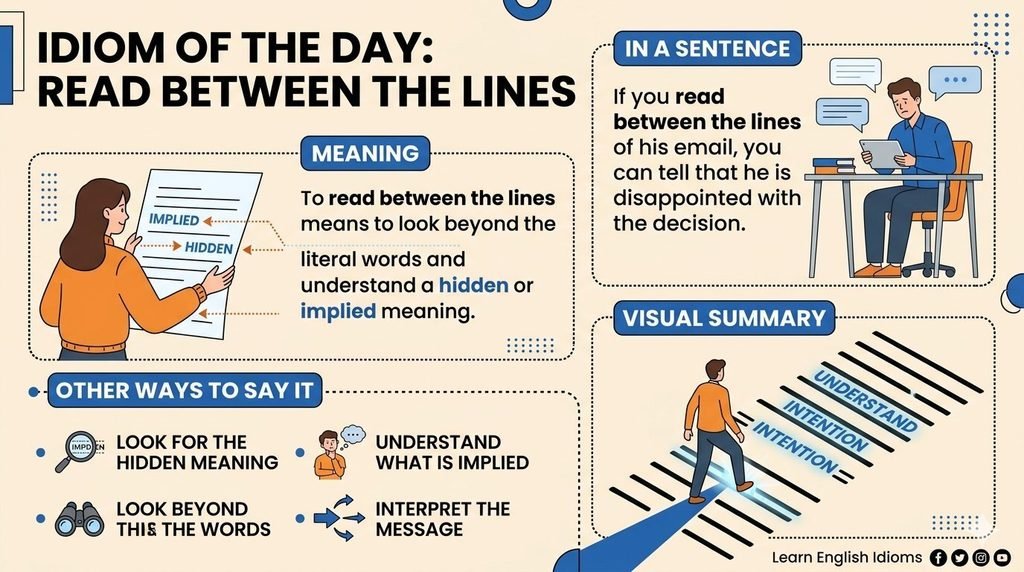
Read Between the Lines
Meaning
To read between the lines means to look beyond the literal words and understand a hidden or implied meaning.
In a Sentence
If you read between the lines of his email, you can tell that he is disappointed with the decision.
Other Ways to Say It
- Look for the hidden meaning
- Understand what is implied
- Look beyond the words
- Interpret the message
Explanation
The “lines” represent the actual words on a page, while the space between them represents what the speaker doesn’t directly say. The idiom is useful when communication is subtle.
Best Use
Use it in professional communication, literature discussions, essays, conversations, and situations involving indirect messages.
Get Your Point Across
Meaning
To get your point across means to communicate an idea clearly enough that other people understand it.
In a Sentence
The teacher used a simple story to get her point across to the class.
Other Ways to Say It
- Make yourself understood
- Communicate your idea
- Explain your message clearly
- Make your meaning clear
Explanation
This expression treats an idea almost like something that travels from one person to another. The goal is successful communication and understanding, not simply speaking.
Best Use
It is suitable for presentations, teaching, meetings, conversations, essays, and professional situations.
Talk Shop
Meaning
To talk shop means to discuss work, business, or professional matters, especially outside normal working hours.
In a Sentence
Even at dinner, the two architects couldn’t stop talking shop.
Other Ways to Say It
- Discuss work
- Talk business
- Discuss professional matters
- Talk about your job
Explanation
“Shop” refers metaphorically to someone’s workplace or professional environment. The expression can suggest that people are so interested in their work that they naturally keep discussing it.
Best Use
This informal idiom is best for casual conversations and workplace-related stories.
Talk Someone’s Ear Off
Meaning
To talk someone’s ear off means to talk to someone for a very long time, often without giving them much chance to speak.
In a Sentence
Uncle Sam talked my ear off about his new car during the entire journey.
Other Ways to Say It
- Talk nonstop
- Talk endlessly
- Keep someone listening
- Ramble on
Explanation
The exaggerated image suggests that so much talking might actually make someone’s ear disappear. It is usually humorous and informal, although it can also express mild annoyance.
Best Use
Use it in casual conversation, humorous writing, and personal stories, rather than formal communication.
Put Words in Someone’s Mouth
Meaning
To put words in someone’s mouth means to claim that someone said something they did not actually say.
In a Sentence
Don’t put words in my mouth; I never said that the project was a failure.
Other Ways to Say It
- Misrepresent someone’s statement
- Misquote someone
- Attribute words falsely
- Claim someone said something
Explanation
The idiom creates a striking image of another person physically supplying your words for you. It is often used when someone feels their position has been unfairly represented.
Best Use
It works naturally in arguments, discussions, conversations, interviews, and opinion-based writing.
Actions Speak Louder Than Words
Meaning
Actions speak louder than words means what someone does can communicate their intentions more clearly than what they say.
In a Sentence
He promised to help, but his actions spoke louder than words when he arrived early to do the work himself.
Other Ways to Say It
- Deeds matter more than promises
- Behavior reveals intentions
- Actions show the truth
- What you do matters more than what you say
Explanation
This familiar expression contrasts spoken promises with observable behavior. It reminds us that communication does not always depend on speech.
Best Use
It fits speeches, essays, personal advice, storytelling, and everyday conversations. It can sound inspirational or serious depending on the context.
Have the Last Word
Meaning
To have the last word means to be the final person to speak in an argument, discussion, or exchange. It can also mean successfully making the final response.
In a Sentence
They kept arguing for another ten minutes, and neither wanted to give the other person the last word.
Other Ways to Say It
- Get the final say
- Have the final response
- Finish the argument
- Make the closing remark
Explanation
The phrase turns conversation into a kind of verbal contest in which the final statement represents control, closure, or victory. Depending on context, it can be playful or argumentative.
Best Use
It works well in everyday conversations, storytelling, debates, and descriptions of disagreements.
Exercise: Practice Using Idioms
Choose the best answer for each question.
1. If someone “has a silver tongue,” what does it mean?
A. They speak very quietly.
B. They are persuasive and skilled with words.
C. They often forget what they want to say.
D. They only speak formally.
2. Maria expressed her feelings honestly during the speech. She really ______.
A. spilled the beans
B. talked shop
C. spoke from the heart
D. bit her tongue
3. What does “beat around the bush” mean?
A. Avoiding something directly
B. Speaking extremely quickly
C. Revealing a secret
D. Ending a conversation
4. Which expression means “express your honest opinion openly”?
A. Speak volumes
B. Speak your mind
C. Talk someone’s ear off
D. Keep something under your hat
5. Ahmed accidentally mentioned the surprise gift. Which idiom best describes what happened?
A. He got his point across.
B. He had the last word.
C. He talked shop.
D. He let the cat out of the bag.
6. Someone says something embarrassing without realizing it. Which idiom fits best?
A. Put your foot in your mouth
B. Speak from the heart
C. Read between the lines
D. Have a way with words
7. What does “have a way with words” suggest?
A. Someone avoids speaking.
B. Someone speaks only in idioms.
C. Someone is naturally skilled at expressing ideas.
D. Someone talks too quickly.
8. Your friend talks continuously throughout a two-hour journey. You might say that your friend ______.
A. bit their tongue
B. talked your ear off
C. kept something under their hat
D. spoke volumes
9. What does “read between the lines” involve?
A. Reading very quickly
B. Ignoring the main message
C. Looking for an implied meaning
D. Memorizing every sentence
10. A teacher explains an idea so clearly that students understand it. Which expression fits?
A. Get your point across
B. Spill the beans
C. Put words in someone’s mouth
D. Talk a blue streak
11. Which situation best demonstrates “bite your tongue”?
A. Someone gives a passionate speech.
B. Someone reveals a secret accidentally.
C. Someone persuades an audience.
D. Someone stops themselves from making a hurtful comment.
12. Two coworkers discuss their profession while having dinner. They are ______.
A. speaking from the heart
B. talking shop
C. beating around the bush
D. having the last word
13. If a person’s silence “speaks volumes,” what does the silence do?
A. Communicates a strong message
B. Makes everyone speak louder
C. Prevents people from understanding anything
D. Changes the subject
14. What does “put words in someone’s mouth” mean?
A. Help someone prepare a speech
B. Teach someone new vocabulary
C. Claim that someone said something they did not say
D. Encourage someone to speak
15. Which statement best illustrates “actions speak louder than words”?
A. James gave a long explanation of his plans.
B. James promised to help but never appeared.
C. James arrived early and helped without being asked.
D. James avoided answering the question.
Answers
- B — “Have a silver tongue” describes someone who is highly persuasive and skilled with words.
- C — “Speak from the heart” means expressing feelings sincerely and genuinely.
- A — “Beat around the bush” means avoiding the main subject or speaking indirectly.
- B — “Speak your mind” means to express your honest thoughts or opinions.
- D — “Let the cat out of the bag” means to reveal a secret, usually accidentally or too soon.
- A — “Put your foot in your mouth” describes saying something embarrassing or inappropriate.
- C — Someone who “has a way with words” is particularly effective or expressive with language.
- B — “Talk someone’s ear off” means talking to someone for a very long time.
- C — “Read between the lines” means looking for meaning that is implied rather than directly stated.
- A — “Get your point across” means to communicate an idea clearly enough for others to understand.
- D — “Bite your tongue” means stopping yourself from saying something.
- B — “Talk shop” means discussing work or professional matters.
- A — Something that “speaks volumes” communicates a powerful message without needing many words.
- C — “Put words in someone’s mouth” means attributing a statement to someone that they did not actually make.
- C — The person’s helpful behavior demonstrates the idea that actions can communicate intentions more strongly than promises.
FAQs
What is a idiom for speaking?
An idiom for speaking is a figurative expression used to describe how someone communicates, what they say, or what their speech reveals. Examples include “speak your mind,” “beat around the bush,” and “speak from the heart.”
How do I create my own idiom for speaking?
Start with a familiar image and connect it to a recognizable communication behavior. For example, you might compare careful speech with walking across thin ice to suggest that every word must be chosen cautiously. The comparison should be clear from context.
What makes a speaking idiom effective?
An effective idiom creates a clear mental image while communicating an idea that would otherwise take more words to explain. It should also fit the tone and situation naturally.
Can I use these idioms in everyday conversation?
Yes. Many of these expressions, such as “speak your mind,” “spill the beans,” and “get straight to the point,” are natural in informal everyday English. Some, such as “talk someone’s ear off,” are especially casual.
What is the difference between a idiom and a simile?
An idiom is an established expression whose figurative meaning may not be obvious from its individual words. A simile directly compares two things using words such as “like” or “as.” For example, “He talks a blue streak” is an idiom, while “Her voice was like a gentle stream” is a simile.
Conclusion
Good speaking is not only about choosing the correct words; it is also about communicating tone, intention, emotion, and personality. Idioms give speakers and writers a compact way to express those qualities with memorable imagery. A person can speak from the heart, beat around the bush, have a silver tongue, or simply get their point across.
The best expression depends on what you want your audience to understand. Choose a warm idiom for an emotional message, a playful one for a casual story, or a direct expression for professional communication. Most importantly, use figurative language naturally rather than forcing it into every sentence. When the right idiom meets the right moment, ordinary speaking can become much more colorful, precise, and memorable.




[…] Read more:20 Idioms for Speaking With Real Examples […]