
Have you ever struggled to describe worry, nervousness, or uncertainty naturally? 20 Idioms for Worried With Real Examples explores vivid expressions that help you communicate anxious feelings with greater clarity. These idioms can make everyday English usage more expressive while strengthening your understanding of figurative language and grammar. Whether you are writing a message, sharing concerns, or describing pressure, the right expression can make your meaning more precise.
Worry can appear in many situations, from meetings and business communication to scheduling, time management, and project management. You may feel anxious about an upcoming calendar deadline, an online booking, or an important event. Learning natural idioms helps you describe these emotions without repeating simple words. It also supports clearer formal writing, storytelling, and everyday conversations.
In this guide, you will discover 20 useful idioms related to feeling worried, each explained through real examples and practical context. You will learn what each expression means, how it works in a sentence, and when it sounds natural. The examples also help build consistency in your vocabulary and improve confident communication. From casual conversations to broadcasting and professional writing, these expressions can add depth to your English.
What Is an Idiom?
An idiom is a common expression whose meaning is different from the literal meaning of the individual words.
For example, “break the ice” does not usually mean physically breaking ice. It means to make people feel more comfortable in a social situation. Similarly, “spill the beans” means to reveal a secret rather than literally dropping beans.
Idioms use figurative language and familiar images to communicate ideas in an expressive way. Their meaning usually comes from common usage rather than the literal words themselves.
Why Use Idioms for Worried Feelings?
Worry is not always one simple emotion. Someone might be mildly uneasy, deeply anxious, afraid of what will happen, or so tense that they cannot relax. Idioms help show these differences.
Using idioms for worried feelings can:
- Express emotions more vividly than plain descriptions.
- Turn an abstract feeling into a memorable mental image.
- Add personality to conversations and storytelling.
- Help creative writers show a character’s emotional state.
- Make personal messages sound more natural and expressive.
- Communicate complicated feelings in a short phrase.
- Add emotional intensity when ordinary words do not feel strong enough.
The best expression depends on the kind of worry you want to communicate.
Quick List of 20 Idioms for Worried
- On pins and needles
- On edge
- Have butterflies in your stomach
- Have your heart in your mouth
- A bundle of nerves
- Lose sleep over something
- Sweat bullets
- Wring your hands
- Have a lot on your mind
- Have your stomach in knots
- Walking on eggshells
- Waiting for the other shoe to drop
- Fear the worst
- Give someone gray hairs
- At your wits’ end
- Hair stand on end
- In a flap
- Fret over something
- Doom and gloom
- On tenterhooks
On Pins and Needles
Read more:20 Idioms for Alone With Real Examples
Meaning
“On pins and needles” describes being very anxious, nervous, or excited while waiting for something to happen. The image suggests sitting so uncomfortably that you cannot relax.
In a Sentence
We were on pins and needles waiting for the doctor to call with the test results.
Other Ways to Say It
- Nervously waiting
- Feeling anxious
- Unable to relax
- Waiting anxiously
Explanation
The expression creates an image of physical discomfort caused by intense anticipation. It works especially well when the worry comes from waiting for news or an outcome.
It is natural in everyday English and can describe anything from mild nervousness to serious concern.
Best Use
Best for conversations, storytelling, personal messages, and informal writing.
On Edge
Meaning
Being “on edge” means feeling tense, nervous, or easily disturbed because you are worried about something.
In a Sentence
Everyone was on edge after hearing strange noises outside the building.
Other Ways to Say It
- Feeling tense
- Nervous and alert
- Uneasy
- Unable to relax
Explanation
This idiom suggests a person is emotionally close to reacting because their nerves are stretched. It is particularly effective when worry makes someone restless, tense, or irritable.
Unlike some stronger expressions, “on edge” can describe relatively ordinary worry.
Best Use
Best for everyday conversation, fiction, essays, and descriptions of tense situations.
Have Butterflies in Your Stomach
Meaning
“Have butterflies in your stomach” describes the nervous, fluttery feeling you get when you are anxious or excited about something important.
In a Sentence
I always get butterflies in my stomach before speaking in front of a large audience.
Other Ways to Say It
- Feel nervous
- Have nervous feelings
- Feel jittery
- Have a nervous stomach
Explanation
The expression turns nervousness into a physical image: imaginary butterflies moving around inside your stomach.
It is usually milder and less fearful than expressions associated with severe anxiety.
Best Use
Best for casual conversations, speeches, storytelling, and situations involving anticipation.
Have Your Heart in Your Mouth
Meaning
To “have your heart in your mouth” means to feel extremely anxious or frightened, especially while waiting to see what happens next.
In a Sentence
My heart was in my mouth as the car narrowly avoided the accident.
Other Ways to Say It
- Feel terrified
- Be extremely nervous
- Be frightened
- Feel a surge of fear
Explanation
The unusual image suggests that fear has risen so strongly that your heart seems to be in your mouth. It conveys intense emotional tension.
This phrase is especially useful when worry is connected to a sudden or frightening event.
Best Use
Best for storytelling, dramatic writing, and emotionally intense conversations.
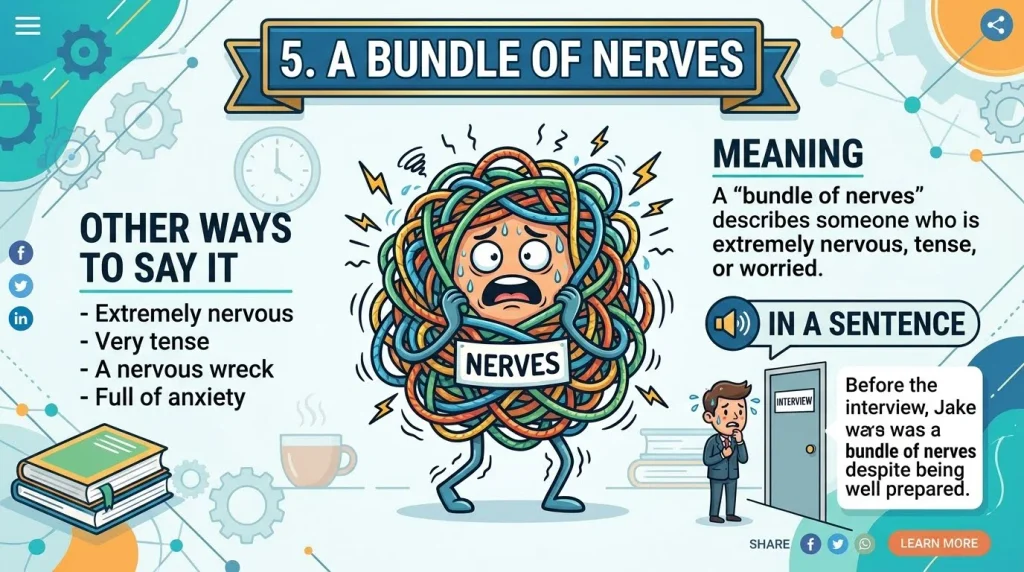
A Bundle of Nerves
Meaning
A “bundle of nerves” describes someone who is extremely nervous, tense, or worried.
In a Sentence
Before the interview, Jake was a bundle of nerves despite being well prepared.
Other Ways to Say It
- Extremely nervous
- Very tense
- A nervous wreck
- Full of anxiety
Explanation
The phrase humorously pictures a person as though their entire body has become a tangled collection of nerves.
It focuses on the person’s overall nervous state, rather than one particular worrying thought.
Best Use
Best for informal conversation, character descriptions, and storytelling.
Lose Sleep Over Something
Meaning
To “lose sleep over something” means to worry about something so much that it affects your ability to sleep peacefully.
In a Sentence
Don’t lose sleep over one small mistake in the report.
Other Ways to Say It
- Worry constantly about something
- Lie awake thinking about something
- Be troubled by something
- Obsess over something
Explanation
This expression connects emotional worry with a very familiar physical consequence: being unable to sleep.
It can be serious or reassuring depending on context. Someone might say it to explain their own worry or to tell another person not to worry so much.
Best Use
Best for everyday conversation, advice, personal messages, and informal writing.
Sweat Bullets
Meaning
“Sweat bullets” means to feel extremely nervous, frightened, or anxious about something.
In a Sentence
I was sweating bullets while waiting for my name to be called.
Other Ways to Say It
- Be extremely nervous
- Be terrified
- Panic
- Be under intense pressure
Explanation
The phrase uses exaggerated imagery to make nervousness feel physical and dramatic. It suggests that worry is so intense that a person is visibly overwhelmed by it.
It is informal and often adds a slightly humorous touch to a stressful situation.
Best Use
Best for casual conversation, humorous storytelling, and informal writing.
Wring Your Hands
Meaning
To “wring your hands” means to show great worry, distress, or helplessness about a difficult situation.
In a Sentence
His parents were wringing their hands while waiting for the missing phone call.
Other Ways to Say It
- Show distress
- Worry helplessly
- Become deeply concerned
- Agonize over something
Explanation
This expression comes from the physical gesture of twisting or squeezing one’s hands when distressed.
It often suggests more than ordinary nervousness: there is a sense of helpless concern or emotional distress.
Best Use
Best for storytelling, serious writing, news-style descriptions, and dramatic scenes.
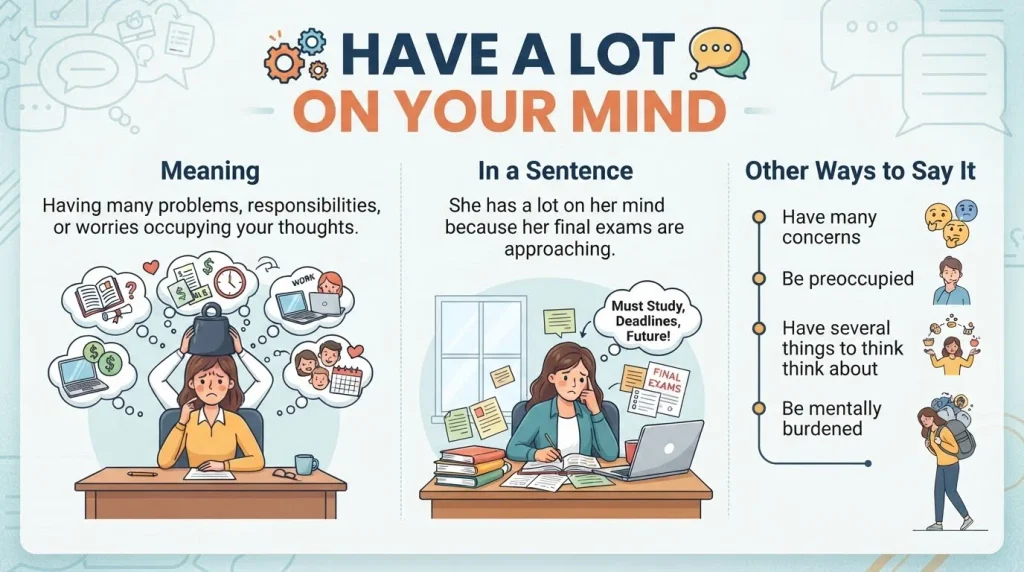
Have a Lot on Your Mind
Meaning
Having “a lot on your mind” means having many problems, responsibilities, or worries occupying your thoughts.
In a Sentence
She has a lot on her mind because her final exams are approaching.
Other Ways to Say It
- Have many concerns
- Be preoccupied
- Have several things to think about
- Be mentally burdened
Explanation
This is a gentle and natural expression for mental pressure. It does not necessarily mean someone is extremely anxious; instead, it suggests their thoughts are crowded with concerns.
It is one of the most flexible expressions on this list.
Best Use
Best for everyday conversations, personal messages, essays, and workplace communication.
Have Your Stomach in Knots
Meaning
To “have your stomach in knots” means to feel very nervous, worried, or emotionally tense.
In a Sentence
The uncertainty about the results had my stomach in knots all afternoon.
Other Ways to Say It
- Feel extremely nervous
- Have a nervous stomach
- Feel tense inside
- Be filled with anxiety
Explanation
The phrase creates a strong physical image of the stomach becoming twisted into knots. It shows how emotional worry can feel physical.
It is particularly effective when nervousness is strong enough to affect someone’s body.
Best Use
Best for personal writing, conversations, fiction, and emotional descriptions.
Walking on Eggshells
Meaning
“Walking on eggshells” means behaving very carefully because you are worried that something you say or do could cause a problem or upset someone.
In a Sentence
After their argument, everyone was walking on eggshells around the manager.
Other Ways to Say It
- Tread carefully
- Be extremely cautious
- Watch what you say
- Avoid causing trouble
Explanation
The mental image is clear: walking over fragile eggs without breaking them. The idiom communicates caution mixed with anxiety.
It is not simply about worrying internally; it usually involves concern about another person’s reaction or a sensitive situation.
Best Use
Best for conversations, workplace situations, relationship stories, and fiction.
Waiting for the Other Shoe to Drop
Meaning
“Waiting for the other shoe to drop” means expecting something unpleasant to happen because you feel that the situation is not over yet.
In a Sentence
The company had announced layoffs, and everyone was waiting for the other shoe to drop.
Other Ways to Say It
- Expecting bad news
- Waiting for something worse
- Anticipating trouble
- Expecting the worst to happen
Explanation
The expression comes from imagining someone upstairs dropping one shoe and knowing the second shoe will eventually fall too.
It captures a very specific kind of worry: the fear that another problem is coming.
Best Use
Best for conversations, storytelling, workplace discussions, and serious writing.
Fear the Worst
Meaning
To “fear the worst” means to believe that the most unpleasant possible outcome may happen.
In a Sentence
When the plane failed to arrive on time, the family began to fear the worst.
Other Ways to Say It
- Expect the worst
- Imagine the worst outcome
- Be deeply concerned
- Anticipate bad news
Explanation
Unlike many colorful idioms, this expression is fairly direct. Its strength comes from the idea of mentally moving toward the most frightening possible outcome.
It works well when the situation is uncertain and the consequences could be serious.
Best Use
Best for serious conversations, journalism-style writing, storytelling, and formal or semi-formal contexts.
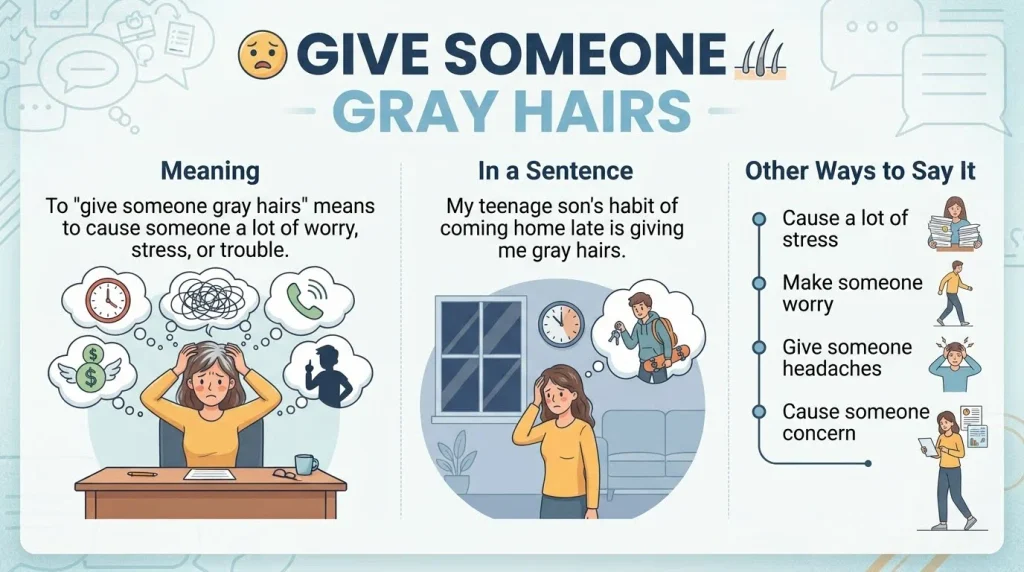
Give Someone Gray Hairs
Meaning
To “give someone gray hairs” means to cause someone a lot of worry, stress, or trouble.
In a Sentence
My teenage son’s habit of coming home late is giving me gray hairs.
Other Ways to Say It
- Cause a lot of stress
- Make someone worry
- Give someone headaches
- Cause someone concern
Explanation
The expression humorously connects prolonged stress with the idea of getting gray hair.
It often has a playful or exaggerated tone, so it can soften a complaint that might otherwise sound very serious.
Best Use
Best for informal conversations, family stories, humor, and lighthearted writing.
At Your Wits’ End
Meaning
Being “at your wits’ end” means feeling so worried, frustrated, or overwhelmed that you do not know what to do next.
In a Sentence
After trying every possible solution, we were at our wits’ end.
Other Ways to Say It
- Completely overwhelmed
- Out of ideas
- Desperate for a solution
- Unable to cope
Explanation
This expression goes beyond ordinary worry. It suggests that stress has reached a point where clear solutions seem to have disappeared.
It can describe emotional exhaustion caused by a difficult or continuing problem.
Best Use
Best for serious conversations, storytelling, personal writing, and descriptions of difficult situations.
Hair Stand on End
Meaning
When your “hair stands on end,” you become extremely frightened or alarmed.
In a Sentence
The strange sound in the empty house made my hair stand on end.
Other Ways to Say It
- Become frightened
- Feel terrified
- Be deeply alarmed
- Get a fright
Explanation
The phrase creates a physical picture of fear so strong that even the hair seems to react.
It is more closely connected to fear and alarm than ordinary worry, making it useful when the emotional situation suddenly becomes intense.
Best Use
Best for horror stories, suspense, dramatic storytelling, and vivid descriptions.
In a Flap
Meaning
To be “in a flap” means to be very worried, excited, or upset, often because something unexpected has happened.
In a Sentence
The office was in a flap when the presentation files suddenly disappeared.
Other Ways to Say It
- In a panic
- Very agitated
- Upset and worried
- In a state of excitement
Explanation
This expression is especially common in British English. It describes a state of fuss and agitation rather than quiet, thoughtful concern.
It can sound informal and slightly humorous.
Best Use
Best for informal British English, conversations, light storytelling, and humorous situations.
Fret Over Something
Meaning
To “fret over something” means to worry about it repeatedly, often more than is helpful.
In a Sentence
He tends to fret over every small detail before an important meeting.
Other Ways to Say It
- Worry about
- Brood over
- Obsess about
- Be troubled by
Explanation
“Fret” suggests repeated or restless worry, especially about something that keeps occupying your thoughts.
It can imply that the person is spending too much emotional energy on the concern.
Best Use
Best for everyday conversation, reflective writing, advice, and character descriptions.
Doom and Gloom
Meaning
“Doom and gloom” refers to a strong feeling or expression of pessimism, fear, or expectation that bad things will happen.
In a Sentence
Despite the problems, there was no need for all this doom and gloom about the future.
Other Ways to Say It
- Pessimism
- Negative thinking
- Fear of disaster
- A gloomy outlook
Explanation
This phrase is useful when worry becomes focused on negative predictions about the future. It often describes an atmosphere, attitude, or way of talking rather than one person’s private anxiety.
Its tone can be serious, but it is also commonly used to challenge excessive negativity.
Best Use
Best for conversations, opinion writing, commentary, and informal discussions.
On Tenterhooks
Meaning
Being “on tenterhooks” means being extremely anxious or tense while waiting for something to happen or be decided.
In a Sentence
The students were on tenterhooks as the competition judges prepared to announce the winner.
Other Ways to Say It
- On edge
- Nervously waiting
- In suspense
- Anxiously anticipating the result
Explanation
This expression describes a state of tense suspense. It is especially appropriate when the person has little control over what happens next.
It can sound somewhat more literary or traditional than “on edge,” making it useful when you want a more expressive phrase.
Best Use
Best for storytelling, formal writing, creative writing, and situations involving suspense.
Exercise: Practice Using Idioms
Test yourself with these 15 questions. Choose the answer that best matches the meaning or use of the idiom.
1. What does “on pins and needles” mean?
A. Experiencing physical exhaustion
B. Becoming restless due to anticipation
C. Holding resentment toward another person
D. Remaining calm and at ease
2. Which sentence uses “on edge” correctly?
A. The children were on edge after hearing the alarm.
B. She was on edge because she had finished her lunch.
C. He put the book on edge of the table.
D. They were on edge because the room was comfortable.
3. “Butterflies in your stomach” usually describes:
A. Hunger
B. Physical illness
C. Nervous anticipation
D. Deep sadness
4. If someone has “their heart in their mouth,” they are likely:
A. Extremely relaxed
B. Very frightened or anxious
C. Feeling hungry
D. Feeling bored
5. What does “a bundle of nerves” describe?
A. A person who feels very anxious
B. An individual with great physical strength
C. A person struggling to stay awake
D. An individual in an exceptionally happy mood
6. If you “lose sleep over” a problem, you:
A. Forget about it quickly
B. Solve it immediately
C. Worry about it so much that it affects your sleep
D. Discuss it only during the day
7. Which situation best fits “walking on eggshells”?
A. Celebrating with close friends
B. Carefully speaking around an angry person
C. Taking a relaxing walk
D. Learning how to cook
8. What does “waiting for the other shoe to drop” suggest?
A. Expecting another unpleasant event
B. Preparing to go shopping
C. Waiting for a friend to arrive
D. Looking for a lost object
9. If you “fear the worst,” you:
A. Expect the best possible result
B. Believe nothing will happen
C. Imagine the most unpleasant outcome
D. Refuse to think about the situation
10. “Give someone gray hairs” means:
A. Help someone relax
B. Cause someone worry or stress
C. Make someone look younger
D. Give someone a new hairstyle
11. What does “at your wits’ end” mean?
A. Having many clever ideas
B. Feeling overwhelmed and unsure what to do
C. Feeling excited about a celebration
D. Being physically exhausted after exercise
12. Which situation best demonstrates “hair stand on end”?
A. Hearing a frightening noise in a dark house
B. Reading a funny story
C. Eating a favorite meal
D. Finishing an easy assignment
13. “Fret over something” means:
A. Celebrate something
B. Ignore something
C. Worry repeatedly about something
D. Explain something carefully
14. Which expression describes a pessimistic atmosphere or outlook?
A. A bundle of nerves
B. Doom and gloom
C. Butterflies in your stomach
D. On pins and needles
15. Which sentence uses “on tenterhooks” correctly?
A. We were on tenterhooks waiting for the final decision.
B. She placed the papers on tenterhooks in the drawer.
C. He felt on tenterhooks after eating breakfast.
D. They used tenterhooks to describe a sunny afternoon.
Answers
- B — “On pins and needles” describes anxious anticipation while waiting.
- A — “On edge” means tense, nervous, or uneasy.
- C — “Butterflies in your stomach” refers to nervous or excited anticipation.
- B — Having your heart in your mouth describes intense fear or anxiety.
- A — A “bundle of nerves” is someone who is extremely nervous.
- C — Losing sleep over something means worrying about it enough to disturb your sleep.
- B — “Walking on eggshells” means behaving cautiously because you fear causing a negative reaction.
- A — The phrase describes expecting another problem or unpleasant event.
- C — To fear the worst is to expect or imagine the most negative possible outcome.
- B — “Give someone gray hairs” means causing them considerable worry or stress.
- B — Being at your wits’ end means feeling overwhelmed and unsure how to proceed.
- A — The expression describes becoming extremely frightened or alarmed.
- C — To fret over something means to worry about it repeatedly.
- B — “Doom and gloom” describes pessimism and expectations of bad outcomes.
- A — “On tenterhooks” means being tense and anxious while waiting for something to happen.
FAQs
What is an idiom for worried?
There are many useful idioms for worried feelings, including “on edge,” “on pins and needles,” “lose sleep over something,” and “have your stomach in knots.” The best choice depends on whether you want to express mild concern, nervous anticipation, fear, or intense stress.
How do I create my own idiom?
A good figurative expression starts with a clear mental image that represents an emotion or situation. Think about what worry feels like physically or emotionally, then connect that feeling with a memorable image. For example, a tense situation might be compared with something fragile or difficult to balance.
What makes an idiom effective?
An effective idiom is clear, memorable, and appropriate for its context. It should create an understandable image without making the reader work too hard to understand the intended feeling.
Can I use these idioms in everyday conversation?
Yes. Expressions such as “on edge,” “have a lot on your mind,” “lose sleep over something,” and “butterflies in your stomach” are natural in everyday English. Some, such as “on tenterhooks,” may sound more literary or traditional.
What is the difference between an idiom and a simile?
An idiom is a familiar expression with a figurative meaning, such as “walking on eggshells.” A simile directly compares two things using words such as “like” or “as.” For example, “He was as nervous as a cat” is a simile.
Conclusion
Finding the right words for worry can make an emotional description much more powerful. These 20 idioms for worried feelings show that concern can take many forms: nervous anticipation, restless thoughts, fear of bad news, emotional exhaustion, or tension caused by uncertainty. Expressions such as “on pins and needles,” “walking on eggshells,” and “waiting for the other shoe to drop” give readers an image they can immediately understand.
When choosing an idiom, think about the exact feeling you want to communicate. A mild concern may need a softer expression, while a frightening situation may call for something much stronger. The most effective figurative language is not necessarily the most dramatic it is the expression that fits the feeling and context naturally. When worry is difficult to explain, the right image can say what ordinary words cannot.

Margaret Saywell is an English author and editor who has spent more than fifteen years working with words teaching, proofreading, and writing about the quirks of the English language.
At Idiom Looms, Margaret gathers idioms from across the English-speaking world and weaves them into clear, practical guides. She loves digging into the history of a phrase and showing readers how a few well-chosen words can say far more than a long explanation.
She believes language should be enjoyed, not feared and that the best way to learn an idiom is to see it in action.


[…] Read more:20 Idioms for Worried With Real Examples […]