
What makes some expressions about time feel so natural and memorable? 20 Idioms for Time With Real Examples explores useful phrases that make everyday English more vivid and expressive. These idioms can help you describe deadlines, duration, delays, routines, and changing schedules with greater clarity. Whether you are discussing time management, planning meetings, or managing a busy calendar, the right expression can make communication sound more natural.
This guide explains each idiom in simple language and provides real examples to show how it works in context. You will discover phrases useful for business communication, project management, online booking, broadcasting, conversations, and everyday English usage. Each example helps you understand the figurative meaning without relying on complicated grammar rules.
Learning these expressions can also strengthen formal writing, speaking, and creative communication. You will see how context, meaning, and consistency shape effective language choices. By the end, you will have practical idioms that can make your English clearer, more flexible, and more engaging.
What Is an Idiom?
An idiom is a familiar expression whose overall meaning cannot always be understood by taking every word literally.
For example, “break the ice” does not mean physically breaking ice. It means to make people feel more comfortable when they first meet.
Another example is “spill the beans.” It does not mean dropping beans. It means to reveal information, often a secret.
This is what makes idioms different from literal statements. A literal sentence says exactly what it means, while an idiom uses figurative language to communicate an idea, feeling, or situation in a more colorful way.
Why Use Idioms for Time?
Time is an abstract idea, so ordinary language does not always capture how we experience it. Idioms give time a stronger image and emotional meaning.
They can help you:
- Express emotions about waiting, rushing, remembering, or losing opportunities.
- Make descriptions of time more vivid and memorable.
- Explain abstract ideas in language that is easier to picture.
- Add personality to conversations and personal messages.
- Make creative writing and storytelling more expressive.
- Communicate complicated feelings about time in just a few words.
- Sound more natural and familiar in everyday English.
For example, “I am very busy” is straightforward, but “I am racing against time” suggests pressure, urgency, and the fear of not finishing soon enough.
Quick List of 20 Idioms for Time
- Time flies
- Beat the clock
- Against the clock
- In the nick of time
- Kill time
- Time on your hands
- Around the clock
- Call it a day
- At the eleventh hour
- Time is money
- Make up for lost time
- Buy time
- Bide your time
- In no time
- For the time being
- Time after time
- A race against time
- Once in a blue moon
- Better late than never
- Time will tell
Time Flies
Read more:20 Idioms for Young With Real Examples
Meaning
“Time flies” means that time seems to pass very quickly, especially when we are enjoying ourselves or are deeply involved in something.
The expression compares passing time to something that can fly away before we notice it.
In a Sentence
We had so much fun talking that we didn’t realize it was midnight—time flies when you’re having a good time.
Other Ways to Say It
- Time passes quickly.
- The hours seem to disappear.
- The days go by fast.
- It feels like no time has passed.
Explanation
The image is simple but powerful: time is imagined as something with wings that quickly moves out of reach. It often carries a warm, nostalgic, or slightly surprised feeling.
It is especially natural when talking about childhood, holidays, friendships, family gatherings, or enjoyable experiences.
Best Use
This idiom works especially well in everyday conversations, personal messages, social media captions, and reflective writing.
Beat the Clock
Meaning
“Beat the clock” means to finish something before a deadline or before a particular amount of time runs out.
It creates the image of a person competing against a clock and winning by finishing before time wins.
In a Sentence
We managed to beat the clock and submit the project just before the office closed.
Other Ways to Say It
- Finish before the deadline.
- Get it done in time.
- Complete it before time runs out.
- Meet the deadline.
Explanation
This idiom gives a task a sense of competition and urgency. The clock becomes almost like an opponent.
It is useful when success depends not only on doing something correctly but also on doing it quickly enough.
Best Use
Use it in work conversations, sports, school situations, storytelling, and situations involving deadlines.
Against the Clock
Meaning
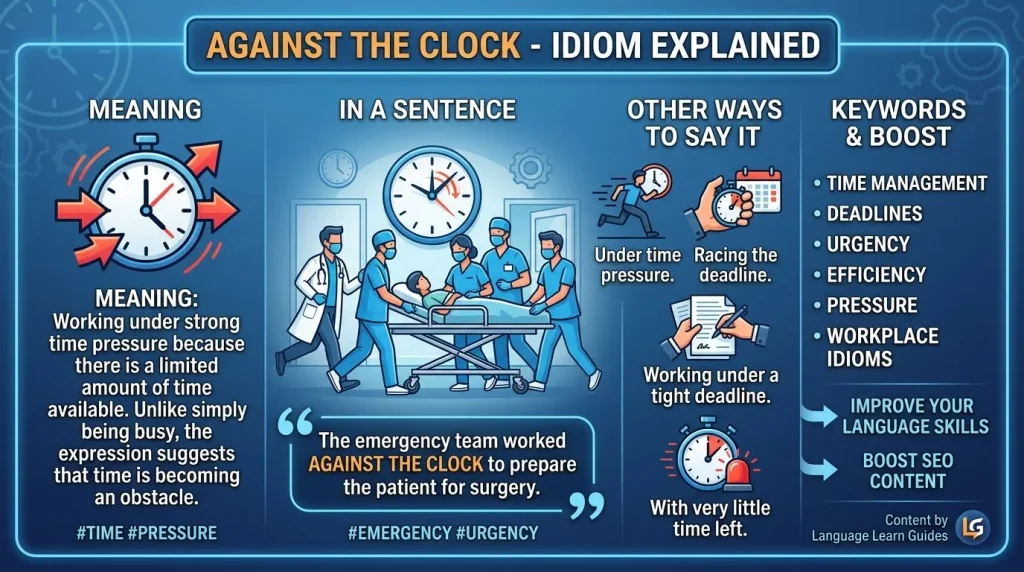
“Against the clock” means working under strong time pressure because there is a limited amount of time available.
Unlike simply being busy, the expression suggests that time is becoming an obstacle.
In a Sentence
The emergency team worked against the clock to prepare the patient for surgery.
Other Ways to Say It
- Under time pressure.
- Racing the deadline.
- Working under a tight deadline.
- With very little time left.
Explanation
The clock represents the pressure of passing time. The expression can make a situation feel tense and urgent without needing a long explanation.
It is particularly effective when the outcome depends on completing an important task quickly.
Best Use
It fits serious conversations, news-style writing, professional communication, essays, and dramatic storytelling.
In the Nick of Time
Meaning
“In the nick of time” means arriving or doing something just before it is too late.
The expression communicates perfectly timed relief.
In a Sentence
I reached the station in the nick of time and caught the last train home.
Other Ways to Say It
- Just in time.
- At the last possible moment.
- Before it was too late.
- With seconds to spare.
Explanation
This idiom creates a vivid picture of a narrow escape. There is usually a feeling that something almost went wrong, but the timing turned out to be exactly right.
It works particularly well when describing close calls and last-minute success.
Best Use
Use it in conversations, stories, personal experiences, and informal writing.
Kill Time
Meaning
“Kill time” means to spend time doing something while waiting for something else to happen.
The word “kill” is not literal here. It simply suggests passing unwanted or empty time.
In a Sentence
I read a few chapters of my book to kill time while waiting for my appointment.
Other Ways to Say It
- Pass the time.
- Keep yourself occupied.
- Fill the time.
- Do something while waiting.
Explanation
The expression is often used when the time itself is not particularly meaningful or when someone is simply waiting. It can sound casual and conversational.
There is often a subtle sense of boredom or impatience, although the activity itself may be enjoyable.
Best Use
It is most natural in everyday conversations, travel situations, casual messages, and informal writing.
Time on Your Hands
Meaning
Having “time on your hands” means having free time because you are not currently busy with other responsibilities.
It suggests that there is extra time available for something new.
In a Sentence
Now that the exams are over, I have time on my hands to learn how to play the guitar.
Other Ways to Say It
- Have plenty of free time.
- Have some spare time.
- Have time to yourself.
- Have nothing urgent to do.
Explanation
The phrase creates a playful physical image of having extra time sitting in your hands, ready to be used.
Depending on context, it can sound positive, neutral, or mildly critical. Someone with free time may use it productively—or may simply be looking for something to do.
Best Use
It works well in casual conversation, personal writing, lifestyle discussions, and friendly messages.
Around the Clock
Meaning
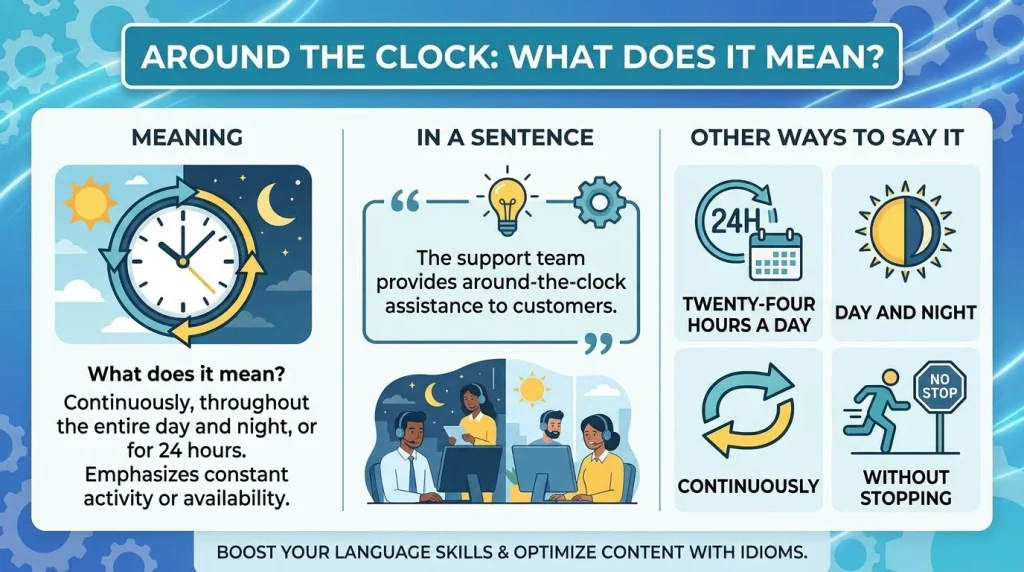
“Around the clock” means continuously, throughout the entire day and night, or for 24 hours.
It emphasizes constant activity or availability.
In a Sentence
The support team provides around-the-clock assistance to customers.
Other Ways to Say It
- Twenty-four hours a day.
- Day and night.
- Continuously.
- Without stopping.
Explanation
The expression imagines the hands of a clock completing a full circle while an activity continues. It is stronger than simply saying something happens “often.”
Because it suggests continuous service or effort, it can sound serious and professional.
Best Use
It is especially useful in business writing, professional communication, news reports, healthcare contexts, and formal descriptions.
Call It a Day
Meaning
“Call it a day” means to stop working on something for the day.
It usually suggests that enough work has been done and it is time to rest or finish for now.
In a Sentence
We’ve finished the most important tasks, so let’s call it a day.
Other Ways to Say It
- Finish for today.
- Stop working for now.
- Wrap things up.
- Leave it until tomorrow.
Explanation
This idiom often carries a sense of practical satisfaction: the work may not be completely finished, but continuing is no longer necessary or useful.
It is a very natural expression for ending a work session or activity.
Best Use
Use it in workplaces, study groups, casual conversations, and collaborative situations.
At the Eleventh Hour
Meaning
“At the eleventh hour” means something happens at the last possible moment, just before a deadline or important event.
In a Sentence
The author made several important changes at the eleventh hour before the book went to print.
Other Ways to Say It
- At the last minute.
- Just before the deadline.
- At the final moment.
- At the very end.
Explanation
The expression gives a situation a feeling of suspense. It suggests that there was almost no time left to act.
It is often more dramatic than “at the last minute,” making it useful when the timing itself is an important part of the story.
Best Use
It works particularly well in storytelling, journalism, essays, speeches, and dramatic descriptions.
Time Is Money
Meaning
“Time is money” means that time is valuable and should not be wasted, especially when time could be used for productive or profitable work.
In a Sentence
Let’s keep the meeting focused because time is money.
Other Ways to Say It
- Time has value.
- Don’t waste valuable time.
- Every minute matters.
- Use your time wisely.
Explanation
This idiom compares time with money because both are considered valuable resources. Once time has passed, it cannot simply be recovered.
The expression often has a practical or business-like tone rather than a poetic one.
Best Use
It is especially suitable for business conversations, professional settings, productivity discussions, and practical advice.
Make Up for Lost Time
Meaning
“Make up for lost time” means to do something faster or spend extra effort because an earlier period was wasted, missed, or unavailable.
In a Sentence
After years of living in different countries, the two friends spent the weekend together to make up for lost time.
Other Ways to Say It
- Catch up on what was missed.
- Recover lost time.
- Catch up quickly.
- Make the most of the remaining time.
Explanation
This idiom often carries an emotional meaning. The “lost time” may refer not only to work but also to missed opportunities, relationships, experiences, or moments.
That makes it especially powerful when discussing people who reconnect after a long separation.
Best Use
It fits personal stories, emotional writing, conversations, family messages, and reflective essays.
Buy Time
Meaning
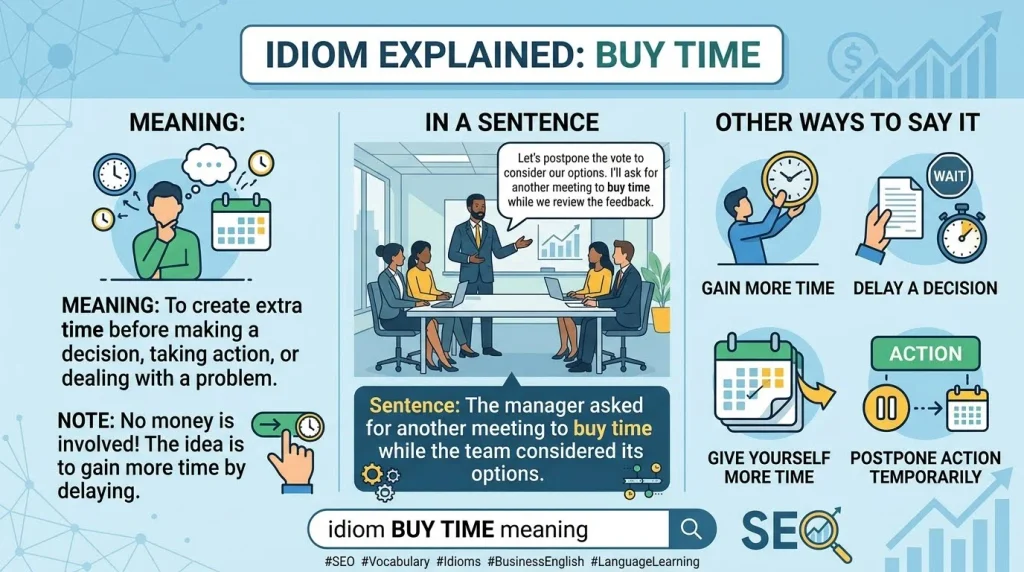
“Buy time” means to create extra time before making a decision, taking action, or dealing with a problem.
No money is literally involved. The idea is to gain a little more time by delaying a decision or action.
In a Sentence
The manager asked for another meeting to buy time while the team considered its options.
Other Ways to Say It
- Gain more time.
- Delay a decision.
- Give yourself more time.
- Postpone action temporarily.
Explanation
The expression treats time almost like something that can be purchased. It is useful when someone needs breathing room rather than an immediate solution.
Depending on the situation, it can sound strategic, practical, or slightly evasive.
Best Use
Use it in business discussions, negotiations, problem-solving, conversations, and storytelling.
Bide Your Time
Meaning
“Bide your time” means to wait patiently for the right opportunity or moment to act.
It is different from simply waiting because it suggests patience combined with preparation or intention.
In a Sentence
She decided to bide her time until the right opportunity came along.
Other Ways to Say It
- Wait patiently.
- Wait for the right moment.
- Hold back for now.
- Stay patient until the opportunity appears.
Explanation
The expression suggests quiet patience. Someone who bides their time is not necessarily inactive; they may be watching, preparing, and waiting for better circumstances.
It can sound strategic or slightly dramatic, especially in storytelling.
Best Use
It works best in creative writing, storytelling, serious conversations, and descriptions of strategy or patience.
In No Time
Meaning
“In no time” means very soon or after only a short amount of time.
It is a friendly way to say that something will happen quickly.
In a Sentence
Give the new recipe a little practice, and you’ll be cooking it confidently in no time.
Other Ways to Say It
- Very soon.
- Before long.
- Quickly.
- In a short while.
Explanation
The phrase emphasizes speed without giving a precise measurement. It is generally positive and reassuring.
Unlike “against the clock,” it does not necessarily involve pressure; it simply highlights that something will happen sooner than expected.
Best Use
It is natural in everyday conversation, instructions, encouragement, friendly messages, and informal writing.
For the Time Being
Meaning
“For the time being” means for now, but not necessarily permanently.
It describes a temporary situation that may change later.
In a Sentence
For the time being, we’ll continue working from home while the office is being renovated.
Other Ways to Say It
- For now.
- Temporarily.
- At present.
- Until further notice.
Explanation
This idiom is useful when you want to make it clear that a current arrangement is not expected to last forever.
It has a more neutral and slightly formal tone than the simple phrase “for now.”
Best Use
It works well in professional communication, announcements, essays, instructions, and everyday conversation.
Time After Time
Meaning
“Time after time” means repeatedly or on many different occasions.
It emphasizes that something happens again and again.
In a Sentence
Time after time, the team proved that patience could overcome difficult challenges.
Other Ways to Say It
- Again and again.
- Repeatedly.
- Over and over.
- On many occasions.
Explanation
The repetition built into the phrase reinforces the idea of repetition. It can be used for habits, experiences, successes, mistakes, or emotional memories.
The expression often adds emphasis and rhythm to writing.
Best Use
It is effective in speeches, storytelling, essays, personal reflections, and emotionally expressive writing.
A Race Against Time
Meaning
“A race against time” describes a situation in which someone must accomplish something before time runs out.
It creates a strong image of urgency, pressure, and limited opportunity.
In a Sentence
Preparing the rescue operation became a race against time as the storm moved closer.
Other Ways to Say It
- A desperate rush to finish.
- A struggle against a deadline.
- A race to beat the deadline.
- A fight against the clock.
Explanation
The metaphor turns time into an opponent in a race. This makes the situation feel immediate and dramatic.
It is particularly powerful when the consequences of running out of time are important.
Best Use
Use it in dramatic storytelling, journalism, speeches, essays, and serious descriptions of urgent situations.
Once in a Blue Moon
Meaning
“Once in a blue moon” means something happens very rarely.
Although this idiom is not specifically about clocks or schedules, it describes frequency over time.
In a Sentence
We only manage to have dinner together once in a blue moon because everyone has such busy schedules.
Other Ways to Say It
- Very rarely.
- Hardly ever.
- Once in a great while.
- On rare occasions.
Explanation
The unusual image of a “blue moon” makes the idea of rarity memorable. It is useful when something happens so infrequently that it feels almost exceptional.
The expression is generally casual and conversational, rather than formal.
Best Use
It works well in everyday conversations, personal writing, social media, and storytelling.
Better Late Than Never
Meaning
“Better late than never” means that doing something late is still better than not doing it at all.
It encourages people not to give up simply because they have missed their ideal time.
In a Sentence
I finally started learning Spanish at forty, but better late than never.
Other Ways to Say It
- Late is better than never.
- It’s still worth doing.
- Starting now is better than not starting.
- It’s never too late to begin.
Explanation
This idiom has an encouraging and reassuring tone. It acknowledges that the timing is not perfect while focusing on the value of taking action anyway.
It is especially useful when someone feels discouraged about a delayed decision, goal, or opportunity.
Best Use
Use it in friendly conversations, motivational messages, personal reflections, and encouraging advice.
Time Will Tell
Meaning
“Time will tell” means that the truth or outcome of a situation will become clear as time passes.
It expresses the idea that the future will provide the answer.
In a Sentence
We don’t know whether the new plan will succeed, but time will tell.
Other Ways to Say It
- The future will reveal the answer.
- We’ll find out eventually.
- Only time will reveal the truth.
- We’ll see what happens.
Explanation
This expression accepts uncertainty without trying to predict the future. It suggests that patience may be the best response when there is not enough evidence to know what will happen.
Its tone can be thoughtful, cautious, philosophical, or slightly mysterious.
Best Use
It works well in conversations, essays, speeches, reflective writing, and discussions about uncertain outcomes.
Exercise: Practice Using Idioms
Test your understanding of these time-related idioms. Choose the best answer for each question.
What does “time flies” mean?
A. A clock is moving quickly
B. Time seems to pass quickly
C. Someone is running late
D. A schedule has changed
Which idiom means finishing something before a deadline?
A. Kill time
B. Call it a day
C. Beat the clock
D. Time on your hands
If someone arrives “in the nick of time,” what happened?
A. Their arrival happened well ahead of time
B. They showed up right at the scheduled hour
C. Everyone had already departed when they got there
D. They reached the place at the last possible moment
What does “kill time” mean?
A. Spend time while waiting
B. Waste an entire year
C. End a workday
D. Save time for later
Someone with “time on their hands” has:
A. A strict deadline
B. Very little time
C. Free time available
D. A problem with a clock
Which expression means continuously throughout the day and night?
A. Around the clock
B. Once in a blue moon
C. In no time
D. At the eleventh hour
If a team decides to “call it a day,” what are they doing?
A. Starting a new project
B. Working overnight
C. Changing their schedule
D. Stopping work for the day
Which idiom describes something done at the last possible moment?
A. Time after time
B. At the eleventh hour
C. Time is money
D. For the time being
What does “time is money” emphasize?
A. Clocks are expensive
B. Money always saves time
C. Time is a valuable resource
D. Work should never stop
If friends “make up for lost time,” they are:
A. Trying to recover missed experiences or opportunities
B. Waiting for a future appointment
C. Delaying an important decision
D. Finishing a task early
What does it mean to “buy time”?
A. Purchase something during a break
B. Gain additional time before acting
C. Work faster than usual
D. Spend money on a schedule
Someone who chooses to “bide their time” is likely to:
A. Act immediately
B. Waste time carelessly
C. Wait patiently for the right opportunity
D. Finish something before lunch
Which phrase means “temporarily” or “for now”?
A. For the time being
B. Time after time
C. A race against time
D. In no time
If something happens “once in a blue moon,” it happens:
A. Every evening
B. At exactly midnight
C. Very rarely
D. Without warning
Which expression means that the future will reveal what happens?
A. Better late than never
B. Time will tell
C. Beat the clock
D. Kill time
Answers
- B — “Time flies” means that time seems to pass very quickly.
- C — To “beat the clock” means to finish something before the available time runs out.
- D — “In the nick of time” means arriving or acting just before it becomes too late.
- A — To “kill time” means to spend time while waiting for something else.
- C — Having “time on your hands” means having free or spare time.
- A — “Around the clock” describes something that continues day and night.
- D — To “call it a day” means to stop working or finish an activity for the day.
- B — “At the eleventh hour” refers to something happening at the last possible moment.
- C — “Time is money” emphasizes that time is valuable and should not be wasted.
- A — To “make up for lost time” means to catch up on missed time, experiences, or opportunities.
- B — To “buy time” means to gain extra time before making a decision or taking action.
- C — To “bide your time” means to wait patiently for the right moment or opportunity.
- A — “For the time being” means temporarily or for now.
- C — “Once in a blue moon” means something happens very rarely.
- B — “Time will tell” means that the outcome will become clear as time passes.
FAQs
What is an idiom for time?
An idiom for time is a figurative expression that communicates an idea about passing time, waiting, deadlines, timing, repetition, or the value of time. Examples include “time flies,” “beat the clock,” and “time will tell.”
How do I create my own idiom for time?
Start with an idea you want to express, such as urgency, patience, change, or nostalgia. Then create a memorable comparison or image that communicates that idea. A strong figurative expression should be easy to picture and should add meaning rather than simply replace an ordinary word.
What makes a time idiom effective?
An effective idiom creates a clear mental image while communicating an understandable idea. It should fit the context and carry the intended emotional tone. For example, “a race against time” creates a much stronger sense of urgency than simply saying “there is a deadline.”
Can I use these idioms in everyday conversation?
Yes. Many of these expressions, including “time flies,” “kill time,” “in no time,” “call it a day,” and “better late than never,” are natural in everyday English. Others, such as “bide your time,” may sound more literary or deliberate depending on the context.
What is the difference between an idiom and a simile?
An idiom is a familiar expression with a figurative meaning, while a simile directly compares two things using words such as “like” or “as.” For example, “time flies” is an idiom, while “time moves like a river” is a simile. Both use imagery, but they work differently in language.
Conclusion
Time is something everyone experiences, yet it can feel completely different from one moment to another. Sometimes it flies, sometimes we race against it, and sometimes we simply have to wait and let it reveal what comes next. These 20 idioms provide expressive ways to talk about deadlines, patience, missed opportunities, free moments, repetition, uncertainty, and the changing nature of life.
The best idiom depends on the feeling and context you want to communicate. Choose one that creates the right image rather than using figurative language simply for decoration. Whether you are writing an essay, telling a story, sending a message, or having an everyday conversation, the right expression can make your words more memorable. After all, time keeps moving, and the words we choose can help us capture a moment before it passes.

Margaret Saywell is an English author and editor who has spent more than fifteen years working with words teaching, proofreading, and writing about the quirks of the English language.
At Idiom Looms, Margaret gathers idioms from across the English-speaking world and weaves them into clear, practical guides. She loves digging into the history of a phrase and showing readers how a few well-chosen words can say far more than a long explanation.
She believes language should be enjoyed, not feared and that the best way to learn an idiom is to see it in action.



[…] Read more:20 Idioms for Time With Real Examples […]