
Have you ever struggled to describe a heated disagreement without sounding repetitive? 20 Idioms for Arguing With Real Examples introduces natural expressions that make conversations more vivid and precise. These phrases help explain disagreements, conflict, frustration, and opposing opinions in everyday English. Each idiom adds context and personality while showing how figurative language works naturally.
Whether you are discussing meetings, business communication, or personal conversations, the right expression can improve clarity. Understanding idioms also supports English usage, grammar, formal writing, and confident communication. Even topics involving scheduling, time management, a calendar, or project management can involve disagreements that require careful language and consistency.
In this guide, you will discover 20 useful idioms connected with arguing, conflict, and disagreement. Every expression includes a clear meaning, a realistic sentence, alternative phrases, and practical usage guidance. You will also learn when each idiom suits conversations, writing, speeches, or broadcasting. The examples keep the language natural, memorable, and easy to apply.
What Is an Idiom?
An idiom is a fixed expression whose meaning is different from the literal meaning of the individual words.
For example, “break the ice” does not mean physically breaking ice. It means to make people feel more comfortable in a social situation.
Similarly, “spill the beans” does not mean dropping beans. It means to reveal a secret.
Idioms make language more colorful, expressive, and memorable. They are especially useful when describing emotions, relationships, conflicts, and everyday experiences.
Why Use Idioms for Arguing?
Arguments can involve frustration, disagreement, competition, anger, or even playful tension. Idioms give speakers and writers a way to express these shades of meaning without explaining everything in a long sentence.
For example, saying two colleagues “butted heads” suggests that they strongly disagreed, while saying they “went at each other” can suggest a much more intense confrontation.
Idioms can help you:
- Express emotional tension naturally.
- Make descriptions of conflict more vivid.
- Explain disagreements in a memorable way.
- Add personality to conversations and dialogue.
- Make stories and creative writing more engaging.
- Describe the difference between a mild disagreement and a heated argument.
- Communicate complicated feelings through familiar images.
Quick List of 20 Idioms
- Butt heads
- Lock horns
- Have words
- Go head-to-head
- Fight tooth and nail
- See eye to eye
- Get into a war of words
- At each other’s throats
- Go at each other
- Pick a fight
- Cross swords
- Draw a line in the sand
- Stand one’s ground
- Blow one’s top
- Fly off the handle
- Give someone an earful
- Have it out
- Bicker back and forth
- Agree to disagree
- Fight like cat and dog
Butt Heads
Read more:20 Idioms for Apology With Real Examples
Meaning
“Butt heads” means to disagree strongly with someone, especially when both people have firm opinions. The image comes from two animals pushing their heads against each other.
In a Sentence
The two managers often butt heads over how the project should be handled.
Other Ways to Say It
- Clash over something
- Have strong disagreements
- Disagree sharply
- Be at odds
Explanation
This idiom suggests a direct clash of opinions rather than necessarily an angry fight. It works well when both sides are stubborn or confident in their positions.
The expression creates the image of two people pushing against each other without easily giving way.
Best Use
Best for everyday conversation, workplace situations, storytelling, and informal writing. It is usually less dramatic than expressions describing an explosive argument.
Lock Horns
Meaning
To “lock horns” means to enter into a strong disagreement or confrontation with someone. It suggests that neither side is willing to back down.
In a Sentence
The two politicians locked horns during the televised debate.
Other Ways to Say It
- Clash
- Come into conflict
- Confront each other
- Face off
Explanation
The expression comes from the image of animals fighting with their horns. It communicates a forceful disagreement where both sides are prepared to defend their positions.
It is especially effective when describing a serious or prolonged conflict.
Best Use
Useful in news-style writing, essays, storytelling, debates, and serious conversations.
Have Words
Meaning
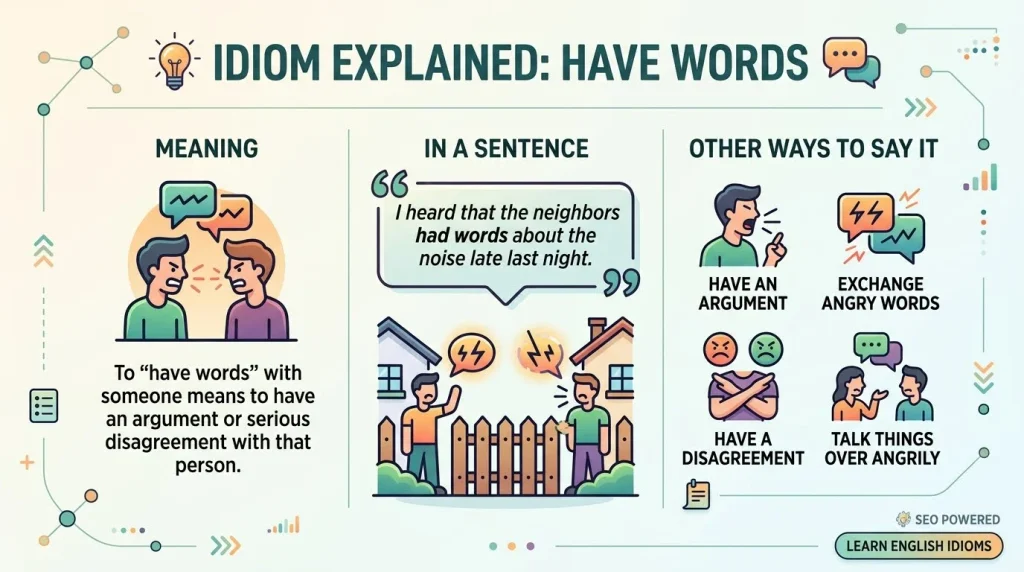
To “have words” with someone means to have an argument or serious disagreement with that person.
In a Sentence
I heard that the neighbors had words about the noise late last night.
Other Ways to Say It
- Have an argument
- Exchange angry words
- Have a disagreement
- Talk things over angrily
Explanation
This idiom is relatively understated. It does not necessarily describe a dramatic fight; it simply suggests that tension led to a verbal confrontation.
Its restrained tone can sometimes make it more effective than saying “they had a huge argument.”
Best Use
Best in everyday speech, informal writing, dialogue, and storytelling.
Go Head-to-Head
Meaning
To “go head-to-head” means to confront someone directly, often because both sides have opposing opinions, goals, or arguments.
In a Sentence
The two experts went head-to-head over whether the new policy would work.
Other Ways to Say It
- Face off
- Confront each other
- Debate directly
- Go against each other
Explanation
The phrase creates an image of two people standing directly opposite one another. It can describe an argument, but it can also refer to competition or a formal debate.
Because of this, it does not always carry an angry tone.
Best Use
Works well in sports writing, debates, journalism, workplace discussions, and casual conversation.
Fight Tooth and Nail
Meaning
To “fight tooth and nail” means to struggle extremely hard to defend something or achieve a goal.
In a Sentence
She fought tooth and nail to prove that her proposal deserved another chance.
Other Ways to Say It
- Fight fiercely
- Defend something strongly
- Resist with everything you have
- Fight with all your might
Explanation
The image suggests someone fighting with every available means. It communicates determination and fierce resistance, rather than simply exchanging angry words.
It is useful when an argument involves something the speaker considers extremely important.
Best Use
Best for dramatic writing, speeches, persuasive writing, storytelling, and serious discussions.
See Eye to Eye
Meaning
To “see eye to eye” means to agree with someone or share the same opinion. It is often used when discussing the absence of an argument or disagreement.
In a Sentence
My brother and I rarely see eye to eye when it comes to spending money.
Other Ways to Say It
- Agree completely
- Share the same view
- Be of the same opinion
- Be on the same page
Explanation
This idiom is useful because it describes agreement as the opposite of conflict. Saying that people do not see eye to eye can politely indicate that they frequently disagree.
It is less aggressive than saying that two people constantly fight.
Best Use
Excellent for conversations, essays, workplace communication, and relationship discussions.
Get Into a War of Words
Meaning
A “war of words” is a heated verbal conflict in which people attack each other’s ideas, opinions, or statements.
In a Sentence
The meeting turned into a war of words when both sides began accusing each other of ignoring the facts.
Other Ways to Say It
- Verbal battle
- Heated exchange
- Bitter argument
- Verbal confrontation
Explanation
The word “war” makes the disagreement sound much more intense than an ordinary discussion. The expression suggests that words are being used almost like weapons.
It is particularly effective when the conflict becomes public or emotionally charged.
Best Use
Best for journalism, essays, political discussions, storytelling, and dramatic descriptions.
At Each Other’s Throats
Meaning
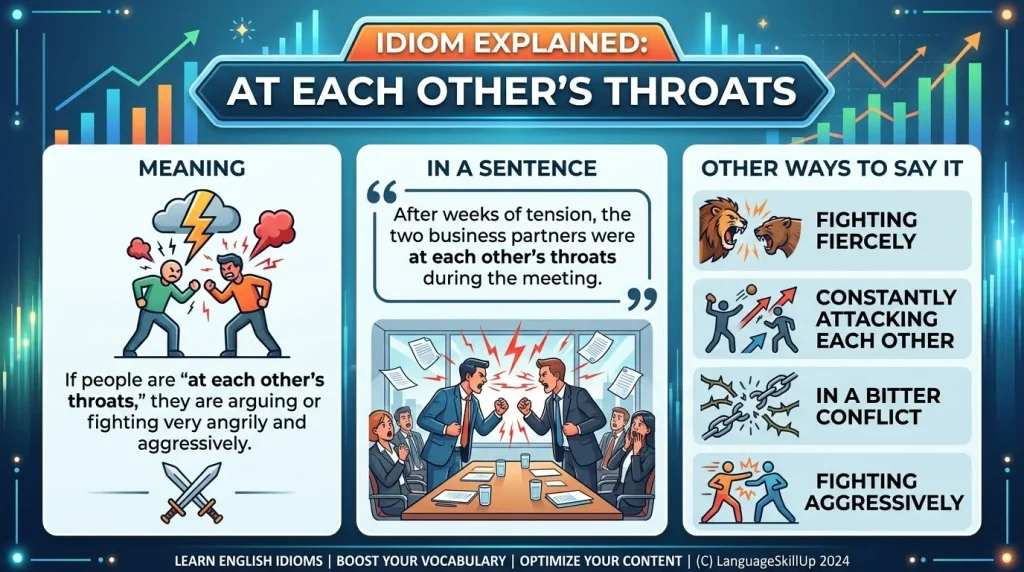
If people are “at each other’s throats,” they are arguing or fighting very angrily and aggressively.
In a Sentence
After weeks of tension, the two business partners were at each other’s throats during the meeting.
Other Ways to Say It
- Fighting fiercely
- Constantly attacking each other
- In a bitter conflict
- Fighting aggressively
Explanation
This is a strongly dramatic idiom. Its violent image communicates serious hostility and emotional intensity.
It should not normally be interpreted literally. The expression is meant to emphasize how badly people are getting along.
Best Use
Best for dramatic storytelling, informal conversation, and vivid descriptions of serious conflict.
Go at Each Other
Meaning
To “go at each other” means to argue, criticize, or attack one another with considerable energy.
In a Sentence
The two commentators went at each other during the live discussion.
Other Ways to Say It
- Attack each other’s arguments
- Argue fiercely
- Clash openly
- Exchange sharp criticism
Explanation
The phrase suggests that both sides are actively participating in the confrontation. Unlike a one-sided complaint, it presents a picture of mutual verbal aggression.
Its meaning depends heavily on context and can range from a heated debate to a serious argument.
Best Use
Suitable for informal speech, sports commentary, storytelling, and descriptions of heated debates.
Pick a Fight
Meaning
To “pick a fight” means to deliberately start an argument or confrontation, often without a good reason.
In a Sentence
There was no need to pick a fight over such a small misunderstanding.
Other Ways to Say It
- Start an argument
- Provoke someone
- Start trouble
- Look for a confrontation
Explanation
This idiom focuses on the choice to start conflict rather than the argument itself. It can suggest unnecessary aggression or deliberate provocation.
It is particularly useful when one person seems to be searching for an opportunity to argue.
Best Use
Best for everyday conversation, personal messages, dialogue, and informal writing.
Cross Swords
Meaning
To “cross swords” means to argue, disagree, or engage in a conflict with someone.
In a Sentence
The two critics crossed swords over the meaning of the controversial novel.
Other Ways to Say It
- Clash
- Disagree strongly
- Debate
- Enter into conflict
Explanation
The idiom creates the image of two people meeting in a sword fight. As a result, it gives an argument a dramatic and slightly literary quality.
It does not necessarily mean that either person is furious; the focus can simply be on a sharp intellectual disagreement.
Best Use
Especially effective in creative writing, essays, literary commentary, and polished storytelling.
Draw a Line in the Sand
Meaning
To “draw a line in the sand” means to establish a clear limit or position that you are unwilling to compromise on.
In a Sentence
The employee drew a line in the sand and refused to accept the unfair conditions.
Other Ways to Say It
- Set a firm boundary
- Take a definite stand
- Establish a limit
- Refuse to compromise
Explanation
The image of a line drawn in sand represents a clear dividing point. Once someone draws that line, crossing it means violating an important boundary.
This idiom is about firm positions rather than ordinary bickering.
Best Use
Works particularly well in business writing, negotiations, speeches, essays, and serious conversations.
Stand One’s Ground
Meaning
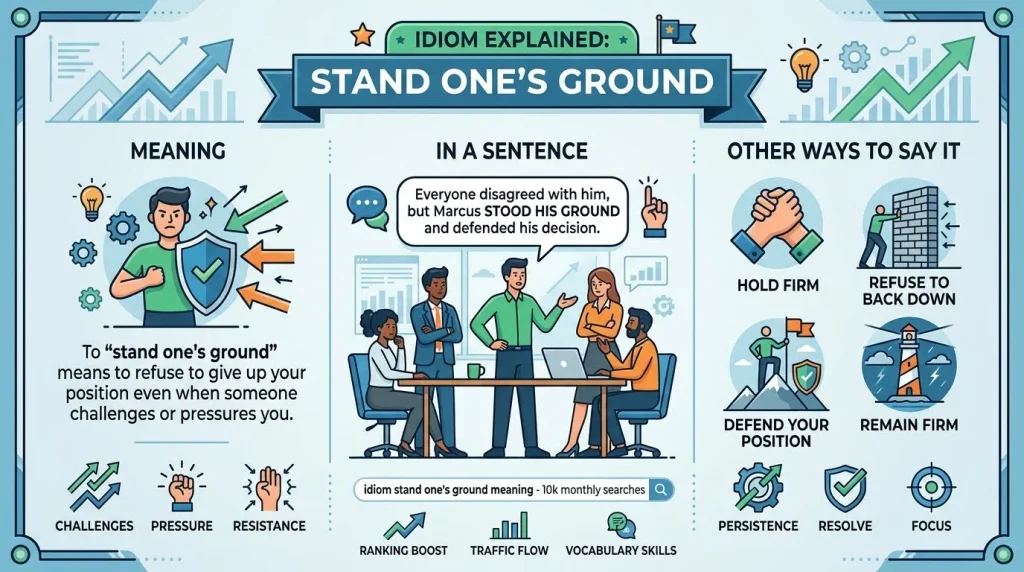
To “stand one’s ground” means to refuse to give up your position even when someone challenges or pressures you.
In a Sentence
Although everyone disagreed with him, Marcus stood his ground and defended his decision.
Other Ways to Say It
- Hold firm
- Refuse to back down
- Defend your position
- Remain firm
Explanation
The expression creates the image of someone refusing to move backward during a confrontation. It communicates confidence, determination, and resistance.
It does not necessarily mean the person is being aggressive; they may simply believe strongly in their position.
Best Use
Useful in debates, workplace discussions, personal conflicts, speeches, and persuasive writing.
Blow One’s Top
Meaning
To “blow one’s top” means to suddenly become extremely angry.
In a Sentence
Dad blew his top when he discovered that someone had damaged his car.
Other Ways to Say It
- Lose one’s temper
- Become furious
- Explode with anger
- Lose control
Explanation
The idiom compares intense anger to something suddenly exploding. Unlike expressions that describe disagreement itself, this one focuses on the emotional reaction during an argument.
It is colorful and informal, making it useful when the person’s anger is obvious.
Best Use
Best for casual conversation, humorous storytelling, dialogue, and informal writing.
Fly Off the Handle
Meaning
To “fly off the handle” means to suddenly become very angry, often in response to something relatively small or unexpected.
In a Sentence
He flew off the handle when his colleague questioned his decision.
Other Ways to Say It
- Lose one’s temper
- Get angry suddenly
- Blow up
- Become enraged
Explanation
This idiom highlights a sudden loss of emotional control. The unusual image makes the phrase memorable and gives an argument a sense of surprise.
It can also suggest that someone’s reaction was stronger than the situation deserved.
Best Use
Useful in everyday conversation, storytelling, dialogue, and informal descriptions.
Give Someone an Earful
Meaning
To “give someone an earful” means to speak angrily or critically to someone for a considerable amount of time.
In a Sentence
The customer gave the manager an earful after waiting nearly an hour for assistance.
Other Ways to Say It
- Give someone a strong reprimand
- Tell someone off
- Complain angrily
- Give someone a piece of one’s mind
Explanation
The phrase humorously suggests that someone’s ears are being filled with a long stream of complaints or angry words.
It focuses on verbal criticism, not necessarily a two-sided argument.
Best Use
Best for informal conversation, personal stories, dialogue, and humorous writing.
Have It Out
Meaning
To “have it out” with someone means to confront that person and discuss a disagreement openly, usually because the conflict has been building.
In a Sentence
They decided to have it out rather than let the misunderstanding damage their friendship.
Other Ways to Say It
- Confront the issue
- Settle the disagreement
- Talk things through
- Face the problem directly
Explanation
This expression suggests that people have reached the point where avoiding the issue is no longer helpful. It can involve a heated argument, but the goal may ultimately be resolution and honesty.
That makes it different from idioms focused purely on aggression.
Best Use
Works well in conversation, relationship discussions, storytelling, and dialogue.
Bicker Back and Forth
Meaning
To “bicker back and forth” means to argue repeatedly about small or unimportant matters.
In a Sentence
The siblings spent the entire car ride bickering back and forth about who should choose the music.
Other Ways to Say It
- Quarrel over little things
- Squabble
- Argue repeatedly
- Pick at each other
Explanation
This expression describes low-level, repetitive arguing rather than a major confrontation. “Bicker” often suggests irritation mixed with triviality.
The phrase “back and forth” emphasizes that both people keep responding to one another.
Best Use
Excellent for family stories, casual conversation, comedy, dialogue, and lighthearted writing.
Agree to Disagree
Meaning
To “agree to disagree” means to accept that two people have different opinions without continuing the argument.
In a Sentence
We could not agree on the issue, so we decided to agree to disagree.
Other Ways to Say It
- Respect our different opinions
- Leave the disagreement there
- Accept that we disagree
- Stop arguing over the issue
Explanation
This idiom is useful because it describes a peaceful way out of an argument. It recognizes that agreement is not always necessary for respectful communication.
The tone is generally calm, mature, and diplomatic.
Best Use
Best for everyday conversations, workplace discussions, essays, personal relationships, and respectful debates.
Fight Like Cat and Dog
Meaning
To “fight like cat and dog” means that two people argue or quarrel frequently.
In a Sentence
The brothers fight like cat and dog, but they always support each other when it matters.
Other Ways to Say It
- Quarrel constantly
- Argue all the time
- Squabble frequently
- Rarely get along
Explanation
The phrase uses the familiar image of a cat and dog constantly chasing or challenging each other. It often describes frequent but not necessarily serious conflict.
Because it can sound playful, it is often suitable for describing family members or close friends.
Best Use
Best for casual conversation, humorous writing, family stories, and informal storytelling.
Exercise: Practice Using Idioms
Choose the best answer for each question.
Question 1
What does “butt heads” mean?
A. Cause bodily harm to another person
B. Express a strong difference of opinion
C. Stay away from a heated disagreement
D. Say sorry after a serious dispute
Question 2
Which idiom suggests that two people are extremely hostile toward each other?
A. See eye to eye
B. Agree to disagree
C. At each other’s throats
D. Have words
Question 3
If someone “picks a fight,” what are they doing?
A. Deliberately starting a confrontation
B. Ending an argument peacefully
C. Changing their opinion
D. Avoiding a difficult subject
Question 4
Which expression means to refuse to give up your position?
A. Have an earful
B. Blow one’s top
C. Stand one’s ground
D. Have words
Question 5
What does “see eye to eye” mean?
A. Keep a close eye on another person
B. Share the same opinion as someone else
C. Question someone’s position or authority
D. Point out another person’s faults or mistakes
Question 6
Which idiom describes repeated arguments about small matters?
A. Bicker back and forth
B. Draw a line in the sand
C. Fight tooth and nail
D. Cross swords
Question 7
What does “blow one’s top” describe?
A. Becoming extremely tired
B. Becoming suddenly angry
C. Winning an argument
D. Ending a disagreement
Question 8
Which idiom suggests a direct confrontation between two sides?
A. Go head-to-head
B. Agree to disagree
C. See eye to eye
D. Give someone an earful
Question 9
If two people “agree to disagree,” what have they decided?
D. To change each other’s minds isy bii
A. Keep debating until one side comes out victorious
B. Remain silent and refuse to speak indefinitely
C. Respect that both sides may hold different views
D. Persuade one another to adopt a new viewpoint
Question 10
What does “give someone an earful” usually involve?
A. Giving someone a gift
B. Speaking angrily or critically to someone
C. Listening carefully to someone
D. Whispering a secret
Question 11
Which idiom means to establish a firm limit or position?
A. Draw a line in the sand
B. Go at each other
C. Have words
D. Fight like cat and dog
Question 12
What does “have it out” mean?
A. Walk away before resolving the dispute
B. Address the conflict directly and honestly
C. Act as though nothing is wrong
D. Accept the other person’s view without hesitation
Question 13
Which idiom best describes people who argue frequently but not necessarily seriously?
A. At each other’s throats
B. Fight like cat and dog
C. Fight tooth and nail
D. Get into a war of words
Question 14
Which expression focuses mainly on suddenly losing one’s temper?
A. Fly off the handle
B. Stand one’s ground
C. Lock horns
D. Cross swords
Question 15
A newspaper describes two politicians having a “war of words.” What does this suggest?
A. Both sides are taking part in an athletic contest
B. The individuals are trading angry words and insults
C. Everyone involved has settled their differences
D. Neither party is willing to talk about the matter
Answers
- B — “Butt heads” means to disagree strongly with another person.
- C — “At each other’s throats” describes intense hostility or aggressive conflict.
- A — To “pick a fight” means to deliberately start an argument or confrontation.
- C — “Stand one’s ground” means to remain firm and refuse to back down.
- B — “See eye to eye” means to agree or share the same opinion.
- A — “Bicker back and forth” describes repeated arguments, usually over minor issues.
- B — “Blow one’s top” means to become extremely angry.
- A — “Go head-to-head” describes a direct confrontation between two sides.
- C — “Agree to disagree” means accepting that people can hold different opinions.
- B — “Give someone an earful” means to speak to someone angrily or critically.
- A — “Draw a line in the sand” means to establish a firm boundary or position.
- B — “Have it out” means to confront and discuss a disagreement openly.
- B — “Fight like cat and dog” often describes frequent, sometimes playful or minor quarrels.
- A — “Fly off the handle” means to become angry very suddenly.
- B — A “war of words” is a heated verbal conflict or exchange of criticism.
FAQs
What is an idiom for arguing?
There are many idioms for arguing, including “butt heads,” “lock horns,” “cross swords,” and “go head-to-head.” Each has a slightly different tone, so the best choice depends on the situation.
How do I choose the right idiom for arguing?
Think about the intensity and purpose of the disagreement. Use “bicker” for minor repeated arguments, “at each other’s throats” for intense hostility, and “agree to disagree” when people peacefully accept different opinions.
Can I use these idioms in everyday conversation?
Yes. Many of these expressions, such as “pick a fight,” “stand your ground,” and “have words,” are natural in everyday informal English. More dramatic expressions, such as “cross swords,” may sound more literary.
What is the difference between an idiom and a simile?
An idiom is a familiar expression with a meaning that cannot always be understood literally, such as “blow one’s top.” A simile directly compares two things using words such as “like” or “as,” such as “he was as angry as a storm.”
Can idioms make writing about arguing more effective?
Yes. Well-chosen idioms can make conflict more vivid and emotionally clear. Instead of repeatedly writing “they argued,” you can show whether the disagreement was playful, stubborn, aggressive, dramatic, or eventually resolved.
Conclusion
Arguing can take many forms, from a minor disagreement between friends to a serious clash between opposing sides. The right idiom helps communicate that difference with color, emotion, and precision. Expressions such as “butt heads” and “bicker back and forth” describe everyday disagreements, while “at each other’s throats” and “war of words” create a much stronger sense of conflict. Other expressions, such as “stand one’s ground” and “agree to disagree,” focus on how people respond to disagreement rather than simply describing the argument itself.
When using idioms for arguing, always consider the tone, audience, and situation. A familiar expression can make your writing or conversation feel natural, but the strongest choice is the one that accurately captures the feeling behind the disagreement. Sometimes the most powerful way to describe arguing is to show not just the clash, but what lies beneath it.




[…] Read more:20 Idioms for Arguing With Real Examples […]