
Have you ever needed a more expressive way to say something costs a lot? 20 Idioms for Expensive With Real Examples explores natural expressions that make everyday English more vivid and precise. Instead of repeating words like expensive, these idioms add personality, emphasis, and context to your communication. You’ll discover expressions that fit conversations, business communication, formal writing, and everyday English usage. Each example shows how the idiom works naturally in context.
Understanding these expressions can also improve your grammar, vocabulary, and English usage. They can describe costly products, high prices, premium services, or unexpected expenses with greater clarity. The examples also show how figurative language works across practical situations, including online booking, meetings, scheduling, and project management. This makes the expressions easier to recognize and use confidently.
Whether you are writing an email, preparing a presentation, or speaking casually, choosing the right expression matters. You may also encounter these idioms in broadcasting, calendars, workplace discussions, and everyday conversations. This guide focuses on clear meanings, natural examples, and practical usage. With attention to consistency and context, you can expand your vocabulary without making your writing sound forced or repetitive.
What Is an Idiom?
An idiom is a fixed or commonly recognized expression whose meaning is different from the literal meaning of its individual words.
For example, “break the ice” does not mean physically breaking ice. It means to make people feel more comfortable when they first meet.
Likewise, “hit the nail on the head” means to describe or identify something exactly right. The words create a picture, but the intended meaning is figurative.
Idioms are different from literal statements because their meaning depends on shared language and context, rather than simply taking every word at face value.
Why Use Idioms for Expensive?
Describing something as expensive can become repetitive when every sentence uses words such as costly, pricey, or high-priced. Idioms give you more expressive choices.
They can show different shades of meaning. One expression may suggest luxury, while another may emphasize financial pain or an unusually high price.
Idiomatic language can also:
- Make descriptions more vivid.
- Add personality to conversations.
- Help explain an emotional reaction to a price.
- Make creative writing more memorable.
- Give reviews and storytelling a stronger voice.
- Turn an abstract idea about money into a recognizable image.
- Communicate the difference between ordinary expense and extreme expense.
The key is choosing an expression that matches the situation rather than treating every idiom as a direct replacement for expensive.
Quick List of 20 Idioms
- Cost an arm and a leg
- Cost a pretty penny
- Break the bank
- Cost a small fortune
- Pay through the nose
- Set you back
- Burn a hole in your pocket
- Have deep pockets
- Live in the lap of luxury
- Money to burn
- Worth its weight in gold
- Put a premium on it
- At a king’s ransom
- Cream of the crop
- Spare no expense
- Gold-plated
- Fit for a king
- Roll in money
- Beyond one’s means
- A luxury you can’t afford
Cost an Arm and a Leg
20 Idioms for Determination With Real Examples
Meaning
“Cost an arm and a leg” means something is extremely expensive. The expression uses an exaggerated image of giving up valuable parts of yourself to emphasize the financial sacrifice.
In a Sentence
That beachfront hotel cost an arm and a leg, but the view was unforgettable.
Other Ways to Say It
- Cost a fortune
- Be incredibly expensive
- Have an enormous price tag
- Cost a small fortune
Explanation
The expression works because its dramatic image immediately communicates extreme expense. Nobody expects an actual arm or leg to be exchanged; the exaggeration makes the financial burden memorable.
It is usually informal and expressive rather than professional.
Best Use
This idiom works especially well in conversations, personal stories, social media posts, and humorous writing.
Cost a Pretty Penny
Meaning
“Cost a pretty penny” means something costs a significant amount of money. It suggests that the price is noticeably high without necessarily meaning that it is outrageously expensive.
In a Sentence
That handcrafted wooden table cost a pretty penny, but its quality is excellent.
Other Ways to Say It
- Be rather expensive
- Cost quite a bit
- Carry a hefty price
- Be pricey
Explanation
The phrase gives a high price a slightly playful and conversational quality. It can sound less severe than saying something costs a fortune.
It is useful when you want to acknowledge a substantial price while keeping the tone light.
Best Use
Use it in casual conversation, lifestyle writing, reviews, and storytelling.
Break the Bank
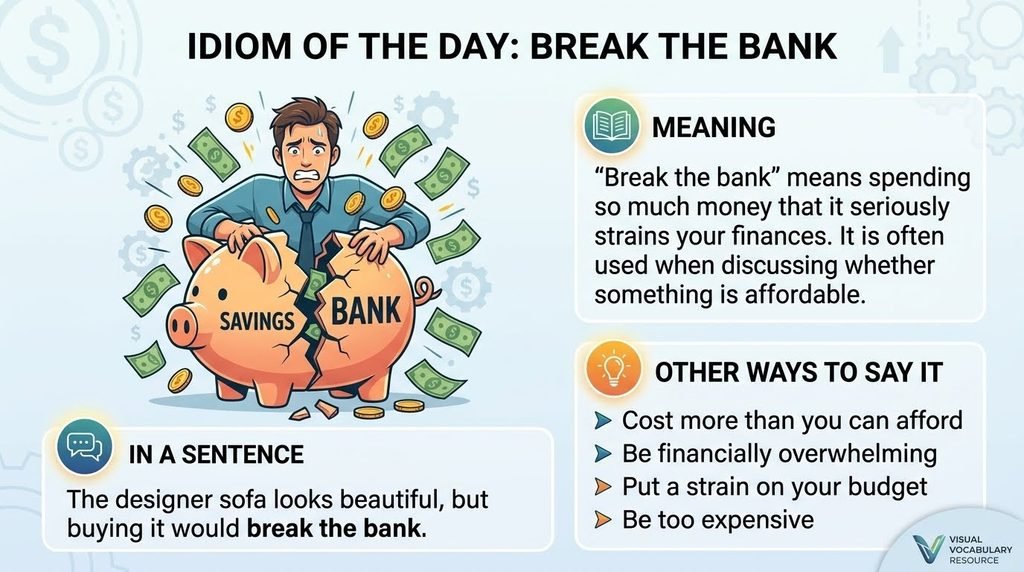
Meaning
“Break the bank” means spending so much money that it seriously strains your finances. It is often used when discussing whether something is affordable.
In a Sentence
The designer sofa looks beautiful, but buying it would break the bank.
Other Ways to Say It
- Cost more than you can afford
- Be financially overwhelming
- Put a strain on your budget
- Be too expensive
Explanation
The image suggests that spending money has somehow broken your financial resources. It often carries a practical sense: the purchase may be desirable, but the price is too high for the buyer’s budget.
The expression can also appear in negative constructions such as “It won’t break the bank,” meaning something is reasonably affordable.
Best Use
It fits naturally in everyday conversations, shopping discussions, advertisements, and financial advice.
Cost a Small Fortune
Meaning
“Cost a small fortune” means something is very expensive and requires a large amount of money.
In a Sentence
Restoring the old house cost a small fortune, especially after they discovered problems with the roof.
Other Ways to Say It
- Cost a fortune
- Cost a great deal
- Require a huge investment
- Have a very high price
Explanation
The phrase creates the image of spending a fortune, but the word small makes the expression playful and ironic. It is not normally intended to describe an exact amount.
The expression is stronger than simply saying something is pricey.
Best Use
It is effective in storytelling, informal writing, conversations, and humorous descriptions of major expenses.
Pay Through the Nose
Meaning
“Pay through the nose” means to pay an excessively high price for something.
In a Sentence
We had to pay through the nose for last-minute tickets during the holiday season.
Other Ways to Say It
- Pay an exorbitant price
- Pay far too much
- Get charged heavily
- Pay a premium
Explanation
This idiom emphasizes the feeling of being charged far more than seems reasonable. It often has a negative or complaining tone.
Unlike some expressions that merely describe luxury, this one focuses on the buyer’s frustration about the price.
Best Use
Use it in informal conversations, complaints, travel stories, and humorous writing. It can sound too casual for formal financial documents.
Set You Back
Meaning
When a purchase “sets you back” a certain amount, it means it costs you that amount of money, often more than you would like.
In a Sentence
The repairs set us back nearly a thousand dollars.
Other Ways to Say It
- Cost you
- Put you out of pocket
- Require a large payment
- Take a chunk of your budget
Explanation
The expression creates a subtle image of a purchase pushing your finances backward. It does not always mean something is extremely expensive; context determines how serious the cost is.
That makes it more flexible than stronger idioms such as cost an arm and a leg.
Best Use
It is particularly natural in everyday conversation, personal finance discussions, and storytelling.
Burn a Hole in Your Pocket
Meaning
“Burn a hole in your pocket” usually means money is tempting you to spend it. It can relate to expensive purchases when someone is eager to use available money.
In a Sentence
That bonus seems to be burning a hole in his pocket, because he keeps looking at expensive watches.
Other Ways to Say It
- Be eager to spend money
- Be tempted to splurge
- Spend freely
- Treat yourself
Explanation
The image is playful: money sitting in your pocket feels as if it is hot enough to burn through the fabric. The expression focuses more on the urge to spend than on the price itself.
That distinction makes it useful when describing someone’s spending behavior.
Best Use
It works best in casual conversation, humorous writing, social media, and personal stories.
Have Deep Pockets
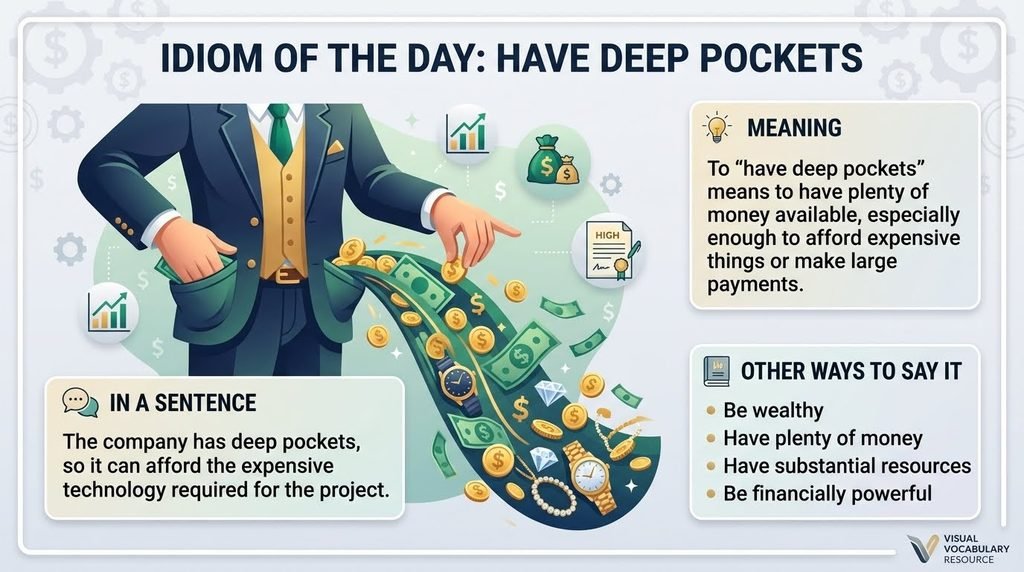
Meaning
To “have deep pockets” means to have plenty of money available, especially enough to afford expensive things or make large payments.
In a Sentence
The company has deep pockets, so it can afford the expensive technology required for the project.
Other Ways to Say It
- Be wealthy
- Have plenty of money
- Have substantial resources
- Be financially powerful
Explanation
The phrase imagines someone’s pockets as so deep that they can hold a great deal of money. It describes financial capacity rather than the price of an individual object.
It can also describe organizations, investors, or other groups with significant resources.
Best Use
This expression is useful in business writing, journalism, conversations, and discussions about wealth or investment.
Live in the Lap of Luxury
Meaning
“Live in the lap of luxury” means to live with exceptional comfort, wealth, and expensive conveniences.
In a Sentence
After years of hard work, they finally spent a week living in the lap of luxury at a private resort.
Other Ways to Say It
- Live lavishly
- Enjoy a luxurious lifestyle
- Live in great comfort
- Enjoy the finer things in life
Explanation
The phrase creates a picture of being comfortably surrounded by luxury and abundance. It describes a lifestyle rather than simply one expensive object.
The tone is often glamorous and slightly dramatic.
Best Use
It is especially effective in travel writing, lifestyle articles, storytelling, promotional copy, and creative writing.
Money to Burn
Meaning
Someone who has “money to burn” has plenty of money and can spend it freely, often without worrying much about the cost.
In a Sentence
You must have money to burn if you’re considering buying a second luxury car.
Other Ways to Say It
- Have money to spare
- Be very wealthy
- Spend freely
- Have cash to splash around
Explanation
The expression creates the exaggerated image of having so much money that you can afford to burn it. It can be admiring, teasing, or critical depending on context.
It often suggests unnecessary or extravagant spending.
Best Use
Use it in informal conversations, humorous comments, storytelling, and social media writing.
Worth Its Weight in Gold
Meaning
“Worth its weight in gold” means something is extremely valuable or useful. It does not necessarily mean that the object itself is expensive to buy.
In a Sentence
That experienced mechanic is worth his weight in gold when a complicated engine problem appears.
Other Ways to Say It
- Extremely valuable
- Invaluable
- Worth a great deal
- Precious to have
Explanation
The expression compares something’s value with the enormous value associated with gold by weight. Its emphasis is on usefulness or importance rather than price alone.
That makes it especially useful when discussing something that may be expensive but is considered genuinely worthwhile.
Best Use
It fits workplace conversations, storytelling, essays, reviews, and appreciative messages.
Put a Premium on It
Meaning
To “put a premium on” something means to give it especially high value or importance. A premium can also refer to an additional amount paid for something desirable.
In a Sentence
Buyers put a premium on original artwork from established artists.
Other Ways to Say It
- Value highly
- Pay extra for
- Place great value on
- Consider especially desirable
Explanation
This expression is more professional and analytical than many of the other idioms on this list. It can explain why a product or service commands a higher price.
It is especially useful when the high price is connected to scarcity, quality, reputation, convenience, or demand.
Best Use
Use it in business writing, essays, reports, market discussions, and professional conversations.
At a King’s Ransom
Meaning
“At a king’s ransom” describes something that costs an extraordinarily large amount of money.
In a Sentence
The rare painting was sold at a king’s ransom to a private collector.
Other Ways to Say It
- At an enormous price
- For a staggering sum
- For a fortune
- At an exorbitant cost
Explanation
The expression draws on the dramatic idea of a ransom demanded for royalty. As a result, it makes the price sound exceptionally large and dramatic.
It is more literary and old-fashioned than everyday expressions such as cost a fortune.
Best Use
It works particularly well in creative writing, historical writing, dramatic storytelling, and polished descriptive prose.
Cream of the Crop
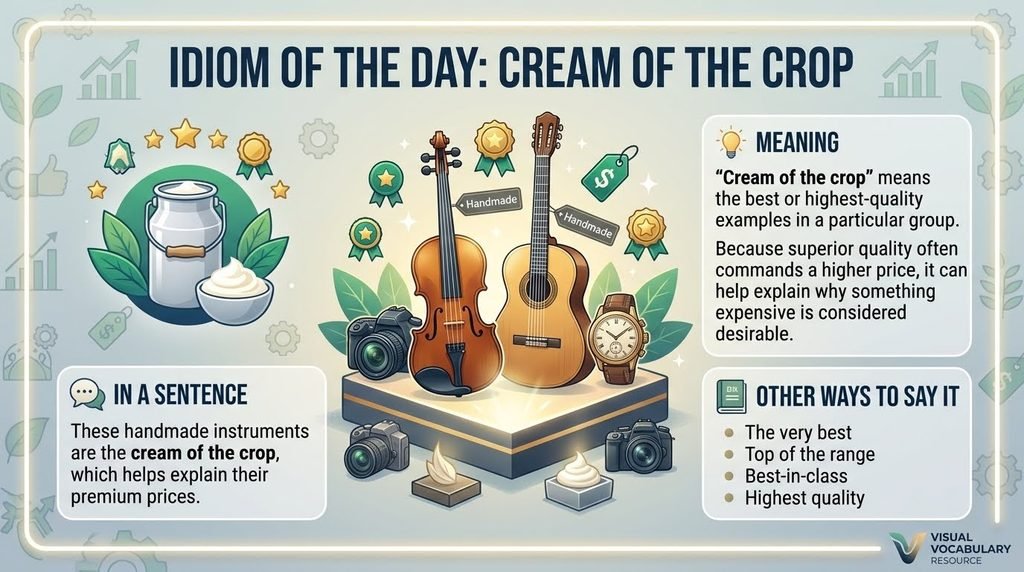
Meaning
“Cream of the crop” means the best or highest-quality examples in a particular group. Because superior quality often commands a higher price, it can help explain why something expensive is considered desirable.
In a Sentence
These handmade instruments are the cream of the crop, which helps explain their premium prices.
Other Ways to Say It
- The very best
- Top of the range
- Best-in-class
- Highest quality
Explanation
The image comes from the idea of cream being the richest or finest part of milk. The expression focuses on exceptional quality rather than expense itself.
It should therefore be used when a high price is connected to superior quality.
Best Use
This phrase suits product reviews, recommendations, advertising, business writing, and conversations about quality.
Spare No Expense
Meaning
“Spare no expense” means to spend whatever amount is necessary to achieve the desired result, without trying to reduce costs.
In a Sentence
For the museum’s grand opening, the organizers spared no expense.
Other Ways to Say It
- Spend without limits
- Go all out
- Invest heavily
- Pay whatever is necessary
Explanation
The expression communicates generosity, extravagance, or determination rather than simply saying something is expensive.
It can describe an expensive event, project, celebration, production, or experience.
Best Use
It works well in formal speeches, storytelling, event descriptions, journalism, and promotional writing.
Gold-Plated
Meaning
“Gold-plated” can be literal when something is covered with a thin layer of gold. Figuratively, it can describe something that seems excessively luxurious, elaborate, or expensive.
In a Sentence
The company proposed a gold-plated solution when a much simpler option would have worked.
Other Ways to Say It
- Excessively luxurious
- Overly elaborate
- Lavishly designed
- More expensive than necessary
Explanation
The image of something covered in gold immediately suggests luxury and expense. Figuratively, the expression can also carry a critical meaning: something may have unnecessary extras that inflate its cost.
Because of that nuance, context matters.
Best Use
It is useful in business commentary, political or economic discussion, creative writing, and informal criticism.
Fit for a King
Meaning
“Fit for a king” means exceptionally luxurious, impressive, comfortable, or high-quality.
In a Sentence
The hotel’s presidential suite was truly fit for a king.
Other Ways to Say It
- Exceptionally luxurious
- Fit for royalty
- Lavish and grand
- Extremely impressive
Explanation
The phrase creates an image of royal standards, suggesting that ordinary comfort is not enough. It can imply that an experience or object is expensive because of its extraordinary quality or luxury.
It is often complimentary and dramatic.
Best Use
Use it in travel writing, storytelling, reviews, celebrations, and creative descriptions.
Roll in Money
Meaning
“Roll in money” means to be extremely wealthy or to have a very large amount of money.
In a Sentence
He seems to roll in money, judging by the luxury cars parked outside his house.
Other Ways to Say It
- Be loaded
- Be extremely wealthy
- Have money in abundance
- Have plenty of cash
Explanation
The expression creates a playful image of someone surrounded by so much money that they could almost roll around in it.
It describes a person’s wealth rather than the price of a particular item.
Best Use
It is best for informal conversation, humorous storytelling, fiction, and social media. Avoid it in formal financial writing.
Beyond One’s Means
Meaning
Something is “beyond one’s means” when a person cannot reasonably afford it without putting their finances under strain.
In a Sentence
Buying a luxury apartment right now is simply beyond my means.
Other Ways to Say It
- Unaffordable
- Outside my budget
- More than I can afford
- Financially out of reach
Explanation
Unlike dramatic idioms about fortunes and kings, this expression focuses on personal affordability. It recognizes that an expensive item may be desirable but still unsuitable for someone’s financial situation.
The tone is usually serious and practical.
Best Use
It works well in personal finance discussions, essays, conversations, and practical advice.
A Luxury You Can’t Afford
Meaning
“A luxury you can’t afford” describes something desirable and enjoyable but financially unrealistic for the person considering it.
In a Sentence
A private driver would be a wonderful convenience, but for me it’s a luxury I can’t afford.
Other Ways to Say It
- An unaffordable indulgence
- Outside my budget
- A costly treat
- Something I can’t justify financially
Explanation
This expression creates a useful contrast between desire and financial reality. It acknowledges that an expensive thing may be appealing without pretending that everyone can reasonably purchase it.
It is straightforward, emotional, and easy for most readers to understand.
Best Use
It fits personal writing, conversations, essays, lifestyle discussions, and reflective storytelling.
Exercise: Practice Using Idioms
Choose the best answer for each question.
What does “cost an arm and a leg” mean?
A. Something is difficult to carry.
B. Something is extremely expensive.
C. Something requires physical work.
D. Something is uncomfortable to use.
Which expression means that something costs a considerable amount but may not be outrageously expensive?
A. Cost a pretty penny
B. Roll in money
C. Have deep pockets
D. Fit for a king
If someone says, “That purchase will break the bank,” what do they mean?
A. The purchase is free.
B. The bank made an error.
C. The purchase may seriously strain their finances.
D. The purchase is an excellent investment.
Which expression focuses on paying an excessively high price?
A. Cream of the crop
B. Pay through the nose
C. Have deep pockets
D. Worth its weight in gold
What does “set you back” mean in a sentence about money?
A. Cause you to travel backward
B. Cost you a certain amount of money
C. Give you additional income
D. Help you save money
Which idiom describes someone who has substantial financial resources?
A. Have deep pockets
B. Cost a small fortune
C. Spare no expense
D. Beyond one’s means
Someone who “has money to burn” is generally:
A. Trying to save every penny.
B. Unable to access their money.
C. Eager or able to spend money freely.
D. Paying for something with coins.
Which expression best describes a luxurious lifestyle?
A. Set you back
B. Live in the lap of luxury
C. Pay through the nose
D. Beyond one’s means
What is the main meaning of “worth its weight in gold”?
A. Literally made of gold
B. Extremely valuable or useful
C. Very difficult to transport
D. More expensive than jewelry
Which expression is most suitable for professional discussion about assigning high value to something?
A. Put a premium on it
B. Money to burn
C. Roll in money
D. Cost an arm and a leg
What does “at a king’s ransom” suggest?
A. A very small payment
B. A charitable donation
C. An extraordinarily large price
D. A government discount
If a product is called “the cream of the crop,” what is being emphasized?
A. A distinctive shade
B. An affordable cost
C. Outstanding craftsmanship
D. A straightforward style
What does “spare no expense” communicate?
A. Avoid spending money whenever possible.
B. Spend whatever is necessary without focusing on cost.
C. Borrow money from someone else.
D. Refuse to buy anything expensive.
Which expression suggests that something is unaffordable for a particular person?
A. Fit for a king
B. Cream of the crop
C. Beyond one’s means
D. Worth its weight in gold
Which statement uses an idiom figuratively rather than literally?
A. The watch has a leather strap.
B. The store closes at eight.
C. The renovation cost an arm and a leg.
D. The package weighs two kilograms.
Answers
- B — “Cost an arm and a leg” means something is extremely expensive.
- A — “Cost a pretty penny” means something costs quite a lot of money, usually in a conversational way.
- C — “Break the bank” means a purchase could seriously strain someone’s finances.
- B — “Pay through the nose” emphasizes paying an excessively high price.
- B — “Set you back” commonly means that something costs you money.
- A — Someone with “deep pockets” has substantial financial resources.
- C — Having “money to burn” means having enough money to spend freely, sometimes extravagantly.
- B — “Live in the lap of luxury” describes a lifestyle of exceptional comfort and luxury.
- B — “Worth its weight in gold” means something is extremely valuable or useful, not necessarily expensive.
- A — “Put a premium on it” is appropriate for explaining why something is valued highly or commands an additional price.
- C — “At a king’s ransom” describes an extraordinarily large price.
- C — “Cream of the crop” refers to the best or highest-quality examples.
- B — “Spare no expense” means to spend whatever is necessary to achieve the desired result.
- C — “Beyond one’s means” means something is not reasonably affordable for that person.
- C — “Cost an arm and a leg” is figurative; it does not literally mean exchanging body parts for a purchase.
FAQs
What is an idiom for expensive?
There are several useful idioms for describing something expensive. “Cost an arm and a leg,” “cost a small fortune,” “cost a pretty penny,” and “break the bank” are common choices. The best one depends on whether you want to emphasize extreme cost, financial pressure, or simply a noticeably high price.
How do I create my own idiom?
Creating a fresh figurative expression starts with an image that clearly connects to the idea you want to communicate. Think about objects, actions, or situations that naturally suggest wealth, sacrifice, luxury, scarcity, or financial pressure. The image should be understandable without needing a long explanation.
What makes an idiom effective?
An effective idiom creates a clear mental image while communicating an idea beyond the literal words. It should fit the context, sound natural, and add something that a plain statement does not. Strong idioms also have a distinct emotional tone.
Can I use these idioms in everyday conversation?
Yes. Expressions such as “cost a pretty penny,” “break the bank,” “set you back,” and “cost an arm and a leg” can sound very natural in casual conversation. More dramatic expressions, such as “at a king’s ransom,” may sound more literary or playful.
What is the difference between an idiom and a simile?
An idiom is a recognized expression whose figurative meaning is understood as a phrase. A simile directly compares two things, usually with words such as “like” or “as.” For example, “It cost an arm and a leg” is an idiomatic expression, while “The price was like a mountain” would be a simile.
Conclusion
There is more than one way to describe something expensive. The right expression can reveal whether the price feels luxurious, unreasonable, impressive, financially painful, or simply beyond your budget. Idioms such as cost an arm and a leg emphasize extreme expense, while worth its weight in gold focuses on value. Expressions such as have deep pockets and roll in money shift attention toward wealth, whereas beyond one’s means brings the discussion back to affordability.
When choosing an idiom for expensive things, think about the feeling you want to create. A casual conversation may call for a playful phrase, while an essay or professional discussion may benefit from a more precise expression. The strongest figurative language is not necessarily the most dramatic it is the expression that makes your meaning clear and memorable.




[…] Read more:20 Idioms for Expensive With Real Examples […]